

Mind Tree
 |
Description
Book Introduction
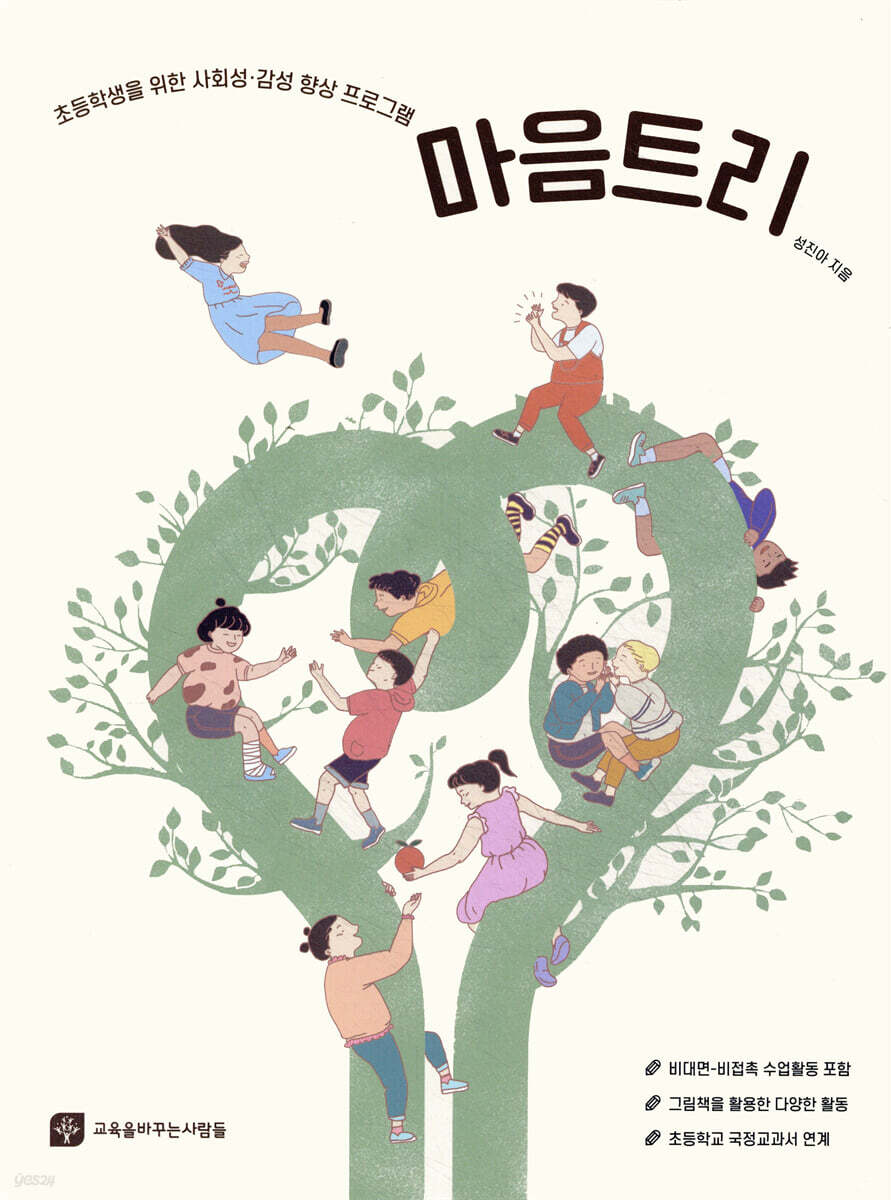
Author Dr. Seong Jin-ah carefully presents "Mind Tree," a systematic and reliable social and emotional development program that has already been proven effective in schools in Korea and the United States, incorporating over 20 years of field experience and research.
The goal of social and emotional education pursued by 'Mind Tree' is to help elementary school children develop healthy self-esteem, understand their own emotions correctly, empathize with the emotions of others, and acquire life skills to live together.
The 'Mind Tree', which means that people can open their hearts to each other and grow healthy hearts, has included various activities to enable social and emotional education, especially in the online, non-face-to-face environment due to COVID-19, and while maintaining non-contact in classroom classes.
The goal of social and emotional education pursued by 'Mind Tree' is to help elementary school children develop healthy self-esteem, understand their own emotions correctly, empathize with the emotions of others, and acquire life skills to live together.
The 'Mind Tree', which means that people can open their hearts to each other and grow healthy hearts, has included various activities to enable social and emotional education, especially in the online, non-face-to-face environment due to COVID-19, and while maintaining non-contact in classroom classes.
- You can preview some of the book's contents.
Preview
index
Recommendation… 006
Preface … 008
Social and emotional education and 'Mind Tree... 010
'Heart Tree' schedule… 020
Analysis of the Link between "Mind Tree" and Elementary School National Textbooks… 023
How to Use the "Mind Tree" Teaching and Learning Guide… 027
01.
Community Stories
Entering… 032
Unit Introduction … 034
Lower grades lesson plan… 036
Upper grade lesson plan… 050
02.
Self-esteem story
Entering… 064
Unit Introduction … 067
Lower grades lesson plan… 069
Senior Lesson Plan … 081
03.
emotional story
Entering… 096
Unit Introduction … 099
Lower Grades Lesson Plan… 101
Upper grade lesson plan… 115
04.
Empathy story
Entering… 132
Unit Introduction … 134
Lower grades lesson plan… 136
Upper grade lesson plan… 151
05.
Communication Story
Entering… 164
Unit Introduction … 168
Lower grades lesson plan… 170
Upper grade lesson plan… 185
06.
Sharing Story
Entering… 200
Unit Introduction … 204
Lower grades lesson plan… 206
Senior Lesson Plan … 217
supplement
Lower Grade Activity Sheets … 229
Upper grade activity sheet… 263·
Preface … 008
Social and emotional education and 'Mind Tree... 010
'Heart Tree' schedule… 020
Analysis of the Link between "Mind Tree" and Elementary School National Textbooks… 023
How to Use the "Mind Tree" Teaching and Learning Guide… 027
01.
Community Stories
Entering… 032
Unit Introduction … 034
Lower grades lesson plan… 036
Upper grade lesson plan… 050
02.
Self-esteem story
Entering… 064
Unit Introduction … 067
Lower grades lesson plan… 069
Senior Lesson Plan … 081
03.
emotional story
Entering… 096
Unit Introduction … 099
Lower Grades Lesson Plan… 101
Upper grade lesson plan… 115
04.
Empathy story
Entering… 132
Unit Introduction … 134
Lower grades lesson plan… 136
Upper grade lesson plan… 151
05.
Communication Story
Entering… 164
Unit Introduction … 168
Lower grades lesson plan… 170
Upper grade lesson plan… 185
06.
Sharing Story
Entering… 200
Unit Introduction … 204
Lower grades lesson plan… 206
Senior Lesson Plan … 217
supplement
Lower Grade Activity Sheets … 229
Upper grade activity sheet… 263·
Detailed image

Into the book
Since the late 1990s, I have worked in various educational settings in Korea and the United States, meeting students from diverse regions, races, and socioeconomic backgrounds.
Through that experience... (omitted)...
We learned the important fact that emotional difficulties lead to maladjustment and behavioral problems in school, as well as academic difficulties.
Furthermore, I realized how much the trust relationship between teachers and students, the emotional climate of the classroom, and the emotional intelligence of each student have on learning.
This experience left me with two questions:
'As a teacher, how can I help children develop not only their intellectual abilities but also their emotional and character development?' 'What and how can I teach children so that they can love themselves, respect each other's differences, and live happily together, regardless of their abilities and backgrounds?' St. Anne's School, which serves mostly children from wealthy families in New York,
These two questions were always on my mind, whether I was teaching gifted children at a private school called Ann's School or working as a Reading Buddy helping struggling elementary school students at a public school in Harlem, a slum in New York.
--- p.8
The need for social and emotional education, aimed at preventing school violence while fostering individual emotional stability and developing the skills necessary to live in harmony with others in a community, is growing globally.
In a future where more jobs and tasks are replaced by artificial intelligence, uniquely human abilities such as empathy, conflict resolution, and collaboration will become more important and demanded.
No, even setting aside the development of skills necessary for the AI era, schools should not ignore the emotional issues our children are experiencing, such as depression, anxiety, and fear, due to the prolonged COVID-19 pandemic.
During this time, it has become more necessary and important for schools to provide students with opportunities to express their feelings honestly and to teach them how to deal with those feelings, thereby helping them become emotionally stable.
--- p.9
"Mind Tree" is a program designed to foster the five core competencies of social and emotional education—self-awareness, self-management, social awareness, interpersonal skills, and responsible decision-making—through interaction within the classroom community.
'Mind Tree' is a word that combines the suffix '-ri', which indicates an expression of will, with the word 'tda', which means 'to clear away what was blocked and make it possible to communicate' and 'to associate with each other without hesitation', and is a name that contains the meaning of 'let's open our hearts (open up our minds)'.
It also contains the meaning that ‘the heart grows like a tree.’
--- p.11
We've made it possible to improve social and emotional skills even in non-face-to-face, non-contact situations.
'Mind Tree' was originally planned as a program where teachers and students could work together in one space.
However, due to the COVID-19 pandemic, children are unable to go to school, and even if they do go, they are forced to avoid physical contact with teachers and friends.
The reality we face is that it is unclear when this situation will calm down and when we will be able to return to the daily life we once took for granted.
...(syncopation)...
Now more than ever, we need to take care of our children's minds.
Accordingly, this book separately presents social and emotional learning activities that can be implemented remotely (online) or in non-contact settings.
Through the 'Mind Tree' program, you will be able to experience forming and maintaining warm relationships with teachers and friends, even when physically distant, and finding emotional stability.
--- p.12
Applying Maslow's theory to the school setting, we can see that students' physiological needs, safety needs, social needs, and esteem needs must be met first before they can move on to the stage of pursuing learning, self-development, and growth.
In other words, it will be difficult to develop a desire to learn and grow when you are hungry, sick, in a situation where your safety is threatened, you are being ostracized by your friends, or in emotional pain.
Therefore, the 'Mind Tree' program aims to help students feel emotionally safe (need for safety), a sense of belonging and intimacy (social needs), and self-esteem (need for respect) within the school community, not only to enhance social and emotional skills, but also to foster academic growth.
--- p.15
According to the theory of social constructivism, an individual's cognitive development is achieved through the learner's verbal exchange and social interaction within a community (Vygotsky, 1978).
In particular, interactions with adults, including teachers and parents, and peers with higher abilities than oneself are considered very important for cognitive development.
...(syncopation)...
Therefore, the 'Mind Tree' program has various activities arranged to ensure sufficient interaction between community members.
--- p.16
Learning that occurs by observing the behavior of others (models) is called the modeling effect. People tend to model the words and actions of people who are similar to them in age, gender, or background, experts in a certain field, or people they respect.
Therefore, when implementing social and emotional education, it is necessary for teachers to strive to be good models for students.
Furthermore, because students can serve as good models for one another, social and emotional education is more effective when conducted at the class level rather than one-on-one.
--- p.16
The most effective way to implement this program in schools is to systematically conduct it in the order of the major units, once a week during creative experiential activity time (community story → self-esteem story → emotion story → empathy story → communication story → sharing story).
However, depending on the class situation or needs, it is possible to change the order of the units and teach them. If time does not permit, you can also select 2 out of 4 periods per unit and teach them.
And you can also reconstruct or apply the content related to subjects such as Korean, ethics, social studies, music, and art.
When restructuring classes in connection with subjects, please refer to the “Analysis Table of Linkage between ‘Mind Tree’ and Elementary National Textbooks” (pp. 23-26).
Through that experience... (omitted)...
We learned the important fact that emotional difficulties lead to maladjustment and behavioral problems in school, as well as academic difficulties.
Furthermore, I realized how much the trust relationship between teachers and students, the emotional climate of the classroom, and the emotional intelligence of each student have on learning.
This experience left me with two questions:
'As a teacher, how can I help children develop not only their intellectual abilities but also their emotional and character development?' 'What and how can I teach children so that they can love themselves, respect each other's differences, and live happily together, regardless of their abilities and backgrounds?' St. Anne's School, which serves mostly children from wealthy families in New York,
These two questions were always on my mind, whether I was teaching gifted children at a private school called Ann's School or working as a Reading Buddy helping struggling elementary school students at a public school in Harlem, a slum in New York.
--- p.8
The need for social and emotional education, aimed at preventing school violence while fostering individual emotional stability and developing the skills necessary to live in harmony with others in a community, is growing globally.
In a future where more jobs and tasks are replaced by artificial intelligence, uniquely human abilities such as empathy, conflict resolution, and collaboration will become more important and demanded.
No, even setting aside the development of skills necessary for the AI era, schools should not ignore the emotional issues our children are experiencing, such as depression, anxiety, and fear, due to the prolonged COVID-19 pandemic.
During this time, it has become more necessary and important for schools to provide students with opportunities to express their feelings honestly and to teach them how to deal with those feelings, thereby helping them become emotionally stable.
--- p.9
"Mind Tree" is a program designed to foster the five core competencies of social and emotional education—self-awareness, self-management, social awareness, interpersonal skills, and responsible decision-making—through interaction within the classroom community.
'Mind Tree' is a word that combines the suffix '-ri', which indicates an expression of will, with the word 'tda', which means 'to clear away what was blocked and make it possible to communicate' and 'to associate with each other without hesitation', and is a name that contains the meaning of 'let's open our hearts (open up our minds)'.
It also contains the meaning that ‘the heart grows like a tree.’
--- p.11
We've made it possible to improve social and emotional skills even in non-face-to-face, non-contact situations.
'Mind Tree' was originally planned as a program where teachers and students could work together in one space.
However, due to the COVID-19 pandemic, children are unable to go to school, and even if they do go, they are forced to avoid physical contact with teachers and friends.
The reality we face is that it is unclear when this situation will calm down and when we will be able to return to the daily life we once took for granted.
...(syncopation)...
Now more than ever, we need to take care of our children's minds.
Accordingly, this book separately presents social and emotional learning activities that can be implemented remotely (online) or in non-contact settings.
Through the 'Mind Tree' program, you will be able to experience forming and maintaining warm relationships with teachers and friends, even when physically distant, and finding emotional stability.
--- p.12
Applying Maslow's theory to the school setting, we can see that students' physiological needs, safety needs, social needs, and esteem needs must be met first before they can move on to the stage of pursuing learning, self-development, and growth.
In other words, it will be difficult to develop a desire to learn and grow when you are hungry, sick, in a situation where your safety is threatened, you are being ostracized by your friends, or in emotional pain.
Therefore, the 'Mind Tree' program aims to help students feel emotionally safe (need for safety), a sense of belonging and intimacy (social needs), and self-esteem (need for respect) within the school community, not only to enhance social and emotional skills, but also to foster academic growth.
--- p.15
According to the theory of social constructivism, an individual's cognitive development is achieved through the learner's verbal exchange and social interaction within a community (Vygotsky, 1978).
In particular, interactions with adults, including teachers and parents, and peers with higher abilities than oneself are considered very important for cognitive development.
...(syncopation)...
Therefore, the 'Mind Tree' program has various activities arranged to ensure sufficient interaction between community members.
--- p.16
Learning that occurs by observing the behavior of others (models) is called the modeling effect. People tend to model the words and actions of people who are similar to them in age, gender, or background, experts in a certain field, or people they respect.
Therefore, when implementing social and emotional education, it is necessary for teachers to strive to be good models for students.
Furthermore, because students can serve as good models for one another, social and emotional education is more effective when conducted at the class level rather than one-on-one.
--- p.16
The most effective way to implement this program in schools is to systematically conduct it in the order of the major units, once a week during creative experiential activity time (community story → self-esteem story → emotion story → empathy story → communication story → sharing story).
However, depending on the class situation or needs, it is possible to change the order of the units and teach them. If time does not permit, you can also select 2 out of 4 periods per unit and teach them.
And you can also reconstruct or apply the content related to subjects such as Korean, ethics, social studies, music, and art.
When restructuring classes in connection with subjects, please refer to the “Analysis Table of Linkage between ‘Mind Tree’ and Elementary National Textbooks” (pp. 23-26).
--- p.17
Publisher's Review
Our children's mental health is at risk!
Should social and emotional development come to a halt amid the COVID-19 pandemic?
Social and emotional development program for elementary school students,
Open your hearts to each other and grow healthy minds
Mind Tree
Children who can't go to school, meet teachers online and friends via Zoom, and even when they do return to school, must maintain contact with their peers. Will our children's social and emotional development come to a halt along with the COVID-19 pandemic? Has our children's mental health reached a critical point? With the gaps in character education and social and emotional development previously centered on schools, and now exacerbated by COVID-19, how can we minimize these gaps in not only the character development of school-age children but also their social and emotional development? As the COVID-19 pandemic prolongs and fatigue intensifies, caring for children's minds and fostering a sense of community are more crucial than ever.
This book started from this sense of crisis.
Author Dr. Seong Jin-ah carefully presents "Mind Tree," a systematic and reliable social and emotional development program that has already been proven effective in schools in Korea and the United States, incorporating over 20 years of field experience and research.
The goal of social and emotional education pursued by 'Mind Tree' is to help elementary school children develop healthy self-esteem, understand their own emotions correctly, empathize with the emotions of others, and acquire life skills to live together.
The book's highlight is the inclusion of various activities that enable social and emotional education, especially in the online, non-face-to-face environment due to COVID-19, and while maintaining non-contact in classroom classes, including the 'Mind Tree', which means that hearts can be opened to each other and healthy hearts can grow.
With children's mental health and emotional and social development more crucial than ever, "Mind Tree," a social and emotional development program that can be applied even in non-face-to-face and non-contact environments, will be an excellent alternative.
| Publisher's Review |
Social and emotional development classes that can be taught remotely and in a non-face-to-face, non-contact environment.
The COVID-19 pandemic has upended many aspects of our daily lives, transforming our very lifestyles in ways we never imagined before.
Education, in particular, was hit hard by the coronavirus.
Due to COVID-19, many days are spent unable to go to school, students are unable to play with friends at school, and online remote classes are becoming the norm. This is a situation no one could have imagined.
Moreover, as the COVID-19 pandemic and the resulting social distancing continue, children's social skills, community awareness, and emotional issues, such as anxiety, depression, and fear, are becoming more serious, making mental health care for children more urgent than ever.
It is said that when a person is isolated or lonely for a long time, their cognitive abilities also decline noticeably.
This may be natural, considering that emotions and the brain are connected.
Accordingly, the 'Mind Tree' program includes social and emotional class activities that can be implemented not only in a normal classroom environment, but also in a non-face-to-face (online remote class) or non-contact (classroom class) environment.
Elementary school students, who are going through a crucial period of emotional and social development, are designed to help them form and maintain warm relationships with teachers and friends, even while physically distant, by becoming closer psychologically, and find emotional stability.
"Friendly Lesson Plans" to ease busy teachers' teaching concerns.
There are many books on teaching and learning on the market, but it is difficult to find a book with content and format that teachers can immediately apply in class.
If the teacher does not have an image of the class after reading the book, he or she must refer to or reorganize the contents of the book and create a separate lesson plan before it can be applied to the school class.
How much dedication can teachers truly devote to such a task in a busy school environment, where they're busy preparing lessons, caring for students, and performing various administrative tasks? Without practical application, even a book on teaching and learning, no matter how excellent, is simply a "well-written book."
When I read 'Mind Tree', the flow of each class from the beginning to the end is clearly pictured in my mind.
Once the lesson plan is drawn up, the teacher does not need to create a separate lesson plan.
This energy can be channeled into more detailed and direct elements, such as individual attention to each child and creating a lively and warm atmosphere, which can further enhance the quality of the class.
"Mind Tree" clearly distinguishes between teacher and student activities, provides ample examples of teacher questions and student activities, outlines the materials needed for class, and provides separate worksheets. With this one book, teachers can easily and systematically conduct social and emotional education classes.
It is perhaps natural that 'Mind Tree' has these advantages.
This program is not only based on the author's field experience as a teacher in Seattle and New York, but also, above all, is the result of collaboration with teachers from elementary school social and emotional research groups across the country, including Seoul, Pohang, and Daejeon.
The 'Mind Tree' program was completed through a process in which teachers in elementary schools actually applied it in their schools, the author received feedback on it, made improvements, and then applied it again in the field to make further improvements.
The six chapters of 'Mind Tree' always begin with the teacher's reflections ("Introduction").
This is a lesson the author has learned from long experience and an expression of affection for teachers: that in order to foster children's social and emotional skills, teachers' social and emotional abilities must come first.
Linkage between subjects and regular subjects is possible
How and when should "Mind Tree" be implemented in schools? To ensure program focus, we recommend a systematic approach, with one period per week during creative experiential activities, organized by unit.
However, depending on the class situation or needs, the order of the units can be changed, or classes can be held by selecting 2 out of 4 periods per unit.
Additionally, the contents of the 'Mind Tree' can be reconstructed or applied to subjects such as Korean, ethics, social studies, music, and art.
This book includes an analysis table of the link between the ‘Mind Tree’ and the elementary school national textbooks.
We analyzed national textbooks published after 2018 and indicated subjects/grades/pages that contained content related to the ‘Mind Tree’ unit and social and emotional competency elements, and included the corresponding keywords.
You can link the 'Mind Tree' unit that deals with that keyword with the subject class time, or you can teach the 'Mind Tree' unit that deals with that keyword during the creative experience activity time of that week before or after the subject class.
If we connect the subjects in this way, children will be able to experience organic connections and integration between classes.
Various activities such as reading picture books and role-playing
If we were to choose the easiest and most effective way to cultivate children's literacy, imagination, and perspective on the world, as well as their emotions and feelings, it would be 'reading picture books.'
'Mind Tree' is a program that selects two picture books for each unit consisting of four periods, with 12 picture books for lower and upper grades each.
The purposes and methods of reading picture books are diverse, but 'Mind Tree' focuses on the fact that social and emotional education begins with the very act of teachers reading picture books to children.
Children can listen to the story told by the teacher and focus on the pictures with their eyes.
By fully immersing oneself in the pictures and text, both visually and aurally, one can appreciate the picture book as a work of art and develop rich emotions and feelings.
More importantly, the act of reading picture books creates an emotional bond between students and teachers.
This is very important in social and emotional education.
In addition, 'Mind Tree' introduced various role-playing, community play, music appreciation and singing, and mindfulness meditation, which are easy yet most effective activities, so that teachers can easily conduct social and emotional classes while doubling the effectiveness.
Activity-focused social skills? Emotional enhancement program: "Mind Tree"
'Mind Tree' is a program for improving social and emotional skills for elementary school students, which incorporates the author, Dr. Seong Jin-ah's 20 years of field experience and research.
Social and emotional education is "education that develops the ability to recognize and regulate one's emotions, set and achieve positive goals, empathize with others, form and maintain positive interpersonal relationships, and make responsible decisions."
The five core competencies we aim to cultivate through this social and emotional education are self-awareness, self-management, social awareness, interpersonal skills, and responsible decision-making.
To foster these five core competencies, 'Mind Tree' incorporated them into activity-centered classes rather than providing detailed explanations, allowing children to intuitively recognize and acquire these competencies.
This program is well-organized and includes easy, enjoyable, and effective activity-based classes organized under six major themes: community, self-esteem, emotions, empathy, communication, and sharing.
Although social and emotional education has not yet become widespread in Korea, the "Character Education Promotion Act," enacted in 2015, clearly states its importance.
The "Character Education Promotion Act" defines character education as "education aimed at cultivating one's inner self in a proper and sound manner and fostering the human character and capabilities necessary to live in harmony with others, the community, and nature," and promotes honesty, responsibility, respect, consideration, communication, and cooperation as core virtues.
'Mind Tree' will also play a significant role as an alternative to the educational programs mandated by the Character Education Promotion Act.
Should social and emotional development come to a halt amid the COVID-19 pandemic?
Social and emotional development program for elementary school students,
Open your hearts to each other and grow healthy minds
Mind Tree
Children who can't go to school, meet teachers online and friends via Zoom, and even when they do return to school, must maintain contact with their peers. Will our children's social and emotional development come to a halt along with the COVID-19 pandemic? Has our children's mental health reached a critical point? With the gaps in character education and social and emotional development previously centered on schools, and now exacerbated by COVID-19, how can we minimize these gaps in not only the character development of school-age children but also their social and emotional development? As the COVID-19 pandemic prolongs and fatigue intensifies, caring for children's minds and fostering a sense of community are more crucial than ever.
This book started from this sense of crisis.
Author Dr. Seong Jin-ah carefully presents "Mind Tree," a systematic and reliable social and emotional development program that has already been proven effective in schools in Korea and the United States, incorporating over 20 years of field experience and research.
The goal of social and emotional education pursued by 'Mind Tree' is to help elementary school children develop healthy self-esteem, understand their own emotions correctly, empathize with the emotions of others, and acquire life skills to live together.
The book's highlight is the inclusion of various activities that enable social and emotional education, especially in the online, non-face-to-face environment due to COVID-19, and while maintaining non-contact in classroom classes, including the 'Mind Tree', which means that hearts can be opened to each other and healthy hearts can grow.
With children's mental health and emotional and social development more crucial than ever, "Mind Tree," a social and emotional development program that can be applied even in non-face-to-face and non-contact environments, will be an excellent alternative.
| Publisher's Review |
Social and emotional development classes that can be taught remotely and in a non-face-to-face, non-contact environment.
The COVID-19 pandemic has upended many aspects of our daily lives, transforming our very lifestyles in ways we never imagined before.
Education, in particular, was hit hard by the coronavirus.
Due to COVID-19, many days are spent unable to go to school, students are unable to play with friends at school, and online remote classes are becoming the norm. This is a situation no one could have imagined.
Moreover, as the COVID-19 pandemic and the resulting social distancing continue, children's social skills, community awareness, and emotional issues, such as anxiety, depression, and fear, are becoming more serious, making mental health care for children more urgent than ever.
It is said that when a person is isolated or lonely for a long time, their cognitive abilities also decline noticeably.
This may be natural, considering that emotions and the brain are connected.
Accordingly, the 'Mind Tree' program includes social and emotional class activities that can be implemented not only in a normal classroom environment, but also in a non-face-to-face (online remote class) or non-contact (classroom class) environment.
Elementary school students, who are going through a crucial period of emotional and social development, are designed to help them form and maintain warm relationships with teachers and friends, even while physically distant, by becoming closer psychologically, and find emotional stability.
"Friendly Lesson Plans" to ease busy teachers' teaching concerns.
There are many books on teaching and learning on the market, but it is difficult to find a book with content and format that teachers can immediately apply in class.
If the teacher does not have an image of the class after reading the book, he or she must refer to or reorganize the contents of the book and create a separate lesson plan before it can be applied to the school class.
How much dedication can teachers truly devote to such a task in a busy school environment, where they're busy preparing lessons, caring for students, and performing various administrative tasks? Without practical application, even a book on teaching and learning, no matter how excellent, is simply a "well-written book."
When I read 'Mind Tree', the flow of each class from the beginning to the end is clearly pictured in my mind.
Once the lesson plan is drawn up, the teacher does not need to create a separate lesson plan.
This energy can be channeled into more detailed and direct elements, such as individual attention to each child and creating a lively and warm atmosphere, which can further enhance the quality of the class.
"Mind Tree" clearly distinguishes between teacher and student activities, provides ample examples of teacher questions and student activities, outlines the materials needed for class, and provides separate worksheets. With this one book, teachers can easily and systematically conduct social and emotional education classes.
It is perhaps natural that 'Mind Tree' has these advantages.
This program is not only based on the author's field experience as a teacher in Seattle and New York, but also, above all, is the result of collaboration with teachers from elementary school social and emotional research groups across the country, including Seoul, Pohang, and Daejeon.
The 'Mind Tree' program was completed through a process in which teachers in elementary schools actually applied it in their schools, the author received feedback on it, made improvements, and then applied it again in the field to make further improvements.
The six chapters of 'Mind Tree' always begin with the teacher's reflections ("Introduction").
This is a lesson the author has learned from long experience and an expression of affection for teachers: that in order to foster children's social and emotional skills, teachers' social and emotional abilities must come first.
Linkage between subjects and regular subjects is possible
How and when should "Mind Tree" be implemented in schools? To ensure program focus, we recommend a systematic approach, with one period per week during creative experiential activities, organized by unit.
However, depending on the class situation or needs, the order of the units can be changed, or classes can be held by selecting 2 out of 4 periods per unit.
Additionally, the contents of the 'Mind Tree' can be reconstructed or applied to subjects such as Korean, ethics, social studies, music, and art.
This book includes an analysis table of the link between the ‘Mind Tree’ and the elementary school national textbooks.
We analyzed national textbooks published after 2018 and indicated subjects/grades/pages that contained content related to the ‘Mind Tree’ unit and social and emotional competency elements, and included the corresponding keywords.
You can link the 'Mind Tree' unit that deals with that keyword with the subject class time, or you can teach the 'Mind Tree' unit that deals with that keyword during the creative experience activity time of that week before or after the subject class.
If we connect the subjects in this way, children will be able to experience organic connections and integration between classes.
Various activities such as reading picture books and role-playing
If we were to choose the easiest and most effective way to cultivate children's literacy, imagination, and perspective on the world, as well as their emotions and feelings, it would be 'reading picture books.'
'Mind Tree' is a program that selects two picture books for each unit consisting of four periods, with 12 picture books for lower and upper grades each.
The purposes and methods of reading picture books are diverse, but 'Mind Tree' focuses on the fact that social and emotional education begins with the very act of teachers reading picture books to children.
Children can listen to the story told by the teacher and focus on the pictures with their eyes.
By fully immersing oneself in the pictures and text, both visually and aurally, one can appreciate the picture book as a work of art and develop rich emotions and feelings.
More importantly, the act of reading picture books creates an emotional bond between students and teachers.
This is very important in social and emotional education.
In addition, 'Mind Tree' introduced various role-playing, community play, music appreciation and singing, and mindfulness meditation, which are easy yet most effective activities, so that teachers can easily conduct social and emotional classes while doubling the effectiveness.
Activity-focused social skills? Emotional enhancement program: "Mind Tree"
'Mind Tree' is a program for improving social and emotional skills for elementary school students, which incorporates the author, Dr. Seong Jin-ah's 20 years of field experience and research.
Social and emotional education is "education that develops the ability to recognize and regulate one's emotions, set and achieve positive goals, empathize with others, form and maintain positive interpersonal relationships, and make responsible decisions."
The five core competencies we aim to cultivate through this social and emotional education are self-awareness, self-management, social awareness, interpersonal skills, and responsible decision-making.
To foster these five core competencies, 'Mind Tree' incorporated them into activity-centered classes rather than providing detailed explanations, allowing children to intuitively recognize and acquire these competencies.
This program is well-organized and includes easy, enjoyable, and effective activity-based classes organized under six major themes: community, self-esteem, emotions, empathy, communication, and sharing.
Although social and emotional education has not yet become widespread in Korea, the "Character Education Promotion Act," enacted in 2015, clearly states its importance.
The "Character Education Promotion Act" defines character education as "education aimed at cultivating one's inner self in a proper and sound manner and fostering the human character and capabilities necessary to live in harmony with others, the community, and nature," and promotes honesty, responsibility, respect, consideration, communication, and cooperation as core virtues.
'Mind Tree' will also play a significant role as an alternative to the educational programs mandated by the Character Education Promotion Act.
GOODS SPECIFICS
- Publication date: December 18, 2020
- Page count, weight, size: 296 pages | 210*280*20mm
- ISBN13: 9788997724086
You may also like
카테고리
korean


korean

![GQ KOREA Mark (Monthly): December [2025]](http://librairie.coreenne.fr/cdn/shop/files/8ef265dbbfbf186523ed75ba7319009d.jpg?v=1765340328&width=3840)


