

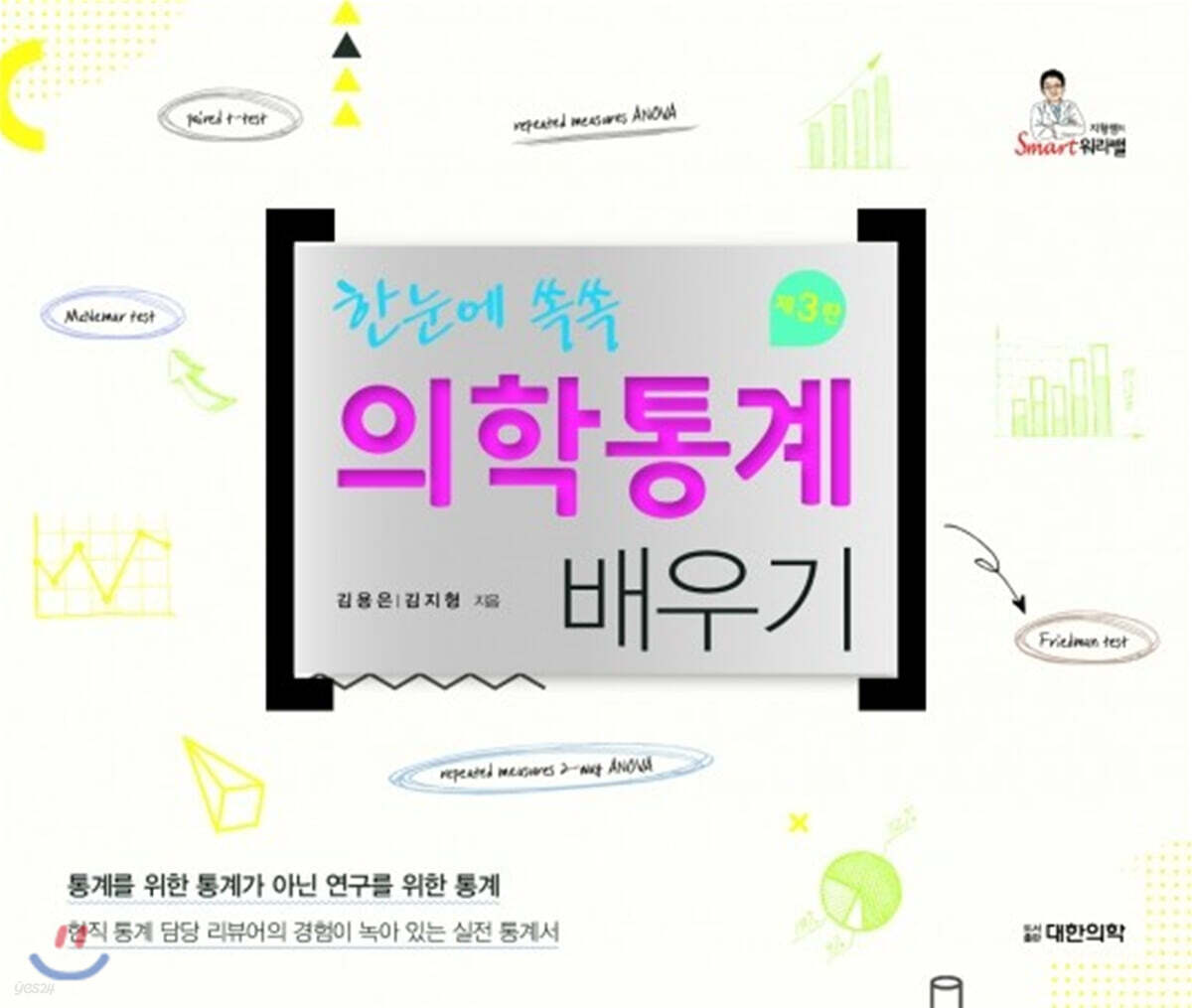
Learning medical statistics
 |
Description
index
Author Biography ii
Preface_Statistics from Dad iii
Note vii
Entry text x
PART.
0 Glossary of Statistics Terms
1) Type 3 of variables
2) Mean, median, mode 3
3) Confidence interval, Type I error, Type II error, null hypothesis, alternative hypothesis 5
4) Relative risk, odds ratio 7
5) Normality Test 9
6) Outlier Problem 9
7) Power Analysis: Calculating the Number of Samples 11
PART.
1 Comparison between homogeneous groups
1.
t-test trio 17
1) t-test 17
2) Mann-Whitney U test 18
3) Chi-square test 20
4) 31 Things You Must Know
2. ANOVA 35
1) ANOVA 35
2) Kruskal-Wallis H test 36
3) Chi-square test 38
4) ANCOVA 49
5) Supplementary learning 52
PART.
Comparison of two paired data
1.
Paired t-test 61
2.
Wilcoxon signed-rank test 63
3.
McNemar test 64
4.
Repeated measures ANOVA 72
5.
Friedman test 77
6.
Repeated measures 2-way ANOVA 78
PART.
3 Comparison of multiple factors within a group
1.
Correlation Analysis 92
1) Pearson correlation analysis 92
2) Partial correlation analysis 93
2.
Regression Analysis 95
1) Multiple regression analysis 95
2) Logistic Regression Analysis 104
PART.
4 Survival Analysis
1.
Drawing a Survival Curve 115
2.
Comparison of Survival Curves 116
3.
Cox proportional hazards model 123
PART.
5 Statistics related to diagnostic methods
1.
Sensitivity and specificity 143
2.
Reproducibility Test 154
1) 154 in case of continuous variable
2) In case of nominal variable 161
3) In case of sequence variable 162
3.
Comparison of Inspection Methods 167
PART.
6 How to Use Statistics Programs
supplement
Non-inferiority study 191
The Pitfalls of Repeated Testing 195
Poisson regression 198
Estimation of population proportions, chi-square goodness-of-fit test 203
JBJS 206: A Look at Statistics
Intention to treat analysis 224
Epilogue 226
Preface_Statistics from Dad iii
Note vii
Entry text x
PART.
0 Glossary of Statistics Terms
1) Type 3 of variables
2) Mean, median, mode 3
3) Confidence interval, Type I error, Type II error, null hypothesis, alternative hypothesis 5
4) Relative risk, odds ratio 7
5) Normality Test 9
6) Outlier Problem 9
7) Power Analysis: Calculating the Number of Samples 11
PART.
1 Comparison between homogeneous groups
1.
t-test trio 17
1) t-test 17
2) Mann-Whitney U test 18
3) Chi-square test 20
4) 31 Things You Must Know
2. ANOVA 35
1) ANOVA 35
2) Kruskal-Wallis H test 36
3) Chi-square test 38
4) ANCOVA 49
5) Supplementary learning 52
PART.
Comparison of two paired data
1.
Paired t-test 61
2.
Wilcoxon signed-rank test 63
3.
McNemar test 64
4.
Repeated measures ANOVA 72
5.
Friedman test 77
6.
Repeated measures 2-way ANOVA 78
PART.
3 Comparison of multiple factors within a group
1.
Correlation Analysis 92
1) Pearson correlation analysis 92
2) Partial correlation analysis 93
2.
Regression Analysis 95
1) Multiple regression analysis 95
2) Logistic Regression Analysis 104
PART.
4 Survival Analysis
1.
Drawing a Survival Curve 115
2.
Comparison of Survival Curves 116
3.
Cox proportional hazards model 123
PART.
5 Statistics related to diagnostic methods
1.
Sensitivity and specificity 143
2.
Reproducibility Test 154
1) 154 in case of continuous variable
2) In case of nominal variable 161
3) In case of sequence variable 162
3.
Comparison of Inspection Methods 167
PART.
6 How to Use Statistics Programs
supplement
Non-inferiority study 191
The Pitfalls of Repeated Testing 195
Poisson regression 198
Estimation of population proportions, chi-square goodness-of-fit test 203
JBJS 206: A Look at Statistics
Intention to treat analysis 224
Epilogue 226
Publisher's Review
Now, time has passed again and the third edition has come out.
Thank you to everyone who has supported and loved me over the years.
I remember when this book first came out.
This book was the first lecture textbook.
There is no original copy of the book because the publisher modified the slides used in the actual lectures and made them into a book.
I changed the notes on the slides into sentences and appropriately inserted the pictures on the slides into the book. I barely managed to get some of them from the printer for the attendees on the morning of the lecture, but it still has that warm book feel from that time.
Let me summarize the strengths of this book in my own way.
Because before reading this book, it is important to know what purpose and intention it is.
Back then, and even now, most books explain how to use SPSS.
There are also books on R or Stata, but ultimately, the content is the same.
To use an analogy, it is a book about 'How to get to Busan' and 'How to get to Daegu'.
However, I feel that the more important and urgent questions are, 'Why should I go to Busan?', 'Why should I go to Daegu instead of Busan in this case?', and 'Where else can I go if something happens while I'm in Daegu?'
So I wrote this book.
It's about comparing this statistical method with that statistical method, and in which cases you shouldn't use one, and in which cases you can use both.
I also remember coining awkward terms like “The Three Musketeers” to group similar statistical methods.
Again, both then and now, there are few books on statistics related to diagnosis.
In medical statistics, and especially in recent machine learning, evaluating and comparing model diagnoses is very important. However, SPSS has few diagnostic-related functions, and R and other related books do not have much diagnostic content. Therefore, I searched the Internet and compared various tools in English to focus on diagnostic content.
The genealogy and names of various statistical methods are very complex.
This is because many things have people's names attached to them, many things have different names for the same thing, and many things are different but have the same name.
I wanted to organize those things by category and make a table.
I had dreamed of this before the book was first published, and it was inspired by the periodic table I learned in the first year of middle school.
I remember being so surprised at that time.
The joy of knowing that there is such a rule.
I would arrange the names of various statistical methods here and there, match them, and when there was a blank space, I would look for something that corresponded to it.
The completed work is the 'Statistical Map', which is an appendix to this book.
At that time, and even now, there are attempts to classify statistical methods according to the nature of the variables.
It's not wrong, but I disagree.
I classified statistical methods according to research design, and the classification is reflected in the 'Statistical Map'.
Some statistical programs handle nonparametric tests in a more subtle way, such as SPSS.
That may be why books on statistics either explain it a little bit at the end or don't explain it at all.
However, since nonparametric tests are widely used in clinical research and should be widely used, I will explain parametric and nonparametric tests together.
I happened to be attending an international conference, and I was having trouble adjusting to the time difference, so I lay down at the conference chair's table and dozed off for a bit. When I woke up, someone was sitting next to me, and as they were leaving, they left behind a recent journal along with various advertisements.
I couldn't sleep at my accommodations, so I read it and corrected the incorrect statistics.
In fact, I only summarize the necessary parts of the journal by subject.
At that time, I had a lot of time, and by looking at the entire book from a statistical perspective, I was able to organize how many parts were wrong and incorrect.
That also came as an appendix to this book.
This book first came out in May 2012.
So exactly 8 years ago.
Still, this book serves as a good guide for me and others.
I still search to check the names of statistical methods that are confusing.
And when I discover a new statistic, I tend to put it on the map to see where it falls.
Recently, I was asked to write a book about SPSS, as SPSS books were selling well.
I politely declined.
There are already so many books out there, and so many blog posts about it, was there really a need to turn it into a book? Readers might buy it, but I didn't want to waste my precious time.
In the meantime, I wrote another book (R Statistics) that introduces various tools created with R to enable practical statistical methods to be implemented.
However, this book, "Learn Medical Statistics at a Glance," covers the essential information you need to know, regardless of the statistical program you use.
I hope that whatever research you do will be like the multiplication table in mathematics or the periodic table in chemistry.
Thank you to everyone who has supported and loved me over the years.
I remember when this book first came out.
This book was the first lecture textbook.
There is no original copy of the book because the publisher modified the slides used in the actual lectures and made them into a book.
I changed the notes on the slides into sentences and appropriately inserted the pictures on the slides into the book. I barely managed to get some of them from the printer for the attendees on the morning of the lecture, but it still has that warm book feel from that time.
Let me summarize the strengths of this book in my own way.
Because before reading this book, it is important to know what purpose and intention it is.
Back then, and even now, most books explain how to use SPSS.
There are also books on R or Stata, but ultimately, the content is the same.
To use an analogy, it is a book about 'How to get to Busan' and 'How to get to Daegu'.
However, I feel that the more important and urgent questions are, 'Why should I go to Busan?', 'Why should I go to Daegu instead of Busan in this case?', and 'Where else can I go if something happens while I'm in Daegu?'
So I wrote this book.
It's about comparing this statistical method with that statistical method, and in which cases you shouldn't use one, and in which cases you can use both.
I also remember coining awkward terms like “The Three Musketeers” to group similar statistical methods.
Again, both then and now, there are few books on statistics related to diagnosis.
In medical statistics, and especially in recent machine learning, evaluating and comparing model diagnoses is very important. However, SPSS has few diagnostic-related functions, and R and other related books do not have much diagnostic content. Therefore, I searched the Internet and compared various tools in English to focus on diagnostic content.
The genealogy and names of various statistical methods are very complex.
This is because many things have people's names attached to them, many things have different names for the same thing, and many things are different but have the same name.
I wanted to organize those things by category and make a table.
I had dreamed of this before the book was first published, and it was inspired by the periodic table I learned in the first year of middle school.
I remember being so surprised at that time.
The joy of knowing that there is such a rule.
I would arrange the names of various statistical methods here and there, match them, and when there was a blank space, I would look for something that corresponded to it.
The completed work is the 'Statistical Map', which is an appendix to this book.
At that time, and even now, there are attempts to classify statistical methods according to the nature of the variables.
It's not wrong, but I disagree.
I classified statistical methods according to research design, and the classification is reflected in the 'Statistical Map'.
Some statistical programs handle nonparametric tests in a more subtle way, such as SPSS.
That may be why books on statistics either explain it a little bit at the end or don't explain it at all.
However, since nonparametric tests are widely used in clinical research and should be widely used, I will explain parametric and nonparametric tests together.
I happened to be attending an international conference, and I was having trouble adjusting to the time difference, so I lay down at the conference chair's table and dozed off for a bit. When I woke up, someone was sitting next to me, and as they were leaving, they left behind a recent journal along with various advertisements.
I couldn't sleep at my accommodations, so I read it and corrected the incorrect statistics.
In fact, I only summarize the necessary parts of the journal by subject.
At that time, I had a lot of time, and by looking at the entire book from a statistical perspective, I was able to organize how many parts were wrong and incorrect.
That also came as an appendix to this book.
This book first came out in May 2012.
So exactly 8 years ago.
Still, this book serves as a good guide for me and others.
I still search to check the names of statistical methods that are confusing.
And when I discover a new statistic, I tend to put it on the map to see where it falls.
Recently, I was asked to write a book about SPSS, as SPSS books were selling well.
I politely declined.
There are already so many books out there, and so many blog posts about it, was there really a need to turn it into a book? Readers might buy it, but I didn't want to waste my precious time.
In the meantime, I wrote another book (R Statistics) that introduces various tools created with R to enable practical statistical methods to be implemented.
However, this book, "Learn Medical Statistics at a Glance," covers the essential information you need to know, regardless of the statistical program you use.
I hope that whatever research you do will be like the multiplication table in mathematics or the periodic table in chemistry.
GOODS SPECIFICS
- Date of issue: July 7, 2020
- Page count, weight, size: 228 pages | Checking size
- ISBN13: 9791155901540
- ISBN10: 1155901541
You may also like
카테고리
korean


korean

![GQ KOREA Mark (Monthly): December [2025]](http://librairie.coreenne.fr/cdn/shop/files/8ef265dbbfbf186523ed75ba7319009d.jpg?v=1765340328&width=3840)


