

Arboriculture
 |
Description
Book Introduction
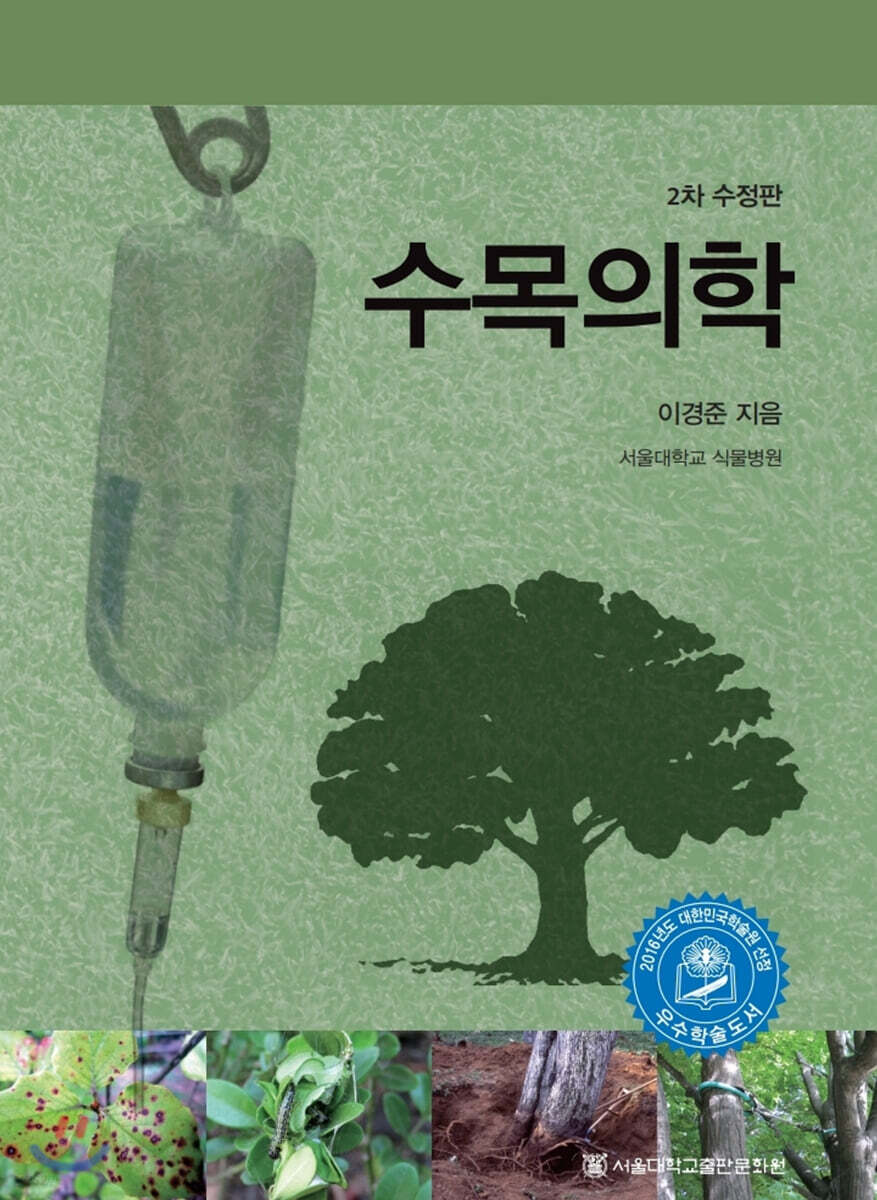
This book covers knowledge and techniques for diagnosing, treating, and preventing pests and diseases to promote the health of trees, and is designed to be used as a university textbook.
The structure and function of trees, the physiological interpretation of normal tree growth, disease outbreaks, diagnosis, infectious diseases, non-infectious diseases, pests, treatment, control, prevention, and health management methods are described with a total of 482 color photographs.
In particular, the second revised edition has revised and supplemented many parts of the types of pesticides used in chemical pest control of trees.
For example, terms such as diphtheria, mephuric acid, methyl bromide, chloropicrin, parathion, and paraquat, which are no longer produced, banned, or used, were removed and replaced with new pesticides.
The main purpose of this book is to serve as a guide to arboriculture for students studying arboriculture.
In particular, it will be a useful reference for many examinees who have or are seeking to obtain the Plant Protection Technician qualification under the Cultural Heritage Administration, the Plant Protection Technician qualification under the Rural Development Administration, or the Tree Protection Technician, Tree Doctor, and Tree Treatment Technician qualifications under the Korea Forest Service.
The structure and function of trees, the physiological interpretation of normal tree growth, disease outbreaks, diagnosis, infectious diseases, non-infectious diseases, pests, treatment, control, prevention, and health management methods are described with a total of 482 color photographs.
In particular, the second revised edition has revised and supplemented many parts of the types of pesticides used in chemical pest control of trees.
For example, terms such as diphtheria, mephuric acid, methyl bromide, chloropicrin, parathion, and paraquat, which are no longer produced, banned, or used, were removed and replaced with new pesticides.
The main purpose of this book is to serve as a guide to arboriculture for students studying arboriculture.
In particular, it will be a useful reference for many examinees who have or are seeking to obtain the Plant Protection Technician qualification under the Cultural Heritage Administration, the Plant Protection Technician qualification under the Rural Development Administration, or the Tree Protection Technician, Tree Doctor, and Tree Treatment Technician qualifications under the Korea Forest Service.
- You can preview some of the book's contents.
Preview
index
preface
Chapter 1: History of Arboriculture
1-1 Medicine and Veterinary Medicine
1-2 Herbal Medicine
1-3 Arboriculture
1-4 History of the Development of Foreign Arboretum
1-5 History of the development of domestic arboriculture
Chapter 2 Structure of Trees
2-1 Relationship between structure and function
2-2 Characteristics of trees
2-3 Age-specific tree forms
2-4 Basic structure of a tree
Chapter 3: Growth of Trees
3-1 Growing point of the tree
3-2 Growth and growth type
3-3 diameter growth
3-4 root growth
3-5 Reproductive growth
Chapter 4: Physiology of Trees
4-1 Physiological response to sunlight
4-2 Energy metabolism
4-3 Material Movement and Distribution
4-4 Water physiology
4-5 Organic metabolism
4-6 Mineral nutrition
4-7 Phytohormone physiology
4-8 flowering period
Chapter 5: Tree Diseases
5-1 Tree disease
5-2 Classification of causes of tree diseases
5-3 Factors affecting pest outbreaks
5-4 Pathogenesis
5-5 Environmental Impact and Outbreak
5-6 Consequences of tree damage: Separation of dead and living parts
Chapter 6: Diagnosis of Tree Diseases and Pests
6-1 Human Diagnostic Medicine and Tree Diagnostic Medicine
6-2 Attitude of a diagnostician
6-3 Investigation of damage situation
6-4 Tree Diagnostic Tool
6-5 Laboratory Analysis and Investigation
6-6 Shaigometer
6-7 Diagnostic Process
6-8 Distinction between communicable and non-communicable diseases
6-9 Symptoms and Signs
6-10 Pest Damage Diagnosis
6-11 Symptoms and diagnosis by cause of damage
Chapter 7 Infectious Diseases of Trees
7-1 Types of tree-borne pathogens
7-2 Classification of infectious diseases by outbreak site and common symptoms
7-3 Fungal diseases
7-4 Bacterial disease
7-5 Viral disease
7-6 Phytoplasmosis
7-7 Nematode disease
7-8 Diseases caused by birds
7-9 Diseases caused by parasitic plants
7-10 Major infectious diseases of major landscape trees
Chapter 8 Tree Pests
8-1 Characteristics of insects
8-2 Classification of insects
8-3 Types of pests
8-4 Classification of pests by harmful habits
8-5 Pest classification by damage symptoms and traces of damage
8-6 Species diversity of major landscape tree pests
8-7 Major domestic pests
Chapter 9 Non-communicable Diseases of Trees
9-1 Diseases caused by meteorological factors
9-2 Diseases caused by soil factors
9-3 Diseases caused by biological factors
9-4 Disease caused by artificial factors
9-5 Abnormal phenomenon due to other factors
Chapter 10: Treatment of Trees
10-1 Interstitial injection
10-2 Foliar fertilization
10-3 Soil irrigation
10-4 Broken Branch Treatment: Pruning
10-5 Skin Wound Treatment
10-6 Interstitial surgery
10-7 Root Surgery
10-8 Installation of support materials
Chapter 11: Pest Control of Trees
11-1 Pest and disease resistance of trees
11-2 National and legal control
11-3 Genetic control
11-4 Biological Control
11-5 Cultivation control
11-6 Removal of parasites
11-7 Mechanical control
11-8 Chemical control
Chapter 12 Tree Health Management
12-1 Natural defense capabilities of trees
12-2 Environmental Stress and Tree Health
12-3 Plant Health Management
12-4 Tree Management for Health Promotion
Citations and References
Search (Korean/English)
Chapter 1: History of Arboriculture
1-1 Medicine and Veterinary Medicine
1-2 Herbal Medicine
1-3 Arboriculture
1-4 History of the Development of Foreign Arboretum
1-5 History of the development of domestic arboriculture
Chapter 2 Structure of Trees
2-1 Relationship between structure and function
2-2 Characteristics of trees
2-3 Age-specific tree forms
2-4 Basic structure of a tree
Chapter 3: Growth of Trees
3-1 Growing point of the tree
3-2 Growth and growth type
3-3 diameter growth
3-4 root growth
3-5 Reproductive growth
Chapter 4: Physiology of Trees
4-1 Physiological response to sunlight
4-2 Energy metabolism
4-3 Material Movement and Distribution
4-4 Water physiology
4-5 Organic metabolism
4-6 Mineral nutrition
4-7 Phytohormone physiology
4-8 flowering period
Chapter 5: Tree Diseases
5-1 Tree disease
5-2 Classification of causes of tree diseases
5-3 Factors affecting pest outbreaks
5-4 Pathogenesis
5-5 Environmental Impact and Outbreak
5-6 Consequences of tree damage: Separation of dead and living parts
Chapter 6: Diagnosis of Tree Diseases and Pests
6-1 Human Diagnostic Medicine and Tree Diagnostic Medicine
6-2 Attitude of a diagnostician
6-3 Investigation of damage situation
6-4 Tree Diagnostic Tool
6-5 Laboratory Analysis and Investigation
6-6 Shaigometer
6-7 Diagnostic Process
6-8 Distinction between communicable and non-communicable diseases
6-9 Symptoms and Signs
6-10 Pest Damage Diagnosis
6-11 Symptoms and diagnosis by cause of damage
Chapter 7 Infectious Diseases of Trees
7-1 Types of tree-borne pathogens
7-2 Classification of infectious diseases by outbreak site and common symptoms
7-3 Fungal diseases
7-4 Bacterial disease
7-5 Viral disease
7-6 Phytoplasmosis
7-7 Nematode disease
7-8 Diseases caused by birds
7-9 Diseases caused by parasitic plants
7-10 Major infectious diseases of major landscape trees
Chapter 8 Tree Pests
8-1 Characteristics of insects
8-2 Classification of insects
8-3 Types of pests
8-4 Classification of pests by harmful habits
8-5 Pest classification by damage symptoms and traces of damage
8-6 Species diversity of major landscape tree pests
8-7 Major domestic pests
Chapter 9 Non-communicable Diseases of Trees
9-1 Diseases caused by meteorological factors
9-2 Diseases caused by soil factors
9-3 Diseases caused by biological factors
9-4 Disease caused by artificial factors
9-5 Abnormal phenomenon due to other factors
Chapter 10: Treatment of Trees
10-1 Interstitial injection
10-2 Foliar fertilization
10-3 Soil irrigation
10-4 Broken Branch Treatment: Pruning
10-5 Skin Wound Treatment
10-6 Interstitial surgery
10-7 Root Surgery
10-8 Installation of support materials
Chapter 11: Pest Control of Trees
11-1 Pest and disease resistance of trees
11-2 National and legal control
11-3 Genetic control
11-4 Biological Control
11-5 Cultivation control
11-6 Removal of parasites
11-7 Mechanical control
11-8 Chemical control
Chapter 12 Tree Health Management
12-1 Natural defense capabilities of trees
12-2 Environmental Stress and Tree Health
12-3 Plant Health Management
12-4 Tree Management for Health Promotion
Citations and References
Search (Korean/English)
Into the book
Arboriculture also has its own unique areas that do not exist in other disciplines, especially plant medicine.
The techniques of treating non-communicable diseases caused by frequent meteorological disasters and human-caused damage, the theory and practice of pruning, protection and defense of stem wounds, trunk injections, and trunk surgery are unique areas that are covered in detail in this book.
--- p.4
All parts of a plant that exhibit life phenomena are composed of living cells.
Life phenomena refer to functions such as cell division, cell elongation, cell differentiation, photosynthesis, respiration, stomata opening and closing, material storage, and secretion.
However, all of these life phenomena appear only in living parenchyma cells.
This is because only in protoplasmic cells exist the relevant enzymes, protoplasm, and cell membrane that make the above phenomenon possible.
--- p.29
The more free-growing a tree species is, the more diverse its appearance becomes as it ages.
Therefore, the tree shape becomes irregular because fixed and free-growing branches are mixed irregularly within one individual.
Zelkova trees are basically free-growing, but as they mature, the proportion of branches that grow fixedly increases, making the tree shape irregular.
Some maple trees also grow freely, but this occurs only on some branches, causing the tree shape to lose balance.
--- p.34
The cell wall is made up of loosely woven fibers with large molecular weights, so there are many gaps, and the intercellular space between cells also has many gaps, which corresponds to a free space where small-diameter water molecules and inorganic salts can freely pass through.
This free movement of inorganic nutrients into the roots along the free space in the form of inorganic salts is called apoplastic movement.
The phenomenon of inorganic nutrients entering the cortex of the root through cell wall movement is considered passive absorption because they enter freely along with water.
--- p.61
Chlorosis refers to the yellowing of leaves due to the destruction of chlorophyll.
It appears as yellowing of the entire leaf, mottling, stippling, and interveinal chlorosis.
Yellowing is caused by infectious diseases, pests, excessive moisture in the soil, cold weather, air and soil pollution, excessive mineral salts in the soil, nutrient deficiencies, topdressing, and herbicide damage.
If the mature leaves turn yellow first, it may indicate a deficiency of nitrogen and phosphorus. If the seedling leaves turn yellow first, it may indicate a deficiency of calcium, iron, or boron.
--- p.100
Pathogen culture is the process of directly culturing a portion of a plant in a laboratory when the pathogen cannot be directly observed in the infected plant (called a label-free plant).
The blotter method or moisture chamber method involves placing two sheets of filter paper in a sterilized cloth, wetting them with sterilized water, placing a part of the diseased plant (leaves, flowers, seeds, branches, roots, etc.), and cultivating them at 20-25℃ for 3-7 days to observe the spores (corresponding to the markers) formed in the lesion area.
--- p.122
It is also called pine diplodia leaf blight.
It is a common disease in pine trees worldwide.
It is mainly caused by the Diplodia fungus in trees aged 10 to 30 years, such as pine, red pine, Korean pine, rigid pine, and white pine.
In spring, new shoots and young leaves turn brown, bend, and quickly dry up and die. When mature leaves are infected, they droop and fade to a whitish-light brown (close to milky white).
Resin oozes from dead branches, and from summer onwards black conidia protrude through the leaf sheath, forming an important landmark.
It occurs in spring when it rains frequently and is cool.
For control, spray benomyl hydrate and thiophan hydrate 2-3 times at 2-week intervals starting in spring.
--- p.170
In Korea, the alder leaf beetle (Agelastica coerulea) is a serious pest that attacks alder, birch, chestnut, hornbeam, pine, apple, pear, cherry, mulberry, poplar, and willow trees. The larvae and adults only eat the leaves, causing them to turn red.
In addition, willow leaf beetles, willow leaf beetles, willow leaf beetles, and walnut leaf beetles also damage broadleaf trees.
For control, spray 1,000-fold dilution of acitretic solution, cysrin solution, deltamethrin, diflubenzuron, triflumuron, fenitrothion emulsion, and chlorfluazuron emulsion at 7-10 day intervals.
--- p.214
The phenomenon of multiple buds gathering in one place on a branch is often observed in black pine trees.
In the case of pine trees, it is known to be caused by parasitism by pine rosette gall mites, and in other cases, it is known to be caused by viruses or genetic causes.
--- p.321
Gravity-type uses a diluted solution, but since it is not commercially available, each tree hospital makes and uses a different one.
Since hydroponic culture is common in horticulture these days, you can prepare it based on Hoagland solution and use it for gravity-type stem injection.
It is used by mixing minerals with Ringer's solution, which is used for 5% glucose intravenous injection in hospitals.
--- p.328
Among the various pest control methods, the most desirable is genetic control.
Resistance and susceptibility to pests and diseases vary greatly depending on the tree species, and even within the same tree species, there are differences depending on the variety.
Among the ornamental trees, there are some that are difficult to manage because they have many pests and diseases, while there are also some that are easy to manage because they have almost no pests and diseases.
(Omitted) In the case of domestic tree species, pine, Korean pine, cherry, and maple trees have many pests and diseases, while yew, larch, ginkgo, magnolia, lily, and maple have few pests and diseases.
By selecting landscape trees that take into account the unique characteristics of these species, you can manage the trees in the most environmentally friendly way.
--- p.365
The basic premise of IPM is that pest numbers increase periodically and, when they reach a certain level, cause economic losses.
The level (number or density) of pests that causes economic loss is called the economic injury level (EIL).
By understanding the specific biological characteristics of a pest, scientists can use models to predict when pest numbers will reach economically damaging levels.
This predicted point is called the economic threshold (ET).
The techniques of treating non-communicable diseases caused by frequent meteorological disasters and human-caused damage, the theory and practice of pruning, protection and defense of stem wounds, trunk injections, and trunk surgery are unique areas that are covered in detail in this book.
--- p.4
All parts of a plant that exhibit life phenomena are composed of living cells.
Life phenomena refer to functions such as cell division, cell elongation, cell differentiation, photosynthesis, respiration, stomata opening and closing, material storage, and secretion.
However, all of these life phenomena appear only in living parenchyma cells.
This is because only in protoplasmic cells exist the relevant enzymes, protoplasm, and cell membrane that make the above phenomenon possible.
--- p.29
The more free-growing a tree species is, the more diverse its appearance becomes as it ages.
Therefore, the tree shape becomes irregular because fixed and free-growing branches are mixed irregularly within one individual.
Zelkova trees are basically free-growing, but as they mature, the proportion of branches that grow fixedly increases, making the tree shape irregular.
Some maple trees also grow freely, but this occurs only on some branches, causing the tree shape to lose balance.
--- p.34
The cell wall is made up of loosely woven fibers with large molecular weights, so there are many gaps, and the intercellular space between cells also has many gaps, which corresponds to a free space where small-diameter water molecules and inorganic salts can freely pass through.
This free movement of inorganic nutrients into the roots along the free space in the form of inorganic salts is called apoplastic movement.
The phenomenon of inorganic nutrients entering the cortex of the root through cell wall movement is considered passive absorption because they enter freely along with water.
--- p.61
Chlorosis refers to the yellowing of leaves due to the destruction of chlorophyll.
It appears as yellowing of the entire leaf, mottling, stippling, and interveinal chlorosis.
Yellowing is caused by infectious diseases, pests, excessive moisture in the soil, cold weather, air and soil pollution, excessive mineral salts in the soil, nutrient deficiencies, topdressing, and herbicide damage.
If the mature leaves turn yellow first, it may indicate a deficiency of nitrogen and phosphorus. If the seedling leaves turn yellow first, it may indicate a deficiency of calcium, iron, or boron.
--- p.100
Pathogen culture is the process of directly culturing a portion of a plant in a laboratory when the pathogen cannot be directly observed in the infected plant (called a label-free plant).
The blotter method or moisture chamber method involves placing two sheets of filter paper in a sterilized cloth, wetting them with sterilized water, placing a part of the diseased plant (leaves, flowers, seeds, branches, roots, etc.), and cultivating them at 20-25℃ for 3-7 days to observe the spores (corresponding to the markers) formed in the lesion area.
--- p.122
It is also called pine diplodia leaf blight.
It is a common disease in pine trees worldwide.
It is mainly caused by the Diplodia fungus in trees aged 10 to 30 years, such as pine, red pine, Korean pine, rigid pine, and white pine.
In spring, new shoots and young leaves turn brown, bend, and quickly dry up and die. When mature leaves are infected, they droop and fade to a whitish-light brown (close to milky white).
Resin oozes from dead branches, and from summer onwards black conidia protrude through the leaf sheath, forming an important landmark.
It occurs in spring when it rains frequently and is cool.
For control, spray benomyl hydrate and thiophan hydrate 2-3 times at 2-week intervals starting in spring.
--- p.170
In Korea, the alder leaf beetle (Agelastica coerulea) is a serious pest that attacks alder, birch, chestnut, hornbeam, pine, apple, pear, cherry, mulberry, poplar, and willow trees. The larvae and adults only eat the leaves, causing them to turn red.
In addition, willow leaf beetles, willow leaf beetles, willow leaf beetles, and walnut leaf beetles also damage broadleaf trees.
For control, spray 1,000-fold dilution of acitretic solution, cysrin solution, deltamethrin, diflubenzuron, triflumuron, fenitrothion emulsion, and chlorfluazuron emulsion at 7-10 day intervals.
--- p.214
The phenomenon of multiple buds gathering in one place on a branch is often observed in black pine trees.
In the case of pine trees, it is known to be caused by parasitism by pine rosette gall mites, and in other cases, it is known to be caused by viruses or genetic causes.
--- p.321
Gravity-type uses a diluted solution, but since it is not commercially available, each tree hospital makes and uses a different one.
Since hydroponic culture is common in horticulture these days, you can prepare it based on Hoagland solution and use it for gravity-type stem injection.
It is used by mixing minerals with Ringer's solution, which is used for 5% glucose intravenous injection in hospitals.
--- p.328
Among the various pest control methods, the most desirable is genetic control.
Resistance and susceptibility to pests and diseases vary greatly depending on the tree species, and even within the same tree species, there are differences depending on the variety.
Among the ornamental trees, there are some that are difficult to manage because they have many pests and diseases, while there are also some that are easy to manage because they have almost no pests and diseases.
(Omitted) In the case of domestic tree species, pine, Korean pine, cherry, and maple trees have many pests and diseases, while yew, larch, ginkgo, magnolia, lily, and maple have few pests and diseases.
By selecting landscape trees that take into account the unique characteristics of these species, you can manage the trees in the most environmentally friendly way.
--- p.365
The basic premise of IPM is that pest numbers increase periodically and, when they reach a certain level, cause economic losses.
The level (number or density) of pests that causes economic loss is called the economic injury level (EIL).
By understanding the specific biological characteristics of a pest, scientists can use models to predict when pest numbers will reach economically damaging levels.
This predicted point is called the economic threshold (ET).
--- p.394
GOODS SPECIFICS
- Date of publication: February 26, 2020
- Page count, weight, size: 468 pages | 188*257*30mm
- ISBN13: 9788952129437
- ISBN10: 8952129431
You may also like
카테고리
korean


korean

![GQ KOREA Mark (Monthly): December [2025]](http://librairie.coreenne.fr/cdn/shop/files/8ef265dbbfbf186523ed75ba7319009d.jpg?v=1765340328&width=3840)


