

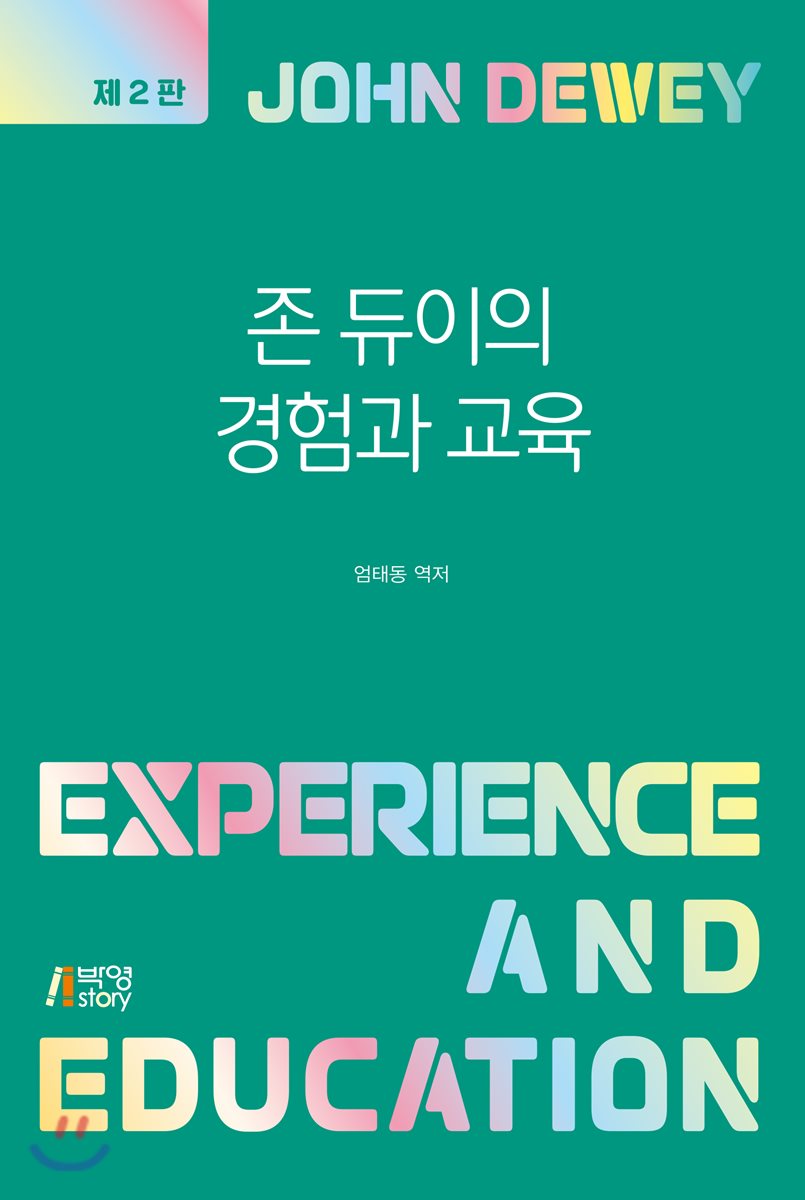
John Dewey's Experience and Education
 |
Description
Book Introduction
Part 1 and 2 of 『Experience and Education of John Dewey』 are John Dewey's Experience and Education.
New York: The Macmillan Company.
1938 and The Child and The Curriculum.
Chicago: The University of Chicago Press.
This is a Korean translation of 1902.
The appendix, “A Defense of John Dewey,” is a revised version of “John Dewey’s Celestial Pedagogy Exiled from Earth (2001),” a paper written by the translator to explain and evaluate Dewey’s educational theory.
In the text of Parts 1 and 2, the text in [ ] was added by the author, Dewey, to supplement the original text, and the text in ( ) was added separately by the translator to naturally connect the context of the original text or to help the reader understand.
The notes at the bottom of the text in Parts 1 and 2 were added separately by the translator and contain somewhat difficult theoretical explanations.
You can skip this and just read the main text.
New York: The Macmillan Company.
1938 and The Child and The Curriculum.
Chicago: The University of Chicago Press.
This is a Korean translation of 1902.
The appendix, “A Defense of John Dewey,” is a revised version of “John Dewey’s Celestial Pedagogy Exiled from Earth (2001),” a paper written by the translator to explain and evaluate Dewey’s educational theory.
In the text of Parts 1 and 2, the text in [ ] was added by the author, Dewey, to supplement the original text, and the text in ( ) was added separately by the translator to naturally connect the context of the original text or to help the reader understand.
The notes at the bottom of the text in Parts 1 and 2 were added separately by the translator and contain somewhat difficult theoretical explanations.
You can skip this and just read the main text.
index
Part 1: Experience and Education
Chapter 1: Traditional and Progressive Education 3
Chapter 2: The Need for Empirical Theory 14
Chapter 3: Criteria for Experience 26
Chapter 4 Social Control 55
Chapter 5: The Nature of Freedom 71
Chapter 6: The Meaning of Purpose 78
Chapter 7: Progressive Organization of Curriculum Content 88
Chapter 8: Experience as a Means and End of Education 113
Part 2 Children and the Curriculum
Children and Curriculum 119
Part 3: A Defense of John Dewey
Chapter 1: The Tragedy of John Dewey: The Misunderstanding and Confusion Surrounding Him 159
Chapter 2: The Confusion between Pragmatism and Pragmatism 167
Chapter 3: Confusion over the Value of Education and the Value of Subjects 176
Chapter 4: Misunderstanding the Idea of a Progressive Organization of Curriculum 187
Chapter 5: Rereading John Dewey: A Pedagogical Reinterpretation 198
Translator's Note 213
Reference 218
Index 221
Chapter 1: Traditional and Progressive Education 3
Chapter 2: The Need for Empirical Theory 14
Chapter 3: Criteria for Experience 26
Chapter 4 Social Control 55
Chapter 5: The Nature of Freedom 71
Chapter 6: The Meaning of Purpose 78
Chapter 7: Progressive Organization of Curriculum Content 88
Chapter 8: Experience as a Means and End of Education 113
Part 2 Children and the Curriculum
Children and Curriculum 119
Part 3: A Defense of John Dewey
Chapter 1: The Tragedy of John Dewey: The Misunderstanding and Confusion Surrounding Him 159
Chapter 2: The Confusion between Pragmatism and Pragmatism 167
Chapter 3: Confusion over the Value of Education and the Value of Subjects 176
Chapter 4: Misunderstanding the Idea of a Progressive Organization of Curriculum 187
Chapter 5: Rereading John Dewey: A Pedagogical Reinterpretation 198
Translator's Note 213
Reference 218
Index 221
Publisher's Review
Author's Preface
All social movements involve conflict, and this conflict often finds expression in the form of intellectual debate.
If an important social concern like education is not a place for practical or theoretical debate, it can never be considered a sign of health.
However, from a theoretical perspective, at least from the perspective of the theory that constitutes educational philosophy, not only actual conflicts but also the debates that unfold around such conflicts often cause problems rather than solve them.
(What should we do?) Rather than joining either of the two opposing camps, we should first investigate the cause of the conflict.
And we must present how to address issues related to education from a perspective that is deeper and broader than what each camp's practices and ideologies suggest.
This is a task that must be performed when academically theorizing education.
To state the task of educational philosophy in this way does not mean that educational philosophy should seek a compromise or a middle ground between schools of thought with conflicting ideas, nor does it mean that it should gather key points from all schools and create a compromise.
This means that we need to introduce a new conceptual framework that can bring about new forms of educational practice.
It is precisely this burden of having to form new concepts that makes it extremely difficult to break away from familiar traditions and customs and construct an educational philosophy that is different from the previous one.
This is precisely why running a school based on a new conceptual system is much more difficult than running a school according to convention.
This difficulty also stems from the fact that movements seeking new theoretical frameworks and practices based on such theories are short-lived, quickly losing momentum, and almost invariably reverting to older theories and practices that seem simpler and more basic.
Even today, attempts to revive the educational principles of ancient Greece or the Middle Ages are often made in the educational world, and this too can be seen as an example of abandoning the new and returning to the old.
With these circumstances in mind, I have concluded this little booklet by saying that those who wish to devise a new educational movement suited to the present demands of the new social order should bear in mind the following points:
In other words, those who wish to realize a new education must keep in mind that they must view education as education itself, and not think about education based on various 'isms', including progressivism.
This is because, regardless of the educational movement, if it develops its thoughts on education and seeks to put them into practice based on a specific ism, it will induce a backlash from other isms that oppose it, and without even realizing it, it will be influenced by them and derail.
In that case, the educational movement will commit the folly of seeking educational principles against other isms, instead of establishing them through a comprehensive and constructive investigation of the needs, problems, and possibilities related to education that actually exist.
Whatever the value of the essays contained in this little booklet, they are the product of an effort to draw attention to broader and deeper issues related to education and to suggest an appropriate framework for dealing with them.
John Dewey
Editor's Preface
Experience and Education is the final book in a series of lecture books published over the first ten years of the Kappa Delta Pi fraternity.
Dr. Dewey was the lecturer who taught the first lecture of our society and also the lecturer who taught the tenth and final lecture of the series.
Therefore, this book can be seen as a publication to commemorate Dr. Dewey, who has such a special relationship with our society.
Although it is smaller than the author's other works, Experience and Education is a monumental work in the field of educational philosophy.
The widespread confusion in American education, with people and groups holding mutually hostile beliefs, is unfortunately fragmenting the forces that should be united to support education.
This small booklet, published in the midst of all this, provides clear and definitive guidance for ensuring that education moves in a unified direction.
Since teachers who believe in the New Education not only openly apply Dr. Dewey's teachings to their own practices, but also emphasize well-known progressive educational concepts such as experience, experimentation, purposeful learning, and freedom, it is also meaningful to examine how Dr. Dewey himself responds to these current educational practices.
The Executive Committee of Kappa Delta Pi asked Dr. Dewey to discuss some of the challenges that are dividing and weakening American education at a time when the educational community should be focusing its energies on leading a nation in turmoil due to rapid social change.
This was done with the intention of clearly understanding the problems of education and uniting the power of the education community.
Experience and Education clearly analyzes both traditional and progressive education.
The fundamental flaws of both traditional and progressive education are also described in this booklet.
While traditional schools emphasize traditional subjects and cultural heritage as the content of their curriculum, new schools emphasize students' inner desires and interests, as well as the issues facing a changing society.
However, it is difficult to see that the things that both sides value are sufficient in themselves.
Neither the subject nor the students are important; in fact, both are essential to education.
A sound educational experience requires, above all, continuity and interaction between the student and what he or she is learning.
There is no doubt that traditional educational systems have ignored children's innate abilities and interests, instead emphasizing strict control and discipline.
But today, the backlash against this type of schooling often encourages the other extreme: a poorly organized curriculum, excessive individualism, and self-indulgence that is mistaken for an indicator of freedom.
Dr. Dewey argues that both traditional and new education are inadequate.
Both are uneducational because they fail to apply the principles of carefully developed experiential philosophy.
A significant portion of this booklet is devoted to explaining what experience means and how it relates to education.
Criticizing the factions that have created and furthered division and conflict in the educational world, Dr. Dewey interprets education as a scientific method that humans use to study the world.
To conduct critical inquiry and lead an intellectual life, knowledge of various meanings and values is required, and the scientific method is a way to acquire and accumulate such knowledge, which is equivalent to education.
(As he said) scientific inquiry is bound to pursue systematic knowledge.
At this time, the system of knowledge pursued by scientific inquiry needs to be understood as a means to help carry out subsequent inquiry.
Therefore, rather than limiting their role to simply exploring problems as they arise, scientists should move on to studying the nature of such problems, the historical context in which they arise, the environmental conditions surrounding them, and their significance.
To achieve this goal, scientists need to investigate whether relevant knowledge has been accumulated and to review such knowledge.
When we think about it this way, education should ultimately be able to organize its subjects progressively (in a way that is faithful to the scientific method that scientists use to explore knowledge), and it should be able to enable students to naturally grasp the meaning and significance of the problems as they study the subjects organized in this way.
Scientific research not only leads us to experience, but also expands our experience.
However, such experiences can be educational only if they are continuously connected to meaningful knowledge, and if that knowledge appropriately transforms or improves students' thinking, attitudes, and skills.
Looking at it this way, there are vertical and horizontal dimensions in the scene where true learning takes place.
It is historical and social at the same time.
It is also orderly yet dynamic.
Many of today's educational professionals and teachers who are seriously seeking reliable teachings related to education will find passages of interest in this booklet.
Experience and Education provides a solid foundation for educators and teachers to work together to build America's education system.
Of course, such an educational system must respect all sources of experience and be based on a positive, rather than negative, philosophy toward experience and education.
Guided by a positive philosophy of experience and education, American educators will dismantle their antagonistic factions and join a solid lineage moving toward a better tomorrow.
Alfred L.
Hall Quest
Kappa Delta Pi Publications Editor
Translator's Note
There are people who want to study the theory of education but don't know which books to read, and ask me for some good books.
Considering the world that is only sensitive to the material benefits that education brings and is too insensitive to what education really is, these people are truly precious to me as an education scholar.
However, even if you look through books here and there for them, it is not easy to find reading material that will satisfy their unique passion or intellectual interest.
Perhaps that is to be expected.
It is highly unlikely that works desired by the general public will come from the hands of educators who consider education a subject for prospective teachers and whose only job is to write teaching materials.
The books on display in the education section of large bookstores are all educational textbooks with similar content, and their content is woefully inadequate to satisfy the general public's theoretical interest and intellectual thirst for education.
Still, it was hard to refuse a request, so I recommended a few books, and every time I did, one or two of Dewey's books were always included.
But I have rarely felt comfortable recommending Dewey's books as worth reading.
This is not to say that Dewey is not a worthwhile figure to read in relation to the theoretical study of education.
Rather, Dewey is one of the most important educational theorists that anyone with a theoretical interest in education should keep by their side and read whenever they have time.
That's why I recommended you read it.
But why did I feel uncomfortable?
Anyone who has read even one of Dewey's books will surely agree that his books are written in a way that is not easy to read at all.
Even considering that it was a time when it was not easy to revise manuscripts written with a pen, his English writings sometimes seem to repeat the same story excessively, and at other times, they contain so many omissions and leaps of thought that it seems as if several sentences were missing between the next.
For this reason, there are probably more than a few people who tried to read Dewey's book in English but ended up putting it down halfway through without finishing it.
Although Dewey's book is by no means an easy read, if you were to choose one that is definitely worth reading, Experience and Education would be a must-read.
However, Dewey's writing skills, which never make the reader feel comfortable, are fully displayed in this book as well.
No matter how patient you are, it's not easy to read all the way to the last page.
This is unfortunate.
Because, although this book is relatively short compared to Dewey's other books, it nevertheless contains almost the entire core of Dewey's educational theory.
Wouldn't it be a shame if such an important book were to be left off readers' reading lists simply because it was inconvenient to read?
I translated and published 『Experience and Education』 quite a while ago with the idea of making it easier for readers to read Dewey's book.
It's been a long time, so my memory isn't entirely clear, but at the time, I had a principle that, as long as Dewey's message wasn't damaged, I should translate his English writings into Korean in a natural way that readers could read comfortably, rather than directly translating them.
It was obvious that directly translating Dewey's English text into Korean would not only be more painful for readers than reading Dewey's writing in English, but would also make it impossible for them to properly understand what Dewey was trying to say.
It was quite difficult to translate it into Korean so naturally that readers would be mistaken into thinking they were reading a book written by a Korean scholar rather than the American Dewey.
That was the first time I realized how difficult translation could be, and as soon as it was published, I decided never to translate someone else's work again.
It seems that while reading 『Experience and Education』, there were not many readers who thought about education, but they did so without stopping.
Now, Park Young-sa has announced that they will republish the translated version of Experience and Education on behalf of the closed publisher.
I thought I could publish the book with only minor revisions, such as correcting typos.
But as I was reading the translated version to revise the manuscript, my heart suddenly became heavy.
This is because, contrary to the original intention of translating into Korean that is easy to read, I still see Korean translations here and there that are not easy to understand.
I was unable to fully escape the temptation of a convenient translation that directly translates English into Korean.
I couldn't publish this book as it was, thinking about the confusion readers would feel while reading it.
So I took on the unusual task of translating a book that had made me think I would never translate again.
As you can see by comparing it with the original translation, a significant portion of Experience and Education has been newly translated.
We have made every effort to translate Dewey's message into Korean so that readers can read it more comfortably and naturally while also making it easier to understand.
It's not just "Experience and Education" that does this.
The translation of Dewey's essay "The Child and the Curriculum," which was also included in Part 2 of this book, was also unsatisfactory, so it was translated again from the beginning.
Although it was published 36 years before "Experience and Education," "The Child and the Curriculum" retains almost all of the most important issues and solutions of Dewey's educational theory that appear in "Experience and Education."
Reading this newly translated article together with the new translation of Experience and Education will make it easier to approach Dewey's educational theory.
“A Defense of John Dewey” is included as an appendix to this book.
This paper is a partial revision of "John Dewey's Celestial Pedagogy Exiled from Earth," written to introduce Dewey's educational theory within the scope of the translator's understanding and to dispel the controversy and misunderstanding surrounding him while translating Dewey's "Experience and Education."
This article, written in defense of Dewey's educational theory, was published almost 19 years ago.
Although there has been no significant change in the belief that Dewey's educational theory is important, the translator's affection for him cannot be the same as before.
The translator now has different ideas about education than Dewey in many ways.
When I first wrote my defense of Dewey's educational theory, it might have seemed like a heavenly pedagogy, but now to me, his educational theory is no longer a heavenly pedagogy.
Although this text does not fully reflect the translator's current thoughts on education, it is still worth reading for readers interested in Dewey's educational theory.
So, with some minor revisions, I republished it under the title "A Defense of John Dewey," removing the somewhat exaggerated praise that the original title contained.
In this age where all sorts of empty talk is being spread in the name of education, I hope that there will continue to be a few people who seriously question what education is.
And if this book can be of even a little help to those rare people, I could not ask for more.
All social movements involve conflict, and this conflict often finds expression in the form of intellectual debate.
If an important social concern like education is not a place for practical or theoretical debate, it can never be considered a sign of health.
However, from a theoretical perspective, at least from the perspective of the theory that constitutes educational philosophy, not only actual conflicts but also the debates that unfold around such conflicts often cause problems rather than solve them.
(What should we do?) Rather than joining either of the two opposing camps, we should first investigate the cause of the conflict.
And we must present how to address issues related to education from a perspective that is deeper and broader than what each camp's practices and ideologies suggest.
This is a task that must be performed when academically theorizing education.
To state the task of educational philosophy in this way does not mean that educational philosophy should seek a compromise or a middle ground between schools of thought with conflicting ideas, nor does it mean that it should gather key points from all schools and create a compromise.
This means that we need to introduce a new conceptual framework that can bring about new forms of educational practice.
It is precisely this burden of having to form new concepts that makes it extremely difficult to break away from familiar traditions and customs and construct an educational philosophy that is different from the previous one.
This is precisely why running a school based on a new conceptual system is much more difficult than running a school according to convention.
This difficulty also stems from the fact that movements seeking new theoretical frameworks and practices based on such theories are short-lived, quickly losing momentum, and almost invariably reverting to older theories and practices that seem simpler and more basic.
Even today, attempts to revive the educational principles of ancient Greece or the Middle Ages are often made in the educational world, and this too can be seen as an example of abandoning the new and returning to the old.
With these circumstances in mind, I have concluded this little booklet by saying that those who wish to devise a new educational movement suited to the present demands of the new social order should bear in mind the following points:
In other words, those who wish to realize a new education must keep in mind that they must view education as education itself, and not think about education based on various 'isms', including progressivism.
This is because, regardless of the educational movement, if it develops its thoughts on education and seeks to put them into practice based on a specific ism, it will induce a backlash from other isms that oppose it, and without even realizing it, it will be influenced by them and derail.
In that case, the educational movement will commit the folly of seeking educational principles against other isms, instead of establishing them through a comprehensive and constructive investigation of the needs, problems, and possibilities related to education that actually exist.
Whatever the value of the essays contained in this little booklet, they are the product of an effort to draw attention to broader and deeper issues related to education and to suggest an appropriate framework for dealing with them.
John Dewey
Editor's Preface
Experience and Education is the final book in a series of lecture books published over the first ten years of the Kappa Delta Pi fraternity.
Dr. Dewey was the lecturer who taught the first lecture of our society and also the lecturer who taught the tenth and final lecture of the series.
Therefore, this book can be seen as a publication to commemorate Dr. Dewey, who has such a special relationship with our society.
Although it is smaller than the author's other works, Experience and Education is a monumental work in the field of educational philosophy.
The widespread confusion in American education, with people and groups holding mutually hostile beliefs, is unfortunately fragmenting the forces that should be united to support education.
This small booklet, published in the midst of all this, provides clear and definitive guidance for ensuring that education moves in a unified direction.
Since teachers who believe in the New Education not only openly apply Dr. Dewey's teachings to their own practices, but also emphasize well-known progressive educational concepts such as experience, experimentation, purposeful learning, and freedom, it is also meaningful to examine how Dr. Dewey himself responds to these current educational practices.
The Executive Committee of Kappa Delta Pi asked Dr. Dewey to discuss some of the challenges that are dividing and weakening American education at a time when the educational community should be focusing its energies on leading a nation in turmoil due to rapid social change.
This was done with the intention of clearly understanding the problems of education and uniting the power of the education community.
Experience and Education clearly analyzes both traditional and progressive education.
The fundamental flaws of both traditional and progressive education are also described in this booklet.
While traditional schools emphasize traditional subjects and cultural heritage as the content of their curriculum, new schools emphasize students' inner desires and interests, as well as the issues facing a changing society.
However, it is difficult to see that the things that both sides value are sufficient in themselves.
Neither the subject nor the students are important; in fact, both are essential to education.
A sound educational experience requires, above all, continuity and interaction between the student and what he or she is learning.
There is no doubt that traditional educational systems have ignored children's innate abilities and interests, instead emphasizing strict control and discipline.
But today, the backlash against this type of schooling often encourages the other extreme: a poorly organized curriculum, excessive individualism, and self-indulgence that is mistaken for an indicator of freedom.
Dr. Dewey argues that both traditional and new education are inadequate.
Both are uneducational because they fail to apply the principles of carefully developed experiential philosophy.
A significant portion of this booklet is devoted to explaining what experience means and how it relates to education.
Criticizing the factions that have created and furthered division and conflict in the educational world, Dr. Dewey interprets education as a scientific method that humans use to study the world.
To conduct critical inquiry and lead an intellectual life, knowledge of various meanings and values is required, and the scientific method is a way to acquire and accumulate such knowledge, which is equivalent to education.
(As he said) scientific inquiry is bound to pursue systematic knowledge.
At this time, the system of knowledge pursued by scientific inquiry needs to be understood as a means to help carry out subsequent inquiry.
Therefore, rather than limiting their role to simply exploring problems as they arise, scientists should move on to studying the nature of such problems, the historical context in which they arise, the environmental conditions surrounding them, and their significance.
To achieve this goal, scientists need to investigate whether relevant knowledge has been accumulated and to review such knowledge.
When we think about it this way, education should ultimately be able to organize its subjects progressively (in a way that is faithful to the scientific method that scientists use to explore knowledge), and it should be able to enable students to naturally grasp the meaning and significance of the problems as they study the subjects organized in this way.
Scientific research not only leads us to experience, but also expands our experience.
However, such experiences can be educational only if they are continuously connected to meaningful knowledge, and if that knowledge appropriately transforms or improves students' thinking, attitudes, and skills.
Looking at it this way, there are vertical and horizontal dimensions in the scene where true learning takes place.
It is historical and social at the same time.
It is also orderly yet dynamic.
Many of today's educational professionals and teachers who are seriously seeking reliable teachings related to education will find passages of interest in this booklet.
Experience and Education provides a solid foundation for educators and teachers to work together to build America's education system.
Of course, such an educational system must respect all sources of experience and be based on a positive, rather than negative, philosophy toward experience and education.
Guided by a positive philosophy of experience and education, American educators will dismantle their antagonistic factions and join a solid lineage moving toward a better tomorrow.
Alfred L.
Hall Quest
Kappa Delta Pi Publications Editor
Translator's Note
There are people who want to study the theory of education but don't know which books to read, and ask me for some good books.
Considering the world that is only sensitive to the material benefits that education brings and is too insensitive to what education really is, these people are truly precious to me as an education scholar.
However, even if you look through books here and there for them, it is not easy to find reading material that will satisfy their unique passion or intellectual interest.
Perhaps that is to be expected.
It is highly unlikely that works desired by the general public will come from the hands of educators who consider education a subject for prospective teachers and whose only job is to write teaching materials.
The books on display in the education section of large bookstores are all educational textbooks with similar content, and their content is woefully inadequate to satisfy the general public's theoretical interest and intellectual thirst for education.
Still, it was hard to refuse a request, so I recommended a few books, and every time I did, one or two of Dewey's books were always included.
But I have rarely felt comfortable recommending Dewey's books as worth reading.
This is not to say that Dewey is not a worthwhile figure to read in relation to the theoretical study of education.
Rather, Dewey is one of the most important educational theorists that anyone with a theoretical interest in education should keep by their side and read whenever they have time.
That's why I recommended you read it.
But why did I feel uncomfortable?
Anyone who has read even one of Dewey's books will surely agree that his books are written in a way that is not easy to read at all.
Even considering that it was a time when it was not easy to revise manuscripts written with a pen, his English writings sometimes seem to repeat the same story excessively, and at other times, they contain so many omissions and leaps of thought that it seems as if several sentences were missing between the next.
For this reason, there are probably more than a few people who tried to read Dewey's book in English but ended up putting it down halfway through without finishing it.
Although Dewey's book is by no means an easy read, if you were to choose one that is definitely worth reading, Experience and Education would be a must-read.
However, Dewey's writing skills, which never make the reader feel comfortable, are fully displayed in this book as well.
No matter how patient you are, it's not easy to read all the way to the last page.
This is unfortunate.
Because, although this book is relatively short compared to Dewey's other books, it nevertheless contains almost the entire core of Dewey's educational theory.
Wouldn't it be a shame if such an important book were to be left off readers' reading lists simply because it was inconvenient to read?
I translated and published 『Experience and Education』 quite a while ago with the idea of making it easier for readers to read Dewey's book.
It's been a long time, so my memory isn't entirely clear, but at the time, I had a principle that, as long as Dewey's message wasn't damaged, I should translate his English writings into Korean in a natural way that readers could read comfortably, rather than directly translating them.
It was obvious that directly translating Dewey's English text into Korean would not only be more painful for readers than reading Dewey's writing in English, but would also make it impossible for them to properly understand what Dewey was trying to say.
It was quite difficult to translate it into Korean so naturally that readers would be mistaken into thinking they were reading a book written by a Korean scholar rather than the American Dewey.
That was the first time I realized how difficult translation could be, and as soon as it was published, I decided never to translate someone else's work again.
It seems that while reading 『Experience and Education』, there were not many readers who thought about education, but they did so without stopping.
Now, Park Young-sa has announced that they will republish the translated version of Experience and Education on behalf of the closed publisher.
I thought I could publish the book with only minor revisions, such as correcting typos.
But as I was reading the translated version to revise the manuscript, my heart suddenly became heavy.
This is because, contrary to the original intention of translating into Korean that is easy to read, I still see Korean translations here and there that are not easy to understand.
I was unable to fully escape the temptation of a convenient translation that directly translates English into Korean.
I couldn't publish this book as it was, thinking about the confusion readers would feel while reading it.
So I took on the unusual task of translating a book that had made me think I would never translate again.
As you can see by comparing it with the original translation, a significant portion of Experience and Education has been newly translated.
We have made every effort to translate Dewey's message into Korean so that readers can read it more comfortably and naturally while also making it easier to understand.
It's not just "Experience and Education" that does this.
The translation of Dewey's essay "The Child and the Curriculum," which was also included in Part 2 of this book, was also unsatisfactory, so it was translated again from the beginning.
Although it was published 36 years before "Experience and Education," "The Child and the Curriculum" retains almost all of the most important issues and solutions of Dewey's educational theory that appear in "Experience and Education."
Reading this newly translated article together with the new translation of Experience and Education will make it easier to approach Dewey's educational theory.
“A Defense of John Dewey” is included as an appendix to this book.
This paper is a partial revision of "John Dewey's Celestial Pedagogy Exiled from Earth," written to introduce Dewey's educational theory within the scope of the translator's understanding and to dispel the controversy and misunderstanding surrounding him while translating Dewey's "Experience and Education."
This article, written in defense of Dewey's educational theory, was published almost 19 years ago.
Although there has been no significant change in the belief that Dewey's educational theory is important, the translator's affection for him cannot be the same as before.
The translator now has different ideas about education than Dewey in many ways.
When I first wrote my defense of Dewey's educational theory, it might have seemed like a heavenly pedagogy, but now to me, his educational theory is no longer a heavenly pedagogy.
Although this text does not fully reflect the translator's current thoughts on education, it is still worth reading for readers interested in Dewey's educational theory.
So, with some minor revisions, I republished it under the title "A Defense of John Dewey," removing the somewhat exaggerated praise that the original title contained.
In this age where all sorts of empty talk is being spread in the name of education, I hope that there will continue to be a few people who seriously question what education is.
And if this book can be of even a little help to those rare people, I could not ask for more.
GOODS SPECIFICS
- Date of issue: April 22, 2019
- Page count, weight, size: 230 pages | 153*224*20mm
- ISBN13: 9791189643959
- ISBN10: 1189643952
You may also like
카테고리
korean


korean

![GQ KOREA Mark (Monthly): December [2025]](http://librairie.coreenne.fr/cdn/shop/files/8ef265dbbfbf186523ed75ba7319009d.jpg?v=1765340328&width=3840)


