

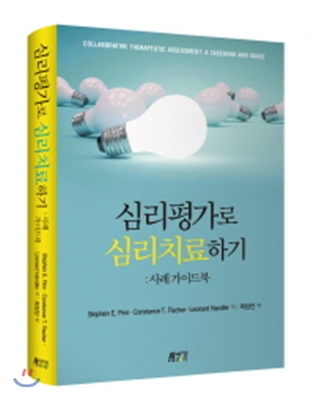
Psychotherapy through psychological evaluation
 |
Description
Book Introduction
This book presents examples of collaborative therapeutic evaluations conducted by experts from four countries.
Each chapter is divided into three parts.
Part I covers C/TA for children and adolescents. Part II presents case studies of children and adolescents. Part III introduces special cases of collaborative therapeutic neuropsychological assessment, therapeutic assessment in parenting, and therapeutic assessment for couples.
The psychological tests used here were HTP, KFD, SCT, MMPI-2, PAI, 16PF, MBTI, Strong's Interest Inventory, TAT, CAT, Rorschach, Imaginary Animal Drawing, Attachment Projective Test, WAIS, Stanford Binet Test, and TMT.
Each chapter is divided into three parts.
Part I covers C/TA for children and adolescents. Part II presents case studies of children and adolescents. Part III introduces special cases of collaborative therapeutic neuropsychological assessment, therapeutic assessment in parenting, and therapeutic assessment for couples.
The psychological tests used here were HTP, KFD, SCT, MMPI-2, PAI, 16PF, MBTI, Strong's Interest Inventory, TAT, CAT, Rorschach, Imaginary Animal Drawing, Attachment Projective Test, WAIS, Stanford Binet Test, and TMT.
index
01 Collaborative/Therapeutic Assessment: Concepts, History, and Research
Part 1 Adult Evaluation
02 Therapeutic Assessment of Clients with Dissociative Symptoms: Learning Inner Exploration
03 Therapeutic Assessment of Depression: Love's Labour's Lost
04 Collaborative Neuropsychological Assessment: A Metaphorical Intervention for Adults at High Risk for Suicide
05 Collaboration through Evaluation: Youth in Transition
06 Therapeutic assessment for crisis intervention of a client who has attempted suicide multiple times
07 Therapeutic Assessment to Explore Emotional Suppression: Creative Professionals in Crisis
08 Therapeutic Assessment for Everyday Topics: Embracing Health, Culture, and Learning Issues
09 Collaborative Assessment for Psychotherapy: A Woman's Recognition
10 Therapeutic Assessment for Severe Abuse: Women Living in the Past
Part 2: Assessment for Children, Adolescents, and Adults
11 Therapeutic Assessment of Adolescents: Understanding the Adopted Teenager
Collaborative Storytelling with Children: A Difficult Six-Year-Old
13 Rorschach-Based Psychotherapy: Collaborative Assessment with Women at Risk for Suicide
14 Collaborative Assessment of Adopted Children: A New Understanding of Problem Behavior
A therapeutic evaluation of a 10-year-old boy and his parents: The pain of rudeness.
Collaborative Assessment in a Child Psychiatry Ward: A Teenage Girl with Psychosis
Part 3 Special Application
17 Therapeutic Evaluation as an Alternative to Custody Evaluation: Adolescents with Parents Who Can't Stop Fighting
18 Therapeutic Assessment of Couples in Crisis: Resolving Projective Identification Through Joint Rorschach
19 Collaborative Neuropsychological Assessment Case Studies: Patients with Brain Injury and Children with Learning Problems
Review: For the Future
Part 1 Adult Evaluation
02 Therapeutic Assessment of Clients with Dissociative Symptoms: Learning Inner Exploration
03 Therapeutic Assessment of Depression: Love's Labour's Lost
04 Collaborative Neuropsychological Assessment: A Metaphorical Intervention for Adults at High Risk for Suicide
05 Collaboration through Evaluation: Youth in Transition
06 Therapeutic assessment for crisis intervention of a client who has attempted suicide multiple times
07 Therapeutic Assessment to Explore Emotional Suppression: Creative Professionals in Crisis
08 Therapeutic Assessment for Everyday Topics: Embracing Health, Culture, and Learning Issues
09 Collaborative Assessment for Psychotherapy: A Woman's Recognition
10 Therapeutic Assessment for Severe Abuse: Women Living in the Past
Part 2: Assessment for Children, Adolescents, and Adults
11 Therapeutic Assessment of Adolescents: Understanding the Adopted Teenager
Collaborative Storytelling with Children: A Difficult Six-Year-Old
13 Rorschach-Based Psychotherapy: Collaborative Assessment with Women at Risk for Suicide
14 Collaborative Assessment of Adopted Children: A New Understanding of Problem Behavior
A therapeutic evaluation of a 10-year-old boy and his parents: The pain of rudeness.
Collaborative Assessment in a Child Psychiatry Ward: A Teenage Girl with Psychosis
Part 3 Special Application
17 Therapeutic Evaluation as an Alternative to Custody Evaluation: Adolescents with Parents Who Can't Stop Fighting
18 Therapeutic Assessment of Couples in Crisis: Resolving Projective Identification Through Joint Rorschach
19 Collaborative Neuropsychological Assessment Case Studies: Patients with Brain Injury and Children with Learning Problems
Review: For the Future
Publisher's Review
This book is by Stephen E.
Finn, Constance T.
This is a translation of Fischer, Leonard Handler's Collaborative/Therapeutic Assessment: A Casebook and Guide.
My first exposure to therapeutic assessment was from Stephen E.
It was in graduate school when I read Finn's “Manual for Using the MMPI-2 as a Therapeutic Intervention.”
That experience, as I was just beginning to learn about psychological assessment and psychotherapy, provided me with a direction to follow as a clinical psychologist.
After training as a clinical psychologist and working as a supervisor, I came to understand the therapeutic power and potential of psychological assessment, and personally realized the usefulness of therapeutic intervention using psychological assessment.
And two years ago, I translated Stephen Finn's “In Our Clients' Shoes: Theory and Techniques of Therapeutic Assessment,” a pioneering work in therapeutic assessment, into a book titled “Through the Client's Eyes: Psychotherapy with Psychological Assessment.”
I still can't forget the emotion I felt while reading the author's writing.
And I once confessed that I hope this book will serve as a practical model for those who want to use psychological evaluation to provide counseling and psychotherapy intervention, as I felt it was a shame to keep the excitement and emotion of that time to myself.
That confession is now about to blossom.
The feeling I had throughout translating this book was warmth.
'How can psychotherapy be done so beautifully through psychological assessment?' The therapist answered the questions brought by the client, respected the client as an expert on himself, and helped the client grow on his own.
I was very surprised to see this therapeutic evaluation process.
Surprise! What else can I say?
This book presents examples of collaborative therapeutic evaluations conducted by experts from four countries.
Each chapter is divided into three parts.
Part I covers C/TA for children and adolescents. Part II presents case studies of children and adolescents. Part III introduces special cases of collaborative therapeutic neuropsychological assessment, therapeutic assessment in parenting, and therapeutic assessment for couples.
The psychological tests used here were HTP, KFD, SCT, MMPI-2, PAI, 16PF, MBTI, Strong's Interest Inventory, TAT, CAT, Rorschach, Imaginary Animal Drawing, Attachment Projective Test, WAIS, Stanford Binet Test, and TMT.
I was delighted to see that tests I had frequently used in clinical and counseling settings were being used in such a vivid way as tools for therapeutic evaluation cases.
Many people helped me get this published.
I would like to express my gratitude to my respected teachers, Professors Shin Hyeon-jeong and Hong Chang-hee.
I would also like to express my gratitude to Professor Seunghee Kook, who has been a foundation for me as a clinical psychologist.
Moreover, I would not have been able to do anything without the many classmates, seniors and juniors, and teachers who helped me become who I am today.
I would also like to express my gratitude to Ms. Sangmi Park of the Busan Sunflower Women and Children's Center, and Ms. Aekyung Kim, Ms. Jeongan Kim, and Ms. Yujin Kim of the Department of Psychiatry, Maryknoll Hospital, Busan Catholic Medical Center, for their help in organizing the manuscript.
I would like to express my gratitude to Park Young-sa's President Jong-man Ahn, Manager Hyeon Noh, and Mr. Geun-ha Bae for his meticulous editing.
Lastly, I would like to express my love to my parents, wife, and daughter Yesul.
I dedicate this book to all the people and clients who have joined me in the journey toward psychotherapy through psychological evaluation.
Finn, Constance T.
This is a translation of Fischer, Leonard Handler's Collaborative/Therapeutic Assessment: A Casebook and Guide.
My first exposure to therapeutic assessment was from Stephen E.
It was in graduate school when I read Finn's “Manual for Using the MMPI-2 as a Therapeutic Intervention.”
That experience, as I was just beginning to learn about psychological assessment and psychotherapy, provided me with a direction to follow as a clinical psychologist.
After training as a clinical psychologist and working as a supervisor, I came to understand the therapeutic power and potential of psychological assessment, and personally realized the usefulness of therapeutic intervention using psychological assessment.
And two years ago, I translated Stephen Finn's “In Our Clients' Shoes: Theory and Techniques of Therapeutic Assessment,” a pioneering work in therapeutic assessment, into a book titled “Through the Client's Eyes: Psychotherapy with Psychological Assessment.”
I still can't forget the emotion I felt while reading the author's writing.
And I once confessed that I hope this book will serve as a practical model for those who want to use psychological evaluation to provide counseling and psychotherapy intervention, as I felt it was a shame to keep the excitement and emotion of that time to myself.
That confession is now about to blossom.
The feeling I had throughout translating this book was warmth.
'How can psychotherapy be done so beautifully through psychological assessment?' The therapist answered the questions brought by the client, respected the client as an expert on himself, and helped the client grow on his own.
I was very surprised to see this therapeutic evaluation process.
Surprise! What else can I say?
This book presents examples of collaborative therapeutic evaluations conducted by experts from four countries.
Each chapter is divided into three parts.
Part I covers C/TA for children and adolescents. Part II presents case studies of children and adolescents. Part III introduces special cases of collaborative therapeutic neuropsychological assessment, therapeutic assessment in parenting, and therapeutic assessment for couples.
The psychological tests used here were HTP, KFD, SCT, MMPI-2, PAI, 16PF, MBTI, Strong's Interest Inventory, TAT, CAT, Rorschach, Imaginary Animal Drawing, Attachment Projective Test, WAIS, Stanford Binet Test, and TMT.
I was delighted to see that tests I had frequently used in clinical and counseling settings were being used in such a vivid way as tools for therapeutic evaluation cases.
Many people helped me get this published.
I would like to express my gratitude to my respected teachers, Professors Shin Hyeon-jeong and Hong Chang-hee.
I would also like to express my gratitude to Professor Seunghee Kook, who has been a foundation for me as a clinical psychologist.
Moreover, I would not have been able to do anything without the many classmates, seniors and juniors, and teachers who helped me become who I am today.
I would also like to express my gratitude to Ms. Sangmi Park of the Busan Sunflower Women and Children's Center, and Ms. Aekyung Kim, Ms. Jeongan Kim, and Ms. Yujin Kim of the Department of Psychiatry, Maryknoll Hospital, Busan Catholic Medical Center, for their help in organizing the manuscript.
I would like to express my gratitude to Park Young-sa's President Jong-man Ahn, Manager Hyeon Noh, and Mr. Geun-ha Bae for his meticulous editing.
Lastly, I would like to express my love to my parents, wife, and daughter Yesul.
I dedicate this book to all the people and clients who have joined me in the journey toward psychotherapy through psychological evaluation.
GOODS SPECIFICS
- Date of issue: April 25, 2016
- Format: Hardcover book binding method guide
- Page count, weight, size: 363 pages | 831g | 176*248*22mm
- ISBN13: 9791187010937
- ISBN10: 1187010936
You may also like
카테고리
korean


korean

![GQ KOREA Mark (Monthly): December [2025]](http://librairie.coreenne.fr/cdn/shop/files/8ef265dbbfbf186523ed75ba7319009d.jpg?v=1765340328&width=3840)


