

Learn electronic circuits easily with comics
 |
Description
Book Introduction
A fun and engaging guide to electronic circuits, illustrated with illustrations!
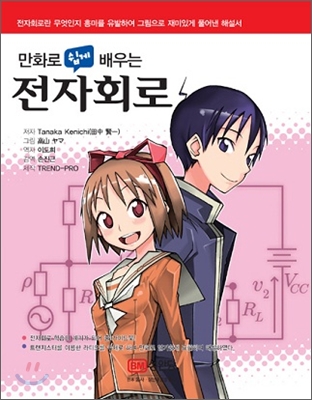
《Learn Electronic Circuits Easily with Comics》
This book is based on the electronic circuit lectures I teach at university, and the content is written in an easy-to-understand way that even technical high school students and beginners can understand.
For those who are learning about electronic circuits for the first time, this book covers the topic of 'radio using transistors' and explains in an easy-to-understand way through cartoons how it is structured to produce sound.
Many books on electronic circuits begin with simple amplifier circuits and gradually move on to more complex circuits.
However, this book boldly explains the flow of signals, that is, the process of selecting the channel you want to hear from the radio waves received through the antenna and making it audible.
The reason is that when understanding the system called radio in a big picture, it is natural to understand the electronic circuit as a flow of signals from radio waves to voice.
The explanation included high school students Kim Mak-dong and Jang Hae-ri appearing in the cartoon to make the explanation more interesting.
《Learn Electronic Circuits Easily with Comics》
This book is based on the electronic circuit lectures I teach at university, and the content is written in an easy-to-understand way that even technical high school students and beginners can understand.
For those who are learning about electronic circuits for the first time, this book covers the topic of 'radio using transistors' and explains in an easy-to-understand way through cartoons how it is structured to produce sound.
Many books on electronic circuits begin with simple amplifier circuits and gradually move on to more complex circuits.
However, this book boldly explains the flow of signals, that is, the process of selecting the channel you want to hear from the radio waves received through the antenna and making it audible.
The reason is that when understanding the system called radio in a big picture, it is natural to understand the electronic circuit as a flow of signals from radio waves to voice.
The explanation included high school students Kim Mak-dong and Jang Hae-ri appearing in the cartoon to make the explanation more interesting.
index
preface
Prologue: Exciting New Member
Chapter 1: What is an Electronic Circuit?
1.
What is an electronic circuit?
2.
Various electronic circuits
3.
For example, radio-
[Advanced Learning]
-Operational amplifier - the ultimate amplifying circuit
-Logic circuit
Chapter 2 Transistor Structure
1.
What is a semiconductor?
2. PN junction diode
3.
bipolar transistor
[Advanced Learning]
-J-FET structure and principle
-MOS-FET
-Differences between bipolar transistors and FETs
Chapter 3 Knowledge of Electrical Circuits
1.
Kirchhoff's laws
2. RLC parallel circuit
3.
h parameter equivalent circuit
[Advanced Learning]
-Voltage source and current source
-Definition of voltage gain
-Current amplification factor
-About the notation of complex numbers I and j
Chapter 4 Tuning Amplifier Circuit
1.
Principle of tuned amplifier circuit
2.
Single-tuned amplifier circuit
[Advanced Learning]
-Frequency characteristics of current amplification in a tuned amplifier
-High-frequency equivalent circuit of a transistor
-Conversion of impedance
Chapter 5 Demodulation Circuit
1.
Demodulation and linear detection circuit
2.
Envelope detection
3.
filter
[Advanced Learning]
-About FM (Frequency Modulation)
Chapter 6 Low-Frequency Amplifier Circuit
1.
low frequency amplifier circuit
2.
Emitter ground amplifier circuit
2-1 Equivalent circuit
2-2 Bias Circuit
2-3 AC amplifier circuit
2-4 current gain
2-5 Input/Output Impedance (1)
3.
Collector ground amplifier circuit
3-1 Emitter Follower Circuit
2-2 Bias Setting
2-3 AC equivalent circuit
2-4 Voltage gain/current gain
2-5 Input/Output Impedance (2)
[Advanced Learning]
-Decibel (db) related information
Why an emitter follower circuit is needed
-If you cascade the emitter follower circuit…
-Cascade connection of amplifiers
-High-frequency characteristics of the amplifier
Epilogue
Search
Prologue: Exciting New Member
Chapter 1: What is an Electronic Circuit?
1.
What is an electronic circuit?
2.
Various electronic circuits
3.
For example, radio-
[Advanced Learning]
-Operational amplifier - the ultimate amplifying circuit
-Logic circuit
Chapter 2 Transistor Structure
1.
What is a semiconductor?
2. PN junction diode
3.
bipolar transistor
[Advanced Learning]
-J-FET structure and principle
-MOS-FET
-Differences between bipolar transistors and FETs
Chapter 3 Knowledge of Electrical Circuits
1.
Kirchhoff's laws
2. RLC parallel circuit
3.
h parameter equivalent circuit
[Advanced Learning]
-Voltage source and current source
-Definition of voltage gain
-Current amplification factor
-About the notation of complex numbers I and j
Chapter 4 Tuning Amplifier Circuit
1.
Principle of tuned amplifier circuit
2.
Single-tuned amplifier circuit
[Advanced Learning]
-Frequency characteristics of current amplification in a tuned amplifier
-High-frequency equivalent circuit of a transistor
-Conversion of impedance
Chapter 5 Demodulation Circuit
1.
Demodulation and linear detection circuit
2.
Envelope detection
3.
filter
[Advanced Learning]
-About FM (Frequency Modulation)
Chapter 6 Low-Frequency Amplifier Circuit
1.
low frequency amplifier circuit
2.
Emitter ground amplifier circuit
2-1 Equivalent circuit
2-2 Bias Circuit
2-3 AC amplifier circuit
2-4 current gain
2-5 Input/Output Impedance (1)
3.
Collector ground amplifier circuit
3-1 Emitter Follower Circuit
2-2 Bias Setting
2-3 AC equivalent circuit
2-4 Voltage gain/current gain
2-5 Input/Output Impedance (2)
[Advanced Learning]
-Decibel (db) related information
Why an emitter follower circuit is needed
-If you cascade the emitter follower circuit…
-Cascade connection of amplifiers
-High-frequency characteristics of the amplifier
Epilogue
Search
GOODS SPECIFICS
- Date of issue: November 7, 2011
- Page count, weight, size: 184 pages | 386g | 182*235*20mm
- ISBN13: 9788931575392
- ISBN10: 8931575394
You may also like
카테고리
korean


korean

![GQ KOREA Mark (Monthly): December [2025]](http://librairie.coreenne.fr/cdn/shop/files/8ef265dbbfbf186523ed75ba7319009d.jpg?v=1765340328&width=3840)


