

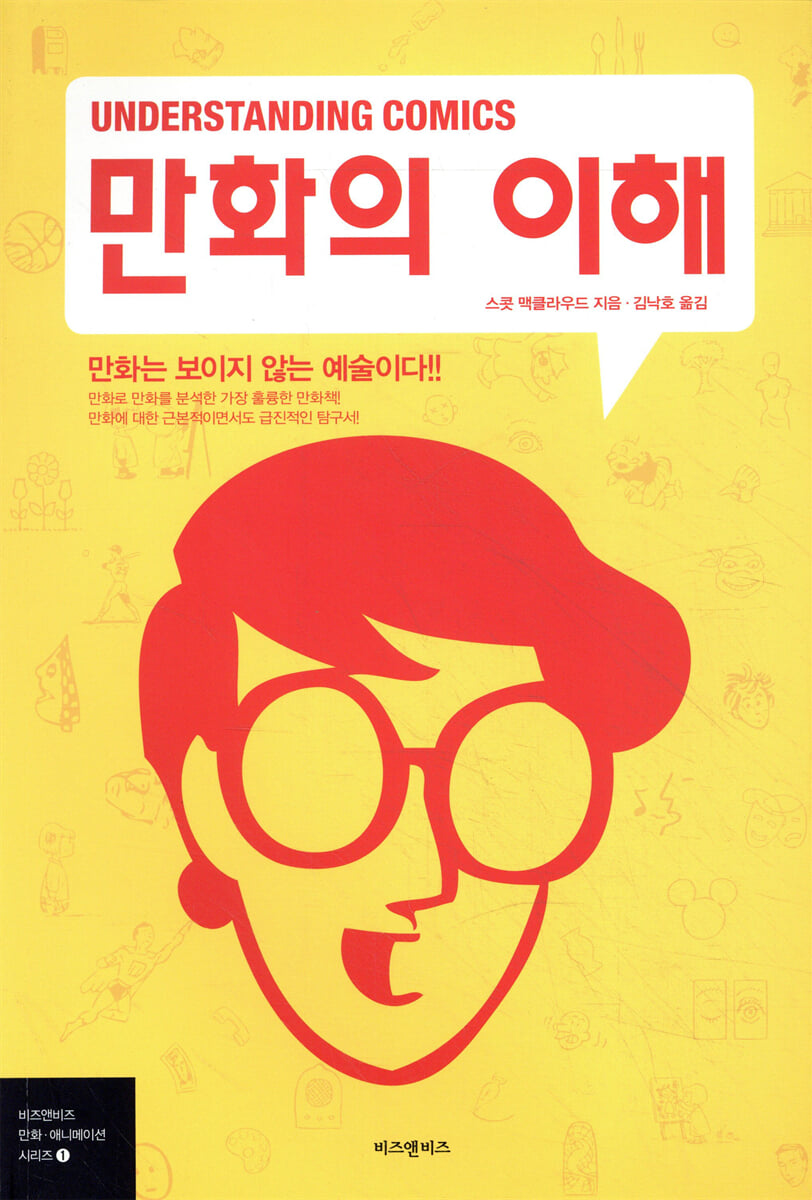
Understanding Comics
 |
Description
Book Introduction
"Understanding Comics," which is considered the most well-written comics theory book, goes beyond a simple understanding of comics to engage in in-depth discussions on the identity and artistry of comics, as well as their definition and scope. This is enough to dispel misunderstandings and prejudices not only about comics but also about popular art in general.
The author, a cartoonist and cartoonist, explains the internal structure of cartoons in a very kind and serious way. The author's keen insight, which does not overlook even the space between the panels of a cartoon, soon led to an enthusiastic response from readers around the world.
Comics are a form of language and a broad range of visual symbols, and the reader can make the still pictures come alive through the spaces between the panels.
He clearly and firmly evaluates the genre of comics, which has been seriously and mercilessly neglected, as 'art'.
This is a book that is most comic-like and for comics, explaining comics in the form of comics.
The author, a cartoonist and cartoonist, explains the internal structure of cartoons in a very kind and serious way. The author's keen insight, which does not overlook even the space between the panels of a cartoon, soon led to an enthusiastic response from readers around the world.
Comics are a form of language and a broad range of visual symbols, and the reader can make the still pictures come alive through the spaces between the panels.
He clearly and firmly evaluates the genre of comics, which has been seriously and mercilessly neglected, as 'art'.
This is a book that is most comic-like and for comics, explaining comics in the form of comics.
- You can preview some of the book's contents.
Preview
index
Entering
Correct the record
Vocabulary of comics
Blood flowing in the gutter
Time frame
Life in the Line
Show and tell
Six steps
About color
To summarize
Correct the record
Vocabulary of comics
Blood flowing in the gutter
Time frame
Life in the Line
Show and tell
Six steps
About color
To summarize
Publisher's Review
Many people like comics, but look down on them.
Why is that?
American cartoonist Scott McCloud says, "Traditionally, great art has been thought of as a combination of words and pictures, far apart."
Therefore, comics, which are a mixture of text and pictures, have been considered a product of poor commercialism and entertainment for the masses rather than art.
So why is it that such 'low-quality entertainment' is being predicted to be the axis of the 21st century cultural industry?
McCloud concludes in his comic book, Understanding Comics:
"When great writing and great art are combined, they create a tremendous power to tell a story.
That is what makes comics possible." In other words, he saw the strength of comics as the ability of the pictures to clearly depict the scene, allowing the text to explore a wider range of areas.
He explains why we become so drawn to comics as children.
The main characters in cartoons are composed of very simple lines, and the reason children respond more to simplified cartoons than to concrete realism is because they see their own faces in them.
In other words, the analysis is that ‘universal identification’ is the most basic phenomenon that causes readers to empathize.
Macleod also says that the space between the cells is where magic and mystery occur.
His sharpness is evident in the passage where he compares American comics, where the connection from one scene to the next is mainly focused on 'action', with Japanese comics, which connect seemingly unrelated scenes to convey atmosphere, to explain the characteristics of Western culture, which is strongly directional, and Eastern culture, which is strongly cyclical.
After graduating from college, McCloud joined DC Comics, a leading American comic book publisher, and worked as a writer until 1984 when he became independent and gained critical acclaim for his indie comic series, "ZOT!"
Why is that?
American cartoonist Scott McCloud says, "Traditionally, great art has been thought of as a combination of words and pictures, far apart."
Therefore, comics, which are a mixture of text and pictures, have been considered a product of poor commercialism and entertainment for the masses rather than art.
So why is it that such 'low-quality entertainment' is being predicted to be the axis of the 21st century cultural industry?
McCloud concludes in his comic book, Understanding Comics:
"When great writing and great art are combined, they create a tremendous power to tell a story.
That is what makes comics possible." In other words, he saw the strength of comics as the ability of the pictures to clearly depict the scene, allowing the text to explore a wider range of areas.
He explains why we become so drawn to comics as children.
The main characters in cartoons are composed of very simple lines, and the reason children respond more to simplified cartoons than to concrete realism is because they see their own faces in them.
In other words, the analysis is that ‘universal identification’ is the most basic phenomenon that causes readers to empathize.
Macleod also says that the space between the cells is where magic and mystery occur.
His sharpness is evident in the passage where he compares American comics, where the connection from one scene to the next is mainly focused on 'action', with Japanese comics, which connect seemingly unrelated scenes to convey atmosphere, to explain the characteristics of Western culture, which is strongly directional, and Eastern culture, which is strongly cyclical.
After graduating from college, McCloud joined DC Comics, a leading American comic book publisher, and worked as a writer until 1984 when he became independent and gained critical acclaim for his indie comic series, "ZOT!"
GOODS SPECIFICS
- Date of issue: July 1, 2008
- Page count, weight, size: 256 pages | 180*260*20mm
- ISBN13: 9788992607148
- ISBN10: 8992607148
You may also like
카테고리
korean


korean

![GQ KOREA Mark (Monthly): December [2025]](http://librairie.coreenne.fr/cdn/shop/files/8ef265dbbfbf186523ed75ba7319009d.jpg?v=1765340328&width=3840)


