

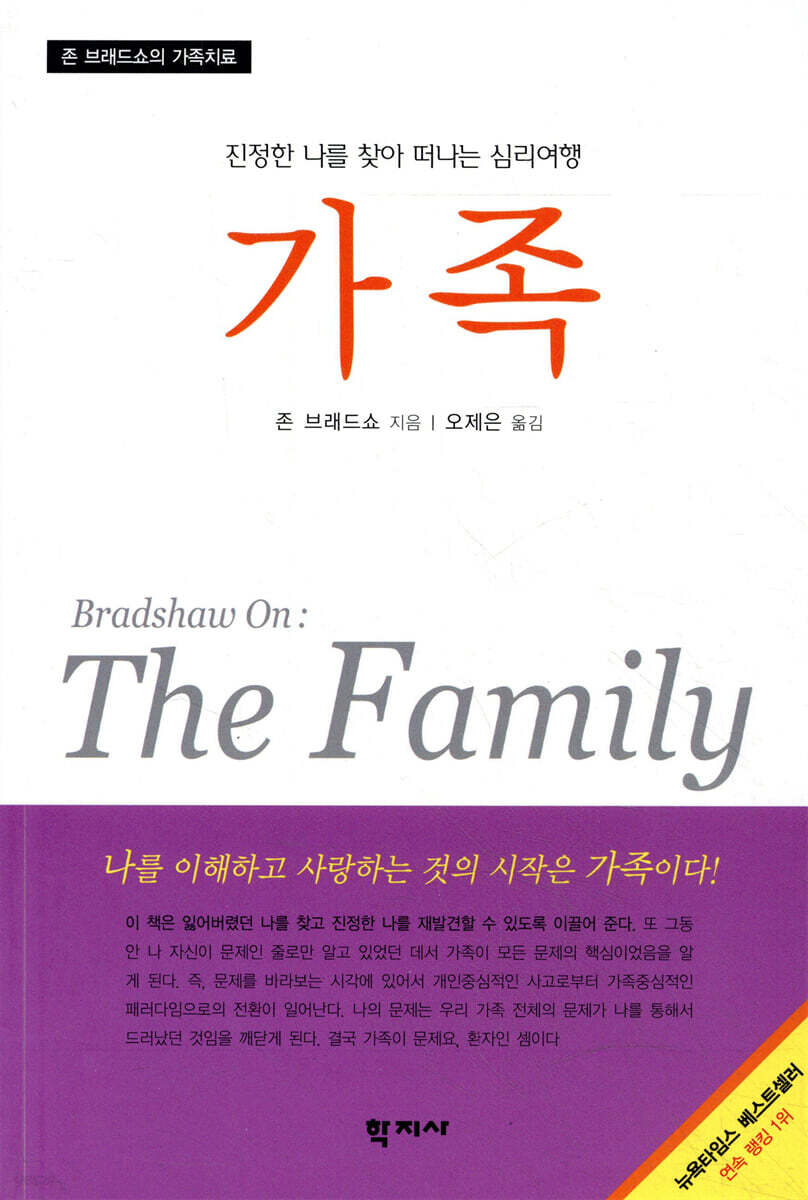
family
 |
Description
Book Introduction
Consecutive #1 New York Times bestseller
The first step to understanding and loving myself is rediscovering my family!
This book is an adaptation of the television series that aired in the United States under the title Bradshaw On: The Family.
The program, which focuses on childhood anger and pain, one's own unresolved issues and family problems, has garnered explosive interest.
This book is written for those who want to know more deeply about the subject of family.
This book will help you find your lost self and rediscover your true self.
Also, I realized that 'family' was the root of all the problems, even though I had always thought that I was the problem.
That is, a shift occurs in the perspective on problems from an individual-centered way of thinking to a family-centered paradigm.
I realized that my problem was a reflection of my entire family's problem.
In the end, it is the 'family' that is the problem, the patient.
It presents a new concept of what emotional health and illness are and explains how such emotional health or illness is passed down through generations.
This book offers new ways to strengthen self-esteem, as well as ways to reclaim your lost childhood self.
It will also help us understand that only when families function properly can we heal the wounds of society.
The first step to understanding and loving myself is rediscovering my family!
This book is an adaptation of the television series that aired in the United States under the title Bradshaw On: The Family.
The program, which focuses on childhood anger and pain, one's own unresolved issues and family problems, has garnered explosive interest.
This book is written for those who want to know more deeply about the subject of family.
This book will help you find your lost self and rediscover your true self.
Also, I realized that 'family' was the root of all the problems, even though I had always thought that I was the problem.
That is, a shift occurs in the perspective on problems from an individual-centered way of thinking to a family-centered paradigm.
I realized that my problem was a reflection of my entire family's problem.
In the end, it is the 'family' that is the problem, the patient.
It presents a new concept of what emotional health and illness are and explains how such emotional health or illness is passed down through generations.
This book offers new ways to strengthen self-esteem, as well as ways to reclaim your lost childhood self.
It will also help us understand that only when families function properly can we heal the wounds of society.
index
Fable: The Story of Hugh
01 Overview: Crisis
02 Family as a rule-based social system
03 Profile of a Functional Family System
04 Profile of a Chronically Dysfunctional Family System
05 Obsessive Family
06 Abused People
07 'Bad' Child
08 The most common consequence of chronic family dysfunction: codependency
09 A Guide to Help You Restore Your Broken Will
10 A Guide to Revealing Your Lost Self
11 A Guide to Discovering Your True Self
Epilogue: Reforming Traditional Values
01 Overview: Crisis
02 Family as a rule-based social system
03 Profile of a Functional Family System
04 Profile of a Chronically Dysfunctional Family System
05 Obsessive Family
06 Abused People
07 'Bad' Child
08 The most common consequence of chronic family dysfunction: codependency
09 A Guide to Help You Restore Your Broken Will
10 A Guide to Revealing Your Lost Self
11 A Guide to Discovering Your True Self
Epilogue: Reforming Traditional Values
Into the book
Let's say your mother has health anxiety and is obsessed with even the slightest illness, often lying down and avoiding responsibility.
If the mother does not fulfill her role, marriage will become a vacuum without intimacy, and the family system will need marriage.
That is, someone in the system needs to become the father's partner and fill the marriage.
In the aforementioned family, one of the daughters will take on the role of mother.
The daughter becomes a surrogate spouse.
Another child can take over the responsibility of raising the child while the father is busy with work.
This child will have tremendous responsibility and become a little parent.
Some children in the system are cute and funny, bringing joy to their families.
This kind of child is a mascot that relieves the tension between mom and dad.
Some children take on the roles of saints and heroes, earning straight A's, becoming class president, and winning awards.
A child like this brings honor to the family.
Some children inherit their father's latent anger toward their mother and display antisocial behavior.
You may use drugs or get into trouble at school.
That blurs the focus between mom and dad.
Parents may actually become closer to their children because of the common interests they develop.
This child is a scapegoat for the family.
The purpose of emphasizing these role names is to show that the roles are fixed.
These roles are not chosen by individuals, but are a result of the needs of the system.
People inherently hate a vacuum.
So children automatically do things to fulfill the overt and covert needs of the system.
If the mother does not fulfill her role, marriage will become a vacuum without intimacy, and the family system will need marriage.
That is, someone in the system needs to become the father's partner and fill the marriage.
In the aforementioned family, one of the daughters will take on the role of mother.
The daughter becomes a surrogate spouse.
Another child can take over the responsibility of raising the child while the father is busy with work.
This child will have tremendous responsibility and become a little parent.
Some children in the system are cute and funny, bringing joy to their families.
This kind of child is a mascot that relieves the tension between mom and dad.
Some children take on the roles of saints and heroes, earning straight A's, becoming class president, and winning awards.
A child like this brings honor to the family.
Some children inherit their father's latent anger toward their mother and display antisocial behavior.
You may use drugs or get into trouble at school.
That blurs the focus between mom and dad.
Parents may actually become closer to their children because of the common interests they develop.
This child is a scapegoat for the family.
The purpose of emphasizing these role names is to show that the roles are fixed.
These roles are not chosen by individuals, but are a result of the needs of the system.
People inherently hate a vacuum.
So children automatically do things to fulfill the overt and covert needs of the system.
--- p.82
Parents who abuse their children are themselves struggling to regain the power they once lost to their parents.
Dysfunctional parents are tricked into not knowing their own feelings of abandonment.
As children, they were insulted, ridiculed, manipulated, threatened, rejected, ignored, treated like dolls or objects, sexually exploited, and brutally beaten.
What's worse is that they were never allowed to express their anger, shame, or hurt.
In particular, there is the scar of wondering why their parents treated them so horribly.
At the root of the hurt is a magical, egocentric belief that one is bad enough to deserve such treatment.
The belief that 'I am bad' still lives on in children who are now parents.
As long as the child idealizes his parents in the illusion of connection, he will continue to blame himself and feel shame.
Parents who were abused as children had no idea what was happening to them.
Because they also thought that the abuse was necessary for them.
Even when abused very harshly, the child had to hear that his parents had been hurt just as much as he had been hurt.
If that doesn't work, you're also taught to respect your parents unconditionally.
What children fundamentally needed most was parental protection.
Parents who abuse their children are themselves struggling to regain the power they once lost to their parents.
Dysfunctional parents are tricked into not knowing their own feelings of abandonment.
As children, they were insulted, ridiculed, manipulated, threatened, rejected, ignored, treated like dolls or objects, sexually exploited, and brutally beaten.
What's worse is that they were never allowed to express their anger, shame, or hurt.
In particular, there is the scar of wondering why their parents treated them so horribly.
At the root of the hurt is a magical, egocentric belief that one is bad enough to deserve such treatment.
The belief that 'I am bad' still lives on in children who are now parents.
As long as the child idealizes his parents in the illusion of connection, he will continue to blame himself and feel shame.
Parents who were abused as children had no idea what was happening to them.
Because they also thought that the abuse was necessary for them.
Even when abused very harshly, the child had to hear that his parents had been hurt just as much as he had been hurt.
If that doesn't work, you're also taught to respect your parents unconditionally.
What children fundamentally needed most was parental protection.
Dysfunctional parents are tricked into not knowing their own feelings of abandonment.
As children, they were insulted, ridiculed, manipulated, threatened, rejected, ignored, treated like dolls or objects, sexually exploited, and brutally beaten.
What's worse is that they were never allowed to express their anger, shame, or hurt.
In particular, there is the scar of wondering why their parents treated them so horribly.
At the root of the hurt is a magical, egocentric belief that one is bad enough to deserve such treatment.
The belief that 'I am bad' still lives on in children who are now parents.
As long as the child idealizes his parents in the illusion of connection, he will continue to blame himself and feel shame.
Parents who were abused as children had no idea what was happening to them.
Because they also thought that the abuse was necessary for them.
Even when abused very harshly, the child had to hear that his parents had been hurt just as much as he had been hurt.
If that doesn't work, you're also taught to respect your parents unconditionally.
What children fundamentally needed most was parental protection.
Parents who abuse their children are themselves struggling to regain the power they once lost to their parents.
Dysfunctional parents are tricked into not knowing their own feelings of abandonment.
As children, they were insulted, ridiculed, manipulated, threatened, rejected, ignored, treated like dolls or objects, sexually exploited, and brutally beaten.
What's worse is that they were never allowed to express their anger, shame, or hurt.
In particular, there is the scar of wondering why their parents treated them so horribly.
At the root of the hurt is a magical, egocentric belief that one is bad enough to deserve such treatment.
The belief that 'I am bad' still lives on in children who are now parents.
As long as the child idealizes his parents in the illusion of connection, he will continue to blame himself and feel shame.
Parents who were abused as children had no idea what was happening to them.
Because they also thought that the abuse was necessary for them.
Even when abused very harshly, the child had to hear that his parents had been hurt just as much as he had been hurt.
If that doesn't work, you're also taught to respect your parents unconditionally.
What children fundamentally needed most was parental protection.
--- p.143
Children need to have their needs for healthy self-love met.
It is clear that this is too much to ask of parents.
This is because the parents themselves were unable to properly fulfill that desire when it arose.
You cannot give to your children what you did not receive yourself.
If the parent has been robbed of healthy self-love, they will spend the rest of their lives trying to regain it through other objects.
The easiest target for parents with damaged narcissism to find satisfaction is their own child or children.
Children are under the control of their parents.
Children will obey their parents.
Because disobedience means death.
Children are the only possession of their parents that can restore their lost narcissistic satisfaction.
Children need to have their needs for healthy self-love met.
It is clear that this is a tall order for parents.
This is because the parents themselves were unable to properly fulfill that desire when it arose.
You cannot give to your children what you did not receive yourself.
If the parent has been robbed of healthy self-love, they will spend the rest of their lives trying to regain it through other objects.
The easiest target for parents with damaged narcissism to find satisfaction is their own child or children.
Children are under the control of their parents.
Children will obey their parents.
Because disobedience means death.
Children are the only possession of their parents that can restore their lost narcissistic satisfaction.
It is clear that this is too much to ask of parents.
This is because the parents themselves were unable to properly fulfill that desire when it arose.
You cannot give to your children what you did not receive yourself.
If the parent has been robbed of healthy self-love, they will spend the rest of their lives trying to regain it through other objects.
The easiest target for parents with damaged narcissism to find satisfaction is their own child or children.
Children are under the control of their parents.
Children will obey their parents.
Because disobedience means death.
Children are the only possession of their parents that can restore their lost narcissistic satisfaction.
Children need to have their needs for healthy self-love met.
It is clear that this is a tall order for parents.
This is because the parents themselves were unable to properly fulfill that desire when it arose.
You cannot give to your children what you did not receive yourself.
If the parent has been robbed of healthy self-love, they will spend the rest of their lives trying to regain it through other objects.
The easiest target for parents with damaged narcissism to find satisfaction is their own child or children.
Children are under the control of their parents.
Children will obey their parents.
Because disobedience means death.
Children are the only possession of their parents that can restore their lost narcissistic satisfaction.
--- p.146
For adult children who grow up in dysfunctional families and exhibit drug addiction, eating disorders, religious addiction, workaholism, etc., it may be most important to connect their dysfunctional behaviors and problems to the experiences of childhood abandonment that created those problems.
The true self that has been invaded continues to hide.
Because you have lost the connection between what happened to you and your reaction to it.
Because the illusion of connection idealizes those who abuse us, we are forced to conclude that our neurotic and dysfunctional behavior is our own fault, not theirs.
But once we recognize that our reactions are a result of what has happened to us and not a result of who we are, we can begin the process of recovery.
We shatter the myth of our idealized parents and learn that we are not bad, flawed, or imperfect.
For adult children who grow up in dysfunctional families and exhibit drug addiction, eating disorders, religious addiction, workaholism, etc., it may be most important to connect their dysfunctional behaviors and problems to the experiences of childhood abandonment that created those problems.
The true self that has been invaded continues to hide.
Because you have lost the connection between what happened to you and your reaction to it.
Because the illusion of connection idealizes those who abuse us, we are forced to conclude that our neurotic and dysfunctional behavior is our own fault, not theirs.
But once we recognize that our reactions are a result of what has happened to us and not a result of who we are, we can begin the process of recovery.
We shatter the myth of our idealized parents and learn that we are not bad, flawed, or imperfect.
The true self that has been invaded continues to hide.
Because you have lost the connection between what happened to you and your reaction to it.
Because the illusion of connection idealizes those who abuse us, we are forced to conclude that our neurotic and dysfunctional behavior is our own fault, not theirs.
But once we recognize that our reactions are a result of what has happened to us and not a result of who we are, we can begin the process of recovery.
We shatter the myth of our idealized parents and learn that we are not bad, flawed, or imperfect.
For adult children who grow up in dysfunctional families and exhibit drug addiction, eating disorders, religious addiction, workaholism, etc., it may be most important to connect their dysfunctional behaviors and problems to the experiences of childhood abandonment that created those problems.
The true self that has been invaded continues to hide.
Because you have lost the connection between what happened to you and your reaction to it.
Because the illusion of connection idealizes those who abuse us, we are forced to conclude that our neurotic and dysfunctional behavior is our own fault, not theirs.
But once we recognize that our reactions are a result of what has happened to us and not a result of who we are, we can begin the process of recovery.
We shatter the myth of our idealized parents and learn that we are not bad, flawed, or imperfect.
--- p.200
The concept of two halves coming together to create a complete marriage is a very dysfunctional concept.
Two imperfect people cannot have a healthy relationship.
A healthy relationship requires two whole people to choose to be in a relationship, and each person must know that they can live without the other.
The opposite relationship is one of closeness and entanglement, where the two people in this relationship believe that they cannot live without the other.
From a young age, we are taught that this inseparable bond is true love.
Women, in particular, have been taught that it is their destiny to dedicate their lives to finding true love.
But this kind of true love is often a relationship addiction.
Closeness replaces intimacy.
Both people believe that they cannot live without the other.
These relationships are at risk when one of the two partners grows or changes.
The concept of two halves coming together to create a complete marriage is a very dysfunctional concept.
Two imperfect people cannot have a healthy relationship.
A healthy relationship requires two whole people to choose to be in a relationship, and each person must know that they can live without the other.
The opposite relationship is one of closeness and entanglement, where the two people in this relationship believe that they cannot live without the other.
From a young age, we are taught that this inseparable bond is true love.
Women, in particular, have been taught that it is their destiny to dedicate their lives to finding true love.
But this kind of true love is often a relationship addiction.
Closeness replaces intimacy.
Both people believe that they cannot live without the other.
These relationships are at risk when one of the two partners grows or changes.
Two imperfect people cannot have a healthy relationship.
A healthy relationship requires two whole people to choose to be in a relationship, and each person must know that they can live without the other.
The opposite relationship is one of closeness and entanglement, where the two people in this relationship believe that they cannot live without the other.
From a young age, we are taught that this inseparable bond is true love.
Women, in particular, have been taught that it is their destiny to dedicate their lives to finding true love.
But this kind of true love is often a relationship addiction.
Closeness replaces intimacy.
Both people believe that they cannot live without the other.
These relationships are at risk when one of the two partners grows or changes.
The concept of two halves coming together to create a complete marriage is a very dysfunctional concept.
Two imperfect people cannot have a healthy relationship.
A healthy relationship requires two whole people to choose to be in a relationship, and each person must know that they can live without the other.
The opposite relationship is one of closeness and entanglement, where the two people in this relationship believe that they cannot live without the other.
From a young age, we are taught that this inseparable bond is true love.
Women, in particular, have been taught that it is their destiny to dedicate their lives to finding true love.
But this kind of true love is often a relationship addiction.
Closeness replaces intimacy.
Both people believe that they cannot live without the other.
These relationships are at risk when one of the two partners grows or changes.
--- p.308
Publisher's Review
A new book by John Bradshaw, author of "Healing the Wounded Inner Child"
Shatter the illusion of "my happy home"!
When we think of family, we instinctively think of a warm and cozy nest.
But, how about looking back and thinking about whether the family that raised and taught you has only had a positive influence on you?
Have you ever seriously considered how your unconscious words and actions are affecting your children?
The characteristics or personality traits that I was not satisfied with even in myself may not be my fault, but may have their origins in the pain and experiences I experienced within my family during my childhood.
It's not just sexual, physical, and emotional abuse that can negatively impact us, as anyone can see.
Most parents grew up receiving a harmful education.
Of course, they did the best they could within the limits of their own perception.
Harmful upbringing, whether conscious or unconscious, creates dysfunction within the family system.
Dysfunctional families create dysfunctional people, who then marry other dysfunctional people, creating new dysfunctional families, a vicious cycle that continues.
This book helped me better understand the root cause of my suffering, how I was hurt within my family, and what the specific issues were.
In the process of healing the wounds from the dysfunction of such a family system and its influence on individuals, I was able to rediscover my lost self and meet my true self.
It's about understanding how each of us lost our true selves through childhood anger and pain within our family systems, and how our family systems have created the addicted society we live in today.
The family system that developed following the example of the monarchy
Religious patriarchy established a political system based on the principle that kings had divine right and that all authority came from God and must be obeyed.
Since unjust kings and rulers would be held accountable before God, it was far more virtuous to blindly obey a king's injustice.
The family naturally followed the monarchical model.
From there, the author's parenting rules, which he calls harmful education in this book, come into being.
We were to obey our parents as if we were God.
Parents had to be respected.
Children should never raise their voices or get angry at their parents.
Like a king in a monarchy, parents were held accountable before God.
There was also a class system in marital relationships.
Women were expected to obey their husbands.
Both fathers and mothers had the right to hit their children.
It was especially forbidden for children to get angry and was punishable.
It seems clear why monarchs did not want their subjects to become angry.
Anger gives us the strength to fight against those who wrong us.
Our anger protects our rights.
Subjects had few rights, and monarchs wanted to make sure they were under their authority and could not resist.
Anger, if allowed to flow, could become a force for revolution.
Since parental authority reflected the king's authority, anger among children was also forbidden.
The hierarchy of power within the family was clearly undemocratic.
The past 50 years can be seen as the beginning of a new and more mature stage of democracy.
A new shift in consciousness has revealed that the previous patriarchal child-rearing system was abusive.
One of the methods used by patriarchal systems to keep children in their place was corporal punishment, which instilled shame.
Minnesota psychologist Marilyn Mason once said that the most damaging form of domestic violence is the one that instills toxic shame.
I want to inform parents that these socially acceptable, normal parenting rules are damaging their children's self-esteem.
This could be especially harmful because the parents may not have known it was harmful and did not do it with ill intentions.
Parents did the best they knew how, but our consciousness must shift to a more mature democratic consciousness before we can see that their tyrannical upbringing was abusive.
The adult child movement of the 1980s demonstrated that childhood trauma and abuse can have devastating effects on adult life.
And it clearly showed that the 'normal' parenting methods (and harmful education) that were effective in past generations are not effective in the age of mature democracy.
These rules are undemocratic and can easily lead to low self-esteem and shame addiction.
In the past, self-denial along with the suppression of strong emotions was desirable.
What was needed then was loyalty to the family system.
Patriarchal parenting rules can be a major factor in child abuse.
It was only recently that we began to realize that child abuse is a major social problem.
It is important to understand that raising children under patriarchal monarchical rules can be considered child abuse.
Children raised according to patriarchal parenting rules quickly learn that in order to be loved, they must give up their true selves and develop a self that is blindly obedient and dutiful.
When the core of oneself is covered by a false self, it becomes impossible to love one's true self and develop self-esteem, and this shows up in various ways as an adult.
Family dysfunction is relative and dynamic.
Any family can become dysfunctional during periods of extreme stress and anxiety.
Strong families are characterized by high parental maturity, which means that such families have flexible and well-developed coping skills.
Because they have good coping strategies, they can shorten the painful time and minimize family dysfunction.
On the other hand, weak families are families in which parents have low maturity and tend to have ineffective coping strategies, and remain dysfunctional over a long period of time, even across generations.
A healthy family is characterized by each member having strong self-esteem.
High levels of self-esteem depend on the degree of individuation or self-differentiation.
Shatter the illusion of "my happy home"!
When we think of family, we instinctively think of a warm and cozy nest.
But, how about looking back and thinking about whether the family that raised and taught you has only had a positive influence on you?
Have you ever seriously considered how your unconscious words and actions are affecting your children?
The characteristics or personality traits that I was not satisfied with even in myself may not be my fault, but may have their origins in the pain and experiences I experienced within my family during my childhood.
It's not just sexual, physical, and emotional abuse that can negatively impact us, as anyone can see.
Most parents grew up receiving a harmful education.
Of course, they did the best they could within the limits of their own perception.
Harmful upbringing, whether conscious or unconscious, creates dysfunction within the family system.
Dysfunctional families create dysfunctional people, who then marry other dysfunctional people, creating new dysfunctional families, a vicious cycle that continues.
This book helped me better understand the root cause of my suffering, how I was hurt within my family, and what the specific issues were.
In the process of healing the wounds from the dysfunction of such a family system and its influence on individuals, I was able to rediscover my lost self and meet my true self.
It's about understanding how each of us lost our true selves through childhood anger and pain within our family systems, and how our family systems have created the addicted society we live in today.
The family system that developed following the example of the monarchy
Religious patriarchy established a political system based on the principle that kings had divine right and that all authority came from God and must be obeyed.
Since unjust kings and rulers would be held accountable before God, it was far more virtuous to blindly obey a king's injustice.
The family naturally followed the monarchical model.
From there, the author's parenting rules, which he calls harmful education in this book, come into being.
We were to obey our parents as if we were God.
Parents had to be respected.
Children should never raise their voices or get angry at their parents.
Like a king in a monarchy, parents were held accountable before God.
There was also a class system in marital relationships.
Women were expected to obey their husbands.
Both fathers and mothers had the right to hit their children.
It was especially forbidden for children to get angry and was punishable.
It seems clear why monarchs did not want their subjects to become angry.
Anger gives us the strength to fight against those who wrong us.
Our anger protects our rights.
Subjects had few rights, and monarchs wanted to make sure they were under their authority and could not resist.
Anger, if allowed to flow, could become a force for revolution.
Since parental authority reflected the king's authority, anger among children was also forbidden.
The hierarchy of power within the family was clearly undemocratic.
The past 50 years can be seen as the beginning of a new and more mature stage of democracy.
A new shift in consciousness has revealed that the previous patriarchal child-rearing system was abusive.
One of the methods used by patriarchal systems to keep children in their place was corporal punishment, which instilled shame.
Minnesota psychologist Marilyn Mason once said that the most damaging form of domestic violence is the one that instills toxic shame.
I want to inform parents that these socially acceptable, normal parenting rules are damaging their children's self-esteem.
This could be especially harmful because the parents may not have known it was harmful and did not do it with ill intentions.
Parents did the best they knew how, but our consciousness must shift to a more mature democratic consciousness before we can see that their tyrannical upbringing was abusive.
The adult child movement of the 1980s demonstrated that childhood trauma and abuse can have devastating effects on adult life.
And it clearly showed that the 'normal' parenting methods (and harmful education) that were effective in past generations are not effective in the age of mature democracy.
These rules are undemocratic and can easily lead to low self-esteem and shame addiction.
In the past, self-denial along with the suppression of strong emotions was desirable.
What was needed then was loyalty to the family system.
Patriarchal parenting rules can be a major factor in child abuse.
It was only recently that we began to realize that child abuse is a major social problem.
It is important to understand that raising children under patriarchal monarchical rules can be considered child abuse.
Children raised according to patriarchal parenting rules quickly learn that in order to be loved, they must give up their true selves and develop a self that is blindly obedient and dutiful.
When the core of oneself is covered by a false self, it becomes impossible to love one's true self and develop self-esteem, and this shows up in various ways as an adult.
Family dysfunction is relative and dynamic.
Any family can become dysfunctional during periods of extreme stress and anxiety.
Strong families are characterized by high parental maturity, which means that such families have flexible and well-developed coping skills.
Because they have good coping strategies, they can shorten the painful time and minimize family dysfunction.
On the other hand, weak families are families in which parents have low maturity and tend to have ineffective coping strategies, and remain dysfunctional over a long period of time, even across generations.
A healthy family is characterized by each member having strong self-esteem.
High levels of self-esteem depend on the degree of individuation or self-differentiation.
GOODS SPECIFICS
- Date of issue: July 28, 2006
- Page count, weight, size: 458 pages | 704g | 153*224*30mm
- ISBN13: 9788958913085
- ISBN10: 8958913088
You may also like
카테고리
korean


korean

![GQ KOREA Mark (Monthly): December [2025]](http://librairie.coreenne.fr/cdn/shop/files/8ef265dbbfbf186523ed75ba7319009d.jpg?v=1765340328&width=3840)


