

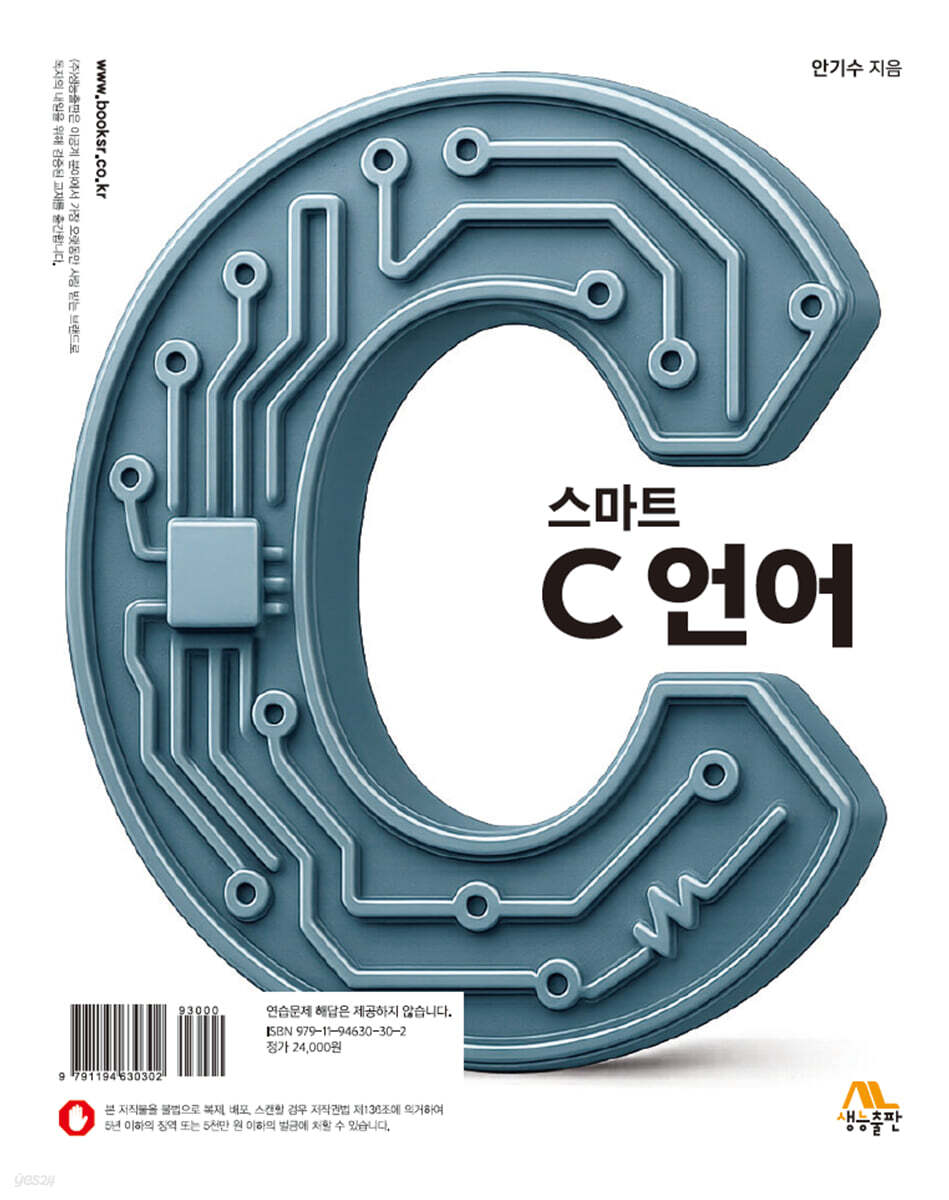
Smart C language
 |
Description
Book Introduction
Although many books have been published recently using the Python language, I think one of the most published computer books on the language itself is the C language.
It is a common and universal computer language with a long history, and it is undoubtedly an important language both theoretically and practically.
The biggest thing that languages used to communicate with foreigners and computer languages have in common is that they are both languages.
Language is defined as a means of expressing thoughts and feelings and communicating intentions, such as through sounds or writing, and has a system structured according to certain rules.
However, just because they have something in common doesn't mean the process of acquiring the language is the same.
The fundamental purpose of language is communication through conversation. But, as some advertising slogan suggests, if you can't speak for even 10 seconds in front of a foreigner after studying for 10 years, can you truly say you've learned that language? Similarly, if you've learned the basics of a programming language but can't even write a simple program, can you truly say you've learned it? If the purpose of learning English is conversation, you should be able to converse after learning it. If the purpose of learning programming is to write programs, you should be able to write them after learning it.
Just as real-life English conversations don't require complex grammar or a lot of vocabulary, the same goes for programming. If you consistently write programs and solve problems, you'll gradually gain confidence and the courage to tackle more challenging problems.
This book is a textbook that has been re-edited based on the author's "Premium C Language Programming" for use in the first semester. It contains the essential content for basic programming, but [SELF TEST] has been added and the ability to solve practice problems has been systematized so that students can progress through the levels of difficulty.
It is a common and universal computer language with a long history, and it is undoubtedly an important language both theoretically and practically.
The biggest thing that languages used to communicate with foreigners and computer languages have in common is that they are both languages.
Language is defined as a means of expressing thoughts and feelings and communicating intentions, such as through sounds or writing, and has a system structured according to certain rules.
However, just because they have something in common doesn't mean the process of acquiring the language is the same.
The fundamental purpose of language is communication through conversation. But, as some advertising slogan suggests, if you can't speak for even 10 seconds in front of a foreigner after studying for 10 years, can you truly say you've learned that language? Similarly, if you've learned the basics of a programming language but can't even write a simple program, can you truly say you've learned it? If the purpose of learning English is conversation, you should be able to converse after learning it. If the purpose of learning programming is to write programs, you should be able to write them after learning it.
Just as real-life English conversations don't require complex grammar or a lot of vocabulary, the same goes for programming. If you consistently write programs and solve problems, you'll gradually gain confidence and the courage to tackle more challenging problems.
This book is a textbook that has been re-edited based on the author's "Premium C Language Programming" for use in the first semester. It contains the essential content for basic programming, but [SELF TEST] has been added and the ability to solve practice problems has been systematized so that students can progress through the levels of difficulty.
index
Chapter 1 Computers and Programs
1.1 Programs and Languages
1.2 Translation
1.3 Program composition and execution
■ Unit Summary
■ Practice problems
Chapter 2 printf() and constants for output
2.1 How to use printf() and output constants
2.2 Output of operation results
■ Unit Summary
■ Practice problems
Chapter 3 Variables and Data Types
3.1 Variables and Constants
3.2 Exchange of values stored in variables
3.3 Data types of variables
■ Unit Summary
■ Practice problems
Chapter 4 scanf() for input
4.1 How to use scanf()
4.2 Inputting multiple data
4.3 Types of format specifiers
■ Unit Summary
■ Practice problems
Chapter 5 Operators and Expressions
5.1 Arithmetic Operators
5.2 Increment and decrement operators
5.3 Assignment Operators
5.4 Formulas and Operations
5.5 Order of operations
5.6 Other operators
5.7 Operator Precedence
■ Unit Summary
■ Practice problems
Chapter 6 Conditional Statements
6.1 if statement
6.2 if~else statement
6.3 if~else if statement
6.4 switch~case statement
6.5 Conditional expressions using logical operators
6.6 Conditional expressions that divide into ranges (intervals)
■ Unit Summary
■ Practice problems
Chapter 7 Loops
7.1 for statement
7.2 while and do~while statements
7.3 Application of loops
7.4 Nested loops
■ Unit Summary
■ Practice problems
Chapter 8 Controlling Processing Flow
8.1 break statement
8.2 continue statement
8.3 goto statement
■ Unit Summary
■ Practice problems
Chapter 9 Functions and Memory Classes
9.1 Previewing Functions
9.2 User-defined functions
9.3 Recursive calls and recursive functions
9.4 Memory Class
9.5 Library Functions
■ Unit Summary
■ Practice problems
Chapter 10 Arrays
10.1 One-dimensional arrays
10.2 Storing strings
10.3 Two-dimensional arrays
10.4 Functions and Arrays
■ Unit Summary
■ Practice problems
Chapter 11 Pointers
11.1 Pointer variables
11.2 Pointers and Arrays
11.3 Pointer Arithmetic
11.4 Initializing a string in a pointer variable
11.5 Functions and Pointers
11.6 String Handling and Library Functions
■ Unit Summary
■ Practice problems
Chapter 12 Structures, Unions, Enumerations, and Bit Fields
12.1 Creating a Structure
12.2 Structure arrays and pointers
12.3 Commons
12.4 Enumerations
■ Unit Summary
■ Practice problems
Chapter 13 File Handling
13.1 File Output and Input
13.2 Specifying input/output formats
13.3 scanf() and file output
■ Unit Summary
■ Practice problems
Chapter 14 Advanced Programming
14.1 Projects and Split Compilation
14.2 Preprocessor
■ Unit Summary
■ Practice problems
[Appendix 1] ASCII code
[Appendix 2] Compilation error messages and solutions
1.1 Programs and Languages
1.2 Translation
1.3 Program composition and execution
■ Unit Summary
■ Practice problems
Chapter 2 printf() and constants for output
2.1 How to use printf() and output constants
2.2 Output of operation results
■ Unit Summary
■ Practice problems
Chapter 3 Variables and Data Types
3.1 Variables and Constants
3.2 Exchange of values stored in variables
3.3 Data types of variables
■ Unit Summary
■ Practice problems
Chapter 4 scanf() for input
4.1 How to use scanf()
4.2 Inputting multiple data
4.3 Types of format specifiers
■ Unit Summary
■ Practice problems
Chapter 5 Operators and Expressions
5.1 Arithmetic Operators
5.2 Increment and decrement operators
5.3 Assignment Operators
5.4 Formulas and Operations
5.5 Order of operations
5.6 Other operators
5.7 Operator Precedence
■ Unit Summary
■ Practice problems
Chapter 6 Conditional Statements
6.1 if statement
6.2 if~else statement
6.3 if~else if statement
6.4 switch~case statement
6.5 Conditional expressions using logical operators
6.6 Conditional expressions that divide into ranges (intervals)
■ Unit Summary
■ Practice problems
Chapter 7 Loops
7.1 for statement
7.2 while and do~while statements
7.3 Application of loops
7.4 Nested loops
■ Unit Summary
■ Practice problems
Chapter 8 Controlling Processing Flow
8.1 break statement
8.2 continue statement
8.3 goto statement
■ Unit Summary
■ Practice problems
Chapter 9 Functions and Memory Classes
9.1 Previewing Functions
9.2 User-defined functions
9.3 Recursive calls and recursive functions
9.4 Memory Class
9.5 Library Functions
■ Unit Summary
■ Practice problems
Chapter 10 Arrays
10.1 One-dimensional arrays
10.2 Storing strings
10.3 Two-dimensional arrays
10.4 Functions and Arrays
■ Unit Summary
■ Practice problems
Chapter 11 Pointers
11.1 Pointer variables
11.2 Pointers and Arrays
11.3 Pointer Arithmetic
11.4 Initializing a string in a pointer variable
11.5 Functions and Pointers
11.6 String Handling and Library Functions
■ Unit Summary
■ Practice problems
Chapter 12 Structures, Unions, Enumerations, and Bit Fields
12.1 Creating a Structure
12.2 Structure arrays and pointers
12.3 Commons
12.4 Enumerations
■ Unit Summary
■ Practice problems
Chapter 13 File Handling
13.1 File Output and Input
13.2 Specifying input/output formats
13.3 scanf() and file output
■ Unit Summary
■ Practice problems
Chapter 14 Advanced Programming
14.1 Projects and Split Compilation
14.2 Preprocessor
■ Unit Summary
■ Practice problems
[Appendix 1] ASCII code
[Appendix 2] Compilation error messages and solutions
Publisher's Review
[SELF TEST] utilizes QR codes to help you immediately identify and understand errors in programming through self-directed learning, and the practice problems are structured so that you can complete the basics of programming through the stages of [Grammar Basics], [Grammar Understanding], and [Grammar Application] before moving on to the final stage, [Practical Programming].
Additionally, the problems in [Practical Programming] were designed to apply or utilize the examples presented as much as possible, and to be expanded upon in connection with the practice problems in the previous chapter.
Features and structure of this book
This book is an introductory programming book for beginners of the C language.
The best way to learn programming is to code and run it yourself, experiencing for yourself what problems arise and how and where to modify them to achieve the right results.
This book features:
● [SELF TEST] is included so that students can solve problems on their own, and QR codes are used so that students can immediately learn why they are wrong.
[SELF TEST] allows you to code directly into the textbook, so you can use the incorrect parts as an error note.
● At the end of each unit, we include a [Unit Summary] that summarizes the core grammar to build confidence in the program.
● In order to reduce the difficulty of solving practice problems, it is structured so that you can complete the basics of program writing by going through the stages of [Grammar Basics], [Grammar Understanding], and [Grammar Application] before moving on to the final stage, [Practical Programming].
Additionally, the problems in [Practical Programming] were designed to apply or utilize the examples presented as much as possible, and to be expanded upon in connection with the practice problems in the previous chapter.
Features and structure of this book
This book is an introductory programming book for beginners of the C language.
The best way to learn programming is to code and run it yourself, experiencing for yourself what problems arise and how and where to modify them to achieve the right results.
This book features:
● [SELF TEST] is included so that students can solve problems on their own, and QR codes are used so that students can immediately learn why they are wrong.
[SELF TEST] allows you to code directly into the textbook, so you can use the incorrect parts as an error note.
● At the end of each unit, we include a [Unit Summary] that summarizes the core grammar to build confidence in the program.
● In order to reduce the difficulty of solving practice problems, it is structured so that you can complete the basics of program writing by going through the stages of [Grammar Basics], [Grammar Understanding], and [Grammar Application] before moving on to the final stage, [Practical Programming].
GOODS SPECIFICS
- Date of issue: November 5, 2025
- Page count, weight, size: 336 pages | 190*240*30mm
- ISBN13: 9791194630302
- ISBN10: 1194630308
You may also like
카테고리
korean


korean

![GQ KOREA Mark (Monthly): December [2025]](http://librairie.coreenne.fr/cdn/shop/files/8ef265dbbfbf186523ed75ba7319009d.jpg?v=1765340328&width=3840)


