

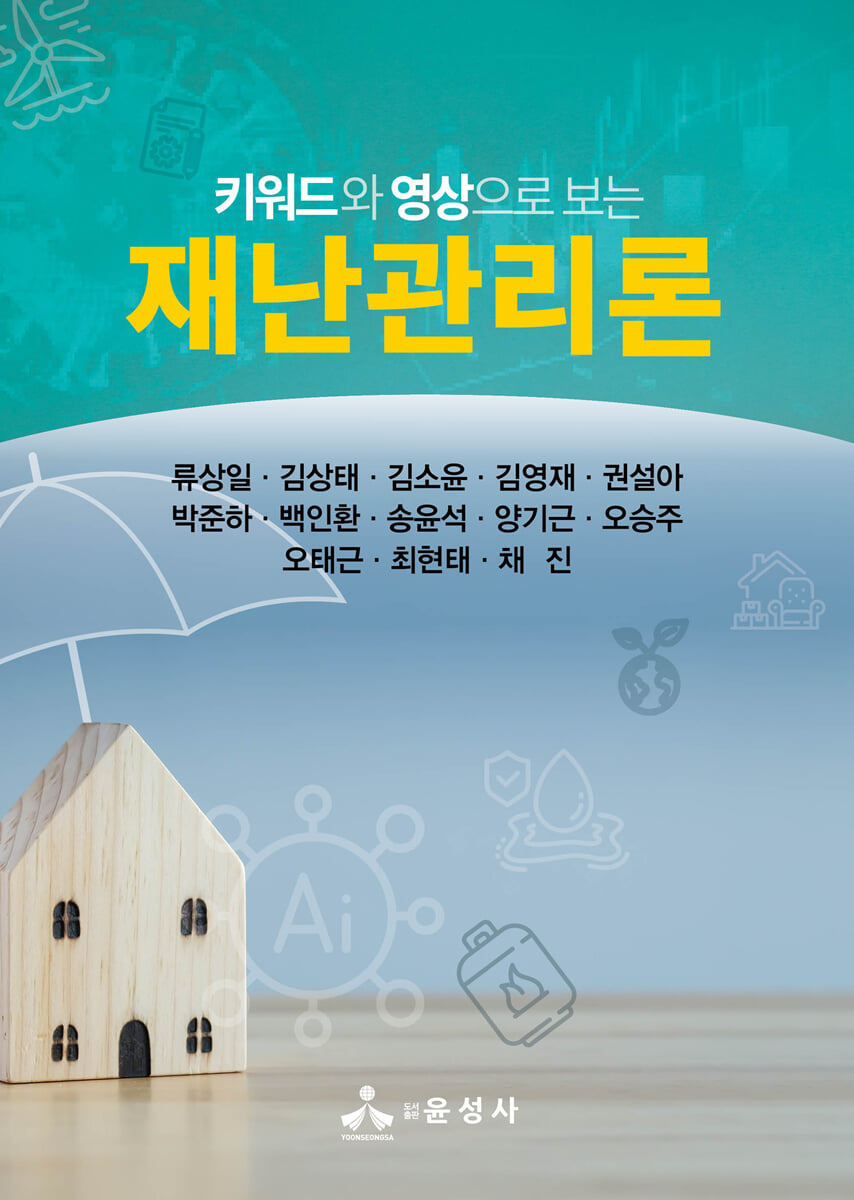
Disaster Management Theory through Keywords and Videos
 |
Description
Book Introduction
Unlike existing theory-centered disaster management textbooks, 『Disaster Management Theory through Keywords and Images』 is a book that organizes the text into a keyword framework so that readers can access and understand it more easily, and then connects various videos and visual materials using QR codes to create a realistic and three-dimensional structure.
index
Chapter 1: Concepts of Disaster and Disaster Management
Section 1: Concept of Disaster
Section 2 Types and Classification of Disasters
Section 3 Distinction between the concepts of disaster, calamity, and safety
Section 4 Characteristics of Disasters
Section 5 Disaster Management Activities by Stage
Section 6 Disaster Management Methods
Chapter 2 Disaster Management System
Section 1. Significance of the Disaster Management System
Section 2: Evolution of the Disaster Management System
Section 3 Organization and Function of the Disaster Management System
Chapter 3 Disaster Management Step-by-Step Activities
Section 1: Key theories and models for disaster management activities at each stage
Section 2 Key contents of each disaster management stage
Chapter 4 Characteristics of Natural Disasters by Type
Section 1: Concept of Natural Disaster
Section 2 Characteristics of Natural Disasters
Section 3 Disaster Management by Type
Section 4 Typhoon
Section 5 Drought
Section 6 Heat Wave
Section 7 Strong Winds
Section 8 Heavy Snow
Section 9 Cold Wave
Section 10: Currents
Section 11 Volcanoes
Section 12 Earthquake
Section 13: Flood
Section 14 Storm and Waves
Chapter 5: Characteristics of Social Disasters by Type
Section 1: The Concept of Social Disaster
Section 2 Characteristics of Social Disasters
Section 3 Fire
Section 4 Collapse
Section 5 Explosion
Section 6 Traffic Accidents
Section 7 Chemical, Biological, and Radiological Accidents
Section 8 Environmental Pollution Accidents
Section 9: Accidents involving large crowds
Section 10 Infectious Diseases
Section 11: Livestock epidemics
Section 12 Fine dust
Section 13 Paralysis of National Infrastructure
Chapter 6 Disaster Psychology
Section 1. Concept and Characteristics of Disaster Psychology
Section 2 Psychological and Behavioral Impact of Disasters
Section 3 Psychological Changes After Disaster
Section 4: Foundational Theories of Disaster Psychology: Integrating Major Psychological Perspectives
Section 5 Post-traumatic stress disorder
Section 6 Psychological First Aid
Section 7 Disaster Psychological Recovery Support Center
Section 8 National Trauma Center
Chapter 7 National Safety Management Basic Plan and Related Cases
Section 1 Legal Basis of the National Safety Management Basic Plan
Section 2: Analysis of the Components of the National Safety Management Basic Plan
Section 3 Safety Management Measures by Sector
Chapter 8 Corporate Disaster Management
Section 1: Background and Necessity of Corporate Disaster Management
Section 2: Concept and Definition of Business Continuity Management
Section 3: Core Concepts and Operational System of the Business Continuity Management System
Section 4 Legal Basis for Corporate Disaster Management
Section 5 Conclusion
Chapter 9 Disaster Management in Foreign Countries
Section 1 International Cooperation
Section 2 United Nations Office for Disaster Risk Reduction
Section 3: Sendai Disaster Risk Reduction Framework
Section 4 Humanitarian Relief
Section 5: Building a Disaster-Resilient City
Section 6 Federal Administrative Offices of the United States
Section 7 Integrated Command System
Section 8 Disaster Refugees
Chapter 10 Artificial Intelligence and Disaster Management
Section 1 Disaster Monitoring and Forecasting
Section 2 Disaster Response and Management
Section 3 Disaster Decision-Making and Integrated Operations
Chapter 11: Development Direction of Disaster Management
Section 1: Disaster Management: The Need for Continuous Change and Innovation
Section 2. Changes in Disaster Management in Korea
Section 3 Changes in the disaster environment
Section 4. Development Direction of Disaster Management in Korea
Section 5 Conclusion
Section 1: Concept of Disaster
Section 2 Types and Classification of Disasters
Section 3 Distinction between the concepts of disaster, calamity, and safety
Section 4 Characteristics of Disasters
Section 5 Disaster Management Activities by Stage
Section 6 Disaster Management Methods
Chapter 2 Disaster Management System
Section 1. Significance of the Disaster Management System
Section 2: Evolution of the Disaster Management System
Section 3 Organization and Function of the Disaster Management System
Chapter 3 Disaster Management Step-by-Step Activities
Section 1: Key theories and models for disaster management activities at each stage
Section 2 Key contents of each disaster management stage
Chapter 4 Characteristics of Natural Disasters by Type
Section 1: Concept of Natural Disaster
Section 2 Characteristics of Natural Disasters
Section 3 Disaster Management by Type
Section 4 Typhoon
Section 5 Drought
Section 6 Heat Wave
Section 7 Strong Winds
Section 8 Heavy Snow
Section 9 Cold Wave
Section 10: Currents
Section 11 Volcanoes
Section 12 Earthquake
Section 13: Flood
Section 14 Storm and Waves
Chapter 5: Characteristics of Social Disasters by Type
Section 1: The Concept of Social Disaster
Section 2 Characteristics of Social Disasters
Section 3 Fire
Section 4 Collapse
Section 5 Explosion
Section 6 Traffic Accidents
Section 7 Chemical, Biological, and Radiological Accidents
Section 8 Environmental Pollution Accidents
Section 9: Accidents involving large crowds
Section 10 Infectious Diseases
Section 11: Livestock epidemics
Section 12 Fine dust
Section 13 Paralysis of National Infrastructure
Chapter 6 Disaster Psychology
Section 1. Concept and Characteristics of Disaster Psychology
Section 2 Psychological and Behavioral Impact of Disasters
Section 3 Psychological Changes After Disaster
Section 4: Foundational Theories of Disaster Psychology: Integrating Major Psychological Perspectives
Section 5 Post-traumatic stress disorder
Section 6 Psychological First Aid
Section 7 Disaster Psychological Recovery Support Center
Section 8 National Trauma Center
Chapter 7 National Safety Management Basic Plan and Related Cases
Section 1 Legal Basis of the National Safety Management Basic Plan
Section 2: Analysis of the Components of the National Safety Management Basic Plan
Section 3 Safety Management Measures by Sector
Chapter 8 Corporate Disaster Management
Section 1: Background and Necessity of Corporate Disaster Management
Section 2: Concept and Definition of Business Continuity Management
Section 3: Core Concepts and Operational System of the Business Continuity Management System
Section 4 Legal Basis for Corporate Disaster Management
Section 5 Conclusion
Chapter 9 Disaster Management in Foreign Countries
Section 1 International Cooperation
Section 2 United Nations Office for Disaster Risk Reduction
Section 3: Sendai Disaster Risk Reduction Framework
Section 4 Humanitarian Relief
Section 5: Building a Disaster-Resilient City
Section 6 Federal Administrative Offices of the United States
Section 7 Integrated Command System
Section 8 Disaster Refugees
Chapter 10 Artificial Intelligence and Disaster Management
Section 1 Disaster Monitoring and Forecasting
Section 2 Disaster Response and Management
Section 3 Disaster Decision-Making and Integrated Operations
Chapter 11: Development Direction of Disaster Management
Section 1: Disaster Management: The Need for Continuous Change and Innovation
Section 2. Changes in Disaster Management in Korea
Section 3 Changes in the disaster environment
Section 4. Development Direction of Disaster Management in Korea
Section 5 Conclusion
Publisher's Review
preface
We now live in an age where disasters have become a daily occurrence.
Large-scale natural disasters and social catastrophes, which once felt like stories from a distant land, are no longer unfamiliar news.
Natural disasters such as heavy rains, wildfires, and cold waves caused by climate change, as well as social disasters such as infectious diseases, collapses, and cyberattacks, are becoming threats in our daily lives.
However, disasters are not simply sudden events; they are the result of a long-term accumulation of risk factors and social vulnerabilities.
Disasters have become so fundamentally disruptive to the very foundations of daily life and life that a single disaster can shake an entire community and require years of psychological and economic recovery.
Therefore, the need to understand disasters not as simple incidents but as problems affecting the entire society and to approach them systematically is growing.
Despite this, we often live our lives without fully recognizing the nature of disasters and the need for their management, considering them as 'one-time events' or 'the domain of experts.'
Disasters are not simply natural phenomena or accidents of force majeure; they are complex problems whose scale and nature of damage are determined by the structural vulnerabilities of society and the level of response of management systems.
Therefore, disasters can no longer be approached solely as a technical response by a select group of experts; they have become a social obligation requiring all citizens to have basic understanding and participation capabilities.
This book, "Disaster Management Theory through Keywords and Images," started from this awareness of the problem.
Unlike existing theory-centered disaster management textbooks, the framework of "keywords" was central to make it easier for readers to access and understand, and related videos and visual materials were linked to enable realistic and three-dimensional learning.
Starting from the fundamental question of “What is a disaster?”, the discussion gradually expanded to cover the types of disasters, management systems, specific methods of prevention and response, and even the importance of integrated disaster management.
Each chapter was co-written by experts from various fields, striving to provide both theoretical depth and practical insight.
In particular, the parallel presentation of real-world examples and policy implications stems from the hope that this book will not remain merely a theoretical text, but also serve as a guide for disaster management educators and practitioners in the field.
We also hope that this book will provide opportunities for cross-learning and convergent thinking in diverse fields, including social welfare, architecture, education, and public administration.
I hope this book will raise awareness among readers about disasters and empower them to transform them into something “manageable.”
Above all, I hope this will serve as an opportunity to once again remind ourselves that safety in everyday life is not something left to chance, but a process created by individuals and society together.
I would also like to express my deepest gratitude to CEO Jaehoon Jeong of Yoon Seongsa, who has always been with me as a friend for 25 years.
July 2025
All authors
We now live in an age where disasters have become a daily occurrence.
Large-scale natural disasters and social catastrophes, which once felt like stories from a distant land, are no longer unfamiliar news.
Natural disasters such as heavy rains, wildfires, and cold waves caused by climate change, as well as social disasters such as infectious diseases, collapses, and cyberattacks, are becoming threats in our daily lives.
However, disasters are not simply sudden events; they are the result of a long-term accumulation of risk factors and social vulnerabilities.
Disasters have become so fundamentally disruptive to the very foundations of daily life and life that a single disaster can shake an entire community and require years of psychological and economic recovery.
Therefore, the need to understand disasters not as simple incidents but as problems affecting the entire society and to approach them systematically is growing.
Despite this, we often live our lives without fully recognizing the nature of disasters and the need for their management, considering them as 'one-time events' or 'the domain of experts.'
Disasters are not simply natural phenomena or accidents of force majeure; they are complex problems whose scale and nature of damage are determined by the structural vulnerabilities of society and the level of response of management systems.
Therefore, disasters can no longer be approached solely as a technical response by a select group of experts; they have become a social obligation requiring all citizens to have basic understanding and participation capabilities.
This book, "Disaster Management Theory through Keywords and Images," started from this awareness of the problem.
Unlike existing theory-centered disaster management textbooks, the framework of "keywords" was central to make it easier for readers to access and understand, and related videos and visual materials were linked to enable realistic and three-dimensional learning.
Starting from the fundamental question of “What is a disaster?”, the discussion gradually expanded to cover the types of disasters, management systems, specific methods of prevention and response, and even the importance of integrated disaster management.
Each chapter was co-written by experts from various fields, striving to provide both theoretical depth and practical insight.
In particular, the parallel presentation of real-world examples and policy implications stems from the hope that this book will not remain merely a theoretical text, but also serve as a guide for disaster management educators and practitioners in the field.
We also hope that this book will provide opportunities for cross-learning and convergent thinking in diverse fields, including social welfare, architecture, education, and public administration.
I hope this book will raise awareness among readers about disasters and empower them to transform them into something “manageable.”
Above all, I hope this will serve as an opportunity to once again remind ourselves that safety in everyday life is not something left to chance, but a process created by individuals and society together.
I would also like to express my deepest gratitude to CEO Jaehoon Jeong of Yoon Seongsa, who has always been with me as a friend for 25 years.
July 2025
All authors
GOODS SPECIFICS
- Date of issue: August 8, 2025
- Format: Paperback book binding method guide
- Page count, weight, size: 312 pages | 173*243*30mm
- ISBN13: 9791193058985
- ISBN10: 1193058988
You may also like
카테고리
korean


korean

![GQ KOREA Mark (Monthly): December [2025]](http://librairie.coreenne.fr/cdn/shop/files/8ef265dbbfbf186523ed75ba7319009d.jpg?v=1765340328&width=3840)


