

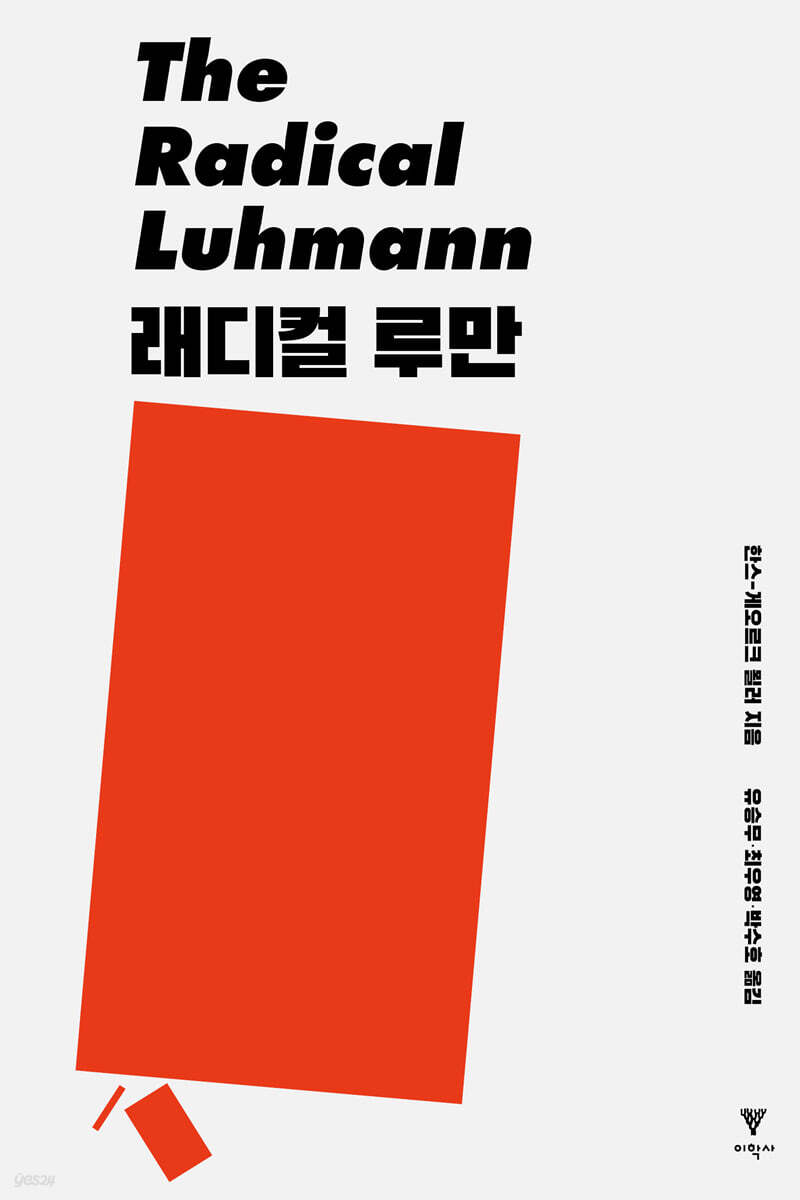
Radical Luhmann
 |
Description
Book Introduction
Niklas Luhmann, the most influential German sociologist of the 20th century!
The clearest explanation of Luhmann's theory
This book clearly and persuasively explains the complex yet unique theories of Niklas Luhmann, a thinker at the center of 20th-century social theory yet still unfamiliar to the general public.
Author Hans-Georg Möller sheds light on German sociologist Niklas Luhmann as a radical theorist who fundamentally overturned Western intellectual traditions. As the provocative title suggests, he interprets Luhmann's thinking with the keyword "radical," meticulously analyzing how Luhmann overturns and transcends existing social views.
In this book, Möller clearly conveys Luhmann's social theory, which is notoriously difficult, and expands it into a new field of philosophical discourse.
Luhmann's theory is discussed as a comprehensive project that seeks to dismantle and reassemble almost all modern thought.
This book effectively demonstrates that Luhmann's theory is not simply a tool for social analysis, but rather an attempt at an ontological and epistemological paradigm shift, conveying Luhmann's outstanding thinking in a reader-friendly yet sharp manner.
The clearest explanation of Luhmann's theory
This book clearly and persuasively explains the complex yet unique theories of Niklas Luhmann, a thinker at the center of 20th-century social theory yet still unfamiliar to the general public.
Author Hans-Georg Möller sheds light on German sociologist Niklas Luhmann as a radical theorist who fundamentally overturned Western intellectual traditions. As the provocative title suggests, he interprets Luhmann's thinking with the keyword "radical," meticulously analyzing how Luhmann overturns and transcends existing social views.
In this book, Möller clearly conveys Luhmann's social theory, which is notoriously difficult, and expands it into a new field of philosophical discourse.
Luhmann's theory is discussed as a comprehensive project that seeks to dismantle and reassemble almost all modern thought.
This book effectively demonstrates that Luhmann's theory is not simply a tool for social analysis, but rather an attempt at an ontological and epistemological paradigm shift, conveying Luhmann's outstanding thinking in a reader-friendly yet sharp manner.
- You can preview some of the book's contents.
Preview
index
introduction
Part 1 Introduction
Chapter 1: The Trojan Horse: Luhmann's Hidden (and Not Too Hidden) Radicalism
Chapter 2 Why Did Luhmann Write Such a Troublesome Book?
Part 2: From Philosophy to Theory
Chapter 3: The Fourth Attack: Refutation of Humanism
Chapter 4: From Necessity to Contingency: The Carnivalization of Philosophy
Chapter 5: Final Notes on Plato: The Solution of the Mind-Body Problem
Chapter 6: Ecological Evolution: A Challenge to Social Creationism
Chapter 7: Constructivism as Postmodern Realism: The Teaching of Difference
Chapter 8 Democracy as Utopia: The Dismantling of Politics
Chapter 9 Conclusion: Neither Hope nor Fear
Appendix Niklas Luhmann (1927–1998): A Brief Intellectual Biography
abbreviation
Translator Boron Luhmann's Path to Sociology
Translator's Note
Search
Part 1 Introduction
Chapter 1: The Trojan Horse: Luhmann's Hidden (and Not Too Hidden) Radicalism
Chapter 2 Why Did Luhmann Write Such a Troublesome Book?
Part 2: From Philosophy to Theory
Chapter 3: The Fourth Attack: Refutation of Humanism
Chapter 4: From Necessity to Contingency: The Carnivalization of Philosophy
Chapter 5: Final Notes on Plato: The Solution of the Mind-Body Problem
Chapter 6: Ecological Evolution: A Challenge to Social Creationism
Chapter 7: Constructivism as Postmodern Realism: The Teaching of Difference
Chapter 8 Democracy as Utopia: The Dismantling of Politics
Chapter 9 Conclusion: Neither Hope nor Fear
Appendix Niklas Luhmann (1927–1998): A Brief Intellectual Biography
abbreviation
Translator Boron Luhmann's Path to Sociology
Translator's Note
Search
Detailed image

Into the book
Luhmann questioned the very idea of democratic participation.
According to Luhmann, the idea of democracy as the rule of the people is merely a utopian fantasy.
--- p.16
Just as we cannot control the universe, our own bodies, or our minds, we cannot shape the social world we live in according to our ideals, hopes, or intentions.
Luhmann compares the actions and promises of politicians who pretend to influence the capitalist economy to the rainmaking dances of the Hopi Indians, and attributes to both an equally important function: “to create the impression that one is doing something, rather than simply waiting for things to change on their own.”
--- p.61
Luhmann's theory radically destroyed the human-centered view of society, just as Darwin had destroyed the Christian notion that humans were "the lords of creation."
--- p.130
Where does Luhmann's radicalism lead us? How does understanding Luhmann change our perspective on the world? What constitutes Luhmann's attitude toward society, the world, and even our own lives?
--- p.191
We are not the center of the universe, we are not the “crown of creation,” we are not the masters of our own minds.
Nor are we autonomous creators of the social world.
Previous attempts to use philosophical insight and wisdom to improve society have largely failed.
According to Luhmann, the idea of democracy as the rule of the people is merely a utopian fantasy.
--- p.16
Just as we cannot control the universe, our own bodies, or our minds, we cannot shape the social world we live in according to our ideals, hopes, or intentions.
Luhmann compares the actions and promises of politicians who pretend to influence the capitalist economy to the rainmaking dances of the Hopi Indians, and attributes to both an equally important function: “to create the impression that one is doing something, rather than simply waiting for things to change on their own.”
--- p.61
Luhmann's theory radically destroyed the human-centered view of society, just as Darwin had destroyed the Christian notion that humans were "the lords of creation."
--- p.130
Where does Luhmann's radicalism lead us? How does understanding Luhmann change our perspective on the world? What constitutes Luhmann's attitude toward society, the world, and even our own lives?
--- p.191
We are not the center of the universe, we are not the “crown of creation,” we are not the masters of our own minds.
Nor are we autonomous creators of the social world.
Previous attempts to use philosophical insight and wisdom to improve society have largely failed.
--- p.209
Publisher's Review
The End of Narcissism: An Intellectual Revolution That Shaken Humanism
There have been three turning points in intellectual history that have shattered human pride.
First, Copernicus's proof that the Earth is not the center of the universe, second, Darwin's discovery that humans are not the pinnacle of creation, and third, Freud's discovery that the ego is powerless before impulses like libido and the unconscious.
Luhmann adds a sociological insult here as a fourth turn.
According to him, human society cannot control itself.
From Kant to Habermas, many mainstream theorists in the tradition of the Western Enlightenment have consistently assumed that politics and political institutions are means by which humans can control, manipulate, and guide society.
This tradition dates back to Plato's Republic, where he postulated that philosopher-kings could control society based on their wisdom, much as the mind controls the body.
Luhmann broke away from the anthropocentric legacy of modern Western philosophy and fundamentally challenged the tradition of political and social philosophy that regarded humans as the measure of all things.
Luhmann's theory of social systems confronts humanity with sociological attack, that is, insight into the limits of social manipulation.
We are not the center of the universe, we are not the crown of creation, we are not the masters of our own minds.
Nor are we autonomous creators of the social world.
Previous attempts to use philosophical insight and wisdom to improve society have largely failed.
Luhmann's theory completely dismantles the existing concept of understanding society centered on humans, and provides a non-anthropocentric insight that human society cannot be manipulated according to human intentions.
Dismantling the human-centered social order and development narrative
Just as Darwin destroyed the Christian notion that humans were the “princes of all creation,” Luhmann destroyed the human-centered view of society.
Luhmann's theory follows evolutionary biology in denying not only a transcendental divinity, but also a priori agency and human intentionality.
This is why Luhmann's theory is a scandal in social theory today, just as Darwin's theory was in 19th-century biology.
In evolutionary theory, ecosystems neither execute God's will nor even freely determine their own development.
In Luhmann's social theory, humans are merely elements within a highly complex system-environment complex that cannot pursue independent development.
Luhmann, who eliminates the structure of domination and denies social centrality itself, develops a polycentric theory of the world and society perceived without a center.
However, Luhmann's theory of social evolution differs fundamentally from Darwin's theory of biological evolution in that it questions progress.
Luhmann's evolutionary view of society does not inherit the Enlightenment narrative of progress.
It does not attempt to scientifically evaluate species according to their individual merits, nor does it rank social systems or social structures.
Evolution emerges as a complex coevolution of system-environment relationships.
Coevolution implies that there is a perpetual feedback mechanism between different systems evolving simultaneously.
Change triggers change, which triggers another change, and so on.
No biological species, no social system, engaged in a highly complex process of coevolution, can control social development.
Luhmann's ecological evolution theory, which dismantles human-centered social order and development narratives, corresponds to radical ecology.
From anti-humanism to the dismantling of democracy,
We are questioning the structure of the world we have become accustomed to.
Make us think beyond that
This book explores Luhmann's radical departure from mainstream social theory and modern Western philosophy by identifying key areas of the paradigm shift his thinking created.
The scope ranges from anti-humanism or post-humanism to the dismantling of democracy.
Luhmann's understanding of democracy further clarifies the limits of social manipulation.
Luhmann questioned the very idea of democratic participation.
According to him, the idea of democracy as the rule of the people is nothing more than a utopian fantasy.
Rather, what he proposed was a concept of functional democracy as a symbolic narrative that enables a political system to constitute its legitimacy.
Luhmann offers a satirical analogy, comparing the G8 summit to the rain dances of Native Americans, in which he argues that politicians' actions and promises serve an equally important function.
Both have the function of spreading the impression that they are doing something rather than just waiting for a change in circumstances.
The Giuje dance and the summit serve as important symbolic events that cause great commotion in their respective social environments.
Luhmann does not consider the summit meeting or the rain dance as useless.
He understands quantum mechanics from a purely functionalist perspective and criticizes understanding their functions from a humanistic perspective.
In this way, Luhmann boldly breaks away from the dominant humanistic notion in understanding politics.
His theory dismantles the existing idealized view of the political system and opens up intellectual possibilities for thinking about society in a new way within an uncontrollable reality.
Luhmann's thought, which crosses philosophy, language, politics, and ethics, shakes the landscape of humanities and social sciences today and fundamentally reorganizes the paradigm of modern intellect regarding humanity and society.
This book is a powerful intellectual challenge that makes us question the structure of the world we have become accustomed to and think beyond it through the thinker Luhmann.
There have been three turning points in intellectual history that have shattered human pride.
First, Copernicus's proof that the Earth is not the center of the universe, second, Darwin's discovery that humans are not the pinnacle of creation, and third, Freud's discovery that the ego is powerless before impulses like libido and the unconscious.
Luhmann adds a sociological insult here as a fourth turn.
According to him, human society cannot control itself.
From Kant to Habermas, many mainstream theorists in the tradition of the Western Enlightenment have consistently assumed that politics and political institutions are means by which humans can control, manipulate, and guide society.
This tradition dates back to Plato's Republic, where he postulated that philosopher-kings could control society based on their wisdom, much as the mind controls the body.
Luhmann broke away from the anthropocentric legacy of modern Western philosophy and fundamentally challenged the tradition of political and social philosophy that regarded humans as the measure of all things.
Luhmann's theory of social systems confronts humanity with sociological attack, that is, insight into the limits of social manipulation.
We are not the center of the universe, we are not the crown of creation, we are not the masters of our own minds.
Nor are we autonomous creators of the social world.
Previous attempts to use philosophical insight and wisdom to improve society have largely failed.
Luhmann's theory completely dismantles the existing concept of understanding society centered on humans, and provides a non-anthropocentric insight that human society cannot be manipulated according to human intentions.
Dismantling the human-centered social order and development narrative
Just as Darwin destroyed the Christian notion that humans were the “princes of all creation,” Luhmann destroyed the human-centered view of society.
Luhmann's theory follows evolutionary biology in denying not only a transcendental divinity, but also a priori agency and human intentionality.
This is why Luhmann's theory is a scandal in social theory today, just as Darwin's theory was in 19th-century biology.
In evolutionary theory, ecosystems neither execute God's will nor even freely determine their own development.
In Luhmann's social theory, humans are merely elements within a highly complex system-environment complex that cannot pursue independent development.
Luhmann, who eliminates the structure of domination and denies social centrality itself, develops a polycentric theory of the world and society perceived without a center.
However, Luhmann's theory of social evolution differs fundamentally from Darwin's theory of biological evolution in that it questions progress.
Luhmann's evolutionary view of society does not inherit the Enlightenment narrative of progress.
It does not attempt to scientifically evaluate species according to their individual merits, nor does it rank social systems or social structures.
Evolution emerges as a complex coevolution of system-environment relationships.
Coevolution implies that there is a perpetual feedback mechanism between different systems evolving simultaneously.
Change triggers change, which triggers another change, and so on.
No biological species, no social system, engaged in a highly complex process of coevolution, can control social development.
Luhmann's ecological evolution theory, which dismantles human-centered social order and development narratives, corresponds to radical ecology.
From anti-humanism to the dismantling of democracy,
We are questioning the structure of the world we have become accustomed to.
Make us think beyond that
This book explores Luhmann's radical departure from mainstream social theory and modern Western philosophy by identifying key areas of the paradigm shift his thinking created.
The scope ranges from anti-humanism or post-humanism to the dismantling of democracy.
Luhmann's understanding of democracy further clarifies the limits of social manipulation.
Luhmann questioned the very idea of democratic participation.
According to him, the idea of democracy as the rule of the people is nothing more than a utopian fantasy.
Rather, what he proposed was a concept of functional democracy as a symbolic narrative that enables a political system to constitute its legitimacy.
Luhmann offers a satirical analogy, comparing the G8 summit to the rain dances of Native Americans, in which he argues that politicians' actions and promises serve an equally important function.
Both have the function of spreading the impression that they are doing something rather than just waiting for a change in circumstances.
The Giuje dance and the summit serve as important symbolic events that cause great commotion in their respective social environments.
Luhmann does not consider the summit meeting or the rain dance as useless.
He understands quantum mechanics from a purely functionalist perspective and criticizes understanding their functions from a humanistic perspective.
In this way, Luhmann boldly breaks away from the dominant humanistic notion in understanding politics.
His theory dismantles the existing idealized view of the political system and opens up intellectual possibilities for thinking about society in a new way within an uncontrollable reality.
Luhmann's thought, which crosses philosophy, language, politics, and ethics, shakes the landscape of humanities and social sciences today and fundamentally reorganizes the paradigm of modern intellect regarding humanity and society.
This book is a powerful intellectual challenge that makes us question the structure of the world we have become accustomed to and think beyond it through the thinker Luhmann.
GOODS SPECIFICS
- Date of issue: November 5, 2025
- Page count, weight, size: 290 pages | 310g | 141*210*14mm
- ISBN13: 9788961474849
- ISBN10: 8961474847
You may also like
카테고리
korean


korean

![GQ KOREA Mark (Monthly): December [2025]](http://librairie.coreenne.fr/cdn/shop/files/8ef265dbbfbf186523ed75ba7319009d.jpg?v=1765340328&width=3840)


