

Posttraumatic stress disorder and posttraumatic growth
 |
Description
Book Introduction
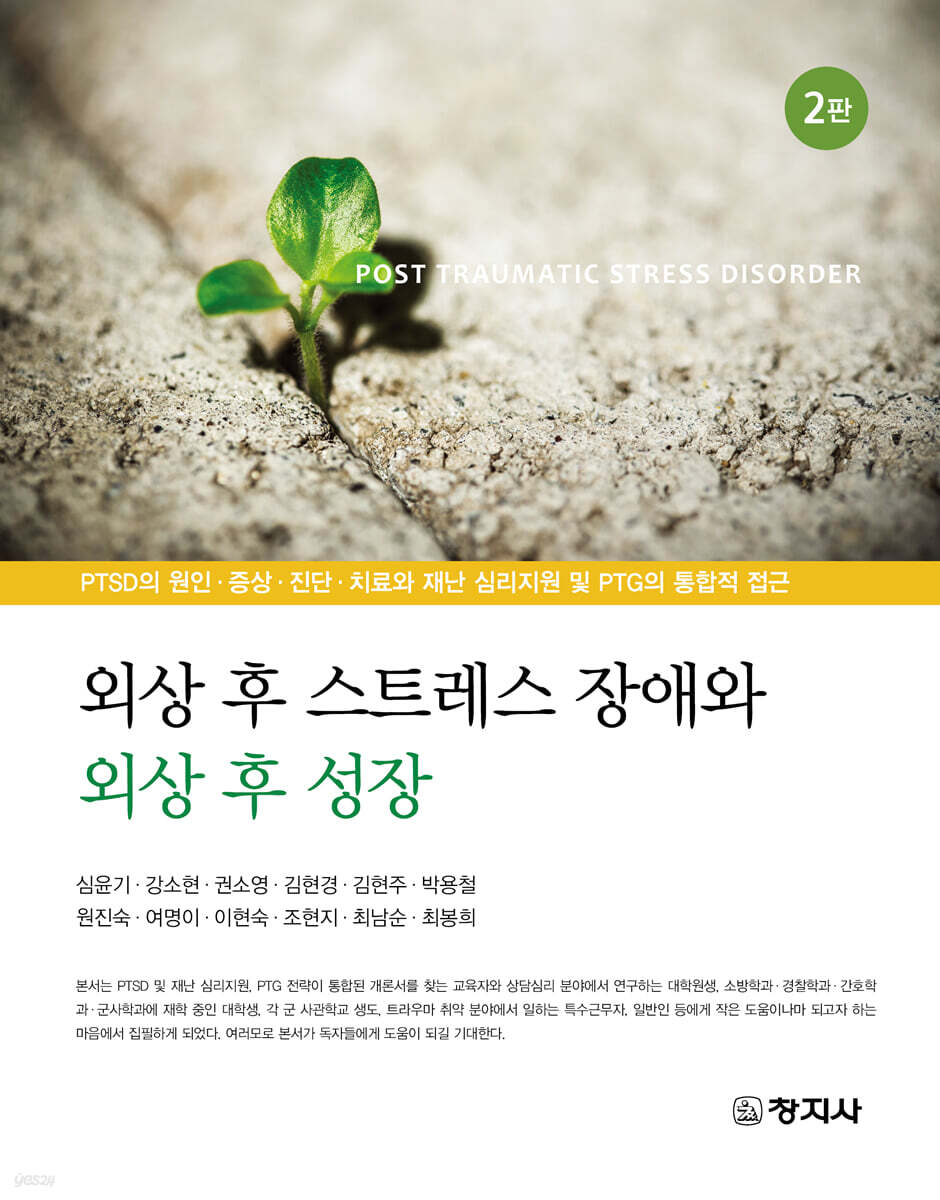
This book was written with the hope that it would be of some help not only to educators looking for an integrated introductory text on PTSD and disaster psychological support, PTG strategies, etc., but also to graduate students studying in mental health-related fields, college students enrolled in military science, police science, and fire science, cadets at military academies, special workers and employees working in fields vulnerable to trauma, and the general public.
Part 1 covers PTSD. It examines the causes, symptoms, and cases of PTSD, explains PTSD diagnostic tools, and suggests various treatment options.
Part 2 deals with disaster psychological support.
We will examine the psychological vulnerabilities, symptoms, and diseases of disaster survivors, examine the characteristics of disaster mental health in children and adolescents, and examine disaster mental health assessment tools. We will then examine disaster psychological support methods by type, target, and stage.
Part 3 deals with PTG.
We will examine theoretical models, PTG assessment tools, and counseling strategies that view traumatic experiences from a positive perspective and lead to growth.
We introduce programs that help people become more mature after experiencing a traumatic event than before.
Part 4 presents appendices including a PTSD diagnostic tool, a disaster mental health scale, and a PTG assessment tool, so that they can be used effectively in mental health settings.
Part 1 covers PTSD. It examines the causes, symptoms, and cases of PTSD, explains PTSD diagnostic tools, and suggests various treatment options.
Part 2 deals with disaster psychological support.
We will examine the psychological vulnerabilities, symptoms, and diseases of disaster survivors, examine the characteristics of disaster mental health in children and adolescents, and examine disaster mental health assessment tools. We will then examine disaster psychological support methods by type, target, and stage.
Part 3 deals with PTG.
We will examine theoretical models, PTG assessment tools, and counseling strategies that view traumatic experiences from a positive perspective and lead to growth.
We introduce programs that help people become more mature after experiencing a traumatic event than before.
Part 4 presents appendices including a PTSD diagnostic tool, a disaster mental health scale, and a PTG assessment tool, so that they can be used effectively in mental health settings.
index
Preface 2
PART 1.
Post-traumatic stress disorder (PTSD)
CHAPTER 01 Understanding PTSD 11
1.
Overview 12
2.
Key Concept 15
3.
Historical Change 28
4.
Dynamics and Influence 33
CHAPTER 02 Diagnosis by Type 43
1.
Diagnostic System 44
2.
Reflection of the DSM 48
3.
Diagnostic criteria 51
4.
Assessment Tool 60
CHAPTER 03 Symptoms and Cases 67
1.
Invasive symptoms 68
2.
Stimulus avoidance 74
3.
Negative changes in cognition and emotion 76
4.
Changes in arousal and reactivity 82
CHAPTER 04 Causes of Disease 89
1.
Personal Perspective 90
2.
Theoretical Perspective 94
3.
Biological Perspective 106
4.
Integrative Perspective 109
CHAPTER 05 PTSD in Special Mission Performers 117
1.
PTSD in Firefighters 118
2.
PTSD in Police Officers 123
3.
PTSD in Military Personnel 128
4.
PTSD in Special Forces 136
CHAPTER 06 PTSD Treatment 141
1.
Treatment 142
2.
Treatment facility 162
3.
Treatment Program 172
PART 2.
Disaster Psychological Support
CHAPTER 07 Disaster Mental Health 253
1.
Disaster Type 254
2.
Disaster Mental Health Symptoms 261
3.
Disaster Mental Health in Children and Adolescents 276
4.
Disaster Mental Health Assessment Tool 284
CHAPTER 08 Disaster Trauma Factors 297
1.
Demographic factors 298
2.
Personality Factors 301
3.
Environmental Characteristics Factor 303
CHAPTER 09 Disaster Psychological Support Methods 307
1.
Disaster Psychological Support Concept 308
2.
Disaster Psychological Support Method 319
3.
Disaster Psychological First Aid 337
4.
Disaster Psychological Support Program 345
PART 3.
Posttraumatic Growth (PTG)
CHAPTER 10 Understanding PTG 357
1. Characteristics of PTG 358
2. Factors of PTG 361
3. PTG Stage 371
4. PTG Assessment Tool 378
CHAPTER 11 PTG Theory 389
1.
Overview 390
2.
Coping Strategy Theory 391
3.
Coping Outcome Theory 394
4.
Other PTG Theories 398
CHAPTER 12 PTG Program 401
1.
Program Model 402
2.
Program Workbook 408
Appendix 427
Search 459
Reference 465
PART 1.
Post-traumatic stress disorder (PTSD)
CHAPTER 01 Understanding PTSD 11
1.
Overview 12
2.
Key Concept 15
3.
Historical Change 28
4.
Dynamics and Influence 33
CHAPTER 02 Diagnosis by Type 43
1.
Diagnostic System 44
2.
Reflection of the DSM 48
3.
Diagnostic criteria 51
4.
Assessment Tool 60
CHAPTER 03 Symptoms and Cases 67
1.
Invasive symptoms 68
2.
Stimulus avoidance 74
3.
Negative changes in cognition and emotion 76
4.
Changes in arousal and reactivity 82
CHAPTER 04 Causes of Disease 89
1.
Personal Perspective 90
2.
Theoretical Perspective 94
3.
Biological Perspective 106
4.
Integrative Perspective 109
CHAPTER 05 PTSD in Special Mission Performers 117
1.
PTSD in Firefighters 118
2.
PTSD in Police Officers 123
3.
PTSD in Military Personnel 128
4.
PTSD in Special Forces 136
CHAPTER 06 PTSD Treatment 141
1.
Treatment 142
2.
Treatment facility 162
3.
Treatment Program 172
PART 2.
Disaster Psychological Support
CHAPTER 07 Disaster Mental Health 253
1.
Disaster Type 254
2.
Disaster Mental Health Symptoms 261
3.
Disaster Mental Health in Children and Adolescents 276
4.
Disaster Mental Health Assessment Tool 284
CHAPTER 08 Disaster Trauma Factors 297
1.
Demographic factors 298
2.
Personality Factors 301
3.
Environmental Characteristics Factor 303
CHAPTER 09 Disaster Psychological Support Methods 307
1.
Disaster Psychological Support Concept 308
2.
Disaster Psychological Support Method 319
3.
Disaster Psychological First Aid 337
4.
Disaster Psychological Support Program 345
PART 3.
Posttraumatic Growth (PTG)
CHAPTER 10 Understanding PTG 357
1. Characteristics of PTG 358
2. Factors of PTG 361
3. PTG Stage 371
4. PTG Assessment Tool 378
CHAPTER 11 PTG Theory 389
1.
Overview 390
2.
Coping Strategy Theory 391
3.
Coping Outcome Theory 394
4.
Other PTG Theories 398
CHAPTER 12 PTG Program 401
1.
Program Model 402
2.
Program Workbook 408
Appendix 427
Search 459
Reference 465
Publisher's Review
preface
-In the 21st century we live in, tremendous changes occur every day.
From the Industrial Revolution to the advent of capitalism, the information age of the Internet has astonished us, and now artificial intelligence and chatbots have even changed our lifestyle patterns.
The reality of facing sociocultural diversity and complexity has long been a familiar phenomenon, and hearing news of unfamiliar lives happening everywhere in society has become a common part of everyday life.
Disasters and traumatic events, large and small, that occur all over the world every day threaten human life and survival.
Our country, which has achieved rapid growth and development at a rate that is difficult to find anywhere else in the world, has not been able to escape the stigma of being a country prone to frequent disasters, a fact that does not befit its national status.
During the rapid process of modernization and democratization, horrific and shocking incidents frequently occurred, and the lack of infrastructure to deal with them has led to a society at high risk of PTSD for a long time.
Traumatic events that cause PTSD, including the Korean War (1950s) and the Vietnam War (1960s-1970s), continue to occur even today.
The year 1900 saw the collapse of the Mapo Wow Apartment complex (1970), the Daeyeongak Hotel fire (1971), the Gwangju Uprising (1980), the collapse of the Hyeonjeong-dong subway construction site (1982), the collapse of the Seongsu Bridge (1994), the collapse of the Sampoong Department Store (1995), the collapse of the Seoul subway (1998), and the fire at a karaoke bar in Incheon (1999).
In 2000, the Daegu subway arson disaster (2003), Yeoncheon GP shooting rampage (2005), Icheon cold storage fire (2008), Cheonan warship attack (2010), Sewol ferry sinking (2014), Jecheon Sports Center fire (2017), and Miryang Sejong Hospital fire (2018) occurred.
In 2022, an unbelievable incident occurred in Itaewon, the heart of Seoul, South Korea, where 159 people were crushed to death. In December 2024, a Jeju Air passenger plane crashed on the runway of Muan International Airport, killing 179 people. There were many large and small disasters and traumatic incidents.
Fortunately, the constant occurrence of disasters and traumatic events has heightened public interest in the nation's mental health, leading to further advancements in practical responses and therapeutic approaches to post-traumatic stress disorder (PTSD).
Furthermore, although it may be late, it is fortunate that the National Trauma Center and Regional Trauma Centers have been established, national policies related to trauma have been established, and systematic support is being provided.
However, it is regrettable that an independent trauma organization or department has not yet been established to treat and prevent PTSD among soldiers, police officers, and firefighters performing their duties in special organizations.
Additionally, there is a lack of practical books that can be used in trauma settings, and there is no comprehensive trauma handbook that integrates both disaster psychological support and posttraumatic growth (PTG) strategies.
This book was conceived with this purpose in mind. It is intended to be of some help not only to educators seeking an integrated introductory text on PTSD, disaster psychological support, and PTG strategies, but also to graduate students studying mental health-related fields, college students in military science, police science, and fire science, cadets at military academies, specialized workers and professionals in trauma-vulnerable fields, and the general public.
I hope that this book will be helpful to readers in many ways.
-This book is composed of four parts.
Part 1 covers PTSD. It examines the causes, symptoms, and cases of PTSD, explains PTSD diagnostic tools, and suggests various treatment options.
Part 2 deals with disaster psychological support.
We will examine the psychological vulnerabilities, symptoms, and diseases of disaster survivors, examine the characteristics of disaster mental health in children and adolescents, and examine disaster mental health assessment tools. We will then examine disaster psychological support methods by type, target, and stage.
Part 3 deals with PTG.
We will examine theoretical models, PTG assessment tools, and counseling strategies that view traumatic experiences from a positive perspective and lead to growth.
We introduce programs that help people become more mature after experiencing a traumatic event than before.
Part 4 presents appendices including a PTSD diagnostic tool, a disaster mental health scale, and a PTG assessment tool, so that they can be used effectively in mental health settings.
-In the 21st century we live in, tremendous changes occur every day.
From the Industrial Revolution to the advent of capitalism, the information age of the Internet has astonished us, and now artificial intelligence and chatbots have even changed our lifestyle patterns.
The reality of facing sociocultural diversity and complexity has long been a familiar phenomenon, and hearing news of unfamiliar lives happening everywhere in society has become a common part of everyday life.
Disasters and traumatic events, large and small, that occur all over the world every day threaten human life and survival.
Our country, which has achieved rapid growth and development at a rate that is difficult to find anywhere else in the world, has not been able to escape the stigma of being a country prone to frequent disasters, a fact that does not befit its national status.
During the rapid process of modernization and democratization, horrific and shocking incidents frequently occurred, and the lack of infrastructure to deal with them has led to a society at high risk of PTSD for a long time.
Traumatic events that cause PTSD, including the Korean War (1950s) and the Vietnam War (1960s-1970s), continue to occur even today.
The year 1900 saw the collapse of the Mapo Wow Apartment complex (1970), the Daeyeongak Hotel fire (1971), the Gwangju Uprising (1980), the collapse of the Hyeonjeong-dong subway construction site (1982), the collapse of the Seongsu Bridge (1994), the collapse of the Sampoong Department Store (1995), the collapse of the Seoul subway (1998), and the fire at a karaoke bar in Incheon (1999).
In 2000, the Daegu subway arson disaster (2003), Yeoncheon GP shooting rampage (2005), Icheon cold storage fire (2008), Cheonan warship attack (2010), Sewol ferry sinking (2014), Jecheon Sports Center fire (2017), and Miryang Sejong Hospital fire (2018) occurred.
In 2022, an unbelievable incident occurred in Itaewon, the heart of Seoul, South Korea, where 159 people were crushed to death. In December 2024, a Jeju Air passenger plane crashed on the runway of Muan International Airport, killing 179 people. There were many large and small disasters and traumatic incidents.
Fortunately, the constant occurrence of disasters and traumatic events has heightened public interest in the nation's mental health, leading to further advancements in practical responses and therapeutic approaches to post-traumatic stress disorder (PTSD).
Furthermore, although it may be late, it is fortunate that the National Trauma Center and Regional Trauma Centers have been established, national policies related to trauma have been established, and systematic support is being provided.
However, it is regrettable that an independent trauma organization or department has not yet been established to treat and prevent PTSD among soldiers, police officers, and firefighters performing their duties in special organizations.
Additionally, there is a lack of practical books that can be used in trauma settings, and there is no comprehensive trauma handbook that integrates both disaster psychological support and posttraumatic growth (PTG) strategies.
This book was conceived with this purpose in mind. It is intended to be of some help not only to educators seeking an integrated introductory text on PTSD, disaster psychological support, and PTG strategies, but also to graduate students studying mental health-related fields, college students in military science, police science, and fire science, cadets at military academies, specialized workers and professionals in trauma-vulnerable fields, and the general public.
I hope that this book will be helpful to readers in many ways.
-This book is composed of four parts.
Part 1 covers PTSD. It examines the causes, symptoms, and cases of PTSD, explains PTSD diagnostic tools, and suggests various treatment options.
Part 2 deals with disaster psychological support.
We will examine the psychological vulnerabilities, symptoms, and diseases of disaster survivors, examine the characteristics of disaster mental health in children and adolescents, and examine disaster mental health assessment tools. We will then examine disaster psychological support methods by type, target, and stage.
Part 3 deals with PTG.
We will examine theoretical models, PTG assessment tools, and counseling strategies that view traumatic experiences from a positive perspective and lead to growth.
We introduce programs that help people become more mature after experiencing a traumatic event than before.
Part 4 presents appendices including a PTSD diagnostic tool, a disaster mental health scale, and a PTG assessment tool, so that they can be used effectively in mental health settings.
GOODS SPECIFICS
- Date of issue: February 14, 2025
- Page count, weight, size: 480 pages | 188*257*30mm
- ISBN13: 9788942619153
- ISBN10: 8942619150
You may also like
카테고리
korean


korean

![GQ KOREA Mark (Monthly): December [2025]](http://librairie.coreenne.fr/cdn/shop/files/8ef265dbbfbf186523ed75ba7319009d.jpg?v=1765340328&width=3840)


