

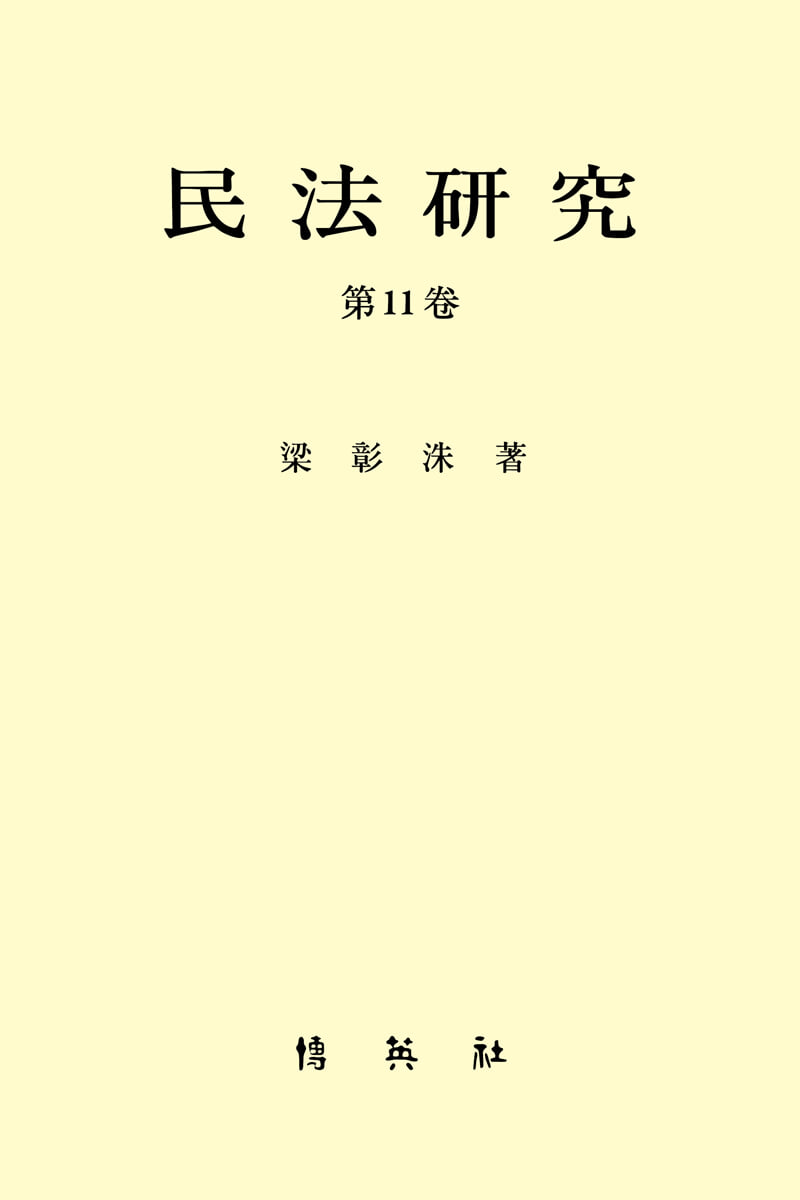
Civil Law Research, Vol. 11
 |
Description
index
1.
Missing Teacher Lee Ho-jeong 1
―Personal reflections on the teacher's life and scholarship―
2.
A fragment on the process of enacting the Civil Code?
―Clear Errors in Our Civil Code―
Ⅰ.
25 before entering
Ⅱ.
Article 201-27
Ⅲ.
Article 294, etc. 29
Ⅳ.
Article 343, Paragraph 30
V.
Article 389, Paragraph 33
Ⅵ.
Article 493, Paragraph 2, Clause 34
Ⅶ.
Article 639, Article 661, etc.? Title 35
Ⅷ.
Article 544? Again, Title 37
Ⅸ.
Title of Section 3, Chapter 2, Section 1 (General Provisions of the Contract), and
39 Regarding ‘termination’ of the contract
Ⅹ.
In closing 41
3.
A Review of the Necessity and Attempts to Revise the Civil Code
―Focusing on the 2004 Civil Code Amendment―
Ⅰ.
Before entering 43
Ⅱ.
Efforts to amend the Civil Code before 1999 45
Ⅲ.
Overview of the Work on the 2004 Civil Code Amendment 49
Ⅳ.
Demand for a Comprehensive Revision of the Civil Code 59
V.
63 Points That Personally Stand Out During Japan's Civil Code Revision Work
Ⅵ.
Private Thoughts on the Civil Code Amendment 66
[Attachment]
Ⅰ.
69 Matters Reviewed at the Plenary Session of the Civil Code Revision Committee
Ⅱ.
71 items determined as subject to revision review in the so-called
4.
75 Regarding the discretion of the judge in sentencing and other matters
―Personal thoughts on another aspect of the trial or legal judgment―
5.
Legislative Purpose and Analogical Application of Article 150 of the Civil Act 93
―Hidden provisions of our civil law―
Ⅰ.
Before entering 93
Ⅱ.
History of Article 150 of the Civil Code 94
1.
Article 143, Paragraph 94 of the Civil Act
2.
National Assembly Deliberation on Article 143 of the Civil Act 95
Ⅲ.
Foreign Legislative Cases? Application Cases—Focusing on Article 162 of the German Civil Code (97)
1.
The Importance of Article 162 of the German Civil Code 97
2.
The process of enacting Article 162 of the German Civil Code 97
3.
Interpretation and Application of Article 162 of the German Civil Code 100
Ⅳ.
105 in Japan
1.
Article 130, Paragraph 105 of the Japanese Civil Code
2.
Interpretation and Application of Article 130 of the Japanese Civil Code 107
V.
Application of Article 150 of the Civil Code in Korea 111
1.
Case law 111 used as a reference for interpreting contracts
2.
In cases other than the original meaning of “condition” and Article 150-112 of the Civil Act
Ⅵ.
Causal relationship at issue in Article 150, Paragraph 1 of the Civil Act 117
1.
Entering 117
2.
Specific details of causality 118
Ⅶ.
Conclusion: On the Possibility of Article 150 of the Civil Code 121
6.
New agreements regarding the timing and method of payment of interest, etc., and the short statute of limitations under Article 163, Paragraph 1 of the Civil Act
Ⅰ.
127 before entering
Ⅱ.
The legislative history of Article 163, Paragraph 1 of the Civil Act and the attitude of case law regarding it 129
1.
Legislative Progress 129
2.
Attitude of Case Law 131
Ⅲ.
New agreements regarding payment timing and method, etc. and Article 163, Paragraph 1, Subparagraph 137 of the Civil Act
1.
Seolrye 137
2.
Problem Solving 139
Ⅳ.
Recent legislative trends regarding the statute of limitations system and legislative work in Korea 147
1.
Germany and France 147
2.
Japan 148
3.
150 Implications for the Legislative Work and Interpretation of Civil Law in Korea
V.
Sintering 151
7.
Causes of Change in Real Estate Rights in Korean Civil Law
Ⅰ.
Article 153 of the Korean Civil Code on Changes in Real Estate Rights
Ⅱ.
Discussion in the legislative process regarding changes in real estate rights 156
1.
The Process of Establishing the Civil Code 156
2.
National Assembly deliberation on the Civil Code 160
Ⅲ.
Theory of Property Rights in Korean Civil Law: Debt-Based and Property-Based Acts 162
1.
Before entering 162
2.
Concept and Components of Property Rights Act 164
3.
The Relationship Between Debt and Real Rights I: A Discussion on the Independence of Real Rights 166
4.
The Relationship Between Debt and Real Rights II: Discussion on the Inhumanity of Real Rights 170
5.
Case law's attitude toward the discussion of property rights 173
[Additional] Comment 173 on Professor Yoshiaki Kaneko's "Additional Comments"
8.
Supplementary argument for 'expression of intent of the parties' as a requirement to limit payment by a third party
―Regarding certain historical characteristics of our civil law―
Ⅰ.
Before entering 179
Ⅱ.
'Expression of intent by the parties' as an exception limiting the exemption of debt assumption 181
Ⅲ.
'Expression of intent by the parties' as an exception limiting the transferability of a bond 182
Ⅳ.
Article 185 on the "Declaration of Intention of the Parties" Prohibiting or Restricting Payment by a Third Party
9.
Regarding the attitude of case law in reading the highest performance in an expression of intent to terminate without effect
Ⅰ.
Case law regarding invalid declarations of intent to terminate 189
Ⅱ.
Question 191 about the attitude of case law
10.
A Critical Review of the Specific Application of the Change of Circumstances Principle
―Supreme Court 2020.
12.
10.
Commentary on the judgment 2020da254846 case (Case Report 2021, Volume 1, p. 216)
Ⅰ.
Introduction 200
Ⅱ.
Regarding the general legal principles of change of circumstances - Dissolution or adjustment of contractual relationships due to change of circumstances 204
1.
Introduction: Statement of the Problem 204
2.
Comparative Legal Considerations 206
3.
Civil Code, etc. Provisions and Doctrines 211
4.
The Attitude of Our Case Law 216
Ⅲ.
Facts of this case 222
1.
Facts of this case 222
2.
Progress of this case 223
Ⅳ.
Regarding the supplementary nature of the principle of change of circumstances—the relevant provisions of this contract should be given priority—224
V.
Review of the contract provisions in this case regarding significant delays or impossibility of issuing employment-based immigration visas, etc. 227
1.
Exceptional Application of the Principle of Change of Circumstances 227
2.
228 Clauses in this contract that foresee the "risks" of immigration agency work
3.
Inclusion in the facts of this case 230
Ⅵ.
From the perspective of the legal nature of the debt for arranging employment immigration visas, 232
1.
Debts given and debts performed, or debts resulting and debts by means of payment 232
2.
The legal nature of the obligation assumed by the defendant under this contract: Is it a resultant obligation or an instrumental obligation? 235
3.
Debtor's Performance and Counter-Performance Claim in Instrumental Obligations 239
Ⅶ.
The need for unification with related events 240
Ⅷ.
Conclusion 241
11.
The starting point of the statute of limitations for a tort claim against the state by a person who has lost ownership due to the completion of the acquisitive prescription
Ⅰ.
Presumed facts 243
Ⅱ.
Legal Issues Subject to Opinion 246
Ⅲ.
Case law 247 on the completion of the acquisitive prescription and the starting point of the statute of limitations under Article 766, Paragraph 2 of the Civil Act
Ⅳ.
Should this case be changed? 250
V.
Claim for damages for tort as a means of redress for the original owner who has lost ownership due to the completion of the acquisitive prescription period 262
Ⅵ.
Conclusion: This case's precedent should be upheld. 271
12.
275. Gross negligence of the plaintiff and malice of the other party, etc.
―Supreme Court 2023.
4. 27.
Decision No. 2017Da227264 (Case Report, Volume 2023, p. 885)
13.
Can a junior mortgagee invoke the completion of the statute of limitations? 287
―Supreme Court 2021.
2. 25.
Decision No. 2016Da232597 (Case Report 2021, Volume 673)
14.
Does the effect of interrupting the statute of limitations by attachment only apply to the "claim" in the attachment application, and not to the claim for delay damages? 295
―Supreme Court 2024.
10.
25.
Decision 2024da233212 (Case Report 2024, Vol. 2, p. 1846)
15.
303 Right to claim reimbursement of expenses by a third-party acquirer of mortgaged real estate as stipulated in Article 367 of the Civil Act
―Supreme Court 2023.
7. 13.
Decision 2022da265093 (Case Report 2023, Vol. 2, p. 1448)
16.
After a final judgment to cancel a fraudulent act ordering the return of the original property to the debtor has been finalized, can the creditor be ordered to pay compensation for the fraudulent act, citing significant difficulties? 311
―Supreme Court 2024.
2. 15.
Decision No. 2019Da238640 (Case Report 2024, Volume 514)
17.
Does Article 496 of the Civil Act, which prohibits the setoff of a tort claim against a passive claim, apply analogically to claims arising from a loan contract arising from fraud?
―Supreme Court 2024.
8. 1.
Decision No. 2024da204696 (Case Report 2024, p. 1567)
18.
After the lease agreement, the real estate lessor transfers the lease to a third party.
If a lien is established, can the tenant immediately refuse to pay rent? 331
―Supreme Court 2024.
9. 13.
Decision 2024da256116 (Case Report 2024, Vol. 2, p. 1637)
19.
Article 339: The effect of the leasehold right against the assignee of the property from the trustee in a housing lease agreement with the trustor
―Supreme Court 2022.
2. 17.
Decision 2019da300095 (Beopgoeul)
20.
347. The statute of limitations for the right to claim the return of the leased property begins
―Supreme Court 2022.
8. 19.
Decision 2020da220140 (Case Report 2022, Vol. 2, p. 1865)
21.
Counterparty 359 in a claim for return of unjust enrichment resulting from an erroneous transfer to an overdraft account
―Supreme Court 2022.
6. 30.
Decision 2016Da237974 (Case Report 2022, Vol. 2, p. 1425)
22.
Completion of the buyer's statute of limitations for acquisition of real property and the original owner's claim for return of unjust enrichment against the seller
―Supreme Court 2022.
12.
29.
Decision No. 2019Da272275 (Case Report 2023, Volume 352)
23.
The German Constitutional Court's decision on the legal status of the biological father
New ruling
―BVerfG judgment of April 9, 2024―
Ⅰ.
Related Regulation 379
Ⅱ.
Predicate Facts 381
Ⅲ.
Constitutional Court Decision 382, April 9, 2024
Ⅳ.
Simple appendix 384
[Data] Regarding the provisions related to contracts in the Civil Act
Overview of the Civil Code Revision Committee's Amendment Proposal
[Full Theory] 389
Ⅰ.
Revision Background 389
Ⅱ.
Basic principles of revision work 391
Ⅲ.
Key contents of this amendment 391
[Amendment Summary] 393
Ⅰ.
Article 3-2 (Medical Capacity) Newly established 394
Ⅱ.
New provisions on the interpretation of legal acts (Article 106) 397
Ⅲ.
Rules on Errors (Article 109) 399
Ⅳ.
New provision on cancellation of legal acts due to undue interference (Article 110-2) 403
V.
Self-Contracting? Supplement to the Provisions on Dual Agency (Article 124, Proviso) 406
Ⅵ.
New provisions on abuse of power of attorney (Article 124-2) 407
Ⅶ.
Confirmation of the creditor's right to subrogation in foreign currency bonds (Article 378) 410
Ⅷ.
Introduction of a floating interest rate system to the statutory interest rate (amendment of Article 379 and deletion of Article 54 of the Commercial Act) 410
Ⅸ.
Establishment of new provisions regarding creditors' right to demand performance (Article 387) 413
Ⅹ.
Exceptional permission for restoration to original condition and expansion of regular payment compensation as a method of compensation for damages (Article 394, etc.) 414
?.
Amendment of the Regulations on Compensation for Damages (Article 395) 417
?.
Establishment of new provisions on compensation for expenditures (Article 395-2) 419
ⅩⅢ .
Special provisions for default on monetary obligations (Article 397) 421
ⅩⅣ .
Recognition of the possibility of reducing the penalty (Article 398) 423
ⅩⅤ .
Establishment of new provisions regarding claims for damages (Article 399-2) 425
ⅩⅥ .
Establishment of Regulations on Contract Formation (Articles 529 et seq. and Article 51 of the Commercial Act) 426
XVII.
Abolition of the doctrine of primitive impossibility (Article 535) 431
ⅩⅧ .
Amendment of the Provisions Concerning the Right to Defend Against Anxiety (Article 536, Paragraph 2) 432
ⅩⅨ .
Provisions for contract modification and termination due to change in circumstances (Article 538-2) 434
XX.
Supplement to the provisions on contracts for third parties (Article 539, Paragraphs 2 and 3 and Article 542-2) 437
XXI.
Amendment of provisions regarding requirements for legal dissolution (Article 544) 439
XXII.
Establishment of general provisions on termination of continuous contracts (Article 546) 442
XXIII.
Amendment of provisions regarding the effects of release (Article 548) 444
XXIV.
Contractual responsibility for collateral liability and system restructuring (Article 569 et seq.) 446
A.
Liability for defects in rights 446
B.
Liability for defects in goods (Article 570) 447
C.
Contents of responsibility (Articles 571 and following) 448
Legal Provision Index 453
Case Index 459
Index of facts and names 464
Missing Teacher Lee Ho-jeong 1
―Personal reflections on the teacher's life and scholarship―
2.
A fragment on the process of enacting the Civil Code?
―Clear Errors in Our Civil Code―
Ⅰ.
25 before entering
Ⅱ.
Article 201-27
Ⅲ.
Article 294, etc. 29
Ⅳ.
Article 343, Paragraph 30
V.
Article 389, Paragraph 33
Ⅵ.
Article 493, Paragraph 2, Clause 34
Ⅶ.
Article 639, Article 661, etc.? Title 35
Ⅷ.
Article 544? Again, Title 37
Ⅸ.
Title of Section 3, Chapter 2, Section 1 (General Provisions of the Contract), and
39 Regarding ‘termination’ of the contract
Ⅹ.
In closing 41
3.
A Review of the Necessity and Attempts to Revise the Civil Code
―Focusing on the 2004 Civil Code Amendment―
Ⅰ.
Before entering 43
Ⅱ.
Efforts to amend the Civil Code before 1999 45
Ⅲ.
Overview of the Work on the 2004 Civil Code Amendment 49
Ⅳ.
Demand for a Comprehensive Revision of the Civil Code 59
V.
63 Points That Personally Stand Out During Japan's Civil Code Revision Work
Ⅵ.
Private Thoughts on the Civil Code Amendment 66
[Attachment]
Ⅰ.
69 Matters Reviewed at the Plenary Session of the Civil Code Revision Committee
Ⅱ.
71 items determined as subject to revision review in the so-called
4.
75 Regarding the discretion of the judge in sentencing and other matters
―Personal thoughts on another aspect of the trial or legal judgment―
5.
Legislative Purpose and Analogical Application of Article 150 of the Civil Act 93
―Hidden provisions of our civil law―
Ⅰ.
Before entering 93
Ⅱ.
History of Article 150 of the Civil Code 94
1.
Article 143, Paragraph 94 of the Civil Act
2.
National Assembly Deliberation on Article 143 of the Civil Act 95
Ⅲ.
Foreign Legislative Cases? Application Cases—Focusing on Article 162 of the German Civil Code (97)
1.
The Importance of Article 162 of the German Civil Code 97
2.
The process of enacting Article 162 of the German Civil Code 97
3.
Interpretation and Application of Article 162 of the German Civil Code 100
Ⅳ.
105 in Japan
1.
Article 130, Paragraph 105 of the Japanese Civil Code
2.
Interpretation and Application of Article 130 of the Japanese Civil Code 107
V.
Application of Article 150 of the Civil Code in Korea 111
1.
Case law 111 used as a reference for interpreting contracts
2.
In cases other than the original meaning of “condition” and Article 150-112 of the Civil Act
Ⅵ.
Causal relationship at issue in Article 150, Paragraph 1 of the Civil Act 117
1.
Entering 117
2.
Specific details of causality 118
Ⅶ.
Conclusion: On the Possibility of Article 150 of the Civil Code 121
6.
New agreements regarding the timing and method of payment of interest, etc., and the short statute of limitations under Article 163, Paragraph 1 of the Civil Act
Ⅰ.
127 before entering
Ⅱ.
The legislative history of Article 163, Paragraph 1 of the Civil Act and the attitude of case law regarding it 129
1.
Legislative Progress 129
2.
Attitude of Case Law 131
Ⅲ.
New agreements regarding payment timing and method, etc. and Article 163, Paragraph 1, Subparagraph 137 of the Civil Act
1.
Seolrye 137
2.
Problem Solving 139
Ⅳ.
Recent legislative trends regarding the statute of limitations system and legislative work in Korea 147
1.
Germany and France 147
2.
Japan 148
3.
150 Implications for the Legislative Work and Interpretation of Civil Law in Korea
V.
Sintering 151
7.
Causes of Change in Real Estate Rights in Korean Civil Law
Ⅰ.
Article 153 of the Korean Civil Code on Changes in Real Estate Rights
Ⅱ.
Discussion in the legislative process regarding changes in real estate rights 156
1.
The Process of Establishing the Civil Code 156
2.
National Assembly deliberation on the Civil Code 160
Ⅲ.
Theory of Property Rights in Korean Civil Law: Debt-Based and Property-Based Acts 162
1.
Before entering 162
2.
Concept and Components of Property Rights Act 164
3.
The Relationship Between Debt and Real Rights I: A Discussion on the Independence of Real Rights 166
4.
The Relationship Between Debt and Real Rights II: Discussion on the Inhumanity of Real Rights 170
5.
Case law's attitude toward the discussion of property rights 173
[Additional] Comment 173 on Professor Yoshiaki Kaneko's "Additional Comments"
8.
Supplementary argument for 'expression of intent of the parties' as a requirement to limit payment by a third party
―Regarding certain historical characteristics of our civil law―
Ⅰ.
Before entering 179
Ⅱ.
'Expression of intent by the parties' as an exception limiting the exemption of debt assumption 181
Ⅲ.
'Expression of intent by the parties' as an exception limiting the transferability of a bond 182
Ⅳ.
Article 185 on the "Declaration of Intention of the Parties" Prohibiting or Restricting Payment by a Third Party
9.
Regarding the attitude of case law in reading the highest performance in an expression of intent to terminate without effect
Ⅰ.
Case law regarding invalid declarations of intent to terminate 189
Ⅱ.
Question 191 about the attitude of case law
10.
A Critical Review of the Specific Application of the Change of Circumstances Principle
―Supreme Court 2020.
12.
10.
Commentary on the judgment 2020da254846 case (Case Report 2021, Volume 1, p. 216)
Ⅰ.
Introduction 200
Ⅱ.
Regarding the general legal principles of change of circumstances - Dissolution or adjustment of contractual relationships due to change of circumstances 204
1.
Introduction: Statement of the Problem 204
2.
Comparative Legal Considerations 206
3.
Civil Code, etc. Provisions and Doctrines 211
4.
The Attitude of Our Case Law 216
Ⅲ.
Facts of this case 222
1.
Facts of this case 222
2.
Progress of this case 223
Ⅳ.
Regarding the supplementary nature of the principle of change of circumstances—the relevant provisions of this contract should be given priority—224
V.
Review of the contract provisions in this case regarding significant delays or impossibility of issuing employment-based immigration visas, etc. 227
1.
Exceptional Application of the Principle of Change of Circumstances 227
2.
228 Clauses in this contract that foresee the "risks" of immigration agency work
3.
Inclusion in the facts of this case 230
Ⅵ.
From the perspective of the legal nature of the debt for arranging employment immigration visas, 232
1.
Debts given and debts performed, or debts resulting and debts by means of payment 232
2.
The legal nature of the obligation assumed by the defendant under this contract: Is it a resultant obligation or an instrumental obligation? 235
3.
Debtor's Performance and Counter-Performance Claim in Instrumental Obligations 239
Ⅶ.
The need for unification with related events 240
Ⅷ.
Conclusion 241
11.
The starting point of the statute of limitations for a tort claim against the state by a person who has lost ownership due to the completion of the acquisitive prescription
Ⅰ.
Presumed facts 243
Ⅱ.
Legal Issues Subject to Opinion 246
Ⅲ.
Case law 247 on the completion of the acquisitive prescription and the starting point of the statute of limitations under Article 766, Paragraph 2 of the Civil Act
Ⅳ.
Should this case be changed? 250
V.
Claim for damages for tort as a means of redress for the original owner who has lost ownership due to the completion of the acquisitive prescription period 262
Ⅵ.
Conclusion: This case's precedent should be upheld. 271
12.
275. Gross negligence of the plaintiff and malice of the other party, etc.
―Supreme Court 2023.
4. 27.
Decision No. 2017Da227264 (Case Report, Volume 2023, p. 885)
13.
Can a junior mortgagee invoke the completion of the statute of limitations? 287
―Supreme Court 2021.
2. 25.
Decision No. 2016Da232597 (Case Report 2021, Volume 673)
14.
Does the effect of interrupting the statute of limitations by attachment only apply to the "claim" in the attachment application, and not to the claim for delay damages? 295
―Supreme Court 2024.
10.
25.
Decision 2024da233212 (Case Report 2024, Vol. 2, p. 1846)
15.
303 Right to claim reimbursement of expenses by a third-party acquirer of mortgaged real estate as stipulated in Article 367 of the Civil Act
―Supreme Court 2023.
7. 13.
Decision 2022da265093 (Case Report 2023, Vol. 2, p. 1448)
16.
After a final judgment to cancel a fraudulent act ordering the return of the original property to the debtor has been finalized, can the creditor be ordered to pay compensation for the fraudulent act, citing significant difficulties? 311
―Supreme Court 2024.
2. 15.
Decision No. 2019Da238640 (Case Report 2024, Volume 514)
17.
Does Article 496 of the Civil Act, which prohibits the setoff of a tort claim against a passive claim, apply analogically to claims arising from a loan contract arising from fraud?
―Supreme Court 2024.
8. 1.
Decision No. 2024da204696 (Case Report 2024, p. 1567)
18.
After the lease agreement, the real estate lessor transfers the lease to a third party.
If a lien is established, can the tenant immediately refuse to pay rent? 331
―Supreme Court 2024.
9. 13.
Decision 2024da256116 (Case Report 2024, Vol. 2, p. 1637)
19.
Article 339: The effect of the leasehold right against the assignee of the property from the trustee in a housing lease agreement with the trustor
―Supreme Court 2022.
2. 17.
Decision 2019da300095 (Beopgoeul)
20.
347. The statute of limitations for the right to claim the return of the leased property begins
―Supreme Court 2022.
8. 19.
Decision 2020da220140 (Case Report 2022, Vol. 2, p. 1865)
21.
Counterparty 359 in a claim for return of unjust enrichment resulting from an erroneous transfer to an overdraft account
―Supreme Court 2022.
6. 30.
Decision 2016Da237974 (Case Report 2022, Vol. 2, p. 1425)
22.
Completion of the buyer's statute of limitations for acquisition of real property and the original owner's claim for return of unjust enrichment against the seller
―Supreme Court 2022.
12.
29.
Decision No. 2019Da272275 (Case Report 2023, Volume 352)
23.
The German Constitutional Court's decision on the legal status of the biological father
New ruling
―BVerfG judgment of April 9, 2024―
Ⅰ.
Related Regulation 379
Ⅱ.
Predicate Facts 381
Ⅲ.
Constitutional Court Decision 382, April 9, 2024
Ⅳ.
Simple appendix 384
[Data] Regarding the provisions related to contracts in the Civil Act
Overview of the Civil Code Revision Committee's Amendment Proposal
[Full Theory] 389
Ⅰ.
Revision Background 389
Ⅱ.
Basic principles of revision work 391
Ⅲ.
Key contents of this amendment 391
[Amendment Summary] 393
Ⅰ.
Article 3-2 (Medical Capacity) Newly established 394
Ⅱ.
New provisions on the interpretation of legal acts (Article 106) 397
Ⅲ.
Rules on Errors (Article 109) 399
Ⅳ.
New provision on cancellation of legal acts due to undue interference (Article 110-2) 403
V.
Self-Contracting? Supplement to the Provisions on Dual Agency (Article 124, Proviso) 406
Ⅵ.
New provisions on abuse of power of attorney (Article 124-2) 407
Ⅶ.
Confirmation of the creditor's right to subrogation in foreign currency bonds (Article 378) 410
Ⅷ.
Introduction of a floating interest rate system to the statutory interest rate (amendment of Article 379 and deletion of Article 54 of the Commercial Act) 410
Ⅸ.
Establishment of new provisions regarding creditors' right to demand performance (Article 387) 413
Ⅹ.
Exceptional permission for restoration to original condition and expansion of regular payment compensation as a method of compensation for damages (Article 394, etc.) 414
?.
Amendment of the Regulations on Compensation for Damages (Article 395) 417
?.
Establishment of new provisions on compensation for expenditures (Article 395-2) 419
ⅩⅢ .
Special provisions for default on monetary obligations (Article 397) 421
ⅩⅣ .
Recognition of the possibility of reducing the penalty (Article 398) 423
ⅩⅤ .
Establishment of new provisions regarding claims for damages (Article 399-2) 425
ⅩⅥ .
Establishment of Regulations on Contract Formation (Articles 529 et seq. and Article 51 of the Commercial Act) 426
XVII.
Abolition of the doctrine of primitive impossibility (Article 535) 431
ⅩⅧ .
Amendment of the Provisions Concerning the Right to Defend Against Anxiety (Article 536, Paragraph 2) 432
ⅩⅨ .
Provisions for contract modification and termination due to change in circumstances (Article 538-2) 434
XX.
Supplement to the provisions on contracts for third parties (Article 539, Paragraphs 2 and 3 and Article 542-2) 437
XXI.
Amendment of provisions regarding requirements for legal dissolution (Article 544) 439
XXII.
Establishment of general provisions on termination of continuous contracts (Article 546) 442
XXIII.
Amendment of provisions regarding the effects of release (Article 548) 444
XXIV.
Contractual responsibility for collateral liability and system restructuring (Article 569 et seq.) 446
A.
Liability for defects in rights 446
B.
Liability for defects in goods (Article 570) 447
C.
Contents of responsibility (Articles 571 and following) 448
Legal Provision Index 453
Case Index 459
Index of facts and names 464
Publisher's Review
Preface
It was in 1991 that I began publishing a book titled “Civil Law Research” by collecting papers and case law commentaries on civil law.
It's been almost 35 years.
Now we have reached the eleventh volume.
It was in June 1985 that I moved my job to the school.
What I felt most strongly when looking back on our legal world at the time was roughly written down in the 'Preface' of Volume 1 of Civil Law Studies.
“We still don’t have a tradition of learning.
It is questionable whether there is a method in place that future generations can rely on, as it has gained the consent of a wide range of well-educated individuals, and it also feels like the process of acquiring academic training is not institutionalized.
… I can’t help but feel that research on civil law in our country has been conducted primarily through the writing of textbooks.
… However, even without mentioning the common sense that the content of textbooks must be based on the rich results of civil law research to be truly substantial, it is difficult to easily accept the reality in which only textbooks are receiving attention.
…Rereading it again, there are more than a few things that make me feel embarrassed, but I decided to publish this book simply to express my hope of communicating with the academic world through the format of writing a paper and then publishing a collection of papers, and to present that hope in a practical way.”
In the meantime, our civil law has made great progress.
Many brilliant scholars have devoted and are devoting their energies to the study and exploration of individual legal issues, and they do not consider textbooks as an issue.
Unfortunately, legal treatises that are considered nothing more than "spiritual salesmen" for some foreign civil law that is superior to ours are rare, though not completely absent.
I am cautiously, but optimistic about the future of our civil law.
This volume of ??Civil Law Studies?? contains quite a few shorter articles than other volumes.
However, I believe this comes from my current objective situation, namely, the fact that I have stepped down from my position at the university.
And I collected the opinions on actual cases that I had written and submitted over the years and published two volumes of "Civil Opinion Collections" in March of this year, but there are some things that could be considered more appropriate to include there.
However, civil law not only obtains its material from actual events in many cases, but also cannot ignore the connection with actual events in the development of its ideas—as can be seen above all in the jurists of the Roman era.
I would like to take this opportunity to express my gratitude to Director Kim Seon-min of Park Young-sa, who worked hard to publish this book.
August 20, 2025
In the Gangnam lab
Yang Chang-su
It was in 1991 that I began publishing a book titled “Civil Law Research” by collecting papers and case law commentaries on civil law.
It's been almost 35 years.
Now we have reached the eleventh volume.
It was in June 1985 that I moved my job to the school.
What I felt most strongly when looking back on our legal world at the time was roughly written down in the 'Preface' of Volume 1 of Civil Law Studies.
“We still don’t have a tradition of learning.
It is questionable whether there is a method in place that future generations can rely on, as it has gained the consent of a wide range of well-educated individuals, and it also feels like the process of acquiring academic training is not institutionalized.
… I can’t help but feel that research on civil law in our country has been conducted primarily through the writing of textbooks.
… However, even without mentioning the common sense that the content of textbooks must be based on the rich results of civil law research to be truly substantial, it is difficult to easily accept the reality in which only textbooks are receiving attention.
…Rereading it again, there are more than a few things that make me feel embarrassed, but I decided to publish this book simply to express my hope of communicating with the academic world through the format of writing a paper and then publishing a collection of papers, and to present that hope in a practical way.”
In the meantime, our civil law has made great progress.
Many brilliant scholars have devoted and are devoting their energies to the study and exploration of individual legal issues, and they do not consider textbooks as an issue.
Unfortunately, legal treatises that are considered nothing more than "spiritual salesmen" for some foreign civil law that is superior to ours are rare, though not completely absent.
I am cautiously, but optimistic about the future of our civil law.
This volume of ??Civil Law Studies?? contains quite a few shorter articles than other volumes.
However, I believe this comes from my current objective situation, namely, the fact that I have stepped down from my position at the university.
And I collected the opinions on actual cases that I had written and submitted over the years and published two volumes of "Civil Opinion Collections" in March of this year, but there are some things that could be considered more appropriate to include there.
However, civil law not only obtains its material from actual events in many cases, but also cannot ignore the connection with actual events in the development of its ideas—as can be seen above all in the jurists of the Roman era.
I would like to take this opportunity to express my gratitude to Director Kim Seon-min of Park Young-sa, who worked hard to publish this book.
August 20, 2025
In the Gangnam lab
Yang Chang-su
GOODS SPECIFICS
- Date of issue: September 20, 2025
- Format: Hardcover book binding method guide
- Page count, weight, size: 488 pages | 153*225*30mm
- ISBN13: 9791130324470
- ISBN10: 1130324478
You may also like
카테고리
korean


korean

![GQ KOREA Mark (Monthly): December [2025]](http://librairie.coreenne.fr/cdn/shop/files/8ef265dbbfbf186523ed75ba7319009d.jpg?v=1765340328&width=3840)


