

Nurses' Shadow Work
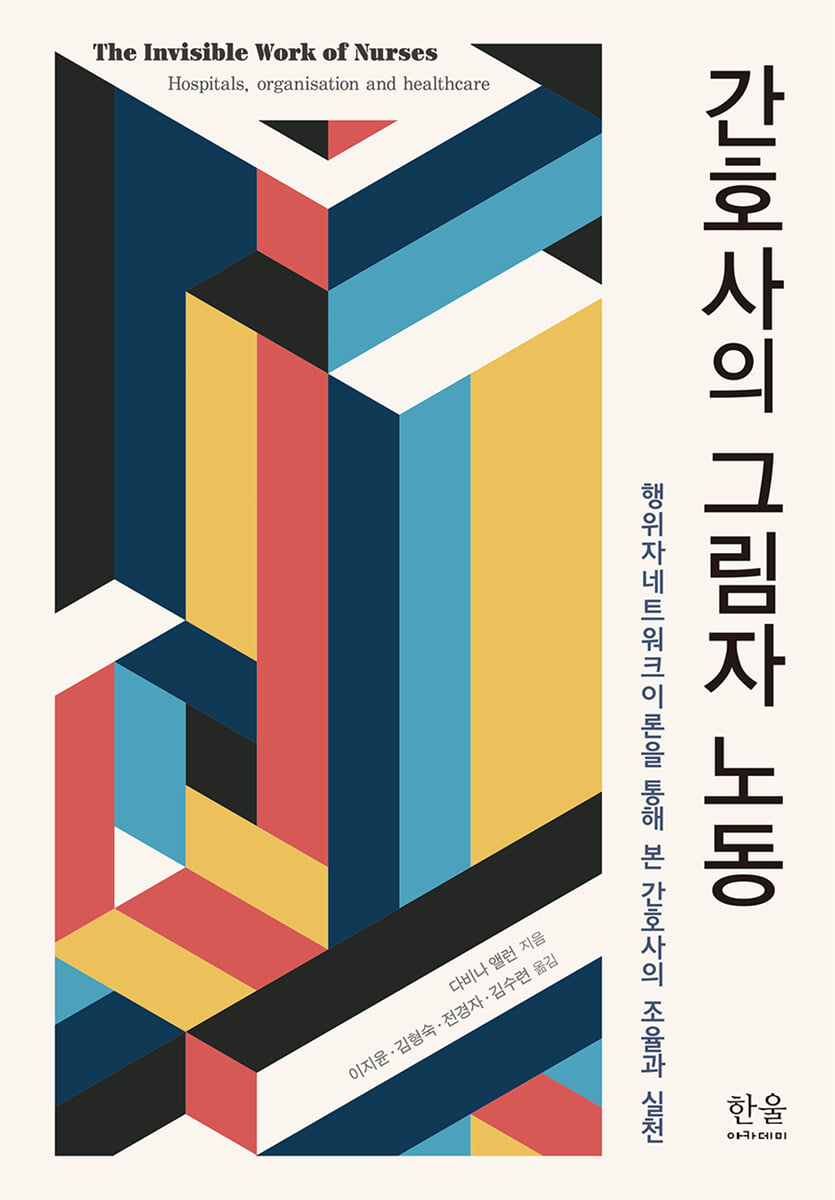 |
Description
Book Introduction
How do nurses fill the gaps in the organization?
Reassessing nursing's social contribution by highlighting the invisible aspects of nurses' work.
In this book, author Davina Allen argues that nurses play a vital role in organizing health care, and she substantiates this claim with data from observational studies of nurses' daily work.
By synthesizing insights from practice-based approaches, actor-network theory, and neo-institutionalism, we attempt to explain healthcare organizations and (re)conceptualize how nursing fills the gaps in these organizations.
This book, which reveals the invisible work of nurses, moves beyond the traditional understanding of nursing as a caregiving identity and focuses on the crucial and valuable work nurses do in large organizations like hospitals: bringing diverse actors into networks and balancing the needs of patients and the organization while maintaining a holistic view.
This may pose a challenge to traditional understandings of the health care system and the role of nurses, and may have important implications for improving services, training nurses, and structuring the nursing workforce.
The primary goal of this book is to highlight the previously neglected functions of nursing, the knowledge and skills that support them, and the characteristics of the healthcare system that makes them possible.
Through this, we aim to provide an integrated understanding of real-world nursing practice and, based on this, provide a new perspective on nurse education, workforce planning, and healthcare service management.
Reassessing nursing's social contribution by highlighting the invisible aspects of nurses' work.
In this book, author Davina Allen argues that nurses play a vital role in organizing health care, and she substantiates this claim with data from observational studies of nurses' daily work.
By synthesizing insights from practice-based approaches, actor-network theory, and neo-institutionalism, we attempt to explain healthcare organizations and (re)conceptualize how nursing fills the gaps in these organizations.
This book, which reveals the invisible work of nurses, moves beyond the traditional understanding of nursing as a caregiving identity and focuses on the crucial and valuable work nurses do in large organizations like hospitals: bringing diverse actors into networks and balancing the needs of patients and the organization while maintaining a holistic view.
This may pose a challenge to traditional understandings of the health care system and the role of nurses, and may have important implications for improving services, training nurses, and structuring the nursing workforce.
The primary goal of this book is to highlight the previously neglected functions of nursing, the knowledge and skills that support them, and the characteristics of the healthcare system that makes them possible.
Through this, we aim to provide an integrated understanding of real-world nursing practice and, based on this, provide a new perspective on nurse education, workforce planning, and healthcare service management.
index
introduction
Note
Chapter 1: Swapping the Foreground and Background
(The 'invisible work' of nurses) │ 'Invisible work' even in 21st century nursing reform: Nurses' organizational work │ Theoretical background for studying nurses' organizational work: Practice-based theory and actor-network theory │ Research methods for studying nurses' organizational work: Research subjects and data collection │ Modern healthcare system and nurses' organizational work: Introduction to the research contents │ Conclusion
Chapter 2: Creating Business Knowledge Using Treatment Trajectory Narratives
Difficulties in knowledge sharing in treatment trajectories │ Nurses are a key resource in managing treatment trajectories │ Creating treatment trajectory narratives │ Summarizing treatment trajectory narratives │ Building understanding through interpretation of treatment trajectory narratives │ Tasks │ Discussion │ Conclusion
Chapter 3: Coordinating Treatment Trajectories
Bringing patients into the healthcare system │ Advancing the treatment trajectory │ Coordinating time │ Assigning activities │ Coordinating supplies │ Integrative coordination │ Maintaining progress │ Understanding and coordinating the activity system │ Tasks │ Discussion │ Conclusion
Chapter 4: Matching Patients and Beds
Bed Management: The Nurse's Role │ Matching Patients to Beds │ What is a Bed? │ How Are Patients Typed? │ Determining Available Beds and Bed Demand │ Matching Activities in Practice │ Challenges │ Discussion │ Conclusion
Chapter 5: Transitioning from Baton Passing to Patient Parsing
Rethinking Treatment Transfer │ Stabilizing Treatment Trajectories and Reconstructing Patients │ Challenges │ Discussion │ Conclusion
Chapter 6: Revisiting the Organizational Work of Nurses
The Social Organization of Hospital Work and Nursing │ From Organization of Work to Organization of Logic │ Back to the Future: Seeing the Future Through the Past │ Brave New World: Imagining the Nursing of the Future │ Conclusion
Search
Translator's Note
Note
Chapter 1: Swapping the Foreground and Background
(The 'invisible work' of nurses) │ 'Invisible work' even in 21st century nursing reform: Nurses' organizational work │ Theoretical background for studying nurses' organizational work: Practice-based theory and actor-network theory │ Research methods for studying nurses' organizational work: Research subjects and data collection │ Modern healthcare system and nurses' organizational work: Introduction to the research contents │ Conclusion
Chapter 2: Creating Business Knowledge Using Treatment Trajectory Narratives
Difficulties in knowledge sharing in treatment trajectories │ Nurses are a key resource in managing treatment trajectories │ Creating treatment trajectory narratives │ Summarizing treatment trajectory narratives │ Building understanding through interpretation of treatment trajectory narratives │ Tasks │ Discussion │ Conclusion
Chapter 3: Coordinating Treatment Trajectories
Bringing patients into the healthcare system │ Advancing the treatment trajectory │ Coordinating time │ Assigning activities │ Coordinating supplies │ Integrative coordination │ Maintaining progress │ Understanding and coordinating the activity system │ Tasks │ Discussion │ Conclusion
Chapter 4: Matching Patients and Beds
Bed Management: The Nurse's Role │ Matching Patients to Beds │ What is a Bed? │ How Are Patients Typed? │ Determining Available Beds and Bed Demand │ Matching Activities in Practice │ Challenges │ Discussion │ Conclusion
Chapter 5: Transitioning from Baton Passing to Patient Parsing
Rethinking Treatment Transfer │ Stabilizing Treatment Trajectories and Reconstructing Patients │ Challenges │ Discussion │ Conclusion
Chapter 6: Revisiting the Organizational Work of Nurses
The Social Organization of Hospital Work and Nursing │ From Organization of Work to Organization of Logic │ Back to the Future: Seeing the Future Through the Past │ Brave New World: Imagining the Nursing of the Future │ Conclusion
Search
Translator's Note
Into the book
Celia Davis likened the "professional predicament" nurses face to polo mint.
Polo mints are a type of candy with a hole in the center, and Davis argues that the healthcare system distracts nurses from their core work with patients by demanding all the support they need to do their jobs.
The healthcare system is responsible for the loss of nurses' core function of caring for patients.
_ Pages 25-26 / Chapter 1: Swapping the Foreground and Background
On the other side of the spectrum, the Specialist Nurse Practitioners (SNPs) complain that there are problems with the patient care system at night and that when they arrive on the ward, nurses greet them with the words, “You’re not my patient.”
They lament the fact that there is no one person in charge of the ward as a whole.
The nurses only handed over their patients to each other, and there was no overall coordinator.
…Patient Access Nurses said they prefer to work on wards with a coordinator, and that it is frustrating when they ask someone a question and only hear, “Sorry, that’s not my patient.”
Pages 84-85 / Chapter 2: Creating Business Knowledge Using Treatment Trajectory Narratives
“Everyone was kind to me, but they didn’t really do anything for me.
Several medical staff said, 'You'll get better if you get an antibiotic injection,' but no one actually gave you one.
What I'm trying to say is that everyone was doing their own thing, but I kept slipping through the cracks.” According to Julie, it wasn't that the medical staff was indifferent to her.
Julie's treatment slipped through the cracks of the system.
These 'gaps' and the day-to-day tasks of managing them are the focus of this chapter.
_ Page 100 / Chapter 3 Coordinating the Treatment Trajectory
When trying to discharge a patient from the emergency room and they told me they didn't have their house keys, the coordinator would 'make some phone calls and contact his wife' to resolve the issue.
When doctors forgot to prescribe laxatives when a patient was being discharged, the attending nurse consulted with the pharmacist to ensure that discharge was not delayed because of this.
When Mrs. Green's discharge was delayed because she needed blister packs (divided pill bottles for each day of the week - translator's note), the nurse took the temporary measure of arranging for a local pharmacist to provide her with the medication.
Because hospital work is unpredictable and complex, it's natural to work flexibly to cope.
_ Page 126 / Chapter 3 Coordinating the Treatment Trajectory
Coordinator: “There was a huge argument yesterday about a patient in the hospital room.
[···] The doctor wanted to send the patient to a transitional care unit (a special facility within the hospital or operated in a separate building where patients who have completed acute treatment can receive additional treatment, rehabilitation, or social support before being discharged - translator's note), but that too was full.
So we were working on another safe discharge plan.
The patient's ultimate goal is to return home, but the doctor says, "No, you can't.
I need to go to the transition room.
“If the patient likes it there, they can go there,” he said.
I know we need to give patients all the options.
However, since the patient is currently in an acute care hospital bed, he or she may continue to be exposed to the risk of infection.
[···] Anyway, what the discharge nurse was trying to do was blocked by the doctor.
[···] The doctor focused on the patient and argued that a transitional care unit bed was needed.
It's all good, but the problem is that it's full.
We live in the real world.
There are patients in the emergency room hallway and patients from other departments in the surgical ward, so we can't keep these patients lying in acute care beds.
We need to find an alternative.
“Doctors only think about their patients, but we consider the entire system.” _ Pages 164-165 / Chapter 4 Matching Patients to Beds
Once all the paperwork was completed, the ward nurse notified the operating room electronically, and the operating room staff received the patient with little or no interaction with the ward nurses.
At this time, a checklist that acts as a translator mediating contact between departments and allows for efficient processing of a large amount of information without missing anything is used to cross boundaries and ensure safe surgery.
This process can be viewed as a technologically mediated patient transfer, made possible by pre-hospital work to assess the patient's suitability for surgery before admission and to develop carefully designed documentation to support patient flow on the day of surgery.
This is an example of black-boxing, as described in actor-network theory, where technology is taken for granted and the complex socio-material relationships that constitute it become invisible.
However, many healthcare encounters cannot be managed in this way, and successful boundary crossing relies on more complex conditions.
A good example is the transfer of a patient from the recovery room to the surgical ward.
_ Pages 193-194 / Chapter 5: Transitioning from Baton Passing to Patient Parsing
“This paperwork is just ridiculous,” the nurse said.
He said the ward was very busy and his feet were often on fire.
Excessive paperwork is making this situation worse and taking away time from patient care.
He also talked about the various forms and brochures used in different departments within the hospital, and the time it takes to copy and transfer information from one format to another.
[…] He said, “As long as all the documents are the same, it’s fine.
It is okay to receive patients from the Green Ward using the same document.
“However, the surgical patient assessment room uses a pink form, and the internal medicine patient assessment room uses a large yellow form,” he said.
_ Page 214 / Chapter 5: Transitioning from Baton Passing to Patient Parsing
Throughout this book, I have argued that nurses are a necessary part of healthcare organizations.
A mandatory passing point is a functionally essential element in an actor network that all other actors must pass through.
Nurses are network builders and key mediators, connecting the various elements that make up the network, arranging treatment trajectories, and, when necessary, separating them.
In health care, there is little that goes on without a nurse.
However, to take this role of nurses seriously and to secure the legitimacy of the logic that underpins their organizing work, it is important to go beyond metaphors and analogies—lubricants, adhesives, and connective tissue.
And we need to develop a formal language to describe the mechanisms of that activity.
_ Pages 229-230 / Chapter 6: Revisiting the Organizational Work of Nurses
One of the objectives of this study is to identify the knowledge and skills that support organizational work.
Let's consider the issue of considering organizational work as something other than the official duties of nurses and explore ways to provide nurses with the necessary training and professional development for organizational work.
When studying practice with cultural technology, we should not seek knowledge that resides in the minds of participants, but rather knowledge that is actually used in activities, events, and procedures.
A closer look at the organizational work of nurses revealed that effective translational mobilization requires a combination of clinical and organizational knowledge.
…The synthesis of these two types of knowledge can be called the nurse’s unique professional vision.
Page 231 / Chapter 6: Revisiting the Organizational Work of Nurses
Polo mints are a type of candy with a hole in the center, and Davis argues that the healthcare system distracts nurses from their core work with patients by demanding all the support they need to do their jobs.
The healthcare system is responsible for the loss of nurses' core function of caring for patients.
_ Pages 25-26 / Chapter 1: Swapping the Foreground and Background
On the other side of the spectrum, the Specialist Nurse Practitioners (SNPs) complain that there are problems with the patient care system at night and that when they arrive on the ward, nurses greet them with the words, “You’re not my patient.”
They lament the fact that there is no one person in charge of the ward as a whole.
The nurses only handed over their patients to each other, and there was no overall coordinator.
…Patient Access Nurses said they prefer to work on wards with a coordinator, and that it is frustrating when they ask someone a question and only hear, “Sorry, that’s not my patient.”
Pages 84-85 / Chapter 2: Creating Business Knowledge Using Treatment Trajectory Narratives
“Everyone was kind to me, but they didn’t really do anything for me.
Several medical staff said, 'You'll get better if you get an antibiotic injection,' but no one actually gave you one.
What I'm trying to say is that everyone was doing their own thing, but I kept slipping through the cracks.” According to Julie, it wasn't that the medical staff was indifferent to her.
Julie's treatment slipped through the cracks of the system.
These 'gaps' and the day-to-day tasks of managing them are the focus of this chapter.
_ Page 100 / Chapter 3 Coordinating the Treatment Trajectory
When trying to discharge a patient from the emergency room and they told me they didn't have their house keys, the coordinator would 'make some phone calls and contact his wife' to resolve the issue.
When doctors forgot to prescribe laxatives when a patient was being discharged, the attending nurse consulted with the pharmacist to ensure that discharge was not delayed because of this.
When Mrs. Green's discharge was delayed because she needed blister packs (divided pill bottles for each day of the week - translator's note), the nurse took the temporary measure of arranging for a local pharmacist to provide her with the medication.
Because hospital work is unpredictable and complex, it's natural to work flexibly to cope.
_ Page 126 / Chapter 3 Coordinating the Treatment Trajectory
Coordinator: “There was a huge argument yesterday about a patient in the hospital room.
[···] The doctor wanted to send the patient to a transitional care unit (a special facility within the hospital or operated in a separate building where patients who have completed acute treatment can receive additional treatment, rehabilitation, or social support before being discharged - translator's note), but that too was full.
So we were working on another safe discharge plan.
The patient's ultimate goal is to return home, but the doctor says, "No, you can't.
I need to go to the transition room.
“If the patient likes it there, they can go there,” he said.
I know we need to give patients all the options.
However, since the patient is currently in an acute care hospital bed, he or she may continue to be exposed to the risk of infection.
[···] Anyway, what the discharge nurse was trying to do was blocked by the doctor.
[···] The doctor focused on the patient and argued that a transitional care unit bed was needed.
It's all good, but the problem is that it's full.
We live in the real world.
There are patients in the emergency room hallway and patients from other departments in the surgical ward, so we can't keep these patients lying in acute care beds.
We need to find an alternative.
“Doctors only think about their patients, but we consider the entire system.” _ Pages 164-165 / Chapter 4 Matching Patients to Beds
Once all the paperwork was completed, the ward nurse notified the operating room electronically, and the operating room staff received the patient with little or no interaction with the ward nurses.
At this time, a checklist that acts as a translator mediating contact between departments and allows for efficient processing of a large amount of information without missing anything is used to cross boundaries and ensure safe surgery.
This process can be viewed as a technologically mediated patient transfer, made possible by pre-hospital work to assess the patient's suitability for surgery before admission and to develop carefully designed documentation to support patient flow on the day of surgery.
This is an example of black-boxing, as described in actor-network theory, where technology is taken for granted and the complex socio-material relationships that constitute it become invisible.
However, many healthcare encounters cannot be managed in this way, and successful boundary crossing relies on more complex conditions.
A good example is the transfer of a patient from the recovery room to the surgical ward.
_ Pages 193-194 / Chapter 5: Transitioning from Baton Passing to Patient Parsing
“This paperwork is just ridiculous,” the nurse said.
He said the ward was very busy and his feet were often on fire.
Excessive paperwork is making this situation worse and taking away time from patient care.
He also talked about the various forms and brochures used in different departments within the hospital, and the time it takes to copy and transfer information from one format to another.
[…] He said, “As long as all the documents are the same, it’s fine.
It is okay to receive patients from the Green Ward using the same document.
“However, the surgical patient assessment room uses a pink form, and the internal medicine patient assessment room uses a large yellow form,” he said.
_ Page 214 / Chapter 5: Transitioning from Baton Passing to Patient Parsing
Throughout this book, I have argued that nurses are a necessary part of healthcare organizations.
A mandatory passing point is a functionally essential element in an actor network that all other actors must pass through.
Nurses are network builders and key mediators, connecting the various elements that make up the network, arranging treatment trajectories, and, when necessary, separating them.
In health care, there is little that goes on without a nurse.
However, to take this role of nurses seriously and to secure the legitimacy of the logic that underpins their organizing work, it is important to go beyond metaphors and analogies—lubricants, adhesives, and connective tissue.
And we need to develop a formal language to describe the mechanisms of that activity.
_ Pages 229-230 / Chapter 6: Revisiting the Organizational Work of Nurses
One of the objectives of this study is to identify the knowledge and skills that support organizational work.
Let's consider the issue of considering organizational work as something other than the official duties of nurses and explore ways to provide nurses with the necessary training and professional development for organizational work.
When studying practice with cultural technology, we should not seek knowledge that resides in the minds of participants, but rather knowledge that is actually used in activities, events, and procedures.
A closer look at the organizational work of nurses revealed that effective translational mobilization requires a combination of clinical and organizational knowledge.
…The synthesis of these two types of knowledge can be called the nurse’s unique professional vision.
Page 231 / Chapter 6: Revisiting the Organizational Work of Nurses
--- From the text
Publisher's Review
Illuminating the "invisible" aspects of nursing through rich case studies and in-depth analysis. The organizational work of nurses is the foreground that can receive the light, while direct patient care is the shadow in the background.
The work performed by nurses goes beyond simple medical skills; it is a complex and comprehensive activity that forms the core of hospital operations and patient care.
“Nursing’s Shadow Labor” is a book that deeply explores the essence of nursing.
Nurses work in the gaps of the health care system, coordinating the arrangement of actors providing care, connecting various professions, departments, and organizations, and mediating between the 'needs' of individual patients and the 'needs' of the entire population.
This process is called 'organization work'.
Organizing tasks is part of the nurse's role, often referred to as the "glue" in the health care system.
This is essential to the quality of service, but is often taken for granted or at least ignored until problems arise.
Although it is estimated that this work accounts for more than 70% of a nurse's work, it is usually not recognized as an official right of the nursing profession.
In past studies, it has been considered a factor that hinders direct patient care rather than a unique right or action of nurses.
The purpose of this book is to place direct patient care in the background, in the shadows, so that the organizational work of nurses can be foregrounded and illuminated.
This book focuses on the 'invisible work' performed by nurses.
The role of nurses in understanding individual patient needs, coordinating collaboration across departments, and addressing unexpected situations is essential to ensuring the efficiency and safety of the healthcare system, yet it is often relegated to outside the formal scope of their duties or undervalued.
In this book, author Davina Allen illuminates these "invisible" aspects of nursing in a three-dimensional way through rich real-world examples and in-depth analysis.
Understanding nurses' "invisible work" ultimately improves the quality of patient care.
This book delves into the holistic and complex roles and "invisible" contributions of nurses, including informal communication with patients, collaboration among colleagues, and unexpected problem-solving that are not included in formal job descriptions.
It vividly shows how nurses promote collaboration and serve as the 'central axis' of communication within the complex organization of a hospital.
It also provides insight into how understanding the “invisible work” of nurses can ultimately improve the quality of patient care.
It provides implications for medical policy by re-evaluating the role of nursing and providing policy suggestions for building a more efficient hospital system.
This book will be a valuable resource for nursing researchers, hospital administrators, healthcare policy makers, and anyone seeking a deeper understanding of the work of nurses.
Especially at a time when discussions are actively taking place on the role and value of nurses in the Korean medical field, this will provide an important opportunity to rethink the essence of nursing.
Key Contents
Chapter 1 introduces the research that formed the basis of this book.
Practice-based theory and actor network theory are the theoretical backgrounds for studying the organizational work of nurses.
In the following chapters, we will describe the organizational work of nurses in four areas and explain the characteristics of the systems that emerge from them.
Chapter 2 examines how nursing contributes to the flow of information.
Nurses develop, maintain, and pass on 'trajectory narratives' that follow the flow of care, forming work knowledge to support service delivery.
Chapter 3 explores the role of nurses in coordinating the treatment trajectory.
Although nurses are not generally recognized as central to the health care team, this book argues that they play a leading role in facilitating, registering, and coordinating the various activities necessary to meet patients' needs, ensuring that all elements fall into place.
Chapter 4 analyzes the contribution of nurses to bedside management.
One of the most effective ways to ensure that patients receive the right intervention at the right time and achieve the right outcome is to allocate beds appropriately.
In situations where acute care bed utilization is high, assigning appropriate beds is very difficult, and nurses play an increasingly important role in this situation.
Chapter 5 explores the work of nurses in facilitating patient movement between services.
Modern health care organizations are highly specialized, and with increasing pressure to ensure that those who can most benefit from them have access, patients are often shuttled between multiple departments during a single inpatient stay.
Differences between departments pose a potential threat to the quality and safety of care, and nurses are essential in mitigating these risks.
Chapter 6 integrates the above research results and examines their implications.
In summary, nurses are the ones who build the network of the medical system.
There is very little that does not pass through the hands of a nurse.
As a mandatory transit point, nurses enable the system, and their 'translational mobilisation' through their organizational work is an essential but taken-for-granted element of health care provision, ensuring the stability and consistency of services.
The work performed by nurses goes beyond simple medical skills; it is a complex and comprehensive activity that forms the core of hospital operations and patient care.
“Nursing’s Shadow Labor” is a book that deeply explores the essence of nursing.
Nurses work in the gaps of the health care system, coordinating the arrangement of actors providing care, connecting various professions, departments, and organizations, and mediating between the 'needs' of individual patients and the 'needs' of the entire population.
This process is called 'organization work'.
Organizing tasks is part of the nurse's role, often referred to as the "glue" in the health care system.
This is essential to the quality of service, but is often taken for granted or at least ignored until problems arise.
Although it is estimated that this work accounts for more than 70% of a nurse's work, it is usually not recognized as an official right of the nursing profession.
In past studies, it has been considered a factor that hinders direct patient care rather than a unique right or action of nurses.
The purpose of this book is to place direct patient care in the background, in the shadows, so that the organizational work of nurses can be foregrounded and illuminated.
This book focuses on the 'invisible work' performed by nurses.
The role of nurses in understanding individual patient needs, coordinating collaboration across departments, and addressing unexpected situations is essential to ensuring the efficiency and safety of the healthcare system, yet it is often relegated to outside the formal scope of their duties or undervalued.
In this book, author Davina Allen illuminates these "invisible" aspects of nursing in a three-dimensional way through rich real-world examples and in-depth analysis.
Understanding nurses' "invisible work" ultimately improves the quality of patient care.
This book delves into the holistic and complex roles and "invisible" contributions of nurses, including informal communication with patients, collaboration among colleagues, and unexpected problem-solving that are not included in formal job descriptions.
It vividly shows how nurses promote collaboration and serve as the 'central axis' of communication within the complex organization of a hospital.
It also provides insight into how understanding the “invisible work” of nurses can ultimately improve the quality of patient care.
It provides implications for medical policy by re-evaluating the role of nursing and providing policy suggestions for building a more efficient hospital system.
This book will be a valuable resource for nursing researchers, hospital administrators, healthcare policy makers, and anyone seeking a deeper understanding of the work of nurses.
Especially at a time when discussions are actively taking place on the role and value of nurses in the Korean medical field, this will provide an important opportunity to rethink the essence of nursing.
Key Contents
Chapter 1 introduces the research that formed the basis of this book.
Practice-based theory and actor network theory are the theoretical backgrounds for studying the organizational work of nurses.
In the following chapters, we will describe the organizational work of nurses in four areas and explain the characteristics of the systems that emerge from them.
Chapter 2 examines how nursing contributes to the flow of information.
Nurses develop, maintain, and pass on 'trajectory narratives' that follow the flow of care, forming work knowledge to support service delivery.
Chapter 3 explores the role of nurses in coordinating the treatment trajectory.
Although nurses are not generally recognized as central to the health care team, this book argues that they play a leading role in facilitating, registering, and coordinating the various activities necessary to meet patients' needs, ensuring that all elements fall into place.
Chapter 4 analyzes the contribution of nurses to bedside management.
One of the most effective ways to ensure that patients receive the right intervention at the right time and achieve the right outcome is to allocate beds appropriately.
In situations where acute care bed utilization is high, assigning appropriate beds is very difficult, and nurses play an increasingly important role in this situation.
Chapter 5 explores the work of nurses in facilitating patient movement between services.
Modern health care organizations are highly specialized, and with increasing pressure to ensure that those who can most benefit from them have access, patients are often shuttled between multiple departments during a single inpatient stay.
Differences between departments pose a potential threat to the quality and safety of care, and nurses are essential in mitigating these risks.
Chapter 6 integrates the above research results and examines their implications.
In summary, nurses are the ones who build the network of the medical system.
There is very little that does not pass through the hands of a nurse.
As a mandatory transit point, nurses enable the system, and their 'translational mobilisation' through their organizational work is an essential but taken-for-granted element of health care provision, ensuring the stability and consistency of services.
GOODS SPECIFICS
- Date of issue: September 25, 2025
- Format: Hardcover book binding method guide
- Page count, weight, size: 264 pages | 153*224*12mm
- ISBN13: 9788946075986
You may also like
카테고리
korean


korean

![GQ KOREA Mark (Monthly): December [2025]](http://librairie.coreenne.fr/cdn/shop/files/8ef265dbbfbf186523ed75ba7319009d.jpg?v=1765340328&width=3840)


