

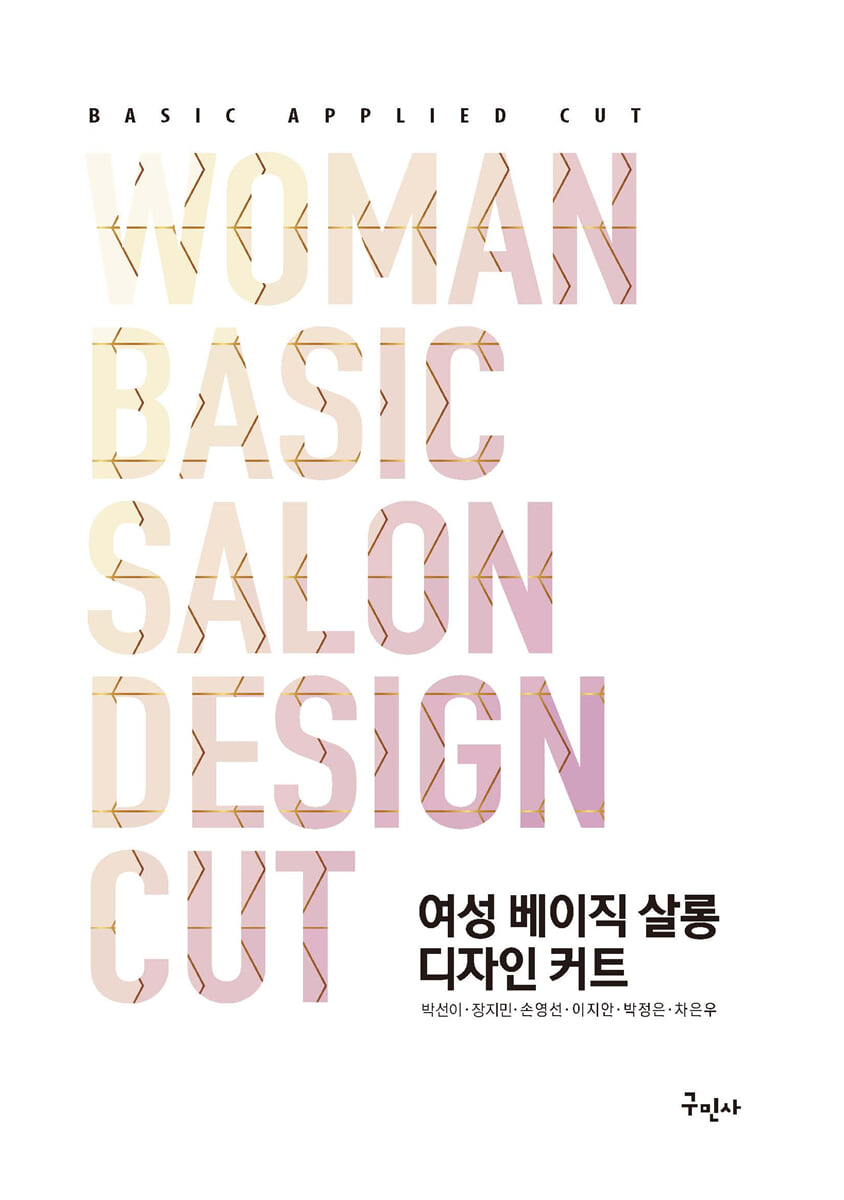
Women's Basic Salon Design Cut
 |
Description
Book Introduction
A cut is a process of expressing the style desired by the customer in an image that matches the customer's head and face shape.
In this process, we must take into account the curvature of the skull and the curves of the face.
Styles continue to evolve with the times, and as a hairdresser, it's your responsibility to adapt flexibly.
The author lacked both dexterity and a keen eye.
So Kurt always felt difficult, and I thought about why for a long time.
Eventually, I realized that the problem wasn't with the tools or the environment, but with myself.
The process of actually implementing the style in the photo or expressed in the customer's words was always fraught with conflict and difficulty.
Of course, the results may vary depending on the head shape, hair texture, and face shape, but that can never be an excuse for lack of skill.
A technician builds his or her skills through repeated practice and standardized standards.
I wanted to find a principle-based cutting method that anyone could follow, even if they lacked dexterity or an eye for detail.
And I included that content in this book.
In this process, we must take into account the curvature of the skull and the curves of the face.
Styles continue to evolve with the times, and as a hairdresser, it's your responsibility to adapt flexibly.
The author lacked both dexterity and a keen eye.
So Kurt always felt difficult, and I thought about why for a long time.
Eventually, I realized that the problem wasn't with the tools or the environment, but with myself.
The process of actually implementing the style in the photo or expressed in the customer's words was always fraught with conflict and difficulty.
Of course, the results may vary depending on the head shape, hair texture, and face shape, but that can never be an excuse for lack of skill.
A technician builds his or her skills through repeated practice and standardized standards.
I wanted to find a principle-based cutting method that anyone could follow, even if they lacked dexterity or an eye for detail.
And I included that content in this book.
- You can preview some of the book's contents.
Preview
index
Part 1: Women's Basic Salon Design Cut Theory
1.
Types and characteristics of basic cuts
2.
Head point
3.
Division and names of the skull
4.
Division and naming of the skull
5.
section
6.
distribution
7.
The concept of up, down, left, and right of the cut
8.
Treatment angle
9.
base
10.
Guidelines
11.
Finger/Scissor Position
12.
Distinguishing between different types of haircuts by head area
13.
Outline
14.
Types and techniques of cutting tools and instruments
15.
Types of haircut techniques
16.
Texture technique
Part 2: Women's Basic Salon Design Cut Practice
Chapter 1 Basic One-Length Cut Style
[Style number 1] Long one-length cut square line
[Style number 2] Long one-length cut with round lines
[Style number 3] Medium one-length cut
[Style number 4] Natural one-length bob cut
[Style number 5] Mushroom one-length cut
Chapter 2 Basic Gradient Incremental
[Style number 6] Low gradient cut increase
[Style number 7] Medium gradient cut increase
[Style number 8] High gradient cut increase
Chapter 3 Basic Layer
[Style number 9] Long layer cut square line
[Style number 10] Long layer cut round line
[Style number 11] Medium layer cut application
Chapter 4 Basic Short Cut Line
[Style number 12] Short cut square line
[Style number 13] Short cut round line
1.
Types and characteristics of basic cuts
2.
Head point
3.
Division and names of the skull
4.
Division and naming of the skull
5.
section
6.
distribution
7.
The concept of up, down, left, and right of the cut
8.
Treatment angle
9.
base
10.
Guidelines
11.
Finger/Scissor Position
12.
Distinguishing between different types of haircuts by head area
13.
Outline
14.
Types and techniques of cutting tools and instruments
15.
Types of haircut techniques
16.
Texture technique
Part 2: Women's Basic Salon Design Cut Practice
Chapter 1 Basic One-Length Cut Style
[Style number 1] Long one-length cut square line
[Style number 2] Long one-length cut with round lines
[Style number 3] Medium one-length cut
[Style number 4] Natural one-length bob cut
[Style number 5] Mushroom one-length cut
Chapter 2 Basic Gradient Incremental
[Style number 6] Low gradient cut increase
[Style number 7] Medium gradient cut increase
[Style number 8] High gradient cut increase
Chapter 3 Basic Layer
[Style number 9] Long layer cut square line
[Style number 10] Long layer cut round line
[Style number 11] Medium layer cut application
Chapter 4 Basic Short Cut Line
[Style number 12] Short cut square line
[Style number 13] Short cut round line
Publisher's Review
* The six principles of Kurt
1.
The same method of dividing equally is applied.
2.
The angle is based on the head angle, and the type of cut is distinguished by the difference in length.
3.
Set the base of the cut using only on-base and overdirection.
(The falling line varies depending on the curve of the skull, so determine the base accordingly.)
4.
First, understand the overall aesthetic.
(square line, round line, combax, concave, full angle, back angle, etc.)
5.
When cutting, make sure to maintain equal division and base when processing the texture.
6.
The point of the head is the standard. (The point of the head is determined by measuring the length and circumference of the wig head in centimeters. This value may vary from customer to customer, so it is important to be aware of the difference.)
* Book structure
This book is systematically divided into theory and practice so that it can be applied directly to real-world situations.
Part 1 - Theory: This section outlines the essential basic principles for cutting.
Part 2 - Practical section is centered around women's basic cut practice.
Chapter 1.
Basic one-length line long, medium, bob, mushroom, etc. cutting techniques based on shoulder line are explained.
Chapter 2.
The basic gradient line focuses on low, medium, and high shapes, focusing on the volume and outline of the back of the head.
Chapter 3.
Basic Layer Line This explains how to create square and round lines based on a 90-degree angle between the two layers.
Chapter 4.
Basic Shortcut Line A shortcut style that applies the basic techniques of chapters 1 to 3, and includes square and round line cuts.
It contains a total of 13 basic cuts that can be easily and accurately followed, and is organized into styles that can be applied and created.
This book is based on cutting methods proven in salons and educational settings.
We also made it possible to watch videos.
We have provided video practice through QR codes in each chapter.
1.
The same method of dividing equally is applied.
2.
The angle is based on the head angle, and the type of cut is distinguished by the difference in length.
3.
Set the base of the cut using only on-base and overdirection.
(The falling line varies depending on the curve of the skull, so determine the base accordingly.)
4.
First, understand the overall aesthetic.
(square line, round line, combax, concave, full angle, back angle, etc.)
5.
When cutting, make sure to maintain equal division and base when processing the texture.
6.
The point of the head is the standard. (The point of the head is determined by measuring the length and circumference of the wig head in centimeters. This value may vary from customer to customer, so it is important to be aware of the difference.)
* Book structure
This book is systematically divided into theory and practice so that it can be applied directly to real-world situations.
Part 1 - Theory: This section outlines the essential basic principles for cutting.
Part 2 - Practical section is centered around women's basic cut practice.
Chapter 1.
Basic one-length line long, medium, bob, mushroom, etc. cutting techniques based on shoulder line are explained.
Chapter 2.
The basic gradient line focuses on low, medium, and high shapes, focusing on the volume and outline of the back of the head.
Chapter 3.
Basic Layer Line This explains how to create square and round lines based on a 90-degree angle between the two layers.
Chapter 4.
Basic Shortcut Line A shortcut style that applies the basic techniques of chapters 1 to 3, and includes square and round line cuts.
It contains a total of 13 basic cuts that can be easily and accurately followed, and is organized into styles that can be applied and created.
This book is based on cutting methods proven in salons and educational settings.
We also made it possible to watch videos.
We have provided video practice through QR codes in each chapter.
GOODS SPECIFICS
- Date of issue: September 20, 2025
- Page count, weight, size: 163 pages | 210*297*20mm
- ISBN13: 9791168755963
- ISBN10: 1168755964
You may also like
카테고리
korean


korean

![ELLE 엘르 스페셜 에디션 A형 : 12월 [2025]](http://librairie.coreenne.fr/cdn/shop/files/b8e27a3de6c9538896439686c6b0e8fb.jpg?v=1766436872&width=3840)


