

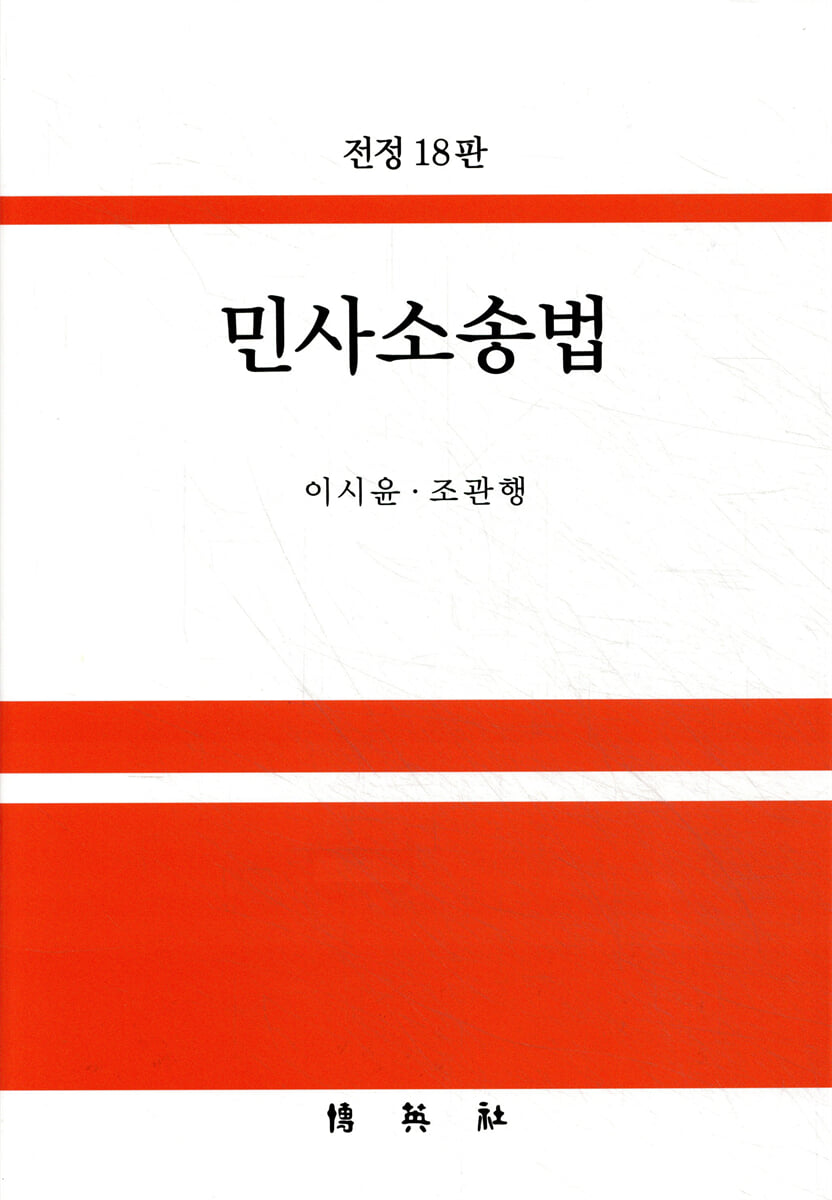
Civil Procedure Act
 |
Description
Book Introduction
『Civil Procedure Law』 is a system book on civil procedure, and is neither a purely practical book nor a commentary that encompasses all doctrines and theories.
This book focuses on functioning as a systematic guide that organizes and introduces the core theories, case law, and practices of civil litigation to law students taking civil procedure law, practitioners in charge of civil trial practice, and related scholars.
Therefore, this book is not only a systematic book, but also an academic and practical one, and we have tried to organize it so that you can understand the theory, case law, and practice of related civil litigation without having to refer to thick commentaries or practical books.
This book focuses on functioning as a systematic guide that organizes and introduces the core theories, case law, and practices of civil litigation to law students taking civil procedure law, practitioners in charge of civil trial practice, and related scholars.
Therefore, this book is not only a systematic book, but also an academic and practical one, and we have tried to organize it so that you can understand the theory, case law, and practice of related civil litigation without having to refer to thick commentaries or practical books.
index
Part 1 General Theory
Chapter 1 Civil Litigation
Section 1 Purpose of Civil Litigation 2
Section 2: The Concept of Civil Litigation and Its Relationship with Other Litigation 4
Ⅰ.
Concept of Civil Procedure 4
Ⅱ.
7. Litigation other than civil litigation and its relationship to civil litigation
1.
Criminal Procedure/7 2.
Administrative Litigation/9
3.
Domestic Litigation/13 4.
Non-litigious case/14
Section 3: Alternative Dispute Resolution (ADR) as an Alternative to Litigation 17
Ⅰ.
General 17
Ⅱ.
Reconciliation 19
Ⅲ.
Adjustment 20
Ⅳ.
Arbitration 24
Section 4: Ideals and Good Faith in Civil Procedure 25
Ⅰ.
Civil Procedure Ideal 26
1.
More accurate/26 2.
Due Process/27
3.
Speedy/28 4.
Economy (lower cost)/29
Ⅱ.
The Reality of Civil Litigation 30
Ⅲ.
Civil Procedure and the Principle of Good Faith 31
1.
General/31 2.
Scope of Persons Subject to the Rules of God/32
3.
Types of Violations of the Rules of God/32 4.
Effect/36
Section 5 Types of Civil Procedures 37
Ⅰ.
Standard Litigation Procedure 38
1.
Judgment Procedure/38 2.
Civil Execution Procedure/38 3.
Supplementary Procedure/38
Ⅱ.
Special Litigation Procedure 39
1.
Summary Litigation Procedure/39 2.
Domestic Litigation Procedure (see page 12)/39 3.
Bankruptcy proceedings/39
Chapter 2 Civil Procedure Act
Section 1: The Significance and Character of Civil Procedure Act 41
Ⅰ.
Meaning 41
Ⅱ.
Personality 42
Section 2 Interpretation and Types of Civil Procedure Rules 43
Ⅰ.
Interpretation 43
Ⅱ.
Type 44
1.
Effectiveness Regulations and Instruction Regulations/45 2.
Mandatory and Optional Provisions/45
Section 3 Limits to the Effect of the Civil Procedure Act 46
Ⅰ.
Poetic Limits 46
Ⅱ.
Locational limitations 46
Section 4: History of Civil Procedure Act 47
Ⅰ.
Application of Japanese Civil Procedure Law 47
Ⅱ.
History of Civil Procedure Act and Old Civil Procedure Act 48
Ⅲ.
1990 Third Amendment Act No. 49
Ⅳ.
1994 Judicial Reform Act 49
V.
Article 50 of the New Civil Procedure Act, revised in 2002
1.
In terms of system/50 2.
In terms of content/50
Ⅵ.
Amendment Act 51 after the New Civil Procedure Act
1.
Improving the efficiency of judicial personnel/51 2.
Class action system reform, etc./51
3.
Follow-up legislation regarding the electronic litigation system, patent infringement litigation system, and adult guardianship system, etc./52
Ⅶ.
Future Civil Justice Challenges 53
Part 2 Subjects of the Litigation
Chapter 1 Court
Section 1 Civil Jurisdiction 58
Ⅰ.
Judicial power (judicial power) general 58
Ⅱ.
Civil jurisdiction 59
1.
Human scope/59 2.
Material Scope - International Jurisdiction/62
3.
Geographical scope/67 4.
Effects of Lack of Jurisdiction/67
Section 2 Types and Composition of Civil Courts 68
Ⅰ.
Types of Courts and the Instance System 68
1.
Types of Civil Courts/68 2.
Emergency system/69
Ⅱ.
Composition of the Court 71
1.
The significance of the court/71 2.
Judicial organ (court in the narrow sense)/71 3.
Agreement/73
Ⅲ.
Judge 75
1.
Types of Judges and Qualifications for Appointment/75
2.
Judicial Independence - Trials by Independent Judges/75
Ⅳ.
Other judicial authorities 78
1.
Court clerk, etc./78 2.
Judicial Assistant (Rechtspfleger)/79
3.
Executor/80 4.
Judicial Research Officer and Judicial Researcher/80
5.
Professional Psychologist/81 6.
Lawyer/81 7.
Prosecutors and Police Officers/83
Section 3: Recusal, Refusal, and Avoidance of Judges 83
Ⅰ.
The significance and scope of the system 83
Ⅱ.
Judicial Disqualification—Exclusion by Law 84
1.
Reason for rejection/84 2.
The Trial of the Dismissed/86 3.
The Effect of Rejection/86
Ⅲ.
Challenge of a Judge—Exclusion by Application 86
1.
Reasons for avoidance/87 2.
Application for avoidance/89
3.
Trial on the motion for recusal/90 4.
Effect of the application for avoidance/90
Ⅳ.
Judicial Recusal—Voluntary Exclusion 91
Section 4 Jurisdiction 92
The meaning and types of jurisdiction in Article 1, Section 92
Ⅰ.
The meaning of jurisdiction 92
Ⅱ.
Type of jurisdiction 93
1.
Jurisdiction based on legal, financial, and party behavior/93
2.
Exclusive Jurisdiction and Discretionary Jurisdiction/93
Article 2, Section 95, Jurisdiction
1.
Concept/95 2.
Jurisdiction of the Hydrogen Court and the Enforcement Court/95
3.
Jurisdiction of a single judge of a district court, a collegiate panel of district courts, and a collegiate panel of the main court/96
4.
Emergency Jurisdiction/96
Article 3, Jurisdiction over Matters 97
Ⅰ.
Concept 97
Ⅱ.
Jurisdiction of the collegiate body (Article 32, Paragraph 1 of the Act) 98
Ⅲ.
Jurisdiction of a single judge 99
1.
Specific jurisdiction/99 2.
Three-tiered classification of single-case cases (high, medium, and small amounts)/100
Ⅳ.
The value of the lawsuit (the claim) is 100
1.
The meaning of cows/100 2.
Calculation method of cattle price/100
3.
Standard time of calculation/101 4.
Case of merger of claims/102
Article 4 Territorial Jurisdiction (Jurisdiction) 103
Ⅰ.
Meaning and Types 103
Ⅱ.
Ordinary Court 105
Ⅲ.
Special Court 105
Ⅳ.
Related Jurisdiction (Jurisdiction of Consolidated Claim) 111
Article 5 Designated Jurisdiction 113
1.
Significance/113 2.
Cause of designation/113 3.
Designation Procedure/113
4.
Effect of Designation/114
Article 6, Agreeable Jurisdiction 114
1.
Significance/114 2.
Temperament/115 3.
This requirement/115
4.
The Appearance of Agreement/117 5.
Validity of Agreement/118
Article 7 Jurisdiction over Arguments (Jurisdiction over Response) 120
1.
Significance/120 2.
This requirement (Article 30)/120 3.
Effect/121
Investigation under the jurisdiction of Section 8, Article 121
1.
Ex officio investigation/121 2.
Investigation Level/Data/122
3.
Standard time for jurisdictional decision/122 4.
Results of the investigation/123
Transfer of Litigation in Section 9 123
Ⅰ.
Meaning 123
Ⅱ.
Reason for transfer (transfer requirements) 124
1.
Transfer due to violation of jurisdiction (Article 34, Paragraph 1)/124
2.
Transfer at the referee's discretion/127
3.
Transfer by counterclaim (Article 269, Paragraph 2)/130
Ⅲ.
Transfer Procedure 130
Ⅳ.
Effect of transfer 131
1.
Binding force/131 2.
Transfer of litigation/132 3.
Submission of litigation records/132
Chapter 2 Parties
Section 1 General Provisions 133
Ⅰ.
The meaning of the parties 133
Ⅱ.
Parties' adversarialism (Zweiparteienprinzip) 134
Ⅲ.
Parties' Rights (Procedural Fundamental Rights) 135
Section 2 Confirmation of Parties 138
Ⅰ.
Meaning 138
Ⅱ.
Theory on the Criteria of Confirmation 138
Ⅲ.
Correction of party indication 140
Ⅳ.
Denial of legal personality and correction of party identification 142
V.
Litigation for the Use of a Name (Litigation for the Use of a False Name) - Investigation of the Parties' Identity 143
Ⅵ.
Litigation involving the deceased as a party 144
Section 3 Qualifications of Parties 147
Article 1, Parties' Capacity 147
Ⅰ.
Meaning 147
Ⅱ.
Person with capacity 148
1.
Person with legal capacity/148 2.
Non-corporate associations/foundations/150
Ⅲ.
Investigation of the Parties' Capacity and the Effects of Lack of Capacity 154
Article 2, Parties' Qualifications 156
Ⅰ.
Concept 156
Ⅱ.
Persons with the qualifications to be parties (legitimate parties) 157
1.
General case/157 2.
Third-Party Litigation (Litigation Concerning the Rights of Others)/159
Ⅲ.
Effects of Lack of Party Qualification 164
Article 3, Litigation Capacity 165
Ⅰ.
Meaning 165
Ⅱ.
Persons with legal capacity 165
Ⅲ.
Litigation Capacity of Persons with Limited Capacity 166
Ⅳ.
The effect of litigation capacity on procedural law 168
1.
Validity requirements for litigation/168 2.
Chuin/168
3.
Investigation and Correction of Litigation Capacity/169
4.
The Impact of Litigation Deficiencies on Litigation/170
Article 4, Argumentative Ability 171
1.
Significance/171 2.
Persons incapable of defending/172
3.
Statement Assistant System to Supplement Defense Ability/173
4.
The Effects of Lack of Argumentative Ability/173
Section 4. Litigation Attorneys 175
Chapter 1, General Provisions 175
Ⅰ.
The Meaning of Agent 175
Ⅱ.
Types of Litigation Agents 175
Article 2 Legal Representative 176
Ⅰ.
Concept 176
Ⅱ.
Type 176
1.
Legal representative under substantive law/177 2.
Special Representatives in Litigation and Revised Law/177
Ⅲ.
Authority of Legal Representative 181
Ⅳ.
Status of Legal Representative 182
V.
Termination of Legal Representation 183
Ⅵ.
Representative of a corporation, etc. 184
1.
Introduction/184 2.
Representative body of corporation, etc./184
3.
Representative's authority and status/185
Article 3, Voluntary Representative (Litigation Representative) 186
Ⅰ.
Concepts and Types 186
Ⅱ.
Qualifications of a Litigation Representative - Principles of Attorney Representation 187
Ⅲ.
Granting of Litigation Powers 189
Ⅳ.
Scope of Litigation Representation 190
V.
Status of Litigation Agent 193
Ⅵ.
Termination of Litigation Representation 195
1.
Reasons for non-extinction (principle of non-extinction due to death of the person, etc.)/195 2.
Reason for termination/195
Article 4 Unauthorized Agents 196
1.
Concept/196 2.
Litigation Handling/196 3.
Prohibition of Dual Agency/198
4.
Litigation and Representation (Anscheinsvollmacht)/201
5.
Non-Attorney Representation/202
Part 3, First Trial Litigation Procedure
Chapter 1: Initiation of Litigation - Filing of Complaint and Defendant's Answer
Section 1: Meaning and Types of Cattle 204
Ⅰ.
The Meaning of a Lawsuit 204
Ⅱ.
Types of cattle 205
1.
Classification by nature and content of the application for judgment/205
2.
Classification by appearance and period of the fire extinguisher/214
Section 2 Litigation Requirements 214
Chapter 1, General Provisions 214
Ⅰ.
The significance of litigation requirements 216
Ⅱ.
Types of Litigation Requirements 216
Ⅲ.
The appearance of the lawsuit requirements 218
Ⅳ.
Investigation of Litigation Requirements 219
V.
Survey results 220
Article 222 of the Second Section: Interests of the Cattle (Rights Protection Requirements)
Ⅰ.
The Interests of the Cattle and the Theory of Petty Rights 222
1.
Judicial right of action/223 2.
Public Law Right of Action/223
Ⅱ.
Concept 224
Ⅲ.
Qualification for Protection of Rights (Common Interests of the Plaintiff) 225
Ⅳ.
Interest or necessity of protection of rights (specific interests of various types of cases) 233
1.
The Cattle of Implementation/233 2.
Confirmation of the cow/239 3.
Formation of the Cow/249
V.
Litigation Handling 250
Section 3 Litigation Matters 250
Ⅰ.
Litigation and its Practical Implications 250
Ⅱ.
Various Views on the Litigation 251
1.
Theory of Substantive Law (Old Litigation Theory)/251
2.
Litigation Law (New Litigation Theory)/252 3.
Theory of the New Substance/254
Ⅲ.
Case law position 255
Ⅳ.
Criticism of the Old Theory 258
1.
General Criticism/258 2.
Individual Criticism/258
V.
Various types of lawsuits and their specifics (reconstruction of lawsuits) 260
1.
Litigation of the execution of the suit/260 2.
Confirmation of the lawsuit/265
3.
Formation of the lawsuit/265 4.
A Review of Criticisms of the New Theory/267
5.
The Public Achievements of the New Theory/268
Section 4 Filing a Petition 269
Ⅰ.
Method of elimination 270
1.
Principle of submission of documents (Article 248)/270 2.
Exceptions to oral submissions, etc./271
3.
Consideration of the Sojegi/272 4.
Special Method of Compensation Order System/272
Ⅱ.
272 Details of the collection
1.
Required information (Article 249, Paragraph 1)/272 2.
Optional Entry (Article 249, Paragraph 2)/277
Section 5. Review of Petitions by the Presiding Judge, etc. and Actions Following Petition Filing 278
Ⅰ.
278 Review of petition by the presiding judge, etc.
1.
Opening/278 2.
Subject of Review/278
3.
Correction Order/279 4.
Order of the Chief of Staff/280 5.
Immediate Appeal/281
Ⅱ.
Delivery of a copy of the complaint (Article 255) and notification of the obligation to submit a response 281
Ⅲ.
Defendant's Obligation to Submit a Response and No-Argument Judgment 282
Ⅳ.
Designation of a hearing date or referral to preparatory procedures 284
Section 6 Litigation Structure 285
Ⅰ.
General 285
Ⅱ.
Structural Requirements 286
Ⅲ.
Structural Procedure 287
Ⅳ.
Effect of Structure 287
Section 7 Effect of the Firearm 289
Ⅰ.
Litigation Continuation 289
1.
Significance/289 2.
Occurrence Date/290 3.
Effect/290 4.
End/290
Ⅱ.
Prohibition of duplicate filings 291
1.
Significance/291 2.
Requirements/291 3.
Effect/298
4.
International Duplicate Filing (International Litigation)/299
Ⅲ.
Substantive Law Effect 300
1.
General/300 2.
Suspension of the statute of limitations/300 3.
Compliance with legal deadlines/303
4.
Effective Date and Expiration Date/304 5.
Statutory interest rate for delay damages/305
6.
Filing of Petitions and Illegal Activities/306
Public Opinion: Defendant's Defense Against the Indictment 307
Chapter 2 Argument (Trial)
Section 1: The Meaning and Types of Arguments 309
Ⅰ.
Meaning 309
Ⅱ.
Type 311
1.
Necessary Argument/311 2.
Arbitrary Argument/311
Section 2: Principles of Psychology 313
Article 1, Public Hearing Principle 313
Article 2, Section 315, Principle of Interrogation
Chapter 3: Oral Examination 316
Chapter 4 Direct Psychology 318
Article 5, Section 320, Dispositional Power
Ⅰ.
Meaning 320
Ⅱ.
Initiation of the Procedure 321
Ⅲ.
Subject and Scope of Judgment 321
1.
Qualitatively identical/322 2.
Quantitative same/323
Ⅳ.
End of Procedure 329
V.
Effects of Violation of the Principle of Dispositional Rights 330
Article 6, Section 330
Ⅰ.
Opening 330
1.
Meaning/330 2.
Grounds/330
3.
Critical Theory of Apologetics (Cooperativeism)/331
Ⅱ.
Contents of the argumentative essay 331
1.
Responsibility for asserting key facts/332 2.
The Binding Power of Confession/336
3.
Responsibility for Submitting Evidence (Prohibition of Ex officio Evidence Investigation)/337
Ⅲ.
The Limits of Deliberativeism 337
Ⅳ.
Supplementation and Modification of the Advocacy Principle (Duty of Truth) 337
V.
Exceptions (Limitations) to the Advocacy Principle 339
1.
Principle of ex officio investigation/339 2.
Matters under ex officio investigation/342
Ⅵ.
Seok Myeong-gwon 344
1.
Meaning/344 2.
Scope (Limits) of the Right to Seokmyeong/346
3.
Object of the Stone/347 4.
Exercise of the right to a memorial/355 5.
Disposition of clarification (Article 140)/356
Article 7, Timely Submission Principle (Submission Timing of Offensive and Defensive Methods) 357
Ⅰ.
Meaning 357
Ⅱ.
Contents of the Timely Submission Principle (Article 146) 358
Ⅲ.
A System for Ensuring the Effectiveness of the Timely Submission Principle—3.3 Effectiveness of Rights 358
1.
Financial Period System (Limited Period for Submission of Offensive and Defensive Methods)/358
2.
Dismissal of Missed Attack/Defense Methods (Article 149, Paragraph 1)/359
3.
Effect of the conclusion of the trial preparation period (Article 285)/362 4.
Other security measures/363
Ⅳ.
Exception to the Timely Submission Principle 363
Chapter 8: Intensive Psychology 364
Ⅰ.
Overview of Focused Psychology 364
1.
Parallel Psychology and Intensive Psychology/364
2.
Case management methods and intensive psychological treatment adopted by the new law/364
3.
Contents of Intensive Psychology/365
Ⅱ.
367 Major Foreign Civil Litigation Trial Methods
1.
Germany/367 2.
United States/367 3.
Japan/368
Article 9, Ex officio Proceedings and the Right to Direct Litigation 368
Ⅰ.
Meaning 368
Ⅱ.
Litigation Command 369
1.
Concept and Content/369 2.
Subject and Form of Litigation Authority/370
3.
Parties' Right to Apply/371
Ⅲ.
Right to Object to Litigation Procedures (Article 151) 371
1.
Significance/371 2.
Scope/371 3.
Waiver and Loss of the Right to Object/373
Section 3: Preparing for the Argument (Pre-trial Procedures) 374
Section 1, Preparatory Document 375
Ⅰ.
Meaning 375
Ⅱ.
Types of preparatory documents 376
Ⅲ.
376. Information to be included in the preparatory document
Ⅳ.
Submission and exchange of preparatory documents 377
V.
Effect of Submission or Non-Submission of Preparatory Documents 377
1.
Effect of sub-submission/377 2.
Effect of Submission/379
Section 2: Preparatory Procedures for Arguments (Organizing Arguments and Evidence) 379
Ⅰ.
The 2002 Legislative Argument Preparation Procedure and Its Regression 379
Ⅱ.
Overview 380
1.
Significance and Character/380 2.
Subjects and Referrals to the Argument Preparation Procedure/381
3.
Court and Parties' Procedural Agreement/382
Ⅲ.
Progress of the trial preparation process 382
1.
Authority of the presiding judge/382 2.
Written Argument Preparation Procedure/383
3.
Argument Preparation Date/384
Ⅳ.
Conclusion of the preparatory proceedings 388
1.
Termination Cause/388 2.
Final Effect of the Argument Preparation Date/388
V.
389. The operation of the argument after the argument preparation procedure
Section 4 Contents of the Argument 390
Ⅰ.
Parties' litigation actions in arguments 390
1.
Application and Response to the Main Proposal/391
2.
Attack and Defense Methods - Claims and Requests for Evidence/392 3.
Defense - Affirmative Defense/396
4.
The Effect of the Exercise of Formative Rights and Their Dismissal in Litigation/400
Ⅱ.
Litigation Act General 402
1.
Meaning/402 2.
Type/403 3.
Litigation Agreement (Litigation Agreement)/404
Ⅲ.
Characteristics of litigation (characteristics different from judicial legal acts) 406
1.
Human Requirements/406 2.
Method of litigation/406
3.
Terms and deadlines for litigation/407
4.
Withdrawal of Litigation and Defects in Intent/407
5.
Defects in Litigation and Their Remedies/410
6.
Interpretation of Litigation—Principle of Indication/411
Section 5 Conduct of Arguments 412
Ⅰ.
Progress of the Argument 412
Ⅱ.
Summary of Arguments: Limitations, Separation, and Merger of Arguments 412
1.
Limitations on Argument/413 2.
Separation of arguments/413 3.
Consolidation of Arguments/413
Ⅲ.
Final Statement of the Parties 414
Ⅳ.
Resumption of Argument 415
V.
Unity of the Argument 416
Ⅵ.
Argument Record 416
1.
Significance/416 2.
Details of the record/417 3.
How to write a report/418
4.
Disclosure of the record/419 5.
Correction of the record/420 6.
The evidentiary power of the record/421
Section 6 Absence of a Party at a Trial Date (Neglect of Date) 422
Ⅰ.
Absence of the party (missing the due date) 422
Ⅱ.
Absence of both parties - Deemed withdrawal of lawsuit (Article 268) 423
1.
Absence of both parties and legislative precedent/423
2.
Requirements for presumed withdrawal (tentative withdrawal)/424 3.
Effect of cancellation/425
Ⅲ.
Absence of one party 426
1.
Introduction/426 2.
Deemed statement (statement agenda, Article 148)/427
3.
Presumed confession (false confession, Article 150)/429
Section 7. Deadline, Period, and Delivery 429
1st Hall, Date 430
Ⅰ.
Meaning 430
Ⅱ.
Date of appointment 430
Ⅲ.
Application for Deadline Designation 431
Ⅳ.
Change of due date 432
1.
Significance/432 2.
Requirements for Change/432 3.
Change Procedure/433
V.
Notice and implementation of deadline 434
Section 2 Period 435
Ⅰ.
Type of period 435
1.
Period of action and grace period/435 2.
Statutory and Financial Periods/436
3.
Constant and Normal Periods/436
Ⅱ.
Calculating the period 437
Ⅲ.
Progress of the period 437
Ⅳ.
Elasticity of the period 438
V.
Noncompliance with the period 438
1.
Noncompliance with the deadline and subsequent supplementation of litigation/438
2.
Period subject to future supplementation/439 3.
Reasons for future supplementation (reasons for non-attribution)/439
4.
Follow-up supplementary procedures/441
3rd Section Delivery 443
Ⅰ.
Meaning 443
Ⅱ.
Delivery agency 444
1.
Delivery agency (administrator)/444 2.
Delivery agency/445
Ⅲ.
Document 446
Ⅳ.
Recipient 446
V.
Method of Delivery 447
1.
Delivery/448 2.
Postal delivery (delivery)/451 3.
Delivery box delivery/452
4.
Public notice/452 5.
Special Delivery Exceptions—Electronic Delivery, etc./455
Ⅵ.
Delivery to foreign countries (delivery by request) 456
Ⅶ.
Delivery Defect (Flaw) 456
Section 8 Suspension of Litigation Proceedings 457
Ⅰ.
General 457
1.
Significance/457 2.
Type/458
Ⅱ.
Suspension of proceedings 458
1.
Reason for suspension/458 2.
Exception to interruption/461 3.
The End of Interruption/463
Ⅲ.
Suspension of proceedings 466
Ⅳ.
Effect of Stay of Litigation Proceedings 467
Chapter 3 Evidence
Section 1 General Provisions 469
Ⅰ.
Need for Evidence 469
Ⅱ.
The Significance of Evidence 470
Ⅲ.
Evidence and Evidence Power 470
1.
Evidence/470 2.
Evidence/472
Ⅳ.
Types of Evidence 472
1.
Direct and indirect evidence/472 2.
Evidence, counter-evidence, and counter-evidence/473
V.
Proof and Calling 473
1.
Proof/474 2.
Calling/474 3.
Rigorous Proof and Free Proof/474
Section 2 Subject of Proof (Facts Required for Evidence) 475
Ⅰ.
Fact 476
Ⅱ.
Rule of thumb 477
Ⅲ.
Law 478
Section 3: Unnecessary facts 479
Ⅰ.
Opening 479
Ⅱ.
Confession in court 480
1.
Significance/480 2.
This requirement/480 3.
Temperament/485
4.
Effect—Binding Force of Confession/485
Ⅲ.
Presumed confession (false confession) 487
1.
Significance/487 2.
Confession-based form/488 3.
Effect of the Confession/489
Ⅳ.
Remarkable Fact 490
V.
Legal Presumptions (See Burden of Proof) 492
Section 4: Initiation and Conduct of Evidence Investigation 492
Chapter 1: Commencement of Evidence Investigation 493
Ⅰ.
Request for Evidence 493
Ⅱ.
Decision on the Admissibility of Evidence (Decision on Evidence) 496
1.
Introduction/496 2.
The Only Evidence (Article 290, Proviso)/497
3.
Decision on Admission of Evidence (Decision on Evidence)/498
Ⅲ.
Ex officio evidence investigation 500
Section 2 Conducting Evidence Investigation 501
Ⅰ.
Opening 501
1.
Evidence investigation and intensive (investigation) attention/501 2.
Evidence Investigation and Direct Examination/502
3.
Parties' right to participate and the principle of party disclosure/503 4.
Documentation of Evidence Investigation/504
Ⅱ.
Witness Examination 504
1.
General/504 2.
Witness Duty/506
3.
Written statement in lieu of witness statement/509 4.
Witness Examination Methods/512
Ⅲ.
Emotion 516
1.
Significance/516 2.
Emotional Duty/518 3.
Emotional Procedure/518
4.
Adoption of emotional results/519
Ⅳ.
Evidence 520
1.
The significance of the evidence/520 2.
Document Type/521 3.
Evidence of Documents/523
4.
Evidence of Documents/523 5.
Procedure for requesting documentary evidence/531
V.
Verification 540
1.
Significance/540 2.
Application for Verification/541 3.
Duty of Verification and Acceptance/541
Ⅵ.
Party Newspaper 542
1.
Significance/542 2.
Abolition of supplementarity - independent method of evidence/542 3.
Procedure/543
Ⅶ.
Other Evidence—Electronic Information 544
Ⅷ.
Request for investigation and submission (fact finding) 547
Ⅸ.
Evidence Preservation 548
Section 5: Free Confidence 550
Ⅰ.
Meaning 550
Ⅱ.
Evidence Cause 550
1.
The purpose of the entire argument/551 2.
Results of the Evidence Investigation/552
Ⅲ.
Degree of freedom of thought 554
Ⅳ.
Illegalities in Fact-Finding and Appeal 557
V.
Exception to the principle of liberalism 558
1.
Evidence method and evidentiary power of the law (Exception 1)/558 2.
Evidence Contract (Exception 2)/559
Section 6 Burden of Proof 561
Ⅰ.
Significance and Function 561
Ⅱ.
Distribution of the Burden of Proof 563
1.
Introduction/563 2.
Distribution based on the classification of legal requirements/563
3.
Criticism of the Legal Requirements Classification Theory: The Rise of the Risk Area Theory and the Evidence Theory/565
4.
Overcoming the Limitations of the Legal Requirements Classification Theory (The Need for the Introduction of the US Discovery System)/567
Ⅲ.
Shifting the Burden of Proof 568
1.
Shifting the burden of proof according to express legal provisions/568
2.
Legal Presumption/568 3.
Estimation power of registration/570 4.
Similar Estimation/571
Ⅳ.
Relief of the Burden of Proof 572
1.
Presumptive or express proof/572 2.
Probability/576
3.
Relief of the Burden of Proof in Special Litigation/576
V.
Duty of a party without burden of proof to explain the matter 580
Part 4: Termination of Litigation
Chapter 1 General Introduction
Ⅰ.
Reason for termination of lawsuit 584
Ⅱ.
Declaration of Closure of Litigation 584
1.
Significance/584 2.
Reasons for declaration of termination of litigation/584 3.
Effectiveness/587
Chapter 2 Termination by Acts of the Parties
Section 1 Withdrawal of Petition 588
Ⅰ.
Meaning 588
Ⅱ.
Cancellation Agreement (Cancellation Agreement) 589
Ⅲ.
Requirements for Sochuha 591
1.
Litigation/591 2.
Period/591 3.
Defendant's consent/591
4.
Must have the qualifications for a valid litigation action/592
Ⅳ.
Procedure for the withdrawal of the petition 594
V.
Effect of Sochuha 594
1.
Retroactive Termination of Pending Litigation (Article 267, Paragraph 1)/594
2.
Prohibition of re-entry (Article 267, Paragraph 2)/595
Ⅵ.
600 for the cancellation of cattle
Ⅶ.
Procedure for Contesting the Effect of a Dismissal 601
Section 2 Waiver and Acceptance of Claims 602
Ⅰ.
Meaning 602
Ⅱ.
Legal nature 604
Ⅲ.
This is 605
1.
Requirements for the parties/605 2.
Requirements for Litigation/606
3.
Requirements for Timing and Method/607
Ⅳ.
Effect 608
Section 3: Reconciliation in court (including mediation) 610
Ⅰ.
Litigation Settlement 610
1.
Overview/610 2.
Temperament/612 3.
This requirement/614 4.
Effect/617
5.
Decision on Recommendation of Reconciliation/621
Ⅱ.
Call 622 to file a complaint
1.
Significance and Problems/622 2.
Reconciliation request/623 3.
Procedure/624
4.
The Effect of the Complaint Telephone Report/624
Ⅲ.
Considered reconciliation - adjustment, etc. 625
Chapter 3 Termination by Final Judgment
Section 1 General Trials 627
Ⅰ.
The Significance of the Trial 627
Ⅱ.
Types of Trials 627
Section 2 Judgment 629
Chapter 1 Types of Judgments 629
Ⅰ.
Interim Judgment 629
1.
Meaning/629 2.
Interim judgment/630 3.
Effectiveness/631
Ⅱ.
Final Verdict 632
1.
Meaning/632 2.
Full Judgment/632 3.
Partial Judgment/633
4.
Omission of trial and additional judgment/634 5.
Judgment and Judgment on the Main Case/635
Establishment of the Second Section Judgment 636
Ⅰ.
Confirmation of the judgment 636
Ⅱ.
Judgment (Original Judgment) 637
1.
Matters to be stated in the judgment (Article 208)/637
2.
Special Provisions Regarding Omission and Simplification of Reasons/640
Ⅲ.
Verdict 641
1.
Sentencing date/641 2.
Sentencing Method/642
Ⅳ.
Delivery of Judgment 642
Effect of the Judgment in Section 3, Article 643
Ⅰ.
Speed 643
Ⅱ.
Formal definitiveness 647
Ⅲ.
General board power 649
1.
The meaning of the power of the board/649 2.
The Essence of Board Power/649
3.
Basis for recognition of the power of res judicata/651 4.
The action of the substrate force/652
5.
A trial with res judicata power/656
Ⅳ.
Range of the board power 663
1.
The poetic scope of the substrate (the substrate in standard time)/663
2.
Objective scope of the power of res judicata (order power of res judicata)/672
3.
Subjective Scope of Responsibility (Responsibility Between Parties)/683
V.
Other Effects of the Judgment 696
1.
Execution/697 2.
Formative power/698
3.
Legal validity (Tatbestandswirkung)/698
4.
Reflexive Effect/699
Ⅵ.
Defect in Judgment 700
1.
General/700 2.
Absence of judgment (non-judgment)/700
3.
Invalid Judgment/701 4.
Fraudulent Judgment (False Judgment)/702
Section 4: Ancillary Trials of the Final Judgment 706
Ⅰ.
Trial of Litigation Costs 706
1.
Litigation costs/706 2.
Burden of litigation costs/709
3.
Litigation Cost Determination Procedure/710 4.
Security for litigation costs/712
Ⅱ.
Provisional Execution Sentence 714
1.
Significance/714 2.
Requirements for Provisional Enforcement/715
3.
Procedure and method for provisional execution/716
4.
Effect of Provisional Enforcement Order and Suspension of Enforcement/717
5.
The Effect of Provisional Execution and Restoration of the Original State/718
Part 5: Merger Litigation
Chapter 1 Consolidated Claims Litigation (Multiple Claims)
Section 1. Merger of Claims (Objective Merger of Claims) 723
Ⅰ.
Meaning 723
Ⅱ.
Merger requirement 724
Ⅲ.
The appearance of the merger 726
1.
Simple Merge/726 2.
Optional Merge/727 3.
Preliminary merger/728
Ⅳ.
Procedure and Adjudication of Consolidated Claims 731
1.
Investigation of the Calculation and Merger Requirements of Soga/731
2.
Common Psychology/732 3.
Final Verdict/732
Section 2 Change of Claim 736
Ⅰ.
General 736
1.
Meaning/736 2.
Change of claim purpose/736
3.
Change of cause of claim/737 4.
Change in attack method/738
Ⅱ.
Type 738
Ⅲ.
This is 739
1.
The basis of the claim will not change (identity of basis of claim)/740
2.
Not to significantly delay the litigation process/741
3.
The trial will continue until the conclusion of the argument/742
4.
Any additional changes to the claim will meet the general requirements for claim consolidation/743
Ⅳ.
Procedure 744
V.
Judgement 745
1.
If the change in claim is unlawful/745
2.
746. The application for review of the claim in cases where the change in claim is lawful.
3.
If you overlook a change in your claim/746
Section 3: Intermediate Confirmation 747
Ⅰ.
Meaning 747
Ⅱ.
This is 748
Ⅲ.
Procedure and Judgment 750
Section 4: Half-Cow 751
Ⅰ.
Meaning 751
Ⅱ.
Type (Appearance) 754
1.
Simple counterclaim and preliminary counterclaim/754 2.
Counterclaims and Counterclaims Against Third Parties/754
Ⅲ.
This requirement (Article 269, Paragraph 1) 755
Ⅳ.
Procedure and Judgment 759
1.
Filing of a counterclaim/759 2.
Investigation of counterclaim requirements, etc./759 3.
Main Trial/760
Chapter 2 Multi-Party Litigation (Multiple Parties)
Section 1 Joint Litigation 761
Ⅰ.
Meaning 761
Ⅱ.
Causes of Occurrence and Disappearance 763
Ⅲ.
General Requirements for Class Actions 764
Ⅳ.
Types of Class Actions 765
1.
Common Lawsuit/765 2.
Mandatory Class Action (Mandatory Class Action)/769
V.
Special Form of Class Action 781
1.
Preliminary and Optional Joint Litigation (Subjective Preliminary and Subjective Optional Consolidation of Litigation)/781
2.
Additional joint action (subjective additional merger of lawsuits)/792
Section 2 Selected Parties 793
Ⅰ.
Meaning 793
Ⅱ.
Article 53 (794)
Ⅲ.
Method of Selection 795
Ⅳ.
Effect of selection 796
1.
Status of the selected party/796 2.
The status of the selector and the effect of the judgment/797
3.
Disqualification of the selected party/798
V.
Effect when the selected party is not qualified 799
Section 3 Class Action Lawsuit 800
Ⅰ.
Class Action System General 800
1.
Introduction/800 2.
Foreign Legislation/801
Ⅱ.
Securities-related class action lawsuit 803 in Korea
1.
Meaning/803 2.
Requirements for Permission for Securities-Related Class Actions/804
3.
Litigation permit procedure/805 4.
Status of litigants/806
5.
Special provisions for litigation procedures/808 6.
Distribution Procedure/809
Ⅲ.
Consumer Class Action 809
Ⅳ.
Personal Information Class Action Lawsuit 811
V.
Current Status of Class Action Lawsuits in Korea and Their Challenges 811
Section 4. Participation of Third Parties in Litigation 813
Ⅰ.
Assistant Participation 815
1.
Meaning/815 2.
This requirement (Article 71)/815 3.
Participation Procedure/819
4.
Participant's Litigation Status/820
5.
Effect of the judgment on the participants (participatory effect)/823
Ⅱ.
Joint Litigation Assistance 825
1.
Meaning/825 2.
When joint litigation assistance is established (Article 78)/826
3.
Status of Co-Litigant/828
Ⅲ.
Notice of Lawsuit 829
1.
Meaning/829 2.
Requirements for Notice of Litigation (Article 84)/830
3.
Method of notice of lawsuit/831 4.
Effect of Notice of Litigation/832
Ⅳ.
Independent party participation 834
1.
Meaning/834 2.
Structure/835 3.
Participation Requirements (Article 79, Paragraph 1)/836
4.
Participation Procedure/842 5.
Adjudication of Participatory Litigation/844
6.
Reversion to a single or joint lawsuit (collapse of independent party participation lawsuit)/848
V.
Participation in joint litigation 852
1.
Meaning/852 2.
Requirements for Participation/852 3.
Participation Procedures and Effects/855
Section 5 Change of Parties 856
Ⅰ.
Change of voluntary party 856
1.
Meaning/856 2.
Case law, doctrine, and related laws/856 3.
Temperament/857
4.
Change of legally voluntary party/858
Ⅱ.
Succession of Litigation 862
1.
General/862 2.
Natural succession/863 3.
Assignment of the subject matter of the lawsuit (specific succession)/865
Part 6 Appeal Procedures
Chapter 1 General Introduction
Ⅰ.
The significance of the petition 876
Ⅱ.
The Purpose and Current Status of the Appeals System 876
Ⅲ.
Types of Petitions 877
1.
Three types/877 2.
Choosing a Method of Appeal/878
3.
Trial Against Form/878
Ⅳ.
Appeal Requirement 879
1.
Meaning/879 2.
General Requirements for Appeals/879
V.
Effect of Appeal 888
1.
Effect of confirmed blocking/888 2.
The Effect of Transfer of Judgment/888
3.
The principle of indivisibility of appeals/889
Ⅵ.
Limitations on Appeals 891
1.
Legislative example/891 2.
Our country's appeal system/892
3.
Appeal restrictions under current law/893
Chapter 2 Appeals
Section 1 General Provisions 895
Ⅰ.
The significance of the appeal 895
Ⅱ.
Appellate Structure 895
1.
Double-mindedness/895 2.
Post-trial system/896 3.
Sokshimje/896
Ⅲ.
Appeal Requirement 897
Ⅳ.
Appellant 897
Section 2 Filing an Appeal 898
Ⅰ.
Method of Filing an Appeal 898
1.
Filing of Appeal/898 2.
Appeal details/899
3.
Obligation to submit a statement of reasons for appeal and required information/899
Ⅱ.
901. Right of the presiding judge to review appeals
Ⅲ.
Effect of Filing an Appeal 903
Ⅳ.
Withdrawal of Appeal (Article 393) 903
1.
Meaning/903 2.
Requirements for withdrawal of appeal/903 3.
Method of Withdrawing an Appeal/905
4.
Effect of withdrawal of appeal/905 5.
Consideration of Withdrawal of Appeal/906
6.
Agreement to Withdraw Appeal/906
V.
Appeal No. 906
1.
Meaning and nature/906 2.
This requirement/907 3.
Method/908 4.
Effectiveness/909
Section 3 Appeals Review 909
Ⅰ.
Examination of the legality of the appeal 910
Ⅱ.
Main hearing (hearing of appeal) 910
1.
General/910 2.
Scope of the Argument - Subject of Appeals/911
3.
Provisional execution sentence/912 4.
Arguments as a continuation of the first trial/913
Section 4 Final Judgment of Appeals 915
Ⅰ.
Appeal dismissed 916
Ⅱ.
Appeal dismissed 916
Ⅲ.
Appeal dismissed 917
Ⅳ.
Appellant's 917
1.
Cancellation of original judgment/917 2.
Principle of Prohibition of Unfavorable Changes/919
V.
Appellate Court Decision Order 924
1.
Appeal dismissed/924 2.
Full acceptance of the appeal/924 3.
Partial citation of the appeal/924
4.
If there is a change in the claim on appeal/925
Chapter 3 Appeal
Section 1: Characteristics of the Supreme Court 927
Ⅰ.
The concept of appeal 927
Ⅱ.
Purpose of the Appeals System 928
Ⅲ.
Appeal as a Legal Tribunal 929
Section 2 Grounds for Appeal 930
Ⅰ.
Grounds for Appeal under the Civil Procedure Act 930
1.
General grounds for appeal/930 2.
Absolute grounds for appeal/933
3.
Other grounds for appeal - grounds for retrial/936
Ⅱ.
Grounds for Appeal under the Small Claims Court Act 937
Section 3 Appeal Procedure 937
Ⅰ.
Filing of Appeal 937
Ⅱ.
Psychological Non-Procedure System (Review of Reasons for Psychological Continuance) 940
1.
Opening/940 2.
Psychological continuation reason/941 3.
Investigation of psychological continuation reasons/943
4.
Special provisions and scope of application of non-continuance judgment/943 5.
Review/944
Ⅲ.
Appeal trial, main trial 945
Ⅳ.
Appeals closed 946
1.
Order of Dismissal of Appeal/947 2.
Appeal dismissal decision/947 3.
Appeal dismissed/947
4.
Appeal Court Decision (Reversal of Original Decision)/948
Chapter 4 Appeals
Ⅰ.
The Concept and Purpose of Appeal 953
Ⅱ.
Types of Appeals 954
Ⅲ.
Scope of Appeal 954
1.
Decisions and orders that can be appealed/954
2.
Decisions and orders that cannot be appealed/956 3.
Abuse of the Right to Appeal/957
Ⅳ.
Appeal Procedure 957
1.
Party/957 2.
Filing of Appeal/957
3.
Effect of filing an appeal/958 4.
Appeals Court Judgment/960
V.
Reappeal No. 961
1.
Concept of re-appeal/961 2.
Scope of Appeal/961
3.
Appeal Procedure/962
Ⅵ.
Special Appeal 963
Part 7 Retrial Procedure
Ⅰ.
Concept of Retrial 968
Ⅱ.
Retrial Suit No. 969
Ⅲ.
Legal Requirement 970
1.
Retrial Party/971 2.
Eligibility for retrial/972 3.
Retrial period/973
Ⅳ.
Reason for Retrial 975
1.
Significance of reasons for retrial/975 2.
Supplementaryness (Relationship between Grounds for Retrial and Appeal)/975
3.
Reasons for individual retrial/976
V.
Retrial Procedure 985
1.
Jurisdiction Court/985 2.
Filing a Petition for Retrial/986
3.
Application Procedure/987 4.
Review of Retrial Petitions and Interim Judgment System/987
Ⅵ.
Semi-retrial 990
1.
Meaning/990 2.
Petition for a quasi-retrial (quasi-retrial on the record)/991
3.
Application for Quasi-Retrial (Quasi-Retrial of Decision/Order)/992
Part 8: Summary Litigation Procedure
Ⅰ.
Introduction 996
Ⅱ.
Small Claims Trial Procedure 996
1.
Scope and Legislation of Minor Claims/996 2.
Implementation Recommendation System/997
3.
Special provisions in the judicial procedure/999 4.
Review of Small Claims Trial Procedures/1004
Ⅲ.
Dunning procedure (Mahnverfahren) 1004
1.
Significance/1004 2.
Application for Payment Order/1005
3.
Trial on application for payment order/1007 4.
Debtor's Objection/1008
5.
Post-objection litigation procedures/1010 6.
Transition to Adjustment of the Collection Procedure/1010
Case Index 1011
Item Index 1050
Chapter 1 Civil Litigation
Section 1 Purpose of Civil Litigation 2
Section 2: The Concept of Civil Litigation and Its Relationship with Other Litigation 4
Ⅰ.
Concept of Civil Procedure 4
Ⅱ.
7. Litigation other than civil litigation and its relationship to civil litigation
1.
Criminal Procedure/7 2.
Administrative Litigation/9
3.
Domestic Litigation/13 4.
Non-litigious case/14
Section 3: Alternative Dispute Resolution (ADR) as an Alternative to Litigation 17
Ⅰ.
General 17
Ⅱ.
Reconciliation 19
Ⅲ.
Adjustment 20
Ⅳ.
Arbitration 24
Section 4: Ideals and Good Faith in Civil Procedure 25
Ⅰ.
Civil Procedure Ideal 26
1.
More accurate/26 2.
Due Process/27
3.
Speedy/28 4.
Economy (lower cost)/29
Ⅱ.
The Reality of Civil Litigation 30
Ⅲ.
Civil Procedure and the Principle of Good Faith 31
1.
General/31 2.
Scope of Persons Subject to the Rules of God/32
3.
Types of Violations of the Rules of God/32 4.
Effect/36
Section 5 Types of Civil Procedures 37
Ⅰ.
Standard Litigation Procedure 38
1.
Judgment Procedure/38 2.
Civil Execution Procedure/38 3.
Supplementary Procedure/38
Ⅱ.
Special Litigation Procedure 39
1.
Summary Litigation Procedure/39 2.
Domestic Litigation Procedure (see page 12)/39 3.
Bankruptcy proceedings/39
Chapter 2 Civil Procedure Act
Section 1: The Significance and Character of Civil Procedure Act 41
Ⅰ.
Meaning 41
Ⅱ.
Personality 42
Section 2 Interpretation and Types of Civil Procedure Rules 43
Ⅰ.
Interpretation 43
Ⅱ.
Type 44
1.
Effectiveness Regulations and Instruction Regulations/45 2.
Mandatory and Optional Provisions/45
Section 3 Limits to the Effect of the Civil Procedure Act 46
Ⅰ.
Poetic Limits 46
Ⅱ.
Locational limitations 46
Section 4: History of Civil Procedure Act 47
Ⅰ.
Application of Japanese Civil Procedure Law 47
Ⅱ.
History of Civil Procedure Act and Old Civil Procedure Act 48
Ⅲ.
1990 Third Amendment Act No. 49
Ⅳ.
1994 Judicial Reform Act 49
V.
Article 50 of the New Civil Procedure Act, revised in 2002
1.
In terms of system/50 2.
In terms of content/50
Ⅵ.
Amendment Act 51 after the New Civil Procedure Act
1.
Improving the efficiency of judicial personnel/51 2.
Class action system reform, etc./51
3.
Follow-up legislation regarding the electronic litigation system, patent infringement litigation system, and adult guardianship system, etc./52
Ⅶ.
Future Civil Justice Challenges 53
Part 2 Subjects of the Litigation
Chapter 1 Court
Section 1 Civil Jurisdiction 58
Ⅰ.
Judicial power (judicial power) general 58
Ⅱ.
Civil jurisdiction 59
1.
Human scope/59 2.
Material Scope - International Jurisdiction/62
3.
Geographical scope/67 4.
Effects of Lack of Jurisdiction/67
Section 2 Types and Composition of Civil Courts 68
Ⅰ.
Types of Courts and the Instance System 68
1.
Types of Civil Courts/68 2.
Emergency system/69
Ⅱ.
Composition of the Court 71
1.
The significance of the court/71 2.
Judicial organ (court in the narrow sense)/71 3.
Agreement/73
Ⅲ.
Judge 75
1.
Types of Judges and Qualifications for Appointment/75
2.
Judicial Independence - Trials by Independent Judges/75
Ⅳ.
Other judicial authorities 78
1.
Court clerk, etc./78 2.
Judicial Assistant (Rechtspfleger)/79
3.
Executor/80 4.
Judicial Research Officer and Judicial Researcher/80
5.
Professional Psychologist/81 6.
Lawyer/81 7.
Prosecutors and Police Officers/83
Section 3: Recusal, Refusal, and Avoidance of Judges 83
Ⅰ.
The significance and scope of the system 83
Ⅱ.
Judicial Disqualification—Exclusion by Law 84
1.
Reason for rejection/84 2.
The Trial of the Dismissed/86 3.
The Effect of Rejection/86
Ⅲ.
Challenge of a Judge—Exclusion by Application 86
1.
Reasons for avoidance/87 2.
Application for avoidance/89
3.
Trial on the motion for recusal/90 4.
Effect of the application for avoidance/90
Ⅳ.
Judicial Recusal—Voluntary Exclusion 91
Section 4 Jurisdiction 92
The meaning and types of jurisdiction in Article 1, Section 92
Ⅰ.
The meaning of jurisdiction 92
Ⅱ.
Type of jurisdiction 93
1.
Jurisdiction based on legal, financial, and party behavior/93
2.
Exclusive Jurisdiction and Discretionary Jurisdiction/93
Article 2, Section 95, Jurisdiction
1.
Concept/95 2.
Jurisdiction of the Hydrogen Court and the Enforcement Court/95
3.
Jurisdiction of a single judge of a district court, a collegiate panel of district courts, and a collegiate panel of the main court/96
4.
Emergency Jurisdiction/96
Article 3, Jurisdiction over Matters 97
Ⅰ.
Concept 97
Ⅱ.
Jurisdiction of the collegiate body (Article 32, Paragraph 1 of the Act) 98
Ⅲ.
Jurisdiction of a single judge 99
1.
Specific jurisdiction/99 2.
Three-tiered classification of single-case cases (high, medium, and small amounts)/100
Ⅳ.
The value of the lawsuit (the claim) is 100
1.
The meaning of cows/100 2.
Calculation method of cattle price/100
3.
Standard time of calculation/101 4.
Case of merger of claims/102
Article 4 Territorial Jurisdiction (Jurisdiction) 103
Ⅰ.
Meaning and Types 103
Ⅱ.
Ordinary Court 105
Ⅲ.
Special Court 105
Ⅳ.
Related Jurisdiction (Jurisdiction of Consolidated Claim) 111
Article 5 Designated Jurisdiction 113
1.
Significance/113 2.
Cause of designation/113 3.
Designation Procedure/113
4.
Effect of Designation/114
Article 6, Agreeable Jurisdiction 114
1.
Significance/114 2.
Temperament/115 3.
This requirement/115
4.
The Appearance of Agreement/117 5.
Validity of Agreement/118
Article 7 Jurisdiction over Arguments (Jurisdiction over Response) 120
1.
Significance/120 2.
This requirement (Article 30)/120 3.
Effect/121
Investigation under the jurisdiction of Section 8, Article 121
1.
Ex officio investigation/121 2.
Investigation Level/Data/122
3.
Standard time for jurisdictional decision/122 4.
Results of the investigation/123
Transfer of Litigation in Section 9 123
Ⅰ.
Meaning 123
Ⅱ.
Reason for transfer (transfer requirements) 124
1.
Transfer due to violation of jurisdiction (Article 34, Paragraph 1)/124
2.
Transfer at the referee's discretion/127
3.
Transfer by counterclaim (Article 269, Paragraph 2)/130
Ⅲ.
Transfer Procedure 130
Ⅳ.
Effect of transfer 131
1.
Binding force/131 2.
Transfer of litigation/132 3.
Submission of litigation records/132
Chapter 2 Parties
Section 1 General Provisions 133
Ⅰ.
The meaning of the parties 133
Ⅱ.
Parties' adversarialism (Zweiparteienprinzip) 134
Ⅲ.
Parties' Rights (Procedural Fundamental Rights) 135
Section 2 Confirmation of Parties 138
Ⅰ.
Meaning 138
Ⅱ.
Theory on the Criteria of Confirmation 138
Ⅲ.
Correction of party indication 140
Ⅳ.
Denial of legal personality and correction of party identification 142
V.
Litigation for the Use of a Name (Litigation for the Use of a False Name) - Investigation of the Parties' Identity 143
Ⅵ.
Litigation involving the deceased as a party 144
Section 3 Qualifications of Parties 147
Article 1, Parties' Capacity 147
Ⅰ.
Meaning 147
Ⅱ.
Person with capacity 148
1.
Person with legal capacity/148 2.
Non-corporate associations/foundations/150
Ⅲ.
Investigation of the Parties' Capacity and the Effects of Lack of Capacity 154
Article 2, Parties' Qualifications 156
Ⅰ.
Concept 156
Ⅱ.
Persons with the qualifications to be parties (legitimate parties) 157
1.
General case/157 2.
Third-Party Litigation (Litigation Concerning the Rights of Others)/159
Ⅲ.
Effects of Lack of Party Qualification 164
Article 3, Litigation Capacity 165
Ⅰ.
Meaning 165
Ⅱ.
Persons with legal capacity 165
Ⅲ.
Litigation Capacity of Persons with Limited Capacity 166
Ⅳ.
The effect of litigation capacity on procedural law 168
1.
Validity requirements for litigation/168 2.
Chuin/168
3.
Investigation and Correction of Litigation Capacity/169
4.
The Impact of Litigation Deficiencies on Litigation/170
Article 4, Argumentative Ability 171
1.
Significance/171 2.
Persons incapable of defending/172
3.
Statement Assistant System to Supplement Defense Ability/173
4.
The Effects of Lack of Argumentative Ability/173
Section 4. Litigation Attorneys 175
Chapter 1, General Provisions 175
Ⅰ.
The Meaning of Agent 175
Ⅱ.
Types of Litigation Agents 175
Article 2 Legal Representative 176
Ⅰ.
Concept 176
Ⅱ.
Type 176
1.
Legal representative under substantive law/177 2.
Special Representatives in Litigation and Revised Law/177
Ⅲ.
Authority of Legal Representative 181
Ⅳ.
Status of Legal Representative 182
V.
Termination of Legal Representation 183
Ⅵ.
Representative of a corporation, etc. 184
1.
Introduction/184 2.
Representative body of corporation, etc./184
3.
Representative's authority and status/185
Article 3, Voluntary Representative (Litigation Representative) 186
Ⅰ.
Concepts and Types 186
Ⅱ.
Qualifications of a Litigation Representative - Principles of Attorney Representation 187
Ⅲ.
Granting of Litigation Powers 189
Ⅳ.
Scope of Litigation Representation 190
V.
Status of Litigation Agent 193
Ⅵ.
Termination of Litigation Representation 195
1.
Reasons for non-extinction (principle of non-extinction due to death of the person, etc.)/195 2.
Reason for termination/195
Article 4 Unauthorized Agents 196
1.
Concept/196 2.
Litigation Handling/196 3.
Prohibition of Dual Agency/198
4.
Litigation and Representation (Anscheinsvollmacht)/201
5.
Non-Attorney Representation/202
Part 3, First Trial Litigation Procedure
Chapter 1: Initiation of Litigation - Filing of Complaint and Defendant's Answer
Section 1: Meaning and Types of Cattle 204
Ⅰ.
The Meaning of a Lawsuit 204
Ⅱ.
Types of cattle 205
1.
Classification by nature and content of the application for judgment/205
2.
Classification by appearance and period of the fire extinguisher/214
Section 2 Litigation Requirements 214
Chapter 1, General Provisions 214
Ⅰ.
The significance of litigation requirements 216
Ⅱ.
Types of Litigation Requirements 216
Ⅲ.
The appearance of the lawsuit requirements 218
Ⅳ.
Investigation of Litigation Requirements 219
V.
Survey results 220
Article 222 of the Second Section: Interests of the Cattle (Rights Protection Requirements)
Ⅰ.
The Interests of the Cattle and the Theory of Petty Rights 222
1.
Judicial right of action/223 2.
Public Law Right of Action/223
Ⅱ.
Concept 224
Ⅲ.
Qualification for Protection of Rights (Common Interests of the Plaintiff) 225
Ⅳ.
Interest or necessity of protection of rights (specific interests of various types of cases) 233
1.
The Cattle of Implementation/233 2.
Confirmation of the cow/239 3.
Formation of the Cow/249
V.
Litigation Handling 250
Section 3 Litigation Matters 250
Ⅰ.
Litigation and its Practical Implications 250
Ⅱ.
Various Views on the Litigation 251
1.
Theory of Substantive Law (Old Litigation Theory)/251
2.
Litigation Law (New Litigation Theory)/252 3.
Theory of the New Substance/254
Ⅲ.
Case law position 255
Ⅳ.
Criticism of the Old Theory 258
1.
General Criticism/258 2.
Individual Criticism/258
V.
Various types of lawsuits and their specifics (reconstruction of lawsuits) 260
1.
Litigation of the execution of the suit/260 2.
Confirmation of the lawsuit/265
3.
Formation of the lawsuit/265 4.
A Review of Criticisms of the New Theory/267
5.
The Public Achievements of the New Theory/268
Section 4 Filing a Petition 269
Ⅰ.
Method of elimination 270
1.
Principle of submission of documents (Article 248)/270 2.
Exceptions to oral submissions, etc./271
3.
Consideration of the Sojegi/272 4.
Special Method of Compensation Order System/272
Ⅱ.
272 Details of the collection
1.
Required information (Article 249, Paragraph 1)/272 2.
Optional Entry (Article 249, Paragraph 2)/277
Section 5. Review of Petitions by the Presiding Judge, etc. and Actions Following Petition Filing 278
Ⅰ.
278 Review of petition by the presiding judge, etc.
1.
Opening/278 2.
Subject of Review/278
3.
Correction Order/279 4.
Order of the Chief of Staff/280 5.
Immediate Appeal/281
Ⅱ.
Delivery of a copy of the complaint (Article 255) and notification of the obligation to submit a response 281
Ⅲ.
Defendant's Obligation to Submit a Response and No-Argument Judgment 282
Ⅳ.
Designation of a hearing date or referral to preparatory procedures 284
Section 6 Litigation Structure 285
Ⅰ.
General 285
Ⅱ.
Structural Requirements 286
Ⅲ.
Structural Procedure 287
Ⅳ.
Effect of Structure 287
Section 7 Effect of the Firearm 289
Ⅰ.
Litigation Continuation 289
1.
Significance/289 2.
Occurrence Date/290 3.
Effect/290 4.
End/290
Ⅱ.
Prohibition of duplicate filings 291
1.
Significance/291 2.
Requirements/291 3.
Effect/298
4.
International Duplicate Filing (International Litigation)/299
Ⅲ.
Substantive Law Effect 300
1.
General/300 2.
Suspension of the statute of limitations/300 3.
Compliance with legal deadlines/303
4.
Effective Date and Expiration Date/304 5.
Statutory interest rate for delay damages/305
6.
Filing of Petitions and Illegal Activities/306
Public Opinion: Defendant's Defense Against the Indictment 307
Chapter 2 Argument (Trial)
Section 1: The Meaning and Types of Arguments 309
Ⅰ.
Meaning 309
Ⅱ.
Type 311
1.
Necessary Argument/311 2.
Arbitrary Argument/311
Section 2: Principles of Psychology 313
Article 1, Public Hearing Principle 313
Article 2, Section 315, Principle of Interrogation
Chapter 3: Oral Examination 316
Chapter 4 Direct Psychology 318
Article 5, Section 320, Dispositional Power
Ⅰ.
Meaning 320
Ⅱ.
Initiation of the Procedure 321
Ⅲ.
Subject and Scope of Judgment 321
1.
Qualitatively identical/322 2.
Quantitative same/323
Ⅳ.
End of Procedure 329
V.
Effects of Violation of the Principle of Dispositional Rights 330
Article 6, Section 330
Ⅰ.
Opening 330
1.
Meaning/330 2.
Grounds/330
3.
Critical Theory of Apologetics (Cooperativeism)/331
Ⅱ.
Contents of the argumentative essay 331
1.
Responsibility for asserting key facts/332 2.
The Binding Power of Confession/336
3.
Responsibility for Submitting Evidence (Prohibition of Ex officio Evidence Investigation)/337
Ⅲ.
The Limits of Deliberativeism 337
Ⅳ.
Supplementation and Modification of the Advocacy Principle (Duty of Truth) 337
V.
Exceptions (Limitations) to the Advocacy Principle 339
1.
Principle of ex officio investigation/339 2.
Matters under ex officio investigation/342
Ⅵ.
Seok Myeong-gwon 344
1.
Meaning/344 2.
Scope (Limits) of the Right to Seokmyeong/346
3.
Object of the Stone/347 4.
Exercise of the right to a memorial/355 5.
Disposition of clarification (Article 140)/356
Article 7, Timely Submission Principle (Submission Timing of Offensive and Defensive Methods) 357
Ⅰ.
Meaning 357
Ⅱ.
Contents of the Timely Submission Principle (Article 146) 358
Ⅲ.
A System for Ensuring the Effectiveness of the Timely Submission Principle—3.3 Effectiveness of Rights 358
1.
Financial Period System (Limited Period for Submission of Offensive and Defensive Methods)/358
2.
Dismissal of Missed Attack/Defense Methods (Article 149, Paragraph 1)/359
3.
Effect of the conclusion of the trial preparation period (Article 285)/362 4.
Other security measures/363
Ⅳ.
Exception to the Timely Submission Principle 363
Chapter 8: Intensive Psychology 364
Ⅰ.
Overview of Focused Psychology 364
1.
Parallel Psychology and Intensive Psychology/364
2.
Case management methods and intensive psychological treatment adopted by the new law/364
3.
Contents of Intensive Psychology/365
Ⅱ.
367 Major Foreign Civil Litigation Trial Methods
1.
Germany/367 2.
United States/367 3.
Japan/368
Article 9, Ex officio Proceedings and the Right to Direct Litigation 368
Ⅰ.
Meaning 368
Ⅱ.
Litigation Command 369
1.
Concept and Content/369 2.
Subject and Form of Litigation Authority/370
3.
Parties' Right to Apply/371
Ⅲ.
Right to Object to Litigation Procedures (Article 151) 371
1.
Significance/371 2.
Scope/371 3.
Waiver and Loss of the Right to Object/373
Section 3: Preparing for the Argument (Pre-trial Procedures) 374
Section 1, Preparatory Document 375
Ⅰ.
Meaning 375
Ⅱ.
Types of preparatory documents 376
Ⅲ.
376. Information to be included in the preparatory document
Ⅳ.
Submission and exchange of preparatory documents 377
V.
Effect of Submission or Non-Submission of Preparatory Documents 377
1.
Effect of sub-submission/377 2.
Effect of Submission/379
Section 2: Preparatory Procedures for Arguments (Organizing Arguments and Evidence) 379
Ⅰ.
The 2002 Legislative Argument Preparation Procedure and Its Regression 379
Ⅱ.
Overview 380
1.
Significance and Character/380 2.
Subjects and Referrals to the Argument Preparation Procedure/381
3.
Court and Parties' Procedural Agreement/382
Ⅲ.
Progress of the trial preparation process 382
1.
Authority of the presiding judge/382 2.
Written Argument Preparation Procedure/383
3.
Argument Preparation Date/384
Ⅳ.
Conclusion of the preparatory proceedings 388
1.
Termination Cause/388 2.
Final Effect of the Argument Preparation Date/388
V.
389. The operation of the argument after the argument preparation procedure
Section 4 Contents of the Argument 390
Ⅰ.
Parties' litigation actions in arguments 390
1.
Application and Response to the Main Proposal/391
2.
Attack and Defense Methods - Claims and Requests for Evidence/392 3.
Defense - Affirmative Defense/396
4.
The Effect of the Exercise of Formative Rights and Their Dismissal in Litigation/400
Ⅱ.
Litigation Act General 402
1.
Meaning/402 2.
Type/403 3.
Litigation Agreement (Litigation Agreement)/404
Ⅲ.
Characteristics of litigation (characteristics different from judicial legal acts) 406
1.
Human Requirements/406 2.
Method of litigation/406
3.
Terms and deadlines for litigation/407
4.
Withdrawal of Litigation and Defects in Intent/407
5.
Defects in Litigation and Their Remedies/410
6.
Interpretation of Litigation—Principle of Indication/411
Section 5 Conduct of Arguments 412
Ⅰ.
Progress of the Argument 412
Ⅱ.
Summary of Arguments: Limitations, Separation, and Merger of Arguments 412
1.
Limitations on Argument/413 2.
Separation of arguments/413 3.
Consolidation of Arguments/413
Ⅲ.
Final Statement of the Parties 414
Ⅳ.
Resumption of Argument 415
V.
Unity of the Argument 416
Ⅵ.
Argument Record 416
1.
Significance/416 2.
Details of the record/417 3.
How to write a report/418
4.
Disclosure of the record/419 5.
Correction of the record/420 6.
The evidentiary power of the record/421
Section 6 Absence of a Party at a Trial Date (Neglect of Date) 422
Ⅰ.
Absence of the party (missing the due date) 422
Ⅱ.
Absence of both parties - Deemed withdrawal of lawsuit (Article 268) 423
1.
Absence of both parties and legislative precedent/423
2.
Requirements for presumed withdrawal (tentative withdrawal)/424 3.
Effect of cancellation/425
Ⅲ.
Absence of one party 426
1.
Introduction/426 2.
Deemed statement (statement agenda, Article 148)/427
3.
Presumed confession (false confession, Article 150)/429
Section 7. Deadline, Period, and Delivery 429
1st Hall, Date 430
Ⅰ.
Meaning 430
Ⅱ.
Date of appointment 430
Ⅲ.
Application for Deadline Designation 431
Ⅳ.
Change of due date 432
1.
Significance/432 2.
Requirements for Change/432 3.
Change Procedure/433
V.
Notice and implementation of deadline 434
Section 2 Period 435
Ⅰ.
Type of period 435
1.
Period of action and grace period/435 2.
Statutory and Financial Periods/436
3.
Constant and Normal Periods/436
Ⅱ.
Calculating the period 437
Ⅲ.
Progress of the period 437
Ⅳ.
Elasticity of the period 438
V.
Noncompliance with the period 438
1.
Noncompliance with the deadline and subsequent supplementation of litigation/438
2.
Period subject to future supplementation/439 3.
Reasons for future supplementation (reasons for non-attribution)/439
4.
Follow-up supplementary procedures/441
3rd Section Delivery 443
Ⅰ.
Meaning 443
Ⅱ.
Delivery agency 444
1.
Delivery agency (administrator)/444 2.
Delivery agency/445
Ⅲ.
Document 446
Ⅳ.
Recipient 446
V.
Method of Delivery 447
1.
Delivery/448 2.
Postal delivery (delivery)/451 3.
Delivery box delivery/452
4.
Public notice/452 5.
Special Delivery Exceptions—Electronic Delivery, etc./455
Ⅵ.
Delivery to foreign countries (delivery by request) 456
Ⅶ.
Delivery Defect (Flaw) 456
Section 8 Suspension of Litigation Proceedings 457
Ⅰ.
General 457
1.
Significance/457 2.
Type/458
Ⅱ.
Suspension of proceedings 458
1.
Reason for suspension/458 2.
Exception to interruption/461 3.
The End of Interruption/463
Ⅲ.
Suspension of proceedings 466
Ⅳ.
Effect of Stay of Litigation Proceedings 467
Chapter 3 Evidence
Section 1 General Provisions 469
Ⅰ.
Need for Evidence 469
Ⅱ.
The Significance of Evidence 470
Ⅲ.
Evidence and Evidence Power 470
1.
Evidence/470 2.
Evidence/472
Ⅳ.
Types of Evidence 472
1.
Direct and indirect evidence/472 2.
Evidence, counter-evidence, and counter-evidence/473
V.
Proof and Calling 473
1.
Proof/474 2.
Calling/474 3.
Rigorous Proof and Free Proof/474
Section 2 Subject of Proof (Facts Required for Evidence) 475
Ⅰ.
Fact 476
Ⅱ.
Rule of thumb 477
Ⅲ.
Law 478
Section 3: Unnecessary facts 479
Ⅰ.
Opening 479
Ⅱ.
Confession in court 480
1.
Significance/480 2.
This requirement/480 3.
Temperament/485
4.
Effect—Binding Force of Confession/485
Ⅲ.
Presumed confession (false confession) 487
1.
Significance/487 2.
Confession-based form/488 3.
Effect of the Confession/489
Ⅳ.
Remarkable Fact 490
V.
Legal Presumptions (See Burden of Proof) 492
Section 4: Initiation and Conduct of Evidence Investigation 492
Chapter 1: Commencement of Evidence Investigation 493
Ⅰ.
Request for Evidence 493
Ⅱ.
Decision on the Admissibility of Evidence (Decision on Evidence) 496
1.
Introduction/496 2.
The Only Evidence (Article 290, Proviso)/497
3.
Decision on Admission of Evidence (Decision on Evidence)/498
Ⅲ.
Ex officio evidence investigation 500
Section 2 Conducting Evidence Investigation 501
Ⅰ.
Opening 501
1.
Evidence investigation and intensive (investigation) attention/501 2.
Evidence Investigation and Direct Examination/502
3.
Parties' right to participate and the principle of party disclosure/503 4.
Documentation of Evidence Investigation/504
Ⅱ.
Witness Examination 504
1.
General/504 2.
Witness Duty/506
3.
Written statement in lieu of witness statement/509 4.
Witness Examination Methods/512
Ⅲ.
Emotion 516
1.
Significance/516 2.
Emotional Duty/518 3.
Emotional Procedure/518
4.
Adoption of emotional results/519
Ⅳ.
Evidence 520
1.
The significance of the evidence/520 2.
Document Type/521 3.
Evidence of Documents/523
4.
Evidence of Documents/523 5.
Procedure for requesting documentary evidence/531
V.
Verification 540
1.
Significance/540 2.
Application for Verification/541 3.
Duty of Verification and Acceptance/541
Ⅵ.
Party Newspaper 542
1.
Significance/542 2.
Abolition of supplementarity - independent method of evidence/542 3.
Procedure/543
Ⅶ.
Other Evidence—Electronic Information 544
Ⅷ.
Request for investigation and submission (fact finding) 547
Ⅸ.
Evidence Preservation 548
Section 5: Free Confidence 550
Ⅰ.
Meaning 550
Ⅱ.
Evidence Cause 550
1.
The purpose of the entire argument/551 2.
Results of the Evidence Investigation/552
Ⅲ.
Degree of freedom of thought 554
Ⅳ.
Illegalities in Fact-Finding and Appeal 557
V.
Exception to the principle of liberalism 558
1.
Evidence method and evidentiary power of the law (Exception 1)/558 2.
Evidence Contract (Exception 2)/559
Section 6 Burden of Proof 561
Ⅰ.
Significance and Function 561
Ⅱ.
Distribution of the Burden of Proof 563
1.
Introduction/563 2.
Distribution based on the classification of legal requirements/563
3.
Criticism of the Legal Requirements Classification Theory: The Rise of the Risk Area Theory and the Evidence Theory/565
4.
Overcoming the Limitations of the Legal Requirements Classification Theory (The Need for the Introduction of the US Discovery System)/567
Ⅲ.
Shifting the Burden of Proof 568
1.
Shifting the burden of proof according to express legal provisions/568
2.
Legal Presumption/568 3.
Estimation power of registration/570 4.
Similar Estimation/571
Ⅳ.
Relief of the Burden of Proof 572
1.
Presumptive or express proof/572 2.
Probability/576
3.
Relief of the Burden of Proof in Special Litigation/576
V.
Duty of a party without burden of proof to explain the matter 580
Part 4: Termination of Litigation
Chapter 1 General Introduction
Ⅰ.
Reason for termination of lawsuit 584
Ⅱ.
Declaration of Closure of Litigation 584
1.
Significance/584 2.
Reasons for declaration of termination of litigation/584 3.
Effectiveness/587
Chapter 2 Termination by Acts of the Parties
Section 1 Withdrawal of Petition 588
Ⅰ.
Meaning 588
Ⅱ.
Cancellation Agreement (Cancellation Agreement) 589
Ⅲ.
Requirements for Sochuha 591
1.
Litigation/591 2.
Period/591 3.
Defendant's consent/591
4.
Must have the qualifications for a valid litigation action/592
Ⅳ.
Procedure for the withdrawal of the petition 594
V.
Effect of Sochuha 594
1.
Retroactive Termination of Pending Litigation (Article 267, Paragraph 1)/594
2.
Prohibition of re-entry (Article 267, Paragraph 2)/595
Ⅵ.
600 for the cancellation of cattle
Ⅶ.
Procedure for Contesting the Effect of a Dismissal 601
Section 2 Waiver and Acceptance of Claims 602
Ⅰ.
Meaning 602
Ⅱ.
Legal nature 604
Ⅲ.
This is 605
1.
Requirements for the parties/605 2.
Requirements for Litigation/606
3.
Requirements for Timing and Method/607
Ⅳ.
Effect 608
Section 3: Reconciliation in court (including mediation) 610
Ⅰ.
Litigation Settlement 610
1.
Overview/610 2.
Temperament/612 3.
This requirement/614 4.
Effect/617
5.
Decision on Recommendation of Reconciliation/621
Ⅱ.
Call 622 to file a complaint
1.
Significance and Problems/622 2.
Reconciliation request/623 3.
Procedure/624
4.
The Effect of the Complaint Telephone Report/624
Ⅲ.
Considered reconciliation - adjustment, etc. 625
Chapter 3 Termination by Final Judgment
Section 1 General Trials 627
Ⅰ.
The Significance of the Trial 627
Ⅱ.
Types of Trials 627
Section 2 Judgment 629
Chapter 1 Types of Judgments 629
Ⅰ.
Interim Judgment 629
1.
Meaning/629 2.
Interim judgment/630 3.
Effectiveness/631
Ⅱ.
Final Verdict 632
1.
Meaning/632 2.
Full Judgment/632 3.
Partial Judgment/633
4.
Omission of trial and additional judgment/634 5.
Judgment and Judgment on the Main Case/635
Establishment of the Second Section Judgment 636
Ⅰ.
Confirmation of the judgment 636
Ⅱ.
Judgment (Original Judgment) 637
1.
Matters to be stated in the judgment (Article 208)/637
2.
Special Provisions Regarding Omission and Simplification of Reasons/640
Ⅲ.
Verdict 641
1.
Sentencing date/641 2.
Sentencing Method/642
Ⅳ.
Delivery of Judgment 642
Effect of the Judgment in Section 3, Article 643
Ⅰ.
Speed 643
Ⅱ.
Formal definitiveness 647
Ⅲ.
General board power 649
1.
The meaning of the power of the board/649 2.
The Essence of Board Power/649
3.
Basis for recognition of the power of res judicata/651 4.
The action of the substrate force/652
5.
A trial with res judicata power/656
Ⅳ.
Range of the board power 663
1.
The poetic scope of the substrate (the substrate in standard time)/663
2.
Objective scope of the power of res judicata (order power of res judicata)/672
3.
Subjective Scope of Responsibility (Responsibility Between Parties)/683
V.
Other Effects of the Judgment 696
1.
Execution/697 2.
Formative power/698
3.
Legal validity (Tatbestandswirkung)/698
4.
Reflexive Effect/699
Ⅵ.
Defect in Judgment 700
1.
General/700 2.
Absence of judgment (non-judgment)/700
3.
Invalid Judgment/701 4.
Fraudulent Judgment (False Judgment)/702
Section 4: Ancillary Trials of the Final Judgment 706
Ⅰ.
Trial of Litigation Costs 706
1.
Litigation costs/706 2.
Burden of litigation costs/709
3.
Litigation Cost Determination Procedure/710 4.
Security for litigation costs/712
Ⅱ.
Provisional Execution Sentence 714
1.
Significance/714 2.
Requirements for Provisional Enforcement/715
3.
Procedure and method for provisional execution/716
4.
Effect of Provisional Enforcement Order and Suspension of Enforcement/717
5.
The Effect of Provisional Execution and Restoration of the Original State/718
Part 5: Merger Litigation
Chapter 1 Consolidated Claims Litigation (Multiple Claims)
Section 1. Merger of Claims (Objective Merger of Claims) 723
Ⅰ.
Meaning 723
Ⅱ.
Merger requirement 724
Ⅲ.
The appearance of the merger 726
1.
Simple Merge/726 2.
Optional Merge/727 3.
Preliminary merger/728
Ⅳ.
Procedure and Adjudication of Consolidated Claims 731
1.
Investigation of the Calculation and Merger Requirements of Soga/731
2.
Common Psychology/732 3.
Final Verdict/732
Section 2 Change of Claim 736
Ⅰ.
General 736
1.
Meaning/736 2.
Change of claim purpose/736
3.
Change of cause of claim/737 4.
Change in attack method/738
Ⅱ.
Type 738
Ⅲ.
This is 739
1.
The basis of the claim will not change (identity of basis of claim)/740
2.
Not to significantly delay the litigation process/741
3.
The trial will continue until the conclusion of the argument/742
4.
Any additional changes to the claim will meet the general requirements for claim consolidation/743
Ⅳ.
Procedure 744
V.
Judgement 745
1.
If the change in claim is unlawful/745
2.
746. The application for review of the claim in cases where the change in claim is lawful.
3.
If you overlook a change in your claim/746
Section 3: Intermediate Confirmation 747
Ⅰ.
Meaning 747
Ⅱ.
This is 748
Ⅲ.
Procedure and Judgment 750
Section 4: Half-Cow 751
Ⅰ.
Meaning 751
Ⅱ.
Type (Appearance) 754
1.
Simple counterclaim and preliminary counterclaim/754 2.
Counterclaims and Counterclaims Against Third Parties/754
Ⅲ.
This requirement (Article 269, Paragraph 1) 755
Ⅳ.
Procedure and Judgment 759
1.
Filing of a counterclaim/759 2.
Investigation of counterclaim requirements, etc./759 3.
Main Trial/760
Chapter 2 Multi-Party Litigation (Multiple Parties)
Section 1 Joint Litigation 761
Ⅰ.
Meaning 761
Ⅱ.
Causes of Occurrence and Disappearance 763
Ⅲ.
General Requirements for Class Actions 764
Ⅳ.
Types of Class Actions 765
1.
Common Lawsuit/765 2.
Mandatory Class Action (Mandatory Class Action)/769
V.
Special Form of Class Action 781
1.
Preliminary and Optional Joint Litigation (Subjective Preliminary and Subjective Optional Consolidation of Litigation)/781
2.
Additional joint action (subjective additional merger of lawsuits)/792
Section 2 Selected Parties 793
Ⅰ.
Meaning 793
Ⅱ.
Article 53 (794)
Ⅲ.
Method of Selection 795
Ⅳ.
Effect of selection 796
1.
Status of the selected party/796 2.
The status of the selector and the effect of the judgment/797
3.
Disqualification of the selected party/798
V.
Effect when the selected party is not qualified 799
Section 3 Class Action Lawsuit 800
Ⅰ.
Class Action System General 800
1.
Introduction/800 2.
Foreign Legislation/801
Ⅱ.
Securities-related class action lawsuit 803 in Korea
1.
Meaning/803 2.
Requirements for Permission for Securities-Related Class Actions/804
3.
Litigation permit procedure/805 4.
Status of litigants/806
5.
Special provisions for litigation procedures/808 6.
Distribution Procedure/809
Ⅲ.
Consumer Class Action 809
Ⅳ.
Personal Information Class Action Lawsuit 811
V.
Current Status of Class Action Lawsuits in Korea and Their Challenges 811
Section 4. Participation of Third Parties in Litigation 813
Ⅰ.
Assistant Participation 815
1.
Meaning/815 2.
This requirement (Article 71)/815 3.
Participation Procedure/819
4.
Participant's Litigation Status/820
5.
Effect of the judgment on the participants (participatory effect)/823
Ⅱ.
Joint Litigation Assistance 825
1.
Meaning/825 2.
When joint litigation assistance is established (Article 78)/826
3.
Status of Co-Litigant/828
Ⅲ.
Notice of Lawsuit 829
1.
Meaning/829 2.
Requirements for Notice of Litigation (Article 84)/830
3.
Method of notice of lawsuit/831 4.
Effect of Notice of Litigation/832
Ⅳ.
Independent party participation 834
1.
Meaning/834 2.
Structure/835 3.
Participation Requirements (Article 79, Paragraph 1)/836
4.
Participation Procedure/842 5.
Adjudication of Participatory Litigation/844
6.
Reversion to a single or joint lawsuit (collapse of independent party participation lawsuit)/848
V.
Participation in joint litigation 852
1.
Meaning/852 2.
Requirements for Participation/852 3.
Participation Procedures and Effects/855
Section 5 Change of Parties 856
Ⅰ.
Change of voluntary party 856
1.
Meaning/856 2.
Case law, doctrine, and related laws/856 3.
Temperament/857
4.
Change of legally voluntary party/858
Ⅱ.
Succession of Litigation 862
1.
General/862 2.
Natural succession/863 3.
Assignment of the subject matter of the lawsuit (specific succession)/865
Part 6 Appeal Procedures
Chapter 1 General Introduction
Ⅰ.
The significance of the petition 876
Ⅱ.
The Purpose and Current Status of the Appeals System 876
Ⅲ.
Types of Petitions 877
1.
Three types/877 2.
Choosing a Method of Appeal/878
3.
Trial Against Form/878
Ⅳ.
Appeal Requirement 879
1.
Meaning/879 2.
General Requirements for Appeals/879
V.
Effect of Appeal 888
1.
Effect of confirmed blocking/888 2.
The Effect of Transfer of Judgment/888
3.
The principle of indivisibility of appeals/889
Ⅵ.
Limitations on Appeals 891
1.
Legislative example/891 2.
Our country's appeal system/892
3.
Appeal restrictions under current law/893
Chapter 2 Appeals
Section 1 General Provisions 895
Ⅰ.
The significance of the appeal 895
Ⅱ.
Appellate Structure 895
1.
Double-mindedness/895 2.
Post-trial system/896 3.
Sokshimje/896
Ⅲ.
Appeal Requirement 897
Ⅳ.
Appellant 897
Section 2 Filing an Appeal 898
Ⅰ.
Method of Filing an Appeal 898
1.
Filing of Appeal/898 2.
Appeal details/899
3.
Obligation to submit a statement of reasons for appeal and required information/899
Ⅱ.
901. Right of the presiding judge to review appeals
Ⅲ.
Effect of Filing an Appeal 903
Ⅳ.
Withdrawal of Appeal (Article 393) 903
1.
Meaning/903 2.
Requirements for withdrawal of appeal/903 3.
Method of Withdrawing an Appeal/905
4.
Effect of withdrawal of appeal/905 5.
Consideration of Withdrawal of Appeal/906
6.
Agreement to Withdraw Appeal/906
V.
Appeal No. 906
1.
Meaning and nature/906 2.
This requirement/907 3.
Method/908 4.
Effectiveness/909
Section 3 Appeals Review 909
Ⅰ.
Examination of the legality of the appeal 910
Ⅱ.
Main hearing (hearing of appeal) 910
1.
General/910 2.
Scope of the Argument - Subject of Appeals/911
3.
Provisional execution sentence/912 4.
Arguments as a continuation of the first trial/913
Section 4 Final Judgment of Appeals 915
Ⅰ.
Appeal dismissed 916
Ⅱ.
Appeal dismissed 916
Ⅲ.
Appeal dismissed 917
Ⅳ.
Appellant's 917
1.
Cancellation of original judgment/917 2.
Principle of Prohibition of Unfavorable Changes/919
V.
Appellate Court Decision Order 924
1.
Appeal dismissed/924 2.
Full acceptance of the appeal/924 3.
Partial citation of the appeal/924
4.
If there is a change in the claim on appeal/925
Chapter 3 Appeal
Section 1: Characteristics of the Supreme Court 927
Ⅰ.
The concept of appeal 927
Ⅱ.
Purpose of the Appeals System 928
Ⅲ.
Appeal as a Legal Tribunal 929
Section 2 Grounds for Appeal 930
Ⅰ.
Grounds for Appeal under the Civil Procedure Act 930
1.
General grounds for appeal/930 2.
Absolute grounds for appeal/933
3.
Other grounds for appeal - grounds for retrial/936
Ⅱ.
Grounds for Appeal under the Small Claims Court Act 937
Section 3 Appeal Procedure 937
Ⅰ.
Filing of Appeal 937
Ⅱ.
Psychological Non-Procedure System (Review of Reasons for Psychological Continuance) 940
1.
Opening/940 2.
Psychological continuation reason/941 3.
Investigation of psychological continuation reasons/943
4.
Special provisions and scope of application of non-continuance judgment/943 5.
Review/944
Ⅲ.
Appeal trial, main trial 945
Ⅳ.
Appeals closed 946
1.
Order of Dismissal of Appeal/947 2.
Appeal dismissal decision/947 3.
Appeal dismissed/947
4.
Appeal Court Decision (Reversal of Original Decision)/948
Chapter 4 Appeals
Ⅰ.
The Concept and Purpose of Appeal 953
Ⅱ.
Types of Appeals 954
Ⅲ.
Scope of Appeal 954
1.
Decisions and orders that can be appealed/954
2.
Decisions and orders that cannot be appealed/956 3.
Abuse of the Right to Appeal/957
Ⅳ.
Appeal Procedure 957
1.
Party/957 2.
Filing of Appeal/957
3.
Effect of filing an appeal/958 4.
Appeals Court Judgment/960
V.
Reappeal No. 961
1.
Concept of re-appeal/961 2.
Scope of Appeal/961
3.
Appeal Procedure/962
Ⅵ.
Special Appeal 963
Part 7 Retrial Procedure
Ⅰ.
Concept of Retrial 968
Ⅱ.
Retrial Suit No. 969
Ⅲ.
Legal Requirement 970
1.
Retrial Party/971 2.
Eligibility for retrial/972 3.
Retrial period/973
Ⅳ.
Reason for Retrial 975
1.
Significance of reasons for retrial/975 2.
Supplementaryness (Relationship between Grounds for Retrial and Appeal)/975
3.
Reasons for individual retrial/976
V.
Retrial Procedure 985
1.
Jurisdiction Court/985 2.
Filing a Petition for Retrial/986
3.
Application Procedure/987 4.
Review of Retrial Petitions and Interim Judgment System/987
Ⅵ.
Semi-retrial 990
1.
Meaning/990 2.
Petition for a quasi-retrial (quasi-retrial on the record)/991
3.
Application for Quasi-Retrial (Quasi-Retrial of Decision/Order)/992
Part 8: Summary Litigation Procedure
Ⅰ.
Introduction 996
Ⅱ.
Small Claims Trial Procedure 996
1.
Scope and Legislation of Minor Claims/996 2.
Implementation Recommendation System/997
3.
Special provisions in the judicial procedure/999 4.
Review of Small Claims Trial Procedures/1004
Ⅲ.
Dunning procedure (Mahnverfahren) 1004
1.
Significance/1004 2.
Application for Payment Order/1005
3.
Trial on application for payment order/1007 4.
Debtor's Objection/1008
5.
Post-objection litigation procedures/1010 6.
Transition to Adjustment of the Collection Procedure/1010
Case Index 1011
Item Index 1050
Publisher's Review
Preface to the 18th edition of Jeonjeong
Professor Lee Si-yoon, a pillar of the legal profession as a lawyer and scholar, passed away in 2024.
11.
9. He left us.
My relationship with the teacher began when I attended his lectures during my college years and he officiated at my wedding.
The professor published the first edition of the Civil Procedure Act in 1982. As a judicial trainee living in a nearby apartment at the time, I helped with the manuscript work and participated in the revision work for over 40 years up to the 17th edition of the New Civil Procedure Act.
Completion of my master's and doctoral degrees and my thesis were all achieved through the professor's recommendation and guidance.
As can be seen from the fact that after passing the 10th Higher Civil Service Examination for the Bar Examination, the teacher lectured at Seoul National University Law School and Graduate School of Law, and studied for two years at the University of Erlangen-Nürnberg in Germany, he is well-versed in the theory of civil procedure law and advanced foreign legal systems.
During his long career as a judge, he was also directly responsible for civil trial practice.
As a result, the teacher thought that there was a need for a 'judge who studies' and a 'scholar who knows the practice'.
In line with that belief, he became a founding member of the Civil Practice Research Association and worked to apply the theory of civil procedure law to trials. Later, he realized the need for an academic society in which practitioners and scholars could work together, and led the establishment of the Korean Civil Procedure Law Association in 1992 and the Korean Civil Execution Law Association in 2003, laying the foundation for each as the founding president.
I participated as a founding member of both societies and was in charge of liaising with practitioners.
As the first Constitutional Court Justice and Chairman of the Board of Audit and Inspection, the professor contributed greatly to laying the foundations of our constitutional court system, including the constitutional petition system and provisional injunctions in constitutional courts. He also demonstrated his capabilities in auditing the legality of the public sector. However, even during this time, he always kept domestic and international civil procedure books by his side and never neglected his research.
Early last year, I was busy revising and supplementing the content of the book, which I had co-authored with the teacher, and it is with great regret and sorrow that he passed away before he could see it published.
Although I cannot match the dedication and theoretical depth that the teacher poured into publishing this book, I have done my best to maintain it as much as possible.
I look forward to a successor who is well-versed in both theory and practice taking over.
I would like to highlight a few points that I focused on while writing the preface.
First, this book is a systematic book on civil procedure, and is neither a purely practical book nor a commentary encompassing all doctrines and theories.
This book focuses on functioning as a systematic guide that organizes and introduces the core theories, case law, and practices of civil litigation to law students taking civil procedure law, practitioners in charge of civil trial practice, and related scholars.
Therefore, this book is not only a systematic book, but also an academic and practical one, and we have tried to organize it so that you can understand the theory, case law, and practice of related civil litigation without having to refer to thick commentaries or practical books.
Second, it has been over 40 years since the first edition of this book was published, and since the revised edition was written by revising and supplementing the original manuscript during that time, there are some expressions that are outdated or difficult for younger readers to understand.
There were also comments that the expressions were difficult, the font size was small, and the layout of each page was too tight, making it difficult to read quickly.
Accordingly, while working on the manuscript by converting it into a Korean file, I was able to reduce the length of the original manuscript by about 10% by changing the description to be as simple and clear as possible even if the content was the same.
However, due to the work of revising and supplementing the content, the manuscript volume was increased by about 5%, which resulted in a 5% reduction in the manuscript volume. However, by increasing the font size and redecorating, the total number of pages became almost the same.
Additionally, a case law index was created for the convenience of readers.
Third, since this book is intended for law students or practitioners, the importance of case law cannot be overlooked.
Therefore, even when the general theory or prevailing theory described in the main text of this book is the same as the case law, the case law number is specified in the footnotes. In particular, when the theories differ, it is made clear which theory the case law adopted. In the case of important case law, the main point is introduced in the main text or footnotes and a brief commentary is provided.
Fourth, many excellent systematic books by civil litigation scholars have been published, and the frequency of publication of related academic journals has increased, so we have made efforts to introduce these by supplementing them with the latest editions.
Existing German, Japanese, and American theories and case laws have also been updated to the latest versions.
Furthermore, there are parts that require supplementation in terms of content or more detailed introduction and commentary on case law and practice, and 2025.
7. 15. Approximately 20% of the 17th edition was revised or supplemented to supplement the case law published in the case law bulletin.
The co-author's career as a legal practitioner has also reached 45 years.
This is something I felt while presiding over trials as a judge and while working as a lawyer, but especially while analyzing related books and case law to write the Jeonjeongpan, I confirmed that the theories and case law of our civil litigation are too complex and difficult for the general public as well as those working in the field to easily understand.
It is questionable whether it is desirable to have the system and theory of civil litigation, which are available to all citizens, broken down into such individual details, and to have to search for different results and precedents for each individual case, with requirements, procedures, and effects, and even if precedents are found, to understand them requires the help of experts.
It is worth reflecting on whether it is only their fault that law school students claim that civil procedure is the most difficult subject.
The author also acknowledges that he has not been able to write this book in a more concise and accessible manner due to the burden of introducing and critiquing the theories and precedents of his fellow scholars. He is determined to make future editions even more readable and convenient.
In writing the full version, I received in-depth advice and assistance from Professor Lee Dong-ryul of Konkuk University Law School, Professor Jeon Hyu-jae of Sungkyunkwan University Law School, and Judge Lee Won-seok of the Seoul High Court.
The organization of German laws, documents, and precedents was greatly assisted by Attorney Seungho Ryu, who is currently working as an AI expert (product owner) at Ernest AI, Inc., and the organization of domestic precedents and references was greatly assisted by Senior Attorney Ji-eun Lee of Daeryun Aju Law Firm.
I am deeply grateful for your willingness to help me even though it was not your job.
Reflecting on our 40-plus-year relationship with the co-authors, I express my deepest gratitude to Chairman Jong-man Ahn, CEO Sang-jun Ahn, and Director Seong-ho Cho for graciously granting permission for publication.
I would like to express my deepest respect to Director Kim Seon-min, who took the time out of his retirement to personally edit this book.
I would like to express my love and gratitude to my wife and two sons, who have helped me write the manuscript and organize case law for this book since the beginning of my marriage, and who, now that I am writing as a co-author, have not been able to spend as much quality time with me as I do sitting at my desk late into the night.
2025.
7.
Written by co-author Jo Gwan-haeng
Professor Lee Si-yoon, a pillar of the legal profession as a lawyer and scholar, passed away in 2024.
11.
9. He left us.
My relationship with the teacher began when I attended his lectures during my college years and he officiated at my wedding.
The professor published the first edition of the Civil Procedure Act in 1982. As a judicial trainee living in a nearby apartment at the time, I helped with the manuscript work and participated in the revision work for over 40 years up to the 17th edition of the New Civil Procedure Act.
Completion of my master's and doctoral degrees and my thesis were all achieved through the professor's recommendation and guidance.
As can be seen from the fact that after passing the 10th Higher Civil Service Examination for the Bar Examination, the teacher lectured at Seoul National University Law School and Graduate School of Law, and studied for two years at the University of Erlangen-Nürnberg in Germany, he is well-versed in the theory of civil procedure law and advanced foreign legal systems.
During his long career as a judge, he was also directly responsible for civil trial practice.
As a result, the teacher thought that there was a need for a 'judge who studies' and a 'scholar who knows the practice'.
In line with that belief, he became a founding member of the Civil Practice Research Association and worked to apply the theory of civil procedure law to trials. Later, he realized the need for an academic society in which practitioners and scholars could work together, and led the establishment of the Korean Civil Procedure Law Association in 1992 and the Korean Civil Execution Law Association in 2003, laying the foundation for each as the founding president.
I participated as a founding member of both societies and was in charge of liaising with practitioners.
As the first Constitutional Court Justice and Chairman of the Board of Audit and Inspection, the professor contributed greatly to laying the foundations of our constitutional court system, including the constitutional petition system and provisional injunctions in constitutional courts. He also demonstrated his capabilities in auditing the legality of the public sector. However, even during this time, he always kept domestic and international civil procedure books by his side and never neglected his research.
Early last year, I was busy revising and supplementing the content of the book, which I had co-authored with the teacher, and it is with great regret and sorrow that he passed away before he could see it published.
Although I cannot match the dedication and theoretical depth that the teacher poured into publishing this book, I have done my best to maintain it as much as possible.
I look forward to a successor who is well-versed in both theory and practice taking over.
I would like to highlight a few points that I focused on while writing the preface.
First, this book is a systematic book on civil procedure, and is neither a purely practical book nor a commentary encompassing all doctrines and theories.
This book focuses on functioning as a systematic guide that organizes and introduces the core theories, case law, and practices of civil litigation to law students taking civil procedure law, practitioners in charge of civil trial practice, and related scholars.
Therefore, this book is not only a systematic book, but also an academic and practical one, and we have tried to organize it so that you can understand the theory, case law, and practice of related civil litigation without having to refer to thick commentaries or practical books.
Second, it has been over 40 years since the first edition of this book was published, and since the revised edition was written by revising and supplementing the original manuscript during that time, there are some expressions that are outdated or difficult for younger readers to understand.
There were also comments that the expressions were difficult, the font size was small, and the layout of each page was too tight, making it difficult to read quickly.
Accordingly, while working on the manuscript by converting it into a Korean file, I was able to reduce the length of the original manuscript by about 10% by changing the description to be as simple and clear as possible even if the content was the same.
However, due to the work of revising and supplementing the content, the manuscript volume was increased by about 5%, which resulted in a 5% reduction in the manuscript volume. However, by increasing the font size and redecorating, the total number of pages became almost the same.
Additionally, a case law index was created for the convenience of readers.
Third, since this book is intended for law students or practitioners, the importance of case law cannot be overlooked.
Therefore, even when the general theory or prevailing theory described in the main text of this book is the same as the case law, the case law number is specified in the footnotes. In particular, when the theories differ, it is made clear which theory the case law adopted. In the case of important case law, the main point is introduced in the main text or footnotes and a brief commentary is provided.
Fourth, many excellent systematic books by civil litigation scholars have been published, and the frequency of publication of related academic journals has increased, so we have made efforts to introduce these by supplementing them with the latest editions.
Existing German, Japanese, and American theories and case laws have also been updated to the latest versions.
Furthermore, there are parts that require supplementation in terms of content or more detailed introduction and commentary on case law and practice, and 2025.
7. 15. Approximately 20% of the 17th edition was revised or supplemented to supplement the case law published in the case law bulletin.
The co-author's career as a legal practitioner has also reached 45 years.
This is something I felt while presiding over trials as a judge and while working as a lawyer, but especially while analyzing related books and case law to write the Jeonjeongpan, I confirmed that the theories and case law of our civil litigation are too complex and difficult for the general public as well as those working in the field to easily understand.
It is questionable whether it is desirable to have the system and theory of civil litigation, which are available to all citizens, broken down into such individual details, and to have to search for different results and precedents for each individual case, with requirements, procedures, and effects, and even if precedents are found, to understand them requires the help of experts.
It is worth reflecting on whether it is only their fault that law school students claim that civil procedure is the most difficult subject.
The author also acknowledges that he has not been able to write this book in a more concise and accessible manner due to the burden of introducing and critiquing the theories and precedents of his fellow scholars. He is determined to make future editions even more readable and convenient.
In writing the full version, I received in-depth advice and assistance from Professor Lee Dong-ryul of Konkuk University Law School, Professor Jeon Hyu-jae of Sungkyunkwan University Law School, and Judge Lee Won-seok of the Seoul High Court.
The organization of German laws, documents, and precedents was greatly assisted by Attorney Seungho Ryu, who is currently working as an AI expert (product owner) at Ernest AI, Inc., and the organization of domestic precedents and references was greatly assisted by Senior Attorney Ji-eun Lee of Daeryun Aju Law Firm.
I am deeply grateful for your willingness to help me even though it was not your job.
Reflecting on our 40-plus-year relationship with the co-authors, I express my deepest gratitude to Chairman Jong-man Ahn, CEO Sang-jun Ahn, and Director Seong-ho Cho for graciously granting permission for publication.
I would like to express my deepest respect to Director Kim Seon-min, who took the time out of his retirement to personally edit this book.
I would like to express my love and gratitude to my wife and two sons, who have helped me write the manuscript and organize case law for this book since the beginning of my marriage, and who, now that I am writing as a co-author, have not been able to spend as much quality time with me as I do sitting at my desk late into the night.
2025.
7.
Written by co-author Jo Gwan-haeng
GOODS SPECIFICS
- Date of issue: August 20, 2025
- Format: Hardcover book binding method guide
- Page count, weight, size: 1,100 pages | 176*248*60mm
- ISBN13: 9791130324654
- ISBN10: 1130324656
You may also like
카테고리
korean


korean

![GQ KOREA Mark (Monthly): December [2025]](http://librairie.coreenne.fr/cdn/shop/files/8ef265dbbfbf186523ed75ba7319009d.jpg?v=1765340328&width=3840)


