

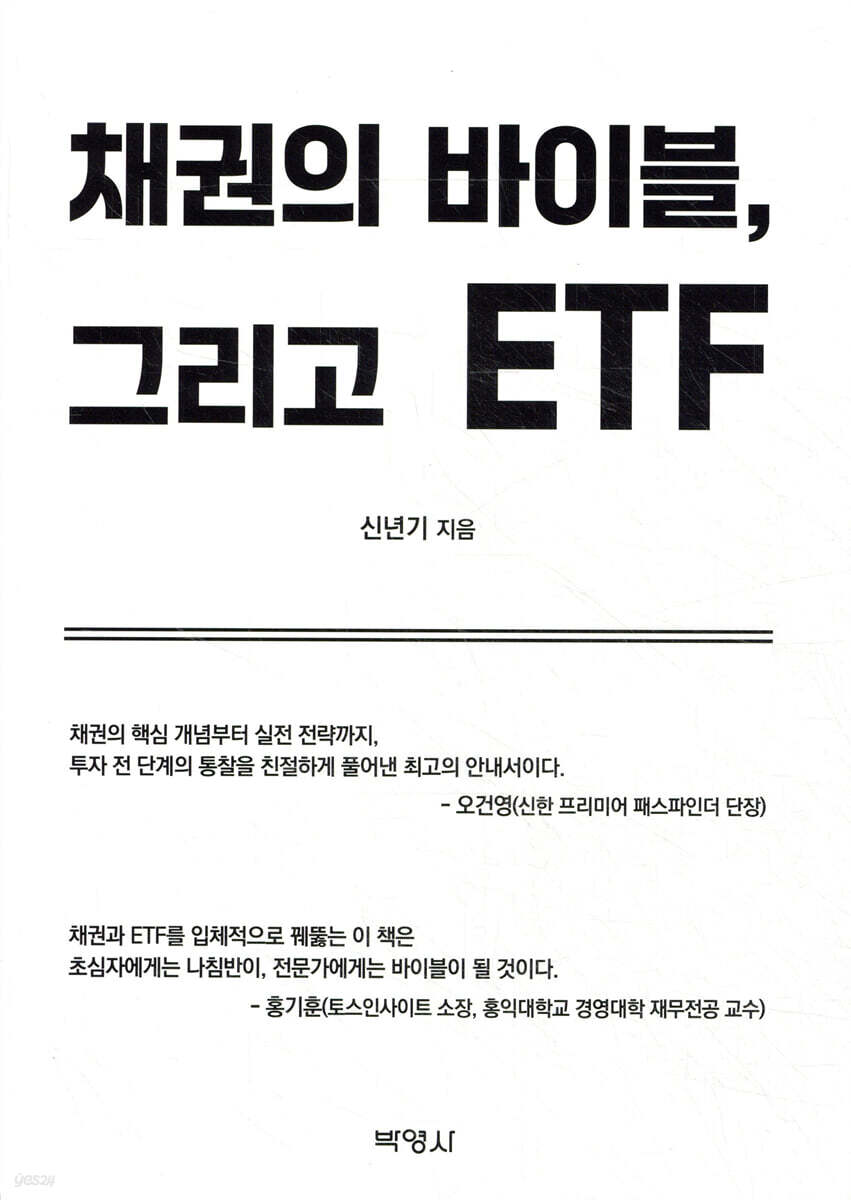
The Bible of Bonds and ETFs
 |
Description
Book Introduction
"The Bond Bible, and ETFs" is divided into four parts. Part 1 explains the basic concepts of bonds and key strategies. Part 2 provides an overview of ETFs, including the basic concepts. Part 3 examines the Federal Reserve's monetary policy objectives, which are one of the factors that absolutely influence bond interest rates and serve as the central bank of the United States, as well as indicators of inflation, employment, and growth.
Next, we describe the business cycle stages and bond strategies appropriate to the business cycle.
In the final PART 4, we introduce overseas bond ETFs that are suitable for the economic cycle.
We will introduce ETFs listed in the US, excluding the US 10-year expected inflation (Breakeven: 10-year Treasury nominal interest rate - 10-year Treasury TIPS interest rate) ETF and the US 2-10 year long-short steepening ETF listed in Europe.
Next, we describe the business cycle stages and bond strategies appropriate to the business cycle.
In the final PART 4, we introduce overseas bond ETFs that are suitable for the economic cycle.
We will introduce ETFs listed in the US, excluding the US 10-year expected inflation (Breakeven: 10-year Treasury nominal interest rate - 10-year Treasury TIPS interest rate) ETF and the US 2-10 year long-short steepening ETF listed in Europe.
- You can preview some of the book's contents.
Preview
index
Part 1: Basic Concepts of Bond Investment
Part 2: Overview of ETFs
Part 3 Key Economic Indicators Affecting Bonds
Part 4 US Bond ETFs
Part 2: Overview of ETFs
Part 3 Key Economic Indicators Affecting Bonds
Part 4 US Bond ETFs
Detailed image

Publisher's Review
prolog
“Credit investments have historically had low returns.
But now things have changed.
High-yield bonds yield 7%, and private debt yields range from 9% to 11%,” said Howard S.
Marks) said.
“They deliver very good absolute returns, competitive with equity returns achieved through independent contractual arrangements.”
“Credit investments have historically had low yields.
Now the tables have turned.
High-yield bonds are at 7%… private credit at 9% to 11%,” Marks said.
“These are very good absolute returns and competitive with equities earned contractually and independently.”
(Source) Morningstar, “Howard Marks expects a lower return from the S&P 500 over the next decade.”
Here’s what he likes better”, 2025.
3. 7., (https://www.morningstar.com/news/marketwatch/20250307198/howard-marks-expects-a-lower-return-from-the-sp-500-over-the-next-decade-heres-what-he-likes-better)
Investors' perceptions of bonds as investment vehicles were that they had lower returns than stocks and were vulnerable to inflation, making them less attractive than risky assets such as stocks, real estate, and, more recently, virtual assets.
While stocks and virtual assets have been experiencing fluctuations due to tariffs and geopolitical risks since Trump's second term, bonds have been quietly building their own "attraction" based on higher interest rates than before.
As of the end of March 2025, with President Trump's threat of reciprocal tariffs raising concerns about a global recession, the downside risk to risky asset prices is increasing.
On the other hand, based on the increased bond interest rates, one can expect a price increase due to a decline in interest rates during an economic downturn, and the steady interest income received periodically fills the pockets of bond investors.
Therefore, it is impossible to imagine an investment portfolio that excludes bonds.
When asked whether they have any concept of bonds, whether they are novice investors new to investing or veterans who have invested in stocks for a long time, most will only respond with something like, "Oh, that's an investment product that pays interest periodically in cash, right?"
In fact, to fully understand bonds, you need to know the key concepts of bonds, which seem easy but are difficult.
The term duration, which is often mentioned by those who have invested in bonds for a long time, generally means that the longer the maturity of a bond, the longer the duration, but it is not a '=' relationship.
If I were to explain that concepts like call options, put options, floating rates, and fixed rates are important factors in determining duration, you might put down your pencil and close the book.
And, to promote the strengthening of the local currency, it might be more convenient to buy Brazilian bonds, which also have tax-exempt interest income, and hold them until maturity.
But these days, two things must be taken into consideration when including bonds in one's personal portfolio.
First, while life expectancy is increasing, the retirement age is still between 55 and 60, so it is necessary to maintain asset value steadily for a long period after retirement.
However, if you invest 100% in highly volatile stocks, virtual assets, and real estate with low trading liquidity, you could suffer significant losses when an economic downturn occurs and prices fall.
On the other hand, if a portion of your portfolio consists of bonds that pay investors a fixed interest rate periodically as promised at the time of issuance and that already know their own lifespan and receive the principal back at maturity, you can overcome market volatility.
Second, the global economic growth rate is gradually decreasing.
As shown in [Figure 1], growth potential is gradually decreasing.
This is due to population decline, the end of globalization, which was a driving force for global growth since the 1990s, the end of the national division of labor system, and the return to an inefficient competitive production system.
In other words, the potential for price increases in risky assets is gradually decreasing, and there is room for fixed-income assets such as bonds to fill the void left by risky assets.
However, the methods for individual investors to directly invest in foreign bonds are limited compared to institutional investors.
However, you can increase your bond exposure by accessing various products listed on foreign bond ETFs, especially those listed on the U.S. market.
Therefore, this book aims to introduce various US-listed bond ETFs suitable for the economic cycle and serve as a Sherpa 1, enabling readers to invest directly.
This book is divided into four parts. Part 1 explains the basic concepts of bonds and key strategies. Part 2 provides an overview of ETFs, including their fundamental concepts. Part 3 examines the Federal Reserve's monetary policy objectives, which are one of the factors that have a decisive influence on bond interest rates and serve as the central bank of the United States, as well as indicators of inflation, employment, and growth.
Next, we describe the business cycle stages and bond strategies appropriate to the business cycle.
In the final PART 4, we introduce overseas bond ETFs that are suitable for the economic cycle.
We will introduce ETFs listed in the US, excluding the US 10-year expected inflation (Breakeven: 10-year Treasury nominal interest rate - 10-year Treasury TIPS interest rate) ETF and the US 2-10 year long-short steepening ETF listed in Europe.
I would like to express my sincere gratitude to Park Young-sa for rolling up their sleeves and actively supporting the publication of a book that might otherwise have never been published.
I sincerely hope that readers of this book will fall in love with the allure of real-world bond investing and, one day, become bond experts better than I am.
“Credit investments have historically had low returns.
But now things have changed.
High-yield bonds yield 7%, and private debt yields range from 9% to 11%,” said Howard S.
Marks) said.
“They deliver very good absolute returns, competitive with equity returns achieved through independent contractual arrangements.”
“Credit investments have historically had low yields.
Now the tables have turned.
High-yield bonds are at 7%… private credit at 9% to 11%,” Marks said.
“These are very good absolute returns and competitive with equities earned contractually and independently.”
(Source) Morningstar, “Howard Marks expects a lower return from the S&P 500 over the next decade.”
Here’s what he likes better”, 2025.
3. 7., (https://www.morningstar.com/news/marketwatch/20250307198/howard-marks-expects-a-lower-return-from-the-sp-500-over-the-next-decade-heres-what-he-likes-better)
Investors' perceptions of bonds as investment vehicles were that they had lower returns than stocks and were vulnerable to inflation, making them less attractive than risky assets such as stocks, real estate, and, more recently, virtual assets.
While stocks and virtual assets have been experiencing fluctuations due to tariffs and geopolitical risks since Trump's second term, bonds have been quietly building their own "attraction" based on higher interest rates than before.
As of the end of March 2025, with President Trump's threat of reciprocal tariffs raising concerns about a global recession, the downside risk to risky asset prices is increasing.
On the other hand, based on the increased bond interest rates, one can expect a price increase due to a decline in interest rates during an economic downturn, and the steady interest income received periodically fills the pockets of bond investors.
Therefore, it is impossible to imagine an investment portfolio that excludes bonds.
When asked whether they have any concept of bonds, whether they are novice investors new to investing or veterans who have invested in stocks for a long time, most will only respond with something like, "Oh, that's an investment product that pays interest periodically in cash, right?"
In fact, to fully understand bonds, you need to know the key concepts of bonds, which seem easy but are difficult.
The term duration, which is often mentioned by those who have invested in bonds for a long time, generally means that the longer the maturity of a bond, the longer the duration, but it is not a '=' relationship.
If I were to explain that concepts like call options, put options, floating rates, and fixed rates are important factors in determining duration, you might put down your pencil and close the book.
And, to promote the strengthening of the local currency, it might be more convenient to buy Brazilian bonds, which also have tax-exempt interest income, and hold them until maturity.
But these days, two things must be taken into consideration when including bonds in one's personal portfolio.
First, while life expectancy is increasing, the retirement age is still between 55 and 60, so it is necessary to maintain asset value steadily for a long period after retirement.
However, if you invest 100% in highly volatile stocks, virtual assets, and real estate with low trading liquidity, you could suffer significant losses when an economic downturn occurs and prices fall.
On the other hand, if a portion of your portfolio consists of bonds that pay investors a fixed interest rate periodically as promised at the time of issuance and that already know their own lifespan and receive the principal back at maturity, you can overcome market volatility.
Second, the global economic growth rate is gradually decreasing.
As shown in [Figure 1], growth potential is gradually decreasing.
This is due to population decline, the end of globalization, which was a driving force for global growth since the 1990s, the end of the national division of labor system, and the return to an inefficient competitive production system.
In other words, the potential for price increases in risky assets is gradually decreasing, and there is room for fixed-income assets such as bonds to fill the void left by risky assets.
However, the methods for individual investors to directly invest in foreign bonds are limited compared to institutional investors.
However, you can increase your bond exposure by accessing various products listed on foreign bond ETFs, especially those listed on the U.S. market.
Therefore, this book aims to introduce various US-listed bond ETFs suitable for the economic cycle and serve as a Sherpa 1, enabling readers to invest directly.
This book is divided into four parts. Part 1 explains the basic concepts of bonds and key strategies. Part 2 provides an overview of ETFs, including their fundamental concepts. Part 3 examines the Federal Reserve's monetary policy objectives, which are one of the factors that have a decisive influence on bond interest rates and serve as the central bank of the United States, as well as indicators of inflation, employment, and growth.
Next, we describe the business cycle stages and bond strategies appropriate to the business cycle.
In the final PART 4, we introduce overseas bond ETFs that are suitable for the economic cycle.
We will introduce ETFs listed in the US, excluding the US 10-year expected inflation (Breakeven: 10-year Treasury nominal interest rate - 10-year Treasury TIPS interest rate) ETF and the US 2-10 year long-short steepening ETF listed in Europe.
I would like to express my sincere gratitude to Park Young-sa for rolling up their sleeves and actively supporting the publication of a book that might otherwise have never been published.
I sincerely hope that readers of this book will fall in love with the allure of real-world bond investing and, one day, become bond experts better than I am.
GOODS SPECIFICS
- Date of issue: July 5, 2025
- Page count, weight, size: 268 pages | 176*248*20mm
- ISBN13: 9791130323312
- ISBN10: 1130323315
You may also like
카테고리
korean


korean

![GQ KOREA Mark (Monthly): December [2025]](http://librairie.coreenne.fr/cdn/shop/files/8ef265dbbfbf186523ed75ba7319009d.jpg?v=1765340328&width=3840)


