

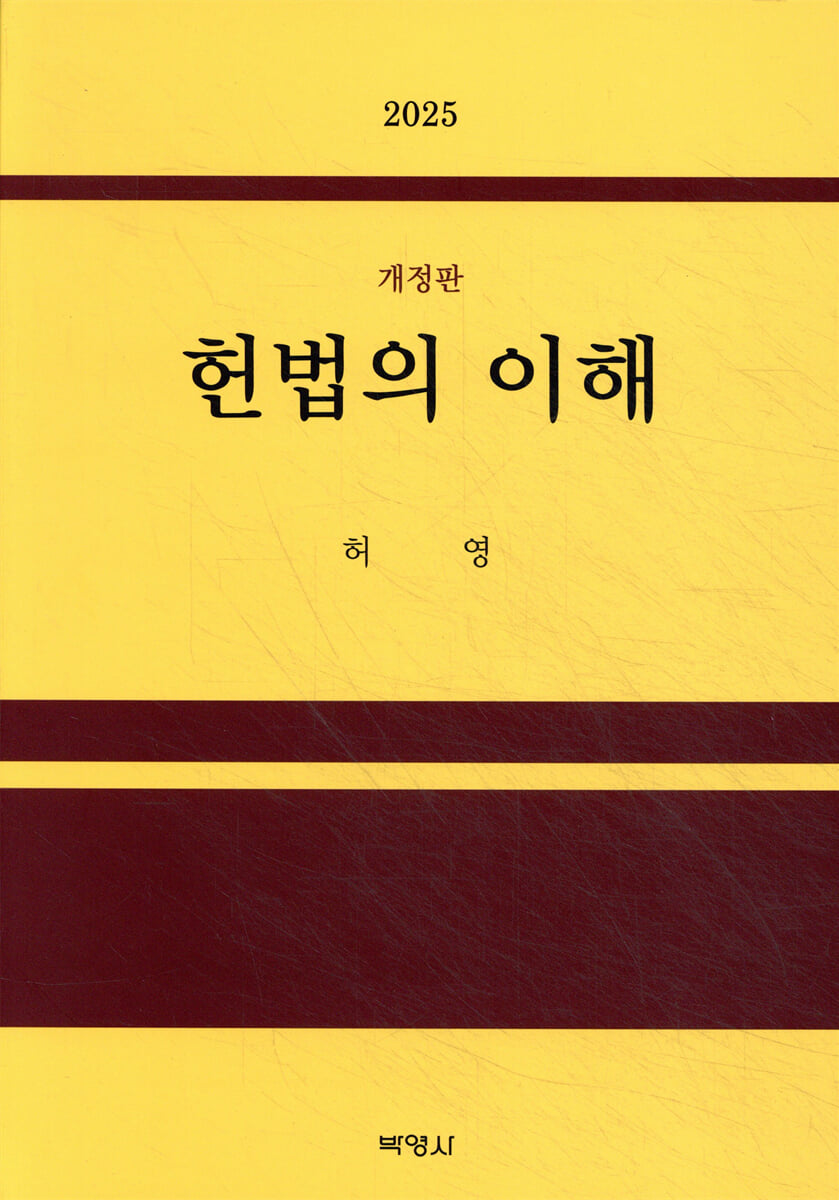
Understanding the Constitution
 |
Description
Book Introduction
In the revised edition of 『Understanding the Constitution』, all new Constitutional Court and Supreme Court precedents were added and an index of precedents was created.
We have also partially supplemented the book's content to make it easier for readers to understand.
Occasionally, typos were found and corrected.
We have also partially supplemented the book's content to make it easier for readers to understand.
Occasionally, typos were found and corrected.
index
Part 1: Basic Principles of the Constitution
Chapter 1 The Essence of the Constitution
1.
What is the Constitution 3
2.
Functions of the Constitution 4
3.
What are the characteristics of the Constitution? 4
1) Highest Normativity 4
2) Political Normativity 4
3) Organizational norms 5
4) Normativity of Power Control 6
5) Normative nature of life 6
6) Historicity 7
Chapter 2 Enactment and Amendment of the Constitution
1.
Establishment of the Constitution 9
1) Significance of the Constitution 9
2) Constitutional enactment power 9
3) Limits of the Constitutional Enactment Power 10
(1) Ideological limitations/10 (2) Legal limitations/10
(3) International legal limitations/ 11
4) Constitutional enactment procedures 11
(1) Constitutional procedures of a single state/11 (2) Constitution of a federal state/11
2.
Amendment 12 of the Constitution
1) Significance of Constitutional Amendment 12
2) The Relationship Between the Characteristics of the Constitution and Its Amendments 12
3) Methods and procedures for constitutional amendment 13
(1) Rigidity of the revision method/13 (2) Revision method/13
(3) Prerequisites for Constitutional Amendment/13 (4) Procedures for Constitutional Amendment/13
(5) Limitations of Constitutional Amendment/14 (6) Provisions for Constitutional Amendment in Our Constitution/15
Chapter 3 Interpretation of the Constitution
1.
The Significance of Constitutional Interpretation 17
2.
Characteristics of Constitutional Interpretation 17
3.
Guideline 18 on Constitutional Interpretation
1) Unity of the Constitution 18
2) Functional Tasks of the Constitution 18
3) Social Stability Elements of the Constitution 19
4.
Constitutional Interpretation of Law 19
1) The meaning and limitations of constitutional interpretation of law 19
2) Theoretical Basis for Constitutional Interpretation of Law 20
(1) Unity of the legal order arising from the supreme normativity of the Constitution/20
(2) The spirit of separation of powers/20 (3) Presumptive effect of law/20
(4) Protecting trust between nations/21
3) Limitations and Technology of Constitutional Legal Interpretation 21
(1) Limitations of Constitutional Legal Interpretation/21 (2) Techniques (Methods) of Constitutional Legal Interpretation/21
Chapter 4 Protection (Guarantee) of the Constitution
1.
The significance of constitutional protection and national protection 23
2.
Means of Constitutional Protection 24
1) Institutional mechanisms for constitutional protection 24
(1) Protective measures for power organizations/24
(2) Means of protection against constitutional infringement by individuals or groups/24
2) The Last Resort to Constitutional Protection: The Right to Resistance 25
Part 2: History and Basic Principles of Our Constitution
Chapter 1: History of Our Constitution
1.
Article 29 of the Constitution
1) The process of establishing the Constitution 29
2) Main contents of the Constitution 30
3) History of the Constitutional Amendment 30
2.
Constitution of the Second Republic, Article 30
1) The process of establishing the Constitution of the Second Republic 30
2) Main contents of the Constitution of the Second Republic 31
3) Amendments to the Constitution of the Second Republic 31
3.
Constitution of the Third Republic, Article 31
1) The process of establishing the Constitution of the Third Republic 31
2) Main contents of the Constitution of the Third Republic 32
3) Amendments to the Constitution of the Third Republic 33
4.
Article 33 of the Constitution of the Fourth Republic
1) The process of establishing the Constitution of the Fourth Republic 33
2) Main contents of the Constitution of the Fourth Republic 34
5.
Article 34 of the Constitution of the Fifth Republic
1) The process of establishing the Constitution of the Fifth Republic 34
2) Main contents of the Constitution of the Fifth Republic 35
6.
Article 36 of the Constitution of the Sixth Republic
1) The process of establishing the Constitution of the 6th Republic 36
2) Main contents of the Constitution of the 6th Republic 37
Chapter 2 Fundamental Ideology and Basic Principles of the Constitution
1.
Preamble to the Constitution, Article 38
1) The nature and effect of the preamble to the Constitution 38
2) Contents of the Preamble to the Constitution 38
(1) The necessity, direction, method, and goal of social integration/39
(2) Humanity in the Constitution/39 (3) Fundamental Ideology Pursued by the Constitution/39
2.
The Ideology and Realization Principles of Popular Sovereignty 40
1) The Ideology and Essence of Popular Sovereignty 40
2) Principle of Realizing Popular Sovereignty 41
(1) Governing power subject to fundamental rights (subordination of governing power to fundamental rights)/41
(2) Principles of Liberal Democracy/42 (3) Principles of the Rule of Law/43
3.
The Ideology and Principles of a Just Society 45
1) The Essence of the Ideology of a Just Society 45
2) Principles for Realizing a Just Society 46
(1) Guarantee of basic social rights/46 (2) Principles of a social state/47
(3) Social Market Economic Order/49
4.
The Ideology and Principles of Realization of a Cultural Nation 51
1) Ideology of a Cultural Nation 51
2) Principles for Realizing the Cultural Nation Ideology 51
(1) Principles of a Cultural State/51 (2) Civilized Marriage and Family Systems/52
5.
The Ideology and Principles of Peace Pursuit 53
1) The Ideology of Peace Pursuit 53
2) Principles for Realizing the Ideology of Pursuing Peace 53
(1) Principle of Peaceful Unification/54 (2) Principle of Respect for International Law/54
Chapter 3: The Foundation of the Republic of Korea and its National Form
1.
The Foundation of the Republic of Korea 57
1) The spatial basis of existence of the Republic of Korea (territory) 57
2) The foundation of human existence in the Republic of Korea (citizens) 59
(1) Acquisition of nationality/59 (2) Loss, recovery, and reacquisition of nationality/59
(3) Overseas Koreans/60
3) The basis of the Republic of Korea's power (sovereignty) 60
2.
Country form 61
1) Classification of national forms 61
2) Our country's national form 62
Part 3 Basic Rights
Chapter 1 General Theory of Fundamental Rights
1.
The Origins of Human Rights and Its Incorporation into the Constitution 65
1) The Origin of Human Rights Thought 65
2) Incorporation of human rights into the Constitution 66
(1) The Declaration of the Rights of Man and of the Citizen in the United Kingdom/66 (2) The Declaration of the Rights of Man and of the Citizen in the United States/66
(3) Declaration of the Rights of Man and of the Citizen in France/67 (4) Guarantee of Human Rights in Germany/67
3) The contemporary situation of human rights protection 67
(1) The phenomenon of the right to freedom becoming a right to life/68 (2) The phenomenon of the internationalization of human rights/68
(3) Strengthening the direct effect of fundamental rights/68
(4) Expansion of the scope of human rights protection due to the development of technological civilization/69
4) Human Rights in Our Constitution 69
2.
The Nature and Function of Fundamental Rights 70
1) The evolution of fundamental rights theory 70
(1) Theory of Fundamental Rights Based on National Purpose/70 (2) Theory of Fundamental Rights Based on Liberty/71
(3) Theory of Fundamental Rights as a Unifying Value of Society/71
2) The significance and nature of the guarantee of basic rights under our Constitution 72
3.
Subject of Fundamental Rights 73
1) Citizen 73
2) Foreigner 74
3) Corporation 75
4.
Content and Effect of Fundamental Rights 77
1) Subjective public rights 77
(1) The Development of Subjective Public Rights Theory/77
(2) Correct Understanding of Subjective Public Rights/77
2) Fundamental Rights as an Objective Order (Duality of Fundamental Rights) 78
3) Effect of fundamental rights between signatories 78
(1) Diversity of the theoretical construction of the quasi-significant effect of fundamental rights/79
(2) The Effect of Basic Rights between Our Constitution and Private Law/81
4) Conflicts (competition and conflicts) between fundamental rights 81
(1) Competition of Fundamental Rights/81 (2) Conflict of Fundamental Rights/82
5.
The Inherent Limits of Fundamental Rights 84
1) Distinction from similar concepts 84
2) The nature of the inherent limitations of fundamental rights 84
3) Argumentative Form of the Inherent Limitations of Fundamental Rights 85
4) The Inherent Limitations of Our Constitution and Fundamental Rights 86
6.
Restrictions on Fundamental Rights 86
1) Constitutional Limits of Fundamental Rights 87
(1) Our Constitutional Provisions/87 (2) The Functions and Effects of the Constitutional Limits of Fundamental Rights/87
2) Restrictions on fundamental rights by law (legal reservation of fundamental rights) 88
(1) Meaning and Types of Legal Reservations/88
(2) Limits on Restrictions on Fundamental Rights by Law/89
3) Formative legal reservation of fundamental rights 92
4) Special status relationships and restrictions on basic rights 93
5) Restrictions on fundamental rights due to national emergency powers 94
(1) Restrictions on fundamental rights by emergency financial and economic orders/94
(2) Restrictions on fundamental rights by emergency order/95
(3) Restrictions on basic rights due to martial law/96
7.
Protection of Fundamental Rights 97
1) Legislative function and protection of fundamental rights 97
(1) Protection of fundamental rights to legislative power/97
(2) Protection of fundamental rights by legislative power/100
2) Enforcement function and protection of fundamental rights 100
(1) Protection of fundamental rights to enforcement power/100
(2) Protection of fundamental rights by enforcement power/101
3) Judicial functions and protection of fundamental rights 103
(1) Protection of fundamental rights to judicial power/103
(2) Protection of fundamental rights by judicial power/104
4) Constitutional Court Functions and Protection of Fundamental Rights 104
(1) Protection of fundamental rights in the Constitutional Court/104
(2) Protection of fundamental rights by the Constitutional Court/105
5) The Last Resort to Protecting Fundamental Rights—Exercising the Right to Resistance 106
Chapter 2 Individual Fundamental Rights under Our Constitution
1.
Human Dignity as the Ideological Foundation of Fundamental Rights 107
1) Guaranteeing human dignity and value 107
(1) Normative meaning of human dignity and value and the constitutional image of human beings/107
(2) Constitutional significance of the provision on human dignity/108
(3) Constitutional Case Law and Issues Regarding the Definition of Human Dignity and Value/109
2) Right to the Pursuit of Happiness 111
(1) The nature and content of the right to pursue happiness/111
(2) Case Law and Issues Concerning the Right to the Pursuit of Happiness/112
2.
Equality Rights 113
1) The Constitutional Significance of Guaranteeing the Right to Equality 113
2) Function of the Right to Equality 113
3) Contents of the right to equality 113
(1) The Relationship Between the Right to Equality and Freedom/113 (2) The Structural Characteristics of the Right to Equality/114
(3) The Meaning of Equality Before the Law/114
4) Effects of the Right to Equality (Individual Right to Equality) 115
(1) Prohibition of discrimination/115 (2) Prohibition of socially privileged classes/116
(3) Prohibition of privileges/116 (4) Equality between men and women in marriage and family life/116
(5) Equal educational opportunity/117 (6) Equal voting rights/117
(7) Social Equality in the Economic Order/117
5) Restrictions on the right to equality 118
(1) Constitutional Limits to the Right to Equality/118 (2) Restrictions on the Right to Equality by Law/118
3.
Human Rights 121
1) Right to life 121
(1) Right to Life and Constitutional Provisions/121 (2) Significance of Guaranteeing the Right to Life/122
(3) Constitutional Limits on Violations of the Right to Life/122
(4) Right to Life and Special Status Relationships/122
2) Freedom of the body 123
(1) The meaning and content of the guarantee of physical freedom/123
(2) Constitutional binding principles for guaranteeing physical freedom/123
(3) Judicial procedural fundamental rights for the protection of personal liberty/131
4.
Protection of Privacy 142
1) Freedom of residence 143
(1) The meaning of freedom of residence/143 (2) The content of freedom of residence/143
(3) Restrictions and Limitations on Freedom of Residence/145
2) Privacy and Freedom 145
(1) The Constitutional Significance of Guaranteeing Privacy and Freedom/145
(2) The Secrets of Private Life and Freedom/145
(3) The Secrets of Privacy and the Limits of Freedom/146
(4) Privacy and Restrictions on Freedom/148
3) The Secret of Communication 149
(1) Special characteristics of confidentiality of communications/149
(2) The significance and constitutional function of confidentiality of communications/149
(3) Contents and limitations of confidentiality of communications/150
(4) Restrictions on the confidentiality of communications/151
5.
Protection of Mental, Cultural, and Healthy Living 153
1) Freedom of conscience 153
(1) The significance and constitutional function of freedom of conscience/153
(2) Contents of freedom of conscience/154 (3) Forms of restrictions on freedom of conscience/156
2) Freedom of Religion 158
(1) The Meaning of Freedom of Religion/158 (2) The Content of Freedom of Religion/159
(3) Limits and Restrictions on Religious Freedom/161
(4) The principle of religious neutrality of the state/161
3) Freedom of Academics and the Arts 162
(1) Constitutional Significance of Academic and Artistic Freedom/162
(2) Competition between academic and artistic freedom and other fundamental rights/163
(3) Academic Freedom/163 (4) Artistic Freedom/167
(5) Protection of Authors, Inventors, Scientists, and Artists/170
4) Right to education 171
(1) Constitutional significance and function of the right to education/171
(2) The Complex Nature of the Right to Education/171
(3) Contents of the right to education and its guarantees/172
5) Right to Health 175
(1) Constitutional significance and nature of the right to health/176
(2) Contents of the Right to Health/176
(3) Violations of the Right to Health and Remedies/177
(4) Obligations of Health Rights Holders/177
6) Environmental Rights 177
(1) The significance and characteristics of environmental rights/178
(2) Comprehensive meaning and functions contained in environmental rights/178
(3) Legal nature of environmental rights/179 (4) Contents of environmental rights/180
(5) Limits and Restrictions of Environmental Rights/182
(6) Special characteristics of remedies for environmental rights violations/182
(7) Expertise in environmental legislation for environmental protection/183
6.
Protection of the Economic Life Sphere 184
1) Freedom of residence and movement 185
(1) The meaning and function of freedom of residence and movement/185
(2) Contents of freedom of residence and movement/185
(3) Restrictions on freedom of residence and movement/187
2) Freedom of occupation 188
(1) Guarantee of freedom of occupation, including occupational choice/188
(2) The Meaning of Freedom of Occupation/188 (3) The Duality of Freedom of Occupation/189
(4) Freedom of corporate business/189
(5) Contents of freedom of occupation/189
(6) Restrictions on and Limits to Occupational Freedom/190
3) Guarantee of property rights 193
(1) Constitutional significance and function of property rights protection/193
(2) The meaning and scope of property rights/195 (3) Property rights protection provisions and legal reservations/196
(4) Contents of property rights protection/196
(5) Social Context of Property Rights (Constitutional Limits)/199
(6) Property Rights Restrictions and Their Limitations/201
4) Right to work 205
(1) Relationship between the contents of the Constitution and other fundamental rights/205
(2) Right to Work (Right to Work)/206
(3) Workers' Labor Rights/209
5) The right to a human life 216
(1) The significance and constitutional function of the right to a decent life/216
(2) The Legal Nature of the Right to a Humane Life/217
(3) Contents of the right to a humane life/218
(4) Restrictions and Limitations of the Right to a Humane Life/219
7.
Protection of Political and Social Life 219
1) Right to vote 220
(1) The significance and constitutional function of the right to vote/220
(2) Ability to exercise suffrage/220 (3) Contents of suffrage/221
(4) Restrictions and Limitations of Voting Rights/226
2) Right to petition 226
(1) The significance of the right to petition and its constitutional function/226
(2) Legal nature of the right to petition/227 (3) Contents of the right to petition/227
(4) Restrictions and Limitations of the Right to Petition/229
3) Freedom of the press and publication 229
(1) Constitutional Significance and Function of Freedom of the Press and Publication/230
(2) Legal nature of freedom of the press and publication/230
(3) Contents of freedom of the press and publication/231
(4) Constitutional Limits to Freedom of the Press and Publication/238
(5) Restrictions and Limitations on Freedom of the Press and Publication/240
4) Freedom of assembly and association 242
(1) Freedom of Assembly/243 (2) Freedom of Association/246
8.
Claim for Redress 249
1) Claim for State Compensation 249
(1) The significance and legal nature of the right to claim compensation from the state/249
(2) Legal nature of claims for state compensation/249
(3) Subject of the claim for state compensation/250 (4) Content and scope of the claim for state compensation/250
(5) The nature of state compensation liability and the person responsible for compensation/251
(6) Procedures for claiming compensation from the state/252 (7) Limitations on claims for compensation from the state/253
2) Crime Victims' Right to Claim Relief 253
(1) The nature and theoretical basis of national structural responsibility/254
(2) The significance and legal nature of the crime victim's right to claim relief/255
(3) Contents of Crime Victim Relief Claims/256
(4) Procedures for exercising the right to claim relief for crime victims/257
(5) Restrictions and Limitations of Crime Victims' Right to Claim Relief/257
9.
Citizen's Duty 258
1) The duty of obedience of the people in creating the nation 258
2) Citizens' ethical obligations implicit in fundamental rights 259
3) Basic duties of citizens under the Constitution 259
(1) Duty to pay taxes/260 (2) Duty to defend national defense/261
(3) Obligation to receive education/261 (4) Obligation to work/262
(5) Environmental Conservation Obligation/263
(6) Obligation to exercise property rights in the public interest/263
Part 4: Governing Structure
Chapter 1: The Nature and Function of the Governing Structure
1) The nature and function of the governance structure as understood by legal positivism 267
2) The nature and function of the governing structure as understood by decisionism 268
3) The nature and function of the governance structure as seen from the perspective of the integrated process theory 269
4) Private opinion 270
Chapter 2: Fundamental Ideology and Basic Principles of a Liberal Democratic Governance Structure
1.
Basic Tasks of a Liberal Democratic Governance Structure 271
1) The binding of fundamental rights to sovereignty 272
2) Democratic legitimacy of the ruling power 272
(1) Principles of the Creation and Continuance of Sovereignty/272
(2) The Relationship Between the Formation of the Governing Body and Democratic Legitimacy/272
(3) Institutional Devices for Ensuring the Democratic Legitimacy of the Governing Authority/273
3) Procedural legitimacy of exercising sovereignty 273
4) Conclusion 274
2.
The Framework of Our Constitution's Governing Structure 274
1) The binding of fundamental rights to sovereignty 274
2) Democratic legitimacy of the ruling power 275
(1) Continuous input channel through exercising basic rights/275
(2) Periodic input channels through elections and referendums/275
(3) Indirect democratic legitimacy system through the National Assembly/276
3) Procedural legitimacy of the ruling power 276
(1) Controlling power through the classical and structural separation of powers system/277
(2) Mechanisms of Functional Power Control/278
4) Vulnerabilities in our governance structure 279
Chapter 3: Principles of Organizing Organizations for Governance
1.
Representative System 284
1) The significance and origins of the representative system 284
(1) The significance of the representative system/284 (2) The basis for the emergence of the representative system/285
2) The ideological basis of the representative system 285
(1) Separation of institutional power and policy-making power/285
(2) Delegation of policy decision-making authority/286
3) The development of the representative system 287
(1) The Development of the Representative System in Britain/288
(2) The Development of the Representative System in France and Germany/288
4) Functions of the representative system and its modern implementation forms 289
(1) Functions of the representative system/289
(2) Modern Realization of the Representative System/291
5) Representative system under our constitution 294
(1) Modern representative system/294
(2) Elements of a party state and direct democracy/294
(3) Explicit provisions on free delegation/294
(4) Regulations for the Implementation of Public and Responsible Politics/295
(5) Electoral System and Separation of Powers System/295 (6) Regulations for the Realization of Specialized Politics/295
2.
Principle of Separation of Powers 295
1) The significance of the principle of separation of powers 295
2) The origin, content, development, and influence of the classical theory of separation of powers 296
(1) The Birth and Development of the Classical Theory of Separation of Powers/296
(2) The influence of classical separation of powers theory/298
3) Changing Times and the Search for a New Separation of Powers System 299
(1) Increased desire to realize a liberal, democratic, and egalitarian society/299
(2) Emergence and increasing influence of social interest groups/300
(3) The phenomenon of power consolidation resulting from the development of a party state/300
(4) Expansion of the national welfare function/300
(5) Changes in the Constitutional View on the Essence of the Constitution and Fundamental Rights/301
4) Modern Functional Power Control Theory and Its Model 301
(1) The separation of powers in the federal system/302
(2) The Separation of Powers Function of the Local Autonomy System/302
(3) The Separation of Powers Function of the Career Civil Service System/302
(4) The Separation of Powers Significance of the Multi-Party System/303
(5) The Separation of Powers Function of the Constitutional Court System/303
(6) Distinction between State and Society as a Functional Power Control Model/304
5) The separation of powers system under our Constitution 304
(1) Acceptance of the classical separation of powers and the modern functional power control model/304
(2) Mechanism of checks and balances between powers/304
3.
Government Form 306
1) The significance of government forms and their typological diversity 306
2) Sample types of government forms and their variations 306
(1) Presidential system/306 (2) Parliamentary system/310
(3) The Structural Truths and Flaws of the Presidential and Parliamentary Systems (The Relativity of Comparing Pros and Cons)/315
(4) Compromise government form/317
3) Our country's form of government 318
(1) Governmental Form of the First Republic/318 (2) Governmental Form of the Second Republic/319
(3) Governmental Form of the Third Republic/319 (4) Governmental Form of the Fourth Republic/320
(5) Governmental Form of the Fifth Republic/321 (6) Governmental Form of the Sixth Republic/322
4.
Electoral System 325
1) The significance and function of the electoral system 326
(1) The Meaning and Types of Elections/326 (2) The Meaning and Function of Elections/327
2) Basic Principles of Democratic Election Law 328
(1) Principle of universal suffrage/329 (2) Principle of equal suffrage/329
(3) Principle of direct election/330 (4) Principle of secret election/330
(5) Principle of Free Elections/331
3) Types of Electoral Systems 331
(1) Majority Representative Election System/331 (2) Proportional Representation Election System/334
4) Our country's electoral system 336
(1) Presidential Election System/336 (2) National Assembly Election System/337
(3) Electoral System for Local Autonomy/339
5.
Public Service System 341
1) The meaning and scope of public officials and civil servants 342
2) Characteristics of the Civil Service System 343
3) Requirements for a basic public service system under a liberal democratic governance structure 343
(1) Enhancing democratic public service ethics/343 (2) Establishing a democratic directive system/343
(3) Guarantee of political neutrality/344 (4) Request for the rule of law/344
(5) Requests from the Social State/345
4) Public office authority and public service system 345
(1) Methods for Realizing the Right to Hold Public Office/345 (2) Public Official Selection System/346
5) Career Civil Service System 347
(1) The significance of the career civil service system and its institutional guarantees/347
(2) Contents of the Career Civil Service System/347
6.
Local Autonomy System 351
1) The nature and function of local autonomy 351
(1) The meaning, essence, and function of local autonomy/351
(2) Institutional guarantees for local autonomy/355
2) Our country's local autonomy system 356
(1) Constitutional provisions on local autonomy/356
(2) Local Autonomy System Contents/357
(3) Problems and Improvement Directions of Our Local Autonomy System/364
7.
Constitutional Court System 364
1) The Concept and Essence of Constitutional Court 365
(1) The Concept of Constitutional Court and Its Ideological Basis/365
(2) Characteristics and Nature of the Constitutional Court/366
2) Functions of the Constitutional Court and its Constitutional Significance 367
(1) Constitutional protection function/368 (2) Power control function/368
(3) Freedom protection function/368 (4) Political peace guarantee function/368
3) Constitutional Court Institution 369
(1) Judicial/369 (2) Independent agency/369
4) Types of Constitutional Court 370
(1) Authority (Agency) Dispute Trial System/370 (2) Norm Control System/370
(3) Constitutional Appeal System/371 (4) Election Review System/372
(5) Procedural Constitutional Court System/372 (6) Federal National Dispute Resolution System/372
5) Limitations of the Constitutional Court 373
6) Our country's constitutional court system 374
(1) Constitutional Court/374 (2) Types of Constitutional Court/376
Chapter 4: Governing bodies under our Constitution
1.
National Assembly 396
1) The Content and Changes of Parliamentarism 396
(1) The Concept of Parliamentarism/396 (2) The Origin, Development, and Changes of Parliamentarism/397
2) Constitutional status of the National Assembly 399
(1) Status as a representative body/399 (2) Status as a legislative body/399
(3) Status as a state control agency/400
(4) Status of the consensus body as a national decision-making body/400
3) Composition and organization of the National Assembly 401
(1) Principles of the National Assembly's composition/401 (2) Composition of the National Assembly under our Constitution/403
(3) Organization of the National Assembly/403
4) National Assembly Meeting Operations and Principles of Procedure 410
(1) National Assembly Session Operations/410 (2) National Assembly Procedures/412
5) Functions of the National Assembly 415
(1) Legislative function/416 (2) Financial function/425
(3) Control function/433
6) Status and Responsibilities of Members of the National Assembly 446
(1) Constitutional Status and Responsibilities of Members of the National Assembly/446
(2) The emergence and extinction of parliamentary qualifications/448 (3) The rights and duties of members of the National Assembly/449
(4) Privileges of National Assembly Members 453
2.
Government 457
1) Characteristics and significance of our government structure 458
2) President 458
(1) Constitutional Status of the President/459 (2) Personal Status of the President/461
(3) Presidential powers and control over them/464
3) Administration 486
(1) Prime Minister/486 (2) State Council Member/492
(3) State Council/493 (4) Administrative Departments/495
(5) Board of Audit and Inspection/498 (6) Presidential Advisory Bodies/501
4) Election Commission 502
(1) Constitutional significance and function of the National Election Commission/502
(2) Constitutional Status of the National Election Commission/503
(3) Types and composition of election management committees/503
(4) Functions and Responsibilities of the National Election Commission/504
(5) Public Election System/506
3.
Court 508
1) The significance and characteristics of the judicial function 508
(1) The significance of the judicial function/508 (2) The characteristics of the judicial function/509
2) Scope and Limits of Judicial Functions 510
(1) Scope of the judicial function/510 (2) Limits of the judicial function/514
3) Independence of the judiciary 520
(1) The Significance and Function of Judicial Independence/520
(2) The Content and Limits of Judicial Independence/521
4) Organization and authority of the court 528
(1) Organization and authority of the Supreme Court/529 (2) Organization and jurisdiction of lower courts/533
5) Procedural guarantees for judicial purposes 542
(1) Trial system/542 (2) Public trial system/544
(3) Citizen Participation Trial/546 (4) Courtroom Order Maintenance Device/549
[Appendix] Constitution of the Republic of Korea, Article 551
Case Index 567
Item Index 574
Chapter 1 The Essence of the Constitution
1.
What is the Constitution 3
2.
Functions of the Constitution 4
3.
What are the characteristics of the Constitution? 4
1) Highest Normativity 4
2) Political Normativity 4
3) Organizational norms 5
4) Normativity of Power Control 6
5) Normative nature of life 6
6) Historicity 7
Chapter 2 Enactment and Amendment of the Constitution
1.
Establishment of the Constitution 9
1) Significance of the Constitution 9
2) Constitutional enactment power 9
3) Limits of the Constitutional Enactment Power 10
(1) Ideological limitations/10 (2) Legal limitations/10
(3) International legal limitations/ 11
4) Constitutional enactment procedures 11
(1) Constitutional procedures of a single state/11 (2) Constitution of a federal state/11
2.
Amendment 12 of the Constitution
1) Significance of Constitutional Amendment 12
2) The Relationship Between the Characteristics of the Constitution and Its Amendments 12
3) Methods and procedures for constitutional amendment 13
(1) Rigidity of the revision method/13 (2) Revision method/13
(3) Prerequisites for Constitutional Amendment/13 (4) Procedures for Constitutional Amendment/13
(5) Limitations of Constitutional Amendment/14 (6) Provisions for Constitutional Amendment in Our Constitution/15
Chapter 3 Interpretation of the Constitution
1.
The Significance of Constitutional Interpretation 17
2.
Characteristics of Constitutional Interpretation 17
3.
Guideline 18 on Constitutional Interpretation
1) Unity of the Constitution 18
2) Functional Tasks of the Constitution 18
3) Social Stability Elements of the Constitution 19
4.
Constitutional Interpretation of Law 19
1) The meaning and limitations of constitutional interpretation of law 19
2) Theoretical Basis for Constitutional Interpretation of Law 20
(1) Unity of the legal order arising from the supreme normativity of the Constitution/20
(2) The spirit of separation of powers/20 (3) Presumptive effect of law/20
(4) Protecting trust between nations/21
3) Limitations and Technology of Constitutional Legal Interpretation 21
(1) Limitations of Constitutional Legal Interpretation/21 (2) Techniques (Methods) of Constitutional Legal Interpretation/21
Chapter 4 Protection (Guarantee) of the Constitution
1.
The significance of constitutional protection and national protection 23
2.
Means of Constitutional Protection 24
1) Institutional mechanisms for constitutional protection 24
(1) Protective measures for power organizations/24
(2) Means of protection against constitutional infringement by individuals or groups/24
2) The Last Resort to Constitutional Protection: The Right to Resistance 25
Part 2: History and Basic Principles of Our Constitution
Chapter 1: History of Our Constitution
1.
Article 29 of the Constitution
1) The process of establishing the Constitution 29
2) Main contents of the Constitution 30
3) History of the Constitutional Amendment 30
2.
Constitution of the Second Republic, Article 30
1) The process of establishing the Constitution of the Second Republic 30
2) Main contents of the Constitution of the Second Republic 31
3) Amendments to the Constitution of the Second Republic 31
3.
Constitution of the Third Republic, Article 31
1) The process of establishing the Constitution of the Third Republic 31
2) Main contents of the Constitution of the Third Republic 32
3) Amendments to the Constitution of the Third Republic 33
4.
Article 33 of the Constitution of the Fourth Republic
1) The process of establishing the Constitution of the Fourth Republic 33
2) Main contents of the Constitution of the Fourth Republic 34
5.
Article 34 of the Constitution of the Fifth Republic
1) The process of establishing the Constitution of the Fifth Republic 34
2) Main contents of the Constitution of the Fifth Republic 35
6.
Article 36 of the Constitution of the Sixth Republic
1) The process of establishing the Constitution of the 6th Republic 36
2) Main contents of the Constitution of the 6th Republic 37
Chapter 2 Fundamental Ideology and Basic Principles of the Constitution
1.
Preamble to the Constitution, Article 38
1) The nature and effect of the preamble to the Constitution 38
2) Contents of the Preamble to the Constitution 38
(1) The necessity, direction, method, and goal of social integration/39
(2) Humanity in the Constitution/39 (3) Fundamental Ideology Pursued by the Constitution/39
2.
The Ideology and Realization Principles of Popular Sovereignty 40
1) The Ideology and Essence of Popular Sovereignty 40
2) Principle of Realizing Popular Sovereignty 41
(1) Governing power subject to fundamental rights (subordination of governing power to fundamental rights)/41
(2) Principles of Liberal Democracy/42 (3) Principles of the Rule of Law/43
3.
The Ideology and Principles of a Just Society 45
1) The Essence of the Ideology of a Just Society 45
2) Principles for Realizing a Just Society 46
(1) Guarantee of basic social rights/46 (2) Principles of a social state/47
(3) Social Market Economic Order/49
4.
The Ideology and Principles of Realization of a Cultural Nation 51
1) Ideology of a Cultural Nation 51
2) Principles for Realizing the Cultural Nation Ideology 51
(1) Principles of a Cultural State/51 (2) Civilized Marriage and Family Systems/52
5.
The Ideology and Principles of Peace Pursuit 53
1) The Ideology of Peace Pursuit 53
2) Principles for Realizing the Ideology of Pursuing Peace 53
(1) Principle of Peaceful Unification/54 (2) Principle of Respect for International Law/54
Chapter 3: The Foundation of the Republic of Korea and its National Form
1.
The Foundation of the Republic of Korea 57
1) The spatial basis of existence of the Republic of Korea (territory) 57
2) The foundation of human existence in the Republic of Korea (citizens) 59
(1) Acquisition of nationality/59 (2) Loss, recovery, and reacquisition of nationality/59
(3) Overseas Koreans/60
3) The basis of the Republic of Korea's power (sovereignty) 60
2.
Country form 61
1) Classification of national forms 61
2) Our country's national form 62
Part 3 Basic Rights
Chapter 1 General Theory of Fundamental Rights
1.
The Origins of Human Rights and Its Incorporation into the Constitution 65
1) The Origin of Human Rights Thought 65
2) Incorporation of human rights into the Constitution 66
(1) The Declaration of the Rights of Man and of the Citizen in the United Kingdom/66 (2) The Declaration of the Rights of Man and of the Citizen in the United States/66
(3) Declaration of the Rights of Man and of the Citizen in France/67 (4) Guarantee of Human Rights in Germany/67
3) The contemporary situation of human rights protection 67
(1) The phenomenon of the right to freedom becoming a right to life/68 (2) The phenomenon of the internationalization of human rights/68
(3) Strengthening the direct effect of fundamental rights/68
(4) Expansion of the scope of human rights protection due to the development of technological civilization/69
4) Human Rights in Our Constitution 69
2.
The Nature and Function of Fundamental Rights 70
1) The evolution of fundamental rights theory 70
(1) Theory of Fundamental Rights Based on National Purpose/70 (2) Theory of Fundamental Rights Based on Liberty/71
(3) Theory of Fundamental Rights as a Unifying Value of Society/71
2) The significance and nature of the guarantee of basic rights under our Constitution 72
3.
Subject of Fundamental Rights 73
1) Citizen 73
2) Foreigner 74
3) Corporation 75
4.
Content and Effect of Fundamental Rights 77
1) Subjective public rights 77
(1) The Development of Subjective Public Rights Theory/77
(2) Correct Understanding of Subjective Public Rights/77
2) Fundamental Rights as an Objective Order (Duality of Fundamental Rights) 78
3) Effect of fundamental rights between signatories 78
(1) Diversity of the theoretical construction of the quasi-significant effect of fundamental rights/79
(2) The Effect of Basic Rights between Our Constitution and Private Law/81
4) Conflicts (competition and conflicts) between fundamental rights 81
(1) Competition of Fundamental Rights/81 (2) Conflict of Fundamental Rights/82
5.
The Inherent Limits of Fundamental Rights 84
1) Distinction from similar concepts 84
2) The nature of the inherent limitations of fundamental rights 84
3) Argumentative Form of the Inherent Limitations of Fundamental Rights 85
4) The Inherent Limitations of Our Constitution and Fundamental Rights 86
6.
Restrictions on Fundamental Rights 86
1) Constitutional Limits of Fundamental Rights 87
(1) Our Constitutional Provisions/87 (2) The Functions and Effects of the Constitutional Limits of Fundamental Rights/87
2) Restrictions on fundamental rights by law (legal reservation of fundamental rights) 88
(1) Meaning and Types of Legal Reservations/88
(2) Limits on Restrictions on Fundamental Rights by Law/89
3) Formative legal reservation of fundamental rights 92
4) Special status relationships and restrictions on basic rights 93
5) Restrictions on fundamental rights due to national emergency powers 94
(1) Restrictions on fundamental rights by emergency financial and economic orders/94
(2) Restrictions on fundamental rights by emergency order/95
(3) Restrictions on basic rights due to martial law/96
7.
Protection of Fundamental Rights 97
1) Legislative function and protection of fundamental rights 97
(1) Protection of fundamental rights to legislative power/97
(2) Protection of fundamental rights by legislative power/100
2) Enforcement function and protection of fundamental rights 100
(1) Protection of fundamental rights to enforcement power/100
(2) Protection of fundamental rights by enforcement power/101
3) Judicial functions and protection of fundamental rights 103
(1) Protection of fundamental rights to judicial power/103
(2) Protection of fundamental rights by judicial power/104
4) Constitutional Court Functions and Protection of Fundamental Rights 104
(1) Protection of fundamental rights in the Constitutional Court/104
(2) Protection of fundamental rights by the Constitutional Court/105
5) The Last Resort to Protecting Fundamental Rights—Exercising the Right to Resistance 106
Chapter 2 Individual Fundamental Rights under Our Constitution
1.
Human Dignity as the Ideological Foundation of Fundamental Rights 107
1) Guaranteeing human dignity and value 107
(1) Normative meaning of human dignity and value and the constitutional image of human beings/107
(2) Constitutional significance of the provision on human dignity/108
(3) Constitutional Case Law and Issues Regarding the Definition of Human Dignity and Value/109
2) Right to the Pursuit of Happiness 111
(1) The nature and content of the right to pursue happiness/111
(2) Case Law and Issues Concerning the Right to the Pursuit of Happiness/112
2.
Equality Rights 113
1) The Constitutional Significance of Guaranteeing the Right to Equality 113
2) Function of the Right to Equality 113
3) Contents of the right to equality 113
(1) The Relationship Between the Right to Equality and Freedom/113 (2) The Structural Characteristics of the Right to Equality/114
(3) The Meaning of Equality Before the Law/114
4) Effects of the Right to Equality (Individual Right to Equality) 115
(1) Prohibition of discrimination/115 (2) Prohibition of socially privileged classes/116
(3) Prohibition of privileges/116 (4) Equality between men and women in marriage and family life/116
(5) Equal educational opportunity/117 (6) Equal voting rights/117
(7) Social Equality in the Economic Order/117
5) Restrictions on the right to equality 118
(1) Constitutional Limits to the Right to Equality/118 (2) Restrictions on the Right to Equality by Law/118
3.
Human Rights 121
1) Right to life 121
(1) Right to Life and Constitutional Provisions/121 (2) Significance of Guaranteeing the Right to Life/122
(3) Constitutional Limits on Violations of the Right to Life/122
(4) Right to Life and Special Status Relationships/122
2) Freedom of the body 123
(1) The meaning and content of the guarantee of physical freedom/123
(2) Constitutional binding principles for guaranteeing physical freedom/123
(3) Judicial procedural fundamental rights for the protection of personal liberty/131
4.
Protection of Privacy 142
1) Freedom of residence 143
(1) The meaning of freedom of residence/143 (2) The content of freedom of residence/143
(3) Restrictions and Limitations on Freedom of Residence/145
2) Privacy and Freedom 145
(1) The Constitutional Significance of Guaranteeing Privacy and Freedom/145
(2) The Secrets of Private Life and Freedom/145
(3) The Secrets of Privacy and the Limits of Freedom/146
(4) Privacy and Restrictions on Freedom/148
3) The Secret of Communication 149
(1) Special characteristics of confidentiality of communications/149
(2) The significance and constitutional function of confidentiality of communications/149
(3) Contents and limitations of confidentiality of communications/150
(4) Restrictions on the confidentiality of communications/151
5.
Protection of Mental, Cultural, and Healthy Living 153
1) Freedom of conscience 153
(1) The significance and constitutional function of freedom of conscience/153
(2) Contents of freedom of conscience/154 (3) Forms of restrictions on freedom of conscience/156
2) Freedom of Religion 158
(1) The Meaning of Freedom of Religion/158 (2) The Content of Freedom of Religion/159
(3) Limits and Restrictions on Religious Freedom/161
(4) The principle of religious neutrality of the state/161
3) Freedom of Academics and the Arts 162
(1) Constitutional Significance of Academic and Artistic Freedom/162
(2) Competition between academic and artistic freedom and other fundamental rights/163
(3) Academic Freedom/163 (4) Artistic Freedom/167
(5) Protection of Authors, Inventors, Scientists, and Artists/170
4) Right to education 171
(1) Constitutional significance and function of the right to education/171
(2) The Complex Nature of the Right to Education/171
(3) Contents of the right to education and its guarantees/172
5) Right to Health 175
(1) Constitutional significance and nature of the right to health/176
(2) Contents of the Right to Health/176
(3) Violations of the Right to Health and Remedies/177
(4) Obligations of Health Rights Holders/177
6) Environmental Rights 177
(1) The significance and characteristics of environmental rights/178
(2) Comprehensive meaning and functions contained in environmental rights/178
(3) Legal nature of environmental rights/179 (4) Contents of environmental rights/180
(5) Limits and Restrictions of Environmental Rights/182
(6) Special characteristics of remedies for environmental rights violations/182
(7) Expertise in environmental legislation for environmental protection/183
6.
Protection of the Economic Life Sphere 184
1) Freedom of residence and movement 185
(1) The meaning and function of freedom of residence and movement/185
(2) Contents of freedom of residence and movement/185
(3) Restrictions on freedom of residence and movement/187
2) Freedom of occupation 188
(1) Guarantee of freedom of occupation, including occupational choice/188
(2) The Meaning of Freedom of Occupation/188 (3) The Duality of Freedom of Occupation/189
(4) Freedom of corporate business/189
(5) Contents of freedom of occupation/189
(6) Restrictions on and Limits to Occupational Freedom/190
3) Guarantee of property rights 193
(1) Constitutional significance and function of property rights protection/193
(2) The meaning and scope of property rights/195 (3) Property rights protection provisions and legal reservations/196
(4) Contents of property rights protection/196
(5) Social Context of Property Rights (Constitutional Limits)/199
(6) Property Rights Restrictions and Their Limitations/201
4) Right to work 205
(1) Relationship between the contents of the Constitution and other fundamental rights/205
(2) Right to Work (Right to Work)/206
(3) Workers' Labor Rights/209
5) The right to a human life 216
(1) The significance and constitutional function of the right to a decent life/216
(2) The Legal Nature of the Right to a Humane Life/217
(3) Contents of the right to a humane life/218
(4) Restrictions and Limitations of the Right to a Humane Life/219
7.
Protection of Political and Social Life 219
1) Right to vote 220
(1) The significance and constitutional function of the right to vote/220
(2) Ability to exercise suffrage/220 (3) Contents of suffrage/221
(4) Restrictions and Limitations of Voting Rights/226
2) Right to petition 226
(1) The significance of the right to petition and its constitutional function/226
(2) Legal nature of the right to petition/227 (3) Contents of the right to petition/227
(4) Restrictions and Limitations of the Right to Petition/229
3) Freedom of the press and publication 229
(1) Constitutional Significance and Function of Freedom of the Press and Publication/230
(2) Legal nature of freedom of the press and publication/230
(3) Contents of freedom of the press and publication/231
(4) Constitutional Limits to Freedom of the Press and Publication/238
(5) Restrictions and Limitations on Freedom of the Press and Publication/240
4) Freedom of assembly and association 242
(1) Freedom of Assembly/243 (2) Freedom of Association/246
8.
Claim for Redress 249
1) Claim for State Compensation 249
(1) The significance and legal nature of the right to claim compensation from the state/249
(2) Legal nature of claims for state compensation/249
(3) Subject of the claim for state compensation/250 (4) Content and scope of the claim for state compensation/250
(5) The nature of state compensation liability and the person responsible for compensation/251
(6) Procedures for claiming compensation from the state/252 (7) Limitations on claims for compensation from the state/253
2) Crime Victims' Right to Claim Relief 253
(1) The nature and theoretical basis of national structural responsibility/254
(2) The significance and legal nature of the crime victim's right to claim relief/255
(3) Contents of Crime Victim Relief Claims/256
(4) Procedures for exercising the right to claim relief for crime victims/257
(5) Restrictions and Limitations of Crime Victims' Right to Claim Relief/257
9.
Citizen's Duty 258
1) The duty of obedience of the people in creating the nation 258
2) Citizens' ethical obligations implicit in fundamental rights 259
3) Basic duties of citizens under the Constitution 259
(1) Duty to pay taxes/260 (2) Duty to defend national defense/261
(3) Obligation to receive education/261 (4) Obligation to work/262
(5) Environmental Conservation Obligation/263
(6) Obligation to exercise property rights in the public interest/263
Part 4: Governing Structure
Chapter 1: The Nature and Function of the Governing Structure
1) The nature and function of the governance structure as understood by legal positivism 267
2) The nature and function of the governing structure as understood by decisionism 268
3) The nature and function of the governance structure as seen from the perspective of the integrated process theory 269
4) Private opinion 270
Chapter 2: Fundamental Ideology and Basic Principles of a Liberal Democratic Governance Structure
1.
Basic Tasks of a Liberal Democratic Governance Structure 271
1) The binding of fundamental rights to sovereignty 272
2) Democratic legitimacy of the ruling power 272
(1) Principles of the Creation and Continuance of Sovereignty/272
(2) The Relationship Between the Formation of the Governing Body and Democratic Legitimacy/272
(3) Institutional Devices for Ensuring the Democratic Legitimacy of the Governing Authority/273
3) Procedural legitimacy of exercising sovereignty 273
4) Conclusion 274
2.
The Framework of Our Constitution's Governing Structure 274
1) The binding of fundamental rights to sovereignty 274
2) Democratic legitimacy of the ruling power 275
(1) Continuous input channel through exercising basic rights/275
(2) Periodic input channels through elections and referendums/275
(3) Indirect democratic legitimacy system through the National Assembly/276
3) Procedural legitimacy of the ruling power 276
(1) Controlling power through the classical and structural separation of powers system/277
(2) Mechanisms of Functional Power Control/278
4) Vulnerabilities in our governance structure 279
Chapter 3: Principles of Organizing Organizations for Governance
1.
Representative System 284
1) The significance and origins of the representative system 284
(1) The significance of the representative system/284 (2) The basis for the emergence of the representative system/285
2) The ideological basis of the representative system 285
(1) Separation of institutional power and policy-making power/285
(2) Delegation of policy decision-making authority/286
3) The development of the representative system 287
(1) The Development of the Representative System in Britain/288
(2) The Development of the Representative System in France and Germany/288
4) Functions of the representative system and its modern implementation forms 289
(1) Functions of the representative system/289
(2) Modern Realization of the Representative System/291
5) Representative system under our constitution 294
(1) Modern representative system/294
(2) Elements of a party state and direct democracy/294
(3) Explicit provisions on free delegation/294
(4) Regulations for the Implementation of Public and Responsible Politics/295
(5) Electoral System and Separation of Powers System/295 (6) Regulations for the Realization of Specialized Politics/295
2.
Principle of Separation of Powers 295
1) The significance of the principle of separation of powers 295
2) The origin, content, development, and influence of the classical theory of separation of powers 296
(1) The Birth and Development of the Classical Theory of Separation of Powers/296
(2) The influence of classical separation of powers theory/298
3) Changing Times and the Search for a New Separation of Powers System 299
(1) Increased desire to realize a liberal, democratic, and egalitarian society/299
(2) Emergence and increasing influence of social interest groups/300
(3) The phenomenon of power consolidation resulting from the development of a party state/300
(4) Expansion of the national welfare function/300
(5) Changes in the Constitutional View on the Essence of the Constitution and Fundamental Rights/301
4) Modern Functional Power Control Theory and Its Model 301
(1) The separation of powers in the federal system/302
(2) The Separation of Powers Function of the Local Autonomy System/302
(3) The Separation of Powers Function of the Career Civil Service System/302
(4) The Separation of Powers Significance of the Multi-Party System/303
(5) The Separation of Powers Function of the Constitutional Court System/303
(6) Distinction between State and Society as a Functional Power Control Model/304
5) The separation of powers system under our Constitution 304
(1) Acceptance of the classical separation of powers and the modern functional power control model/304
(2) Mechanism of checks and balances between powers/304
3.
Government Form 306
1) The significance of government forms and their typological diversity 306
2) Sample types of government forms and their variations 306
(1) Presidential system/306 (2) Parliamentary system/310
(3) The Structural Truths and Flaws of the Presidential and Parliamentary Systems (The Relativity of Comparing Pros and Cons)/315
(4) Compromise government form/317
3) Our country's form of government 318
(1) Governmental Form of the First Republic/318 (2) Governmental Form of the Second Republic/319
(3) Governmental Form of the Third Republic/319 (4) Governmental Form of the Fourth Republic/320
(5) Governmental Form of the Fifth Republic/321 (6) Governmental Form of the Sixth Republic/322
4.
Electoral System 325
1) The significance and function of the electoral system 326
(1) The Meaning and Types of Elections/326 (2) The Meaning and Function of Elections/327
2) Basic Principles of Democratic Election Law 328
(1) Principle of universal suffrage/329 (2) Principle of equal suffrage/329
(3) Principle of direct election/330 (4) Principle of secret election/330
(5) Principle of Free Elections/331
3) Types of Electoral Systems 331
(1) Majority Representative Election System/331 (2) Proportional Representation Election System/334
4) Our country's electoral system 336
(1) Presidential Election System/336 (2) National Assembly Election System/337
(3) Electoral System for Local Autonomy/339
5.
Public Service System 341
1) The meaning and scope of public officials and civil servants 342
2) Characteristics of the Civil Service System 343
3) Requirements for a basic public service system under a liberal democratic governance structure 343
(1) Enhancing democratic public service ethics/343 (2) Establishing a democratic directive system/343
(3) Guarantee of political neutrality/344 (4) Request for the rule of law/344
(5) Requests from the Social State/345
4) Public office authority and public service system 345
(1) Methods for Realizing the Right to Hold Public Office/345 (2) Public Official Selection System/346
5) Career Civil Service System 347
(1) The significance of the career civil service system and its institutional guarantees/347
(2) Contents of the Career Civil Service System/347
6.
Local Autonomy System 351
1) The nature and function of local autonomy 351
(1) The meaning, essence, and function of local autonomy/351
(2) Institutional guarantees for local autonomy/355
2) Our country's local autonomy system 356
(1) Constitutional provisions on local autonomy/356
(2) Local Autonomy System Contents/357
(3) Problems and Improvement Directions of Our Local Autonomy System/364
7.
Constitutional Court System 364
1) The Concept and Essence of Constitutional Court 365
(1) The Concept of Constitutional Court and Its Ideological Basis/365
(2) Characteristics and Nature of the Constitutional Court/366
2) Functions of the Constitutional Court and its Constitutional Significance 367
(1) Constitutional protection function/368 (2) Power control function/368
(3) Freedom protection function/368 (4) Political peace guarantee function/368
3) Constitutional Court Institution 369
(1) Judicial/369 (2) Independent agency/369
4) Types of Constitutional Court 370
(1) Authority (Agency) Dispute Trial System/370 (2) Norm Control System/370
(3) Constitutional Appeal System/371 (4) Election Review System/372
(5) Procedural Constitutional Court System/372 (6) Federal National Dispute Resolution System/372
5) Limitations of the Constitutional Court 373
6) Our country's constitutional court system 374
(1) Constitutional Court/374 (2) Types of Constitutional Court/376
Chapter 4: Governing bodies under our Constitution
1.
National Assembly 396
1) The Content and Changes of Parliamentarism 396
(1) The Concept of Parliamentarism/396 (2) The Origin, Development, and Changes of Parliamentarism/397
2) Constitutional status of the National Assembly 399
(1) Status as a representative body/399 (2) Status as a legislative body/399
(3) Status as a state control agency/400
(4) Status of the consensus body as a national decision-making body/400
3) Composition and organization of the National Assembly 401
(1) Principles of the National Assembly's composition/401 (2) Composition of the National Assembly under our Constitution/403
(3) Organization of the National Assembly/403
4) National Assembly Meeting Operations and Principles of Procedure 410
(1) National Assembly Session Operations/410 (2) National Assembly Procedures/412
5) Functions of the National Assembly 415
(1) Legislative function/416 (2) Financial function/425
(3) Control function/433
6) Status and Responsibilities of Members of the National Assembly 446
(1) Constitutional Status and Responsibilities of Members of the National Assembly/446
(2) The emergence and extinction of parliamentary qualifications/448 (3) The rights and duties of members of the National Assembly/449
(4) Privileges of National Assembly Members 453
2.
Government 457
1) Characteristics and significance of our government structure 458
2) President 458
(1) Constitutional Status of the President/459 (2) Personal Status of the President/461
(3) Presidential powers and control over them/464
3) Administration 486
(1) Prime Minister/486 (2) State Council Member/492
(3) State Council/493 (4) Administrative Departments/495
(5) Board of Audit and Inspection/498 (6) Presidential Advisory Bodies/501
4) Election Commission 502
(1) Constitutional significance and function of the National Election Commission/502
(2) Constitutional Status of the National Election Commission/503
(3) Types and composition of election management committees/503
(4) Functions and Responsibilities of the National Election Commission/504
(5) Public Election System/506
3.
Court 508
1) The significance and characteristics of the judicial function 508
(1) The significance of the judicial function/508 (2) The characteristics of the judicial function/509
2) Scope and Limits of Judicial Functions 510
(1) Scope of the judicial function/510 (2) Limits of the judicial function/514
3) Independence of the judiciary 520
(1) The Significance and Function of Judicial Independence/520
(2) The Content and Limits of Judicial Independence/521
4) Organization and authority of the court 528
(1) Organization and authority of the Supreme Court/529 (2) Organization and jurisdiction of lower courts/533
5) Procedural guarantees for judicial purposes 542
(1) Trial system/542 (2) Public trial system/544
(3) Citizen Participation Trial/546 (4) Courtroom Order Maintenance Device/549
[Appendix] Constitution of the Republic of Korea, Article 551
Case Index 567
Item Index 574
Publisher's Review
In publishing a revised edition
This book, which was first published in July of last year, was so well-received by readers that it went into a second edition in September, and a revised edition was published a year later.
In this revised edition, we have added all the new Constitutional Court and Supreme Court precedents and created an index of precedents.
We have also partially supplemented the book's content to make it easier for readers to understand.
Occasionally, typos were found and corrected.
The past year has been a turbulent time, unprecedented in our constitutional history.
The Democratic Party, the massive opposition party that completely dominated the 22nd National Assembly, initiated 29 impeachment motions against high-ranking public officials and prosecutors, unilaterally cut and approved budget bills, and unilaterally passed a slew of unconstitutional bills without any consultation with the ruling People Power Party, abusing the majority rule.
After President Yoon Seok-yeol's sudden declaration of martial law on December 3rd of last year, which became a catalyst, our constitutional order experienced the greatest upheaval in constitutional history.
The first impeachment motion against President Yoon, who declared martial law, on charges of sedition was effectively rejected in the December 7 National Assembly vote due to insufficient quorum.
The second impeachment motion, proposed in the National Assembly on December 12, was passed on December 14 with 204 votes in favor, and President Yoon was impeached by the National Assembly.
Afterwards, amidst the continued rallies for and against impeachment, a sitting president was arrested and detained for the first time in constitutional history, but was released after a court ruled that the arrest and detention were illegal.
The criminal trial for sedition is still ongoing.
The Constitutional Court's impeachment trial was met with much criticism from academics and legal circles for over ten procedural violations, but the Constitutional Court ignored them and impeached and removed President Yoon Seok-yeol on April 4th of this year.
This is the second impeachment and removal of a president in our constitutional history in the past eight years.
Many constitutional issues were raised during this process.
Representative examples include the scope of the duties of the acting president, the quorum for impeachment of the prime minister acting as president, and whether, despite the president's right to appoint public officials, a candidate for the Constitutional Court Justice recommended by the opposition party in the name of the National Assembly must be unconditionally appointed.
In the 21st presidential by-election held on June 3, Democratic Party candidate Lee Jae-myung defeated People Power Party candidate Kim Moon-soo and was elected president.
For the first time in our constitutional history, as well as in the world's constitutional history, a criminal defendant on trial for five cases was elected president.
Accordingly, contrary to the position of many scholars on the interpretation of Article 84 of the Constitution and Article 68, Paragraph 2, which stipulate the President's criminal prosecution privilege, the court disregarded Article 68, Paragraph 2 and suspended the trial of President Lee Jae-myung based on Article 84 of the Constitution.
The court is facing strong criticism for undermining the independence of the judiciary according to the separation of powers and submitting to political power.
Many constitutional questions raised in the midst of the turbulent constitutional history we are experiencing must find answers not in political logic but in constitutional principles and norms.
Because the Constitution is the highest norm that guides political life.
This is why a correct understanding of the Constitution is more important than ever.
2025.
7.
Author Heo Young
This book, which was first published in July of last year, was so well-received by readers that it went into a second edition in September, and a revised edition was published a year later.
In this revised edition, we have added all the new Constitutional Court and Supreme Court precedents and created an index of precedents.
We have also partially supplemented the book's content to make it easier for readers to understand.
Occasionally, typos were found and corrected.
The past year has been a turbulent time, unprecedented in our constitutional history.
The Democratic Party, the massive opposition party that completely dominated the 22nd National Assembly, initiated 29 impeachment motions against high-ranking public officials and prosecutors, unilaterally cut and approved budget bills, and unilaterally passed a slew of unconstitutional bills without any consultation with the ruling People Power Party, abusing the majority rule.
After President Yoon Seok-yeol's sudden declaration of martial law on December 3rd of last year, which became a catalyst, our constitutional order experienced the greatest upheaval in constitutional history.
The first impeachment motion against President Yoon, who declared martial law, on charges of sedition was effectively rejected in the December 7 National Assembly vote due to insufficient quorum.
The second impeachment motion, proposed in the National Assembly on December 12, was passed on December 14 with 204 votes in favor, and President Yoon was impeached by the National Assembly.
Afterwards, amidst the continued rallies for and against impeachment, a sitting president was arrested and detained for the first time in constitutional history, but was released after a court ruled that the arrest and detention were illegal.
The criminal trial for sedition is still ongoing.
The Constitutional Court's impeachment trial was met with much criticism from academics and legal circles for over ten procedural violations, but the Constitutional Court ignored them and impeached and removed President Yoon Seok-yeol on April 4th of this year.
This is the second impeachment and removal of a president in our constitutional history in the past eight years.
Many constitutional issues were raised during this process.
Representative examples include the scope of the duties of the acting president, the quorum for impeachment of the prime minister acting as president, and whether, despite the president's right to appoint public officials, a candidate for the Constitutional Court Justice recommended by the opposition party in the name of the National Assembly must be unconditionally appointed.
In the 21st presidential by-election held on June 3, Democratic Party candidate Lee Jae-myung defeated People Power Party candidate Kim Moon-soo and was elected president.
For the first time in our constitutional history, as well as in the world's constitutional history, a criminal defendant on trial for five cases was elected president.
Accordingly, contrary to the position of many scholars on the interpretation of Article 84 of the Constitution and Article 68, Paragraph 2, which stipulate the President's criminal prosecution privilege, the court disregarded Article 68, Paragraph 2 and suspended the trial of President Lee Jae-myung based on Article 84 of the Constitution.
The court is facing strong criticism for undermining the independence of the judiciary according to the separation of powers and submitting to political power.
Many constitutional questions raised in the midst of the turbulent constitutional history we are experiencing must find answers not in political logic but in constitutional principles and norms.
Because the Constitution is the highest norm that guides political life.
This is why a correct understanding of the Constitution is more important than ever.
2025.
7.
Author Heo Young
GOODS SPECIFICS
- Date of issue: July 20, 2025
- Page count, weight, size: 616 pages | 176*248*35mm
- ISBN13: 9791130324715
- ISBN10: 1130324710
You may also like
카테고리
korean


korean

![ELLE 엘르 스페셜 에디션 A형 : 12월 [2025]](http://librairie.coreenne.fr/cdn/shop/files/b8e27a3de6c9538896439686c6b0e8fb.jpg?v=1766436872&width=3840)


