

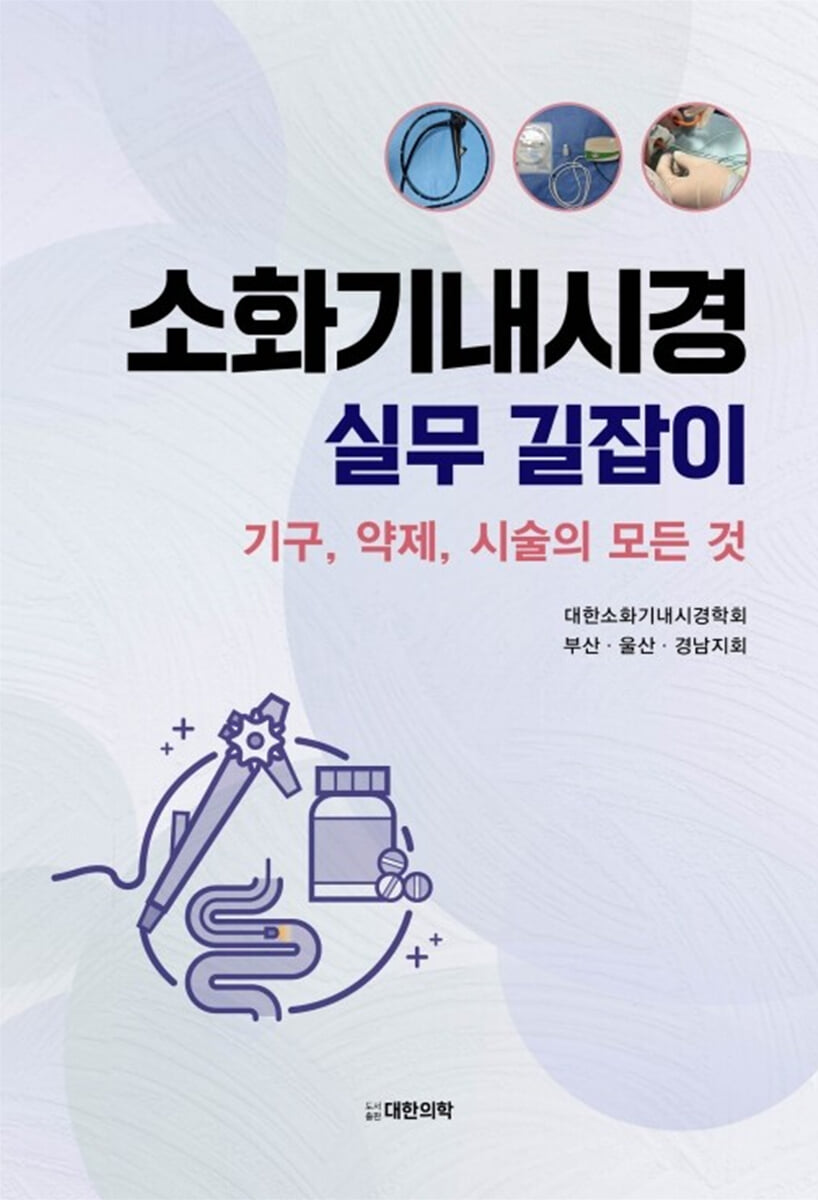
Gastrointestinal Endoscopy Practical Guide
 |
Description
Book Introduction
In the endoscopy room, not only screening endoscopy but also various therapeutic endoscopies are performed.
To perform these procedures accurately and safely, it is essential to have a thorough understanding of how to use endoscopic instruments and auxiliary devices.
Endoscopists and assistants must have accurate knowledge of endoscopic equipment, medications, and surgical techniques, which is directly related to patient safety and treatment success.
Accordingly, the Korean Society of Gastrointestinal Endoscopy, Busan Branch, has compiled a book that not only explains the equipment and instruments used in endoscopy rooms, but also compiles various surgical methods.
To perform these procedures accurately and safely, it is essential to have a thorough understanding of how to use endoscopic instruments and auxiliary devices.
Endoscopists and assistants must have accurate knowledge of endoscopic equipment, medications, and surgical techniques, which is directly related to patient safety and treatment success.
Accordingly, the Korean Society of Gastrointestinal Endoscopy, Busan Branch, has compiled a book that not only explains the equipment and instruments used in endoscopy rooms, but also compiles various surgical methods.
index
Part 1 Endoscopy Overview
Endoscopic system
Endoscope scope structure
Various endoscopic scopes
Upper endoscopy scope
Lower endoscopy scope
Endoscopy scope
Endoscopic peripheral devices
Songgi, Songsu, Suction
carbon dioxide delivery device
water pump
High-frequency electrosurgical device
argon plasma coagulation
Endoscopic ultrasound
magnifying endoscope
two-channel endoscope
Multi-bending endoscope
Image-enhanced endoscopy
Computer-assisted endoscopy (AI endoscopy)
Part 2 Gastrointestinal Diagnostic Endoscopy
Laryngeal anesthetic (lidocaine), debuffer, mucus remover
Endoscopy room medications and sedatives
Preparation tools: mouthpiece, overtube, biopsy forceps
Mouthpiece
Overtube
biopsy forceps
sedation endoscopy
Upper endoscopy
Lower gastrointestinal endoscopy
small bowel endoscopy
Capsule endoscopy
Chromoendoscopy
Part 3 Gastrointestinal therapeutic endoscopy
Assistive devices used
Injector
Submucosal infusion
snare
knife
cap (hood)
band
Net forceps
Esophageal variceal ligation
Sclerotherapy of gastric varicose veins
Cryo-snare polypectomy
Mucosal resection
modified mucosal resection
Cap-mounted endoscopic mucosal resection
Endoscopic mucosal resection after ligation
Endoscopic mucosal resection after mucosal incision
endoscopic submucosal dissection
Percutaneous endoscopic gastrostomy
Foreign body removal
Balloon angioplasty and endoscopic dilatation
Stent insertion
Part 4: Incidents of Diagnostic and Therapeutic Endoscopy
Drug related
Inspection related
bleeding
boring
Assistive devices used
Local injection of hypertonic saline with epinephrine
hemostatic forceps
Endoscopic clips and clip fixation devices
powder spray
Over-The-Scope-Clip (OTSCⓡ)
Part 5: Pancreatobiliary Endoscopy and Endoscopic Ultrasound
Pancreatobiliary endoscopy equipment
duodenoscope
cholangioscopy
Endoscopic ultrasound
accessories
Insertion catheter
Yoo Do-cheol
Sphincterotomy
basket
balloon catheter
Balloon for stricture dilation
Biliary duct drainage and pancreatic duct drainage
plastic stents
metal stents
Accessories for tissue collection (cytology brush, biopsy forceps)
Endoscopic ultrasound aspiration needle
Endoscopic retrograde cholangiopancreatography
Preparation for endoscopic retrograde cholangiopancreatography
Progression of endoscopic retrograde cholangiopancreatography
endoscopic papillotomy
Endoscopic papillary balloon dilatation
Gallstone removal using endoscopic retrograde cholangiopancreatography
Tissue collection via endoscopic retrograde cholangiopancreatography
Endoscopic transbiliary drainage
Endoscopic retrograde biliary drainage
Endoscopic papillectomy
cholangioscopy
Percutaneous transhepatic cholangioscopy
Single-Operator Cholangioscopy
Endoscopic ultrasound of the pancreatobiliary tract
INDEX
Endoscopic system
Endoscope scope structure
Various endoscopic scopes
Upper endoscopy scope
Lower endoscopy scope
Endoscopy scope
Endoscopic peripheral devices
Songgi, Songsu, Suction
carbon dioxide delivery device
water pump
High-frequency electrosurgical device
argon plasma coagulation
Endoscopic ultrasound
magnifying endoscope
two-channel endoscope
Multi-bending endoscope
Image-enhanced endoscopy
Computer-assisted endoscopy (AI endoscopy)
Part 2 Gastrointestinal Diagnostic Endoscopy
Laryngeal anesthetic (lidocaine), debuffer, mucus remover
Endoscopy room medications and sedatives
Preparation tools: mouthpiece, overtube, biopsy forceps
Mouthpiece
Overtube
biopsy forceps
sedation endoscopy
Upper endoscopy
Lower gastrointestinal endoscopy
small bowel endoscopy
Capsule endoscopy
Chromoendoscopy
Part 3 Gastrointestinal therapeutic endoscopy
Assistive devices used
Injector
Submucosal infusion
snare
knife
cap (hood)
band
Net forceps
Esophageal variceal ligation
Sclerotherapy of gastric varicose veins
Cryo-snare polypectomy
Mucosal resection
modified mucosal resection
Cap-mounted endoscopic mucosal resection
Endoscopic mucosal resection after ligation
Endoscopic mucosal resection after mucosal incision
endoscopic submucosal dissection
Percutaneous endoscopic gastrostomy
Foreign body removal
Balloon angioplasty and endoscopic dilatation
Stent insertion
Part 4: Incidents of Diagnostic and Therapeutic Endoscopy
Drug related
Inspection related
bleeding
boring
Assistive devices used
Local injection of hypertonic saline with epinephrine
hemostatic forceps
Endoscopic clips and clip fixation devices
powder spray
Over-The-Scope-Clip (OTSCⓡ)
Part 5: Pancreatobiliary Endoscopy and Endoscopic Ultrasound
Pancreatobiliary endoscopy equipment
duodenoscope
cholangioscopy
Endoscopic ultrasound
accessories
Insertion catheter
Yoo Do-cheol
Sphincterotomy
basket
balloon catheter
Balloon for stricture dilation
Biliary duct drainage and pancreatic duct drainage
plastic stents
metal stents
Accessories for tissue collection (cytology brush, biopsy forceps)
Endoscopic ultrasound aspiration needle
Endoscopic retrograde cholangiopancreatography
Preparation for endoscopic retrograde cholangiopancreatography
Progression of endoscopic retrograde cholangiopancreatography
endoscopic papillotomy
Endoscopic papillary balloon dilatation
Gallstone removal using endoscopic retrograde cholangiopancreatography
Tissue collection via endoscopic retrograde cholangiopancreatography
Endoscopic transbiliary drainage
Endoscopic retrograde biliary drainage
Endoscopic papillectomy
cholangioscopy
Percutaneous transhepatic cholangioscopy
Single-Operator Cholangioscopy
Endoscopic ultrasound of the pancreatobiliary tract
INDEX
Publisher's Review
preface
In the endoscopy room, not only screening endoscopy but also various therapeutic endoscopies are performed.
To perform these procedures accurately and safely, it is essential to have a thorough understanding of how to use endoscopic instruments and auxiliary devices.
Endoscopists and assistants must have accurate knowledge of endoscopic equipment, medications, and surgical techniques, which is directly related to patient safety and treatment success.
Accordingly, the Korean Society of Gastrointestinal Endoscopy, Busan Branch, has compiled a book that not only explains the equipment and instruments used in endoscopy rooms, but also compiles various surgical methods.
This book is written with practical application in mind and is rich in photographs, helping you gain a comprehensive understanding of endoscopy procedures.
In particular, experienced medical staff participated in writing the book to broaden understanding of endoscopic examination and treatment and to provide practical assistance in the field.
It will be a useful reference for medical staff working in endoscopy rooms, as it includes explanations of precautions that are easy to miss in the field.
However, while this booklet is based on the latest information, medical technology and equipment are constantly evolving.
Therefore, some contents may differ from the latest changes, and it is recommended to refer to the manufacturer's manual or attached documents for more specific details.
This book introduces basic concepts and cutting-edge equipment concisely and clearly, and summarizes key content and highlights important points under each subheading.
This book will be especially useful for fellows and nurses starting their careers in the endoscopy department.
Additionally, it is designed to help all medical professionals involved in endoscopy rooms easily understand areas that may be overlooked in practice.
If placed in the endoscopy room and utilized, it would be helpful to everyone.
thank you
Park Soo-beom, writing committee chairman
Preface to the editor
Since its founding in 1977, the Busan-Ulsan-Gyeongnam Branch of the Korean Society of Gastrointestinal Endoscopy has been working to revitalize the academic field of gastrointestinal endoscopy in the region.
In addition, our branch has been working to organize and share our diverse experiences and latest knowledge by publishing books such as 『Practical Strategy Clinical Gastrointestinal Endoscopy』 in 2010, 『Practical Gastrointestinal Endoscopy Guidelines』 in 2013, 『Percutaneous Endoscopic Gastrostomy』 in 2022, and 『Gastrointestinal Endoscopy Conference Case Collection』 in 2023.
This is the result of the efforts of the past branch directors, presidents, and many senior and junior executives.
This time, our branch is publishing a new booklet titled “A Guide to Gastrointestinal Endoscopy: Everything About Equipment, Drugs, and Procedures.”
In order to perform diagnostic endoscopy and various therapeutic endoscopies in the endoscopy room, endoscopists and assistants must have a precise understanding of the endoscopic machine, how to use endoscopic auxiliary devices, and the drugs used.
This booklet is divided into five sections: Overview of Endoscopy, Diagnostic Endoscopy of the Gastrointestinal Tract, Therapeutic Endoscopy of the Gastrointestinal Tract, Incidents of Diagnostic and Therapeutic Endoscopy, Pancreatobiliary Endoscopy, and Endoscopic Ultrasound. We have tried to explain each examination, the mechanical equipment, the drugs used, and the auxiliary devices from the preparation stage.
This booklet provides a comprehensive understanding of the work that takes place in an endoscopy room, with numerous photographs to help you understand the actual endoscopy room environment.
Although this book cannot describe all the latest information and new equipment that comes in every day, it is intended to be helpful to endoscopists and nurses who are starting new endoscopy work.
I would like to express my gratitude to the past chairmen and other presidents who have spared no effort in guiding the publication of this booklet, and to the executives who have assisted in various ways.
In particular, I would like to express my gratitude to Editor-in-Chief Park Su-beom and the writing staff who, despite the difficult circumstances of the medical field, did not hesitate to make personal sacrifices in organizing and writing the materials.
Chairman of the Busan, Ulsan, and Gyeongnam Chapters of the Korean Society of Gastrointestinal Endoscopy
Ji Sam-ryong
River Ryu Bridge
In the endoscopy room, not only screening endoscopy but also various therapeutic endoscopies are performed.
To perform these procedures accurately and safely, it is essential to have a thorough understanding of how to use endoscopic instruments and auxiliary devices.
Endoscopists and assistants must have accurate knowledge of endoscopic equipment, medications, and surgical techniques, which is directly related to patient safety and treatment success.
Accordingly, the Korean Society of Gastrointestinal Endoscopy, Busan Branch, has compiled a book that not only explains the equipment and instruments used in endoscopy rooms, but also compiles various surgical methods.
This book is written with practical application in mind and is rich in photographs, helping you gain a comprehensive understanding of endoscopy procedures.
In particular, experienced medical staff participated in writing the book to broaden understanding of endoscopic examination and treatment and to provide practical assistance in the field.
It will be a useful reference for medical staff working in endoscopy rooms, as it includes explanations of precautions that are easy to miss in the field.
However, while this booklet is based on the latest information, medical technology and equipment are constantly evolving.
Therefore, some contents may differ from the latest changes, and it is recommended to refer to the manufacturer's manual or attached documents for more specific details.
This book introduces basic concepts and cutting-edge equipment concisely and clearly, and summarizes key content and highlights important points under each subheading.
This book will be especially useful for fellows and nurses starting their careers in the endoscopy department.
Additionally, it is designed to help all medical professionals involved in endoscopy rooms easily understand areas that may be overlooked in practice.
If placed in the endoscopy room and utilized, it would be helpful to everyone.
thank you
Park Soo-beom, writing committee chairman
Preface to the editor
Since its founding in 1977, the Busan-Ulsan-Gyeongnam Branch of the Korean Society of Gastrointestinal Endoscopy has been working to revitalize the academic field of gastrointestinal endoscopy in the region.
In addition, our branch has been working to organize and share our diverse experiences and latest knowledge by publishing books such as 『Practical Strategy Clinical Gastrointestinal Endoscopy』 in 2010, 『Practical Gastrointestinal Endoscopy Guidelines』 in 2013, 『Percutaneous Endoscopic Gastrostomy』 in 2022, and 『Gastrointestinal Endoscopy Conference Case Collection』 in 2023.
This is the result of the efforts of the past branch directors, presidents, and many senior and junior executives.
This time, our branch is publishing a new booklet titled “A Guide to Gastrointestinal Endoscopy: Everything About Equipment, Drugs, and Procedures.”
In order to perform diagnostic endoscopy and various therapeutic endoscopies in the endoscopy room, endoscopists and assistants must have a precise understanding of the endoscopic machine, how to use endoscopic auxiliary devices, and the drugs used.
This booklet is divided into five sections: Overview of Endoscopy, Diagnostic Endoscopy of the Gastrointestinal Tract, Therapeutic Endoscopy of the Gastrointestinal Tract, Incidents of Diagnostic and Therapeutic Endoscopy, Pancreatobiliary Endoscopy, and Endoscopic Ultrasound. We have tried to explain each examination, the mechanical equipment, the drugs used, and the auxiliary devices from the preparation stage.
This booklet provides a comprehensive understanding of the work that takes place in an endoscopy room, with numerous photographs to help you understand the actual endoscopy room environment.
Although this book cannot describe all the latest information and new equipment that comes in every day, it is intended to be helpful to endoscopists and nurses who are starting new endoscopy work.
I would like to express my gratitude to the past chairmen and other presidents who have spared no effort in guiding the publication of this booklet, and to the executives who have assisted in various ways.
In particular, I would like to express my gratitude to Editor-in-Chief Park Su-beom and the writing staff who, despite the difficult circumstances of the medical field, did not hesitate to make personal sacrifices in organizing and writing the materials.
Chairman of the Busan, Ulsan, and Gyeongnam Chapters of the Korean Society of Gastrointestinal Endoscopy
Ji Sam-ryong
River Ryu Bridge
GOODS SPECIFICS
- Date of issue: July 10, 2025
- Page count, weight, size: 264 pages | 150*220*20mm
- ISBN13: 9791155903148
- ISBN10: 1155903145
You may also like
카테고리
korean


korean

![ELLE 엘르 스페셜 에디션 A형 : 12월 [2025]](http://librairie.coreenne.fr/cdn/shop/files/b8e27a3de6c9538896439686c6b0e8fb.jpg?v=1766436872&width=3840)


