

Utopian pedagogy
 |
Description
Book Introduction
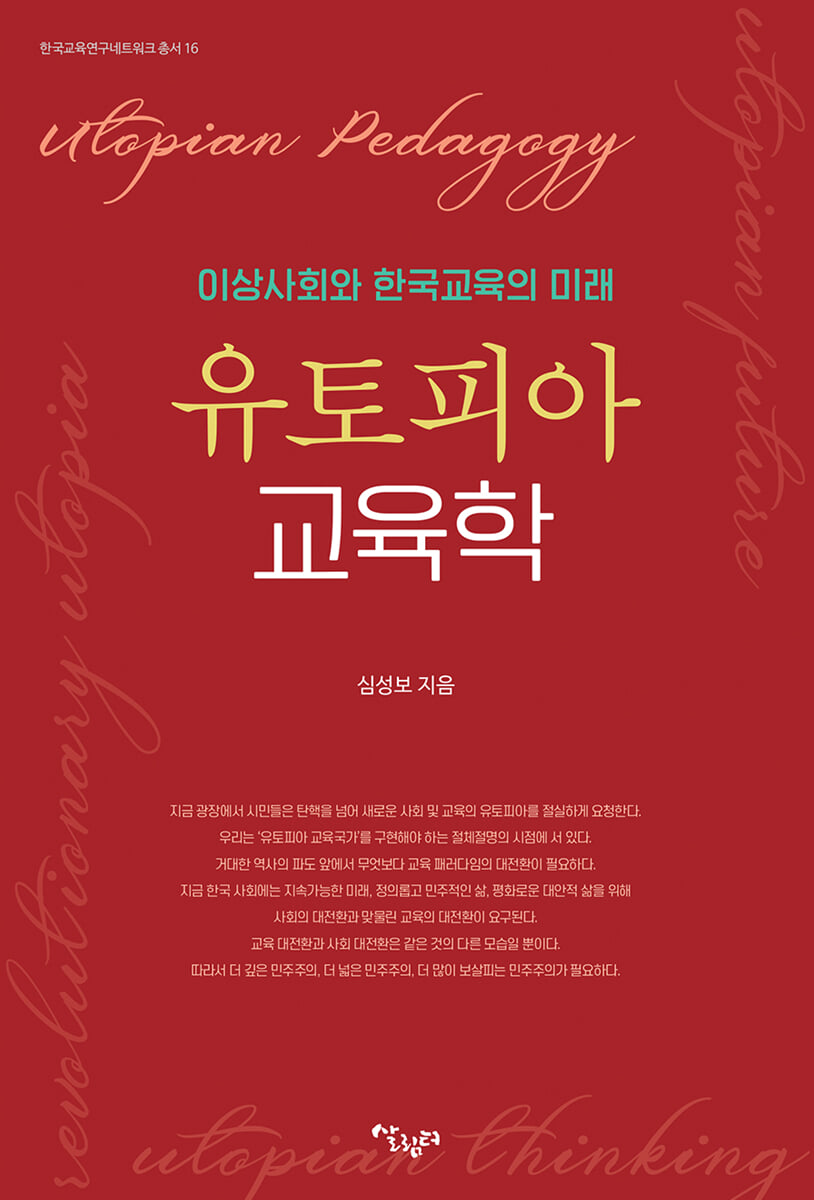
"Utopian Pedagogy" is a message about ideal education delivered by Professor Sim Seong-bo, a giant in the field of education who dreams of being a "practical theorist" and a "theoretical practitioner."
The author seeks to lead the way toward realizing a "utopian educational state" for those who desperately demand a new social and educational utopia.
The author seeks to lead the way toward realizing a "utopian educational state" for those who desperately demand a new social and educational utopia.
- You can preview some of the book's contents.
Preview
index
Preface | Toward the Return of Utopian Thought and the Reconstruction of Ideal Education 5
Part 1: The Overlapping Phases of Utopia and Dystopia
Chapter 1: Hope Born from the Swamp of Despair
Despair is the irony of hope / A prospect for those without a future / The power of heterotopia / The trap of utopianism / The utopian principle of the '68 revolution becomes reality / Progress is the process of realizing utopia
Chapter 2: Research on Utopian Educational Thought and Alternative Practices
Utopian Thought for a Better Society / Various Approaches to Utopianism / Weak Utopian Education Strategies / Realistic Educational Utopia Project
Chapter 3: Plato, The Republic, and the Education That Transforms the Soul
An ideal state ruled by philosophers / Education that transforms the soul / Citizenship education for a just society / The limitations of class-obsessed education / Implications of a critique of democracy
Chapter 4: More, the Kingdom of Imagination, and Humanistic Education
A Kingdom of Equality for All: Utopia / The Diverse Paths of Humanistic Education / The Dream of a Sharing Society for the Dispossessed
Chapter 5: Owen, Dystopian Socialism and the Formation of a New Humanity
The Twelve Fundamental Laws of Human Nature / Education for the Formation of a New Human Nature / Education for Happiness / Life in a Cooperative Community
Chapter 6: Morris: Utopia as a Life and Education Blending Labor, Art, and Rest
Freedom and Autonomy, a Living Utopia / Life as Art, the World as Art / Education that Inspires Utopian Imagination
Chapter 7: Huxley, Rebellion Against Happiness and Moral Utopia
A Warning Against Dystopia: Brave New World / The Paradox of the Disintegrated Family / The Law of Happiness Seen Upside Down / The Educational Significance of Moral Utopia
Chapter 8: Orwell, Utopian Imagination and Dystopian Socialism
Distinguishing between patriotism and nationalism / Appealing to human dignity / 'Tragic heroism' and imperfect love / The struggle toward utopian perfection / The power of the invisible Big Brother / We need a utopian imagination!
Chapter 9: Skinner, Manipulable Utopias and a World Without Heroes
A Utopian Society That Can Be Manipulated / The Operating Principles of Walden Two / Skepticism About Human Free Will / Skinner's Principles of Education / A World Without Heroes / Controversy Over Beyond Freedom and Dignity
Chapter 10: Marcuse, "Civilization Without Oppression" as Utopia and the Aesthetic Imagination
Actively seeking alternatives to critical theory / Acceptance and transformation of Freudian theory / 'Civilization without oppression' as a utopia and aesthetic imagination / Pioneer of revolutionary ecological education
Chapter 11: Ricoeur's Critique of Ideology and Utopian Thought
Criticism of ideology / The function of ideology / The balance between ideology and utopia / The positive function of utopia / The educational task between ideology and utopia
Chapter 12: The Ideal Society Aimed at by Donghak: 空?公?共
The utopia of the people, Donghak/Donghak's idea of opening the world, the educational significance of 空·公·共/空·公·共
Chapter 13: The Birth and Resurrection of the Democratic Republic
The spirit of republicanism, the spirit of the republic, the birth of a democratic republic, the revival of the democratic republic and the challenges following the civil war.
Part 2: The Utopia of Schools and the Construction of an Ideal Educational State
Chapter 14: Schools Transform into Dystopian Environments
Trends in global education reform / Criticism of meritocracy and hyper-competitive education / What kind of society does school need?
Chapter 15: Utopia, Dystopia, and Edutopia
The Future of Utopian Thought and Education / Practical Utopian Education Experiment / Children's Imagination Transforms into Adults' Utopian Imagination
Chapter 16: Deliberative and Associational Democracy, Cooperation, and Educational Governance
Deliberative democracy and associational democracy as conditions for cooperation/From governance to cooperation, and educational governance
Chapter 17: The Relationship Between the State, the Market, and Civil Society and the Civilization of Schools
The Relationship Between the State, the Market, and Civil Society / The Utopia of Civil Society and the Civilization of Schools / The Consolidation of Civil Society and Civic Etiquette Education
Chapter 18: A Community School Where Communication and Discourse Form
The combination of communitas and respubblica / Various models of community education / Communicative schools aiming for utopia / Schools are places that create educated publics / Schools are public forums where interpretations and discourses are exchanged / The rise of inquiry communities / Obstacles and clues to restoring school community
Chapter 19: Anarchist Education as Utopian Hope
Anarchy, Order, and the State/ Radical Educational Experiments of Social Anarchists/ Changes in Education and Changes in Society Must Not Be Separated
Chapter 20: Democratic Experimentalism and the Experimental School Model
Democratic experimentalism/Experimental spirit and experimental schools/Reggio Emilia movement/Expansion of experimental schools and their connection to the local community
Chapter 21: Education for Democracy and Autonomous Schools
Education for Democracy / What is Autonomy in Democracy? / Autonomy Advocated by Civic Republicanism / The Ultimate Goal of Educational Autonomy: 'School Autonomy' / A Model of Self-Governing Autonomous Schools / Summerhill School, the Utopia of Educational Autonomy
Chapter 22: The Coexistence of Just Schools and Dignified Schools
Establishment of a just education system / Public education in a just republic / Public education in a benevolent nation / Schools embracing justice and dignity
Chapter 23: Utopian Perspectives and the Future Direction of Education
The gap between technological progress and moral progress / Is the future of technology a utopia or a dystopia? / The controversy over the effectiveness of AI digital textbooks / The importance of future thinking / Future research, future education, and future schools / Future possibilities and the utopia of education / 'Present pedagogy' as the intersection of the past and the future / The direction of future education
Chapter 24: Utopian Leadership as Transformational Leadership
Criticism of Transactional Leadership / Transformational Leadership that Changes Society / Utopian Leadership Preparing for an Ideal Society / Utopian Leadership is Sustainable Leadership / 'Team' Leadership in Small Schools
Chapter 25: Liquidating the Outdated Education System and Building an Ideal Educational Nation
Social upheaval and systemic crisis / Niche transformation and educational revolution / Building a democratic educational state / Convergence of democratic education and republican education / Democracy at a crossroads and the crisis of the classroom / From democratic citizenship education to democratic education / Adults must become democrats first / Why should children be treated as citizens? / Social consensus for a great transformation in education / UNESCO's new social contract for education / Civil war, public squares, democracy, and schools
Part 1: The Overlapping Phases of Utopia and Dystopia
Chapter 1: Hope Born from the Swamp of Despair
Despair is the irony of hope / A prospect for those without a future / The power of heterotopia / The trap of utopianism / The utopian principle of the '68 revolution becomes reality / Progress is the process of realizing utopia
Chapter 2: Research on Utopian Educational Thought and Alternative Practices
Utopian Thought for a Better Society / Various Approaches to Utopianism / Weak Utopian Education Strategies / Realistic Educational Utopia Project
Chapter 3: Plato, The Republic, and the Education That Transforms the Soul
An ideal state ruled by philosophers / Education that transforms the soul / Citizenship education for a just society / The limitations of class-obsessed education / Implications of a critique of democracy
Chapter 4: More, the Kingdom of Imagination, and Humanistic Education
A Kingdom of Equality for All: Utopia / The Diverse Paths of Humanistic Education / The Dream of a Sharing Society for the Dispossessed
Chapter 5: Owen, Dystopian Socialism and the Formation of a New Humanity
The Twelve Fundamental Laws of Human Nature / Education for the Formation of a New Human Nature / Education for Happiness / Life in a Cooperative Community
Chapter 6: Morris: Utopia as a Life and Education Blending Labor, Art, and Rest
Freedom and Autonomy, a Living Utopia / Life as Art, the World as Art / Education that Inspires Utopian Imagination
Chapter 7: Huxley, Rebellion Against Happiness and Moral Utopia
A Warning Against Dystopia: Brave New World / The Paradox of the Disintegrated Family / The Law of Happiness Seen Upside Down / The Educational Significance of Moral Utopia
Chapter 8: Orwell, Utopian Imagination and Dystopian Socialism
Distinguishing between patriotism and nationalism / Appealing to human dignity / 'Tragic heroism' and imperfect love / The struggle toward utopian perfection / The power of the invisible Big Brother / We need a utopian imagination!
Chapter 9: Skinner, Manipulable Utopias and a World Without Heroes
A Utopian Society That Can Be Manipulated / The Operating Principles of Walden Two / Skepticism About Human Free Will / Skinner's Principles of Education / A World Without Heroes / Controversy Over Beyond Freedom and Dignity
Chapter 10: Marcuse, "Civilization Without Oppression" as Utopia and the Aesthetic Imagination
Actively seeking alternatives to critical theory / Acceptance and transformation of Freudian theory / 'Civilization without oppression' as a utopia and aesthetic imagination / Pioneer of revolutionary ecological education
Chapter 11: Ricoeur's Critique of Ideology and Utopian Thought
Criticism of ideology / The function of ideology / The balance between ideology and utopia / The positive function of utopia / The educational task between ideology and utopia
Chapter 12: The Ideal Society Aimed at by Donghak: 空?公?共
The utopia of the people, Donghak/Donghak's idea of opening the world, the educational significance of 空·公·共/空·公·共
Chapter 13: The Birth and Resurrection of the Democratic Republic
The spirit of republicanism, the spirit of the republic, the birth of a democratic republic, the revival of the democratic republic and the challenges following the civil war.
Part 2: The Utopia of Schools and the Construction of an Ideal Educational State
Chapter 14: Schools Transform into Dystopian Environments
Trends in global education reform / Criticism of meritocracy and hyper-competitive education / What kind of society does school need?
Chapter 15: Utopia, Dystopia, and Edutopia
The Future of Utopian Thought and Education / Practical Utopian Education Experiment / Children's Imagination Transforms into Adults' Utopian Imagination
Chapter 16: Deliberative and Associational Democracy, Cooperation, and Educational Governance
Deliberative democracy and associational democracy as conditions for cooperation/From governance to cooperation, and educational governance
Chapter 17: The Relationship Between the State, the Market, and Civil Society and the Civilization of Schools
The Relationship Between the State, the Market, and Civil Society / The Utopia of Civil Society and the Civilization of Schools / The Consolidation of Civil Society and Civic Etiquette Education
Chapter 18: A Community School Where Communication and Discourse Form
The combination of communitas and respubblica / Various models of community education / Communicative schools aiming for utopia / Schools are places that create educated publics / Schools are public forums where interpretations and discourses are exchanged / The rise of inquiry communities / Obstacles and clues to restoring school community
Chapter 19: Anarchist Education as Utopian Hope
Anarchy, Order, and the State/ Radical Educational Experiments of Social Anarchists/ Changes in Education and Changes in Society Must Not Be Separated
Chapter 20: Democratic Experimentalism and the Experimental School Model
Democratic experimentalism/Experimental spirit and experimental schools/Reggio Emilia movement/Expansion of experimental schools and their connection to the local community
Chapter 21: Education for Democracy and Autonomous Schools
Education for Democracy / What is Autonomy in Democracy? / Autonomy Advocated by Civic Republicanism / The Ultimate Goal of Educational Autonomy: 'School Autonomy' / A Model of Self-Governing Autonomous Schools / Summerhill School, the Utopia of Educational Autonomy
Chapter 22: The Coexistence of Just Schools and Dignified Schools
Establishment of a just education system / Public education in a just republic / Public education in a benevolent nation / Schools embracing justice and dignity
Chapter 23: Utopian Perspectives and the Future Direction of Education
The gap between technological progress and moral progress / Is the future of technology a utopia or a dystopia? / The controversy over the effectiveness of AI digital textbooks / The importance of future thinking / Future research, future education, and future schools / Future possibilities and the utopia of education / 'Present pedagogy' as the intersection of the past and the future / The direction of future education
Chapter 24: Utopian Leadership as Transformational Leadership
Criticism of Transactional Leadership / Transformational Leadership that Changes Society / Utopian Leadership Preparing for an Ideal Society / Utopian Leadership is Sustainable Leadership / 'Team' Leadership in Small Schools
Chapter 25: Liquidating the Outdated Education System and Building an Ideal Educational Nation
Social upheaval and systemic crisis / Niche transformation and educational revolution / Building a democratic educational state / Convergence of democratic education and republican education / Democracy at a crossroads and the crisis of the classroom / From democratic citizenship education to democratic education / Adults must become democrats first / Why should children be treated as citizens? / Social consensus for a great transformation in education / UNESCO's new social contract for education / Civil war, public squares, democracy, and schools
Publisher's Review
Dreaming of utopia is essential to changing the reality of education.
- For the return of utopian thought and the reconstruction of ideal education -
'Utopian pedagogy' is soon to be 'pedagogy of hope.'
The author, who proposes a 'utopian pedagogy' in an age of ruins, is soon to be called a 'pedagogy of hope,' and argues for the preparation of a new educational system.
“In the post-civil war world, a more just and democratic education system, a more peaceful and ecological education system, must come.
Faced with multiple crises—rising social inequality, the climate crisis, resource overuse, the erosion of commons, the decline of democracy, disruptive technological automation, a deepening low birth rate, and an aging population—we must create a new educational order.
Our society also needs to reach a new social consensus to prepare for a new educational system after the civil war.”
Dreaming of utopia is essential to changing the reality of education.
The author, who emphasizes the need to have a vision of an 'ideal educational nation,' suggests that a 'realistic/real' educational utopia project must be conceived and implemented to achieve an epistemological transformation after the civil war.
In 'Part 1: The Overlapping Phase of Utopia and Dystopia,' we begin by examining the process by which the word 'utopia,' which refers to the 'ideal society' that people desire, came to be established among us, and then examine the ideal society theories and educational arguments of Plato, Thomas More, Robert Owen, Morris, Aldous Huxley, George Orwell, Skinner, Marcuse, and Ricoeur.
The ideal society that Donghak pursued is also not left out.
And we talk about democratic education, focusing on the revival of the democratic republic and the tasks ahead.
“A new democratic republic will not be achieved with just one more change of government.
At the same time, we must strive to strengthen the roots of democracy in civil society.
To achieve this, we must strengthen democratic education for all walks of life, including students, the general public, civil servants, and military personnel.
Only then will the memories of the citizens' struggle, solidarity, and victory to preserve the democratic republic be passed down through the waves of history to the next generation and the generation after that.”
Beyond a sick society and sick education
Part 2, "The Utopia of Schools and the Construction of an Ideal Educational Nation," contains an exploration of an ideal educational theory that seeks to break through the "sick society, sick education," which is the simplest expression of the reality of today's Korean society and education.
Examining trends in global education reform, the author continues his journey toward utopia, dystopia, and edutopia.
“Many educational thinkers explore the role of educational utopias, or ‘edutopias,’ in the utopian tradition, exploring their sources and locations as a means of understanding the purpose and goals of education, seeking to realize social values, and critiquing current economic, technological, and organizational patterns.”
While providing a detailed account of the history and present of various schools, including community schools, and exploring education for democracy, just schools, and utopian leadership, the author explores the future direction of education and finally faces the task of "liquidating the outdated education system and building an ideal educational nation."
“Ultimately, for democracy to be consolidated, the only way is for us to learn about democracy throughout our lives and grow into democrats ourselves.
As John Dewey understood, the essence of democracy is a realistic ideal that does not yet exist and a possibility of a desirable future.”
- For the return of utopian thought and the reconstruction of ideal education -
'Utopian pedagogy' is soon to be 'pedagogy of hope.'
The author, who proposes a 'utopian pedagogy' in an age of ruins, is soon to be called a 'pedagogy of hope,' and argues for the preparation of a new educational system.
“In the post-civil war world, a more just and democratic education system, a more peaceful and ecological education system, must come.
Faced with multiple crises—rising social inequality, the climate crisis, resource overuse, the erosion of commons, the decline of democracy, disruptive technological automation, a deepening low birth rate, and an aging population—we must create a new educational order.
Our society also needs to reach a new social consensus to prepare for a new educational system after the civil war.”
Dreaming of utopia is essential to changing the reality of education.
The author, who emphasizes the need to have a vision of an 'ideal educational nation,' suggests that a 'realistic/real' educational utopia project must be conceived and implemented to achieve an epistemological transformation after the civil war.
In 'Part 1: The Overlapping Phase of Utopia and Dystopia,' we begin by examining the process by which the word 'utopia,' which refers to the 'ideal society' that people desire, came to be established among us, and then examine the ideal society theories and educational arguments of Plato, Thomas More, Robert Owen, Morris, Aldous Huxley, George Orwell, Skinner, Marcuse, and Ricoeur.
The ideal society that Donghak pursued is also not left out.
And we talk about democratic education, focusing on the revival of the democratic republic and the tasks ahead.
“A new democratic republic will not be achieved with just one more change of government.
At the same time, we must strive to strengthen the roots of democracy in civil society.
To achieve this, we must strengthen democratic education for all walks of life, including students, the general public, civil servants, and military personnel.
Only then will the memories of the citizens' struggle, solidarity, and victory to preserve the democratic republic be passed down through the waves of history to the next generation and the generation after that.”
Beyond a sick society and sick education
Part 2, "The Utopia of Schools and the Construction of an Ideal Educational Nation," contains an exploration of an ideal educational theory that seeks to break through the "sick society, sick education," which is the simplest expression of the reality of today's Korean society and education.
Examining trends in global education reform, the author continues his journey toward utopia, dystopia, and edutopia.
“Many educational thinkers explore the role of educational utopias, or ‘edutopias,’ in the utopian tradition, exploring their sources and locations as a means of understanding the purpose and goals of education, seeking to realize social values, and critiquing current economic, technological, and organizational patterns.”
While providing a detailed account of the history and present of various schools, including community schools, and exploring education for democracy, just schools, and utopian leadership, the author explores the future direction of education and finally faces the task of "liquidating the outdated education system and building an ideal educational nation."
“Ultimately, for democracy to be consolidated, the only way is for us to learn about democracy throughout our lives and grow into democrats ourselves.
As John Dewey understood, the essence of democracy is a realistic ideal that does not yet exist and a possibility of a desirable future.”
GOODS SPECIFICS
- Date of issue: June 15, 2025
- Page count, weight, size: 464 pages | 153*224*30mm
- ISBN13: 9791159303241
- ISBN10: 115930324X
You may also like
카테고리
korean


korean

![ELLE 엘르 스페셜 에디션 A형 : 12월 [2025]](http://librairie.coreenne.fr/cdn/shop/files/b8e27a3de6c9538896439686c6b0e8fb.jpg?v=1766436872&width=3840)


