

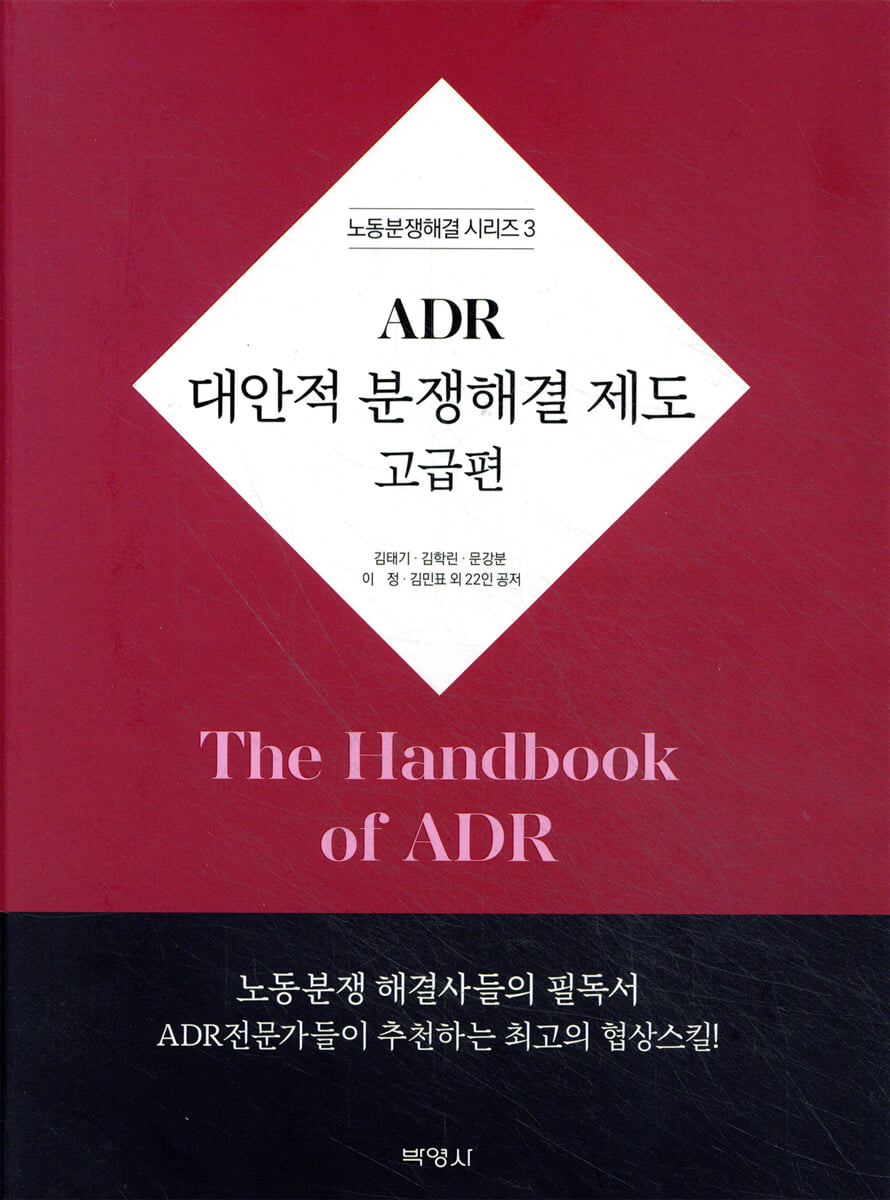
ADR - Advanced Alternative Dispute Resolution
 |
Description
Book Introduction
The ADR Level III textbook being published this time is aimed at those who have completed Level I and II training, and focuses on resolving issues that frequently arise, are chronic, or are difficult to resolve.
The goal of education is to help people understand the causes and consequences of these problems and find solutions to overcome them.
Because the book's scope and content are vast, it was written in a handbook format to make it easy to find and use by topic.
The book's contents are broadly divided into 25 topics in 4 sections.
Part 1: "How to Overcome Obstacles to Negotiation," Part 2: "How to Resolve Workplace Conflicts," Part 3: "How to Resolve Legal Disputes in the Workplace," and Part 4: "How to Support Dispute Resolution Practices," introduce the main points of each subject in the first chapter of each section.
The goal of education is to help people understand the causes and consequences of these problems and find solutions to overcome them.
Because the book's scope and content are vast, it was written in a handbook format to make it easy to find and use by topic.
The book's contents are broadly divided into 25 topics in 4 sections.
Part 1: "How to Overcome Obstacles to Negotiation," Part 2: "How to Resolve Workplace Conflicts," Part 3: "How to Resolve Legal Disputes in the Workplace," and Part 4: "How to Support Dispute Resolution Practices," introduce the main points of each subject in the first chapter of each section.
index
Part 1: Obstacles to Negotiation: How to Overcome Them?
Part 1: Overview: How to Overcome Obstacles to Negotiation 2
Knowing the Cause Reveals the Solution - Diagnosing Conflict and Improving Systems - [Kim Tae-gi]… 7
Ⅰ.
Why is our company like this? 7
1.
Company A's Labor Dispute Story 7
2.
Company B's Employment Dispute Story 8
Ⅱ.
Understanding Dispute Resolution Systems 10
1.
10 from support to advice
2.
System Configuration and Analysis Method 11
Ⅲ.
Diagnosing Conflict: What's Wrong and Why? 20
1.
Diagnostic TF Configuration and Tools 20
2.
Diagnosis Case 22
Ⅳ.
Prescriptions for Conflict Resolution: Where and How to Start 25
1.
Task Selection and Implementation 25
2.
In the case of Company A, 27
3.
In the case of Company B, 27
V.
28 To successfully implement, feedback on, and institutionalize solutions
1.
Task Execution 28
2.
In the case of Company A, 30
3.
In the case of Company B, 31
Uncertainty makes conflict more intense - Managing Information Asymmetry in Employment Relations - [Kim Yong-min]… 37
Ⅰ.
The employment relationship is fundamentally information asymmetry 37
1.
Why Information Asymmetry Occurs and Its Impact on Results 40
2.
40 Representative Cases of Information Asymmetry
3.
The more information, the better 41
Ⅱ.
Pre-Negotiation Information Gathering and Negotiation Preparation 41
1.
42 Types of Information to Collect
2.
Information Gathering Method 42
3.
Negotiation Checklist 43
Ⅲ.
Information Gathering During Negotiations 45
1.
Negotiations begin with friendly conversation 45
2.
Questions are the keys that open the door to the information warehouse 45
3.
Listening is an optical lens that peers into the information warehouse. 47
4.
Information Sharing 47
5.
50 Ways to Respond When Your Opponent Uses Deception Tactics
Ⅳ.
50 Ways to Manage Information Asymmetry in Negotiations
1.
When I have information advantage 56
2.
When I was at an information disadvantage 59
3.
The Role of Coordinators in Reducing Information Asymmetry 61
V.
Reducing information asymmetry leads to win-win outcomes. 66
Negotiation Techniques Learned Through Failure [Park Ho-hwan]… 71
Ⅰ.
Failure is the mother of success 71
Ⅱ.
Failure Cases and Cause Analysis 72
1.
Case 1: Failure due to insufficient prior preparation 72
2.
Case 2: Problems with Alternatives and Leverage 82
3.
Case 3: Wage negotiations fail due to a tense standoff between labor and management.
What's the Difference Between Public and Private Sector Labor Disputes? - Characteristics and Resolutions of Public Sector Labor Disputes - [Kim Hak-rin]… 101
Ⅰ.
Public Sector Labor Disputes: Why Are They So Difficult to Resolve? 101
1.
○○ Area City Bus 2023 Wage and Labor Negotiations (Case 1) 101
2.
○○ Regional Teachers' Union (○○ Regional Office of Education) 2021 Collective Bargaining (Case 2) 103
3.
Labor Disputes in the Healthcare Sector 2023 (Case 3) 105
Ⅱ.
Characteristics of Labor-Management Relations in the Public Sector 106
1.
What is the public sector? 106
2.
Characteristics of Labor-Management Relations in the Public Sector 108
Ⅲ.
Structure and Characteristics of Public Sector Labor Disputes 110
1.
The Structure of Public Sector Labor Disputes 110
2.
Characteristics of Public Sector Labor Disputes 111
Ⅳ.
Principles and Challenges of Resolving Public Sector Labor Disputes 114
1.
Public Sector Labor Disputes and Complexity 114
2.
Task 116: Rational Resolution of Public Sector Labor Disputes
Negotiation Methods for Resolving Labor Disputes that Have Become Social Issues - Finding a Way to Negotiate as Labor-Management Disputes Derive into Extreme Confrontation - [Lee Seong-hee]… 125
Ⅰ.
Labor disputes have become a social problem, and new negotiation methods are needed. 125
Ⅱ.
126 Cases of Socially Issued Labor Disputes and Their Key Characteristics
1.
126 Major Cases of Labor Disputes That Have Become Social Issues
2.
The nature and key characteristics of labor disputes that have become social problems 131
Ⅲ.
Finding a Negotiated Solution to Labor Disputes, a Social Issue 134
1.
Negotiation experts are needed to resolve extreme confrontations through negotiation. 134
2.
Intelligence Analysis 135: Finding a Way to Negotiate in a Total Crisis
3.
Analysis of the issues, interests, and negotiation obstacles in labor disputes that have become social problems 135
Ⅳ.
Negotiation Methods for Resolving Socially Issued Labor Disputes 139
1.
Unraveling the Mystery of Labor Disputes 139
2.
Creating an Atmosphere for a Negotiation Transition and Reestablishing Ground Rules for Negotiation 141
3.
Building a New Negotiation Framework and Promoting a Step-by-Step Agreement 143
4.
Negotiations in a state of total crisis require the role of a dispute resolution supporter. 145
How to Manage Internal Labor Union Conflict [Hwang Gi-don]… 151
Ⅰ.
Case Summary 151
1.
Case A: Confrontational Group Psychology and Union Executive Leadership 151
2.
Case B: Preventing the Eruption of Partisan Conflict Through the Electoral System 152
3.
Case C: Minimizing Violations of Collective Bargaining Rights for Minority Unions 153
Ⅱ.
Key contents of the adjustment 153
1.
Case A: Union Members' Confrontational Group Psychology and Executive Leadership 153
2.
Case B: Preventing the Expression of Partisan Conflict Through the Electoral System 159
3.
Case C: Implementing Union Democracy Substantively by Minimizing the Sacrifice of Minority Unions 162
Ⅲ.
Summary and Implications 167
1.
Summary 167
2.
Case Study Implications 169
How Labor Unions Use Management Information - Promoting Labor-Management Trust and Pursuing Common Benefits - [Pyeon Jeong-il]… 177
Ⅰ.
A win-win negotiation that pursues growth and distribution together 177
1.
Company K's Negotiation Using Management Information Data 178
2.
Labor Union Negotiation Demand 179
Ⅱ.
Basic Preparation for Wage-Management Negotiations 180
1.
Collecting and Analyzing Member Opinions 181
2.
Internal Regulations Review 182
3.
Establishing a Negotiation Strategy 183
Ⅲ.
Information Gathering for Wage and Labor Negotiations 183
1.
Macroeconomic Indicators 184
2.
Financial Soundness 186
3.
Labor Cost Adequacy 191
4.
Information Gathering through Education and Benchmarking 194
Ⅳ.
The progress of the wage negotiations 195
1.
Pre-negotiation preparation 195
2.
Key Issues and Agreement 196
3.
Final Agreement and Report 198
V.
Labor-Management Cooperation for Common Development 198
1.
Direction pursued by the company 199
2.
200 Directions Pursued by Labor Unions
3.
200 Directions Jointly Pursued by Labor and Management
Part 2: How to Resolve Workplace Conflicts
Part 2 Overview: How to Resolve Workplace Conflicts? 206
Preventing Destructive Conflicts with Preemptive Response - Establishing a Workplace Bullying Resolution System - [Moon Kang-bun]… 211
Ⅰ.
The Need for Prevention through Preemptive Response 211
1.
Population Structure Change and the Need for Diversity Management 213
2.
Legalizing Workplace Bullying and the Expansion of Conflict 214
3.
Workplace Bullying Dispute Resolution Structure and Dispute Resolution Status 214
4.
The Need for a Prevention-Focused, Integrated Response 218
Ⅱ.
Establishing an Anti-Bullying Policy and Establishing a Preventive Grievance Resolution System 220
1.
Adoption of the Anti-Bullying Policy Statement and Code of Conduct 222
2.
Establishing an Anti-Bullying System and Establishing Guidelines 224
3.
Institutionalization and Limitations of Post-Response Procedures Consistent with Legal Standards 226
4.
Establishing a Preventive Complaint Handling System 229
Ⅲ.
Establishing a Workplace Bullying Prevention System Through an Integrated Solution 231
1.
Systematic Diagnosis and Risk Management 232
2.
Fostering a Culture of Respectful Leadership and Collaboration 237
3.
Designing and Implementing Effective Education 239
Let's break free from identity-based thinking and moral sentiments - Communication strategies to lower the temperature of conflict - [Kim Na-jeong]… 245
Ⅰ.
245 Common Conflicts in Employment Relationships
Ⅱ.
The Nature of Employment Relations Conflict: The Role of Identity, Thinking Habits, and Moral Emotions 249
1.
What is Conflict in Employment Relations? 249
2.
The Role of Identity: The "Us" and "Them" Construct 249
3.
Rigidity of Thinking Habits and Frames: How Do We See the World? 252
4.
Moral Sentiments - "This is not a simple matter!" 253
5.
The Consequences of Extreme Conflict: Case Study 260: The Collapse of Company M
Ⅲ.
A Practical Approach to Resolving Conflict in Organizations by Cooling the Heat: Reframing the Mindset and Moral Emotions, Beyond Identity-Based Thinking 262
1.
Breaking Free from Group Identity and Establishing a New Conflict Frame 263
2.
Objectifying Moral Feelings and Shifting to Solution-Oriented Discussions 264
3.
Using Perspective-Taking Conversation Techniques to Understand the Other Person's Perspective 265
4.
How to Transform Moral Feelings into a Force for Change 266
5.
Individualized Relationship Building Strategies 267
6.
Building a Sustainable Conflict Resolution System 268
7.
Introducing Conversational Techniques for Building New Relationships 269
8.
A Long-Term Approach 273
Ⅳ.
Turning Conflict in Your Organization into an Opportunity for Growth 276
Preventing Workplace Conflict with a Positive Organizational Culture - Building a Positive Organizational Culture - [Do Bo-ram]… 283
Ⅰ.
Organizational Approaches to Conflict and Dispute Prevention 284
Ⅱ.
Types of Workplace Conflict and Their Resolution 284
1.
Definition and Types of Workplace Conflict 284
2.
In which organizations does destructive conflict intensify? 287
3.
Factors Aggravating Conflict in Our Organization: Measurement Tool 291
Ⅲ.
Preventing Destructive Workplace Conflict: Organizational Development for a Positive Organizational Culture 291
1.
Understanding Organizational Culture 291
2.
Positive Organizational Culture for Conflict Resilience: Active Communication, Authenticity, and Mutual Respect 292
3.
A Systematic Approach to Building a Conflict-Resilient Organizational Culture: Organization Development 293
Ⅳ.
Change Strategies for Increasing Conflict Resilience: How to Create a Positive Organizational Culture 295
1.
The First Step to a Positive Organizational Culture: The Essentials of Organizational Development 295
2.
Company X's Organizational Development for a Positive Organizational Culture: An Implementation Process 298
3.
Organizational Development: Diagnostic Strategies 298
4.
Organizational Development: Intervention Strategies 300
5.
Organizational Development for a Positive Organizational Culture: Case Study 304 at Company Y
V.
Towards a Positive Organizational Culture 305
How to Communicate with Generation MZ - Non-Face-to-Face/Real-Time Communication - [Lee Young-myeon]… 309
Ⅰ.
Why do conflicts arise in non-face-to-face communication? 309
Ⅱ.
Virtual Communication and Conflict in the Workplace 311
1.
Non-face-to-face communication and conflict 312
2.
Non-real-time communication and conflict 312
Ⅲ.
How to Prevent and Resolve Conflicts in the Workplace: 316
1.
Treat others as individuals and limit communication to job-related matters.
316
2.
Obtain information that complements non-face-to-face communication 317
3.
Non-real-time communication is accurate and specific 317
4.
Preparation and practice are necessary for conflicts to arise. 319
5.
Prevent recurrence by organizing after handling the incident 319
Ⅳ.
320 to avoid conflict in non-face-to-face and non-real-time communication
1.
Non-face-to-face, non-real-time communication and human resource management 320
2.
Example: Case 321 of emotional verbal abuse and unfair dismissal
3.
Avoiding Conflict in Virtual and Real-Time Communication 322
Change Your Mindset, Find Solutions - A People-Centered Grievance Counseling Model - [Cha Myung-ho]… 329
Ⅰ.
Is there any other way? 329
Ⅱ.
What should we consider when it comes to conflict? 333
1.
Are We Living in the Same Reality? 334
2.
What is the center of my view of the world? 337
Ⅲ.
A People-Centered Workplace Conflict Management Model: People First! 340
1.
The Implications of the Person-Centered Conflict Counseling Model 340
2.
Counseling Basics 341
3.
Conflict Resolution Counseling Fundamentals Course 346
4.
How to resolve conflict with difficult people? 351
Part 3: How to Resolve Legal Disputes in the Workplace
Part 3: Overview: How to Resolve Legal Disputes in the Workplace? 362
Is the Law an Obstacle to Negotiation? - Principles of Legal Negotiation - [Lee Jeong]… 367
Ⅰ.
Labor Disputes and ADR 367
1.
Changing Patterns of Labor Disputes 367
2.
The Characteristics of Labor Disputes and the Need for ADR 368
Ⅱ.
Concepts and Models of Legal Negotiation 370
1.
The Concept of Legal Negotiation 370
2.
Model 370 of Legal Negotiation
Ⅲ.
Labor Disputes and ADR Utilization Methods 372
1.
Classification by Type of Labor Dispute 372
2.
Labor Disputes and ADR Use Case 374
3.
Conditions for Success in Legal Negotiations 387
Ⅳ.
The Role of Legal Counsel in Legal Negotiations 388
1.
Negotiations without legal representation 388
2.
The significance of legal representation in negotiations 389
3.
What Makes a Competent Legal Negotiator? 391
V.
Prospects and Challenges of Legal Negotiations 393
1.
Negotiation is a Comprehensive Art 393
2.
Legal negotiations cannot be replaced by AI. 393
3.
394 Reasons Why You Should Learn Legal Negotiation
How to Make the Most of Your Employment Contract and Employment Rules [Lee Kwang-seon]… 399
Ⅰ.
The Significance and Necessity of Employment Contracts and Employment Rules 399
1.
Problem 399
2.
The Significance of Employment Contracts and Employment Rules 400
3.
The Need for Employment Contracts and Employment Rules 401
Ⅱ.
Tips for Drafting Employment Contracts and Work Rules to Prevent and Resolve Disputes 403
1.
403. Matters to be stated in employment contracts and employment rules
2.
Priority 406 of employment contracts and employment rules
3.
408 Things to Consider When Changing Employment Contracts and Employment Rules
4.
Requirements for the Effectiveness of Employment Contracts and Employment Rules 410
5.
How to Write a Successful Employment Contract and Work Rules 412
6.
Preventing and Practical Resolution of Disputes Regarding Employment Contracts and Employment Rules 414
Tips for a Beautiful End to Your Work Life (Resignation and Dismissal) [Kwon Soon-ha]… 421
Ⅰ.
The Meaning and Necessity of Seeking Alternative Dispute Resolution Methods for Ending Work Life 421
Ⅱ.
The Legal Nature and Meaning of Resignation and Dismissal 422
1.
The Legal Nature and Meaning of Resignation 422
2.
The Legal Nature and Meaning of Dismissal 424
Ⅲ.
Resolution through resignation by agreement or other means of reconciliation 426
1.
Preparing for and Conducting Negotiations 426
2.
Documentation of Negotiation Results 428
3.
Plan 431 in case of refusal or breakdown of negotiations
Ⅳ.
Alternative Dispute Resolution Methods in Cases Where Resignation or Dismissal Is Denied 432
1.
Various issues surrounding retroactive wage payments and reinstatement to original positions 432
2.
Alternative 434, including monetary compensation
3.
Seeking Solutions to Avoid Becoming a So-Called "Workplace Villain" 434
V.
Continuous efforts to explore alternative dispute resolution methods 435
Employment Discrimination - Smart Solutions for Irregular Workers, Gender, and Age Discrimination Disputes - [Byun Seong-yeong]… 439
Ⅰ.
Characteristics and Cases of Irregular Worker, Gender, and Age Discrimination Disputes 439
1.
Overview of Non-Regular Work, Gender, and Age Discrimination 439
2.
Characteristics of Discrimination Disputes - Problems Caused by Misunderstandings of Legal Theory by Disputing Parties - 440
3.
Employment Discrimination Dispute Case 440
Ⅱ.
Type 443 Inaccurate Perceptions About Discrimination Against Non-Regular Workers
1.
Comparable workers 443
2.
Unfavorable treatment 444
3.
Reason 445
Ⅲ.
Type 446 Inaccurate Perceptions About Gender Discrimination in Employment
1.
Equal Value Labor Requirement 447
2.
Duty to take appropriate action 448
3.
Indirect Discrimination 448
4.
Contents of the corrective order 449
Ⅳ.
Type 449 Inaccurate Perceptions About Age Discrimination in Employment
1.
True Occupational Qualification 450
2.
Exclusion of certain age groups in employment succession and dismissal for business reasons, etc. 450
3.
Specific age limit for promotion review and selection of education/training candidates 450
4.
Reemployment of retirees 451
V.
Action Plan 451 for Resolving Employment Discrimination (Non-Regular Employment, Gender, and Age Discrimination) Disputes
1.
451. Attempting to improve the inaccurate perceptions of the parties to the dispute
2.
Providing balanced information to the parties to the dispute 453
3.
Creating a Conversational Atmosphere and Psychological Stability 454
4.
Building trust and empathy 455
5.
Designing and Managing Autonomous Dispute Resolution Procedures, Facilitating Problem Resolution 456
Ⅵ.
Employment Discrimination (Non-Regular Employment, Gender, and Age Discrimination) Dispute Resolution 457
1.
Common Cases of Employment Discrimination (Non-Regular Employment, Gender, and Age Discrimination) 457
2.
Resolution of the Non-Regular Worker Discrimination Dispute (Case 1) 459
3.
Resolution of Employment Gender Discrimination Dispute (Case 2) 459
4.
Resolution of an Age Discrimination Dispute in Employment (Case 3) 461
Legal Issues in the Workplace Bullying Prohibition System: Focusing on Judgment Criteria and Employer Obligations to Take Action - [Lee Se-ri]… 467
Ⅰ.
How to Determine Workplace Bullying 467
Ⅱ.
Prohibition of Workplace Bullying under the Labor Standards Act 468
1.
Characteristics of the current workplace bullying ban system 468
2.
Determining Workplace Bullying 469
3.
Employer's Obligation to Take Action Regarding Workplace Bullying 469
4.
Remedies for Workplace Bullying 469
Ⅲ.
Elements of Workplace Bullying 470
1.
Subject of Action 470
2.
Object of Action 471
3.
Behavioral Elements of Workplace Bullying 472
Ⅳ.
Warning Against Abuse and Misuse of Workplace Bullying Prevention Systems 479
V.
Employers' Legal Obligations to Take Action Against Workplace Bullying 481
Ⅵ.
483 To prevent workplace bullying and protect victims
Key Issues in Collective Labor Disputes: Resolving Them Rationally [Choi Young-woo]… 489
Ⅰ.
Key Issues in Collective Labor Disputes 490
Ⅱ.
The Controversy Surrounding the Time Off System 491
1.
Reasons Why Conflicts Occur 491
2.
Working Hours Exemption System 492
3.
Duty of Fair Representation 493
4.
494 Reasonable Resolution
Ⅲ.
Dispute over termination of collective agreement 495
1.
Reasons Why Conflicts Occur 496
2.
Termination of Collective Agreement 496
3.
Automatic Extension Agreement 497
4.
Normative and Debt Parts 497
5.
497 Reasonable Resolution
Ⅳ.
Dispute over contract workers 498
1.
Reasons Why Conflicts Occur 499
2.
Work for contract workers 499
3.
500 Case Studies and Procedures for Introducing Contract Workers
4.
500 Reasonable Solutions
V.
501 Controversy Surrounding the General Assembly's Pre-Approval Procedure
1.
502 Reasons Why Conflicts Occur
2.
Powers of Trade Union Representatives 502
3.
Legal Effect of the General Assembly Pre-Approval Procedure 502
4.
503 Reasonable Resolution
Ⅵ.
Dispute over wage payment during strike 504
1.
504 Reasons Why Conflicts Occur
2.
Industrial Action and Wages 504
3.
Wage Claims of Non-Striking Workers 505
4.
506 Reasonable Resolution
Ⅶ.
The dispute over wage increases for non-union workers 507
1.
508 Reasons Why Conflicts Occur
2.
General Binding Force of Collective Agreements 508
3.
Requirements for extended application 509
4.
Application to Non-Union Members 510
5.
510 Reasonable Resolution
Tips for Using Labor Law, Case Law, and Judgments [Choi Seon-ae]… 515
Ⅰ.
Litigation is a Living Thing 515
1.
Case Summary 516
2.
Progress of the Case 517
3.
Significance and Considerations of the Full Bench Decision 521
Ⅱ.
Key Laws Relating to Case 522
1.
Labor Standards Act 522
2.
Labor Relations Commission Act 524
3.
Labor Relations Commission Rule 524
Ⅲ.
How to Search and Access Labor Law-Related Materials 526
1.
Search for laws and precedents 526
2.
Search for Labor Relations Commission decisions 530
3.
General Information Search 530
Ⅳ.
Special Features and Precautions in Interpreting Labor Law 532
1.
Basic Principles of Statutory Interpretation 532
2.
Precautions for practical application 533
3.
Practical Response Plan 534
Korean Labor Laws and Practices Global Companies Should Know [Seo Deok-il]… 539
Ⅰ.
Global Companies' Perspectives on the Korean Labor Market 539
Ⅱ.
Characteristics of Korean Labor Law and Labor-Management Relations 542
1.
Strict Labor Law 542 for Employers
2.
Differences in Labor Market Flexibility 542
3.
Differences in Employee Compensation Systems 543
4.
Differences in Labor-Management Relations 543
Ⅲ.
545 Key Issues Facing Global Companies
1.
Hiring and Firing 545
2.
Wages and Working Hours 547
3.
Labor-Management Relations 547
4.
Restructuring and Liquidation 548
Ⅳ.
Effective Dispute Resolution Methods: Case Studies 549
1.
Case 549: Responding Hastily Without Thorough Preparation
2.
Case 551: Lack of Understanding of Korean Labor Law and Labor-Management Relations
3.
Case 552: Whether domestic labor laws were violated in the process of implementing the headquarters' management decisions
4.
554 Successful Cases of Global Headquarters' Active Efforts to Improve Labor-Management Relations
V.
Building a Virtuous Cycle Through Understanding and Coordination 556
Part 4: How to Support Dispute Resolution Practices
Part 4: Overview: How can we support dispute resolution practices? 562
Introduction to Labor Relations Commission Practice - A Glance at Labor Relations Commission Practice from Case Assignment to Closure - [Kim Min-pyo]… 567
Ⅰ.
What will you learn in this course? 567
Ⅱ.
Types of Cases Filed to the Labor Relations Commission 567
1.
Overview of the Labor Relations Commission Case 567
2.
Detailed List of Cases Filed by the Labor Relations Commission 568
Ⅲ.
Assignment of Case 572
1.
Assignment of Trial Cases and Discrimination Correction Cases 572
2.
Assignment of Adjustment Case 574
Ⅳ.
Investigation of Case 577
1.
Labor Relations Commission's Fact-Finding Power 577
2.
Basic Principles of Fact-Finding in Trial Cases (Discrimination Correction Cases) 579
3.
Let's use the checklist to investigate the facts of a mediation case 582
V.
Composition of various committees and case handling 585
1.
Types and Roles of Committees 585
2.
The Steering Committee's Case Handling Method 585
3.
The Arbitration Committee's Case Processing Method 588
Ⅵ.
Preparation of the judgment 593
1.
Composition of the judgment 593
2.
595 Materials to Prepare for the Judgment
3.
Full-scale preparation of the judgment 596
Tips for Using Evidence and Testimony - Determining the Facts of Statements - [Maeng Su-seok]… 617
Ⅰ.
617. The progress of the interrogation and the clarification of the facts
1.
Characteristics of the Procedure for Holding and Conducting Interrogation Meetings 617
2.
How to determine the facts 618
Ⅱ.
Examination of Parties and Witnesses and Fact Finding 624
1.
Basic Principles of Interrogation Procedures 624
2.
626 Precautions during the interrogation process
Ⅲ.
628 Fact-finding through the use of evidence, etc.
1.
Investigating Evidence and Ensuring Fairness 628
2.
Criteria for Judging the Truth of Evidence 633
3.
Utilization of Evidence by Type 638
Drafting a Reconciliation Agreement, Understanding, and Interpreting It - Everything You Need to Know About Reconciliation - [Park Jin-hwan]… 647
Ⅰ.
The Effect of Reconciliation 647
1.
Are Labor Disputes Beneficial to Reconciliation? 647
2.
Legal Effect of Settlement in Court 648
3.
How to Challenge the Validity of a Settlement in Court 651
Ⅱ.
General Principles for Drafting a Reconciliation Agreement 652
1.
Outline of the Reconciliation Agreement 652
2.
652 Considerations in Reaching a Reconciliation Agreement
3.
653 Things to Consider When Drafting a Settlement Clause
Ⅲ.
Interpretation and Application of the Settlement Agreement 660
1.
The evidentiary power of disposition documents and the interpretation of the parties' intentions expressed in the disposition documents 660
2.
How to Interpret a Contract 662
3.
Basic Position on the Interpretation of Legal Acts (Goal, Target) 663
4.
Summary of relevant legal principles as determined by case law 666
Ⅳ.
667 Points to Keep in Mind to Prevent Conflicts Surrounding the Interpretation and Application of the Agreement
1.
Errors and Problems in Labor-Related Documents 667
2.
Interpretation of Employment Contracts and Collective Agreements 667
3.
669 Conflict Resolution Measures After the Reconciliation Agreement
V.
To avoid disputes related to reconciliation, 674
There are separate guidelines for communicating with applicants and respondents and for writing fact-finding reports. - Guidelines for communicating with applicants and respondents and for writing fact-finding reports - [Jo Young-sik? Lee Seok-jun]… 679
Ⅰ.
Tips for Conversation with Applicants and Respondents 679
1.
Two Conversation Tips 679
2.
Duty to Dialogue Based on Truth 680
Ⅱ.
Conversation Tips for Reconciliation 681
1.
681 Conversational Tips for Resolving Disputes in the UK's Civil Mediation System
2.
Implications for Our Country (Dialogue for Reconciliation) 690
Ⅲ.
Conversation Tips for Research Reports 693
1.
Step-by-step conversation tips for writing a research report 693
2.
702 Things to Keep in Mind When Talking with the Parties During the Investigation Process
Ⅳ.
Case Study 704: Investigation Report Writing
1.
Labor Relations Commission Investigation Report Functions and Composition, etc. 704
2.
Preparation of an investigation report on a trial case 705
3.
Preparation of an investigation report on a mediation case 718
Dispute resolution must be based on ethics - Ethics and trust-building among dispute resolution support staff - [Yoon Kwang-hee? Son Dong-hee]… 727
Ⅰ.
Dispute Resolution: Why Ethics? 727
1.
Company A's Employment Dispute Resolution Case and Ethics 729
2.
Company B's Labor Dispute Resolution Case and Ethics 730
Ⅱ.
Dispute Resolution Support and Ethics 731
1.
Dispute Resolution Support Ethics 731
2.
Ethical Components of Dispute Resolution Support Personnel 732
Ⅲ.
Ethical Conduct for Dispute Resolution Support Personnel 734
1.
Friendly and courteous attitude: Listening 736
2.
Efforts to improve professionalism 738
3.
Efforts to Prevent Conflicts of Interest: Implementation of Recusal and Avoidance 742
4.
746 Efforts to carry out fair, honest, and prompt work
Ⅳ.
749 Unethical Behaviors Dispute Resolution Support Personnel Should Not Engage
1.
Discrimination and Unfair Speech and Behavior 750
2.
Conflicts of Interest and Disclosure 754
3.
Private Contact 757
V.
Code of Conduct under the Labor Relations Commission Act and Code of Ethics for Labor Relations Commission Members 759
Ⅵ.
To ensure the ethics of dispute resolution support personnel, 764
1.
Ethics as a Basis for Dispute Resolution 764
2.
In the case of Company A, 765
3.
In the case of Company B, 766
Item Index 767
Part 1: Overview: How to Overcome Obstacles to Negotiation 2
Knowing the Cause Reveals the Solution - Diagnosing Conflict and Improving Systems - [Kim Tae-gi]… 7
Ⅰ.
Why is our company like this? 7
1.
Company A's Labor Dispute Story 7
2.
Company B's Employment Dispute Story 8
Ⅱ.
Understanding Dispute Resolution Systems 10
1.
10 from support to advice
2.
System Configuration and Analysis Method 11
Ⅲ.
Diagnosing Conflict: What's Wrong and Why? 20
1.
Diagnostic TF Configuration and Tools 20
2.
Diagnosis Case 22
Ⅳ.
Prescriptions for Conflict Resolution: Where and How to Start 25
1.
Task Selection and Implementation 25
2.
In the case of Company A, 27
3.
In the case of Company B, 27
V.
28 To successfully implement, feedback on, and institutionalize solutions
1.
Task Execution 28
2.
In the case of Company A, 30
3.
In the case of Company B, 31
Uncertainty makes conflict more intense - Managing Information Asymmetry in Employment Relations - [Kim Yong-min]… 37
Ⅰ.
The employment relationship is fundamentally information asymmetry 37
1.
Why Information Asymmetry Occurs and Its Impact on Results 40
2.
40 Representative Cases of Information Asymmetry
3.
The more information, the better 41
Ⅱ.
Pre-Negotiation Information Gathering and Negotiation Preparation 41
1.
42 Types of Information to Collect
2.
Information Gathering Method 42
3.
Negotiation Checklist 43
Ⅲ.
Information Gathering During Negotiations 45
1.
Negotiations begin with friendly conversation 45
2.
Questions are the keys that open the door to the information warehouse 45
3.
Listening is an optical lens that peers into the information warehouse. 47
4.
Information Sharing 47
5.
50 Ways to Respond When Your Opponent Uses Deception Tactics
Ⅳ.
50 Ways to Manage Information Asymmetry in Negotiations
1.
When I have information advantage 56
2.
When I was at an information disadvantage 59
3.
The Role of Coordinators in Reducing Information Asymmetry 61
V.
Reducing information asymmetry leads to win-win outcomes. 66
Negotiation Techniques Learned Through Failure [Park Ho-hwan]… 71
Ⅰ.
Failure is the mother of success 71
Ⅱ.
Failure Cases and Cause Analysis 72
1.
Case 1: Failure due to insufficient prior preparation 72
2.
Case 2: Problems with Alternatives and Leverage 82
3.
Case 3: Wage negotiations fail due to a tense standoff between labor and management.
What's the Difference Between Public and Private Sector Labor Disputes? - Characteristics and Resolutions of Public Sector Labor Disputes - [Kim Hak-rin]… 101
Ⅰ.
Public Sector Labor Disputes: Why Are They So Difficult to Resolve? 101
1.
○○ Area City Bus 2023 Wage and Labor Negotiations (Case 1) 101
2.
○○ Regional Teachers' Union (○○ Regional Office of Education) 2021 Collective Bargaining (Case 2) 103
3.
Labor Disputes in the Healthcare Sector 2023 (Case 3) 105
Ⅱ.
Characteristics of Labor-Management Relations in the Public Sector 106
1.
What is the public sector? 106
2.
Characteristics of Labor-Management Relations in the Public Sector 108
Ⅲ.
Structure and Characteristics of Public Sector Labor Disputes 110
1.
The Structure of Public Sector Labor Disputes 110
2.
Characteristics of Public Sector Labor Disputes 111
Ⅳ.
Principles and Challenges of Resolving Public Sector Labor Disputes 114
1.
Public Sector Labor Disputes and Complexity 114
2.
Task 116: Rational Resolution of Public Sector Labor Disputes
Negotiation Methods for Resolving Labor Disputes that Have Become Social Issues - Finding a Way to Negotiate as Labor-Management Disputes Derive into Extreme Confrontation - [Lee Seong-hee]… 125
Ⅰ.
Labor disputes have become a social problem, and new negotiation methods are needed. 125
Ⅱ.
126 Cases of Socially Issued Labor Disputes and Their Key Characteristics
1.
126 Major Cases of Labor Disputes That Have Become Social Issues
2.
The nature and key characteristics of labor disputes that have become social problems 131
Ⅲ.
Finding a Negotiated Solution to Labor Disputes, a Social Issue 134
1.
Negotiation experts are needed to resolve extreme confrontations through negotiation. 134
2.
Intelligence Analysis 135: Finding a Way to Negotiate in a Total Crisis
3.
Analysis of the issues, interests, and negotiation obstacles in labor disputes that have become social problems 135
Ⅳ.
Negotiation Methods for Resolving Socially Issued Labor Disputes 139
1.
Unraveling the Mystery of Labor Disputes 139
2.
Creating an Atmosphere for a Negotiation Transition and Reestablishing Ground Rules for Negotiation 141
3.
Building a New Negotiation Framework and Promoting a Step-by-Step Agreement 143
4.
Negotiations in a state of total crisis require the role of a dispute resolution supporter. 145
How to Manage Internal Labor Union Conflict [Hwang Gi-don]… 151
Ⅰ.
Case Summary 151
1.
Case A: Confrontational Group Psychology and Union Executive Leadership 151
2.
Case B: Preventing the Eruption of Partisan Conflict Through the Electoral System 152
3.
Case C: Minimizing Violations of Collective Bargaining Rights for Minority Unions 153
Ⅱ.
Key contents of the adjustment 153
1.
Case A: Union Members' Confrontational Group Psychology and Executive Leadership 153
2.
Case B: Preventing the Expression of Partisan Conflict Through the Electoral System 159
3.
Case C: Implementing Union Democracy Substantively by Minimizing the Sacrifice of Minority Unions 162
Ⅲ.
Summary and Implications 167
1.
Summary 167
2.
Case Study Implications 169
How Labor Unions Use Management Information - Promoting Labor-Management Trust and Pursuing Common Benefits - [Pyeon Jeong-il]… 177
Ⅰ.
A win-win negotiation that pursues growth and distribution together 177
1.
Company K's Negotiation Using Management Information Data 178
2.
Labor Union Negotiation Demand 179
Ⅱ.
Basic Preparation for Wage-Management Negotiations 180
1.
Collecting and Analyzing Member Opinions 181
2.
Internal Regulations Review 182
3.
Establishing a Negotiation Strategy 183
Ⅲ.
Information Gathering for Wage and Labor Negotiations 183
1.
Macroeconomic Indicators 184
2.
Financial Soundness 186
3.
Labor Cost Adequacy 191
4.
Information Gathering through Education and Benchmarking 194
Ⅳ.
The progress of the wage negotiations 195
1.
Pre-negotiation preparation 195
2.
Key Issues and Agreement 196
3.
Final Agreement and Report 198
V.
Labor-Management Cooperation for Common Development 198
1.
Direction pursued by the company 199
2.
200 Directions Pursued by Labor Unions
3.
200 Directions Jointly Pursued by Labor and Management
Part 2: How to Resolve Workplace Conflicts
Part 2 Overview: How to Resolve Workplace Conflicts? 206
Preventing Destructive Conflicts with Preemptive Response - Establishing a Workplace Bullying Resolution System - [Moon Kang-bun]… 211
Ⅰ.
The Need for Prevention through Preemptive Response 211
1.
Population Structure Change and the Need for Diversity Management 213
2.
Legalizing Workplace Bullying and the Expansion of Conflict 214
3.
Workplace Bullying Dispute Resolution Structure and Dispute Resolution Status 214
4.
The Need for a Prevention-Focused, Integrated Response 218
Ⅱ.
Establishing an Anti-Bullying Policy and Establishing a Preventive Grievance Resolution System 220
1.
Adoption of the Anti-Bullying Policy Statement and Code of Conduct 222
2.
Establishing an Anti-Bullying System and Establishing Guidelines 224
3.
Institutionalization and Limitations of Post-Response Procedures Consistent with Legal Standards 226
4.
Establishing a Preventive Complaint Handling System 229
Ⅲ.
Establishing a Workplace Bullying Prevention System Through an Integrated Solution 231
1.
Systematic Diagnosis and Risk Management 232
2.
Fostering a Culture of Respectful Leadership and Collaboration 237
3.
Designing and Implementing Effective Education 239
Let's break free from identity-based thinking and moral sentiments - Communication strategies to lower the temperature of conflict - [Kim Na-jeong]… 245
Ⅰ.
245 Common Conflicts in Employment Relationships
Ⅱ.
The Nature of Employment Relations Conflict: The Role of Identity, Thinking Habits, and Moral Emotions 249
1.
What is Conflict in Employment Relations? 249
2.
The Role of Identity: The "Us" and "Them" Construct 249
3.
Rigidity of Thinking Habits and Frames: How Do We See the World? 252
4.
Moral Sentiments - "This is not a simple matter!" 253
5.
The Consequences of Extreme Conflict: Case Study 260: The Collapse of Company M
Ⅲ.
A Practical Approach to Resolving Conflict in Organizations by Cooling the Heat: Reframing the Mindset and Moral Emotions, Beyond Identity-Based Thinking 262
1.
Breaking Free from Group Identity and Establishing a New Conflict Frame 263
2.
Objectifying Moral Feelings and Shifting to Solution-Oriented Discussions 264
3.
Using Perspective-Taking Conversation Techniques to Understand the Other Person's Perspective 265
4.
How to Transform Moral Feelings into a Force for Change 266
5.
Individualized Relationship Building Strategies 267
6.
Building a Sustainable Conflict Resolution System 268
7.
Introducing Conversational Techniques for Building New Relationships 269
8.
A Long-Term Approach 273
Ⅳ.
Turning Conflict in Your Organization into an Opportunity for Growth 276
Preventing Workplace Conflict with a Positive Organizational Culture - Building a Positive Organizational Culture - [Do Bo-ram]… 283
Ⅰ.
Organizational Approaches to Conflict and Dispute Prevention 284
Ⅱ.
Types of Workplace Conflict and Their Resolution 284
1.
Definition and Types of Workplace Conflict 284
2.
In which organizations does destructive conflict intensify? 287
3.
Factors Aggravating Conflict in Our Organization: Measurement Tool 291
Ⅲ.
Preventing Destructive Workplace Conflict: Organizational Development for a Positive Organizational Culture 291
1.
Understanding Organizational Culture 291
2.
Positive Organizational Culture for Conflict Resilience: Active Communication, Authenticity, and Mutual Respect 292
3.
A Systematic Approach to Building a Conflict-Resilient Organizational Culture: Organization Development 293
Ⅳ.
Change Strategies for Increasing Conflict Resilience: How to Create a Positive Organizational Culture 295
1.
The First Step to a Positive Organizational Culture: The Essentials of Organizational Development 295
2.
Company X's Organizational Development for a Positive Organizational Culture: An Implementation Process 298
3.
Organizational Development: Diagnostic Strategies 298
4.
Organizational Development: Intervention Strategies 300
5.
Organizational Development for a Positive Organizational Culture: Case Study 304 at Company Y
V.
Towards a Positive Organizational Culture 305
How to Communicate with Generation MZ - Non-Face-to-Face/Real-Time Communication - [Lee Young-myeon]… 309
Ⅰ.
Why do conflicts arise in non-face-to-face communication? 309
Ⅱ.
Virtual Communication and Conflict in the Workplace 311
1.
Non-face-to-face communication and conflict 312
2.
Non-real-time communication and conflict 312
Ⅲ.
How to Prevent and Resolve Conflicts in the Workplace: 316
1.
Treat others as individuals and limit communication to job-related matters.
316
2.
Obtain information that complements non-face-to-face communication 317
3.
Non-real-time communication is accurate and specific 317
4.
Preparation and practice are necessary for conflicts to arise. 319
5.
Prevent recurrence by organizing after handling the incident 319
Ⅳ.
320 to avoid conflict in non-face-to-face and non-real-time communication
1.
Non-face-to-face, non-real-time communication and human resource management 320
2.
Example: Case 321 of emotional verbal abuse and unfair dismissal
3.
Avoiding Conflict in Virtual and Real-Time Communication 322
Change Your Mindset, Find Solutions - A People-Centered Grievance Counseling Model - [Cha Myung-ho]… 329
Ⅰ.
Is there any other way? 329
Ⅱ.
What should we consider when it comes to conflict? 333
1.
Are We Living in the Same Reality? 334
2.
What is the center of my view of the world? 337
Ⅲ.
A People-Centered Workplace Conflict Management Model: People First! 340
1.
The Implications of the Person-Centered Conflict Counseling Model 340
2.
Counseling Basics 341
3.
Conflict Resolution Counseling Fundamentals Course 346
4.
How to resolve conflict with difficult people? 351
Part 3: How to Resolve Legal Disputes in the Workplace
Part 3: Overview: How to Resolve Legal Disputes in the Workplace? 362
Is the Law an Obstacle to Negotiation? - Principles of Legal Negotiation - [Lee Jeong]… 367
Ⅰ.
Labor Disputes and ADR 367
1.
Changing Patterns of Labor Disputes 367
2.
The Characteristics of Labor Disputes and the Need for ADR 368
Ⅱ.
Concepts and Models of Legal Negotiation 370
1.
The Concept of Legal Negotiation 370
2.
Model 370 of Legal Negotiation
Ⅲ.
Labor Disputes and ADR Utilization Methods 372
1.
Classification by Type of Labor Dispute 372
2.
Labor Disputes and ADR Use Case 374
3.
Conditions for Success in Legal Negotiations 387
Ⅳ.
The Role of Legal Counsel in Legal Negotiations 388
1.
Negotiations without legal representation 388
2.
The significance of legal representation in negotiations 389
3.
What Makes a Competent Legal Negotiator? 391
V.
Prospects and Challenges of Legal Negotiations 393
1.
Negotiation is a Comprehensive Art 393
2.
Legal negotiations cannot be replaced by AI. 393
3.
394 Reasons Why You Should Learn Legal Negotiation
How to Make the Most of Your Employment Contract and Employment Rules [Lee Kwang-seon]… 399
Ⅰ.
The Significance and Necessity of Employment Contracts and Employment Rules 399
1.
Problem 399
2.
The Significance of Employment Contracts and Employment Rules 400
3.
The Need for Employment Contracts and Employment Rules 401
Ⅱ.
Tips for Drafting Employment Contracts and Work Rules to Prevent and Resolve Disputes 403
1.
403. Matters to be stated in employment contracts and employment rules
2.
Priority 406 of employment contracts and employment rules
3.
408 Things to Consider When Changing Employment Contracts and Employment Rules
4.
Requirements for the Effectiveness of Employment Contracts and Employment Rules 410
5.
How to Write a Successful Employment Contract and Work Rules 412
6.
Preventing and Practical Resolution of Disputes Regarding Employment Contracts and Employment Rules 414
Tips for a Beautiful End to Your Work Life (Resignation and Dismissal) [Kwon Soon-ha]… 421
Ⅰ.
The Meaning and Necessity of Seeking Alternative Dispute Resolution Methods for Ending Work Life 421
Ⅱ.
The Legal Nature and Meaning of Resignation and Dismissal 422
1.
The Legal Nature and Meaning of Resignation 422
2.
The Legal Nature and Meaning of Dismissal 424
Ⅲ.
Resolution through resignation by agreement or other means of reconciliation 426
1.
Preparing for and Conducting Negotiations 426
2.
Documentation of Negotiation Results 428
3.
Plan 431 in case of refusal or breakdown of negotiations
Ⅳ.
Alternative Dispute Resolution Methods in Cases Where Resignation or Dismissal Is Denied 432
1.
Various issues surrounding retroactive wage payments and reinstatement to original positions 432
2.
Alternative 434, including monetary compensation
3.
Seeking Solutions to Avoid Becoming a So-Called "Workplace Villain" 434
V.
Continuous efforts to explore alternative dispute resolution methods 435
Employment Discrimination - Smart Solutions for Irregular Workers, Gender, and Age Discrimination Disputes - [Byun Seong-yeong]… 439
Ⅰ.
Characteristics and Cases of Irregular Worker, Gender, and Age Discrimination Disputes 439
1.
Overview of Non-Regular Work, Gender, and Age Discrimination 439
2.
Characteristics of Discrimination Disputes - Problems Caused by Misunderstandings of Legal Theory by Disputing Parties - 440
3.
Employment Discrimination Dispute Case 440
Ⅱ.
Type 443 Inaccurate Perceptions About Discrimination Against Non-Regular Workers
1.
Comparable workers 443
2.
Unfavorable treatment 444
3.
Reason 445
Ⅲ.
Type 446 Inaccurate Perceptions About Gender Discrimination in Employment
1.
Equal Value Labor Requirement 447
2.
Duty to take appropriate action 448
3.
Indirect Discrimination 448
4.
Contents of the corrective order 449
Ⅳ.
Type 449 Inaccurate Perceptions About Age Discrimination in Employment
1.
True Occupational Qualification 450
2.
Exclusion of certain age groups in employment succession and dismissal for business reasons, etc. 450
3.
Specific age limit for promotion review and selection of education/training candidates 450
4.
Reemployment of retirees 451
V.
Action Plan 451 for Resolving Employment Discrimination (Non-Regular Employment, Gender, and Age Discrimination) Disputes
1.
451. Attempting to improve the inaccurate perceptions of the parties to the dispute
2.
Providing balanced information to the parties to the dispute 453
3.
Creating a Conversational Atmosphere and Psychological Stability 454
4.
Building trust and empathy 455
5.
Designing and Managing Autonomous Dispute Resolution Procedures, Facilitating Problem Resolution 456
Ⅵ.
Employment Discrimination (Non-Regular Employment, Gender, and Age Discrimination) Dispute Resolution 457
1.
Common Cases of Employment Discrimination (Non-Regular Employment, Gender, and Age Discrimination) 457
2.
Resolution of the Non-Regular Worker Discrimination Dispute (Case 1) 459
3.
Resolution of Employment Gender Discrimination Dispute (Case 2) 459
4.
Resolution of an Age Discrimination Dispute in Employment (Case 3) 461
Legal Issues in the Workplace Bullying Prohibition System: Focusing on Judgment Criteria and Employer Obligations to Take Action - [Lee Se-ri]… 467
Ⅰ.
How to Determine Workplace Bullying 467
Ⅱ.
Prohibition of Workplace Bullying under the Labor Standards Act 468
1.
Characteristics of the current workplace bullying ban system 468
2.
Determining Workplace Bullying 469
3.
Employer's Obligation to Take Action Regarding Workplace Bullying 469
4.
Remedies for Workplace Bullying 469
Ⅲ.
Elements of Workplace Bullying 470
1.
Subject of Action 470
2.
Object of Action 471
3.
Behavioral Elements of Workplace Bullying 472
Ⅳ.
Warning Against Abuse and Misuse of Workplace Bullying Prevention Systems 479
V.
Employers' Legal Obligations to Take Action Against Workplace Bullying 481
Ⅵ.
483 To prevent workplace bullying and protect victims
Key Issues in Collective Labor Disputes: Resolving Them Rationally [Choi Young-woo]… 489
Ⅰ.
Key Issues in Collective Labor Disputes 490
Ⅱ.
The Controversy Surrounding the Time Off System 491
1.
Reasons Why Conflicts Occur 491
2.
Working Hours Exemption System 492
3.
Duty of Fair Representation 493
4.
494 Reasonable Resolution
Ⅲ.
Dispute over termination of collective agreement 495
1.
Reasons Why Conflicts Occur 496
2.
Termination of Collective Agreement 496
3.
Automatic Extension Agreement 497
4.
Normative and Debt Parts 497
5.
497 Reasonable Resolution
Ⅳ.
Dispute over contract workers 498
1.
Reasons Why Conflicts Occur 499
2.
Work for contract workers 499
3.
500 Case Studies and Procedures for Introducing Contract Workers
4.
500 Reasonable Solutions
V.
501 Controversy Surrounding the General Assembly's Pre-Approval Procedure
1.
502 Reasons Why Conflicts Occur
2.
Powers of Trade Union Representatives 502
3.
Legal Effect of the General Assembly Pre-Approval Procedure 502
4.
503 Reasonable Resolution
Ⅵ.
Dispute over wage payment during strike 504
1.
504 Reasons Why Conflicts Occur
2.
Industrial Action and Wages 504
3.
Wage Claims of Non-Striking Workers 505
4.
506 Reasonable Resolution
Ⅶ.
The dispute over wage increases for non-union workers 507
1.
508 Reasons Why Conflicts Occur
2.
General Binding Force of Collective Agreements 508
3.
Requirements for extended application 509
4.
Application to Non-Union Members 510
5.
510 Reasonable Resolution
Tips for Using Labor Law, Case Law, and Judgments [Choi Seon-ae]… 515
Ⅰ.
Litigation is a Living Thing 515
1.
Case Summary 516
2.
Progress of the Case 517
3.
Significance and Considerations of the Full Bench Decision 521
Ⅱ.
Key Laws Relating to Case 522
1.
Labor Standards Act 522
2.
Labor Relations Commission Act 524
3.
Labor Relations Commission Rule 524
Ⅲ.
How to Search and Access Labor Law-Related Materials 526
1.
Search for laws and precedents 526
2.
Search for Labor Relations Commission decisions 530
3.
General Information Search 530
Ⅳ.
Special Features and Precautions in Interpreting Labor Law 532
1.
Basic Principles of Statutory Interpretation 532
2.
Precautions for practical application 533
3.
Practical Response Plan 534
Korean Labor Laws and Practices Global Companies Should Know [Seo Deok-il]… 539
Ⅰ.
Global Companies' Perspectives on the Korean Labor Market 539
Ⅱ.
Characteristics of Korean Labor Law and Labor-Management Relations 542
1.
Strict Labor Law 542 for Employers
2.
Differences in Labor Market Flexibility 542
3.
Differences in Employee Compensation Systems 543
4.
Differences in Labor-Management Relations 543
Ⅲ.
545 Key Issues Facing Global Companies
1.
Hiring and Firing 545
2.
Wages and Working Hours 547
3.
Labor-Management Relations 547
4.
Restructuring and Liquidation 548
Ⅳ.
Effective Dispute Resolution Methods: Case Studies 549
1.
Case 549: Responding Hastily Without Thorough Preparation
2.
Case 551: Lack of Understanding of Korean Labor Law and Labor-Management Relations
3.
Case 552: Whether domestic labor laws were violated in the process of implementing the headquarters' management decisions
4.
554 Successful Cases of Global Headquarters' Active Efforts to Improve Labor-Management Relations
V.
Building a Virtuous Cycle Through Understanding and Coordination 556
Part 4: How to Support Dispute Resolution Practices
Part 4: Overview: How can we support dispute resolution practices? 562
Introduction to Labor Relations Commission Practice - A Glance at Labor Relations Commission Practice from Case Assignment to Closure - [Kim Min-pyo]… 567
Ⅰ.
What will you learn in this course? 567
Ⅱ.
Types of Cases Filed to the Labor Relations Commission 567
1.
Overview of the Labor Relations Commission Case 567
2.
Detailed List of Cases Filed by the Labor Relations Commission 568
Ⅲ.
Assignment of Case 572
1.
Assignment of Trial Cases and Discrimination Correction Cases 572
2.
Assignment of Adjustment Case 574
Ⅳ.
Investigation of Case 577
1.
Labor Relations Commission's Fact-Finding Power 577
2.
Basic Principles of Fact-Finding in Trial Cases (Discrimination Correction Cases) 579
3.
Let's use the checklist to investigate the facts of a mediation case 582
V.
Composition of various committees and case handling 585
1.
Types and Roles of Committees 585
2.
The Steering Committee's Case Handling Method 585
3.
The Arbitration Committee's Case Processing Method 588
Ⅵ.
Preparation of the judgment 593
1.
Composition of the judgment 593
2.
595 Materials to Prepare for the Judgment
3.
Full-scale preparation of the judgment 596
Tips for Using Evidence and Testimony - Determining the Facts of Statements - [Maeng Su-seok]… 617
Ⅰ.
617. The progress of the interrogation and the clarification of the facts
1.
Characteristics of the Procedure for Holding and Conducting Interrogation Meetings 617
2.
How to determine the facts 618
Ⅱ.
Examination of Parties and Witnesses and Fact Finding 624
1.
Basic Principles of Interrogation Procedures 624
2.
626 Precautions during the interrogation process
Ⅲ.
628 Fact-finding through the use of evidence, etc.
1.
Investigating Evidence and Ensuring Fairness 628
2.
Criteria for Judging the Truth of Evidence 633
3.
Utilization of Evidence by Type 638
Drafting a Reconciliation Agreement, Understanding, and Interpreting It - Everything You Need to Know About Reconciliation - [Park Jin-hwan]… 647
Ⅰ.
The Effect of Reconciliation 647
1.
Are Labor Disputes Beneficial to Reconciliation? 647
2.
Legal Effect of Settlement in Court 648
3.
How to Challenge the Validity of a Settlement in Court 651
Ⅱ.
General Principles for Drafting a Reconciliation Agreement 652
1.
Outline of the Reconciliation Agreement 652
2.
652 Considerations in Reaching a Reconciliation Agreement
3.
653 Things to Consider When Drafting a Settlement Clause
Ⅲ.
Interpretation and Application of the Settlement Agreement 660
1.
The evidentiary power of disposition documents and the interpretation of the parties' intentions expressed in the disposition documents 660
2.
How to Interpret a Contract 662
3.
Basic Position on the Interpretation of Legal Acts (Goal, Target) 663
4.
Summary of relevant legal principles as determined by case law 666
Ⅳ.
667 Points to Keep in Mind to Prevent Conflicts Surrounding the Interpretation and Application of the Agreement
1.
Errors and Problems in Labor-Related Documents 667
2.
Interpretation of Employment Contracts and Collective Agreements 667
3.
669 Conflict Resolution Measures After the Reconciliation Agreement
V.
To avoid disputes related to reconciliation, 674
There are separate guidelines for communicating with applicants and respondents and for writing fact-finding reports. - Guidelines for communicating with applicants and respondents and for writing fact-finding reports - [Jo Young-sik? Lee Seok-jun]… 679
Ⅰ.
Tips for Conversation with Applicants and Respondents 679
1.
Two Conversation Tips 679
2.
Duty to Dialogue Based on Truth 680
Ⅱ.
Conversation Tips for Reconciliation 681
1.
681 Conversational Tips for Resolving Disputes in the UK's Civil Mediation System
2.
Implications for Our Country (Dialogue for Reconciliation) 690
Ⅲ.
Conversation Tips for Research Reports 693
1.
Step-by-step conversation tips for writing a research report 693
2.
702 Things to Keep in Mind When Talking with the Parties During the Investigation Process
Ⅳ.
Case Study 704: Investigation Report Writing
1.
Labor Relations Commission Investigation Report Functions and Composition, etc. 704
2.
Preparation of an investigation report on a trial case 705
3.
Preparation of an investigation report on a mediation case 718
Dispute resolution must be based on ethics - Ethics and trust-building among dispute resolution support staff - [Yoon Kwang-hee? Son Dong-hee]… 727
Ⅰ.
Dispute Resolution: Why Ethics? 727
1.
Company A's Employment Dispute Resolution Case and Ethics 729
2.
Company B's Labor Dispute Resolution Case and Ethics 730
Ⅱ.
Dispute Resolution Support and Ethics 731
1.
Dispute Resolution Support Ethics 731
2.
Ethical Components of Dispute Resolution Support Personnel 732
Ⅲ.
Ethical Conduct for Dispute Resolution Support Personnel 734
1.
Friendly and courteous attitude: Listening 736
2.
Efforts to improve professionalism 738
3.
Efforts to Prevent Conflicts of Interest: Implementation of Recusal and Avoidance 742
4.
746 Efforts to carry out fair, honest, and prompt work
Ⅳ.
749 Unethical Behaviors Dispute Resolution Support Personnel Should Not Engage
1.
Discrimination and Unfair Speech and Behavior 750
2.
Conflicts of Interest and Disclosure 754
3.
Private Contact 757
V.
Code of Conduct under the Labor Relations Commission Act and Code of Ethics for Labor Relations Commission Members 759
Ⅵ.
To ensure the ethics of dispute resolution support personnel, 764
1.
Ethics as a Basis for Dispute Resolution 764
2.
In the case of Company A, 765
3.
In the case of Company B, 766
Item Index 767
Publisher's Review
introduction
Our lives are a series of conflicts.
We experience conflicts in everything from our home and school lives to our work and social lives.
It would be nice if conflicts were resolved naturally, but sometimes they escalate into disputes, causing economic and mental suffering.
The traditional method of dispute resolution is through legal means such as litigation.
Litigation may be an inevitable option, but court proceedings are time-consuming and costly, and the relationship between the parties can become hostile during the process.
Across the country, a culture of litigation-based dispute resolution fosters social distrust and hinders cooperation and innovation.
For this reason, rather than relying on others to resolve disputes one-sidedly, the parties themselves are seeking alternative dispute resolution methods, and this trend is manifesting as a civilizational shift across the globe.
Alternative dispute resolution is when the parties to a dispute become the main actors in resolving the dispute.
The parties resolve their disputes through negotiation, and if negotiation is difficult, experts in this field assist the parties through consultation, reconciliation, mediation, and other methods.
The desire for alternative dispute resolution is based on the understanding that the parties themselves are best aware of the causes of the dispute and that the resolution they agree upon is the fairest in both process and outcome.
This tendency becomes more pronounced as the unit of conflict becomes more individualized.
Especially with the transition to the digital age, people's needs are diversifying, and it is becoming increasingly difficult to resolve conflicts and disputes using uniform standards. This has led to a growing need for customized dispute resolution tailored to the expectations and needs of the parties involved.
Because people earn income and maintain their identity through work, employment relationships are often fraught with conflict.
As the nature of work changes and employment forms diversify, traditional dispute resolution methods such as strikes and litigation are undergoing changes.
Rather than seeking resolution through judgment or ruling, we seek autonomous resolution by the parties through reconciliation or mediation.
According to a survey of parties to a dispute by the Labor Relations Commission, approximately 95% of respondents would like to utilize alternative dispute resolution.
However, the rate of lack of experts to support this is very high at 95%.
In addition, when looking at a survey of the parties' satisfaction with the resolution of a case, the satisfaction level is 2-5 times higher in cases resolved through reconciliation than in cases resolved through judgment, and the time taken for resolution is only half that of judgment.
Autonomous dispute resolution is greatly influenced by the individual conflict resolution skills of the parties as well as the social atmosphere.
These capabilities are also reflected in differences in wage levels, etc.
According to related research, even under the same conditions, people with good social relationship skills such as communication, negotiation, reconciliation, and mediation have higher job opportunities and higher salaries.
However, in our country, although these abilities are basic qualities required for work life, related education is poor.
Developing the ability of parties in employment relationships to prevent and resolve disputes is a critical infrastructure that has been lacking to date. Therefore, the National Labor Relations Commission, with government funding and assistance from the Korea Employment and Labor Education Institute, will launch an alternative dispute resolution (ADR) training course in 2024.
The Central Labor Relations Commission's ADR training course in the field of labor and employment is based on the 'ADR Academy'.
To achieve this, experts in related fields held discussions to design the training and evaluation process and write the textbook. The ADR curriculum consists of three stages, followed by a Meister course that continuously builds expertise based on experience. ADR Level I training is conducted through distance learning so that anyone can develop basic dispute resolution skills at any time. ADR Level II training is conducted through lectures and role-playing to develop the specialized skills required for those working in dispute prevention and resolution. ADR Level III training is conducted through lectures and field training to develop the advanced skills needed to resolve difficult disputes or support their resolution.
Surprisingly, the enthusiasm for ADR training is hotter than expected.
The number of students who signed up for the course was far greater than expected, the professions were diverse, and the enthusiasm for the class was intense.
Accordingly, the government has significantly increased the budget for ADR education in 2025.
The passion and patience of the professors who wrote the textbooks were truly special.
Although each of us has a different area of expertise, we shared the same understanding of the necessity and educational goals of ADR education. We completed this textbook through repeated revisions to ensure consistency between subjects and the authors' writing style.
This was possible because we had a strong sense of mission to be the first in Korea to provide ADR education and to create our own textbooks. With this in mind, we will identify areas for improvement and supplementation and reflect these in future revisions of the textbooks.
The ADR Level III textbook being published this time is aimed at those who have completed Level I and II training, and focuses on resolving issues that are frequent, chronic, or difficult to resolve.
The goal of education is to help people understand the causes and consequences of these problems and find solutions to overcome them.
Because the book's scope and content are vast, it was written in a handbook format to make it easy to find and utilize by topic.
The book's contents are broadly divided into four sections and 25 topics.
Part 1: "How to Overcome Obstacles to Negotiation," Part 2: "How to Resolve Workplace Conflicts," Part 3: "How to Resolve Legal Disputes in the Workplace," and Part 4: "How to Support Dispute Resolution Practices," introduce the main points of each subject in the first chapter of each section.
Finally, many people worked hard to publish the ADR Level Ⅲ textbook.
Professors Lee Jeong, Kim Hak-rin, Moon Kang-bun, and Kim Min-pyo, who are both authors and writing coordinators for each department, as well as former Vice Minister of Employment and Labor Lee Seong-hee, who participated in a special capacity, dedicated a significant amount of time to separate meetings and other activities.
Thank you to the subject-specific writers: Professor Kim Yong-min, Professor Hwang Ki-don, Professor Park Ho-hwan, Professor Pyeon Jeong-il, Professor Kim Na-jeong, Professor Do Bo-ram, Professor Lee Yeong-myeon, Professor Cha Myeong-ho, Professor Lee Gwang-seon, Professor Kwon Soon-ha, Professor Byeon Seong-yeong, Professor Lee Se-ri, Professor Choi Yeong-woo, Professor Choi Seon-ae, Professor Seo Deok-il, Professor Maeng Su-seok, Professor Park Jin-hwan, Professor Cho Yeong-sik, Professor Lee Seok-jun, Professor Yoon Gwang-hee, and Professor Son Dong-hee.
I would like to express my gratitude to the Central Labor Relations Commission and the Korea Employment and Labor Education Institute for their unwavering support in all aspects of education, including textbook publishing.
We also thank Park Young-sa for cooperating with external publication of textbooks to increase the transparency of the Central Labor Relations Commission's ADR training.
May 2025
Kim Tae-gi, Chairman of the Central Labor Relations Commission
Our lives are a series of conflicts.
We experience conflicts in everything from our home and school lives to our work and social lives.
It would be nice if conflicts were resolved naturally, but sometimes they escalate into disputes, causing economic and mental suffering.
The traditional method of dispute resolution is through legal means such as litigation.
Litigation may be an inevitable option, but court proceedings are time-consuming and costly, and the relationship between the parties can become hostile during the process.
Across the country, a culture of litigation-based dispute resolution fosters social distrust and hinders cooperation and innovation.
For this reason, rather than relying on others to resolve disputes one-sidedly, the parties themselves are seeking alternative dispute resolution methods, and this trend is manifesting as a civilizational shift across the globe.
Alternative dispute resolution is when the parties to a dispute become the main actors in resolving the dispute.
The parties resolve their disputes through negotiation, and if negotiation is difficult, experts in this field assist the parties through consultation, reconciliation, mediation, and other methods.
The desire for alternative dispute resolution is based on the understanding that the parties themselves are best aware of the causes of the dispute and that the resolution they agree upon is the fairest in both process and outcome.
This tendency becomes more pronounced as the unit of conflict becomes more individualized.
Especially with the transition to the digital age, people's needs are diversifying, and it is becoming increasingly difficult to resolve conflicts and disputes using uniform standards. This has led to a growing need for customized dispute resolution tailored to the expectations and needs of the parties involved.
Because people earn income and maintain their identity through work, employment relationships are often fraught with conflict.
As the nature of work changes and employment forms diversify, traditional dispute resolution methods such as strikes and litigation are undergoing changes.
Rather than seeking resolution through judgment or ruling, we seek autonomous resolution by the parties through reconciliation or mediation.
According to a survey of parties to a dispute by the Labor Relations Commission, approximately 95% of respondents would like to utilize alternative dispute resolution.
However, the rate of lack of experts to support this is very high at 95%.
In addition, when looking at a survey of the parties' satisfaction with the resolution of a case, the satisfaction level is 2-5 times higher in cases resolved through reconciliation than in cases resolved through judgment, and the time taken for resolution is only half that of judgment.
Autonomous dispute resolution is greatly influenced by the individual conflict resolution skills of the parties as well as the social atmosphere.
These capabilities are also reflected in differences in wage levels, etc.
According to related research, even under the same conditions, people with good social relationship skills such as communication, negotiation, reconciliation, and mediation have higher job opportunities and higher salaries.
However, in our country, although these abilities are basic qualities required for work life, related education is poor.
Developing the ability of parties in employment relationships to prevent and resolve disputes is a critical infrastructure that has been lacking to date. Therefore, the National Labor Relations Commission, with government funding and assistance from the Korea Employment and Labor Education Institute, will launch an alternative dispute resolution (ADR) training course in 2024.
The Central Labor Relations Commission's ADR training course in the field of labor and employment is based on the 'ADR Academy'.
To achieve this, experts in related fields held discussions to design the training and evaluation process and write the textbook. The ADR curriculum consists of three stages, followed by a Meister course that continuously builds expertise based on experience. ADR Level I training is conducted through distance learning so that anyone can develop basic dispute resolution skills at any time. ADR Level II training is conducted through lectures and role-playing to develop the specialized skills required for those working in dispute prevention and resolution. ADR Level III training is conducted through lectures and field training to develop the advanced skills needed to resolve difficult disputes or support their resolution.
Surprisingly, the enthusiasm for ADR training is hotter than expected.
The number of students who signed up for the course was far greater than expected, the professions were diverse, and the enthusiasm for the class was intense.
Accordingly, the government has significantly increased the budget for ADR education in 2025.
The passion and patience of the professors who wrote the textbooks were truly special.
Although each of us has a different area of expertise, we shared the same understanding of the necessity and educational goals of ADR education. We completed this textbook through repeated revisions to ensure consistency between subjects and the authors' writing style.
This was possible because we had a strong sense of mission to be the first in Korea to provide ADR education and to create our own textbooks. With this in mind, we will identify areas for improvement and supplementation and reflect these in future revisions of the textbooks.
The ADR Level III textbook being published this time is aimed at those who have completed Level I and II training, and focuses on resolving issues that are frequent, chronic, or difficult to resolve.
The goal of education is to help people understand the causes and consequences of these problems and find solutions to overcome them.
Because the book's scope and content are vast, it was written in a handbook format to make it easy to find and utilize by topic.
The book's contents are broadly divided into four sections and 25 topics.
Part 1: "How to Overcome Obstacles to Negotiation," Part 2: "How to Resolve Workplace Conflicts," Part 3: "How to Resolve Legal Disputes in the Workplace," and Part 4: "How to Support Dispute Resolution Practices," introduce the main points of each subject in the first chapter of each section.
Finally, many people worked hard to publish the ADR Level Ⅲ textbook.
Professors Lee Jeong, Kim Hak-rin, Moon Kang-bun, and Kim Min-pyo, who are both authors and writing coordinators for each department, as well as former Vice Minister of Employment and Labor Lee Seong-hee, who participated in a special capacity, dedicated a significant amount of time to separate meetings and other activities.
Thank you to the subject-specific writers: Professor Kim Yong-min, Professor Hwang Ki-don, Professor Park Ho-hwan, Professor Pyeon Jeong-il, Professor Kim Na-jeong, Professor Do Bo-ram, Professor Lee Yeong-myeon, Professor Cha Myeong-ho, Professor Lee Gwang-seon, Professor Kwon Soon-ha, Professor Byeon Seong-yeong, Professor Lee Se-ri, Professor Choi Yeong-woo, Professor Choi Seon-ae, Professor Seo Deok-il, Professor Maeng Su-seok, Professor Park Jin-hwan, Professor Cho Yeong-sik, Professor Lee Seok-jun, Professor Yoon Gwang-hee, and Professor Son Dong-hee.
I would like to express my gratitude to the Central Labor Relations Commission and the Korea Employment and Labor Education Institute for their unwavering support in all aspects of education, including textbook publishing.
We also thank Park Young-sa for cooperating with external publication of textbooks to increase the transparency of the Central Labor Relations Commission's ADR training.
May 2025
Kim Tae-gi, Chairman of the Central Labor Relations Commission
GOODS SPECIFICS
- Date of issue: June 23, 2025
- Format: Hardcover book binding method guide
- Page count, weight, size: 810 pages | 188*257*40mm
- ISBN13: 9791130324401
- ISBN10: 1130324400
You may also like
카테고리
korean


korean

![GQ KOREA Mark (Monthly): December [2025]](http://librairie.coreenne.fr/cdn/shop/files/8ef265dbbfbf186523ed75ba7319009d.jpg?v=1765340328&width=3840)


