

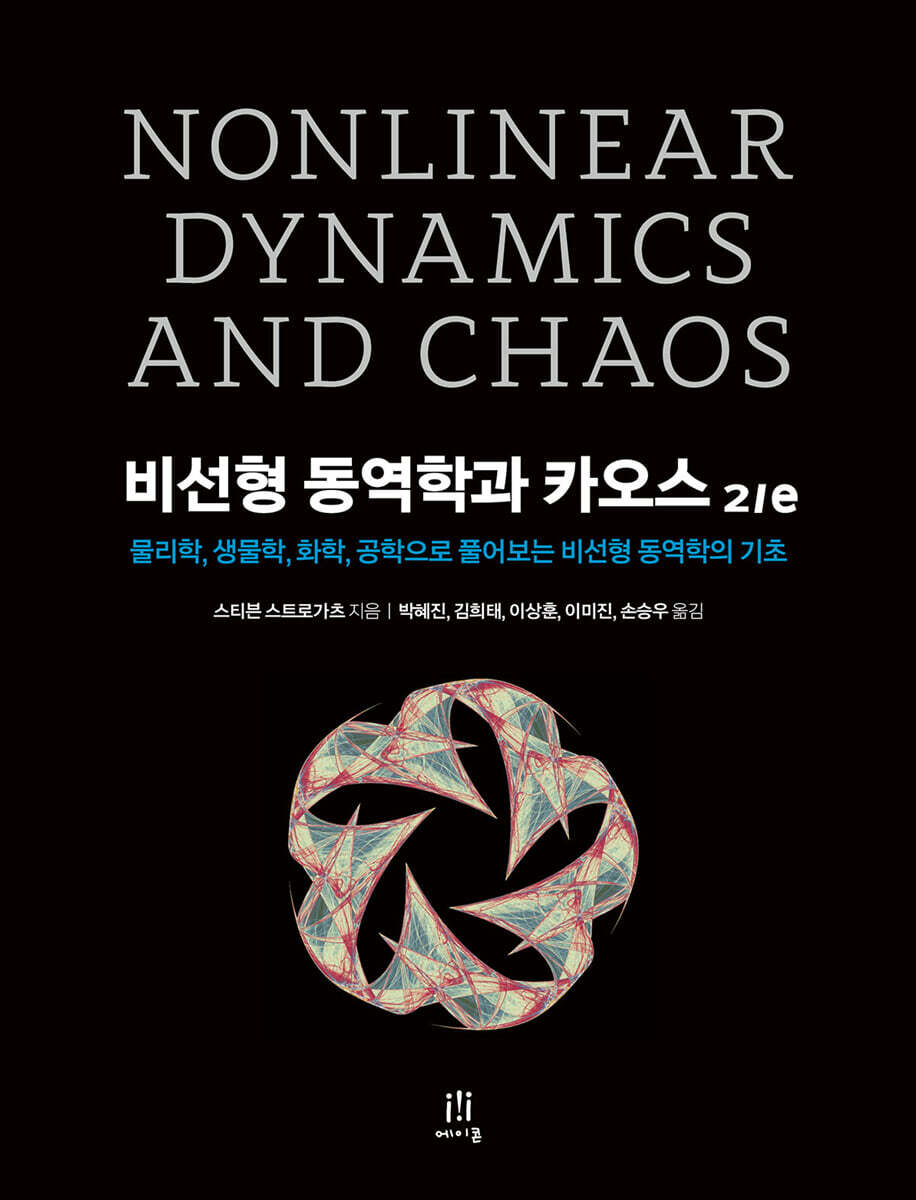
Nonlinear Dynamics and Chaos 2/e
 |
Description
Book Introduction
A scientific classic that reveals the hidden order in a complex world.
The second edition of Nonlinear Dynamics and Chaos has been published.
Modern science and engineering, biology, and even social phenomena… .
We live in a world of countless nonlinear systems.
Chaos theory, represented by the butterfly effect, the swing of a pendulum, the firing of neurons, the periodicity of chemical reactions, the rhythm of heartbeats... all of these are worlds that cannot be explained by linear equations.
Nonlinear Dynamics and Chaos 2/e is a classic that unravels this complex and beautiful world mathematically, intuitively, and practically.
Since its first publication in 1994, this book has been widely loved as the "most easily understandable and practical textbook" among students and researchers new to complexity and chaos theory. In particular, it has been highly praised by readers for its explanation of difficult theories through real-world examples and its harmonious combination of mathematical approaches and intuitive understanding.
Based on this, the second edition has further enhanced the learning effect by adding the latest research results and practical materials.
The second edition of Nonlinear Dynamics and Chaos has been published.
Modern science and engineering, biology, and even social phenomena… .
We live in a world of countless nonlinear systems.
Chaos theory, represented by the butterfly effect, the swing of a pendulum, the firing of neurons, the periodicity of chemical reactions, the rhythm of heartbeats... all of these are worlds that cannot be explained by linear equations.
Nonlinear Dynamics and Chaos 2/e is a classic that unravels this complex and beautiful world mathematically, intuitively, and practically.
Since its first publication in 1994, this book has been widely loved as the "most easily understandable and practical textbook" among students and researchers new to complexity and chaos theory. In particular, it has been highly praised by readers for its explanation of difficult theories through real-world examples and its harmonious combination of mathematical approaches and intuitive understanding.
Based on this, the second edition has further enhanced the learning effect by adding the latest research results and practical materials.
- You can preview some of the book's contents.
Preview
index
About the Author
Preface to the 2nd edition
Preface to the First Edition
Translator's Introduction
Translator's Note
Chapter 1 Overview
1.0 Chaos, Fractals, Dynamics
1.1 A brief introduction to the history of dynamics
1.2 The Importance of Nonlinearity
_Non-autonomous system
_Why are nonlinear problems so difficult to understand?
1.3 The world from a dynamic perspective
Part 1 One-Dimensional Flow
Chapter 2 Flow on the Line
2.0 Introduction
2.1 Thinking Geometrically
2.2 Fixed points and stability
2.3 Population growth
Criticism of the logistic model
2.4 Linear stability analysis
2.5 Existence and Uniqueness
2.6 Impossibility of vibration
_Mechanical Analysis: Overdamped Systems
2.7 Potential
2.8 Solving Equations on a Computer
Euler's method
_improvement
_Practical problems
Chapter 2 Practice Problems
Chapter 3: Forking
3.0 Introduction
3.1 Saddle point splitting
_Schematic notation
_Standard type
3.2 Transcendental Critical Branching
3.3 Laser threshold
_Physical background
_model
3.4 Rake fork
_Supercritical rake forking
_Subcritical rake forking
_Terminology
3.5 Overdamped bead on a rotating circular ring
_1st system analysis
_Dimensional Analysis and Scaling
_paradox
_Phase plane analysis
_Singular Extreme
3.6 Incomplete branching and sudden changes
_Beads on a slanted string
3.7 Insect infestation
_model
_Expressing without dimensions
_Fixed point analysis
_Calculating the fork curve
_Comparison with observation
Chapter 3 Practice Problems
Chapter 4 Flow on the Circle
Introduction to 4.0
4.1 Examples and Definitions
4.2 Uniform vibrator
4.3 Non-uniform vibrators
_Vector field
_Vibration cycle
_The goblin and the bottleneck
4.4 Overdamped pendulum
4.5 Firefly
_model
_analyze
4.6 Superconducting Josephson junction
_Physical background
_Josephson Relationship
_Electronic circuit and pendulum corresponding to Josephson junction
_Typical parameter values
_Dimensionless formula
Chapter 4 Practice Problems
Part 2 Two-dimensional flow
Chapter 5 Linear Systems
5.0 Introduction
5.1 Definitions and Examples
_Stability Language
5.2 Types of linear systems
_Types of fixed points
5.3 Dating
Chapter 5 Practice Problems
Chapter 6 Phase Plane
6.0 Introduction
6.1 Phase diagram
_Phase diagram obtained by numerical calculation
6.2 Existence, Uniqueness, and Topological Consequences
6.3 Fixed points and linearization
_Linearized system
_Effect of small nonlinear terms
_Hyperbolic fixed points, topological equivalence, structural stability
6.4 Rabbit vs. Sheep
6.5 Conservation system
_Nonlinear center
6.6 Reversible system
6.7 Pendulum
_Cylindrical topological space
_attenuation
6.8 Indicator Theory
_Indicator of closed curve
_Nature of indicators
Indicator at point _
Chapter 6 Practice Problems
Chapter 7 Extreme Periodic Orbits
7.0 Introduction
7.1 Example
7.2 Rejecting closed orbits
_Tilt system
_Lyapunov function
_Dulak standard
7.3 Poincaré–Bendixon theorem
_There is no chaos in the phase plane
7.4 Lienaar System
7.5 Relaxation vibration
7.6 Weak nonlinear oscillators
_The theory of regular perturbations and its failures
_Two timings
_Mean equation
_Verification of two timing techniques
Chapter 7 Practice Problems
Chapter 8: Forking Revisited
8.0 Introduction
8.1 Saddle Point, Transcendence Threshold, and Rake Fork
_Saddle point splitting
_Transcendence threshold and rake fork
8.2 Hope Split
_Supercritical Hope Splitting
_Rule of thumb
_Subcritical Hope Fork
_Subcritical, supercritical, or overlapping forks?
8.3 Vibrating chemical reactions
Belousov's 'The Discovery That Was Found'
_Chlorine dioxide-iodine-malonic acid reaction
8.4 Global forking of circular orbits
_Saddle point splitting of circular orbit
_Infinite cycle branching
_Same group splitting
_Law of Scaling
8.5 Different paths of driving pendulum and Josephson joint
_Governing equation
_Fixed point
_The existence of closed orbits
_Uniqueness of Extreme Periodic Orbits
_Same group splitting
_Other path and sensitivity curves for current-voltage
8.6 Coupled oscillators and quasi-periodicity
_Separated system
_Combined systems
8.7 Poincaré idea
_Linear stability of periodic orbits
Chapter 8 Practice Problems
Part 3 Chaos
Chapter 9 Lorenz Equations
9.0 Introduction
9.1 Chaos Watermill
_notation
Conservation of mass
_Torque balance
_Amplitude equation
_Fixed point
9.2 Simple properties of the Lorenz equation
_Nonlinearity
_Symmetry
_Volume shrinkage
_Fixed point
_Linear stability of the origin
_Global stability of the origin
Stability of _C+ and C-
9.3 Chaos in the Strange Attractor
Exponential divergence of the surrounding trajectories
Defining Chaos
_Defining attractors and strange attractors
9.4 Lorenz thought
_Excluding stable extreme orbital periods
9.5 Exploring the Parameter Space
9.6 Using Chaos to Send Secure Messages
_Cuomo's demonstration
_Proof of synchronization
Chapter 9 Practice Problems
Chapter 10 One-Dimensional Thought
10.0 Introduction
10.1 Fixed points and spider webs
_Academic point
_Fixed point and linear stability
_cobweb
10.2 Logistics: A Numerical Approach
_Period doubling
_Chaos and periodic intervals
10.3 Logistics: An Interpretive Approach
10.4 Periodic interval
_Intermittency
_Period doubling within the interval
10.5 Lyapunov exponent
10.6 Universality and Experimentation
_Qualitative universality: U sequence
_Quantitative universality
_Experimental verification
_What does one-dimensional thinking have to do with science?
10.7 Renormalization
_First Steps to Renormalization
Chapter 10 Practice Problems
Chapter 11 Fractals
11.0 Introduction
11.1 Countable and uncountable sets
11.2 Cantor sets
_Fractal properties of Cantor sets
11.3 Dimensions of Self-Similar Fractals
_paradox
_Similarity dimension
_More general Cantor sets
11.4 Box Dimensions
_Definition of box dimensions
_Criticism of box dimensions
11.5 Point-by-point correlation dimension
_Multiple fractals
Chapter 11 Practice Problems
Chapter 12: The Strange Attractor
12.0 Introduction
12.1 The simplest example
_Making Pastry
_Terminology
_The importance of consumption
12.2 Henon Thought
_Basic properties of Henon's thought
_Parameter selection
_Zoom in on the strange attractor
_Unstable manifold of saddle points
12.3 Rösler System
12.4 Chemical Chaos and Attractor Reconstruction
Criticism of the drag reconfiguration
12.5 Forced double well oscillator
_Magnetoelastomeric mechanical system
_Double well interpretation
_Models and Simulations
_Temporary Chaos
_Fractal domain boundaries
Chapter 12 Practice Problems
Selected Practice Problem Solutions
References
Search
Preface to the 2nd edition
Preface to the First Edition
Translator's Introduction
Translator's Note
Chapter 1 Overview
1.0 Chaos, Fractals, Dynamics
1.1 A brief introduction to the history of dynamics
1.2 The Importance of Nonlinearity
_Non-autonomous system
_Why are nonlinear problems so difficult to understand?
1.3 The world from a dynamic perspective
Part 1 One-Dimensional Flow
Chapter 2 Flow on the Line
2.0 Introduction
2.1 Thinking Geometrically
2.2 Fixed points and stability
2.3 Population growth
Criticism of the logistic model
2.4 Linear stability analysis
2.5 Existence and Uniqueness
2.6 Impossibility of vibration
_Mechanical Analysis: Overdamped Systems
2.7 Potential
2.8 Solving Equations on a Computer
Euler's method
_improvement
_Practical problems
Chapter 2 Practice Problems
Chapter 3: Forking
3.0 Introduction
3.1 Saddle point splitting
_Schematic notation
_Standard type
3.2 Transcendental Critical Branching
3.3 Laser threshold
_Physical background
_model
3.4 Rake fork
_Supercritical rake forking
_Subcritical rake forking
_Terminology
3.5 Overdamped bead on a rotating circular ring
_1st system analysis
_Dimensional Analysis and Scaling
_paradox
_Phase plane analysis
_Singular Extreme
3.6 Incomplete branching and sudden changes
_Beads on a slanted string
3.7 Insect infestation
_model
_Expressing without dimensions
_Fixed point analysis
_Calculating the fork curve
_Comparison with observation
Chapter 3 Practice Problems
Chapter 4 Flow on the Circle
Introduction to 4.0
4.1 Examples and Definitions
4.2 Uniform vibrator
4.3 Non-uniform vibrators
_Vector field
_Vibration cycle
_The goblin and the bottleneck
4.4 Overdamped pendulum
4.5 Firefly
_model
_analyze
4.6 Superconducting Josephson junction
_Physical background
_Josephson Relationship
_Electronic circuit and pendulum corresponding to Josephson junction
_Typical parameter values
_Dimensionless formula
Chapter 4 Practice Problems
Part 2 Two-dimensional flow
Chapter 5 Linear Systems
5.0 Introduction
5.1 Definitions and Examples
_Stability Language
5.2 Types of linear systems
_Types of fixed points
5.3 Dating
Chapter 5 Practice Problems
Chapter 6 Phase Plane
6.0 Introduction
6.1 Phase diagram
_Phase diagram obtained by numerical calculation
6.2 Existence, Uniqueness, and Topological Consequences
6.3 Fixed points and linearization
_Linearized system
_Effect of small nonlinear terms
_Hyperbolic fixed points, topological equivalence, structural stability
6.4 Rabbit vs. Sheep
6.5 Conservation system
_Nonlinear center
6.6 Reversible system
6.7 Pendulum
_Cylindrical topological space
_attenuation
6.8 Indicator Theory
_Indicator of closed curve
_Nature of indicators
Indicator at point _
Chapter 6 Practice Problems
Chapter 7 Extreme Periodic Orbits
7.0 Introduction
7.1 Example
7.2 Rejecting closed orbits
_Tilt system
_Lyapunov function
_Dulak standard
7.3 Poincaré–Bendixon theorem
_There is no chaos in the phase plane
7.4 Lienaar System
7.5 Relaxation vibration
7.6 Weak nonlinear oscillators
_The theory of regular perturbations and its failures
_Two timings
_Mean equation
_Verification of two timing techniques
Chapter 7 Practice Problems
Chapter 8: Forking Revisited
8.0 Introduction
8.1 Saddle Point, Transcendence Threshold, and Rake Fork
_Saddle point splitting
_Transcendence threshold and rake fork
8.2 Hope Split
_Supercritical Hope Splitting
_Rule of thumb
_Subcritical Hope Fork
_Subcritical, supercritical, or overlapping forks?
8.3 Vibrating chemical reactions
Belousov's 'The Discovery That Was Found'
_Chlorine dioxide-iodine-malonic acid reaction
8.4 Global forking of circular orbits
_Saddle point splitting of circular orbit
_Infinite cycle branching
_Same group splitting
_Law of Scaling
8.5 Different paths of driving pendulum and Josephson joint
_Governing equation
_Fixed point
_The existence of closed orbits
_Uniqueness of Extreme Periodic Orbits
_Same group splitting
_Other path and sensitivity curves for current-voltage
8.6 Coupled oscillators and quasi-periodicity
_Separated system
_Combined systems
8.7 Poincaré idea
_Linear stability of periodic orbits
Chapter 8 Practice Problems
Part 3 Chaos
Chapter 9 Lorenz Equations
9.0 Introduction
9.1 Chaos Watermill
_notation
Conservation of mass
_Torque balance
_Amplitude equation
_Fixed point
9.2 Simple properties of the Lorenz equation
_Nonlinearity
_Symmetry
_Volume shrinkage
_Fixed point
_Linear stability of the origin
_Global stability of the origin
Stability of _C+ and C-
9.3 Chaos in the Strange Attractor
Exponential divergence of the surrounding trajectories
Defining Chaos
_Defining attractors and strange attractors
9.4 Lorenz thought
_Excluding stable extreme orbital periods
9.5 Exploring the Parameter Space
9.6 Using Chaos to Send Secure Messages
_Cuomo's demonstration
_Proof of synchronization
Chapter 9 Practice Problems
Chapter 10 One-Dimensional Thought
10.0 Introduction
10.1 Fixed points and spider webs
_Academic point
_Fixed point and linear stability
_cobweb
10.2 Logistics: A Numerical Approach
_Period doubling
_Chaos and periodic intervals
10.3 Logistics: An Interpretive Approach
10.4 Periodic interval
_Intermittency
_Period doubling within the interval
10.5 Lyapunov exponent
10.6 Universality and Experimentation
_Qualitative universality: U sequence
_Quantitative universality
_Experimental verification
_What does one-dimensional thinking have to do with science?
10.7 Renormalization
_First Steps to Renormalization
Chapter 10 Practice Problems
Chapter 11 Fractals
11.0 Introduction
11.1 Countable and uncountable sets
11.2 Cantor sets
_Fractal properties of Cantor sets
11.3 Dimensions of Self-Similar Fractals
_paradox
_Similarity dimension
_More general Cantor sets
11.4 Box Dimensions
_Definition of box dimensions
_Criticism of box dimensions
11.5 Point-by-point correlation dimension
_Multiple fractals
Chapter 11 Practice Problems
Chapter 12: The Strange Attractor
12.0 Introduction
12.1 The simplest example
_Making Pastry
_Terminology
_The importance of consumption
12.2 Henon Thought
_Basic properties of Henon's thought
_Parameter selection
_Zoom in on the strange attractor
_Unstable manifold of saddle points
12.3 Rösler System
12.4 Chemical Chaos and Attractor Reconstruction
Criticism of the drag reconfiguration
12.5 Forced double well oscillator
_Magnetoelastomeric mechanical system
_Double well interpretation
_Models and Simulations
_Temporary Chaos
_Fractal domain boundaries
Chapter 12 Practice Problems
Selected Practice Problem Solutions
References
Search
Detailed image

Publisher's Review
Unraveling the Hidden Order of a Complex World with Nonlinear Dynamics and Chaos Theory
A clear introduction to science chosen by hundreds of thousands of readers worldwide.
The world we live in is full of complex, multi-layered systems that cannot be explained by simple laws or linear principles.
Climate change, the balance of ecosystems, the fluctuations of financial markets, the activity of neural networks in the brain, and even the operation of advanced technologies—all these phenomena are constantly changing in a complex, nonlinear interaction, resulting in a chaotic and difficult-to-predict landscape.
Understanding and predicting such complex systems is one of the most important challenges in modern science and engineering.
Nonlinear Dynamics and Chaos 2/e is the leading introductory text in this field, chosen by hundreds of thousands of scientists, engineers, and students worldwide.
Author Stephen Strogatz explains difficult mathematics and abstract concepts in an intuitive and clear way that anyone can follow, and he provides a wealth of real-world examples from various fields such as physics, biology, chemistry, and engineering.
In particular, the second edition published this time provides a more in-depth understanding of nonlinear dynamics and chaos through various fields and application problems, such as animal behavior and classical mechanics, and enhances understanding of them.
Through this book, readers will be able to understand and acquire advanced content on nonlinear dynamics.
◈ Author's Note ◈
This book is based on a one-semester course I taught at MIT over the past several years, intended for students new to nonlinear dynamics and chaos, particularly those taking these courses for the first time.
The goal was to explain mathematical expressions as clearly as possible and to show how mathematics can be used to understand the wonders of the nonlinear world.
Although the mathematical approach is used in a simplified and informal manner, it is handled carefully, emphasizing analytical methods, concrete examples, and geometric intuition.
Starting with first-order differential equations and their branches, he systematically developed the theory, moving on to phase space analysis, limit periodic orbits and their branches, and concluding with the Lorenz equation, chaos, iterative mapping, period doubling, renormalization, fractals, and strange attractors.
A unique feature of this book is its focus on application.
These include mechanical vibrations, lasers, biorhythms, superconducting circuits, insect infestations, chemical oscillators, genetic control systems, chaos watermills, and even technology to use chaos to send secret messages.
In each case, mathematical theory was closely integrated with the scientific background.
Prerequisite knowledge includes single-variable calculus, including curve plotting, Taylor series, and separable differential equations.
In some parts, multivariate calculus (partial differentiation, Jacobian matrices, divergence theorem) or linear algebra (eigenvalues and eigenvectors) is used.
It is not assumed that you have learned Fourier analysis, but it is expanded and used when necessary.
The textbook covers introductory level physics throughout.
The scientific background required will vary depending on the application being addressed, but in any case, having taken introductory-level courses is sufficient.
Additionally, this book can be used for many different types of lectures.
This is a broad introductory course for students new to nonlinear dynamics (the type of course I used to teach), covering the core material at the beginning of each chapter and then discussing a few selected applications in more depth.
You can skim through the entire book, lightly covering or skipping advanced theoretical topics.
Chapters 1 through 8 should take about 7 weeks, and chapters 9 through 12 should take about 5 to 6 weeks.
You should make sure to set aside enough time during the semester to cover the topics of chaos, thought, and fractals in Chapters 9 through 12.
Although this is a traditional nonlinear ordinary differential equations course, when teaching a course that focuses more on applications than perturbation theory, I recommend focusing on Chapters 1 through 8.
When teaching a course on branching, chaos, fractals, and their applications to students who have already encountered topological plane analysis, you can freely choose topics from Chapters 3, 4, and 8-12.
Any course should assign students homework on the exercises at the end of each chapter.
You can work on computer-based projects, such as building chaos circuits and mechanical systems, or you can research references to gain hands-on experience with cutting-edge research.
Not only is it interesting to teach, but the students taking the class can also find it interesting to listen to.
I hope you have a good time.
◈ Translator's Note ◈
There is not much difference between 98ºC water and 99ºC water.
However, even with the same 1ºC difference, water at 99ºC and water at 100ºC are very different in that the state of the substance changes from liquid to gas.
As such, there are many cases around us where systems do not respond linearly to a given control variable (temperature in the previous example).
This nonlinearity applies not only to the phenomenon of boiling water, but also to the spread of infectious diseases such as COVID-19, the Black Death, and smallpox.
Subtle differences in transmission probability allow some epidemics to spread globally, while others spread only locally.
These differences are also due to nonlinearity.
So how can we simplify and understand this complex phenomenon?
Mathematics is often a powerful tool for simplifying reality and finding underlying patterns.
In particular, bifurcation phenomena, such as phase changes in materials or the spread of infectious diseases caused by nonlinearity, occur in completely different systems, but are mathematically similar.
This common structure allows us to understand diverse phenomena by integrating them into a single mechanism.
Nonlinear dynamics helps us interpret these complex phenomena within a simple framework.
However, in the nonlinear world, the methods we are familiar with in linear systems, such as directly finding solutions to differential equations, are often not possible.
So new approaches have developed, and in the process, many interesting techniques have emerged.
This is the really fun part, because you can't get the exact solution, instead you analyze the behavior of the system, look for patterns, and approximate its essential characteristics.
This book helps us systematically understand the phenomena that emerge through nonlinearity, and shows that nonlinear dynamics is not simply a change in mathematical tools, but a revolutionary concept that changes the very way we understand the world.
The author of the original book, Stephen Strogatz, a world-renowned scholar in the fields of nonlinear dynamics and complex systems science, is still actively engaged in research.
The book explains the various nonlinear dynamics methodologies described in the book in various fields such as physics, biology, and neuroscience, and it explains the methodologies with various examples, making it suitable as an undergraduate or graduate school textbook.
This friendly, example-based book, complete with practice problems, will be a great help to students in understanding new concepts.
This new edition will be helpful to both undergraduate and graduate students, as it includes practice problems that cover recent research.
By looking at the latest research topics one by one while reviewing the references, you can start a new study relatively easily.
Most of the translators first encountered this book in college or graduate school classes, so they know better than anyone how much help it will be to students.
Although the translation was not an easy task, I was able to complete it successfully thanks to the hope that someone would be able to experience the joy I felt as a student while reading this book.
My heart races when I think about who will read this book and enjoy it next time.
I hope this book will give readers a fresh perspective on how to view complex phenomena in a simple way.
A clear introduction to science chosen by hundreds of thousands of readers worldwide.
The world we live in is full of complex, multi-layered systems that cannot be explained by simple laws or linear principles.
Climate change, the balance of ecosystems, the fluctuations of financial markets, the activity of neural networks in the brain, and even the operation of advanced technologies—all these phenomena are constantly changing in a complex, nonlinear interaction, resulting in a chaotic and difficult-to-predict landscape.
Understanding and predicting such complex systems is one of the most important challenges in modern science and engineering.
Nonlinear Dynamics and Chaos 2/e is the leading introductory text in this field, chosen by hundreds of thousands of scientists, engineers, and students worldwide.
Author Stephen Strogatz explains difficult mathematics and abstract concepts in an intuitive and clear way that anyone can follow, and he provides a wealth of real-world examples from various fields such as physics, biology, chemistry, and engineering.
In particular, the second edition published this time provides a more in-depth understanding of nonlinear dynamics and chaos through various fields and application problems, such as animal behavior and classical mechanics, and enhances understanding of them.
Through this book, readers will be able to understand and acquire advanced content on nonlinear dynamics.
◈ Author's Note ◈
This book is based on a one-semester course I taught at MIT over the past several years, intended for students new to nonlinear dynamics and chaos, particularly those taking these courses for the first time.
The goal was to explain mathematical expressions as clearly as possible and to show how mathematics can be used to understand the wonders of the nonlinear world.
Although the mathematical approach is used in a simplified and informal manner, it is handled carefully, emphasizing analytical methods, concrete examples, and geometric intuition.
Starting with first-order differential equations and their branches, he systematically developed the theory, moving on to phase space analysis, limit periodic orbits and their branches, and concluding with the Lorenz equation, chaos, iterative mapping, period doubling, renormalization, fractals, and strange attractors.
A unique feature of this book is its focus on application.
These include mechanical vibrations, lasers, biorhythms, superconducting circuits, insect infestations, chemical oscillators, genetic control systems, chaos watermills, and even technology to use chaos to send secret messages.
In each case, mathematical theory was closely integrated with the scientific background.
Prerequisite knowledge includes single-variable calculus, including curve plotting, Taylor series, and separable differential equations.
In some parts, multivariate calculus (partial differentiation, Jacobian matrices, divergence theorem) or linear algebra (eigenvalues and eigenvectors) is used.
It is not assumed that you have learned Fourier analysis, but it is expanded and used when necessary.
The textbook covers introductory level physics throughout.
The scientific background required will vary depending on the application being addressed, but in any case, having taken introductory-level courses is sufficient.
Additionally, this book can be used for many different types of lectures.
This is a broad introductory course for students new to nonlinear dynamics (the type of course I used to teach), covering the core material at the beginning of each chapter and then discussing a few selected applications in more depth.
You can skim through the entire book, lightly covering or skipping advanced theoretical topics.
Chapters 1 through 8 should take about 7 weeks, and chapters 9 through 12 should take about 5 to 6 weeks.
You should make sure to set aside enough time during the semester to cover the topics of chaos, thought, and fractals in Chapters 9 through 12.
Although this is a traditional nonlinear ordinary differential equations course, when teaching a course that focuses more on applications than perturbation theory, I recommend focusing on Chapters 1 through 8.
When teaching a course on branching, chaos, fractals, and their applications to students who have already encountered topological plane analysis, you can freely choose topics from Chapters 3, 4, and 8-12.
Any course should assign students homework on the exercises at the end of each chapter.
You can work on computer-based projects, such as building chaos circuits and mechanical systems, or you can research references to gain hands-on experience with cutting-edge research.
Not only is it interesting to teach, but the students taking the class can also find it interesting to listen to.
I hope you have a good time.
◈ Translator's Note ◈
There is not much difference between 98ºC water and 99ºC water.
However, even with the same 1ºC difference, water at 99ºC and water at 100ºC are very different in that the state of the substance changes from liquid to gas.
As such, there are many cases around us where systems do not respond linearly to a given control variable (temperature in the previous example).
This nonlinearity applies not only to the phenomenon of boiling water, but also to the spread of infectious diseases such as COVID-19, the Black Death, and smallpox.
Subtle differences in transmission probability allow some epidemics to spread globally, while others spread only locally.
These differences are also due to nonlinearity.
So how can we simplify and understand this complex phenomenon?
Mathematics is often a powerful tool for simplifying reality and finding underlying patterns.
In particular, bifurcation phenomena, such as phase changes in materials or the spread of infectious diseases caused by nonlinearity, occur in completely different systems, but are mathematically similar.
This common structure allows us to understand diverse phenomena by integrating them into a single mechanism.
Nonlinear dynamics helps us interpret these complex phenomena within a simple framework.
However, in the nonlinear world, the methods we are familiar with in linear systems, such as directly finding solutions to differential equations, are often not possible.
So new approaches have developed, and in the process, many interesting techniques have emerged.
This is the really fun part, because you can't get the exact solution, instead you analyze the behavior of the system, look for patterns, and approximate its essential characteristics.
This book helps us systematically understand the phenomena that emerge through nonlinearity, and shows that nonlinear dynamics is not simply a change in mathematical tools, but a revolutionary concept that changes the very way we understand the world.
The author of the original book, Stephen Strogatz, a world-renowned scholar in the fields of nonlinear dynamics and complex systems science, is still actively engaged in research.
The book explains the various nonlinear dynamics methodologies described in the book in various fields such as physics, biology, and neuroscience, and it explains the methodologies with various examples, making it suitable as an undergraduate or graduate school textbook.
This friendly, example-based book, complete with practice problems, will be a great help to students in understanding new concepts.
This new edition will be helpful to both undergraduate and graduate students, as it includes practice problems that cover recent research.
By looking at the latest research topics one by one while reviewing the references, you can start a new study relatively easily.
Most of the translators first encountered this book in college or graduate school classes, so they know better than anyone how much help it will be to students.
Although the translation was not an easy task, I was able to complete it successfully thanks to the hope that someone would be able to experience the joy I felt as a student while reading this book.
My heart races when I think about who will read this book and enjoy it next time.
I hope this book will give readers a fresh perspective on how to view complex phenomena in a simple way.
GOODS SPECIFICS
- Date of issue: June 23, 2025
- Page count, weight, size: 600 pages | 1,180g | 188*246*28mm
- ISBN13: 9791161759807
- ISBN10: 1161759808
You may also like
카테고리
korean


korean

![GQ KOREA Mark (Monthly): December [2025]](http://librairie.coreenne.fr/cdn/shop/files/8ef265dbbfbf186523ed75ba7319009d.jpg?v=1765340328&width=3840)


