

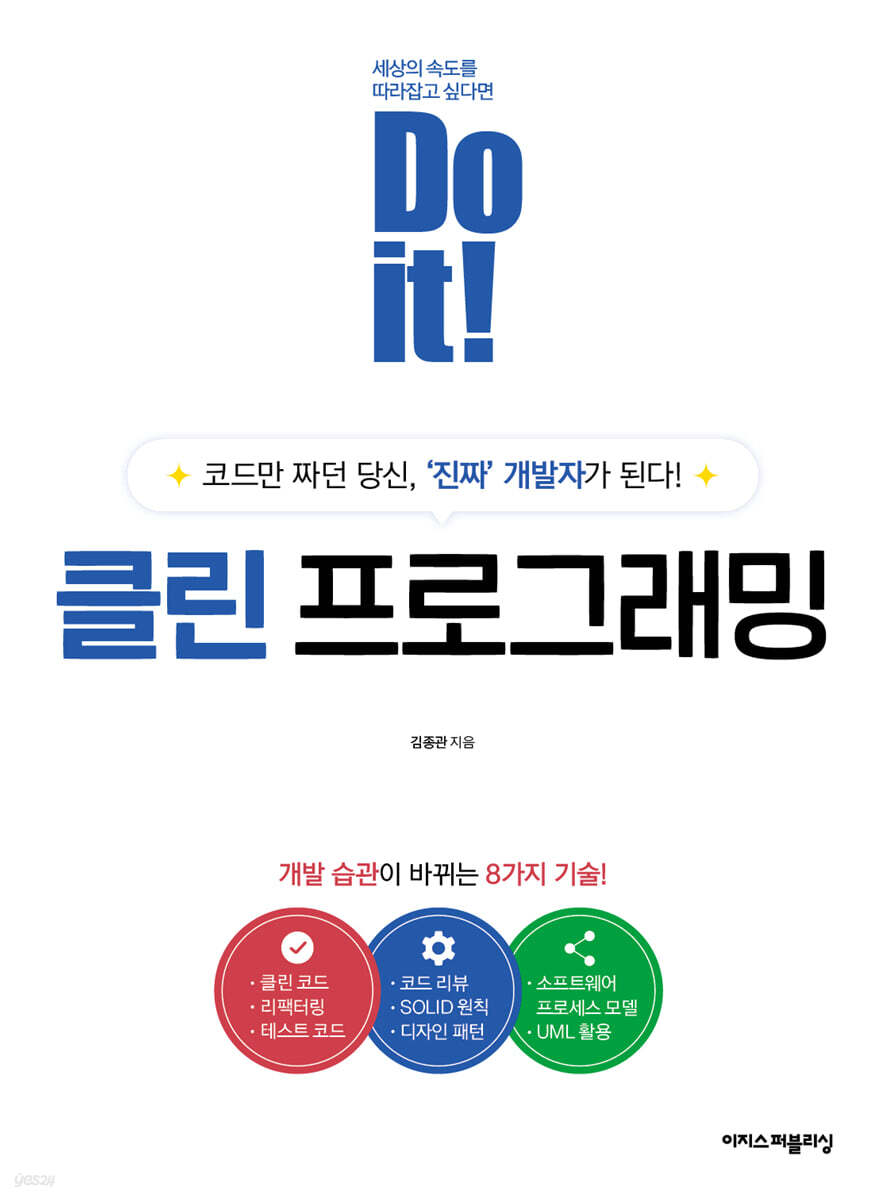
Do it! Clean Programming
 |
Description
Book Introduction
8 Code Improvement Techniques Every Developer Must Learn 'Eventually'!
From improving code quality to architectural design, transform yourself into a skilled developer with this one book!
"Do it! Clean Programming" covers everything developers need to know, from writing clean code to sustainable improvement, efficient collaboration, and robust software design, organized around theory and examples.
It covers the core principles of clean code, such as naming conventions, effective comment writing, and functional unit design, as well as refactoring to eliminate code smells and how to improve quality by writing test code.
This book also covers a wide range of topics, including code review culture and collaboration know-how utilizing GitHub features, object-oriented design and SOLID principles, how to improve maintainability and scalability with design patterns, and finally, software process models such as Agile and UP, as well as systems utilizing UML.
Based on the author's practical experience of leading various projects for 15 years at a domestic IT company, the book is rich in practical examples that can be applied not only in theory but also in practice.
If you want to take your practical skills to the next level, dive into the world of "clean programming" right now!
From improving code quality to architectural design, transform yourself into a skilled developer with this one book!
"Do it! Clean Programming" covers everything developers need to know, from writing clean code to sustainable improvement, efficient collaboration, and robust software design, organized around theory and examples.
It covers the core principles of clean code, such as naming conventions, effective comment writing, and functional unit design, as well as refactoring to eliminate code smells and how to improve quality by writing test code.
This book also covers a wide range of topics, including code review culture and collaboration know-how utilizing GitHub features, object-oriented design and SOLID principles, how to improve maintainability and scalability with design patterns, and finally, software process models such as Agile and UP, as well as systems utilizing UML.
Based on the author's practical experience of leading various projects for 15 years at a domestic IT company, the book is rich in practical examples that can be applied not only in theory but also in practice.
If you want to take your practical skills to the next level, dive into the world of "clean programming" right now!
- You can preview some of the book's contents.
Preview
index
First Yard | Becoming a Clean Code Developer - Write Clean Code and Continuously Improve It!
* Terms frequently used in clean code
Chapter 1: Principles of Clean Code
__1-1 Why you should keep your code clean
__1-2 Naming with Meaning
__1-3 Using comments properly
__1-4 Change complex conditional expressions into functions
__1-5 function performs only one function
__1-6 Improving constructor readability
Using exceptions rather than __1-7 error codes
Chapter 2: Code Smells and Refactoring
__2-1 Causes of Code Smells and the Need for Refactoring
__2-2 Removing duplicate code
__2-3 Splitting long functions
__2-4 Divide the giant class
__2-5 Refactoring 'Scattered Modifications'
__2-6 Refactoring 'Shotgun Surgery'
__2-7 Remove feature favoritism
__2-8 Reducing excessive parameters
__2-9 Remove the magic number
Chapter 3: Test Code from a Clean Code Perspective
__3-1 Why writing test code is essential
__3-2 JUnit Preview
__3-3 Write test code in clean code
__3-4 Writing test code with coverage in mind
__3-5 Writing test code that works well
__3-6 Using Test Code in a CI/CD Environment
Second Yard | Becoming a Collaborative Developer - How to Conduct Effective Code Reviews!
Chapter 4: Understanding Code Reviews
__4-1 Why Code Review is Needed
__4-2 Why it's difficult to maintain meaningful code reviews
Chapter 5: How to Conduct Effective Code Reviews
__5-1 Requesting a Clean Code Review
__5-2 Conducting Effective Code Reviews
__5-3 Useful GitHub features for code review
Third Yard | Become a Developer Who Creates Good Structures - Become Proficient in Object-Oriented Design and Design Patterns!
Chapter 6: Understanding Object-Oriented Programming
__6-1 Characteristics of object-oriented programming
__6-2 SOLID principles for increasing development productivity
Chapter 7: Effective Design Pattern Utilization Strategies
__7-1 Types and characteristics of design patterns
__7-2 Creation Pattern
__7-3 Structural Pattern
__7-4 Behavioral Patterns
__7-5 MVC pattern
Fourth Yard | Becoming a Software Designer - Get Familiar with Software Process Models and UML!
Chapter 8: Understanding Software Process Models
__8-1 What is a software process model?
__8-2 Waterfall model with emphasis on step-by-step progress and documentation
__8-3 An iterative model focused on continuous improvement
__8-4 Spiral model focusing on risk minimization
__8-5 Agile with a focus on rapid development experience
__8-6 Object-Oriented Programming Standard, Unified Process
Chapter 9 Software Modeling Using UML
__9-1 What is UML?
__9-2 Use Case Diagram
__9-3 Class Diagram
__9-4 Sequence Diagram
__9-5 State Chart Diagram
__9-6 Activity Diagram
__9-7 Component Diagram
Search
* Terms frequently used in clean code
Chapter 1: Principles of Clean Code
__1-1 Why you should keep your code clean
__1-2 Naming with Meaning
__1-3 Using comments properly
__1-4 Change complex conditional expressions into functions
__1-5 function performs only one function
__1-6 Improving constructor readability
Using exceptions rather than __1-7 error codes
Chapter 2: Code Smells and Refactoring
__2-1 Causes of Code Smells and the Need for Refactoring
__2-2 Removing duplicate code
__2-3 Splitting long functions
__2-4 Divide the giant class
__2-5 Refactoring 'Scattered Modifications'
__2-6 Refactoring 'Shotgun Surgery'
__2-7 Remove feature favoritism
__2-8 Reducing excessive parameters
__2-9 Remove the magic number
Chapter 3: Test Code from a Clean Code Perspective
__3-1 Why writing test code is essential
__3-2 JUnit Preview
__3-3 Write test code in clean code
__3-4 Writing test code with coverage in mind
__3-5 Writing test code that works well
__3-6 Using Test Code in a CI/CD Environment
Second Yard | Becoming a Collaborative Developer - How to Conduct Effective Code Reviews!
Chapter 4: Understanding Code Reviews
__4-1 Why Code Review is Needed
__4-2 Why it's difficult to maintain meaningful code reviews
Chapter 5: How to Conduct Effective Code Reviews
__5-1 Requesting a Clean Code Review
__5-2 Conducting Effective Code Reviews
__5-3 Useful GitHub features for code review
Third Yard | Become a Developer Who Creates Good Structures - Become Proficient in Object-Oriented Design and Design Patterns!
Chapter 6: Understanding Object-Oriented Programming
__6-1 Characteristics of object-oriented programming
__6-2 SOLID principles for increasing development productivity
Chapter 7: Effective Design Pattern Utilization Strategies
__7-1 Types and characteristics of design patterns
__7-2 Creation Pattern
__7-3 Structural Pattern
__7-4 Behavioral Patterns
__7-5 MVC pattern
Fourth Yard | Becoming a Software Designer - Get Familiar with Software Process Models and UML!
Chapter 8: Understanding Software Process Models
__8-1 What is a software process model?
__8-2 Waterfall model with emphasis on step-by-step progress and documentation
__8-3 An iterative model focused on continuous improvement
__8-4 Spiral model focusing on risk minimization
__8-5 Agile with a focus on rapid development experience
__8-6 Object-Oriented Programming Standard, Unified Process
Chapter 9 Software Modeling Using UML
__9-1 What is UML?
__9-2 Use Case Diagram
__9-3 Class Diagram
__9-4 Sequence Diagram
__9-5 State Chart Diagram
__9-6 Activity Diagram
__9-7 Component Diagram
Search
Detailed image

Publisher's Review
Features of this book
ㆍ We provide concise explanations of concepts and practical guidance on how to apply them!
ㆍ We provide abundant example code so you can immediately put what you've learned into practice!
ㆍ You can understand the key concepts and flow at a glance by showing them in pictures!
ㆍ We deliver realistic insights that you won't find in translated books, incorporating the experience and know-how of current developers!
ㆍ You can easily set up a practice environment by using the provided Java-based practice code and GitHub!
ㆍ You can learn only the necessary skills through module-based training, or you can systematically develop your development skills according to the order!
I recommend this to these people!
Job seekers who are good at writing code but lack experience in team development and collaboration
ㆍ New developers with 0 years of experience who are curious about how to apply object-oriented and design patterns in practice
Junior developers with 1-3 years of experience who want to strengthen their practical skills in code review, testing, and architecture design.
ㆍ College students who want to learn development methodologies that focus on practice rather than theory.
Learn clean code, refactoring, architecture design, and process modeling in one book!
Let's practice with various examples and gain collaboration know-how and practical tips!
"Do it! Clean Programming" is a practical guide that covers essential topics every developer must master, including clean code, refactoring, architecture design, and process modeling.
It is structured to help you learn practical, step-by-step content that can be immediately applied in practice, such as clean code principles, refactoring techniques, writing test code, code reviews, object-oriented design, and UML modeling.
Rather than explaining complex theories, this book focuses on examples that you can follow along with yourself, allowing you to develop a practical sense. It is useful for everyone from aspiring developers to junior developers who want to hone their skills, to developers who are concerned about team collaboration and structural design in the field.
Take the first step toward becoming a "good developer" right now!
We provide a variety of study materials to help you study this book.
Includes study plan + practice code + author channel!
Page 7 of this book provides a study plan.
If you are studying alone, try studying according to this schedule.
If you write down your target date and study for 2 hours a day for about 30 days, you can complete it without difficulty.
If you have already studied this material, I recommend the 15-day course.
The example code required for practice can be downloaded from the Easy Publishing website's data room and the author's GitHub. You can increase your learning effectiveness by comparing it with your own code or checking the entire code.
The author, who has 15 years of experience in practical development and is a professional instructor, provides lectures on IT practical knowledge and careers, as well as coding tests, through various channels.
If you want to gain more diverse knowledge, be sure to visit the author's channel as well.
Easy Publishing website (file provided) | www.easyspub.co.kr → [Data Room] → Search by book title
Author's GitHub (file provided) | github.com/DoitCleanProgramming
Author's YouTube channel (video provided) | youtube.com/@codingtest
Author: Inflearn (video provided) | inflearn.com/users/788879/@harucoding
Apply for a study group at 'Do it! Study Room'!
You can meet friends and receive books as gifts.
If you plan and study alone, you will quickly become tired.
Sign up for the "Do it! Study Room" study group and challenge yourself to complete "Do it! Clean Programming"! Meet fellow study partners, share your work, and earn a free copy of the book if you share and verify your progress.
Also, if you have any questions, please leave them on the 'Do it! Study Room' bulletin board.
Experts and authors will provide clear answers.
Do it! Study Room: cafe.naver.com/doitstudyroom
ㆍ We provide concise explanations of concepts and practical guidance on how to apply them!
ㆍ We provide abundant example code so you can immediately put what you've learned into practice!
ㆍ You can understand the key concepts and flow at a glance by showing them in pictures!
ㆍ We deliver realistic insights that you won't find in translated books, incorporating the experience and know-how of current developers!
ㆍ You can easily set up a practice environment by using the provided Java-based practice code and GitHub!
ㆍ You can learn only the necessary skills through module-based training, or you can systematically develop your development skills according to the order!
I recommend this to these people!
Job seekers who are good at writing code but lack experience in team development and collaboration
ㆍ New developers with 0 years of experience who are curious about how to apply object-oriented and design patterns in practice
Junior developers with 1-3 years of experience who want to strengthen their practical skills in code review, testing, and architecture design.
ㆍ College students who want to learn development methodologies that focus on practice rather than theory.
Learn clean code, refactoring, architecture design, and process modeling in one book!
Let's practice with various examples and gain collaboration know-how and practical tips!
"Do it! Clean Programming" is a practical guide that covers essential topics every developer must master, including clean code, refactoring, architecture design, and process modeling.
It is structured to help you learn practical, step-by-step content that can be immediately applied in practice, such as clean code principles, refactoring techniques, writing test code, code reviews, object-oriented design, and UML modeling.
Rather than explaining complex theories, this book focuses on examples that you can follow along with yourself, allowing you to develop a practical sense. It is useful for everyone from aspiring developers to junior developers who want to hone their skills, to developers who are concerned about team collaboration and structural design in the field.
Take the first step toward becoming a "good developer" right now!
We provide a variety of study materials to help you study this book.
Includes study plan + practice code + author channel!
Page 7 of this book provides a study plan.
If you are studying alone, try studying according to this schedule.
If you write down your target date and study for 2 hours a day for about 30 days, you can complete it without difficulty.
If you have already studied this material, I recommend the 15-day course.
The example code required for practice can be downloaded from the Easy Publishing website's data room and the author's GitHub. You can increase your learning effectiveness by comparing it with your own code or checking the entire code.
The author, who has 15 years of experience in practical development and is a professional instructor, provides lectures on IT practical knowledge and careers, as well as coding tests, through various channels.
If you want to gain more diverse knowledge, be sure to visit the author's channel as well.
Easy Publishing website (file provided) | www.easyspub.co.kr → [Data Room] → Search by book title
Author's GitHub (file provided) | github.com/DoitCleanProgramming
Author's YouTube channel (video provided) | youtube.com/@codingtest
Author: Inflearn (video provided) | inflearn.com/users/788879/@harucoding
Apply for a study group at 'Do it! Study Room'!
You can meet friends and receive books as gifts.
If you plan and study alone, you will quickly become tired.
Sign up for the "Do it! Study Room" study group and challenge yourself to complete "Do it! Clean Programming"! Meet fellow study partners, share your work, and earn a free copy of the book if you share and verify your progress.
Also, if you have any questions, please leave them on the 'Do it! Study Room' bulletin board.
Experts and authors will provide clear answers.
Do it! Study Room: cafe.naver.com/doitstudyroom
GOODS SPECIFICS
- Date of issue: June 1, 2025
- Page count, weight, size: 440 pages | 188*257*30mm
- ISBN13: 9791163037224
- ISBN10: 1163037222
You may also like
카테고리
korean


korean

![GQ KOREA Mark (Monthly): December [2025]](http://librairie.coreenne.fr/cdn/shop/files/8ef265dbbfbf186523ed75ba7319009d.jpg?v=1765340328&width=3840)


