

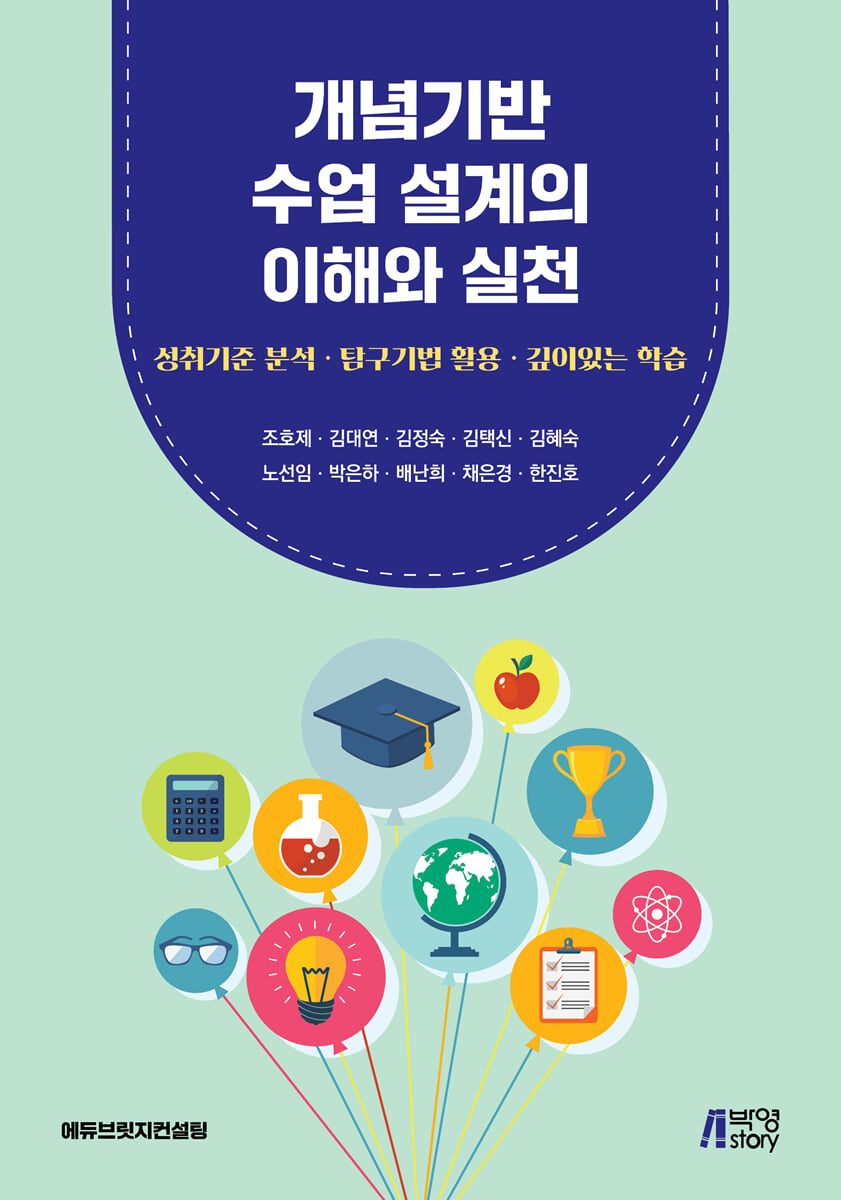
Understanding and Practicing Concept-Based Instructional Design
 |
Description
Book Introduction
We realized that there were many difficulties in analyzing and reconstructing the 'structure of knowledge' and 'structure of process', which are the core of the concept-based curriculum theory, using the Korean curriculum achievement standards. Therefore, we wrote a textbook that guides students from the theory of the concept-based curriculum to the method of designing units based on the 2022 revised curriculum in a more easily understandable way.
- You can preview some of the book's contents.
Preview
index
CHAPTER 1 Understanding Concept-Based Curriculum
1. The need for class change 2.
2 Overview of the Concept-Based Curriculum 6
CHAPTER 2 Understanding Concept-Based Curriculum Instructional Design
1 Understanding the Core Idea 20
2 Understanding and Relevance of Key Terms in Concept-Based Curriculum 21
3 Design Methods for Concept-Based Learning 34
4 Concept-based design method according to the single subject type 46
5 Concept-based design plan according to curriculum integration 60
CHAPTER 3 Analysis of achievement standards for 1st and 2nd graders
Extracting concepts and generalizations
1. Concept-based design according to the structure of knowledge 76
Concept-based design according to the structure of the 2nd process 100
3 Concept-Based Design Based on the Structure of Knowledge + Process 119
CHAPTER 4 Analysis of achievement standards for 3rd and 4th graders
Extracting concepts and generalizations
1 Concept-based design according to the structure of knowledge 136
Concept-based design according to the structure of the two processes 151
3 Concept-Based Design Based on the Knowledge + Process Structure 165
CHAPTER 5 Analysis of achievement standards for 5th and 6th graders
Extracting concepts and generalizations
1 Concept-based design according to the structure of knowledge 184
Concept-based design according to the structure of the two processes 198
3 Concept-Based Design Based on the Knowledge + Process Structure 213
CHAPTER 6 Exploration Techniques
1 Engagement 232
2 Focus 239
3 Investigate 248
4 Organize 260
5 Generalize 276
6 Transfer 283
7 Reflect 287
CHAPTER 7 2022 Revised Curriculum Achievement Standards Concept Analysis Roadmap
PART 1 IB PYP Transdisciplinary Subject-Based Achievement Standards Analysis Roadmap 294
294 Points to note in writing and use
Transdisciplinary Topics and Detailed Explanations 295
IB PYP Stated and Additional Concepts 296
PART 2: 2022 Revised Curriculum General Theory Linked Achievement Standards Analysis Roadmap 345
345 Points to note in writing and use
2022 Revised Curriculum General Theory-Based Framework 346
Framework for the 2022 Revised Curriculum Overview 347
Roadmap for Achievement Analysis Based on the Framework of the 2022 Revised Curriculum 348
355 Unit Design Cases Based on the 2022 Revised Curriculum General Framework
Reference 358
Index 360
1. The need for class change 2.
2 Overview of the Concept-Based Curriculum 6
CHAPTER 2 Understanding Concept-Based Curriculum Instructional Design
1 Understanding the Core Idea 20
2 Understanding and Relevance of Key Terms in Concept-Based Curriculum 21
3 Design Methods for Concept-Based Learning 34
4 Concept-based design method according to the single subject type 46
5 Concept-based design plan according to curriculum integration 60
CHAPTER 3 Analysis of achievement standards for 1st and 2nd graders
Extracting concepts and generalizations
1. Concept-based design according to the structure of knowledge 76
Concept-based design according to the structure of the 2nd process 100
3 Concept-Based Design Based on the Structure of Knowledge + Process 119
CHAPTER 4 Analysis of achievement standards for 3rd and 4th graders
Extracting concepts and generalizations
1 Concept-based design according to the structure of knowledge 136
Concept-based design according to the structure of the two processes 151
3 Concept-Based Design Based on the Knowledge + Process Structure 165
CHAPTER 5 Analysis of achievement standards for 5th and 6th graders
Extracting concepts and generalizations
1 Concept-based design according to the structure of knowledge 184
Concept-based design according to the structure of the two processes 198
3 Concept-Based Design Based on the Knowledge + Process Structure 213
CHAPTER 6 Exploration Techniques
1 Engagement 232
2 Focus 239
3 Investigate 248
4 Organize 260
5 Generalize 276
6 Transfer 283
7 Reflect 287
CHAPTER 7 2022 Revised Curriculum Achievement Standards Concept Analysis Roadmap
PART 1 IB PYP Transdisciplinary Subject-Based Achievement Standards Analysis Roadmap 294
294 Points to note in writing and use
Transdisciplinary Topics and Detailed Explanations 295
IB PYP Stated and Additional Concepts 296
PART 2: 2022 Revised Curriculum General Theory Linked Achievement Standards Analysis Roadmap 345
345 Points to note in writing and use
2022 Revised Curriculum General Theory-Based Framework 346
Framework for the 2022 Revised Curriculum Overview 347
Roadmap for Achievement Analysis Based on the Framework of the 2022 Revised Curriculum 348
355 Unit Design Cases Based on the 2022 Revised Curriculum General Framework
Reference 358
Index 360
Publisher's Review
preface
Curriculum revisions are made not only in response to trends in educational theory but also to the demands of social change.
It is worth noting the comment of someone who said, “I feel that there is too much innovation and strategy going on in the educational field.”
Unlike in the past, the speed at which knowledge and information are created in society is accelerating and their validity period is shortening. Therefore, the key issues in curriculum revision are what content should be included and how broad and deep it should be.
Considering recent social changes, our country's curriculum appears to be responding appropriately to this trend.
The 2022 revised curriculum emphasizes the need for "in-depth learning," suggesting that rather than simply learning more subject matter or reaching a difficult level, students possess the ability to correctly understand and internalize core concepts and principles and apply them to real-life situations.
Rather than being an academic expert in a single subject, it emphasizes learning the process of structuring facts and concepts in relation to each other and creating meaning.
Furthermore, through this learning process, learners can apply, expand, and practice their knowledge at a higher level.
Concept-based instruction is a method of carefully designing teaching and learning to find relationships between concepts, generalizations, and laws and transfer them to real life and higher-level learning.
The effectiveness of concept-based teaching methods has been proven through various studies, media, and practices in IB schools around the world. Despite the high barriers to entry, such as the difficulty of classes and the need to restructure them based on the Korean curriculum, domestic schools are showing interest in introducing IB education based on concept-based teaching methods.
Recently, although the IB program has not been specifically introduced, there has been a lot of movement to reconstruct the concept-based classes that form the basis of the IB program based on the national curriculum and implement them in classes. Related books have been translated and introduced, and research conducted in collaboration with the translation team has been published, attracting the attention of teachers.
However, teachers who must implement or practice curriculum documents in the field are struggling with how to implement the 'deep learning' presented in the curriculum outline for students.
It is stated that classes are designed to expand the breadth and depth of learning experiences according to the students' developmental stages by organically linking the content elements of knowledge and understanding, process and function, and value and attitude centered around the core ideas of each subject, avoiding the memorization of fragmented knowledge. However, as always, the specific 'how?' is entirely dependent on the capabilities of the field teachers.
Many teachers, driven by their passion for teaching, try to apply concept-based teaching methods introduced in theoretical textbooks, but often find it difficult to apply them in the classroom.
The authors realized that there were many difficulties in analyzing and reconstructing the "structure of knowledge" and "structure of process," which are the core of the concept-based curriculum theory, using the Korean curriculum achievement standards. Therefore, they wrote a textbook that guides students from the theory of the concept-based curriculum to the method of designing units based on the 2022 revised curriculum in a more easily understandable way.
The authors have painstakingly written this book to provide a practical guide from theory to practice, identifying the fundamental reasons why teachers find it difficult to apply concept-based curricula in the field and making it more accessible.
Chapter 1 introduces the theoretical background and key concepts of concept-based curriculum.
Readers will clearly understand that concept-based instruction is an appropriate learning method for fostering talents that fit the trend of the times through comparison with the traditional two-dimensional learning model and the three-dimensional model that pursues in-depth learning. In addition, from the perspective of economic efficiency in teaching and learning, they will feel the appeal of concept-based instruction because it deepens learning and promotes the transfer of understanding through conceptual lenses (macro concepts).
In Chapter 2, you can understand the structure of knowledge and the structure of the process through various examples.
From the perspective of designing a concept-based lesson, the teacher's ability to analyze the structure of knowledge and process within a unit is crucial.
Readers will examine the concept-based lesson design method based on the structure of knowledge, focusing on curriculum unit cases, in both single-subject and integrated-subject types.
Additionally, we can examine through examples how the design method based on the structure of the process and the subsequent hybridization of knowledge and process structure can be implemented.
Chapters 3 through 5 present various examples of actual design based on analysis of the subject achievement standards of the 2022 revised curriculum for each grade group.
In the concept-based curriculum, the characteristics of the subject matter suggest subjects that are more specialized in the structure of knowledge and the structure of the process. In order to expand its possibilities, we analyzed the units and achievement standards of various subjects and presented examples of class design according to the structure of knowledge and the structure of the process.
We presented case studies of single-subject and integrated-subject cases, evaluation designs, and inquiry-based learning processes.
Chapter 6 introduces various teaching application techniques that can be utilized in concept-based classes.
We present teaching techniques that can be utilized in concept-based classes along with various examples to help readers understand the practical application of these techniques.
Chapter 7 presents a concept analysis roadmap for the entire 2022 revised curriculum achievement standards, enabling a macroscopic perspective and understanding of the entire elementary school curriculum in Korea within the framework of a concept-based curriculum.
Part 1 analyzes the IBPYP's transdisciplinary themes and achievement standards. The IB PYP's stated concepts are categorized as macro concepts, while the concepts outlined in each subject's achievement standards are categorized as micro concepts, presented as generalized examples.
Part 2 presents an analysis of the achievement standards for grades 1 and 2, based on an alternative framework proposed based on the 2022 revised curriculum general principles for concept-based lesson design, to analyze core values and core concepts.
We also introduced a case study of concept-centered learning designed based on the contents of our country's own framework.
It can serve as a roadmap for all teachers who wish to develop the expertise to apply concept-based teaching and design lessons so that students can grow into truly human beings with an understanding of the world and humanity.
Before implementing classes that apply a concept-based curriculum, teachers must first have a good understanding of concept-based classes, and continuous efforts should be made to apply it based on the Korean curriculum.
We hope that readers will sympathize with the need for a major shift in teaching and become interested in putting it into practice by referring to the examples the authors suggest, as they have experienced the appeal and potential of concept-based teaching during the writing process.
I hope that this book will serve as a useful guide in such ongoing efforts, helping each reader develop their own educational expertise.
I would like to express my gratitude to the readers who showed interest in this book and to those who have taken an interest in and practiced new educational methods, even in an educational environment where diverse desires clash, without forgetting the original purpose. I also express my gratitude to the staff at Park Young Story who worked hard to publish this book.
Curriculum revisions are made not only in response to trends in educational theory but also to the demands of social change.
It is worth noting the comment of someone who said, “I feel that there is too much innovation and strategy going on in the educational field.”
Unlike in the past, the speed at which knowledge and information are created in society is accelerating and their validity period is shortening. Therefore, the key issues in curriculum revision are what content should be included and how broad and deep it should be.
Considering recent social changes, our country's curriculum appears to be responding appropriately to this trend.
The 2022 revised curriculum emphasizes the need for "in-depth learning," suggesting that rather than simply learning more subject matter or reaching a difficult level, students possess the ability to correctly understand and internalize core concepts and principles and apply them to real-life situations.
Rather than being an academic expert in a single subject, it emphasizes learning the process of structuring facts and concepts in relation to each other and creating meaning.
Furthermore, through this learning process, learners can apply, expand, and practice their knowledge at a higher level.
Concept-based instruction is a method of carefully designing teaching and learning to find relationships between concepts, generalizations, and laws and transfer them to real life and higher-level learning.
The effectiveness of concept-based teaching methods has been proven through various studies, media, and practices in IB schools around the world. Despite the high barriers to entry, such as the difficulty of classes and the need to restructure them based on the Korean curriculum, domestic schools are showing interest in introducing IB education based on concept-based teaching methods.
Recently, although the IB program has not been specifically introduced, there has been a lot of movement to reconstruct the concept-based classes that form the basis of the IB program based on the national curriculum and implement them in classes. Related books have been translated and introduced, and research conducted in collaboration with the translation team has been published, attracting the attention of teachers.
However, teachers who must implement or practice curriculum documents in the field are struggling with how to implement the 'deep learning' presented in the curriculum outline for students.
It is stated that classes are designed to expand the breadth and depth of learning experiences according to the students' developmental stages by organically linking the content elements of knowledge and understanding, process and function, and value and attitude centered around the core ideas of each subject, avoiding the memorization of fragmented knowledge. However, as always, the specific 'how?' is entirely dependent on the capabilities of the field teachers.
Many teachers, driven by their passion for teaching, try to apply concept-based teaching methods introduced in theoretical textbooks, but often find it difficult to apply them in the classroom.
The authors realized that there were many difficulties in analyzing and reconstructing the "structure of knowledge" and "structure of process," which are the core of the concept-based curriculum theory, using the Korean curriculum achievement standards. Therefore, they wrote a textbook that guides students from the theory of the concept-based curriculum to the method of designing units based on the 2022 revised curriculum in a more easily understandable way.
The authors have painstakingly written this book to provide a practical guide from theory to practice, identifying the fundamental reasons why teachers find it difficult to apply concept-based curricula in the field and making it more accessible.
Chapter 1 introduces the theoretical background and key concepts of concept-based curriculum.
Readers will clearly understand that concept-based instruction is an appropriate learning method for fostering talents that fit the trend of the times through comparison with the traditional two-dimensional learning model and the three-dimensional model that pursues in-depth learning. In addition, from the perspective of economic efficiency in teaching and learning, they will feel the appeal of concept-based instruction because it deepens learning and promotes the transfer of understanding through conceptual lenses (macro concepts).
In Chapter 2, you can understand the structure of knowledge and the structure of the process through various examples.
From the perspective of designing a concept-based lesson, the teacher's ability to analyze the structure of knowledge and process within a unit is crucial.
Readers will examine the concept-based lesson design method based on the structure of knowledge, focusing on curriculum unit cases, in both single-subject and integrated-subject types.
Additionally, we can examine through examples how the design method based on the structure of the process and the subsequent hybridization of knowledge and process structure can be implemented.
Chapters 3 through 5 present various examples of actual design based on analysis of the subject achievement standards of the 2022 revised curriculum for each grade group.
In the concept-based curriculum, the characteristics of the subject matter suggest subjects that are more specialized in the structure of knowledge and the structure of the process. In order to expand its possibilities, we analyzed the units and achievement standards of various subjects and presented examples of class design according to the structure of knowledge and the structure of the process.
We presented case studies of single-subject and integrated-subject cases, evaluation designs, and inquiry-based learning processes.
Chapter 6 introduces various teaching application techniques that can be utilized in concept-based classes.
We present teaching techniques that can be utilized in concept-based classes along with various examples to help readers understand the practical application of these techniques.
Chapter 7 presents a concept analysis roadmap for the entire 2022 revised curriculum achievement standards, enabling a macroscopic perspective and understanding of the entire elementary school curriculum in Korea within the framework of a concept-based curriculum.
Part 1 analyzes the IBPYP's transdisciplinary themes and achievement standards. The IB PYP's stated concepts are categorized as macro concepts, while the concepts outlined in each subject's achievement standards are categorized as micro concepts, presented as generalized examples.
Part 2 presents an analysis of the achievement standards for grades 1 and 2, based on an alternative framework proposed based on the 2022 revised curriculum general principles for concept-based lesson design, to analyze core values and core concepts.
We also introduced a case study of concept-centered learning designed based on the contents of our country's own framework.
It can serve as a roadmap for all teachers who wish to develop the expertise to apply concept-based teaching and design lessons so that students can grow into truly human beings with an understanding of the world and humanity.
Before implementing classes that apply a concept-based curriculum, teachers must first have a good understanding of concept-based classes, and continuous efforts should be made to apply it based on the Korean curriculum.
We hope that readers will sympathize with the need for a major shift in teaching and become interested in putting it into practice by referring to the examples the authors suggest, as they have experienced the appeal and potential of concept-based teaching during the writing process.
I hope that this book will serve as a useful guide in such ongoing efforts, helping each reader develop their own educational expertise.
I would like to express my gratitude to the readers who showed interest in this book and to those who have taken an interest in and practiced new educational methods, even in an educational environment where diverse desires clash, without forgetting the original purpose. I also express my gratitude to the staff at Park Young Story who worked hard to publish this book.
GOODS SPECIFICS
- Date of issue: May 30, 2025
- Page count, weight, size: 380 pages | 176*248*30mm
- ISBN13: 9791172790905
- ISBN10: 1172790906
You may also like
카테고리
korean


korean

![ELLE 엘르 스페셜 에디션 A형 : 12월 [2025]](http://librairie.coreenne.fr/cdn/shop/files/b8e27a3de6c9538896439686c6b0e8fb.jpg?v=1766436872&width=3840)


