

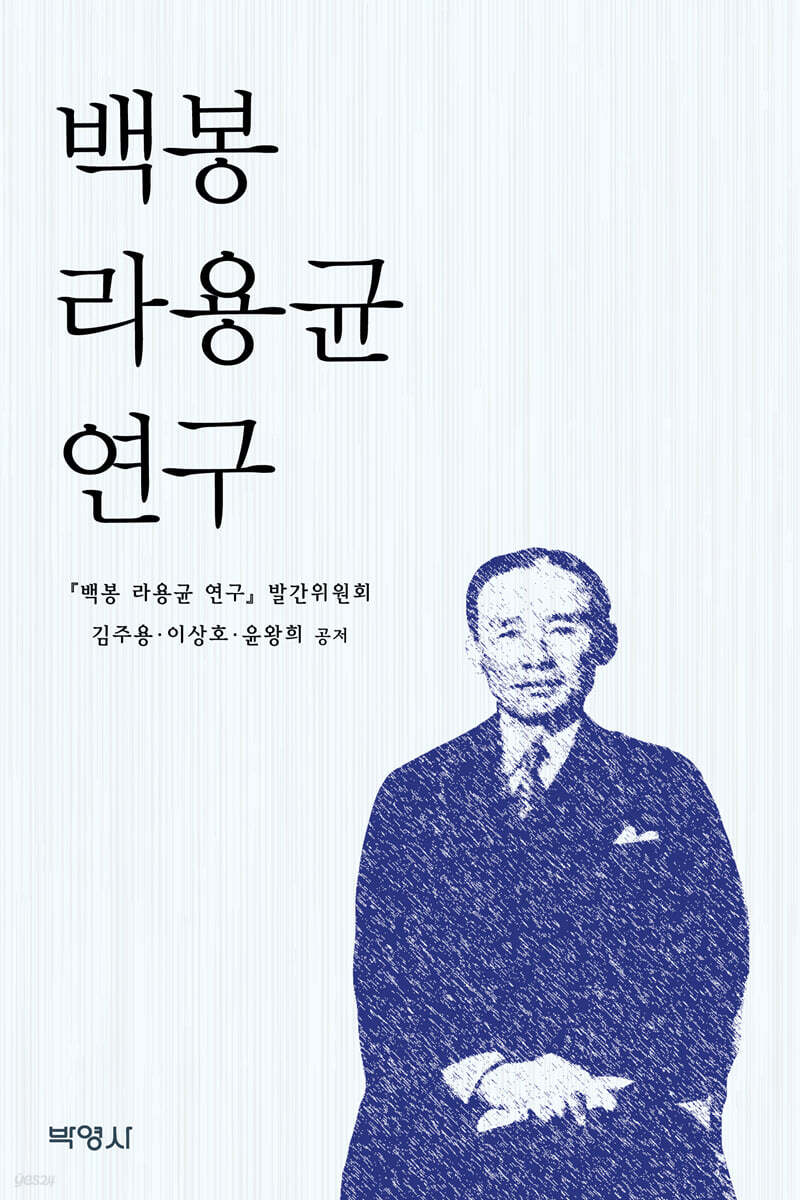
Baekbong Rayonggyun Research
 |
Description
Book Introduction
We say that the ultimate goal of history education is not to create heroes adorned with some fictitious, grand myth, but to cultivate mature citizens of a democratic republic who respect their ordinary parents and grandparents, appreciate the hard work of previous generations, and understand their concerns.
But at the same time, there is something we must tell our descendants: the importance of visionaries and leaders.
So we studied the lives and thoughts of many great men, and as a result, among those we knew, there were many who stood tall and proud like peaks, but when we climbed those peaks, we often realized too late that what we saw were not the main vein but a branch vein.
In the process, we came to know that the footsteps of Baekbong Ra Yong-gyun were the very vein of the history of the Republic of Korea that we had been looking for.
Indeed, it would be difficult to find another person like Mr. Baekbong, who left his mark on the main flow of Korean history and made such a great dedication and contribution over a period of more than half a century, from the February 8th Declaration of Independence to the completion of the POSCO.
Therefore, I believe that by studying Baekbong and following in his footsteps, we can gain a correct perspective on the birth and growth of the Republic of Korea.
But at the same time, there is something we must tell our descendants: the importance of visionaries and leaders.
So we studied the lives and thoughts of many great men, and as a result, among those we knew, there were many who stood tall and proud like peaks, but when we climbed those peaks, we often realized too late that what we saw were not the main vein but a branch vein.
In the process, we came to know that the footsteps of Baekbong Ra Yong-gyun were the very vein of the history of the Republic of Korea that we had been looking for.
Indeed, it would be difficult to find another person like Mr. Baekbong, who left his mark on the main flow of Korean history and made such a great dedication and contribution over a period of more than half a century, from the February 8th Declaration of Independence to the completion of the POSCO.
Therefore, I believe that by studying Baekbong and following in his footsteps, we can gain a correct perspective on the birth and growth of the Republic of Korea.
index
Part 1: The Challenges and Trials of Young Ra Yong-gyun
Chapter 1 Birth and Studying in Japan ·························································· 13
1.
Jeongeup Yeongwon-myeon Naju Na clan ·········································· 13
2.
Tokyo Waseda University Department of Political Science and the February 8th Independence Movement ········· 26
Chapter 2 Exile in China and Study in England ····················· 42
1.
Independence Movement in Shanghai ·························································· 42
2.
Six Years in London and Professor Harold Lasky ··················· 77
3.
Reclamation Projects After Returning to Korea ························································ 82
Part 2: The Foundations of Political Parties and Parliamentary Politics
Chapter 1: Establishment of Political Parties and Members of the Constitutional Assembly after Liberation ················ 91
1.
Participation in the Democratic Party of Korea ································································ 91
2.
The Secretary General of the Democratic Party of Korea and the May 10 General Election ················ 97
3.
Activities of the Constituent Assembly Members ······································································ 101
Chapter 2: Pioneering Pragmatic Centrist Parliamentary Politics ············· 125
1.
Failure ················································································· 125
2.
The Fourth National Assembly Member and UN Diplomacy ·················· 134
3.
Conflict within the Democratic Party ·········································································· 143
4.
The April 19 Democratic Revolution and the Minister of Health and Social Affairs ··················· 151
5.
Post-camp politics after the May 16 coup d'état ································ 163
Part 3 Attitudes and Philosophy toward Politics
Chapter 1: 'Liberal Moderns' and Parliamentarism ············ 185
1.
Policy-Oriented Pragmatism ······················································· 185
2.
Pioneers of Parliamentary Diplomacy ·························································· 193
3.
Rational Parliamentarians ·························································· 199
Chapter 2 Between Factions and Nations ·················································· 206
1.
The decisive scenes that created Baekbong ············································· 206
2.
The 'Unyielding' Negotiator ································· 213
3.
Politics with Dignity ·········································································· 221
Chapter 1 Birth and Studying in Japan ·························································· 13
1.
Jeongeup Yeongwon-myeon Naju Na clan ·········································· 13
2.
Tokyo Waseda University Department of Political Science and the February 8th Independence Movement ········· 26
Chapter 2 Exile in China and Study in England ····················· 42
1.
Independence Movement in Shanghai ·························································· 42
2.
Six Years in London and Professor Harold Lasky ··················· 77
3.
Reclamation Projects After Returning to Korea ························································ 82
Part 2: The Foundations of Political Parties and Parliamentary Politics
Chapter 1: Establishment of Political Parties and Members of the Constitutional Assembly after Liberation ················ 91
1.
Participation in the Democratic Party of Korea ································································ 91
2.
The Secretary General of the Democratic Party of Korea and the May 10 General Election ················ 97
3.
Activities of the Constituent Assembly Members ······································································ 101
Chapter 2: Pioneering Pragmatic Centrist Parliamentary Politics ············· 125
1.
Failure ················································································· 125
2.
The Fourth National Assembly Member and UN Diplomacy ·················· 134
3.
Conflict within the Democratic Party ·········································································· 143
4.
The April 19 Democratic Revolution and the Minister of Health and Social Affairs ··················· 151
5.
Post-camp politics after the May 16 coup d'état ································ 163
Part 3 Attitudes and Philosophy toward Politics
Chapter 1: 'Liberal Moderns' and Parliamentarism ············ 185
1.
Policy-Oriented Pragmatism ······················································· 185
2.
Pioneers of Parliamentary Diplomacy ·························································· 193
3.
Rational Parliamentarians ·························································· 199
Chapter 2 Between Factions and Nations ·················································· 206
1.
The decisive scenes that created Baekbong ············································· 206
2.
The 'Unyielding' Negotiator ································· 213
3.
Politics with Dignity ·········································································· 221
Detailed image
Publisher's Review
introduction
We live in a good country.
The reason we live in such a good country is, above all, because our ancestors shed blood, sweat, and tears.
So, we are educating the next generation, expressing our gratitude to our ancestors and hoping to pass on the freedom, human rights, abundance, and peace we enjoy to our descendants so they too can enjoy them.
Sometimes we realize that we don't know much about those who laid the foundation for this wonderful country.
The independence activists we have known so far were indomitable fighters against the Japanese, but it seems that many of them failed to deeply understand modern democratic laws and systems and to internalize the culture of respect for freedom and human rights.
Who, after all, created this wonderful nation, the Republic of Korea? So, we began reading the minutes of the Constitutional Assembly and studying the members of the Constitutional Assembly.
And finally, among those who fought for independence in their youth and served as members of the Constitutional Assembly in their middle years, we learned that modern people, people with a deep understanding of liberalism and republicanism, and perhaps even a deeper understanding of the flow of international order than we do today, were active in various fields.
One of them is Baekbong Ra Yong-gyun.
"Ah, so this is exactly who we are! It was thanks to these people that we actively embraced the principles of a new world proclaimed by the UN in the Universal Declaration of Human Rights after World War II! The ideals and dreams of humanity—to ensure that the tens of millions who sacrificed their lives in a long war were not in vain—could be realized right here in the Republic of Korea, at the very tip of East Asia!"
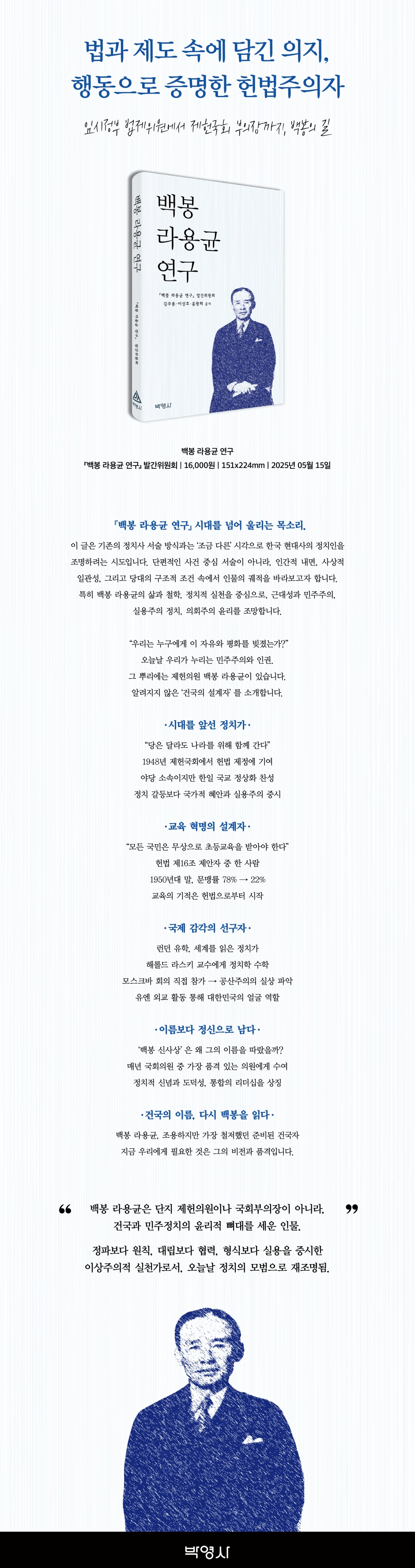
We are moved and thrilled when we read Article 16 of the Constitution (equivalent to Article 26, Paragraph 1 of the Universal Declaration of Human Rights), which guarantees all citizens the right to equal education and specifically stipulates that “elementary education shall be compulsory and free.”
In accordance with this very spirit of the Constitution, our country implemented compulsory elementary education upon its founding, thereby reducing the illiteracy rate from 78% at the time of liberation to 22% by the late 1950s.
Isn't that a miracle?
When we think about the poverty and difficult conditions of the Republic of Korea at the time, which we are all familiar with, we realize that the members of the Constitutional Assembly and the founders of the Republic of Korea were those who possessed the foresight to see far ahead even in the midst of chaos and the deep intellect to distinguish between right and wrong even in the midst of darkness.
We studied under one of them, Mr. Rayonggyun.
As a former Japanese exchange student, my participation in the 'February 8th Declaration of Independence' is not much different from other people's.
However, the fact that he was dispatched and elected as a member of the Provisional Government of the Republic of Korea at the young age of 24 shows that he was regarded by his friends and comrades as a person of much greater importance than he appeared to be.
More importantly, the many experiences he had in Shanghai during his youth were ultimately invaluable.
In that respect, he was lucky.
In fact, the provisional government also plays a role in managing funds, which is the most secret and practical work in the revolutionary and independence movement, and is a dense experience on a different level from just exchanging flowery words.
As a parliamentarian, he had another momentous experience that would shape his life as a liberal and progressive democrat.
In 1922, he attended the ‘Far East National Revolutionary Organization Representative Conference’ held in Moscow together with his seniors, including Kim Kyu-sik and Yeo Un-hyeong.
In fact, many young people have never been to a real communist country, so they have vague longings, are absorbed in idealistic theories, or are deceived by propaganda.
But he experienced the Soviet Union firsthand and saw the reality of communism.
He had two significant experiences at a young age: serving as a member of the Provisional Government and visiting the Soviet Union firsthand.
And finally, through studying abroad in England, he learned the political philosophy and culture based on the unique British empiricism and agnosticism at the starting point of modern democracy and capitalism.
Just as Dosan Ahn Chang-ho, the leader of the provisional government, advised the young Ra Yong-gyun to “go to England and study”, Ra Yong-gyun was the one who was prepared to become a member of the Constitutional Assembly when liberation came and the nation was founded.
It was precisely because these people sat between the National Assembly buildings and held the center that the Republic of Korea was able to have a sound foundation from the beginning.
Later, when he was a senior member of the National Assembly and Vice-Speaker, he was a member of the opposition party but supported the normalization of diplomatic relations between Korea and Japan. Through this, we learned how far Ra Yong-gyun's thoughts on industrial capitalist economic growth and national development reached, and how firm and deep his convictions and political philosophy on parliamentary democracy truly were.
His words and actions at that time make us think again and again.
Therefore, rather than being remembered as the 'Baekbong New Thought' given to the National Assembly members, Baekbong Ra Yong-gyun should be remembered as the person who most deeply understood the Universal Declaration of Human Rights, that is, the spirit of the times, among the founders of the nation, and as the politician who most deeply understood and practiced modern parliamentary democracy, which was at the center of the early history of Korean democracy.
We say that the ultimate goal of history education is not to create heroes adorned with some fictitious, grand myth, but to cultivate mature citizens of a democratic republic who respect their ordinary parents and grandparents, appreciate the hard work of previous generations, and understand their concerns.
But at the same time, there is something we must tell our descendants: the importance of visionaries and leaders.
So we studied the lives and thoughts of many great men, and as a result, among those we knew, there were many who stood tall and proud like peaks, but when we climbed those peaks, we often realized too late that what we saw were not the main vein but a branch vein.
In the process, we came to know that the footsteps of Baekbong Ra Yong-gyun were the very vein of the history of the Republic of Korea that we had been looking for.
Indeed, it would be difficult to find another person like Mr. Baekbong, who left his mark on the main flow of Korean history and made such a great dedication and contribution over a period of more than half a century, from the February 8th Declaration of Independence to the completion of the POSCO.
Therefore, I believe that by studying Baekbong and following in his footsteps, we can gain a correct perspective on the birth and growth of the Republic of Korea.
The past two years have been a happy time, with many meetings held while studying Baekbong Rayonggyun.
It was a time of learning and realizing a lot.
Professor Kim Joo-yong, Dr. Lee Sang-ho, and Dr. Yoon Wang-hee worked hard to find scattered data and write excellent papers and manuscripts.
I am deeply grateful to the three people who have dimly portrayed the image of Baekbong, an Oriental gentleman who was ahead of his time, a man who may have seemed lonely in his time but was easy to understand for us, someone who seemed like someone we could easily open the door with a smile and have a pleasant conversation with.
I would also like to express my gratitude to all of you who reviewed the manuscript and put the puzzle together through discussion, including Representative Yoo Seong-yeop, a politician from Jeongeup who can be considered a junior of Baek Seo-mun's 5th Bong, civic activist Choi Young-dae, historian Professor Lee Seung-ryeol, and Dr. Hwang In-su, Secretary General of the Baekbong Research Institute, and Researcher Cho Hye-rang, who provided practical support for the meeting.
April 2025
Joo Dae-hwan, Chairman of the Publication Committee for the "Baekbong Ra Yong-gyun Study"
Baekbong Rayonggyun Research Publication Review
Many thoughts come to mind about how research on my father came to light.
It's not that there weren't any stories about my father's biography during that time.
When my father was alive, I mentioned writing an autobiography several times.
But he never responded, just with his signature smile.
I remember one time, when I strongly urged him to leave a personal statement, saying that it was a kind of duty as a public figure to do so, he smiled and replied that he would end up lying if he did.
I laughed when you said, as you often do, that you could start your autobiography at the creation of the world.
After he passed away, several people came together to recommend preparations for his biography.
At times like that, I hesitated, recalling memories from when my father was alive.
Then, this time, several people with similar interests mentioned preparing a research paper, and I was moved.
So to speak, it is not something like a common electrical current, but a serious academic study.
The work was led by two dedicated individuals, Joo Dae-hwan and Choi Young-dae, and Dr. Lee Seung-ryeol, who has conducted the highest level of research and writing in this field.
The three scholars who conducted the actual research and writing, Kim Joo-yong, Lee Sang-ho, and Yoon Wang-hee, are all individuals who have made significant research and achievements on the relevant period and topic.
Participants in the study met approximately once every three months to discuss their work and any issues they encountered.
My research fellows, Dr. Hwang In-su and Dr. Jo Hye-rang, assisted with the practical aspects of the work and occasionally provided materials.
Despite the extensive research and discussion, everyone involved said they still had regrets when looking at the final manuscript.
I also tried to console them by saying that all work done by humans (and perhaps even by God) is unfinished.
However, if the publication of this study sparks new interest and raises questions about a period of hardship for our people in various ways, we leave open the possibility of further work.
I would like to express my gratitude and condolences to all those who participated in the work, including Chairman Joo Dae-hwan, for his hard work. I also express my gratitude to Chairman Ahn Jong-man and Director Jo Seong-ho, who took charge of the publication.
April 2025
Ra Jong-il
We live in a good country.
The reason we live in such a good country is, above all, because our ancestors shed blood, sweat, and tears.
So, we are educating the next generation, expressing our gratitude to our ancestors and hoping to pass on the freedom, human rights, abundance, and peace we enjoy to our descendants so they too can enjoy them.
Sometimes we realize that we don't know much about those who laid the foundation for this wonderful country.
The independence activists we have known so far were indomitable fighters against the Japanese, but it seems that many of them failed to deeply understand modern democratic laws and systems and to internalize the culture of respect for freedom and human rights.
Who, after all, created this wonderful nation, the Republic of Korea? So, we began reading the minutes of the Constitutional Assembly and studying the members of the Constitutional Assembly.
And finally, among those who fought for independence in their youth and served as members of the Constitutional Assembly in their middle years, we learned that modern people, people with a deep understanding of liberalism and republicanism, and perhaps even a deeper understanding of the flow of international order than we do today, were active in various fields.
One of them is Baekbong Ra Yong-gyun.
"Ah, so this is exactly who we are! It was thanks to these people that we actively embraced the principles of a new world proclaimed by the UN in the Universal Declaration of Human Rights after World War II! The ideals and dreams of humanity—to ensure that the tens of millions who sacrificed their lives in a long war were not in vain—could be realized right here in the Republic of Korea, at the very tip of East Asia!"
We are moved and thrilled when we read Article 16 of the Constitution (equivalent to Article 26, Paragraph 1 of the Universal Declaration of Human Rights), which guarantees all citizens the right to equal education and specifically stipulates that “elementary education shall be compulsory and free.”
In accordance with this very spirit of the Constitution, our country implemented compulsory elementary education upon its founding, thereby reducing the illiteracy rate from 78% at the time of liberation to 22% by the late 1950s.
Isn't that a miracle?
When we think about the poverty and difficult conditions of the Republic of Korea at the time, which we are all familiar with, we realize that the members of the Constitutional Assembly and the founders of the Republic of Korea were those who possessed the foresight to see far ahead even in the midst of chaos and the deep intellect to distinguish between right and wrong even in the midst of darkness.
We studied under one of them, Mr. Rayonggyun.
As a former Japanese exchange student, my participation in the 'February 8th Declaration of Independence' is not much different from other people's.
However, the fact that he was dispatched and elected as a member of the Provisional Government of the Republic of Korea at the young age of 24 shows that he was regarded by his friends and comrades as a person of much greater importance than he appeared to be.
More importantly, the many experiences he had in Shanghai during his youth were ultimately invaluable.
In that respect, he was lucky.
In fact, the provisional government also plays a role in managing funds, which is the most secret and practical work in the revolutionary and independence movement, and is a dense experience on a different level from just exchanging flowery words.
As a parliamentarian, he had another momentous experience that would shape his life as a liberal and progressive democrat.
In 1922, he attended the ‘Far East National Revolutionary Organization Representative Conference’ held in Moscow together with his seniors, including Kim Kyu-sik and Yeo Un-hyeong.
In fact, many young people have never been to a real communist country, so they have vague longings, are absorbed in idealistic theories, or are deceived by propaganda.
But he experienced the Soviet Union firsthand and saw the reality of communism.
He had two significant experiences at a young age: serving as a member of the Provisional Government and visiting the Soviet Union firsthand.
And finally, through studying abroad in England, he learned the political philosophy and culture based on the unique British empiricism and agnosticism at the starting point of modern democracy and capitalism.
Just as Dosan Ahn Chang-ho, the leader of the provisional government, advised the young Ra Yong-gyun to “go to England and study”, Ra Yong-gyun was the one who was prepared to become a member of the Constitutional Assembly when liberation came and the nation was founded.
It was precisely because these people sat between the National Assembly buildings and held the center that the Republic of Korea was able to have a sound foundation from the beginning.
Later, when he was a senior member of the National Assembly and Vice-Speaker, he was a member of the opposition party but supported the normalization of diplomatic relations between Korea and Japan. Through this, we learned how far Ra Yong-gyun's thoughts on industrial capitalist economic growth and national development reached, and how firm and deep his convictions and political philosophy on parliamentary democracy truly were.
His words and actions at that time make us think again and again.
Therefore, rather than being remembered as the 'Baekbong New Thought' given to the National Assembly members, Baekbong Ra Yong-gyun should be remembered as the person who most deeply understood the Universal Declaration of Human Rights, that is, the spirit of the times, among the founders of the nation, and as the politician who most deeply understood and practiced modern parliamentary democracy, which was at the center of the early history of Korean democracy.
We say that the ultimate goal of history education is not to create heroes adorned with some fictitious, grand myth, but to cultivate mature citizens of a democratic republic who respect their ordinary parents and grandparents, appreciate the hard work of previous generations, and understand their concerns.
But at the same time, there is something we must tell our descendants: the importance of visionaries and leaders.
So we studied the lives and thoughts of many great men, and as a result, among those we knew, there were many who stood tall and proud like peaks, but when we climbed those peaks, we often realized too late that what we saw were not the main vein but a branch vein.
In the process, we came to know that the footsteps of Baekbong Ra Yong-gyun were the very vein of the history of the Republic of Korea that we had been looking for.
Indeed, it would be difficult to find another person like Mr. Baekbong, who left his mark on the main flow of Korean history and made such a great dedication and contribution over a period of more than half a century, from the February 8th Declaration of Independence to the completion of the POSCO.
Therefore, I believe that by studying Baekbong and following in his footsteps, we can gain a correct perspective on the birth and growth of the Republic of Korea.
The past two years have been a happy time, with many meetings held while studying Baekbong Rayonggyun.
It was a time of learning and realizing a lot.
Professor Kim Joo-yong, Dr. Lee Sang-ho, and Dr. Yoon Wang-hee worked hard to find scattered data and write excellent papers and manuscripts.
I am deeply grateful to the three people who have dimly portrayed the image of Baekbong, an Oriental gentleman who was ahead of his time, a man who may have seemed lonely in his time but was easy to understand for us, someone who seemed like someone we could easily open the door with a smile and have a pleasant conversation with.
I would also like to express my gratitude to all of you who reviewed the manuscript and put the puzzle together through discussion, including Representative Yoo Seong-yeop, a politician from Jeongeup who can be considered a junior of Baek Seo-mun's 5th Bong, civic activist Choi Young-dae, historian Professor Lee Seung-ryeol, and Dr. Hwang In-su, Secretary General of the Baekbong Research Institute, and Researcher Cho Hye-rang, who provided practical support for the meeting.
April 2025
Joo Dae-hwan, Chairman of the Publication Committee for the "Baekbong Ra Yong-gyun Study"
Baekbong Rayonggyun Research Publication Review
Many thoughts come to mind about how research on my father came to light.
It's not that there weren't any stories about my father's biography during that time.
When my father was alive, I mentioned writing an autobiography several times.
But he never responded, just with his signature smile.
I remember one time, when I strongly urged him to leave a personal statement, saying that it was a kind of duty as a public figure to do so, he smiled and replied that he would end up lying if he did.
I laughed when you said, as you often do, that you could start your autobiography at the creation of the world.
After he passed away, several people came together to recommend preparations for his biography.
At times like that, I hesitated, recalling memories from when my father was alive.
Then, this time, several people with similar interests mentioned preparing a research paper, and I was moved.
So to speak, it is not something like a common electrical current, but a serious academic study.
The work was led by two dedicated individuals, Joo Dae-hwan and Choi Young-dae, and Dr. Lee Seung-ryeol, who has conducted the highest level of research and writing in this field.
The three scholars who conducted the actual research and writing, Kim Joo-yong, Lee Sang-ho, and Yoon Wang-hee, are all individuals who have made significant research and achievements on the relevant period and topic.
Participants in the study met approximately once every three months to discuss their work and any issues they encountered.
My research fellows, Dr. Hwang In-su and Dr. Jo Hye-rang, assisted with the practical aspects of the work and occasionally provided materials.
Despite the extensive research and discussion, everyone involved said they still had regrets when looking at the final manuscript.
I also tried to console them by saying that all work done by humans (and perhaps even by God) is unfinished.
However, if the publication of this study sparks new interest and raises questions about a period of hardship for our people in various ways, we leave open the possibility of further work.
I would like to express my gratitude and condolences to all those who participated in the work, including Chairman Joo Dae-hwan, for his hard work. I also express my gratitude to Chairman Ahn Jong-man and Director Jo Seong-ho, who took charge of the publication.
April 2025
Ra Jong-il
GOODS SPECIFICS
- Date of issue: May 15, 2025
- Format: Hardcover book binding method guide
- Page count, weight, size: 236 pages | 153*224*20mm
- ISBN13: 9788910980513
- ISBN10: 8910980516
You may also like
카테고리
korean


korean

![GQ KOREA Mark (Monthly): December [2025]](http://librairie.coreenne.fr/cdn/shop/files/8ef265dbbfbf186523ed75ba7319009d.jpg?v=1765340328&width=3840)


