

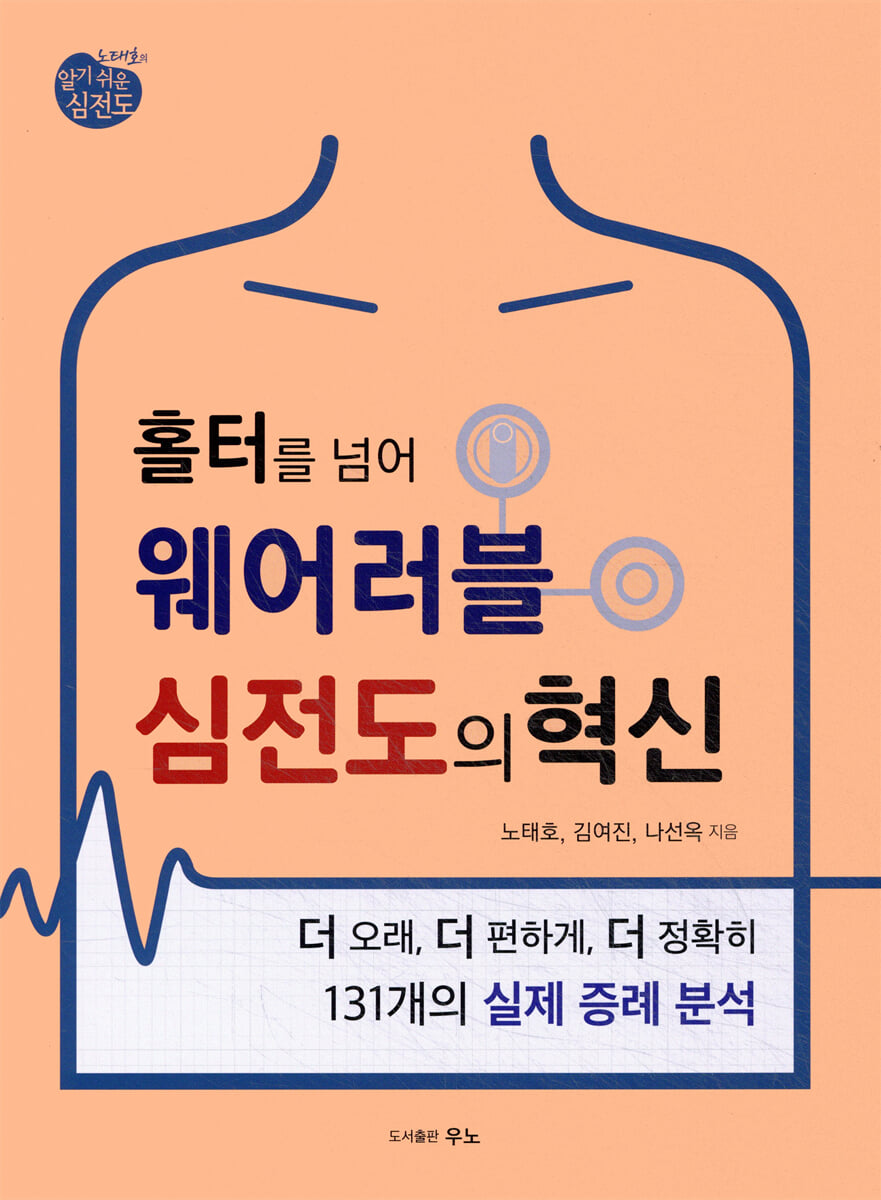
Innovations in Wearable ECGs Beyond Holter
 |
Description
Book Introduction
"Beyond Holter: Innovation in Wearable ECG" is based on the experience accumulated at the Noh Tae-ho Bao Clinic's Arrhythmia Interpretation Center, the first, largest, and best in Korea, and shows how wearable ECG technology can save patients' lives through early diagnosis of arrhythmia in real clinical practice.
With 131 real-world case studies, it provides practical guidance for all healthcare professionals, from cardiologists to students, to effectively interpret and utilize long-term electrocardiogram data.
With 131 real-world case studies, it provides practical guidance for all healthcare professionals, from cardiologists to students, to effectively interpret and utilize long-term electrocardiogram data.
index
PART 1.
The Era of Wearable Patch-Type ECGs
1.
Heart, the Source of Life 12
2.
Right Heart and Left Heart 14
3.
Atria and Ventricles 16
4.
Electrical Generation and Flow in the Heart, and the Electrocardiogram 17
5.
The Invention and Development of the Electrocardiogram 18
6.
The advent of the Holter ECG, which surpassed the 10-second limit and went beyond the hospital walls, has expanded to 20
7.
Wearable long-term ECG monitoring now goes beyond Holter ECGs.
8.
23 Advantages of Wearable Patch-Type ECGs
9.
There are also limitations 25
10.
Cardiac Event Recording (ECG/Event Recorder) 27
11.
Current Status of Long-Term Electrocardiogram Monitoring in Korea 29
PART2.
The Unknown World of Arrhythmia in 10 Seconds
Chapter 1: The Moment of Crisis
1-1.
Threatening rhythm ventricular tachycardia 34
1-2.
Abnormally shaped ventricular tachycardia TdP 37
1-3.
Don't be fooled even if you're in a hurry 40
1-4.
Where is the suddenly missing ECG? 41
1-5.
Tachycardia-Bradycardia Syndrome 43
1-6.
Sinus node dysfunction due to disease and exhaustion 45
Chapter 2: PAC and PVC: What We Know Isn't Everything
2-1. The Various Faces of PAC 50
2-2. Is PAC bigeminy correct? 53
2-3. What if it's not PAC? 57
2-4. Not all wide QRS rhythms are PVCs. 59
2-5.
A series of PACs? 62
2-6.
Calipers are needed in these cases: 64
2-7. The Various Faces of PVC 66
2-8. Note the margin behind the PVC 69
2-9. There's a reason why the gap behind the PVC isn't exactly right. 71
2-10.
Unidentified QRS 73 stuck in the middle
2-11. There may be no space behind the PVC 75
2-12.
PVC Parasystole 77 with its own rhythm
2-13.
PVC above T wave, R on T 78, dangerous timing
Chapter 3: The Beginning of Chaos
3-1.
P has changed P wave fusion 80
3-2.
P has changed MAT 81
3-3.
P has changed Junction rhythm 82
3-4. QRS changed Intermittent bundle branch block 84
3-5. QRS changed Intermittent fascicle block 86
3-6. QRS changed Alternating bundle branch block 87
3-7. QRS changed Intermittent V preexcitation 88
3-8. QRS changed Postural change 90
3-9. QRS changed Lead reversal 91
3-10.
Not the East-West Pulse? Don't Be Fooled by PAC 94
3-11.
Sinus arrhythmia: The Hidden Story 96
Chapter 4: The Running Heart
4-1.
Encountering Wide QRS (1) 100
4-2.
Encountering Wide QRS (2) 102
4-3.
Encountering Wide QRS (3) 104
4-4.
Interesting Wide QRS (1) 106
4-5.
Interesting Wide QRS (2) 107
4-6.
Interesting Wide QRS (3) 110
4-7.
112 in a circuit that goes round and round
4-8.
Two AV nodes? 114
4-9. There is also AVNNRT 116
Chapter 5: Finding the Flow
5-1.
The pitfalls of second-degree heart block (1) 120
5-2.
The Pitfalls of Second-Degree Heart Blockage (2) 121
5-3.
The Trap of Complete Room Blocking 123
5-4.
Same speed, but no connection 125
5-5.
Second-degree heart block: Type 1 or 2? 128
5-6.
Are there fake room blockers? 130
5-7.
Changes in atrioventricular block over time (1) 132
5-8.
Changes in atrioventricular block over time (2) 134
5-9.
2:1 AV block, what next? 136
5-10.
139 sudden room block
5-11.
Atrioventricular block 140 from birth
5-12.
Atrial fibrillation is not called atrial fibrillation 142
5-13.
Multiple stages of atrioventricular block 144
Chapter 6: Atrial Fibrillation: Familiar Yet Unfamiliar
6-1.
Can atrial fibrillation be regular? (1) 148
6-2.
Can atrial fibrillation be regular? (2) 150
6-3.
Can atrial fibrillation be regular? (3) 152
6-4.
Can atrial fibrillation be regular? (4) 153
6-5.
Wide QRS Aberrancy in Atrial Fibrillation 155
6-6.
Wide QRS BBB 157 in atrial fibrillation
6-7.
Wide QRS PVC 159 in atrial fibrillation
6-8.
Wide QRS V pacing in atrial fibrillation 161
6-9.
Wide QRS V preexcitation in atrial fibrillation 163
Chapter 7: Conversations with a Pacemaker
7-1.
Spike A pacing 166 before P wave
7-2. Spike V pacing before QRS complex 168
7-3.
Pacemaker 170 in atrial fibrillation
7-4.
Why did V-pacing suddenly get faster? 172
7-5.
Pacemaker misses the signal from the atrium 174
7-6.
Pacemaker missed ventricular signal 176
7-7.
Pacemaker can't wake up the atrium 178
7-8.
Pacemaker ventricle not awakened 180
PART3.
Assessment of arrhythmia seen in long-term electrocardiograms
1. Frequency of PVC occurrence and definition of 'Frequent PVC' 184
2.
What does 'High Burden PVC' mean? 186
3.
Premature ventricular contractions, which require special attention, 187
4.
Are atrial premature contractions classified as frequent or rare? 188
5.
What does 'High Burden PAC' mean? 189
6. What are the differences between SVT, AT, and PAC runs? 190
7.
Will I need to keep a long-term record for several days? 191
8.
Such arrhythmias are considered emergencies and should be reported immediately. 192
PART4.
Just looking at the reading summary report is enough.
1.
The first page of the report is a summary. It is enough to look at this in detail. 196
2.
What happens when a patient develops symptoms? 199
3.
You can see your heart rate changes clearly at a glance 200
4. Distribution of RR intervals 202
5.
You can also find out the type and frequency of arrhythmia by hour, as well as the heart rate. 203
6.
The most important thing...
Summarize and organize all arrhythmias that occurred during the recording period 204
7.
Actual records of arrhythmias that occurred 207
8.
Final Summary and Conclusions, Medical Recommendations 210
The Era of Wearable Patch-Type ECGs
1.
Heart, the Source of Life 12
2.
Right Heart and Left Heart 14
3.
Atria and Ventricles 16
4.
Electrical Generation and Flow in the Heart, and the Electrocardiogram 17
5.
The Invention and Development of the Electrocardiogram 18
6.
The advent of the Holter ECG, which surpassed the 10-second limit and went beyond the hospital walls, has expanded to 20
7.
Wearable long-term ECG monitoring now goes beyond Holter ECGs.
8.
23 Advantages of Wearable Patch-Type ECGs
9.
There are also limitations 25
10.
Cardiac Event Recording (ECG/Event Recorder) 27
11.
Current Status of Long-Term Electrocardiogram Monitoring in Korea 29
PART2.
The Unknown World of Arrhythmia in 10 Seconds
Chapter 1: The Moment of Crisis
1-1.
Threatening rhythm ventricular tachycardia 34
1-2.
Abnormally shaped ventricular tachycardia TdP 37
1-3.
Don't be fooled even if you're in a hurry 40
1-4.
Where is the suddenly missing ECG? 41
1-5.
Tachycardia-Bradycardia Syndrome 43
1-6.
Sinus node dysfunction due to disease and exhaustion 45
Chapter 2: PAC and PVC: What We Know Isn't Everything
2-1. The Various Faces of PAC 50
2-2. Is PAC bigeminy correct? 53
2-3. What if it's not PAC? 57
2-4. Not all wide QRS rhythms are PVCs. 59
2-5.
A series of PACs? 62
2-6.
Calipers are needed in these cases: 64
2-7. The Various Faces of PVC 66
2-8. Note the margin behind the PVC 69
2-9. There's a reason why the gap behind the PVC isn't exactly right. 71
2-10.
Unidentified QRS 73 stuck in the middle
2-11. There may be no space behind the PVC 75
2-12.
PVC Parasystole 77 with its own rhythm
2-13.
PVC above T wave, R on T 78, dangerous timing
Chapter 3: The Beginning of Chaos
3-1.
P has changed P wave fusion 80
3-2.
P has changed MAT 81
3-3.
P has changed Junction rhythm 82
3-4. QRS changed Intermittent bundle branch block 84
3-5. QRS changed Intermittent fascicle block 86
3-6. QRS changed Alternating bundle branch block 87
3-7. QRS changed Intermittent V preexcitation 88
3-8. QRS changed Postural change 90
3-9. QRS changed Lead reversal 91
3-10.
Not the East-West Pulse? Don't Be Fooled by PAC 94
3-11.
Sinus arrhythmia: The Hidden Story 96
Chapter 4: The Running Heart
4-1.
Encountering Wide QRS (1) 100
4-2.
Encountering Wide QRS (2) 102
4-3.
Encountering Wide QRS (3) 104
4-4.
Interesting Wide QRS (1) 106
4-5.
Interesting Wide QRS (2) 107
4-6.
Interesting Wide QRS (3) 110
4-7.
112 in a circuit that goes round and round
4-8.
Two AV nodes? 114
4-9. There is also AVNNRT 116
Chapter 5: Finding the Flow
5-1.
The pitfalls of second-degree heart block (1) 120
5-2.
The Pitfalls of Second-Degree Heart Blockage (2) 121
5-3.
The Trap of Complete Room Blocking 123
5-4.
Same speed, but no connection 125
5-5.
Second-degree heart block: Type 1 or 2? 128
5-6.
Are there fake room blockers? 130
5-7.
Changes in atrioventricular block over time (1) 132
5-8.
Changes in atrioventricular block over time (2) 134
5-9.
2:1 AV block, what next? 136
5-10.
139 sudden room block
5-11.
Atrioventricular block 140 from birth
5-12.
Atrial fibrillation is not called atrial fibrillation 142
5-13.
Multiple stages of atrioventricular block 144
Chapter 6: Atrial Fibrillation: Familiar Yet Unfamiliar
6-1.
Can atrial fibrillation be regular? (1) 148
6-2.
Can atrial fibrillation be regular? (2) 150
6-3.
Can atrial fibrillation be regular? (3) 152
6-4.
Can atrial fibrillation be regular? (4) 153
6-5.
Wide QRS Aberrancy in Atrial Fibrillation 155
6-6.
Wide QRS BBB 157 in atrial fibrillation
6-7.
Wide QRS PVC 159 in atrial fibrillation
6-8.
Wide QRS V pacing in atrial fibrillation 161
6-9.
Wide QRS V preexcitation in atrial fibrillation 163
Chapter 7: Conversations with a Pacemaker
7-1.
Spike A pacing 166 before P wave
7-2. Spike V pacing before QRS complex 168
7-3.
Pacemaker 170 in atrial fibrillation
7-4.
Why did V-pacing suddenly get faster? 172
7-5.
Pacemaker misses the signal from the atrium 174
7-6.
Pacemaker missed ventricular signal 176
7-7.
Pacemaker can't wake up the atrium 178
7-8.
Pacemaker ventricle not awakened 180
PART3.
Assessment of arrhythmia seen in long-term electrocardiograms
1. Frequency of PVC occurrence and definition of 'Frequent PVC' 184
2.
What does 'High Burden PVC' mean? 186
3.
Premature ventricular contractions, which require special attention, 187
4.
Are atrial premature contractions classified as frequent or rare? 188
5.
What does 'High Burden PAC' mean? 189
6. What are the differences between SVT, AT, and PAC runs? 190
7.
Will I need to keep a long-term record for several days? 191
8.
Such arrhythmias are considered emergencies and should be reported immediately. 192
PART4.
Just looking at the reading summary report is enough.
1.
The first page of the report is a summary. It is enough to look at this in detail. 196
2.
What happens when a patient develops symptoms? 199
3.
You can see your heart rate changes clearly at a glance 200
4. Distribution of RR intervals 202
5.
You can also find out the type and frequency of arrhythmia by hour, as well as the heart rate. 203
6.
The most important thing...
Summarize and organize all arrhythmias that occurred during the recording period 204
7.
Actual records of arrhythmias that occurred 207
8.
Final Summary and Conclusions, Medical Recommendations 210
Publisher's Review
Finding the Hidden Rhythm of the Heart:
The Era of Wearable ECG Monitoring
Throughout our lives, our hearts accompany us on our journey through life, beating incessantly about 3 billion times.
But it's nearly impossible to detect this remarkable heart rhythm abnormality with just a 10-second standard electrocardiogram or a 24-hour Holter monitor.
“The moment a patient experiences symptoms, the doctor is not there.” This has been the biggest challenge I have seen in my 40 years as an arrhythmia specialist.
We have now entered a new era, 'beyond the halter'.
Wearable patch-based electrocardiogram monitoring demonstrates not just a technological evolution, but a paradigm shift in arrhythmia diagnosis.
Accurate and continuous heart rhythm monitoring is now possible for days or weeks, even during showers and exercise, without any inconvenience in daily life, dramatically increasing the detection rate of important arrhythmias.
This is where innovations in “longer, more comfortable, and more accurate” take place.
Moreover, real-time data transmission and AI analysis capabilities can save lives by enabling immediate intervention through on-site monitoring in the event of life-threatening arrhythmias.
This is what the near future looks like.
This book, based on the experience accumulated at the Noh Tae-ho Bao Clinic's Arrhythmia Diagnosis Center, the first, largest, and most advanced in Korea, demonstrates how wearable electrocardiography technology can save patients' lives through early diagnosis of arrhythmia in real-world clinical settings.
With 131 real-world case studies, it provides practical guidance for all healthcare professionals, from cardiologists to students, to effectively interpret and utilize long-term ECG data.
Beyond the 10-second time frame, beyond the 24-hour time frame, we can now understand a patient's heart rhythm more fully than ever before.
I hope this book will serve as a compass in your hands as you navigate the era of wearable electrocardiograms, illuminating the path toward an accurate diagnosis amidst the maze of arrhythmia.
May 2025
Professor Emeritus, Catholic University of Korea College of Medicine
Noh Tae-ho Paulo Internal Medicine, Heart & Arrhythmia Clinic
Noh Tae-ho
The Era of Wearable ECG Monitoring
Throughout our lives, our hearts accompany us on our journey through life, beating incessantly about 3 billion times.
But it's nearly impossible to detect this remarkable heart rhythm abnormality with just a 10-second standard electrocardiogram or a 24-hour Holter monitor.
“The moment a patient experiences symptoms, the doctor is not there.” This has been the biggest challenge I have seen in my 40 years as an arrhythmia specialist.
We have now entered a new era, 'beyond the halter'.
Wearable patch-based electrocardiogram monitoring demonstrates not just a technological evolution, but a paradigm shift in arrhythmia diagnosis.
Accurate and continuous heart rhythm monitoring is now possible for days or weeks, even during showers and exercise, without any inconvenience in daily life, dramatically increasing the detection rate of important arrhythmias.
This is where innovations in “longer, more comfortable, and more accurate” take place.
Moreover, real-time data transmission and AI analysis capabilities can save lives by enabling immediate intervention through on-site monitoring in the event of life-threatening arrhythmias.
This is what the near future looks like.
This book, based on the experience accumulated at the Noh Tae-ho Bao Clinic's Arrhythmia Diagnosis Center, the first, largest, and most advanced in Korea, demonstrates how wearable electrocardiography technology can save patients' lives through early diagnosis of arrhythmia in real-world clinical settings.
With 131 real-world case studies, it provides practical guidance for all healthcare professionals, from cardiologists to students, to effectively interpret and utilize long-term ECG data.
Beyond the 10-second time frame, beyond the 24-hour time frame, we can now understand a patient's heart rhythm more fully than ever before.
I hope this book will serve as a compass in your hands as you navigate the era of wearable electrocardiograms, illuminating the path toward an accurate diagnosis amidst the maze of arrhythmia.
May 2025
Professor Emeritus, Catholic University of Korea College of Medicine
Noh Tae-ho Paulo Internal Medicine, Heart & Arrhythmia Clinic
Noh Tae-ho
GOODS SPECIFICS
- Date of issue: May 17, 2025
- Page count, weight, size: 212 pages | 188*257*20mm
- ISBN13: 9791195727643
- ISBN10: 119572764X
You may also like
카테고리
korean


korean

![GQ KOREA Mark (Monthly): December [2025]](http://librairie.coreenne.fr/cdn/shop/files/8ef265dbbfbf186523ed75ba7319009d.jpg?v=1765340328&width=3840)


