

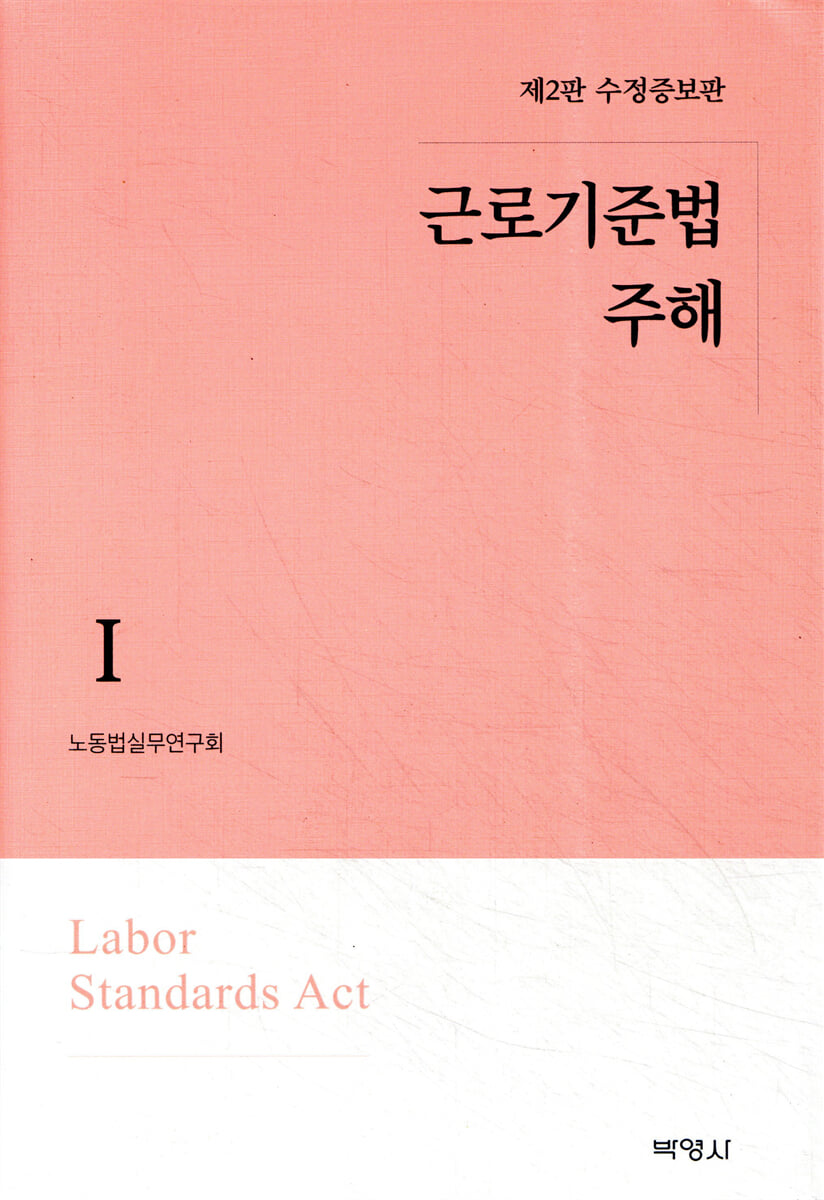
Labor Standards Act Commentary 1
 |
Description
Book Introduction
The Labor Standards Act has been revised five times, excluding revisions to other laws.
New provisions were established to promote the use of annual paid leave by workers with less than one year of continuous employment, a flexible working hour system was established where the unit period exceeds three months and is within six months, and provisions were established to impose an objective investigation obligation on employers in relation to the system prohibiting workplace bullying and to impose fines on employers who commit workplace bullying.
Even in cases where reinstatement to the original position is impossible in the event of an unfair dismissal, a basis for receiving monetary compensation through the unfair dismissal relief procedure has been established, the limit on enforcement fines for non-compliance with relief orders has been raised, and pregnant female workers are permitted to apply for changes to their work start and end times.
The scope of application of delayed interest payment for unpaid wages has been expanded to include employed workers, and the basis for expanding and strengthening sanctions against habitual non-paying employers has been established.
In line with the revision of the Labor Standards Act, laws concerning individual employment relationships, such as the Equal Employment Opportunity Act, the Workers' Retirement Benefits Security Act, and the Wage Claims Security Act, were also revised.
New provisions were established to promote the use of annual paid leave by workers with less than one year of continuous employment, a flexible working hour system was established where the unit period exceeds three months and is within six months, and provisions were established to impose an objective investigation obligation on employers in relation to the system prohibiting workplace bullying and to impose fines on employers who commit workplace bullying.
Even in cases where reinstatement to the original position is impossible in the event of an unfair dismissal, a basis for receiving monetary compensation through the unfair dismissal relief procedure has been established, the limit on enforcement fines for non-compliance with relief orders has been raised, and pregnant female workers are permitted to apply for changes to their work start and end times.
The scope of application of delayed interest payment for unpaid wages has been expanded to include employed workers, and the basis for expanding and strengthening sanctions against habitual non-paying employers has been established.
In line with the revision of the Labor Standards Act, laws concerning individual employment relationships, such as the Equal Employment Opportunity Act, the Workers' Retirement Benefits Security Act, and the Wage Claims Security Act, were also revised.
index
Introduction [Kim Heung-jun and Shin Kwon-cheol] 3
Chapter 1 General Provisions
Article 1 (Purpose) [Lee Yong-gu, Choi Jeong-eun] 101
Article 2 (Definitions) Paragraph 1, Item 1 (Workers) [Kwon Du-seop, Im Sang-min] 114
Article 2 (Definitions) Paragraph 1, Item 2 (Employers) [Kwon Du-seop, Im Sang-min] 173
Article 2 (Definitions) Paragraph 1, Item 3 (Labor) [Kwon Du-seop, Im Sang-min] 194
Article 2 (Definitions) Paragraph 1, Item 4 (Employment Contract) [Volume 195, Volume 195, Issue ...
Article 2 (Definitions) Paragraph 1, Item 5 (Wages) [Choi Eun-bae] 234
Article 2 (Definitions) Paragraph 1, Item 6 and Paragraph 2 (Average Wage/Regular Wage) [Choi Eun-bae, Seong Jun-gyu] 293
Article 2 (Definitions) Paragraph 1, Item 7 (1 week) [Go Jong-wan] 390
Article 2 (Definitions) Paragraph 1, Item 8 (Regular Working Hours) [Lee Jeong-han, Kim Jin, and Go Jong-wan] 391
Article 2 (Definitions) Paragraph 1, Item 9 (Part-time Workers) [Lee Jeong-han, Kim Jin] 394
Article 3 (Standards for Working Conditions) [Lee Yong-gu, Choi Jeong-eun] 401
Article 4 (Determination of Working Conditions) [Lee Yong-gu, Choi Jeong-eun] 406
Article 5 (Compliance with Working Conditions) [Lee Yong-gu, Choi Jeong-eun] 415
Article 6 (Equal Treatment) [Kim Min-gi and Jeong Ji-won] 428
Article 7 (Prohibition of Forced Labor) [Lee Yong-gu, Choi Jeong-eun] 834
Article 8 (Prohibition of Violence) [Lee Yong-gu, Choi Jeong-eun] 846
Article 9 (Exclusion of Intermediary Exploitation) [Kim Seong-su, Kim Seon-il, Lee Hyeon-seok] 850
Article 10 (Guarantee of the Exercise of Civil Rights) [Lee Yong-gu and Im Sang-eun] 925
Article 11 (Scope of Application) [This application/clinical application] 934
Article 12 (Scope of Application) [This application/clinical application] 969
Article 13 (Duty to Report and Attend) [Lee Yong-gu and Im Sang-eun] 971
Article 14 (Posting of Summary of Laws, etc.) [This Yong-gu/Clinical Eun] 972
Item Index 977
Chapter 1 General Provisions
Article 1 (Purpose) [Lee Yong-gu, Choi Jeong-eun] 101
Article 2 (Definitions) Paragraph 1, Item 1 (Workers) [Kwon Du-seop, Im Sang-min] 114
Article 2 (Definitions) Paragraph 1, Item 2 (Employers) [Kwon Du-seop, Im Sang-min] 173
Article 2 (Definitions) Paragraph 1, Item 3 (Labor) [Kwon Du-seop, Im Sang-min] 194
Article 2 (Definitions) Paragraph 1, Item 4 (Employment Contract) [Volume 195, Volume 195, Issue ...
Article 2 (Definitions) Paragraph 1, Item 5 (Wages) [Choi Eun-bae] 234
Article 2 (Definitions) Paragraph 1, Item 6 and Paragraph 2 (Average Wage/Regular Wage) [Choi Eun-bae, Seong Jun-gyu] 293
Article 2 (Definitions) Paragraph 1, Item 7 (1 week) [Go Jong-wan] 390
Article 2 (Definitions) Paragraph 1, Item 8 (Regular Working Hours) [Lee Jeong-han, Kim Jin, and Go Jong-wan] 391
Article 2 (Definitions) Paragraph 1, Item 9 (Part-time Workers) [Lee Jeong-han, Kim Jin] 394
Article 3 (Standards for Working Conditions) [Lee Yong-gu, Choi Jeong-eun] 401
Article 4 (Determination of Working Conditions) [Lee Yong-gu, Choi Jeong-eun] 406
Article 5 (Compliance with Working Conditions) [Lee Yong-gu, Choi Jeong-eun] 415
Article 6 (Equal Treatment) [Kim Min-gi and Jeong Ji-won] 428
Article 7 (Prohibition of Forced Labor) [Lee Yong-gu, Choi Jeong-eun] 834
Article 8 (Prohibition of Violence) [Lee Yong-gu, Choi Jeong-eun] 846
Article 9 (Exclusion of Intermediary Exploitation) [Kim Seong-su, Kim Seon-il, Lee Hyeon-seok] 850
Article 10 (Guarantee of the Exercise of Civil Rights) [Lee Yong-gu and Im Sang-eun] 925
Article 11 (Scope of Application) [This application/clinical application] 934
Article 12 (Scope of Application) [This application/clinical application] 969
Article 13 (Duty to Report and Attend) [Lee Yong-gu and Im Sang-eun] 971
Article 14 (Posting of Summary of Laws, etc.) [This Yong-gu/Clinical Eun] 972
Item Index 977
Publisher's Review
Publisher's Note (2nd Revised and Expanded Edition)
It has already been five years since the second edition of the Labor Standards Act Commentary was published.
In the meantime, laws concerning individual labor relations, such as the Labor Standards Act, have been revised several times, and many notable precedents have been handed down.
First, the Labor Standards Act has been revised five times, excluding revisions to other laws (March 31, 2020).
Law No. 17185, January 5, 2021.
Law No. 17862, April 13, 2021.
Law No. 18037, May 18, 2021.
Law No. 18176, October 22, 2024.
(Law No. 20520).
New regulations were established to promote the use of annual paid leave by workers with less than one year of continuous employment, a flexible working hour system was established where the unit period exceeds three months but is within six months, and regulations were established to impose an objective investigation obligation on employers in relation to the system prohibiting workplace bullying and to impose fines on employers who commit workplace bullying.
Even in cases where reinstatement is impossible in the event of an unfair dismissal, a basis for receiving monetary compensation through the unfair dismissal relief procedure has been established, the limit on enforcement fines for non-compliance with relief orders has been raised, and pregnant female workers are now permitted to apply for changes to their work start and end times.
The scope of application of interest on delayed payment of unpaid wages has been expanded to include employed workers, and the basis for expanding and strengthening sanctions against habitual non-paying employers has been established.
In line with the revision of the Labor Standards Act, laws concerning individual employment relationships, such as the Equal Employment Opportunity Act, the Workers' Retirement Benefits Security Act, and the Wage Claims Security Act, were also revised.
Subsequently, several full-court decisions were issued, setting new standards for legal discipline on the issue.
Supreme Court 2020.
1. 22.
The full bench decision in Decision No. 2015da73067 stated that when converting a fixed allowance paid in the form of a monthly salary as wages for agreed working hours exceeding the standard working hours into an hourly wage, unless otherwise specified, the number of hours the worker actually agreed to provide work should be added together, and the number of overtime hours and night work hours that take into account the 'surcharge rate' for calculating the surcharge should not be added together.
Supreme Court 2020.
2. 20.
The full bench decision in case No. 2019du52386 ruled that if a worker who had filed an application for relief from unfair dismissal and was contesting the validity of the dismissal became unable to return to his or her original position due to reasons such as reaching retirement age or the expiration of the employment contract, but needed to receive an amount equivalent to the wages during the period of dismissal, there was an interest in appealing the Central Labor Relations Commission's retrial decision that dismissed the application for relief.
Supreme Court 2023.
5. 11.
The full bench decision in cases 2017da35588 and 35595 abolished the so-called “socially acceptable rationality doctrine” of previous precedents, stating that if an employer changes the employment rules to the disadvantage of employees without obtaining the employees’ consent through a collective decision-making method, the validity of the employment rules cannot be recognized simply because the drafting or change of the rules is socially acceptable, unless there are special circumstances that can be seen as an abuse of the labor union or employees’ right to collective consent.
Supreme Court 2024.
12.
19.
The full bench decision of Sentence 2020da247190 redefined the concept of regular wages, excluding the concept of fixedness suggested by previous case law from the conceptual indicators of regular wages.
In addition to the above plenary decisions, there are also decisions on whether platform workers are considered workers under the Labor Standards Act, such as decisions on the criteria for determining whether workers are workers, decisions on the worker status of exclusive contract drivers, decisions on whether retroactive wage increases correspond to regular wages, decisions on the distinction between dispatched and subcontracted work, decisions on working conditions applicable to workers who were dispatched workers and then directly hired, decisions on invalidating the wage peak system for maintaining retirement age due to age discrimination, decisions on expectations such as the right to expect re-employment after retirement, the right to expect employment succession due to a change in service provider, and the right to expect employment conversion to regular employment, decisions on the prescribed working hours of university part-time lecturers, decisions on ordinary dismissal due to poor work performance or work ability, decisions on liability for damages due to violation of the obligation to re-employ after layoff, decisions on the validity of wage deductions provided for in employment rules or employment contracts, decisions on whether waiting time, rest time, and training time correspond to working hours, and decisions on the criteria for determining whether the limit on overtime work per week is exceeded. There were rulings, rulings on whether a holiday is considered a holiday, rulings on the statute of limitations and starting point for claims for unused annual leave, rulings on the worker's right to stop work, rulings on whether an employer has violated the duty of care for a worker raising a child and the criteria for judging it, rulings on the legality of personnel orders for workers who have completed childcare leave, etc.
In this revised and expanded edition of the 2nd edition of the Labor Standards Act, 2024.
12.
It reflects the revised laws and precedents announced up to the 31st.
However, with some exceptions, literature published after the publication of the second edition was not reflected, and we hope to reflect this in the third edition.
The Supreme Court Labor Law Practice Research Association published the second edition of the Labor Standards Act Commentary in 2023.
2. The second edition of the Trade Union and Labor Relations Adjustment Act has been published.
I would also like to express my sincere gratitude to the authors and editors who worked with me on the revised and expanded second edition of the Labor Standards Act Commentary.
I would also like to express my gratitude to the staff at Park Young-sa, who have continued to publish this book.
I hope this book will contribute, even if only slightly, to realizing the constitutional vision that human dignity should be guaranteed in individual employment relationships.
thank you
2025.
1.
Co-editor-in-chief
Lee Heung-gu
It has already been five years since the second edition of the Labor Standards Act Commentary was published.
In the meantime, laws concerning individual labor relations, such as the Labor Standards Act, have been revised several times, and many notable precedents have been handed down.
First, the Labor Standards Act has been revised five times, excluding revisions to other laws (March 31, 2020).
Law No. 17185, January 5, 2021.
Law No. 17862, April 13, 2021.
Law No. 18037, May 18, 2021.
Law No. 18176, October 22, 2024.
(Law No. 20520).
New regulations were established to promote the use of annual paid leave by workers with less than one year of continuous employment, a flexible working hour system was established where the unit period exceeds three months but is within six months, and regulations were established to impose an objective investigation obligation on employers in relation to the system prohibiting workplace bullying and to impose fines on employers who commit workplace bullying.
Even in cases where reinstatement is impossible in the event of an unfair dismissal, a basis for receiving monetary compensation through the unfair dismissal relief procedure has been established, the limit on enforcement fines for non-compliance with relief orders has been raised, and pregnant female workers are now permitted to apply for changes to their work start and end times.
The scope of application of interest on delayed payment of unpaid wages has been expanded to include employed workers, and the basis for expanding and strengthening sanctions against habitual non-paying employers has been established.
In line with the revision of the Labor Standards Act, laws concerning individual employment relationships, such as the Equal Employment Opportunity Act, the Workers' Retirement Benefits Security Act, and the Wage Claims Security Act, were also revised.
Subsequently, several full-court decisions were issued, setting new standards for legal discipline on the issue.
Supreme Court 2020.
1. 22.
The full bench decision in Decision No. 2015da73067 stated that when converting a fixed allowance paid in the form of a monthly salary as wages for agreed working hours exceeding the standard working hours into an hourly wage, unless otherwise specified, the number of hours the worker actually agreed to provide work should be added together, and the number of overtime hours and night work hours that take into account the 'surcharge rate' for calculating the surcharge should not be added together.
Supreme Court 2020.
2. 20.
The full bench decision in case No. 2019du52386 ruled that if a worker who had filed an application for relief from unfair dismissal and was contesting the validity of the dismissal became unable to return to his or her original position due to reasons such as reaching retirement age or the expiration of the employment contract, but needed to receive an amount equivalent to the wages during the period of dismissal, there was an interest in appealing the Central Labor Relations Commission's retrial decision that dismissed the application for relief.
Supreme Court 2023.
5. 11.
The full bench decision in cases 2017da35588 and 35595 abolished the so-called “socially acceptable rationality doctrine” of previous precedents, stating that if an employer changes the employment rules to the disadvantage of employees without obtaining the employees’ consent through a collective decision-making method, the validity of the employment rules cannot be recognized simply because the drafting or change of the rules is socially acceptable, unless there are special circumstances that can be seen as an abuse of the labor union or employees’ right to collective consent.
Supreme Court 2024.
12.
19.
The full bench decision of Sentence 2020da247190 redefined the concept of regular wages, excluding the concept of fixedness suggested by previous case law from the conceptual indicators of regular wages.
In addition to the above plenary decisions, there are also decisions on whether platform workers are considered workers under the Labor Standards Act, such as decisions on the criteria for determining whether workers are workers, decisions on the worker status of exclusive contract drivers, decisions on whether retroactive wage increases correspond to regular wages, decisions on the distinction between dispatched and subcontracted work, decisions on working conditions applicable to workers who were dispatched workers and then directly hired, decisions on invalidating the wage peak system for maintaining retirement age due to age discrimination, decisions on expectations such as the right to expect re-employment after retirement, the right to expect employment succession due to a change in service provider, and the right to expect employment conversion to regular employment, decisions on the prescribed working hours of university part-time lecturers, decisions on ordinary dismissal due to poor work performance or work ability, decisions on liability for damages due to violation of the obligation to re-employ after layoff, decisions on the validity of wage deductions provided for in employment rules or employment contracts, decisions on whether waiting time, rest time, and training time correspond to working hours, and decisions on the criteria for determining whether the limit on overtime work per week is exceeded. There were rulings, rulings on whether a holiday is considered a holiday, rulings on the statute of limitations and starting point for claims for unused annual leave, rulings on the worker's right to stop work, rulings on whether an employer has violated the duty of care for a worker raising a child and the criteria for judging it, rulings on the legality of personnel orders for workers who have completed childcare leave, etc.
In this revised and expanded edition of the 2nd edition of the Labor Standards Act, 2024.
12.
It reflects the revised laws and precedents announced up to the 31st.
However, with some exceptions, literature published after the publication of the second edition was not reflected, and we hope to reflect this in the third edition.
The Supreme Court Labor Law Practice Research Association published the second edition of the Labor Standards Act Commentary in 2023.
2. The second edition of the Trade Union and Labor Relations Adjustment Act has been published.
I would also like to express my sincere gratitude to the authors and editors who worked with me on the revised and expanded second edition of the Labor Standards Act Commentary.
I would also like to express my gratitude to the staff at Park Young-sa, who have continued to publish this book.
I hope this book will contribute, even if only slightly, to realizing the constitutional vision that human dignity should be guaranteed in individual employment relationships.
thank you
2025.
1.
Co-editor-in-chief
Lee Heung-gu
GOODS SPECIFICS
- Date of issue: April 30, 2025
- Format: Hardcover book binding method guide
- Page count, weight, size: 1,024 pages | 176*248*60mm
- ISBN13: 9791130347400
- ISBN10: 1130347400
You may also like
카테고리
korean


korean

![ELLE 엘르 스페셜 에디션 A형 : 12월 [2025]](http://librairie.coreenne.fr/cdn/shop/files/b8e27a3de6c9538896439686c6b0e8fb.jpg?v=1766436872&width=3840)


