

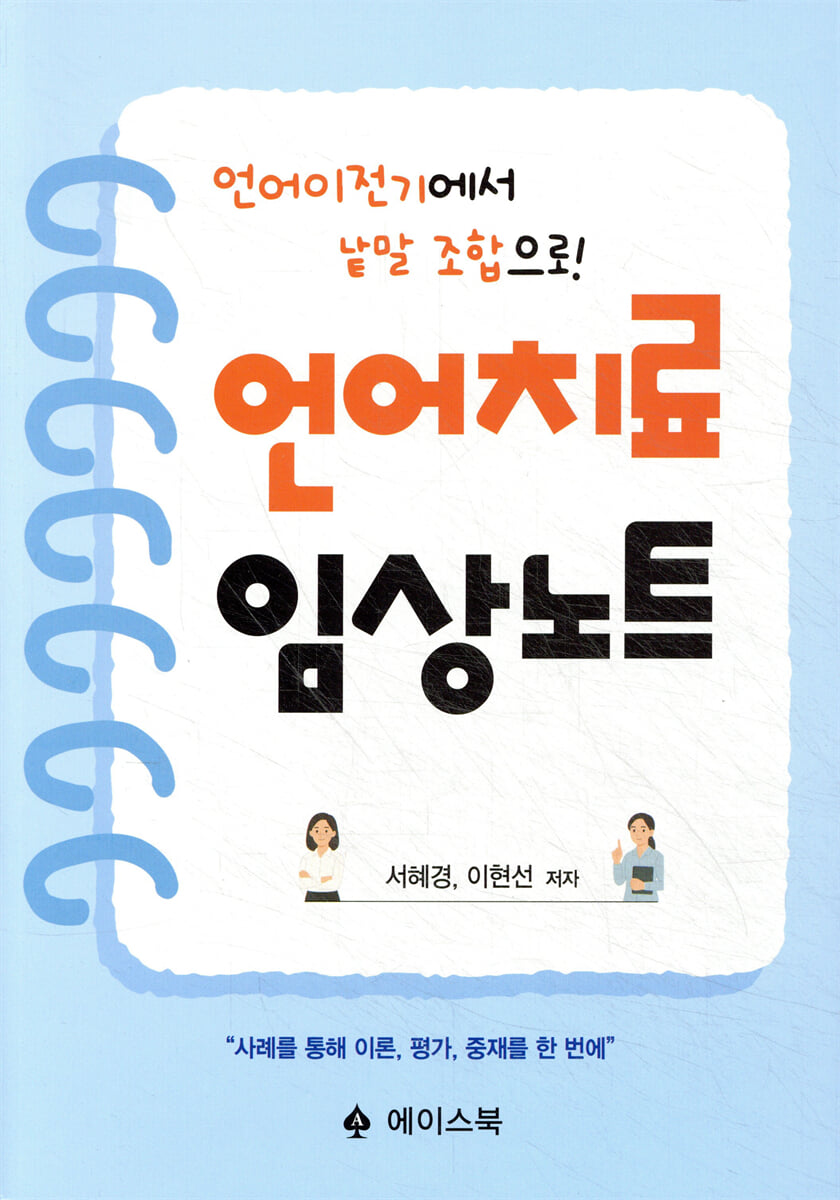
Speech Therapy Clinical Notes
 |
Description
Book Introduction
Infants usually produce their first words, such as 'mama' and 'dada', around 12 months of age and begin to imitate adult speech sounds.
Afterwards, the number of words that can be understood and expressed gradually increases. However, if the child is unable to produce words with clear linguistic meaning even after the time when he or she should be able to speak has passed, he or she will be referred to a speech therapy room.
Therefore, this book aims to first understand the developmental stages of each sub-area in language development, such as basic cognitive development, speech sound development, and early vocabulary development.
Afterwards, we provided evaluation forms and examples of what kind of evaluation to conduct for each area.
Additionally, in the area of intervention, various therapeutic activities, techniques, and cases actually used in treatment settings are presented sequentially so that they can be applied immediately.
Finally, we wanted to provide a space where we can think together and expand on the concepts through 'Think About' questions and example answers for each chapter.
Afterwards, the number of words that can be understood and expressed gradually increases. However, if the child is unable to produce words with clear linguistic meaning even after the time when he or she should be able to speak has passed, he or she will be referred to a speech therapy room.
Therefore, this book aims to first understand the developmental stages of each sub-area in language development, such as basic cognitive development, speech sound development, and early vocabulary development.
Afterwards, we provided evaluation forms and examples of what kind of evaluation to conduct for each area.
Additionally, in the area of intervention, various therapeutic activities, techniques, and cases actually used in treatment settings are presented sequentially so that they can be applied immediately.
Finally, we wanted to provide a space where we can think together and expand on the concepts through 'Think About' questions and example answers for each chapter.
- You can preview some of the book's contents.
Preview
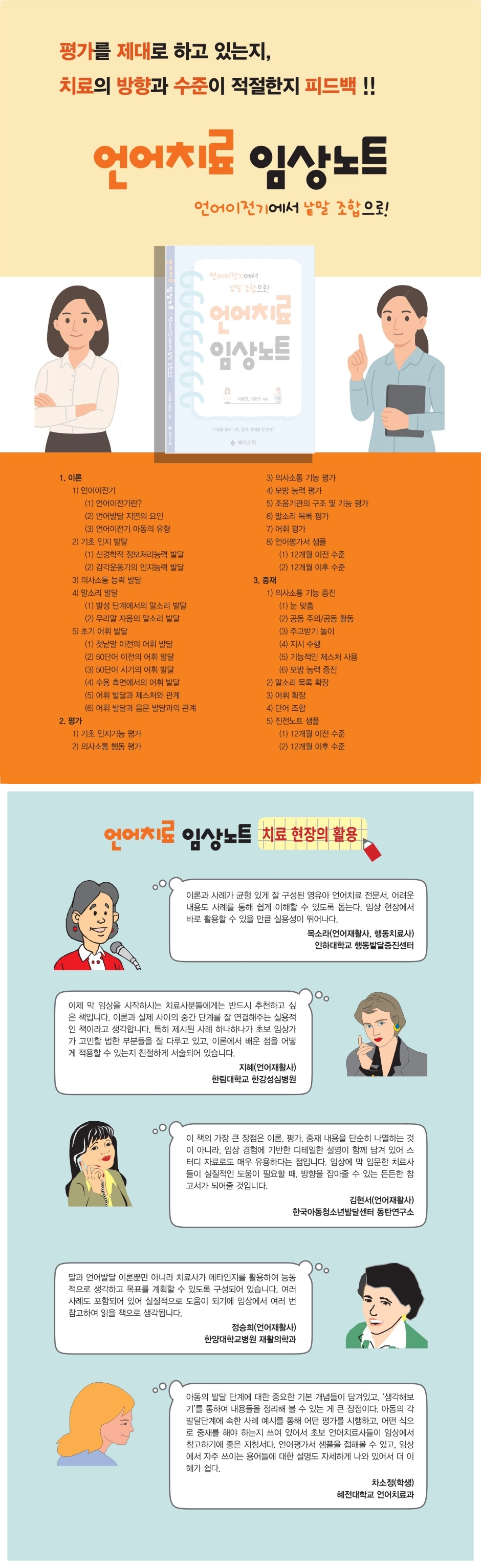
index
1.
Theory 1
2.
Rating 23
3.
Arbitration 75
[Example Answer for Thinking] 191
[Evaluation Form] 216
Theory 1
2.
Rating 23
3.
Arbitration 75
[Example Answer for Thinking] 191
[Evaluation Form] 216
Detailed image
Publisher's Review
preface
After learning about speech pathology in the classroom, I still remember the feeling of bewilderment I felt when I first encountered children in a speech therapy setting.
It was even more disconcerting because this happened despite years of hard study and practice, with every session of language assessment and treatment being done to the best of my ability.
Unlike in school, no one gives me feedback on whether I'm assessing correctly or whether the direction and level of treatment is appropriate.
What makes it even more frightening is that the children and their caregivers we meet want to trust us completely and follow us as language impairment specialists.
This book is a practical guide to speech therapy that will be helpful for clinical observation, clinical practice, and field work for students currently studying speech pathology and novice speech therapists with less than five years of clinical experience who are just beginning to gain experience in the field.
It would be impossible to include the extensive information on intervention for preverbal children in this one book.
However, based on the authors' field experience, we have focused on the core content that we believe must be known.
Depending on the environment you work in after graduation, the speech therapy patients you will meet will vary.
You might meet a school-age child with cerebral palsy at a welfare center, an elderly patient with dementia at a nursing home, or a toddler with language delay at a developmental center.
In the authors' experience, one of the most challenging speech therapy patient types for novice clinicians and trainees is the preverbal patient, also known as averbal.
Therefore, the authors focused on the target audience of pre-language learners in this book.
Infants usually produce their first words, such as 'mama' and 'dada', around 12 months of age and begin to imitate adult speech sounds.
Afterwards, the number of words that can be understood and expressed gradually increases. However, if the child is unable to produce words with clear linguistic meaning even after the time when he or she should be able to speak has passed, he or she will be referred to a speech therapy room.
Therefore, this book aims to first understand the developmental stages of each sub-area of language development, such as basic cognitive development, speech sound development, and early vocabulary development.
Afterwards, we provided evaluation forms and examples of what kind of evaluation to conduct for each area.
Additionally, in the area of intervention, various therapeutic activities, techniques, and cases actually used in treatment settings are presented sequentially so that they can be applied immediately.
Finally, we have provided a space for reflection and expansion through 'Think About' questions and example answers for each chapter.
Finally, I would like to express my gratitude to Director Youngsoo Koh of Acebook Publishing for his interest and passion in publishing this book, as well as to the editors who worked tirelessly on the editing.
I also express my gratitude and encouragement to the many speech therapists, students, parents, and other related professionals who, as you open this book, bring to mind the children you care about.
After learning about speech pathology in the classroom, I still remember the feeling of bewilderment I felt when I first encountered children in a speech therapy setting.
It was even more disconcerting because this happened despite years of hard study and practice, with every session of language assessment and treatment being done to the best of my ability.
Unlike in school, no one gives me feedback on whether I'm assessing correctly or whether the direction and level of treatment is appropriate.
What makes it even more frightening is that the children and their caregivers we meet want to trust us completely and follow us as language impairment specialists.
This book is a practical guide to speech therapy that will be helpful for clinical observation, clinical practice, and field work for students currently studying speech pathology and novice speech therapists with less than five years of clinical experience who are just beginning to gain experience in the field.
It would be impossible to include the extensive information on intervention for preverbal children in this one book.
However, based on the authors' field experience, we have focused on the core content that we believe must be known.
Depending on the environment you work in after graduation, the speech therapy patients you will meet will vary.
You might meet a school-age child with cerebral palsy at a welfare center, an elderly patient with dementia at a nursing home, or a toddler with language delay at a developmental center.
In the authors' experience, one of the most challenging speech therapy patient types for novice clinicians and trainees is the preverbal patient, also known as averbal.
Therefore, the authors focused on the target audience of pre-language learners in this book.
Infants usually produce their first words, such as 'mama' and 'dada', around 12 months of age and begin to imitate adult speech sounds.
Afterwards, the number of words that can be understood and expressed gradually increases. However, if the child is unable to produce words with clear linguistic meaning even after the time when he or she should be able to speak has passed, he or she will be referred to a speech therapy room.
Therefore, this book aims to first understand the developmental stages of each sub-area of language development, such as basic cognitive development, speech sound development, and early vocabulary development.
Afterwards, we provided evaluation forms and examples of what kind of evaluation to conduct for each area.
Additionally, in the area of intervention, various therapeutic activities, techniques, and cases actually used in treatment settings are presented sequentially so that they can be applied immediately.
Finally, we have provided a space for reflection and expansion through 'Think About' questions and example answers for each chapter.
Finally, I would like to express my gratitude to Director Youngsoo Koh of Acebook Publishing for his interest and passion in publishing this book, as well as to the editors who worked tirelessly on the editing.
I also express my gratitude and encouragement to the many speech therapists, students, parents, and other related professionals who, as you open this book, bring to mind the children you care about.
GOODS SPECIFICS
- Date of issue: May 5, 2025
- Page count, weight, size: 336 pages | 182*257*30mm
- ISBN13: 9791198843074
- ISBN10: 1198843071
You may also like
카테고리
korean


korean

![GQ KOREA Mark (Monthly): December [2025]](http://librairie.coreenne.fr/cdn/shop/files/8ef265dbbfbf186523ed75ba7319009d.jpg?v=1765340328&width=3840)


