

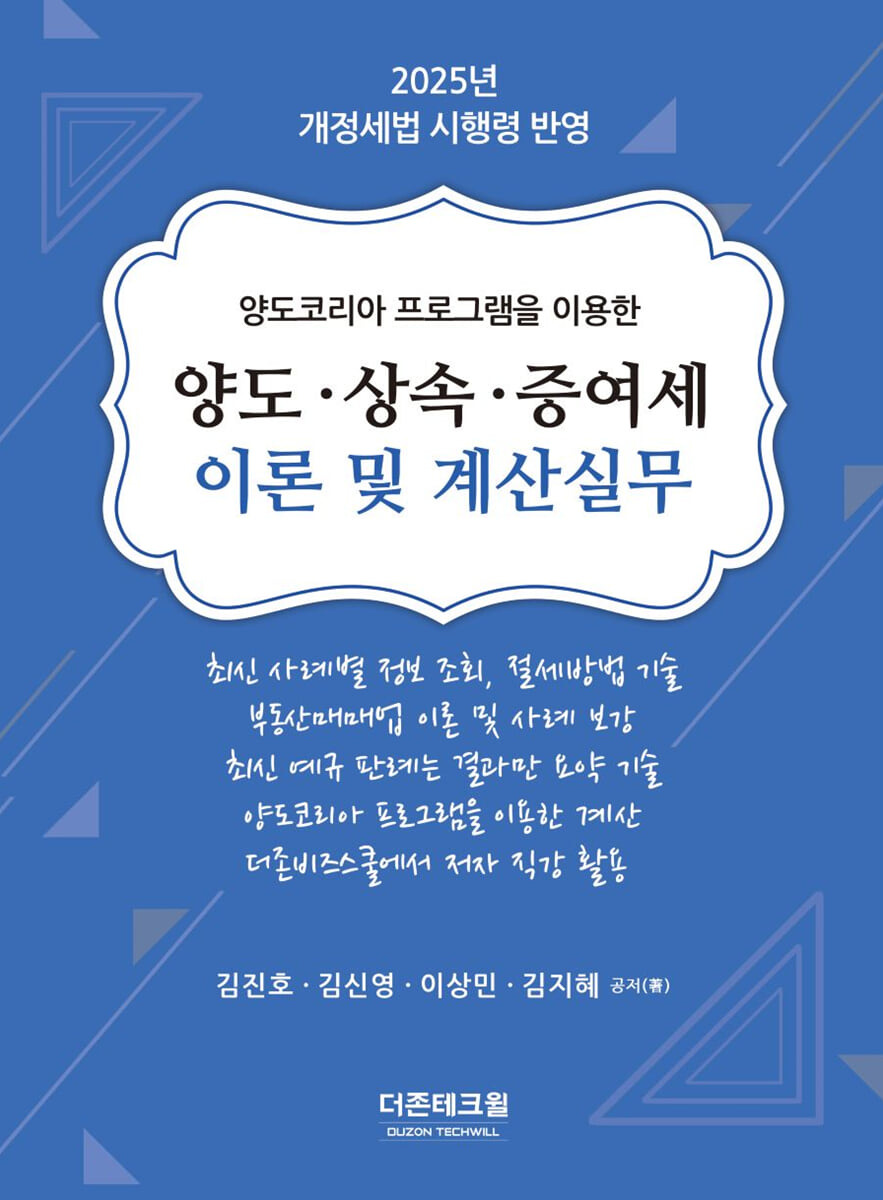
2025 Transfer, Inheritance, and Gift Tax Theory and Calculation Practice
 |
Description
Book Introduction
The purpose of "2025 Transfer, Inheritance, and Gift Tax Theory and Calculation Practice" is to help readers easily understand property-related taxes, establish a system in the shortest possible time, and familiarize themselves with the judgments that must be made before calculating taxes.
By understanding the theoretical content contained in the book and inputting the presented cases into the Yangdo Korea program and practicing them, students learned how to calculate taxes, understood which factors were at issue, and explained effective tax-saving methods.
By understanding the theoretical content contained in the book and inputting the presented cases into the Yangdo Korea program and practicing them, students learned how to calculate taxes, understood which factors were at issue, and explained effective tax-saving methods.
index
[Part 01 Overview of Capital Gains Tax]
Chapter 1 Transfer, Transfer Income, and Transfer Income Tax
Chapter 2 Transactions Considered as Transfers
Chapter 3 Timing of Transfer or Acquisition
Chapter 4 Taxpayer, Tax Payment Place, and Jurisdiction Tax Office
[Part 02 Overview of Capital Gains Tax Subjects]
Chapter 1 Overview of Taxable Subjects
Chapter 2 Real Estate (Land and Buildings)
Chapter 3 Rights Regarding Real Estate
Chapter 4 Other Assets
Chapter 5 Common Stocks (Listed and Unlisted) and Derivatives
[Part 03 Tax Exemption, Overtaxation, Reduction/Taxation Special Provisions]
Chapter 1 Tax Exemption for One House per Generation
Chapter 2. Imposition of Capital Gains Tax
Chapter 3 Reduction of Capital Gains Tax
Chapter 4 Other Tax Special Provisions for Capital Gains Tax
[Part 04 Reporting and Payment]
Chapter 1: Preliminary Reporting of Capital Gains Tax
Chapter 2 Final Report of Capital Gains Tax
Chapter 3 Amendment of Capital Gains Tax Return, etc.
[Part 05 Calculation of Standard Price]
Chapter 1 Calculation of the standard market price of land
Chapter 2 Calculating the Standard Price of a House
Chapter 3 Calculation of the standard market price of general buildings
Chapter 4 Calculation of the Standard Price of Apartments and Townhouses
Chapter 5 Calculation of the Standard Price of Commercial Buildings and Officetels
Chapter 6 Calculating the Stock Price
Chapter 7 Calculation of the standard market value of other assets
[Part 06: Example of Capital Gains Tax Calculation Using the Transfer Korea Program]
Chapter 1: Preparing to Calculate Capital Gains Tax
Chapter 2 Installation and Use of Yangdo Korea
Chapter 3: Land Calculation Cases
Chapter 4: Calculation Examples for Individual Houses
Chapter 5: Apartment Calculation Cases
Chapter 6: Calculation Cases for Officetels
Chapter 7 Calculation Examples for General Buildings
Chapter 8: Calculation Cases for Redevelopment and Reconstruction
Chapter 9: Stock Calculation Examples
Chapter 10: Calculation Examples for Specific Stocks
Chapter 11 Calculation Examples of Specific Facility Usage Rights
Chapter 12 Calculation Examples of Other Assets
[Part 07 Inheritance Tax]
Chapter 1: Inheritance Tax Calculation Method
Chapter 2: Contents of Inheritance-Related Laws
Chapter 3 Inheritance Tax Overview
Chapter 4 Inheritance Tax Amount
Chapter 5 Inheritance Deduction
Chapter 6 Calculated Tax Amount, Tax Deduction, Surcharge for Reporting and Payment, etc.
Chapter 7: Calculating Inheritance Tax Using Transfer Korea
[Part 08 Gift Tax]
Chapter 1: Gift Tax Calculation Method
Chapter 2 Gift Tax Overview
Chapter 3 Valuation of Inherited and Donated Property
Chapter 4 Calculation of Gift Tax Amount
Chapter 5 Calculation of Gift Tax Base and Tax Amount
Chapter 6 Gift Tax Reporting and Payment Surcharges, etc.
Chapter 7 Gift Tax Calculation Examples
[Part 09 Real Estate Sales]
Chapter 1: Overview of the Real Estate Sales Business
Chapter 2 Real Estate Transaction Reporting and Payment
Chapter 1 Transfer, Transfer Income, and Transfer Income Tax
Chapter 2 Transactions Considered as Transfers
Chapter 3 Timing of Transfer or Acquisition
Chapter 4 Taxpayer, Tax Payment Place, and Jurisdiction Tax Office
[Part 02 Overview of Capital Gains Tax Subjects]
Chapter 1 Overview of Taxable Subjects
Chapter 2 Real Estate (Land and Buildings)
Chapter 3 Rights Regarding Real Estate
Chapter 4 Other Assets
Chapter 5 Common Stocks (Listed and Unlisted) and Derivatives
[Part 03 Tax Exemption, Overtaxation, Reduction/Taxation Special Provisions]
Chapter 1 Tax Exemption for One House per Generation
Chapter 2. Imposition of Capital Gains Tax
Chapter 3 Reduction of Capital Gains Tax
Chapter 4 Other Tax Special Provisions for Capital Gains Tax
[Part 04 Reporting and Payment]
Chapter 1: Preliminary Reporting of Capital Gains Tax
Chapter 2 Final Report of Capital Gains Tax
Chapter 3 Amendment of Capital Gains Tax Return, etc.
[Part 05 Calculation of Standard Price]
Chapter 1 Calculation of the standard market price of land
Chapter 2 Calculating the Standard Price of a House
Chapter 3 Calculation of the standard market price of general buildings
Chapter 4 Calculation of the Standard Price of Apartments and Townhouses
Chapter 5 Calculation of the Standard Price of Commercial Buildings and Officetels
Chapter 6 Calculating the Stock Price
Chapter 7 Calculation of the standard market value of other assets
[Part 06: Example of Capital Gains Tax Calculation Using the Transfer Korea Program]
Chapter 1: Preparing to Calculate Capital Gains Tax
Chapter 2 Installation and Use of Yangdo Korea
Chapter 3: Land Calculation Cases
Chapter 4: Calculation Examples for Individual Houses
Chapter 5: Apartment Calculation Cases
Chapter 6: Calculation Cases for Officetels
Chapter 7 Calculation Examples for General Buildings
Chapter 8: Calculation Cases for Redevelopment and Reconstruction
Chapter 9: Stock Calculation Examples
Chapter 10: Calculation Examples for Specific Stocks
Chapter 11 Calculation Examples of Specific Facility Usage Rights
Chapter 12 Calculation Examples of Other Assets
[Part 07 Inheritance Tax]
Chapter 1: Inheritance Tax Calculation Method
Chapter 2: Contents of Inheritance-Related Laws
Chapter 3 Inheritance Tax Overview
Chapter 4 Inheritance Tax Amount
Chapter 5 Inheritance Deduction
Chapter 6 Calculated Tax Amount, Tax Deduction, Surcharge for Reporting and Payment, etc.
Chapter 7: Calculating Inheritance Tax Using Transfer Korea
[Part 08 Gift Tax]
Chapter 1: Gift Tax Calculation Method
Chapter 2 Gift Tax Overview
Chapter 3 Valuation of Inherited and Donated Property
Chapter 4 Calculation of Gift Tax Amount
Chapter 5 Calculation of Gift Tax Base and Tax Amount
Chapter 6 Gift Tax Reporting and Payment Surcharges, etc.
Chapter 7 Gift Tax Calculation Examples
[Part 09 Real Estate Sales]
Chapter 1: Overview of the Real Estate Sales Business
Chapter 2 Real Estate Transaction Reporting and Payment
Publisher's Review
The main amendments related to the capital gains tax in 2025 are:
First, the application period for the special provision for one house per generation for marriage has been extended from 5 years to 10 years.
Second, stocks received as a gift within one year prior to the transfer date were added to the scope of capital gains tax carryforward taxation.
Third, an exception to the apportionment calculation was created when acquiring or transferring land and buildings in bulk.
Fourth, when changing the purpose of use to housing, the calculation method for the special deduction for long-term use has been changed to calculate the deduction rate by adding up the holding and occupancy periods for each purpose period.
Fifth, in cases where the purpose of a house is changed from residential to commercial or other non-residential, according to a sales contract, the tax base has been rationalized to the date of the sales contract.
Sixth, the limit on the number of times a housing rental business operator can apply for exemption from capital gains tax on the transfer of residential housing has been abolished.
Seventh, the provision for temporary exclusion from the capital gains tax on multiple homeowners has been extended for one more year until May 9, 2026, and the 6-year short-term private rental housing system (applicable to properties registered after June 4, 2025) has been revived.
Eighth, the capital gains tax reduction rate for land for public projects, etc. (Article 77 of the Special Taxation Act) was raised by 5%, and the reduction limit for one tax period in the provisions related to expropriation (Articles 77, 77-2, and 77-3 of the Special Taxation Act) was raised from 100 million to 200 million, and the reduction limit for five tax periods was raised from 200 million to 300 million.
The main revisions related to inheritance tax and gift tax in 2025 include including pre-sale rights in assets that can be appraised by a single appraisal agency to ease the burden of appraisal, adjusting the scope of relatives eligible for gift tax deduction to match the scope of relatives under the National Tax Basic Act to blood relatives within the fourth degree of kinship and relatives within the third degree of kinship, adjusting the scope of business-unrelated assets for corporate business inheritance deduction and business inheritance gift tax special cases, and adding the requirement that the donor be the CEO in office to the requirements for business succession gift tax special cases.
The purpose of this book is to make property taxes easy to understand, to help you establish a system in the shortest possible time, and to familiarize yourself with the judgments that must be made before calculating taxes.
By understanding the theoretical content contained in the book and inputting the presented cases into the Yangdo Korea program and practicing them, students learned how to calculate taxes, understood which factors were at issue, and explained effective tax-saving methods.
In addition, we have interpreted the results of tax calculations after calculating capital gains tax, inheritance tax, gift tax, and real estate sales tax, and explained where errors may occur as much as possible.
The detailed features of this book are as follows:
First, the contents of the theory and precedents were systematized and diagrammed as much as possible.
The theories have been described as closely as possible to the tax laws to avoid misjudgments due to the author's explanations. The book's contents have been presented in diagrams whenever possible and, where necessary, with illustrations to help readers quickly understand the practical content and grasp the main points.
Second, we summarized the revision history and organized cases according to the revised tax law.
To reduce reader confusion, we have attempted to avoid mentioning past tax laws whenever possible, except where they affect the application of current tax laws.
The cases presented situations that are difficult to resolve as easily as possible, and the tax calculation process was organized in an easy-to-understand manner using the YangdoKorea program.
Third, the regulations and precedents only summarize the results of the judgment.
This book summarizes only the core of relevant case law by topic, and the specific details can be found online.
Additionally, to ensure that all readers can easily check, we have tried to include only the regulations and case laws that can be found in the National Tax Service Information System.
However, regulations and precedents that cannot be found in the National Tax Service Information System can be found at eTax Korea.
Fourth, calculation examples and tax saving methods by type were explained in accordance with the latest revised tax laws.
The calculation cases and tax-saving methods covered in this book are explained in accordance with the latest revised tax laws, so that readers can immediately use them as a reference for calculating taxes in practice.
There's always a sense of regret after finishing a book.
I did my best to avoid such regrets this year, but looking at the finished manuscript, I am left with regrets once again.
Still, I sincerely hope that this book will be of some help to readers in calculating capital gains tax, inheritance tax, gift tax, and real estate transaction tax.
And I would like to once again express my gratitude to the staff at Thezone Techwill who worked hard to publish this book.
April 2025.
All co-authors
First, the application period for the special provision for one house per generation for marriage has been extended from 5 years to 10 years.
Second, stocks received as a gift within one year prior to the transfer date were added to the scope of capital gains tax carryforward taxation.
Third, an exception to the apportionment calculation was created when acquiring or transferring land and buildings in bulk.
Fourth, when changing the purpose of use to housing, the calculation method for the special deduction for long-term use has been changed to calculate the deduction rate by adding up the holding and occupancy periods for each purpose period.
Fifth, in cases where the purpose of a house is changed from residential to commercial or other non-residential, according to a sales contract, the tax base has been rationalized to the date of the sales contract.
Sixth, the limit on the number of times a housing rental business operator can apply for exemption from capital gains tax on the transfer of residential housing has been abolished.
Seventh, the provision for temporary exclusion from the capital gains tax on multiple homeowners has been extended for one more year until May 9, 2026, and the 6-year short-term private rental housing system (applicable to properties registered after June 4, 2025) has been revived.
Eighth, the capital gains tax reduction rate for land for public projects, etc. (Article 77 of the Special Taxation Act) was raised by 5%, and the reduction limit for one tax period in the provisions related to expropriation (Articles 77, 77-2, and 77-3 of the Special Taxation Act) was raised from 100 million to 200 million, and the reduction limit for five tax periods was raised from 200 million to 300 million.
The main revisions related to inheritance tax and gift tax in 2025 include including pre-sale rights in assets that can be appraised by a single appraisal agency to ease the burden of appraisal, adjusting the scope of relatives eligible for gift tax deduction to match the scope of relatives under the National Tax Basic Act to blood relatives within the fourth degree of kinship and relatives within the third degree of kinship, adjusting the scope of business-unrelated assets for corporate business inheritance deduction and business inheritance gift tax special cases, and adding the requirement that the donor be the CEO in office to the requirements for business succession gift tax special cases.
The purpose of this book is to make property taxes easy to understand, to help you establish a system in the shortest possible time, and to familiarize yourself with the judgments that must be made before calculating taxes.
By understanding the theoretical content contained in the book and inputting the presented cases into the Yangdo Korea program and practicing them, students learned how to calculate taxes, understood which factors were at issue, and explained effective tax-saving methods.
In addition, we have interpreted the results of tax calculations after calculating capital gains tax, inheritance tax, gift tax, and real estate sales tax, and explained where errors may occur as much as possible.
The detailed features of this book are as follows:
First, the contents of the theory and precedents were systematized and diagrammed as much as possible.
The theories have been described as closely as possible to the tax laws to avoid misjudgments due to the author's explanations. The book's contents have been presented in diagrams whenever possible and, where necessary, with illustrations to help readers quickly understand the practical content and grasp the main points.
Second, we summarized the revision history and organized cases according to the revised tax law.
To reduce reader confusion, we have attempted to avoid mentioning past tax laws whenever possible, except where they affect the application of current tax laws.
The cases presented situations that are difficult to resolve as easily as possible, and the tax calculation process was organized in an easy-to-understand manner using the YangdoKorea program.
Third, the regulations and precedents only summarize the results of the judgment.
This book summarizes only the core of relevant case law by topic, and the specific details can be found online.
Additionally, to ensure that all readers can easily check, we have tried to include only the regulations and case laws that can be found in the National Tax Service Information System.
However, regulations and precedents that cannot be found in the National Tax Service Information System can be found at eTax Korea.
Fourth, calculation examples and tax saving methods by type were explained in accordance with the latest revised tax laws.
The calculation cases and tax-saving methods covered in this book are explained in accordance with the latest revised tax laws, so that readers can immediately use them as a reference for calculating taxes in practice.
There's always a sense of regret after finishing a book.
I did my best to avoid such regrets this year, but looking at the finished manuscript, I am left with regrets once again.
Still, I sincerely hope that this book will be of some help to readers in calculating capital gains tax, inheritance tax, gift tax, and real estate transaction tax.
And I would like to once again express my gratitude to the staff at Thezone Techwill who worked hard to publish this book.
April 2025.
All co-authors
GOODS SPECIFICS
- Date of issue: April 23, 2025
- Page count, weight, size: 1,072 pages | 182*257*60mm
- ISBN13: 9791163061243
- ISBN10: 1163061247
You may also like
카테고리
korean


korean

![GQ KOREA Mark (Monthly): December [2025]](http://librairie.coreenne.fr/cdn/shop/files/8ef265dbbfbf186523ed75ba7319009d.jpg?v=1765340328&width=3840)


