

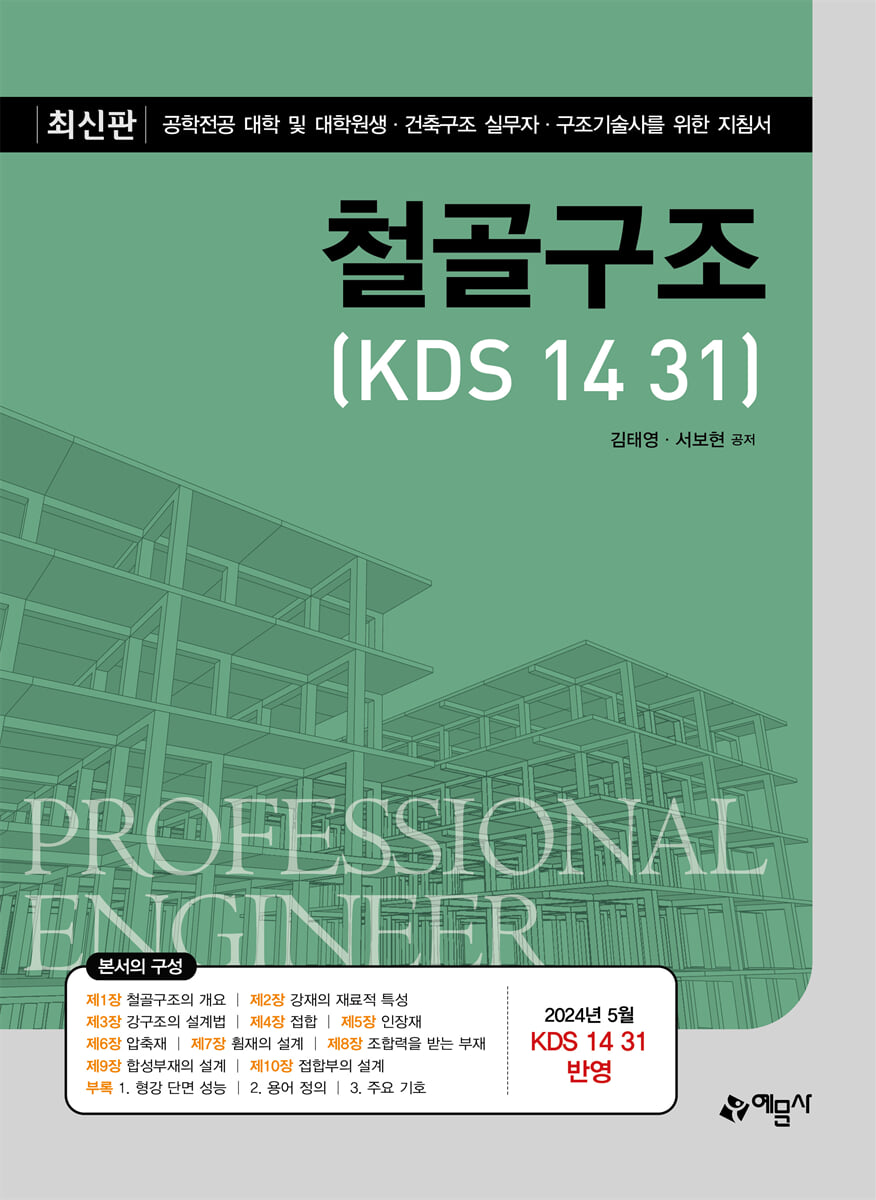
KDS 14 31 steel structure
 |
Description
Book Introduction
This book contains a variety of examples and background theoretical content to help undergraduate and graduate students majoring in architectural engineering and practitioners easily understand the newly announced steel structure design standards.
In June 2016, KDS 14 31 was announced in accordance with the transition to the construction standard code system, and has been revised twice since then.
The main revisions are as follows:
In accordance with the transition to the construction standard code system, the code was integrated and reorganized, and the main mechanical properties such as strength and elongation were adjusted and detailed regulations were revised in accordance with the revision of the steel material KS.
Afterwards, it was revised in accordance with the research on the improvement of construction standards in the field of steel structures to improve structural safety.
In June 2016, KDS 14 31 was announced in accordance with the transition to the construction standard code system, and has been revised twice since then.
The main revisions are as follows:
In accordance with the transition to the construction standard code system, the code was integrated and reorganized, and the main mechanical properties such as strength and elongation were adjusted and detailed regulations were revised in accordance with the revision of the steel material KS.
Afterwards, it was revised in accordance with the research on the improvement of construction standards in the field of steel structures to improve structural safety.
- You can preview some of the book's contents.
Preview
index
Chapter 1 Overview of Steel Structures
1.1 Overview
Chapter 2 Material Properties of Steel
2.1 Steel production method
2.2 Mechanical properties of steel
2.3 Heat treatment and weldability of steel
2.4 Types and characteristics of structural steel
Chapter 3 Design Methods for Steel Structures
3.1 Allowable Stress Design (ASD)
3.2 Limit State Design (LRFD)
3.3 Structural planning and structural design
Chapter 4 Bonding
4.1 Overview
4.2 High-strength bolt joints
4.3 Welding
4.4 Eccentric joint
· Practice problems
Chapter 5 Tensile Material
5.1 Overview of Tensile Material Design
5.2 Cross-sectional area of tensile member
5.3 Design tensile strength by load resistance factor design method
5.4 Assembled tension member
5.5 Pin joint member
5.6 Eyebar
· Practice problems
Chapter 6 Compression Materials
6.1 Overview
6.2 Basic theory of compression materials
6.3 Design compressive strength
· Practice problems
Chapter 7 Design of Bending Members
7.1 General
7.2 Design bending strength
7.3 Shear strength
7.4 Concentrated load point reinforcement
· Practice problems
Chapter 8: Members subject to combinational force
8.1 Single- and two-axis symmetrical cross-section members subjected to bending and compression
· Practice problems
Chapter 9 Design of Composite Members
9.1 General
9.2 Members subjected to axial forces
9.3 Members subjected to bending
9.4 Component receiving the shear
9.5 steel anchor
· Practice problems
Chapter 10 Joint Design
10.1 Design strength of joint members
10.2 Visible
10.3 Column joints
10.4 Column-beam connection
10.5 Panel Zone
10.6 Base Plate Design
· Practice problems
Appendix
1.
Sectional performance of steel beams
2.
Definition of terms
3.
Key symbols
1.1 Overview
Chapter 2 Material Properties of Steel
2.1 Steel production method
2.2 Mechanical properties of steel
2.3 Heat treatment and weldability of steel
2.4 Types and characteristics of structural steel
Chapter 3 Design Methods for Steel Structures
3.1 Allowable Stress Design (ASD)
3.2 Limit State Design (LRFD)
3.3 Structural planning and structural design
Chapter 4 Bonding
4.1 Overview
4.2 High-strength bolt joints
4.3 Welding
4.4 Eccentric joint
· Practice problems
Chapter 5 Tensile Material
5.1 Overview of Tensile Material Design
5.2 Cross-sectional area of tensile member
5.3 Design tensile strength by load resistance factor design method
5.4 Assembled tension member
5.5 Pin joint member
5.6 Eyebar
· Practice problems
Chapter 6 Compression Materials
6.1 Overview
6.2 Basic theory of compression materials
6.3 Design compressive strength
· Practice problems
Chapter 7 Design of Bending Members
7.1 General
7.2 Design bending strength
7.3 Shear strength
7.4 Concentrated load point reinforcement
· Practice problems
Chapter 8: Members subject to combinational force
8.1 Single- and two-axis symmetrical cross-section members subjected to bending and compression
· Practice problems
Chapter 9 Design of Composite Members
9.1 General
9.2 Members subjected to axial forces
9.3 Members subjected to bending
9.4 Component receiving the shear
9.5 steel anchor
· Practice problems
Chapter 10 Joint Design
10.1 Design strength of joint members
10.2 Visible
10.3 Column joints
10.4 Column-beam connection
10.5 Panel Zone
10.6 Base Plate Design
· Practice problems
Appendix
1.
Sectional performance of steel beams
2.
Definition of terms
3.
Key symbols
GOODS SPECIFICS
- Date of issue: April 10, 2025
- Page count, weight, size: 416 pages | 190*260*20mm
- ISBN13: 9788927458074
You may also like
카테고리
korean


korean

![ELLE 엘르 스페셜 에디션 A형 : 12월 [2025]](http://librairie.coreenne.fr/cdn/shop/files/b8e27a3de6c9538896439686c6b0e8fb.jpg?v=1766436872&width=3840)


