

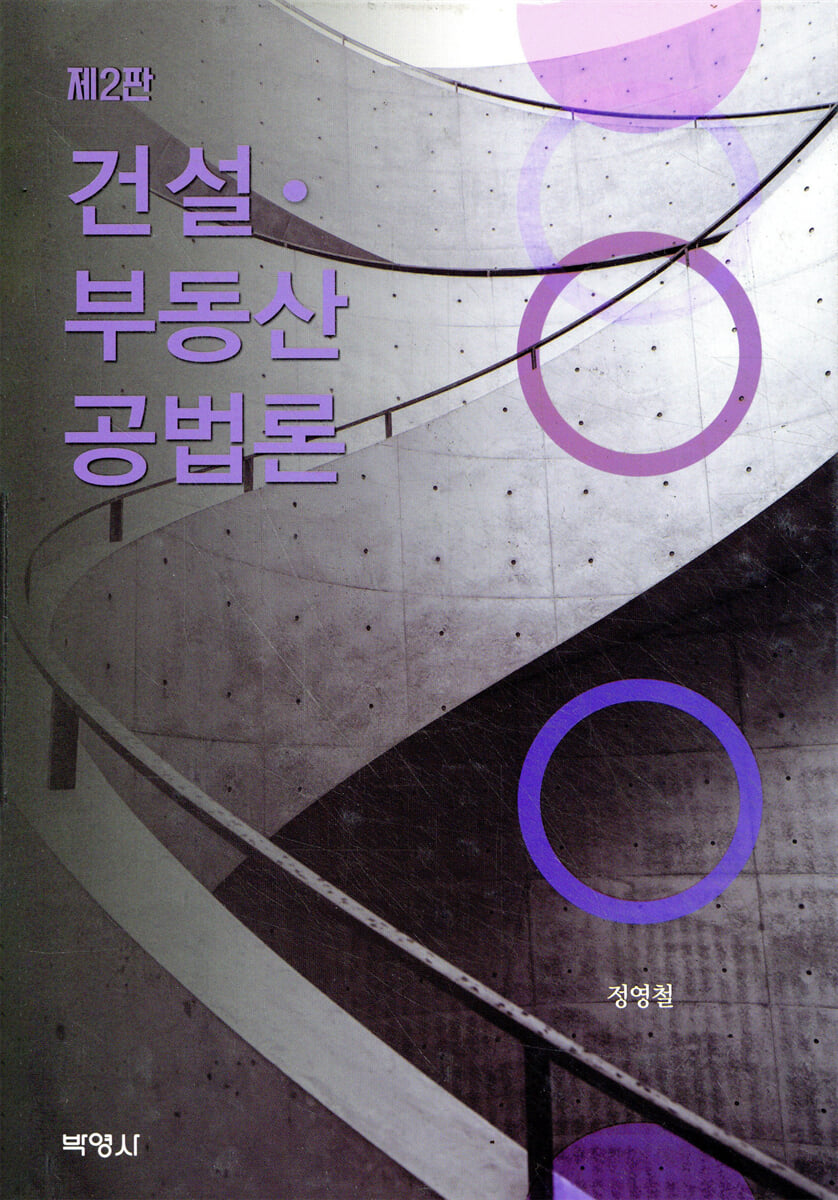
Construction and Real Estate Law
 |
Description
Book Introduction
Newly added or revised items include types of buildings under the Building Act, rights to sunlight and views, building agreements, combined buildings, spatial restructuring plans under the National Land Planning Act, growth management plans, urban innovation zones and mixed-use zones, three-dimensional complex zones for urban and county planning facilities, land expropriation and compensation for losses, public contributions, methods for calculating the number of landowners who consent under the Urban Development Act, construction supervision, standards for land replotting plans, cost burdens for urban development projects, compensation for losses and free attribution of public facilities, resident representative meetings and general meetings of landowners, etc. under the Urban Redevelopment Act, integrated review of project implementation plans, installation of trunk facilities, prior visits, and industrialized housing under the Housing Act.
index
Chapter 1: Understanding Construction and Real Estate Law
Chapter 2 Building Code
Chapter 3 Act on National Land Planning and Utilization
Chapter 4 Urban Development Act
Chapter 5 Urban and Residential Environment Improvement Act
Chapter 6 Housing Law
Chapter 2 Building Code
Chapter 3 Act on National Land Planning and Utilization
Chapter 4 Urban Development Act
Chapter 5 Urban and Residential Environment Improvement Act
Chapter 6 Housing Law
Publisher's Review
Two years have passed since the first edition was published.
Although it has not been a long time, the law has been revised in so many areas.
The second edition is published in accordance with the revision of the law.
The fields of architecture, construction, and real estate are highly specialized and technical, and the scope and intensity of regulations are also strong, so revision of laws and regulations that are consistent with reality are inevitable.
This is the reason why the second edition has a relatively larger volume than the first edition.
Although it was written based on the laws currently in effect, the inclusion of laws scheduled to be implemented in advance in this edition is intended to proactively prepare for frequent revisions to laws.
So, the Building Act is Law No. 20424, which came into effect on June 27, 2024, the Enforcement Decree and Enforcement Rules of the Building Act are Presidential Decree No. 34580 and Ministry of Land, Infrastructure and Transport Decree No. 1416, which came into effect on December 19, 2024, the National Land Planning Act is Law No. 20234, which came into effect on August 7, 2024, the Enforcement Decree and Enforcement Rules of the National Land Planning Act are Presidential Decree No. 35152 and Ministry of Land, Infrastructure and Transport Decree No. 1338, which came into effect on January 3, 2025 and November 30, 2024, the Urban Development Act is Law No. 19561, which came into effect on October 19, 2023, the Enforcement Decree and Enforcement Rules of the Urban Development Act are Presidential Decree No. 34881, which came into effect on September 15, 2024 and January 21, 2022, and The content is described based on Ordinance No. 1099 of the Ministry of Land, Infrastructure and Transport, the Urban Development Act, Act No. 20549, which is scheduled to take effect on December 4, 2025, the Enforcement Decree and Enforcement Rules of the Urban Development Act, Presidential Decree No. 35083 and Ordinance No. 1348 of the Ministry of Land, Infrastructure and Transport, which are scheduled to take effect on March 18, 2025 and June 27, 2024, the Housing Act, Act No. 20048, which is scheduled to take effect on July 17, 2024, the Enforcement Decree and Enforcement Rules of the Housing Act, Presidential Decree No. 35221 and Ordinance No. 1373, which are scheduled to take effect on January 21, 2025 and February 3, 2025.
Although some laws are not yet in effect at the time of publication, considering the time lag until the publication of the revised edition, it will still conform to the legal reality as much as possible.
In addition to the revision of the law, recent case law is also a driving force for the revision.
It reflects the Supreme Court precedents announced on January 1, 2025 and the Constitutional Court decisions made by the end of 2024.
A significant number of typos and sentences that were close to being ungrammatical were also significantly revised.
Since specialized books have the nature of specialized academic books, they are mainly composed of abstract and general sentences. However, it was necessary to break away from this to increase readability for readers.
However, there are still many areas where it is lacking, and I ask for your understanding.
In addition, the second edition has supplemented as much of the content that was not included or was insufficient in the first edition as possible.
Newly added or revised sections include types of buildings under the Building Act, rights to sunlight and views, building agreements, combined buildings, spatial restructuring plans under the National Land Planning Act, growth management plans, urban innovation zones, mixed-use zones, cities, county planning facility three-dimensional complex zones, land expropriation and compensation for losses, public contributions, methods for calculating the number of landowners who consent under the Urban Development Act, construction supervision, standards for land replotting plans, cost burdens for urban development projects, compensation for losses and free attribution of public facilities, resident representative meetings under the Urban Redevelopment Act, general meetings of landowners, etc., integrated review of project implementation plans, installation of trunk facilities under the Housing Act, prior visits, and industrialized housing.
The systemic disharmony of the five laws described in this book is still ongoing.
From a macro perspective, I believe that a level of reorganization is needed.
It is still questionable how well our legal system, based on modernism, will respond to the postmodern era.
We need professional, forward-looking, sustainable insights and foresight.
Park Young-sa's agent, Choi Dong-in, took on the role of the villain in urging manuscripts, and took on the dirty work from planning to sales.
Manager Han Du-hee edited and proofread with the spirit of “honing one’s skills through careful consideration.”
The disciples of Huigangsanghoe also conveyed critical views from a practical perspective.
They are all people I am thankful and grateful for.
My parents in heaven, my wife, and my daughter are the strong pillars of this book.
February 2025
At Sangrojae
Author 拜
Although it has not been a long time, the law has been revised in so many areas.
The second edition is published in accordance with the revision of the law.
The fields of architecture, construction, and real estate are highly specialized and technical, and the scope and intensity of regulations are also strong, so revision of laws and regulations that are consistent with reality are inevitable.
This is the reason why the second edition has a relatively larger volume than the first edition.
Although it was written based on the laws currently in effect, the inclusion of laws scheduled to be implemented in advance in this edition is intended to proactively prepare for frequent revisions to laws.
So, the Building Act is Law No. 20424, which came into effect on June 27, 2024, the Enforcement Decree and Enforcement Rules of the Building Act are Presidential Decree No. 34580 and Ministry of Land, Infrastructure and Transport Decree No. 1416, which came into effect on December 19, 2024, the National Land Planning Act is Law No. 20234, which came into effect on August 7, 2024, the Enforcement Decree and Enforcement Rules of the National Land Planning Act are Presidential Decree No. 35152 and Ministry of Land, Infrastructure and Transport Decree No. 1338, which came into effect on January 3, 2025 and November 30, 2024, the Urban Development Act is Law No. 19561, which came into effect on October 19, 2023, the Enforcement Decree and Enforcement Rules of the Urban Development Act are Presidential Decree No. 34881, which came into effect on September 15, 2024 and January 21, 2022, and The content is described based on Ordinance No. 1099 of the Ministry of Land, Infrastructure and Transport, the Urban Development Act, Act No. 20549, which is scheduled to take effect on December 4, 2025, the Enforcement Decree and Enforcement Rules of the Urban Development Act, Presidential Decree No. 35083 and Ordinance No. 1348 of the Ministry of Land, Infrastructure and Transport, which are scheduled to take effect on March 18, 2025 and June 27, 2024, the Housing Act, Act No. 20048, which is scheduled to take effect on July 17, 2024, the Enforcement Decree and Enforcement Rules of the Housing Act, Presidential Decree No. 35221 and Ordinance No. 1373, which are scheduled to take effect on January 21, 2025 and February 3, 2025.
Although some laws are not yet in effect at the time of publication, considering the time lag until the publication of the revised edition, it will still conform to the legal reality as much as possible.
In addition to the revision of the law, recent case law is also a driving force for the revision.
It reflects the Supreme Court precedents announced on January 1, 2025 and the Constitutional Court decisions made by the end of 2024.
A significant number of typos and sentences that were close to being ungrammatical were also significantly revised.
Since specialized books have the nature of specialized academic books, they are mainly composed of abstract and general sentences. However, it was necessary to break away from this to increase readability for readers.
However, there are still many areas where it is lacking, and I ask for your understanding.
In addition, the second edition has supplemented as much of the content that was not included or was insufficient in the first edition as possible.
Newly added or revised sections include types of buildings under the Building Act, rights to sunlight and views, building agreements, combined buildings, spatial restructuring plans under the National Land Planning Act, growth management plans, urban innovation zones, mixed-use zones, cities, county planning facility three-dimensional complex zones, land expropriation and compensation for losses, public contributions, methods for calculating the number of landowners who consent under the Urban Development Act, construction supervision, standards for land replotting plans, cost burdens for urban development projects, compensation for losses and free attribution of public facilities, resident representative meetings under the Urban Redevelopment Act, general meetings of landowners, etc., integrated review of project implementation plans, installation of trunk facilities under the Housing Act, prior visits, and industrialized housing.
The systemic disharmony of the five laws described in this book is still ongoing.
From a macro perspective, I believe that a level of reorganization is needed.
It is still questionable how well our legal system, based on modernism, will respond to the postmodern era.
We need professional, forward-looking, sustainable insights and foresight.
Park Young-sa's agent, Choi Dong-in, took on the role of the villain in urging manuscripts, and took on the dirty work from planning to sales.
Manager Han Du-hee edited and proofread with the spirit of “honing one’s skills through careful consideration.”
The disciples of Huigangsanghoe also conveyed critical views from a practical perspective.
They are all people I am thankful and grateful for.
My parents in heaven, my wife, and my daughter are the strong pillars of this book.
February 2025
At Sangrojae
Author 拜
GOODS SPECIFICS
- Date of issue: February 28, 2025
- Format: Hardcover book binding method guide
- Page count, weight, size: 820 pages | 176*248*40mm
- ISBN13: 9791130349190
- ISBN10: 1130349195
You may also like
카테고리
korean


korean

![GQ KOREA Mark (Monthly): December [2025]](http://librairie.coreenne.fr/cdn/shop/files/8ef265dbbfbf186523ed75ba7319009d.jpg?v=1765340328&width=3840)


