

EU Artificial Intelligence Law Regulations
 |
Description
Book Introduction
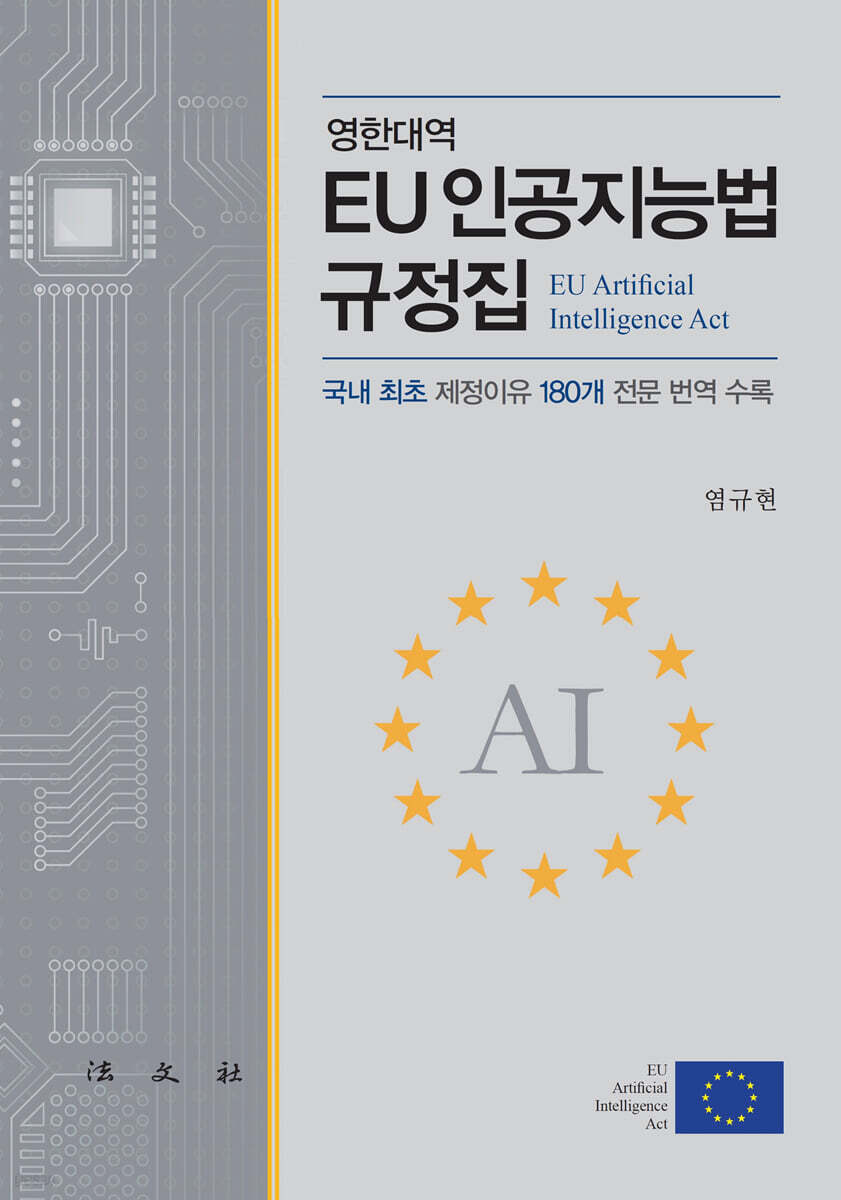
This translation is the first in Korea to fully translate the entire text and annexes of the EU Artificial Intelligence Act, as well as all 180 articles of the Recital.
Through this work, the translator aims to go beyond simple translation of legal texts and provide a foundation for establishing new norms for the AI era.
To this end, I maintained three principles during the writing process.
First, we wanted to understand exactly how technical terms like "general purpose AI" and "high-risk AI" are implemented in real-world settings and reflect this in our translation.
Second, we sought to select legal terms that conform to our country's legal system as much as possible, while maintaining a balance so as not to undermine the industrial characteristics and context of the AI field.
Third, I tried to translate the extensive legal text into sentences that were as clear and understandable as possible.
A more detailed explanation of the principles of translation and the background knowledge essential to reading this law, such as the European Union system, is provided in a separate 'Notes' section.
Through this work, the translator aims to go beyond simple translation of legal texts and provide a foundation for establishing new norms for the AI era.
To this end, I maintained three principles during the writing process.
First, we wanted to understand exactly how technical terms like "general purpose AI" and "high-risk AI" are implemented in real-world settings and reflect this in our translation.
Second, we sought to select legal terms that conform to our country's legal system as much as possible, while maintaining a balance so as not to undermine the industrial characteristics and context of the AI field.
Third, I tried to translate the extensive legal text into sentences that were as clear and understandable as possible.
A more detailed explanation of the principles of translation and the background knowledge essential to reading this law, such as the European Union system, is provided in a separate 'Notes' section.
- You can preview some of the book's contents.
Preview
index
European Union Artificial Intelligence Act
Chapter 1 General Provisions
Chapter 2 Prohibited Artificial Intelligence Practices
Chapter 3 High-Risk AI Systems
Chapter 4 Transparency Obligations for Providers and Deployers of Specific AI Systems and General-Purpose AI Models
Chapter 5: General-Purpose AI Models
Chapter 6 Measures to Support Innovation
Chapter 7 Governance
Chapter 8: EU Database on High-Risk AI Systems
Chapter 9: Post-Market Monitoring, Information Sharing, and Market Surveillance
Chapter 10 Code of Practice and Guidelines
Chapter 11 Delegation of Authority and Committee Procedures
Chapter 12 Confidentiality and Punishment
Chapter 13 Final Rules
Annex
Annex I List of Harmonized European Union Legislation
List of crimes referred to in subparagraph (h) (iii) of the first subparagraph of Article 5, paragraph 1 of Annex II
High-risk AI systems referred to in Article 6, Paragraph 2 of Annex III
Technical documents referred to in Article 11, Paragraph 1 of Annex IV
Annex V EU Declaration of Conformity
Annex VI Conformity Assessment Procedures Based on Internal Controls
Appendix VII Conformity Assessment Based on Quality Management System and Technical Documentation Evaluation
Information to be submitted when registering a high-risk AI system pursuant to Article 49 of Annex VIII
Information to be submitted when registering high-risk AI systems listed in Annex III in relation to testing under real-world environmental conditions pursuant to Article 60 of Annex IX
Annex X European Union law on large-scale IT systems in the area of freedom, security and justice
Technical documentation referred to in Article 53, paragraph 1 (a) of Annex XI - Technical documentation for suppliers of general-purpose AI models
Transparency information referred to in Article 53, Paragraph 1 (b) of Annex XII - Technical documentation of general-purpose AI model providers for downstream supply chain providers that integrate models into AI systems.
Criteria for designating general-purpose AI models with systemic risks as mentioned in Article 51 of Annex XIII
Reason for proposal (1-180)
Chapter 1 General Provisions
Chapter 2 Prohibited Artificial Intelligence Practices
Chapter 3 High-Risk AI Systems
Chapter 4 Transparency Obligations for Providers and Deployers of Specific AI Systems and General-Purpose AI Models
Chapter 5: General-Purpose AI Models
Chapter 6 Measures to Support Innovation
Chapter 7 Governance
Chapter 8: EU Database on High-Risk AI Systems
Chapter 9: Post-Market Monitoring, Information Sharing, and Market Surveillance
Chapter 10 Code of Practice and Guidelines
Chapter 11 Delegation of Authority and Committee Procedures
Chapter 12 Confidentiality and Punishment
Chapter 13 Final Rules
Annex
Annex I List of Harmonized European Union Legislation
List of crimes referred to in subparagraph (h) (iii) of the first subparagraph of Article 5, paragraph 1 of Annex II
High-risk AI systems referred to in Article 6, Paragraph 2 of Annex III
Technical documents referred to in Article 11, Paragraph 1 of Annex IV
Annex V EU Declaration of Conformity
Annex VI Conformity Assessment Procedures Based on Internal Controls
Appendix VII Conformity Assessment Based on Quality Management System and Technical Documentation Evaluation
Information to be submitted when registering a high-risk AI system pursuant to Article 49 of Annex VIII
Information to be submitted when registering high-risk AI systems listed in Annex III in relation to testing under real-world environmental conditions pursuant to Article 60 of Annex IX
Annex X European Union law on large-scale IT systems in the area of freedom, security and justice
Technical documentation referred to in Article 53, paragraph 1 (a) of Annex XI - Technical documentation for suppliers of general-purpose AI models
Transparency information referred to in Article 53, Paragraph 1 (b) of Annex XII - Technical documentation of general-purpose AI model providers for downstream supply chain providers that integrate models into AI systems.
Criteria for designating general-purpose AI models with systemic risks as mentioned in Article 51 of Annex XIII
Reason for proposal (1-180)
Publisher's Review
Opening remarks
The enactment of the European Union's (EU) Artificial Intelligence Act (AI Act) is of profound significance. The EU AI Act is the world's first comprehensive AI regulatory framework, encompassing everything from startups to large corporations and global Big Tech companies.
While encompassing AI companies of all sizes, the law adopts a risk-based approach, introducing differentiated regulations based on risk. While encompassing companies of all sizes developing or utilizing AI, it establishes a regulatory framework tailored to each individual situation. Furthermore, it clearly defines the means of ensuring effectiveness through new forms of governance and regulations such as administrative fines.
Moreover, this bill also carries the significance of a strategic move.
The enactment of the Artificial Intelligence Act can be interpreted as an attempt to project European values onto the direction of AI technology development, while also establishing a unique European position in the international order surrounding the competition for AI development.
In this way, the EU AI Act will serve as a crucial reference, embodying the complex intentions of the European Union, a latecomer to the AI industry. As a pioneering model, the EU AI Act will serve as a touchstone for AI regulation, and its limitations and challenges will also provide valuable insights.
This law has significant implications for Korea. A deep understanding of the EU's AI regulatory framework will not only serve as a valuable reference point for Korea's AI policy and legislation, but will also be essential for establishing industrial strategies.
From a corporate perspective, regulatory issues are an area that must be addressed when establishing product strategies or development roadmaps.
The translator approached this translation with a sense of mission to contribute to both the macro and micro realms.
This translation is the first in Korea to fully translate the entire text and annexes of the EU Artificial Intelligence Act, as well as all 180 articles of the Recital.
Through this work, the translator aims to go beyond simple translation of legal texts and provide a foundation for establishing new norms for the AI era.
To this end, I maintained three principles during the writing process.
First, we wanted to understand exactly how technical terms like "general purpose AI" and "high-risk AI" are implemented in real-world settings and reflect this in our translation.
Second, we sought to select legal terms that conform to our country's legal system as much as possible, while maintaining a balance so as not to undermine the industrial characteristics and context of the AI field.
Third, I tried to translate the extensive legal text into sentences that were as clear and understandable as possible.
A more detailed explanation of the principles of translation and the background knowledge essential to reading this law, such as the European Union system, is provided in a separate 'Notes' section.
We hope this translation will serve as a practical reference for lawyers, policymakers, businesspeople, developers, and researchers preparing for the AI era.
Furthermore, we hope that this will serve as important basic data in the process of establishing AI-related laws and social consensus in our country.
The enactment of the European Union's (EU) Artificial Intelligence Act (AI Act) is of profound significance. The EU AI Act is the world's first comprehensive AI regulatory framework, encompassing everything from startups to large corporations and global Big Tech companies.
While encompassing AI companies of all sizes, the law adopts a risk-based approach, introducing differentiated regulations based on risk. While encompassing companies of all sizes developing or utilizing AI, it establishes a regulatory framework tailored to each individual situation. Furthermore, it clearly defines the means of ensuring effectiveness through new forms of governance and regulations such as administrative fines.
Moreover, this bill also carries the significance of a strategic move.
The enactment of the Artificial Intelligence Act can be interpreted as an attempt to project European values onto the direction of AI technology development, while also establishing a unique European position in the international order surrounding the competition for AI development.
In this way, the EU AI Act will serve as a crucial reference, embodying the complex intentions of the European Union, a latecomer to the AI industry. As a pioneering model, the EU AI Act will serve as a touchstone for AI regulation, and its limitations and challenges will also provide valuable insights.
This law has significant implications for Korea. A deep understanding of the EU's AI regulatory framework will not only serve as a valuable reference point for Korea's AI policy and legislation, but will also be essential for establishing industrial strategies.
From a corporate perspective, regulatory issues are an area that must be addressed when establishing product strategies or development roadmaps.
The translator approached this translation with a sense of mission to contribute to both the macro and micro realms.
This translation is the first in Korea to fully translate the entire text and annexes of the EU Artificial Intelligence Act, as well as all 180 articles of the Recital.
Through this work, the translator aims to go beyond simple translation of legal texts and provide a foundation for establishing new norms for the AI era.
To this end, I maintained three principles during the writing process.
First, we wanted to understand exactly how technical terms like "general purpose AI" and "high-risk AI" are implemented in real-world settings and reflect this in our translation.
Second, we sought to select legal terms that conform to our country's legal system as much as possible, while maintaining a balance so as not to undermine the industrial characteristics and context of the AI field.
Third, I tried to translate the extensive legal text into sentences that were as clear and understandable as possible.
A more detailed explanation of the principles of translation and the background knowledge essential to reading this law, such as the European Union system, is provided in a separate 'Notes' section.
We hope this translation will serve as a practical reference for lawyers, policymakers, businesspeople, developers, and researchers preparing for the AI era.
Furthermore, we hope that this will serve as important basic data in the process of establishing AI-related laws and social consensus in our country.
GOODS SPECIFICS
- Date of issue: May 15, 2025
- Format: Hardcover book binding method guide
- Page count, weight, size: 472 pages | 174*246*30mm
- ISBN13: 9788918916040
- ISBN10: 8918916043
You may also like
카테고리
korean


korean

![ELLE 엘르 스페셜 에디션 A형 : 12월 [2025]](http://librairie.coreenne.fr/cdn/shop/files/b8e27a3de6c9538896439686c6b0e8fb.jpg?v=1766436872&width=3840)


