

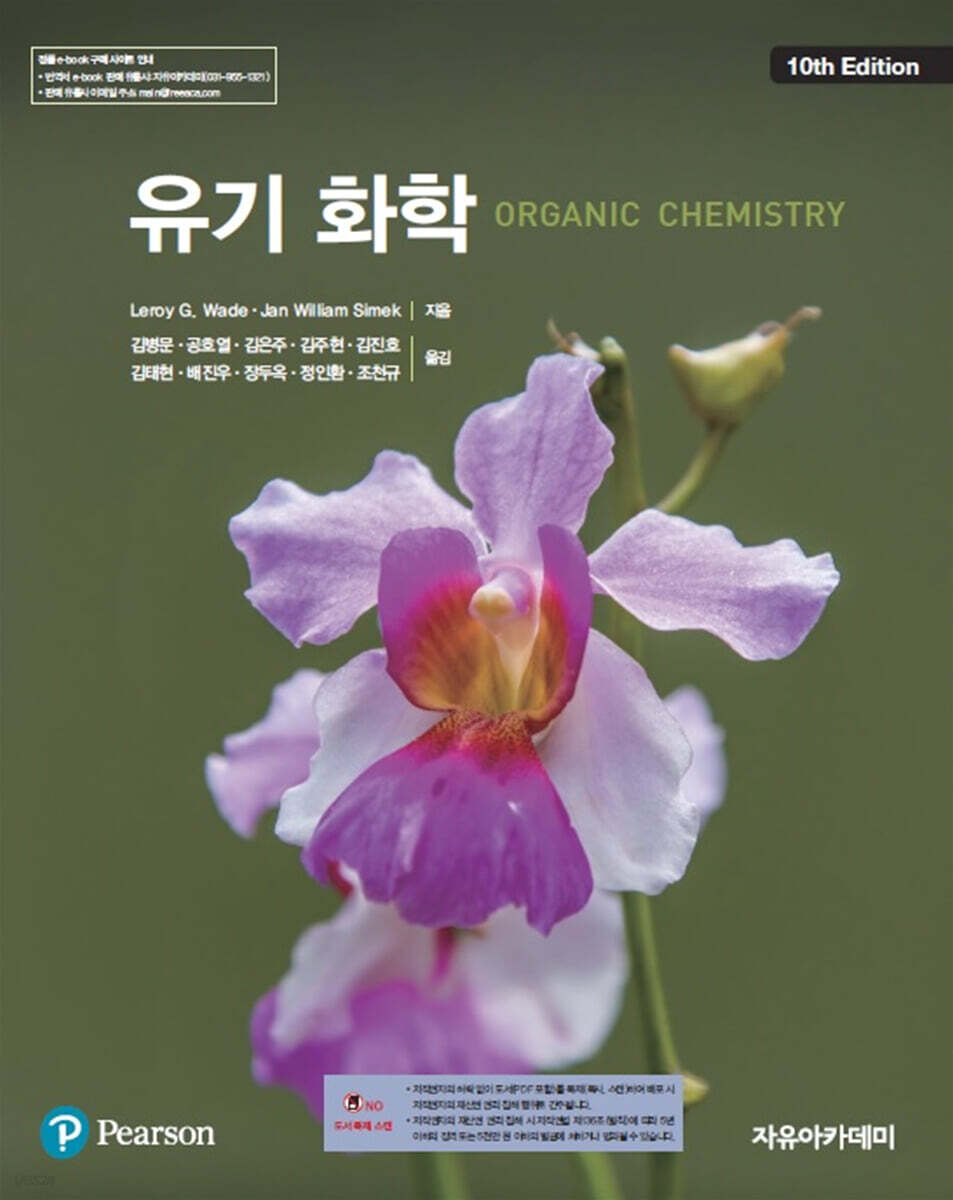
Wade Organic Chemistry
 |
Description
Book Introduction
An understanding of organic chemistry, which enables the design and synthesis of new materials, is essential for the emergence of cutting-edge new industries such as new displays, development of new functional materials, 3D printing, and development of new drugs for the treatment of incurable diseases.
Furthermore, the continuous development of life sciences is also based on the understanding of biological molecules based on organic chemistry, that is, molecular biology.
In this way, organic chemistry is an essential subject not only for chemistry majors but also for the development of adjacent academic fields that study all organic substances.
To understand these fundamental concepts and applications of organic chemistry, a basic understanding of the structure and bonding principles of organic molecules, as well as the unique properties and reactivity of the functional groups formed by the bonding of individual atoms, is essential.
LG
Wade's 10th edition of Organic Chemistry provides a suitable study method for this.
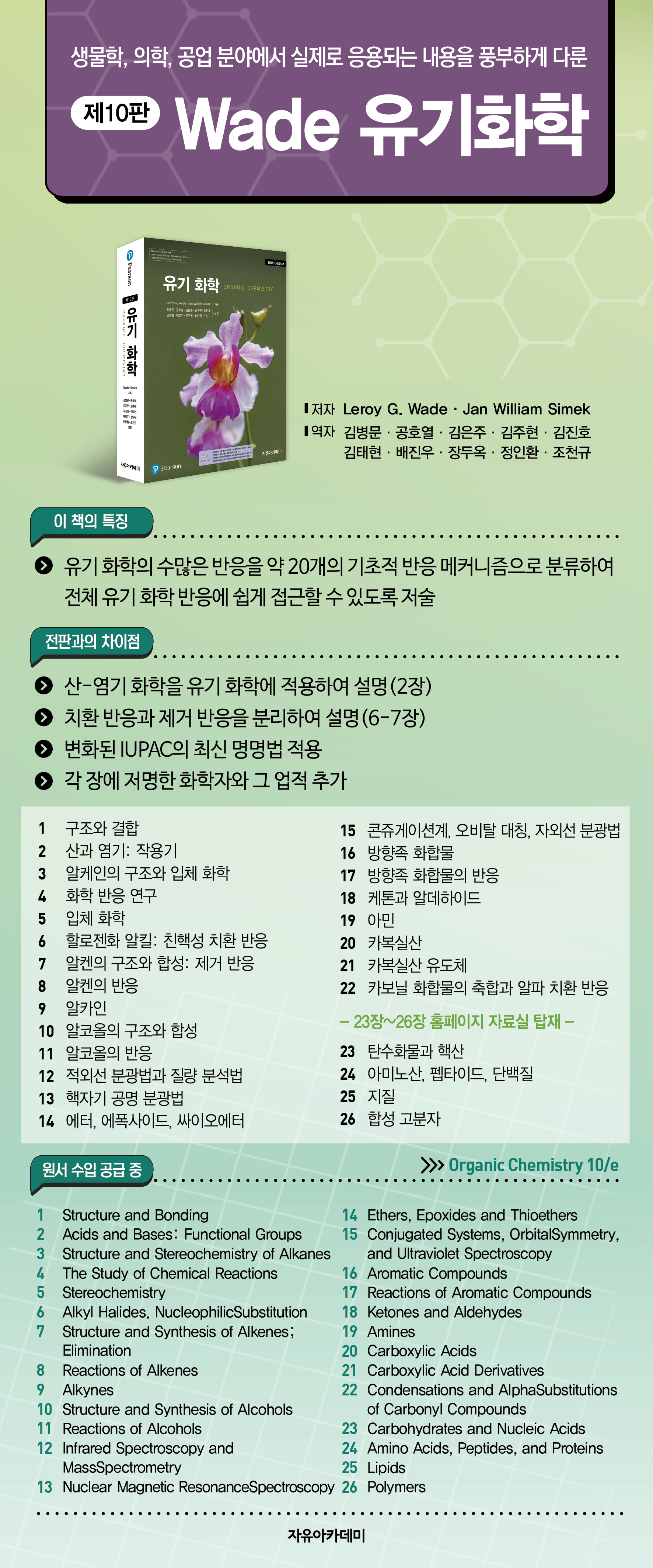
The author has written a book that provides easy access to the entire spectrum of organic chemistry reactions by categorizing the numerous reactions in organic chemistry, which appear to be very complex and diverse, into about 20 basic reaction mechanisms.
This book, which has been revised and supplemented with new content, covers a wealth of practical applications in biology, medicine, and industry in each chapter.
In the 10th edition, acid-base chemistry is explained in the beginning by applying it to organic chemistry, and, unlike before, substitution reactions and elimination reactions are explained separately.
And we have applied the latest IUPAC nomenclature, and added new names of prominent chemists and their achievements to each chapter.
Furthermore, the continuous development of life sciences is also based on the understanding of biological molecules based on organic chemistry, that is, molecular biology.
In this way, organic chemistry is an essential subject not only for chemistry majors but also for the development of adjacent academic fields that study all organic substances.
To understand these fundamental concepts and applications of organic chemistry, a basic understanding of the structure and bonding principles of organic molecules, as well as the unique properties and reactivity of the functional groups formed by the bonding of individual atoms, is essential.
LG
Wade's 10th edition of Organic Chemistry provides a suitable study method for this.
The author has written a book that provides easy access to the entire spectrum of organic chemistry reactions by categorizing the numerous reactions in organic chemistry, which appear to be very complex and diverse, into about 20 basic reaction mechanisms.
This book, which has been revised and supplemented with new content, covers a wealth of practical applications in biology, medicine, and industry in each chapter.
In the 10th edition, acid-base chemistry is explained in the beginning by applying it to organic chemistry, and, unlike before, substitution reactions and elimination reactions are explained separately.
And we have applied the latest IUPAC nomenclature, and added new names of prominent chemists and their achievements to each chapter.
- You can preview some of the book's contents.
Preview
index
1 Structure and Combination
2 Acids and Bases: Functional Groups
3 Structure and stereochemistry of alkanes
4. Study of chemical reactions
5 Stereochemistry
6 Halogenated Alkyl: Nucleophilic Substitution Reaction
7 Structure and Synthesis of Alkenes: Elimination Reactions
8 Alkene reactions
9 Alkaline
10 Structure and Synthesis of Alcohols
11 Alcohol Reactions
12 Infrared spectroscopy and mass spectrometry
13 Nuclear magnetic resonance spectroscopy
14 Ethers, epoxides, and thioethers
15 Conjugation systems, orbital symmetry, and ultraviolet spectroscopy
16 aromatic compounds
17 Reactions of aromatic compounds
18 Ketones and aldehydes
19 Amin
20 carboxylic acids
21 Carboxylic acid derivatives
22 Condensation and alpha substitution reactions of carbonyl compounds
-----Chapters 23 to 26 are available in the Free Academy website (www.freeaca.com)-----
23 Carbohydrates and nucleic acids
24 amino acids, peptides, proteins
25 Geology
26 Synthetic polymers
2 Acids and Bases: Functional Groups
3 Structure and stereochemistry of alkanes
4. Study of chemical reactions
5 Stereochemistry
6 Halogenated Alkyl: Nucleophilic Substitution Reaction
7 Structure and Synthesis of Alkenes: Elimination Reactions
8 Alkene reactions
9 Alkaline
10 Structure and Synthesis of Alcohols
11 Alcohol Reactions
12 Infrared spectroscopy and mass spectrometry
13 Nuclear magnetic resonance spectroscopy
14 Ethers, epoxides, and thioethers
15 Conjugation systems, orbital symmetry, and ultraviolet spectroscopy
16 aromatic compounds
17 Reactions of aromatic compounds
18 Ketones and aldehydes
19 Amin
20 carboxylic acids
21 Carboxylic acid derivatives
22 Condensation and alpha substitution reactions of carbonyl compounds
-----Chapters 23 to 26 are available in the Free Academy website (www.freeaca.com)-----
23 Carbohydrates and nucleic acids
24 amino acids, peptides, proteins
25 Geology
26 Synthetic polymers
Detailed image
Publisher's Review
Key Features of the 10th Edition
Expanding the Scope of Acids and Bases: After reviewing the fundamentals of bonding, hybridization, and molecular structure in Chapter 1, Chapter 2 focuses on acids and bases and explains how these concepts apply to organic compounds.
Introduce and explain the definitions of Arrhenius, Brønsted-Lowry, and Lewis.
After explaining the use of pKa and pKb, a discussion and problem-solving strategies for predicting the location of acid-base equilibrium reactions follow.
Describes factors affecting acidity and basicity, including solvent effects, size, electronegativity, inductive effects, hybridization effects, and resonance effects.
We will look at the correct use of the curved arrow format and cover Lewis acid-base reactions.
Separation of substitution and elimination reactions: The section on substitution and elimination has been revised so that substitution reactions are covered in Chapter 6 and elimination reactions are covered in Chapter 7.
This setup allows students to more comfortably understand the differences between SN1 and SN2 substitution before expanding the reaction pathway to include elimination reactions.
Chapter 7 provides a thorough treatment of the competition between substitution and elimination reactions and presents methods for predicting which mechanism and product are most likely.
Organic Synthesis: Many new synthesis problems have been added, some of which are derived from recent literature.
It supplements the material on organic synthesis and retrosynthesis analysis, with a particular focus on multistep aromatic synthesis.
Nomenclature: We have tried to keep the IUPAC nomenclature as up-to-date as possible and have reflected some changes.
From the 8th edition onwards, names were designated using the previous position (e.g., 1-butene) along with the position designation (e.g., but-1-ene) in accordance with the 1993 IUPAC regulations.
We have also defined stereochemical terms (e.g., stereocenter and chiral center) precisely and clearly, trying to use the most specific term in each case.
Expanding the Scope of Acids and Bases: After reviewing the fundamentals of bonding, hybridization, and molecular structure in Chapter 1, Chapter 2 focuses on acids and bases and explains how these concepts apply to organic compounds.
Introduce and explain the definitions of Arrhenius, Brønsted-Lowry, and Lewis.
After explaining the use of pKa and pKb, a discussion and problem-solving strategies for predicting the location of acid-base equilibrium reactions follow.
Describes factors affecting acidity and basicity, including solvent effects, size, electronegativity, inductive effects, hybridization effects, and resonance effects.
We will look at the correct use of the curved arrow format and cover Lewis acid-base reactions.
Separation of substitution and elimination reactions: The section on substitution and elimination has been revised so that substitution reactions are covered in Chapter 6 and elimination reactions are covered in Chapter 7.
This setup allows students to more comfortably understand the differences between SN1 and SN2 substitution before expanding the reaction pathway to include elimination reactions.
Chapter 7 provides a thorough treatment of the competition between substitution and elimination reactions and presents methods for predicting which mechanism and product are most likely.
Organic Synthesis: Many new synthesis problems have been added, some of which are derived from recent literature.
It supplements the material on organic synthesis and retrosynthesis analysis, with a particular focus on multistep aromatic synthesis.
Nomenclature: We have tried to keep the IUPAC nomenclature as up-to-date as possible and have reflected some changes.
From the 8th edition onwards, names were designated using the previous position (e.g., 1-butene) along with the position designation (e.g., but-1-ene) in accordance with the 1993 IUPAC regulations.
We have also defined stereochemical terms (e.g., stereocenter and chiral center) precisely and clearly, trying to use the most specific term in each case.
GOODS SPECIFICS
- Date of issue: August 23, 2024
- Page count, weight, size: 1,288 pages | 215*275*60mm
- ISBN13: 9789813350984
- ISBN10: 9813350989
You may also like
카테고리
korean


korean

![ELLE 엘르 스페셜 에디션 A형 : 12월 [2025]](http://librairie.coreenne.fr/cdn/shop/files/b8e27a3de6c9538896439686c6b0e8fb.jpg?v=1766436872&width=3840)


