

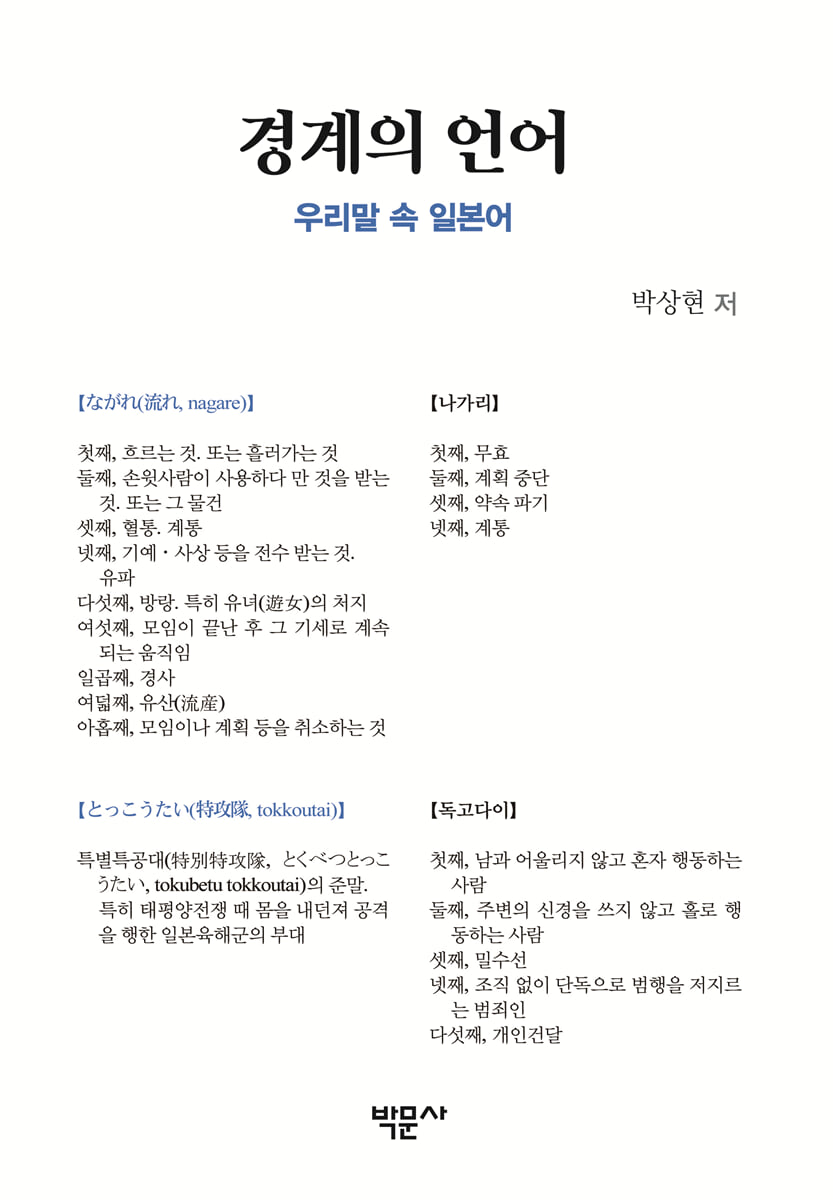
Language of the Border
 |
Description
Book Introduction
'Japanese words in our language are a remnant of Japanese colonial rule.
It is difficult to deny the proposition that the Japanese language is a pollutant and a dreg and must be purified.
Because it is natural.
But this proposition seems so obvious that it leaves no room for further thought, but in fact it is not so.
Here, I don't want to bring up the principle of fairness by citing examples of English borrowing or abuse, such as "English works, so why not Japanese?"
Before criticizing the above proposition by bringing it up in terms of equity with other foreign languages, it is because our complex linguistic reality exists in the ‘Japanese in our language’ itself.
In this book, we will focus on Japanese origins, or “transformed” Japanese, which can be replaced with Korean words, but whose meaning and nuance cannot be properly preserved when done so.
Because there hasn't been enough discussion about this so far.
This issue is also important in terms of the ecosystem and diversity of language.
I believe that we have reached a point where we must approach 'Japanese in Korean' from a new perspective.
It is difficult to deny the proposition that the Japanese language is a pollutant and a dreg and must be purified.
Because it is natural.
But this proposition seems so obvious that it leaves no room for further thought, but in fact it is not so.
Here, I don't want to bring up the principle of fairness by citing examples of English borrowing or abuse, such as "English works, so why not Japanese?"
Before criticizing the above proposition by bringing it up in terms of equity with other foreign languages, it is because our complex linguistic reality exists in the ‘Japanese in our language’ itself.
In this book, we will focus on Japanese origins, or “transformed” Japanese, which can be replaced with Korean words, but whose meaning and nuance cannot be properly preserved when done so.
Because there hasn't been enough discussion about this so far.
This issue is also important in terms of the ecosystem and diversity of language.
I believe that we have reached a point where we must approach 'Japanese in Korean' from a new perspective.
index
Chapter 1: Native Japanese
Section 1 Gao
Section 2: Ganji
Section 3 Gode
Section 4: Gura
Section 5 Nagari
Section 6: The City of Nara
Section 7: Nogada
Section 8: Short sword
Section 9 Dakdoritang
Section 10 Dokgo Dai
Section 11 Mudepo
Section 12: Beep
Section 13 Sakura
Section 14 Soba
Section 15
Section 16: Sight
Section 17 Tsunami
Section 18 Assari
Section 19 Yame
Section 20 Engko
Section 21 Oden
Section 22 Waku
Section 23: Yudo-ri
Section 24: Ippai
Section 25: Jjirashi
Chapter 2 Japanese Loanwords
Section 1 Tempura
Section 2 Regi
Section 3 Sewing Machine
Section 4: Pakku
Section 5 Bread
Section 6 Apartments
Section 7 Perm
Section 1 Gao
Section 2: Ganji
Section 3 Gode
Section 4: Gura
Section 5 Nagari
Section 6: The City of Nara
Section 7: Nogada
Section 8: Short sword
Section 9 Dakdoritang
Section 10 Dokgo Dai
Section 11 Mudepo
Section 12: Beep
Section 13 Sakura
Section 14 Soba
Section 15
Section 16: Sight
Section 17 Tsunami
Section 18 Assari
Section 19 Yame
Section 20 Engko
Section 21 Oden
Section 22 Waku
Section 23: Yudo-ri
Section 24: Ippai
Section 25: Jjirashi
Chapter 2 Japanese Loanwords
Section 1 Tempura
Section 2 Regi
Section 3 Sewing Machine
Section 4: Pakku
Section 5 Bread
Section 6 Apartments
Section 7 Perm
GOODS SPECIFICS
- Date of issue: September 12, 2023
- Page count, weight, size: 264 pages | 153*224*20mm
- ISBN13: 9791192365381
- ISBN10: 1192365380
You may also like
카테고리
korean


korean

![ELLE 엘르 스페셜 에디션 A형 : 12월 [2025]](http://librairie.coreenne.fr/cdn/shop/files/b8e27a3de6c9538896439686c6b0e8fb.jpg?v=1766436872&width=3840)


