

Easy-to-understand linear algebra
 |
Description
Book Introduction
This book was published in 2019 by H.
Anton, C.
Rorres, A.
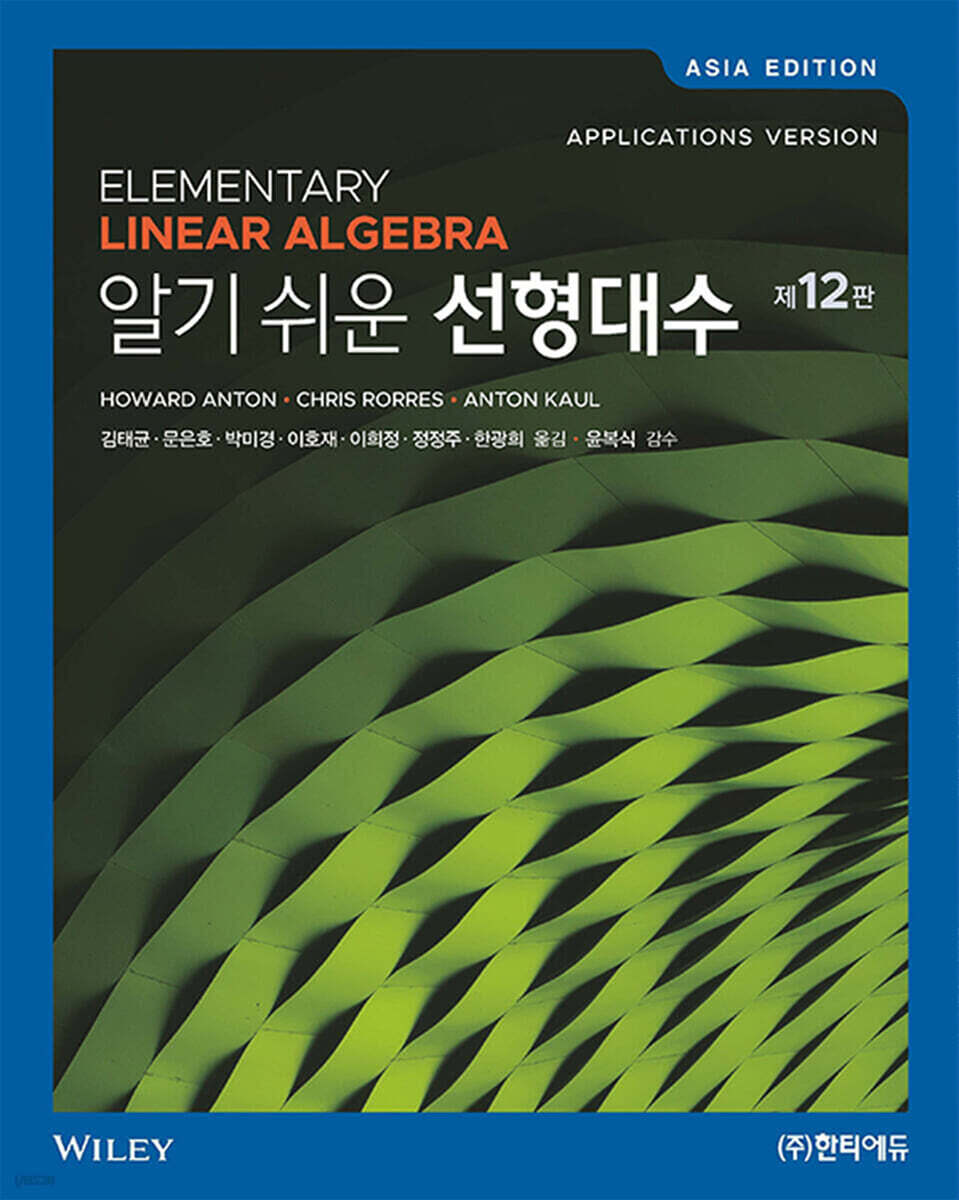
This is a translation of Kaul's Elementary Linear Algebra, 12th edition.
As can be seen from the edition, the original book has been used for a long time and is a popular linear algebra textbook worldwide. A translated version has also been published in Korea and is used as a standard textbook.
Compared to the 11th edition in 2015, which was a minor revision that added practice problems to each chapter and strengthened practice problems for projects using calculation tools, this 12th edition has undergone relatively more revisions.
Above all, it is notable that the basic contents of linear transformations are transferred to Chapter 1, covering the core topics from the beginning of the course, and that the practice problems are organized into proof problems, true/false problems, and calculation tool problems.
It is also interesting to add historical notes to introduce mathematicians who developed key concepts or techniques in linear algebra.
Don't miss out on the many new examples and practice problems, including applications of facial recognition.
Anton, C.
Rorres, A.
This is a translation of Kaul's Elementary Linear Algebra, 12th edition.
As can be seen from the edition, the original book has been used for a long time and is a popular linear algebra textbook worldwide. A translated version has also been published in Korea and is used as a standard textbook.
Compared to the 11th edition in 2015, which was a minor revision that added practice problems to each chapter and strengthened practice problems for projects using calculation tools, this 12th edition has undergone relatively more revisions.
Above all, it is notable that the basic contents of linear transformations are transferred to Chapter 1, covering the core topics from the beginning of the course, and that the practice problems are organized into proof problems, true/false problems, and calculation tool problems.
It is also interesting to add historical notes to introduce mathematicians who developed key concepts or techniques in linear algebra.
Don't miss out on the many new examples and practice problems, including applications of facial recognition.
index
01 Systems of linear equations and matrices
02 Determinant
03 Euclidean vector space
04 General vector space
05 Eigenvalues and Eigenvectors
06 Inner space
07 Diagonalization and Quadratic Form
08 General linear transformation
09 Numerical Methods
APPENDIX A Handling the Proof
APPENDIX B Complex Numbers
Practice Problem Answers
02 Determinant
03 Euclidean vector space
04 General vector space
05 Eigenvalues and Eigenvectors
06 Inner space
07 Diagonalization and Quadratic Form
08 General linear transformation
09 Numerical Methods
APPENDIX A Handling the Proof
APPENDIX B Complex Numbers
Practice Problem Answers
Publisher's Review
Linear algebra has a long history.
It can be said that it was established as a basic subject in university mathematics courses in the 20th century after Cramer's rule for solving simultaneous linear equations in 1750 became the basis, and after passing through Gaussian elimination around 1800, matrix theory was established by Cayley and Sylvester around 1850.
Because it is an algebra that deals with the simplest linear (first-order) systems, linear algebra naturally becomes the starting point for higher mathematics such as abstract algebra and functional analysis.
Linear algebra also has direct applications in science and engineering, as linear systems appear in modeling in almost all sciences and engineering.
Moreover, matrices and linear transformations, which are the main characters of linear algebra, are directly related to various numerical calculations using computers and the development of applied theories, so they are in line with modern trends.
For this reason, linear algebra is becoming increasingly popular as a required subject not only for mathematics majors but also for all majors in science and engineering, and even for serious analysts in business, economics, and social sciences.
This book was published in 2019 by H.
Anton, C.
Rorres, A.
This is a translation of Kaul's Elementary Linear Algebra, 12th edition.
As can be seen from the edition, the original book has been used for a long time and is a popular linear algebra textbook worldwide. A translated version has also been published in Korea and is used as a standard textbook.
The secret to this popularity seems to be its strength as a textbook that introduces not only the main fundamental concepts of linear algebra but also the latest techniques and applications, while consistently maintaining a friendly and systematic explanation suitable for first-year college students.
Compared to the 11th edition in 2015, which was a minor revision that added practice problems to each chapter and strengthened practice problems for projects using calculation tools, this 12th edition has undergone relatively more revisions.
Above all, it is notable that the basic contents of linear transformations are transferred to Chapter 1, covering the core topics from the beginning of the course, and that the practice problems are organized into proof problems, true/false problems, and calculation tool problems.
It is also interesting to add historical notes to introduce mathematicians who developed key concepts or techniques in linear algebra.
Don't miss out on the many new examples and practice problems, including applications of facial recognition.
Many of the computerized resources posted on the Internet site listed in the author's preface have also been updated.
It can be said that it was established as a basic subject in university mathematics courses in the 20th century after Cramer's rule for solving simultaneous linear equations in 1750 became the basis, and after passing through Gaussian elimination around 1800, matrix theory was established by Cayley and Sylvester around 1850.
Because it is an algebra that deals with the simplest linear (first-order) systems, linear algebra naturally becomes the starting point for higher mathematics such as abstract algebra and functional analysis.
Linear algebra also has direct applications in science and engineering, as linear systems appear in modeling in almost all sciences and engineering.
Moreover, matrices and linear transformations, which are the main characters of linear algebra, are directly related to various numerical calculations using computers and the development of applied theories, so they are in line with modern trends.
For this reason, linear algebra is becoming increasingly popular as a required subject not only for mathematics majors but also for all majors in science and engineering, and even for serious analysts in business, economics, and social sciences.
This book was published in 2019 by H.
Anton, C.
Rorres, A.
This is a translation of Kaul's Elementary Linear Algebra, 12th edition.
As can be seen from the edition, the original book has been used for a long time and is a popular linear algebra textbook worldwide. A translated version has also been published in Korea and is used as a standard textbook.
The secret to this popularity seems to be its strength as a textbook that introduces not only the main fundamental concepts of linear algebra but also the latest techniques and applications, while consistently maintaining a friendly and systematic explanation suitable for first-year college students.
Compared to the 11th edition in 2015, which was a minor revision that added practice problems to each chapter and strengthened practice problems for projects using calculation tools, this 12th edition has undergone relatively more revisions.
Above all, it is notable that the basic contents of linear transformations are transferred to Chapter 1, covering the core topics from the beginning of the course, and that the practice problems are organized into proof problems, true/false problems, and calculation tool problems.
It is also interesting to add historical notes to introduce mathematicians who developed key concepts or techniques in linear algebra.
Don't miss out on the many new examples and practice problems, including applications of facial recognition.
Many of the computerized resources posted on the Internet site listed in the author's preface have also been updated.
GOODS SPECIFICS
- Publication date: February 25, 2021
- Page count, weight, size: 692 pages | 204*254*35mm
- ISBN13: 9791190017114
- ISBN10: 1190017113
You may also like
카테고리
korean


korean

![GQ KOREA Mark (Monthly): December [2025]](http://librairie.coreenne.fr/cdn/shop/files/8ef265dbbfbf186523ed75ba7319009d.jpg?v=1765340328&width=3840)


