

Washington Manual Echocardiography
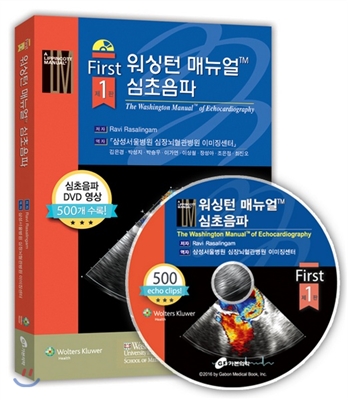 |
Description
Book Introduction
Recently, a new volume on echocardiography was published as part of the Washington Manual series, which is renowned for its concise summary of various medical fields. I thought that the content would be useful to medical professionals performing echocardiography examinations because it is concise and easy to understand.
In particular, the various accompanying video files are expected to be of great help in easily understanding the structure and function of the moving heart.
In particular, the various accompanying video files are expected to be of great help in easily understanding the structure and function of the moving heart.
index
Chapter 1: Introduction to the Principles of Echocardiography
Chapter 2: Transthoracic Echocardiography
Chapter 3: The Role of Contrast Agents in Echocardiography
Chapter 4: Quantification of Left Ventricular Systolic and Diastolic Function
Chapter 5: Right ventricular function and pulmonary artery hemodynamic measurements
Chapter 6: Stress Echocardiography for Assessment of Myocardial Ischemia and Viability
Chapter 7: Ischemic Heart Disease and Post-Myocardial Infarction Complications
Chapter 8: Cardiomyopathy
Chapter 9: Aortic Valve Disease
Chapter 10: Mitral Valve Disease
Chapter 11: Pulmonary Valve
Chapter 12: Tricuspid Valve Disease
Chapter 13: Evaluation of Artificial Valves
Chapter 14: Infective Endocarditis
Chapter 15: Pericardial Effusion and Tamponade
Chapter 16: Macrovascular Disease: Aorta and Pulmonary Artery
Chapter 17: Congenital Heart Disease
Chapter 18: Heart Mass
Chapter 19: Clinical Findings of Systemic Diseases in the Heart
Chapter 20: Transesophageal Echocardiography
Chapter 2: Transthoracic Echocardiography
Chapter 3: The Role of Contrast Agents in Echocardiography
Chapter 4: Quantification of Left Ventricular Systolic and Diastolic Function
Chapter 5: Right ventricular function and pulmonary artery hemodynamic measurements
Chapter 6: Stress Echocardiography for Assessment of Myocardial Ischemia and Viability
Chapter 7: Ischemic Heart Disease and Post-Myocardial Infarction Complications
Chapter 8: Cardiomyopathy
Chapter 9: Aortic Valve Disease
Chapter 10: Mitral Valve Disease
Chapter 11: Pulmonary Valve
Chapter 12: Tricuspid Valve Disease
Chapter 13: Evaluation of Artificial Valves
Chapter 14: Infective Endocarditis
Chapter 15: Pericardial Effusion and Tamponade
Chapter 16: Macrovascular Disease: Aorta and Pulmonary Artery
Chapter 17: Congenital Heart Disease
Chapter 18: Heart Mass
Chapter 19: Clinical Findings of Systemic Diseases in the Heart
Chapter 20: Transesophageal Echocardiography
Publisher's Review
Advances in computer and IT technology have made it possible to obtain more and more medical information accurately and quickly through echocardiography.
Additionally, the device's lightweight and miniaturized design has made it a useful test for evaluating the heart anytime, anywhere.
Therefore, not only cardiologists but also medical professionals in other fields dealing with heart disease are paying attention to echocardiography examinations.
The most representative textbook for learning echocardiography in Korean is “Clinical Echocardiography” published by the Korean Society of Echocardiography. It is an excellent textbook in terms of both quality and quantity of content.
However, the amount of material is vast and the level of depth is so deep that it can be somewhat overwhelming for beginners or medical professionals who are not cardiologists, so there was a need for a more concise educational material.
Recently, a new volume on echocardiography was published as part of the Washington Manual series, which is renowned for its concise summary of key points in various medical fields. I thought that the content would be useful to medical professionals performing echocardiography examinations because it is concise and easy to understand.
In particular, the various accompanying video files are expected to be of great help in easily understanding the structure and function of the moving heart.
So, doctors in charge of echocardiography at Samsung Medical Center in Seoul joined forces to translate it into Korean so that it is as easy and understandable as possible.
Despite its small size, this book covers the basic principles of cardiac ultrasound as well as common heart diseases we encounter in clinical practice in an easy-to-understand manner, using illustrations and videos.
Therefore, we believe that even medical professionals unfamiliar with echocardiography will be able to easily read, understand, and apply it to actual examinations.
I would like to take this opportunity to express my gratitude to the many professors who have generously contributed to the translation effort.
In particular, I believe that such a fine book would not have been possible without the passion of Professor Park Seong-ji, who silently managed the tedious work of distributing and receiving manuscripts for translation. Therefore, I would like to express my deepest gratitude once again to Professor Park Seong-ji for her hard work.
I would also like to thank Gabon Medical Science for selecting good books and making efforts to create books that are easy to read and comfortable.
I sincerely hope that this book can provide easy-to-understand and practical help to many medical professionals interested in and practicing echocardiography, and that the translators' hard work will have been rewarded.
Additionally, the device's lightweight and miniaturized design has made it a useful test for evaluating the heart anytime, anywhere.
Therefore, not only cardiologists but also medical professionals in other fields dealing with heart disease are paying attention to echocardiography examinations.
The most representative textbook for learning echocardiography in Korean is “Clinical Echocardiography” published by the Korean Society of Echocardiography. It is an excellent textbook in terms of both quality and quantity of content.
However, the amount of material is vast and the level of depth is so deep that it can be somewhat overwhelming for beginners or medical professionals who are not cardiologists, so there was a need for a more concise educational material.
Recently, a new volume on echocardiography was published as part of the Washington Manual series, which is renowned for its concise summary of key points in various medical fields. I thought that the content would be useful to medical professionals performing echocardiography examinations because it is concise and easy to understand.
In particular, the various accompanying video files are expected to be of great help in easily understanding the structure and function of the moving heart.
So, doctors in charge of echocardiography at Samsung Medical Center in Seoul joined forces to translate it into Korean so that it is as easy and understandable as possible.
Despite its small size, this book covers the basic principles of cardiac ultrasound as well as common heart diseases we encounter in clinical practice in an easy-to-understand manner, using illustrations and videos.
Therefore, we believe that even medical professionals unfamiliar with echocardiography will be able to easily read, understand, and apply it to actual examinations.
I would like to take this opportunity to express my gratitude to the many professors who have generously contributed to the translation effort.
In particular, I believe that such a fine book would not have been possible without the passion of Professor Park Seong-ji, who silently managed the tedious work of distributing and receiving manuscripts for translation. Therefore, I would like to express my deepest gratitude once again to Professor Park Seong-ji for her hard work.
I would also like to thank Gabon Medical Science for selecting good books and making efforts to create books that are easy to read and comfortable.
I sincerely hope that this book can provide easy-to-understand and practical help to many medical professionals interested in and practicing echocardiography, and that the translators' hard work will have been rewarded.
GOODS SPECIFICS
- Page count, weight, size: 368 pages | 215*286*30mm
- ISBN13: 9788997736362
- ISBN10: 8997736361
You may also like
카테고리
korean


korean

![ELLE 엘르 A형 (여성월간) : 1월 [2026]](http://librairie.coreenne.fr/cdn/shop/files/3b70e1cf77cf67d6da56e0eb041901e8.jpg?v=1767265322&width=3840)


