

montage
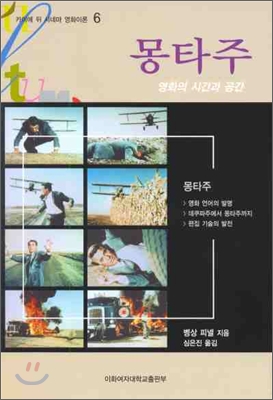 |
Description
Book Introduction
『Montage』, an explanation of the concept of montage.
Today, montage (or editing) is recognized not only as one of the essential elements of 'film language', but also as the most special cinematic element.
If the individual shots created by filming correspond to words, montage is like the work of connecting words to create a single sentence.
Just as the arrangement of words creates completely different expressions in sentences, montage gives new life to the filmed shots.
Part 1 of this book examines the establishment and development of the concept of montage in chronological order.
This book explores the history of montage, from the early signs of montage in films, to the rapid changes and establishment of the concept of montage in the 1910s and 1920s, and to current digital editing.
Through this, we can see that montage is not a spontaneous process or the result of a sudden discovery, but rather the result of dialectical development, a result of the constant formal experimentation of several cineastes and the maturity of the audience's gaze.
Part 2 helps you understand montage by providing a wealth of photographic material taken from scenes from great classic films and explaining various editing tools used in actual editing.
Additionally, excerpts from important literature objectively convey various directors' perspectives on montage.
Today, montage (or editing) is recognized not only as one of the essential elements of 'film language', but also as the most special cinematic element.
If the individual shots created by filming correspond to words, montage is like the work of connecting words to create a single sentence.
Just as the arrangement of words creates completely different expressions in sentences, montage gives new life to the filmed shots.
Part 1 of this book examines the establishment and development of the concept of montage in chronological order.
This book explores the history of montage, from the early signs of montage in films, to the rapid changes and establishment of the concept of montage in the 1910s and 1920s, and to current digital editing.
Through this, we can see that montage is not a spontaneous process or the result of a sudden discovery, but rather the result of dialectical development, a result of the constant formal experimentation of several cineastes and the maturity of the audience's gaze.
Part 2 helps you understand montage by providing a wealth of photographic material taken from scenes from great classic films and explaining various editing tools used in actual editing.
Additionally, excerpts from important literature objectively convey various directors' perspectives on montage.
index
Part 1: Theory of Montage
Chapter 1: The Age of Tablo
A film without montage
D.
W. Griffith's Intuition (USA, 1908-1916)
Chapter 2 Relationships between images
Soviets and the Weapon of Montage (Russia, 1920s)
A Means of Expression or a Narrative Tool? (France, 1918-1928)
Hollywood Sets the Rules (USA, 1916-1928)
Chapter 3: Combining Sound and Image
classic montage
Auteur cinema and montage
Part 2: The Reality of Montage
References
Chapter 1: The Age of Tablo
A film without montage
D.
W. Griffith's Intuition (USA, 1908-1916)
Chapter 2 Relationships between images
Soviets and the Weapon of Montage (Russia, 1920s)
A Means of Expression or a Narrative Tool? (France, 1918-1928)
Hollywood Sets the Rules (USA, 1916-1928)
Chapter 3: Combining Sound and Image
classic montage
Auteur cinema and montage
Part 2: The Reality of Montage
References
Publisher's Review
Series Introduction
Ewha Womans University Press is publishing a series of selected and translated volumes from the 'Les Petits Cahiers' series, a film theory collection jointly planned by a prominent French film magazine and the French Ministry of Culture.
This series, which covers each element of film theory in a separate booklet, includes explanations of the most fundamental concepts and historical developments in each field, making it easy for even the general public and high school students who want to learn about film as a general subject to understand.
In particular, the book is divided into two parts, with Part 1 devoted to theoretical explanations and commentary, and Part 2 providing case studies of how the theories are actually applied in film production in various ways, such as testimonies and work processes of film professionals related to the field, quotes related to the topic, and analysis of individual film sequences. By doing so, it complements the limitations and shortcomings of existing theoretical books and provides readers with an opportunity to approach and understand the film medium more specifically.
Currently, eight volumes have been confirmed for publication, all of which cover the basic concepts of film theory.
The French 'Les Petits Cahiers' series is currently being published continuously, and as it covers both director and film studies, a second installment of the series focusing on director and film studies is also being planned.
Ewha Womans University Press is publishing a series of selected and translated volumes from the 'Les Petits Cahiers' series, a film theory collection jointly planned by a prominent French film magazine and the French Ministry of Culture.
This series, which covers each element of film theory in a separate booklet, includes explanations of the most fundamental concepts and historical developments in each field, making it easy for even the general public and high school students who want to learn about film as a general subject to understand.
In particular, the book is divided into two parts, with Part 1 devoted to theoretical explanations and commentary, and Part 2 providing case studies of how the theories are actually applied in film production in various ways, such as testimonies and work processes of film professionals related to the field, quotes related to the topic, and analysis of individual film sequences. By doing so, it complements the limitations and shortcomings of existing theoretical books and provides readers with an opportunity to approach and understand the film medium more specifically.
Currently, eight volumes have been confirmed for publication, all of which cover the basic concepts of film theory.
The French 'Les Petits Cahiers' series is currently being published continuously, and as it covers both director and film studies, a second installment of the series focusing on director and film studies is also being planned.
GOODS SPECIFICS
- Date of issue: February 28, 2008
- Page count, weight, size: 126 pages | 153*224*20mm
- ISBN13: 9788973007868
- ISBN10: 8973007866
You may also like
카테고리
korean


korean

![ELLE 엘르 A형 (여성월간) : 1월 [2026]](http://librairie.coreenne.fr/cdn/shop/files/3b70e1cf77cf67d6da56e0eb041901e8.jpg?v=1767265322&width=3840)


