

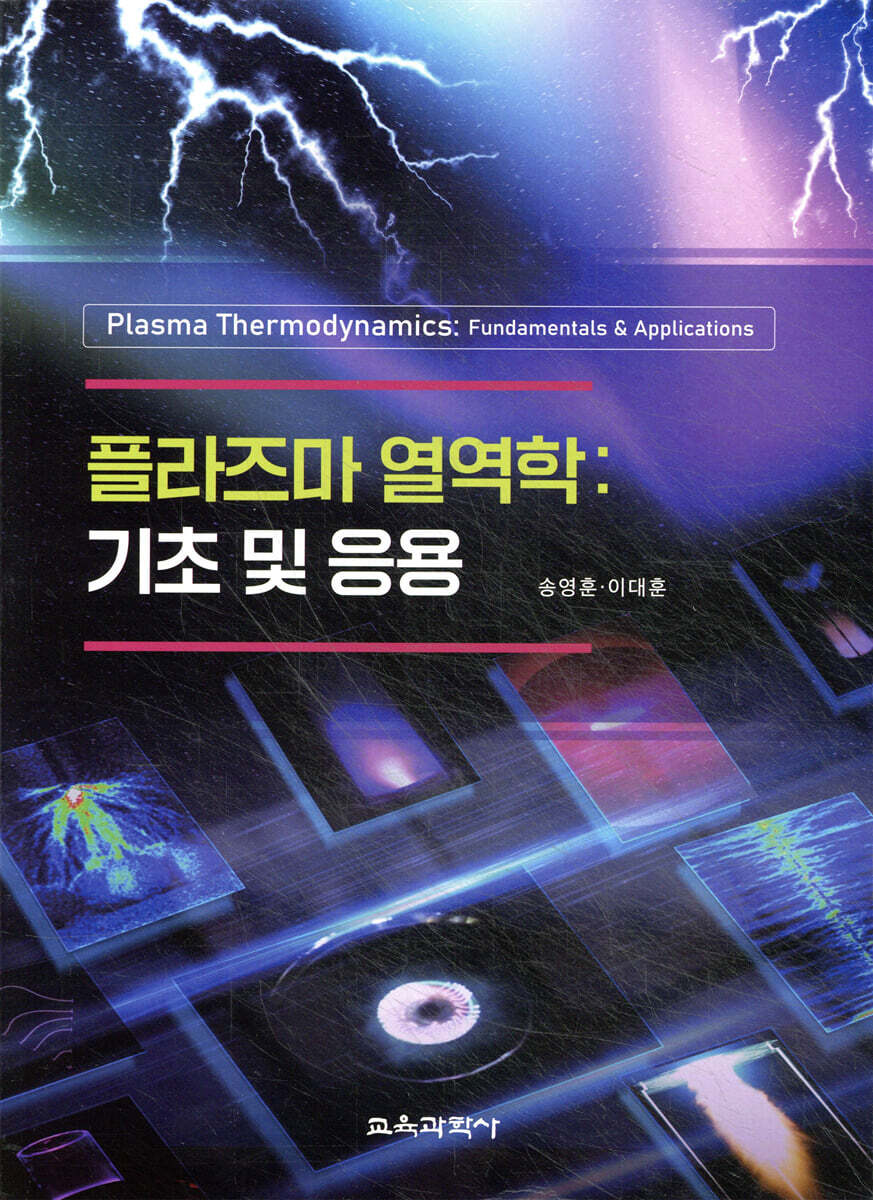
Plasma Thermodynamics: Fundamentals and Applications
 |
Description
Book Introduction
This book introduces chemical reactions in plasma state, i.e. chemical changes of atoms and gas molecules that occur at high temperatures of thousands to tens of thousands of degrees, from a thermodynamic perspective.
The authors of this book have been researching industrial plasma generation and chemical reaction process technology utilizing it for the past 30 years at the Korea Institute of Machinery and Materials.
Accordingly, this book was able to present various plasma-related data and experimental results that the authors had personally acquired over a long period of time, and to introduce how this plasma knowledge is connected to the thermodynamics we have known so far.
The authors of this book have been researching industrial plasma generation and chemical reaction process technology utilizing it for the past 30 years at the Korea Institute of Machinery and Materials.
Accordingly, this book was able to present various plasma-related data and experimental results that the authors had personally acquired over a long period of time, and to introduce how this plasma knowledge is connected to the thermodynamics we have known so far.
index
Preface _ 3
Chapter 1: Energy of Atoms and Molecules… … … 9
1-1.
Understanding Light: The Beginnings of Quantum Mechanics _ 11
1-2.
Fingerprints of Atoms and Molecules: Spectra of Atoms and Molecules _ 14
Number of atoms and molecules _ 14
Fingerprints of Atoms and Molecules: The Spectrum of Light _ 15
Internal Energy of Atoms and Molecules _ 17
Comparison of the relative magnitudes of translational, rotational, and vibrational energies and electronic transition energies _ 19
Spectra of molecules _ 22
1-3.
Natural phenomena caused by changes in the internal energy of atoms and molecules (emission of light, release of heat, chemical reactions, ionization) _ 25
Radiative and non-radiative decay, radiative relaxation and non-radiative relaxation _ 26
Chemical Reactions and Ionization _ 29
LIF, Laser Induced Fluorescence _ 33
1-4.
Types and energies of light: Ultraviolet rays have higher energy than hot infrared rays_35
1-5.
Light and Electromagnetic Waves: Different Yet Similar _ 41
Light Transmission _ 42
Penetration of electromagnetic waves into solids (1): Microwaves _ 45
Penetration of electromagnetic waves into solids (2): X-rays _ 46
1-6.
Blackbody Radiation: The Failure of Classical Mechanics and the Dawn of Quantum Mechanics _ 47
Derivation of the Rayleigh-Jeans formula for the intensity of light and the UV catastrophe _ 52
Rayleigh-Jeans derived process _ 56
Planck-derived process _ 58
1-7.
Visible Light and Invisible Light _ 60
Candlelight: Visible and Invisible Light _ 60
Gas Fire: Blue Fire _ 62
Why is charcoal grilling so delicious? _ 63
1-8.
History of Lighting _ 65
Chapter 2: The Energy of Matter… … … 71
2-1.
The four states of matter: solid, liquid, gas, and plasma _ 73
Solid, Liquid, Gas, and Plasma States _ 74
2-2.
Gas Physics: Microscopic and Macroscopic Perspectives _ 80
Micro and Macro Perspectives _ 83
The Starting Point of Statistical Thermodynamics: Distributions and Probability _ 84
Normal Distribution _ 86
Maxwell-Boltzmann Speed Distribution_89
2-3.
Pressure and Heat and Mass Transfer from a Microscopic Perspective _ 95
Thermal conductivity, viscosity, and diffusion coefficients _ 99
2-4.
Internal Energy of a System from a Microscopic Perspective _ 103
Internal Energy and Enthalpy from a Macroscopic Perspective _ 103
Internal Energy from a Microscopic Perspective: Internal Energy at Low Temperatures _ 109
Specific heat of diatomic molecules as a function of temperature _111
Specific heat at high temperatures: dissociation and ionization of molecules _ 112
Thermal conductivity at high temperature conditions _ 115
2-5.
Boltzmann's distribution law _ 119
Why does the natural exponential function ex keep appearing in physics and chemistry? _ 125
Boltzmann distribution rule, Boltzmann distribution law _ 126
Partition Functions: A Link Between Statistical and Classical Thermodynamics _ 132
Thermodynamic State Function _ 135
Boltzmann's Distributive Law and Other Distributive Laws _ 136
2-6.
Entropy: The Law That Hints at the Beginning and End of the Universe _ 137
Entropy Born from Clausius's Insight _ 147
The Future of the Universe as Entropy Hints at It _ 156
2-7.
Gibbs Free Energy: A Thermodynamic Function Predicting Natural Changes _ 158
Chapter 3: Plasma Chemical Reaction Processes… … … 169
3-1.
Heat-Driven Chemical Reactions: Chemical Reactions at Equilibrium _ 171
Thermochemical Reactions in the Gaseous State as a Physical Phenomena _ 171
Understanding Activation Energy (1): Reducing Activation Energy Using Catalysts _ 177
Understanding Activation Energy (2): Activation Energy Varies Depending on the Type of Chemical Reaction _ 179
Pathways of Realistic Thermochemical Reactions _ 180
Low-Temperature Chemical Reactions: Ignition _ 184
3-2.
Chemical Reactions that Occur Independently of Heat: Chemical Reactions in Nonequilibrium _ 187
Photochemical Reaction Example 1: Stratospheric Ozone Creation and Destruction _ 189
Photochemical Reaction Example 2: Ozone Production and Photosmog on the Earth's Surface _ 190
Electron-Molecular Chemical Reactions and Chemical Reaction Rates _ 192
Characteristics of Plasma Chemical Reactions (1): Various Reaction Pathways _ 197
Characteristics of Plasma Chemical Reactions (2): Reaction Efficiency and Rate _ 198
Characteristics of Plasma Chemical Reactions (3): Temperature-Independent Reactions _ 201
Characteristics of Plasma Chemical Reactions (4): Spatial Selectivity _ 202
3-3.
Laser _ 203
spontaneous emission and stimulated emission _ 207
Light Amplification Conditions: Population Inversion _ 209
3-4.
Plasma Characteristics (1): Nonequilibrium and Equilibrium Plasma _ 213
Nonequilibrium and equilibrium plasmas _ 215
Criteria for equilibrium and nonequilibrium plasmas, E/n _ 217
3-5.
Plasma Characteristics (2): Particle Motion in Plasma _ 218
Comparison of the Relative Influence of Heat Diffusion Rate and Drift Rate _ 221
Ideal Plasma Conditions: Debye Shielding and Quasi-Neutrality _ 222
3-6.
Generation and Characteristics of Atmospheric Pressure Non-Equilibrium Plasma _ 225
Atmospheric pressure non-thermal plasma generation _ 225
Electron Temperature and Concentration in Atmospheric Pressure Specific Heat Plasma _ 229
3-7.
Generation and Characteristics of Atmospheric Pressure Arc Plasma _ 233
Generation of atmospheric pressure arc plasma: shape and structure of the arc column _ 234
Arc shape according to the type of carrier gas _ 236
Heat and material balance of arc columns _ 238
Life and cooling of cathode electrodes _ 243
Heat and mass balance near the cathode electrode _ 246
3-8.
Chemical reaction process using plasma _ 250
Applications of Plasma Chemical Reaction Processes - General Theory _ 251
Characteristics of Chemical Reactions According to Plasma Type - Research by the Korea Institute of Machinery and Materials _ 256
3-9.
Thermal Engineering Applications Using Plasma _ 270
Adsorption and Desorption of Hydrocarbons Using Non-thermal Plasma _ 270
Plasma burner (1): combustion assisted by plasma _ 272
Plasma burner (2): diesel burner assisted by plasma _ 273
Ultra Low NOx Burner with Fuel Reformer _ 276
Search _ 279
Chapter 1: Energy of Atoms and Molecules… … … 9
1-1.
Understanding Light: The Beginnings of Quantum Mechanics _ 11
1-2.
Fingerprints of Atoms and Molecules: Spectra of Atoms and Molecules _ 14
Number of atoms and molecules _ 14
Fingerprints of Atoms and Molecules: The Spectrum of Light _ 15
Internal Energy of Atoms and Molecules _ 17
Comparison of the relative magnitudes of translational, rotational, and vibrational energies and electronic transition energies _ 19
Spectra of molecules _ 22
1-3.
Natural phenomena caused by changes in the internal energy of atoms and molecules (emission of light, release of heat, chemical reactions, ionization) _ 25
Radiative and non-radiative decay, radiative relaxation and non-radiative relaxation _ 26
Chemical Reactions and Ionization _ 29
LIF, Laser Induced Fluorescence _ 33
1-4.
Types and energies of light: Ultraviolet rays have higher energy than hot infrared rays_35
1-5.
Light and Electromagnetic Waves: Different Yet Similar _ 41
Light Transmission _ 42
Penetration of electromagnetic waves into solids (1): Microwaves _ 45
Penetration of electromagnetic waves into solids (2): X-rays _ 46
1-6.
Blackbody Radiation: The Failure of Classical Mechanics and the Dawn of Quantum Mechanics _ 47
Derivation of the Rayleigh-Jeans formula for the intensity of light and the UV catastrophe _ 52
Rayleigh-Jeans derived process _ 56
Planck-derived process _ 58
1-7.
Visible Light and Invisible Light _ 60
Candlelight: Visible and Invisible Light _ 60
Gas Fire: Blue Fire _ 62
Why is charcoal grilling so delicious? _ 63
1-8.
History of Lighting _ 65
Chapter 2: The Energy of Matter… … … 71
2-1.
The four states of matter: solid, liquid, gas, and plasma _ 73
Solid, Liquid, Gas, and Plasma States _ 74
2-2.
Gas Physics: Microscopic and Macroscopic Perspectives _ 80
Micro and Macro Perspectives _ 83
The Starting Point of Statistical Thermodynamics: Distributions and Probability _ 84
Normal Distribution _ 86
Maxwell-Boltzmann Speed Distribution_89
2-3.
Pressure and Heat and Mass Transfer from a Microscopic Perspective _ 95
Thermal conductivity, viscosity, and diffusion coefficients _ 99
2-4.
Internal Energy of a System from a Microscopic Perspective _ 103
Internal Energy and Enthalpy from a Macroscopic Perspective _ 103
Internal Energy from a Microscopic Perspective: Internal Energy at Low Temperatures _ 109
Specific heat of diatomic molecules as a function of temperature _111
Specific heat at high temperatures: dissociation and ionization of molecules _ 112
Thermal conductivity at high temperature conditions _ 115
2-5.
Boltzmann's distribution law _ 119
Why does the natural exponential function ex keep appearing in physics and chemistry? _ 125
Boltzmann distribution rule, Boltzmann distribution law _ 126
Partition Functions: A Link Between Statistical and Classical Thermodynamics _ 132
Thermodynamic State Function _ 135
Boltzmann's Distributive Law and Other Distributive Laws _ 136
2-6.
Entropy: The Law That Hints at the Beginning and End of the Universe _ 137
Entropy Born from Clausius's Insight _ 147
The Future of the Universe as Entropy Hints at It _ 156
2-7.
Gibbs Free Energy: A Thermodynamic Function Predicting Natural Changes _ 158
Chapter 3: Plasma Chemical Reaction Processes… … … 169
3-1.
Heat-Driven Chemical Reactions: Chemical Reactions at Equilibrium _ 171
Thermochemical Reactions in the Gaseous State as a Physical Phenomena _ 171
Understanding Activation Energy (1): Reducing Activation Energy Using Catalysts _ 177
Understanding Activation Energy (2): Activation Energy Varies Depending on the Type of Chemical Reaction _ 179
Pathways of Realistic Thermochemical Reactions _ 180
Low-Temperature Chemical Reactions: Ignition _ 184
3-2.
Chemical Reactions that Occur Independently of Heat: Chemical Reactions in Nonequilibrium _ 187
Photochemical Reaction Example 1: Stratospheric Ozone Creation and Destruction _ 189
Photochemical Reaction Example 2: Ozone Production and Photosmog on the Earth's Surface _ 190
Electron-Molecular Chemical Reactions and Chemical Reaction Rates _ 192
Characteristics of Plasma Chemical Reactions (1): Various Reaction Pathways _ 197
Characteristics of Plasma Chemical Reactions (2): Reaction Efficiency and Rate _ 198
Characteristics of Plasma Chemical Reactions (3): Temperature-Independent Reactions _ 201
Characteristics of Plasma Chemical Reactions (4): Spatial Selectivity _ 202
3-3.
Laser _ 203
spontaneous emission and stimulated emission _ 207
Light Amplification Conditions: Population Inversion _ 209
3-4.
Plasma Characteristics (1): Nonequilibrium and Equilibrium Plasma _ 213
Nonequilibrium and equilibrium plasmas _ 215
Criteria for equilibrium and nonequilibrium plasmas, E/n _ 217
3-5.
Plasma Characteristics (2): Particle Motion in Plasma _ 218
Comparison of the Relative Influence of Heat Diffusion Rate and Drift Rate _ 221
Ideal Plasma Conditions: Debye Shielding and Quasi-Neutrality _ 222
3-6.
Generation and Characteristics of Atmospheric Pressure Non-Equilibrium Plasma _ 225
Atmospheric pressure non-thermal plasma generation _ 225
Electron Temperature and Concentration in Atmospheric Pressure Specific Heat Plasma _ 229
3-7.
Generation and Characteristics of Atmospheric Pressure Arc Plasma _ 233
Generation of atmospheric pressure arc plasma: shape and structure of the arc column _ 234
Arc shape according to the type of carrier gas _ 236
Heat and material balance of arc columns _ 238
Life and cooling of cathode electrodes _ 243
Heat and mass balance near the cathode electrode _ 246
3-8.
Chemical reaction process using plasma _ 250
Applications of Plasma Chemical Reaction Processes - General Theory _ 251
Characteristics of Chemical Reactions According to Plasma Type - Research by the Korea Institute of Machinery and Materials _ 256
3-9.
Thermal Engineering Applications Using Plasma _ 270
Adsorption and Desorption of Hydrocarbons Using Non-thermal Plasma _ 270
Plasma burner (1): combustion assisted by plasma _ 272
Plasma burner (2): diesel burner assisted by plasma _ 273
Ultra Low NOx Burner with Fuel Reformer _ 276
Search _ 279
GOODS SPECIFICS
- Date of issue: September 25, 2025
- Page count, weight, size: 288 pages | 188*257*20mm
- ISBN13: 9788925419367
- ISBN10: 892541936X
You may also like
카테고리
korean


korean

![ELLE 엘르 A형 (여성월간) : 1월 [2026]](http://librairie.coreenne.fr/cdn/shop/files/3b70e1cf77cf67d6da56e0eb041901e8.jpg?v=1767265322&width=3840)


