

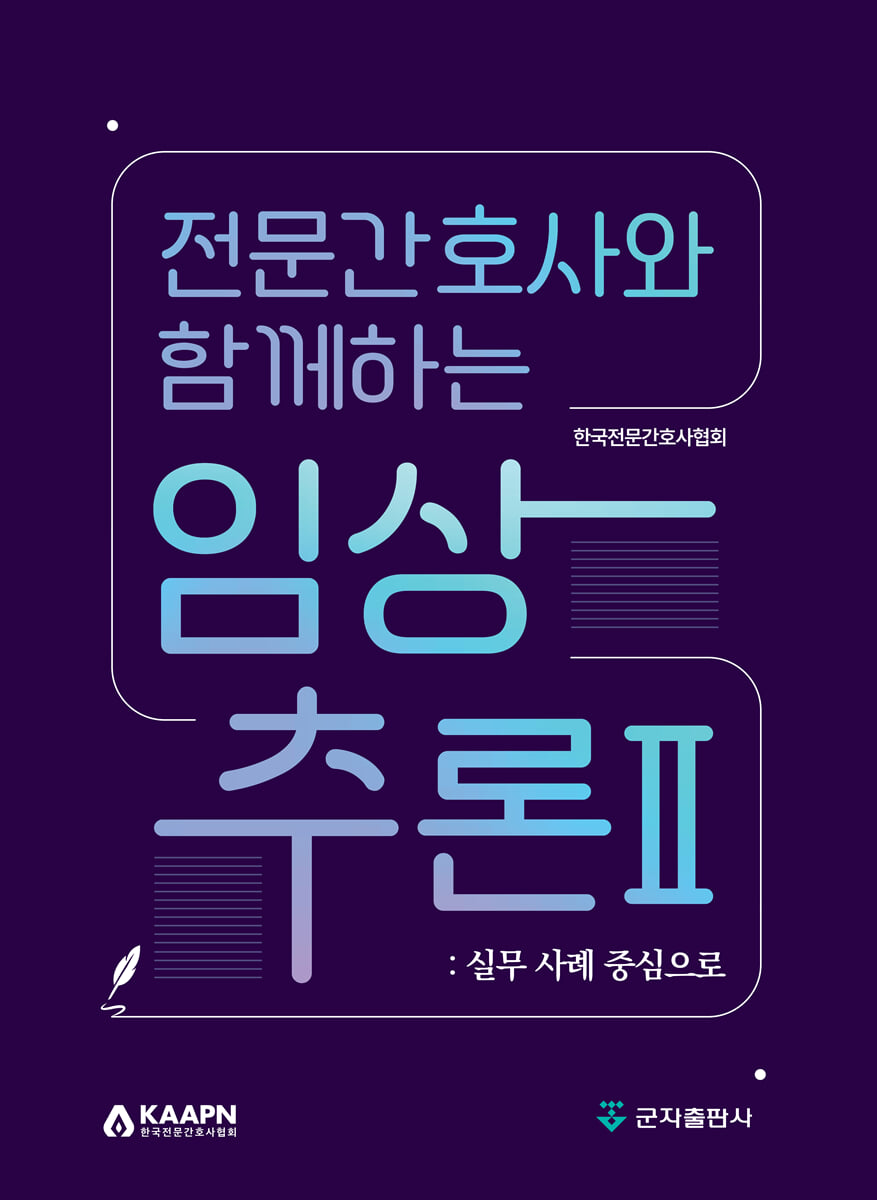
Clinical Reasoning with a Nurse Practitioner 2
 |
Description
Book Introduction
Part 2 of 『Clinical Reasoning with Professional Nurses: Focusing on Practical Cases』, like Part 1, continues to ask questions about the subjects' problems based on cases of patients seen in clinical settings.
The process of diagnosing a subject's health problems and exploring problem-solving methods was described through the process of exploring what the subject's most important problems are and what information is needed to solve them.
In addition, the role of professional nurses in this clinical reasoning process and lessons learned from cases were organized to increase its usability in clinical practice.
The process of diagnosing a subject's health problems and exploring problem-solving methods was described through the process of exploring what the subject's most important problems are and what information is needed to solve them.
In addition, the role of professional nurses in this clinical reasoning process and lessons learned from cases were organized to increase its usability in clinical practice.
- You can preview some of the book's contents.
Preview
index
endocrine system
01 Hyperglycemic hyperosmolar state
02 Diabetic ketoacidosis
03 Adrenal insufficiency
04 Syndrome of inappropriate antidiuretic hormone secretion
digestive system
05 Hepatotoxicity
06 Hepatic vein occlusion
07 Closed-intestinal obstruction
08 Pancreatic fistula after pancreatectomy
nervous system
09 Hydrocephalus
10 Subarachnoid hemorrhage
11 Spinal cord compression
cardiovascular system
12 Infective endocarditis
13 Superior vena cava syndrome
14 Stress cardiomyopathy due to subarachnoid hemorrhage
15 Heart failure
16 Cardiac tamponade
17 Septic shock
respiratory system
18 Acute hypoxemic respiratory failure
19 Postoperative respiratory failure in a patient with cervical spine injury
20 Acute respiratory distress syndrome
21 Asthma and chronic obstructive pulmonary disease overlap syndrome
etc
22 Acute kidney injury
23 Acute graft-versus-host disease
24 Tumor Decomposition Syndrome
Index
01 Hyperglycemic hyperosmolar state
02 Diabetic ketoacidosis
03 Adrenal insufficiency
04 Syndrome of inappropriate antidiuretic hormone secretion
digestive system
05 Hepatotoxicity
06 Hepatic vein occlusion
07 Closed-intestinal obstruction
08 Pancreatic fistula after pancreatectomy
nervous system
09 Hydrocephalus
10 Subarachnoid hemorrhage
11 Spinal cord compression
cardiovascular system
12 Infective endocarditis
13 Superior vena cava syndrome
14 Stress cardiomyopathy due to subarachnoid hemorrhage
15 Heart failure
16 Cardiac tamponade
17 Septic shock
respiratory system
18 Acute hypoxemic respiratory failure
19 Postoperative respiratory failure in a patient with cervical spine injury
20 Acute respiratory distress syndrome
21 Asthma and chronic obstructive pulmonary disease overlap syndrome
etc
22 Acute kidney injury
23 Acute graft-versus-host disease
24 Tumor Decomposition Syndrome
Index
Publisher's Review
I believe clinical reasoning is the ability to understand a patient's overall condition and problems, whether performing a physical examination, filling out medical records, or administering any treatment, infer what needs to be considered, and find ways to respond appropriately, enabling safer patient management.
The role does not end with performing tasks or procedures delegated by the physician; it also requires the ability to detect unseen or predictable problems for the patient.
This requires thinking systematically and developing the habit of pondering and asking questions to avoid missing the patient's problems.
To help improve clinical reasoning skills, one of the essential competencies for professional nurses, this book covers 24 cases developed based on clinical field experience, following the 23 cases included in Part 1.
We hope this book will be a useful guide for all nurses working in clinical settings.
The role does not end with performing tasks or procedures delegated by the physician; it also requires the ability to detect unseen or predictable problems for the patient.
This requires thinking systematically and developing the habit of pondering and asking questions to avoid missing the patient's problems.
To help improve clinical reasoning skills, one of the essential competencies for professional nurses, this book covers 24 cases developed based on clinical field experience, following the 23 cases included in Part 1.
We hope this book will be a useful guide for all nurses working in clinical settings.
GOODS SPECIFICS
- Date of issue: July 25, 2025
- Page count, weight, size: 360 pages | 684g | 188*257*30mm
- ISBN13: 9791170683070
- ISBN10: 117068307X
You may also like
카테고리
korean


korean

![ELLE 엘르 A형 (여성월간) : 1월 [2026]](http://librairie.coreenne.fr/cdn/shop/files/3b70e1cf77cf67d6da56e0eb041901e8.jpg?v=1767265322&width=3840)


