

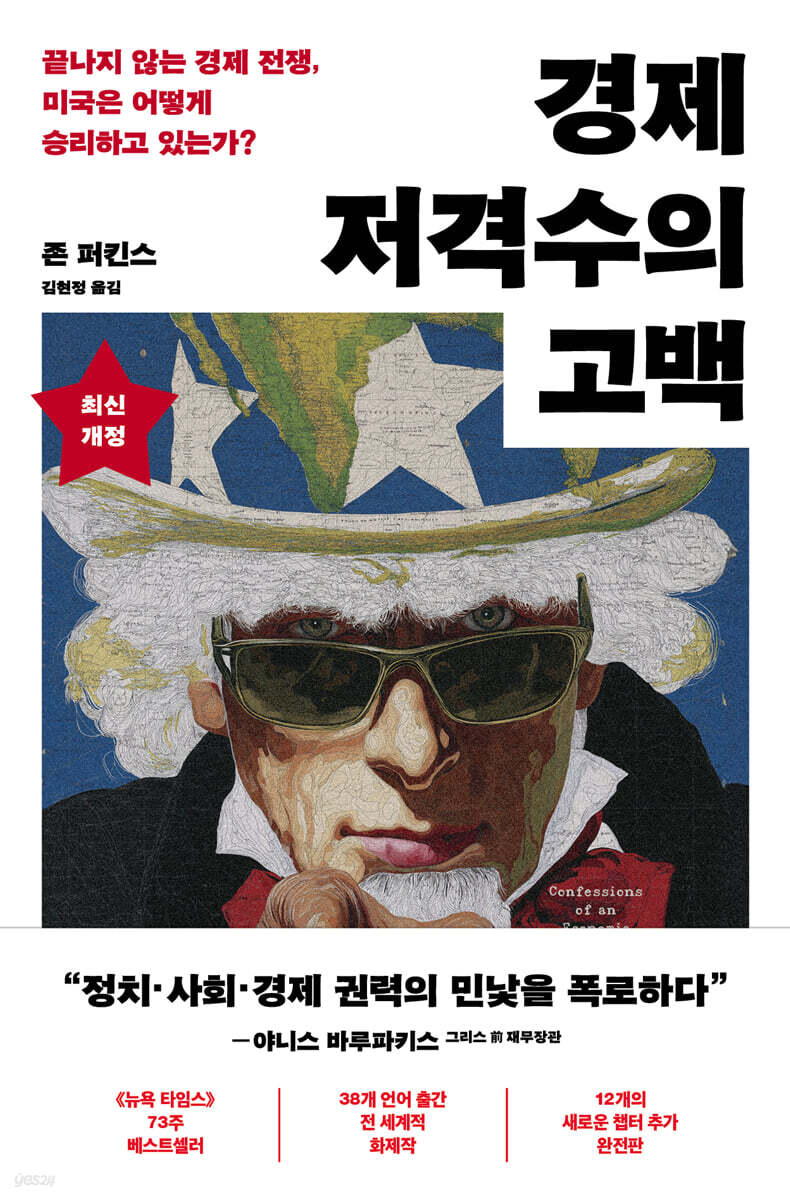
Confessions of an Economic Sniper (20th Anniversary Complete Edition)
 |
Description
Book Introduction
★ New York Times Bestseller for 73 Weeks ★
★ Translated into 38 languages worldwide, 2 million copies sold ★
★ Amazon Economy #1 ★
The world-famous work, "Confessions of an Economic Sniper,"
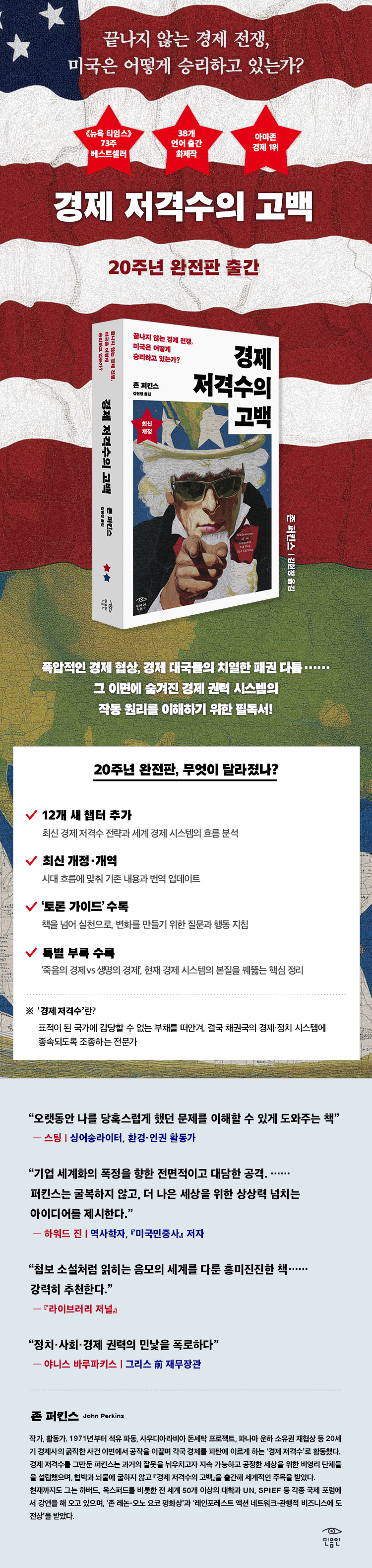
The '20th Anniversary Complete Edition' with 12 new chapters has been released!
Exposing the true face of political, social, and economic power
—Yannis Varoufakis (former Greek Finance Minister)
The book "Confessions of an Economic Sniper (20th Anniversary Complete Edition)", which shocked the world by revealing in detail the economic exploitation methods of the United States and China from an insider's perspective, has been published by Minumsa.
First published in 2004, this book has been translated into 38 languages, sold over 2 million copies, and remained on the New York Times bestseller list for 73 weeks. It is a must-read for understanding the complex global economic order of today, with its intensifying tariff war and the US-China hegemony struggle.
Twelve new chapters have been added to reflect the rapidly changing world situation, and the existing text has also been revised in content and translation to reflect the times.
British singer-songwriter and human rights activist Sting recommended the book, saying it “helped me understand issues that have puzzled me for a long time,” and world-renowned scholar and Harvard Business School professor David Cotton described the book as “incredibly helpful.”
In addition, experts from various fields such as historian and author of A People's History of the United States Howard Zinn, artist Yoko Ono, and spiritual authority Deepak Chopra have given praise.
Author John Perkins worked as a senior economist at a major American consulting firm in the 1970s and acted as an "economic sniper" in countries such as Ecuador, Indonesia, Panama, and Saudi Arabia.
An economic sniper is a specialist who imposes unmanageable debt on a targeted country, ultimately manipulating it into becoming dependent on the creditor country's economic and political system.
In this book, Perkins delves into the evolution of economic sniper strategies and how they have shaken the global economy, focusing on four tactics: debt, fear, the fear of scarcity, and divide and conquer.
Confessions of an Economic Sniper (20th Anniversary Complete Edition) analyzes new economic sniper strategies while also diagnosing the fundamental causes of exploitation that persists even after exposure.
Through this, readers can more clearly understand the operating principles of the economic power system hidden behind Trump's endless economic pressure and the fierce competition among major economic powers.
Furthermore, this book provides a framework for understanding the true meaning of the daily news, and offers practical solutions and insights to navigate turbulent times without being swayed.
★ Translated into 38 languages worldwide, 2 million copies sold ★
★ Amazon Economy #1 ★
The world-famous work, "Confessions of an Economic Sniper,"
The '20th Anniversary Complete Edition' with 12 new chapters has been released!
Exposing the true face of political, social, and economic power
—Yannis Varoufakis (former Greek Finance Minister)
The book "Confessions of an Economic Sniper (20th Anniversary Complete Edition)", which shocked the world by revealing in detail the economic exploitation methods of the United States and China from an insider's perspective, has been published by Minumsa.
First published in 2004, this book has been translated into 38 languages, sold over 2 million copies, and remained on the New York Times bestseller list for 73 weeks. It is a must-read for understanding the complex global economic order of today, with its intensifying tariff war and the US-China hegemony struggle.
Twelve new chapters have been added to reflect the rapidly changing world situation, and the existing text has also been revised in content and translation to reflect the times.
British singer-songwriter and human rights activist Sting recommended the book, saying it “helped me understand issues that have puzzled me for a long time,” and world-renowned scholar and Harvard Business School professor David Cotton described the book as “incredibly helpful.”
In addition, experts from various fields such as historian and author of A People's History of the United States Howard Zinn, artist Yoko Ono, and spiritual authority Deepak Chopra have given praise.
Author John Perkins worked as a senior economist at a major American consulting firm in the 1970s and acted as an "economic sniper" in countries such as Ecuador, Indonesia, Panama, and Saudi Arabia.
An economic sniper is a specialist who imposes unmanageable debt on a targeted country, ultimately manipulating it into becoming dependent on the creditor country's economic and political system.
In this book, Perkins delves into the evolution of economic sniper strategies and how they have shaken the global economy, focusing on four tactics: debt, fear, the fear of scarcity, and divide and conquer.
Confessions of an Economic Sniper (20th Anniversary Complete Edition) analyzes new economic sniper strategies while also diagnosing the fundamental causes of exploitation that persists even after exposure.
Through this, readers can more clearly understand the operating principles of the economic power system hidden behind Trump's endless economic pressure and the fierce competition among major economic powers.
Furthermore, this book provides a framework for understanding the true meaning of the daily news, and offers practical solutions and insights to navigate turbulent times without being swayed.
- You can preview some of the book's contents.
Preview
index
Introduction 10
Introduction: The Third Wave of Economic Snipers and China's Economic Sniper Strategy 17
|Part 1| Signs of the Coming Future
Chapter 1: The Rebellious President 35
Chapter 2: The Savior Who Embraced Nightmares 43
Chapter 3: The Canary in the Cage 49
|Part 2| 1963–1971
Chapter 4 Dirty Work 61
Chapter 5: The Birth of the Economic Sniper 74
Chapter 6: "It's not something you can just quit." 88
Chapter 7: First Target: Indonesia 101
Chapter 8: Saving a Nation from Communism 106
Chapter 9: The Soul Bartered for Money 113
|Part 3| 1971–1975
Chapter 10: The American Investigator in Bandung 125
Chapter 11: Civilization in the Face of Trials 130
Chapter 12: The Opportunity of a Lifetime 138
Chapter 13: Torrijos, the Hero of Panama 148
Chapter 14: The Raiders of the Panama Canal 155
Chapter 15: Conversation with Torrijos 158
Chapter 16: The Darkness Cast Over the World Economy 167
Chapter 17: Saudi Arabia's Money Laundering Project 173
Chapter 18: The Prince, the Pimp, and Osama Bin Laden 191
|Part 4| 1975–1981
Chapter 19: Panama Canal Negotiations 201
Chapter 20: The King of Kings of Iran 209
Chapter 21: Confessions of a Tortured Man 215
Chapter 22: The Fall of the King of Kings 221
Chapter 23: Colombia: The Keystone of South America 226
Chapter 24: Republic vs. World Empire 230
Chapter 25: Manipulated Resume 241
Chapter 26: The Ecuadorian President's Fight for Oil 249
Chapter 27: Finally Resigned 256
|Part 5| 1981–2004
Chapter 28: The Death of the Ecuadorian President 263
Chapter 29: This Time in Panama, Another President's Death 270
Chapter 30 My Energy Company and George W.
Bush 274
Chapter 31: Bribery 281
Chapter 32: The American Invasion of Panama 290
Chapter 33: The Failed Economic Sniper in Iraq 303
|Part 6| 2004-2016
Chapter 34: Conspiracy: Who Poisoned It? 317
Chapter 35: Istanbul: The Economy of Life and the Economy of Death 325
Chapter 36: Another Banking Scandal Involving Economic Snipers 333
Chapter 37: The New Economic Sniper of the New Millennium 341
Chapter 38: The New Jackal of the New Millennium 353
|Part 7| China's Economic Sniper Strategy
Chapter 39: China's Disruption of the World 363
Chapter 40: China's Economic Sniper 377
Chapter 41: Central and South America 383
Chapter 42 Asia 400
Chapter 43 Africa 419
Chapter 44: The Middle East 441
Chapter 45 Europe 458
Chapter 46: United States 474
Conclusion: Change is only possible if everyone makes an effort. 481
Discussion Guide 494
Appendix: The Economy of Death vs. the Economy of Life 502
Author's Biography 509
Reference 516
Week 519
Acknowledgments 543
About the Author 546
Translator's Note 550
Introduction: The Third Wave of Economic Snipers and China's Economic Sniper Strategy 17
|Part 1| Signs of the Coming Future
Chapter 1: The Rebellious President 35
Chapter 2: The Savior Who Embraced Nightmares 43
Chapter 3: The Canary in the Cage 49
|Part 2| 1963–1971
Chapter 4 Dirty Work 61
Chapter 5: The Birth of the Economic Sniper 74
Chapter 6: "It's not something you can just quit." 88
Chapter 7: First Target: Indonesia 101
Chapter 8: Saving a Nation from Communism 106
Chapter 9: The Soul Bartered for Money 113
|Part 3| 1971–1975
Chapter 10: The American Investigator in Bandung 125
Chapter 11: Civilization in the Face of Trials 130
Chapter 12: The Opportunity of a Lifetime 138
Chapter 13: Torrijos, the Hero of Panama 148
Chapter 14: The Raiders of the Panama Canal 155
Chapter 15: Conversation with Torrijos 158
Chapter 16: The Darkness Cast Over the World Economy 167
Chapter 17: Saudi Arabia's Money Laundering Project 173
Chapter 18: The Prince, the Pimp, and Osama Bin Laden 191
|Part 4| 1975–1981
Chapter 19: Panama Canal Negotiations 201
Chapter 20: The King of Kings of Iran 209
Chapter 21: Confessions of a Tortured Man 215
Chapter 22: The Fall of the King of Kings 221
Chapter 23: Colombia: The Keystone of South America 226
Chapter 24: Republic vs. World Empire 230
Chapter 25: Manipulated Resume 241
Chapter 26: The Ecuadorian President's Fight for Oil 249
Chapter 27: Finally Resigned 256
|Part 5| 1981–2004
Chapter 28: The Death of the Ecuadorian President 263
Chapter 29: This Time in Panama, Another President's Death 270
Chapter 30 My Energy Company and George W.
Bush 274
Chapter 31: Bribery 281
Chapter 32: The American Invasion of Panama 290
Chapter 33: The Failed Economic Sniper in Iraq 303
|Part 6| 2004-2016
Chapter 34: Conspiracy: Who Poisoned It? 317
Chapter 35: Istanbul: The Economy of Life and the Economy of Death 325
Chapter 36: Another Banking Scandal Involving Economic Snipers 333
Chapter 37: The New Economic Sniper of the New Millennium 341
Chapter 38: The New Jackal of the New Millennium 353
|Part 7| China's Economic Sniper Strategy
Chapter 39: China's Disruption of the World 363
Chapter 40: China's Economic Sniper 377
Chapter 41: Central and South America 383
Chapter 42 Asia 400
Chapter 43 Africa 419
Chapter 44: The Middle East 441
Chapter 45 Europe 458
Chapter 46: United States 474
Conclusion: Change is only possible if everyone makes an effort. 481
Discussion Guide 494
Appendix: The Economy of Death vs. the Economy of Life 502
Author's Biography 509
Reference 516
Week 519
Acknowledgments 543
About the Author 546
Translator's Note 550
Detailed image
Into the book
The purpose of domination is cleverly obscured.
The perception that those who rule are helping those who are ruled obscures the true purpose of rule.
The logic that everyone will ultimately enjoy a better life justifies the economic sniper strategy.
Their argument is that low-income countries will become high-income countries and the poorest will become middle class.
--- p.17~18
The reason I'm writing my third book on economic snipers is because I believe it's important to analyze the relationship between economic sniper strategies and the many crises facing humanity.
--- p.30
Ener hired me as an economics expert, but I quickly learned that my role was much more than that.
In fact, the tasks I was assigned to in the main were closer to the activities of James Bond than the work of an economic expert.
--- p.87
The condition was that Saudi Arabia had to purchase bonds issued by the U.S. government with the dollars it earned from exporting oil.
Instead, the U.S. Treasury promised to use the money from bond sales to help Saudi Arabia shed its archaic social structure and transform itself into a modern, industrial society.
In other words, Saudi Arabia makes billions of dollars selling oil, and then, with interest, gives all that money back to American companies under the guise of developing Saudi Arabia in line with the vision presented by me and other consulting firms.
--- p.187
For the past ten years, I've been living like a descendant of slave traders.
The way I work is more modern and subtle, so I don't have to watch people die, smell rotting flesh, or hear the screams of grief.
But I too have sinned.
Perhaps it was because he could separate himself from such horrors—because he didn't have to directly endure the suffering, rotting flesh, and screams of human beings—that he could be so much more evil.
--- p.259
Governments and business leaders around the world have taken the lead in promoting Milton Friedman's logic of "profit maximization."
Issues related to social welfare, the environment, and quality of life all disappeared, leaving only greed.
In the process, revitalizing private businesses was considered excessively important.
--- p.284
What had previously been done secretly by me and a few colleagues was now being done together with executives from various industries.
They spread across the globe, seeking out the cheapest labor, the most readily available resources, and the largest markets.
Their approach was ruthless.
(······) The ripples created by the new economic snipers have come together to create a second huge wave.
--- p.284~285
Tools that have been used for a long time have been sharpened even further, and new tools have even appeared.
The core of the system remains the same today.
Ultimately, the core of the economic sniper system is an economic and political ideology based on four tactics: fear, debt, insecurity, and divide and conquer.
--- p.321
There are hundreds of thousands of economic snipers scattered around the world.
They created a true global empire and an economic system that threatens our way of life as we know it.
Economic snipers sometimes operate openly and sometimes covertly.
This system has become so widespread and deeply rooted that it is now considered normal business practice.
That's why most people don't feel any alarm about this method.
--- p.327
Xi Jinping emphasized that China's approach to other countries is very different from that of the United States.
First, let's look at the fear tactics: Xi Jinping promised not to interfere in the internal affairs of other countries or influence their domestic and foreign policies.
It was a subtle suggestion that cooperation with China might soon become a way to escape American interference.
Faced with debt and the anxiety of inadequacy, Xi Jinping has pledged to pursue strategic interests through Chinese investment rather than entangle aid programs with political issues in helping other countries develop.
The divide-and-conquer strategy was replaced by a demand for unity through the New Silk Road.
--- p.387
However, the facts that are actually revealed often differ from the perception that China emphasizes.
The Chinese government demands that the vassal states receiving its investments support China's foreign policy.
In particular, they argue that China's foreign policy surrounding Tibet, Hong Kong, and Taiwan, as well as its domestic policies regarding ethnic minorities, including the Uyghurs, should be supported.
Nonetheless, Latin American countries, tired of the long-standing harassment from the US government and Wall Street, valued China's promise not to interfere in their internal affairs.
--- p.387~388
As elsewhere, the most important conclusion regarding Africa is that the economic sniper strategy is not helpful to the continent or the world.
(······) Problems surrounding local workers, social welfare systems, and the environment became increasingly serious, while debt, poorly constructed construction projects, and corruption also became more serious by the day.
Moreover, more and more resources became the target of plunder.
But I am well aware that this new form of colonialism is the result of the very same strategy that reached new heights during my time as an economic sniper.
--- p.439~440
The concepts we accepted without resistance ultimately led to a destructive clash between the economic sniper strategies of the United States and China.
(······) The two countries have similar goals and their economies are also closely intertwined.
Because of these two countries, the whole world has faced numerous crises.
The perception that those who rule are helping those who are ruled obscures the true purpose of rule.
The logic that everyone will ultimately enjoy a better life justifies the economic sniper strategy.
Their argument is that low-income countries will become high-income countries and the poorest will become middle class.
--- p.17~18
The reason I'm writing my third book on economic snipers is because I believe it's important to analyze the relationship between economic sniper strategies and the many crises facing humanity.
--- p.30
Ener hired me as an economics expert, but I quickly learned that my role was much more than that.
In fact, the tasks I was assigned to in the main were closer to the activities of James Bond than the work of an economic expert.
--- p.87
The condition was that Saudi Arabia had to purchase bonds issued by the U.S. government with the dollars it earned from exporting oil.
Instead, the U.S. Treasury promised to use the money from bond sales to help Saudi Arabia shed its archaic social structure and transform itself into a modern, industrial society.
In other words, Saudi Arabia makes billions of dollars selling oil, and then, with interest, gives all that money back to American companies under the guise of developing Saudi Arabia in line with the vision presented by me and other consulting firms.
--- p.187
For the past ten years, I've been living like a descendant of slave traders.
The way I work is more modern and subtle, so I don't have to watch people die, smell rotting flesh, or hear the screams of grief.
But I too have sinned.
Perhaps it was because he could separate himself from such horrors—because he didn't have to directly endure the suffering, rotting flesh, and screams of human beings—that he could be so much more evil.
--- p.259
Governments and business leaders around the world have taken the lead in promoting Milton Friedman's logic of "profit maximization."
Issues related to social welfare, the environment, and quality of life all disappeared, leaving only greed.
In the process, revitalizing private businesses was considered excessively important.
--- p.284
What had previously been done secretly by me and a few colleagues was now being done together with executives from various industries.
They spread across the globe, seeking out the cheapest labor, the most readily available resources, and the largest markets.
Their approach was ruthless.
(······) The ripples created by the new economic snipers have come together to create a second huge wave.
--- p.284~285
Tools that have been used for a long time have been sharpened even further, and new tools have even appeared.
The core of the system remains the same today.
Ultimately, the core of the economic sniper system is an economic and political ideology based on four tactics: fear, debt, insecurity, and divide and conquer.
--- p.321
There are hundreds of thousands of economic snipers scattered around the world.
They created a true global empire and an economic system that threatens our way of life as we know it.
Economic snipers sometimes operate openly and sometimes covertly.
This system has become so widespread and deeply rooted that it is now considered normal business practice.
That's why most people don't feel any alarm about this method.
--- p.327
Xi Jinping emphasized that China's approach to other countries is very different from that of the United States.
First, let's look at the fear tactics: Xi Jinping promised not to interfere in the internal affairs of other countries or influence their domestic and foreign policies.
It was a subtle suggestion that cooperation with China might soon become a way to escape American interference.
Faced with debt and the anxiety of inadequacy, Xi Jinping has pledged to pursue strategic interests through Chinese investment rather than entangle aid programs with political issues in helping other countries develop.
The divide-and-conquer strategy was replaced by a demand for unity through the New Silk Road.
--- p.387
However, the facts that are actually revealed often differ from the perception that China emphasizes.
The Chinese government demands that the vassal states receiving its investments support China's foreign policy.
In particular, they argue that China's foreign policy surrounding Tibet, Hong Kong, and Taiwan, as well as its domestic policies regarding ethnic minorities, including the Uyghurs, should be supported.
Nonetheless, Latin American countries, tired of the long-standing harassment from the US government and Wall Street, valued China's promise not to interfere in their internal affairs.
--- p.387~388
As elsewhere, the most important conclusion regarding Africa is that the economic sniper strategy is not helpful to the continent or the world.
(······) Problems surrounding local workers, social welfare systems, and the environment became increasingly serious, while debt, poorly constructed construction projects, and corruption also became more serious by the day.
Moreover, more and more resources became the target of plunder.
But I am well aware that this new form of colonialism is the result of the very same strategy that reached new heights during my time as an economic sniper.
--- p.439~440
The concepts we accepted without resistance ultimately led to a destructive clash between the economic sniper strategies of the United States and China.
(······) The two countries have similar goals and their economies are also closely intertwined.
Because of these two countries, the whole world has faced numerous crises.
--- p.479
Publisher's Review
Even as times change, the economic sniper strategy persists.
The core of the economic sniper strategy is four tactics: debt, fear, the fear of shortages, and divide and conquer.
In the 1970s, when author John Perkins first entered the economic sniper business, America, having lost the ability to create military fear after its failure in the Vietnam War, turned to debt as its primary weapon.
This was a method of imposing neoliberalism on developing countries by saddled them with debt through the World Bank and the IMF (first wave). After 2001, this strategy spread from developing countries to developed countries (second wave), and China subsequently adapted the four tactics to its own needs.
Rather than military threats, they promoted the economic temptation of a rapidly growing domestic model; instead of imposing neoliberalism, they pledged non-interference in internal affairs; and instead of fomenting division, they promoted a vision of integration through the New Silk Road (the Third Wave).
"Confessions of an Economic Sniper (20th Anniversary Complete Edition)" strongly suggests, with concrete examples, that while this new economic sniper model may seem beneficial, the results are equally destructive.
For example, Sri Lanka lost the right to operate a strategically important port to China due to its massive debt.
Infrastructure projects in countries including Vietnam, Indonesia, and Ecuador have suffered from poor construction, while power plants and steel mills built in Serbia have caused serious environmental pollution problems.
After making the creditor nation economically dependent on them, they began to force them to support certain diplomatic positions.
John Perkins, having been active in the economic sniper strategy since its inception, sees this pattern better than anyone else, one that has remained the same for 50 years, with only the actors changing.
It also provides specific information that only insiders would know, empowering you to objectively look at and think about why the same mistakes are repeated and how to break free from this vicious cycle.
Through this, anyone can quickly detect signs of impending change and develop a three-dimensional perspective on the world situation.
Penetrating the essence of the economic system that drives the world
John Perkins was an economic sniper who led the operations behind major events in 20th-century economic history, such as the oil crisis, Saudi Arabia's money-laundering scheme, and the renegotiation of ownership of the Panama Canal, and brought about the collapse of economies around the world.
After reflecting on his own actions and working hard to uncover the methods of exploitation, he discovered that various recent incidents, which seemed individual, were actually based on a single strategy.
It is a 'death economy' system that fills the bellies of economic powers based on the ideology that it is acceptable to sacrifice the majority for the wealth and power of a few.
This system, which focuses only on the wealth of a few and spreads the corrupted concept of capitalism, has destructive consequences not only in the economy but in all aspects.
The threats to our lives—worsening inequality, endless genocide and war, and climate catastrophe caused by materialism—all stem from this.
"Confessions of an Economic Sniper (20th Anniversary Complete Edition)" traces the flow of the global economy over a full 50 years, allowing readers to understand the structure of reality beyond superficial issues.
It helps us understand the structural context of recent events, including not only historical events but also President Trump's oppressive economic negotiations and South Korea's precarious tightrope walk between the United States and China.
The back of the book includes a 'Discussion Guide' and 'Appendix: The Economy of Death vs. the Economy of Life,' providing readers with the opportunity to explore their own alternatives beyond simply reading the book.
If we clearly understand the principles of the system and each participate in the change in our own way, this book will finally be able to remain as a 'story of the past.'
The core of the economic sniper strategy is four tactics: debt, fear, the fear of shortages, and divide and conquer.
In the 1970s, when author John Perkins first entered the economic sniper business, America, having lost the ability to create military fear after its failure in the Vietnam War, turned to debt as its primary weapon.
This was a method of imposing neoliberalism on developing countries by saddled them with debt through the World Bank and the IMF (first wave). After 2001, this strategy spread from developing countries to developed countries (second wave), and China subsequently adapted the four tactics to its own needs.
Rather than military threats, they promoted the economic temptation of a rapidly growing domestic model; instead of imposing neoliberalism, they pledged non-interference in internal affairs; and instead of fomenting division, they promoted a vision of integration through the New Silk Road (the Third Wave).
"Confessions of an Economic Sniper (20th Anniversary Complete Edition)" strongly suggests, with concrete examples, that while this new economic sniper model may seem beneficial, the results are equally destructive.
For example, Sri Lanka lost the right to operate a strategically important port to China due to its massive debt.
Infrastructure projects in countries including Vietnam, Indonesia, and Ecuador have suffered from poor construction, while power plants and steel mills built in Serbia have caused serious environmental pollution problems.
After making the creditor nation economically dependent on them, they began to force them to support certain diplomatic positions.
John Perkins, having been active in the economic sniper strategy since its inception, sees this pattern better than anyone else, one that has remained the same for 50 years, with only the actors changing.
It also provides specific information that only insiders would know, empowering you to objectively look at and think about why the same mistakes are repeated and how to break free from this vicious cycle.
Through this, anyone can quickly detect signs of impending change and develop a three-dimensional perspective on the world situation.
Penetrating the essence of the economic system that drives the world
John Perkins was an economic sniper who led the operations behind major events in 20th-century economic history, such as the oil crisis, Saudi Arabia's money-laundering scheme, and the renegotiation of ownership of the Panama Canal, and brought about the collapse of economies around the world.
After reflecting on his own actions and working hard to uncover the methods of exploitation, he discovered that various recent incidents, which seemed individual, were actually based on a single strategy.
It is a 'death economy' system that fills the bellies of economic powers based on the ideology that it is acceptable to sacrifice the majority for the wealth and power of a few.
This system, which focuses only on the wealth of a few and spreads the corrupted concept of capitalism, has destructive consequences not only in the economy but in all aspects.
The threats to our lives—worsening inequality, endless genocide and war, and climate catastrophe caused by materialism—all stem from this.
"Confessions of an Economic Sniper (20th Anniversary Complete Edition)" traces the flow of the global economy over a full 50 years, allowing readers to understand the structure of reality beyond superficial issues.
It helps us understand the structural context of recent events, including not only historical events but also President Trump's oppressive economic negotiations and South Korea's precarious tightrope walk between the United States and China.
The back of the book includes a 'Discussion Guide' and 'Appendix: The Economy of Death vs. the Economy of Life,' providing readers with the opportunity to explore their own alternatives beyond simply reading the book.
If we clearly understand the principles of the system and each participate in the change in our own way, this book will finally be able to remain as a 'story of the past.'
GOODS SPECIFICS
- Date of issue: October 15, 2025
- Page count, weight, size: 556 pages | 145*220*35mm
- ISBN13: 9791170526728
- ISBN10: 1170526721
You may also like
카테고리
korean


korean

![GQ KOREA Mark (Monthly): December [2025]](http://librairie.coreenne.fr/cdn/shop/files/8ef265dbbfbf186523ed75ba7319009d.jpg?v=1765340328&width=3840)


