

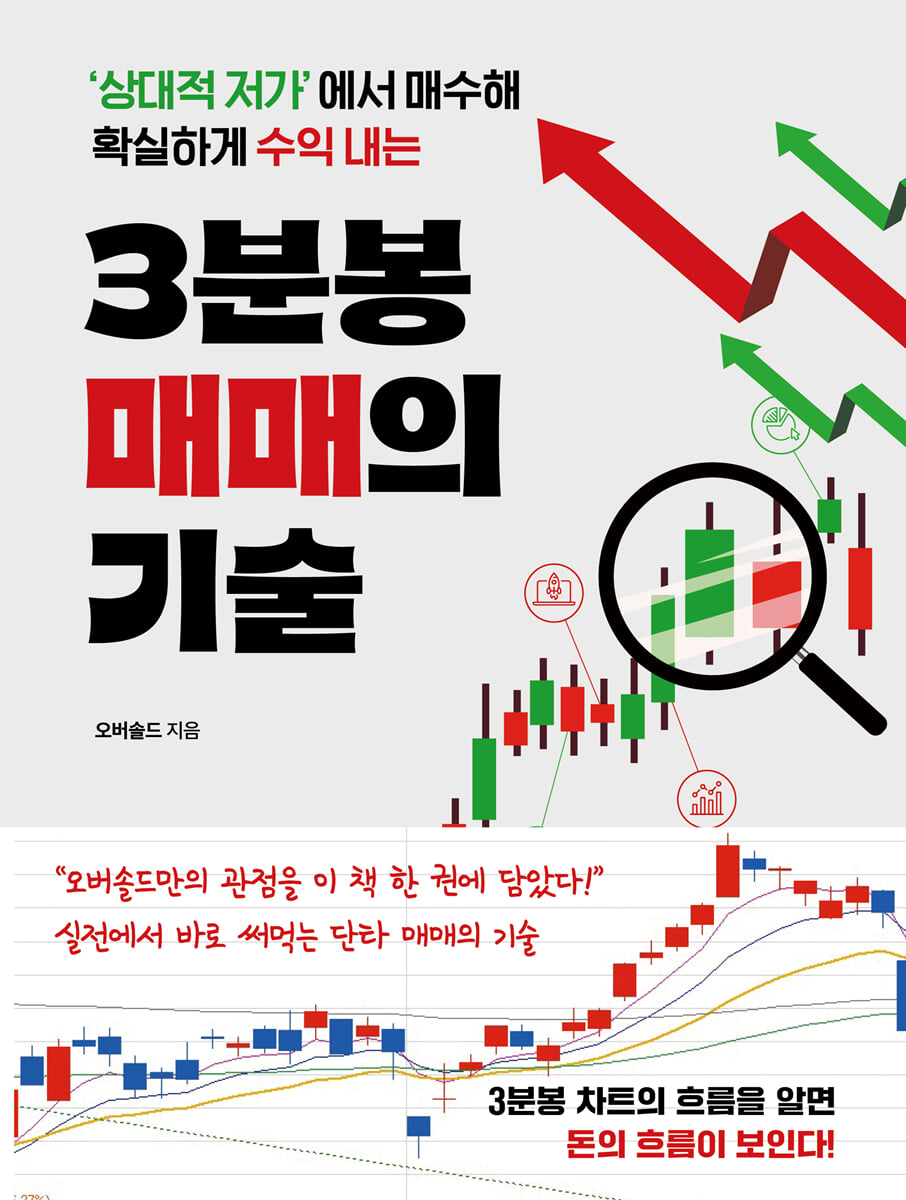
3-minute chart trading techniques
 |
Description
Book Introduction
Korea's first 3-minute short-term trading technique book!
The latest installment in the bestselling Oversold investment technique series
From 2024 to the first half of 2025, the stock market was plagued by numerous events and volatility that left investors wondering, "What should I do?"
It was a time when it was difficult to put down the charts for even a single day.
Many investors are left wondering, "When should I buy?" and "When should I sell?"
However, anyone who has mastered the '3-minute chart trading technique' will have found the answer even in the midst of confusion.
The author of this book, Oversold, advises that in order to boldly trade at a critical juncture in the market, you must be able to surrender yourself to the flow of the market rather than trying to adapt your circumstances to the market.
To achieve this, we must actively utilize auxiliary indicators as a means to maximize profits while simultaneously limiting losses by purchasing at low prices that everyone fears.
The author has been investing in stocks for over 20 years and has experienced three setbacks. However, he never gave up and delved into the essence of trading, eventually establishing his own trading technique.
As a result, he established an investment technique that generates substantial profits by purchasing stocks that have entered the oversold zone in installments, and introduced the know-how through 『Stock Selection Techniques』, 『Short-Term Trading Techniques』, and 『Price-Purchasing Techniques』.
This book, "3-Minute Chart Trading Techniques," contains strategies that utilize the movement of 3-minute charts, which are arrangements of bars created over a period of 2 to 3 days.
It covers techniques that allow for a certain degree of leeway in responding to 'relative lows that create short-term corrections during an upward trend', and intensively utilizes search formulas to find arrangements of candlesticks with a high probability of inducing an upward trend.
In other words, it is not a blind investment where you just buy a stock because you think it is good, but rather a step-by-step approach where you thoroughly study the theory, fully understand it, identify the characteristics of the stock extracted through the search formula, and trade accordingly.
The latest installment in the bestselling Oversold investment technique series
From 2024 to the first half of 2025, the stock market was plagued by numerous events and volatility that left investors wondering, "What should I do?"
It was a time when it was difficult to put down the charts for even a single day.
Many investors are left wondering, "When should I buy?" and "When should I sell?"
However, anyone who has mastered the '3-minute chart trading technique' will have found the answer even in the midst of confusion.
The author of this book, Oversold, advises that in order to boldly trade at a critical juncture in the market, you must be able to surrender yourself to the flow of the market rather than trying to adapt your circumstances to the market.
To achieve this, we must actively utilize auxiliary indicators as a means to maximize profits while simultaneously limiting losses by purchasing at low prices that everyone fears.
The author has been investing in stocks for over 20 years and has experienced three setbacks. However, he never gave up and delved into the essence of trading, eventually establishing his own trading technique.
As a result, he established an investment technique that generates substantial profits by purchasing stocks that have entered the oversold zone in installments, and introduced the know-how through 『Stock Selection Techniques』, 『Short-Term Trading Techniques』, and 『Price-Purchasing Techniques』.
This book, "3-Minute Chart Trading Techniques," contains strategies that utilize the movement of 3-minute charts, which are arrangements of bars created over a period of 2 to 3 days.
It covers techniques that allow for a certain degree of leeway in responding to 'relative lows that create short-term corrections during an upward trend', and intensively utilizes search formulas to find arrangements of candlesticks with a high probability of inducing an upward trend.
In other words, it is not a blind investment where you just buy a stock because you think it is good, but rather a step-by-step approach where you thoroughly study the theory, fully understand it, identify the characteristics of the stock extracted through the search formula, and trade accordingly.
- You can preview some of the book's contents.
Preview
index
Introduction_To those considering short-term trading
Chapter 1.
Why short-term trading?
Why You Should Short-Term Trade
How much profit do you want?
Why Use 3-Minute Charts?
Market trading and intraday trading
The criteria are candlesticks and moving averages
One year old when born
If the previous day's closing price = high candlestick, then the gap rises on the same day
If the gap rises today from the previous day's upper tail candle,
Why the previous day's closing price is important
If you are a top-tailed beekeeper and are short,
Chapter 2.
The art of short-term cigar trading
Taking advantage of the gap rising price the day after the upper limit
1-1.
KEPCO Industrial, J2K Bio
1-2. SK, Advanced Beauty Science
1-3.
Ecopromity, Taesung
1-4.
Inventage Lab, Hanil Danjo
1-5.
Korea Zinc
Short-term trading using the previous day's new candlestick as a standard
2-1.
Inglewood Lab, YC
2-2.
Alteogen, STI
2-3.
Hanwha Aerospace, LIG Nex1
2-4.
Alteogen, Voronoi
2-5.
Korean cosmetics manufacturing
Short-term trading using upper tail candlesticks as a standard
3-1. SK, Juseong Engineering
3-2. SDN, POSCO International
3-3. LK Samyang, Hanil Forging
3-4.
Cocom, Purstec
3-5.
Hanmi Science
Short-term trading using hidden candlesticks
4-1. LIG Nex1, Hearts
4-2.
Shin Poong Pharmaceutical, Olix
4-3.
Olix, LK Samyang
4-4.
Lab Genomics, SY Steel Tech
Chapter 3.
The art of intraday short-term trading
Short-term trading using the rebound of the 20-day moving average
1-1.
Samhwa Electric, Samhwa Electric
1-2.
Jeryong Electric, Samhwa Electric
1-3.
Silicon Two, Gridwiz
1-4.
Chaperone, Big Context
Short-term trading using the rebound of the 65 and 130 moving averages after a sharp rise
2-1.
Samchuly Bicycle, Taesung
2-2.
Korea Gas Corporation and Advanced Beauty Science
2-3.
Advanced Beauty Science, Our Technology
2-4.
Peptron, Hyundai Everdigm
2-5.
Dasco
Short-term trading using the rebound of the 5-day or 10-day moving average
3-1.
Our technology, Inglewood Lab
3-2.
Korea Gas Corporation, SKC
3-3.
Cosmecca Korea, LIG Nex1
3-4.
Cosmecca Korea, Samsung Air Conditioning
3-5.
Hyundai Glovis
Short-term trading using rebounds after a sharp decline
4-1.
Hanmi Semiconductor, Hanmi Semiconductor
4-2.
Cosmecca Korea, Doosan
4-3.
Doosan, Hyundai Motors
4-4.
Futurechem, PSK Holdings
4-5.
Peptron
Find stocks using the appendix search function
Chapter 1.
Why short-term trading?
Why You Should Short-Term Trade
How much profit do you want?
Why Use 3-Minute Charts?
Market trading and intraday trading
The criteria are candlesticks and moving averages
One year old when born
If the previous day's closing price = high candlestick, then the gap rises on the same day
If the gap rises today from the previous day's upper tail candle,
Why the previous day's closing price is important
If you are a top-tailed beekeeper and are short,
Chapter 2.
The art of short-term cigar trading
Taking advantage of the gap rising price the day after the upper limit
1-1.
KEPCO Industrial, J2K Bio
1-2. SK, Advanced Beauty Science
1-3.
Ecopromity, Taesung
1-4.
Inventage Lab, Hanil Danjo
1-5.
Korea Zinc
Short-term trading using the previous day's new candlestick as a standard
2-1.
Inglewood Lab, YC
2-2.
Alteogen, STI
2-3.
Hanwha Aerospace, LIG Nex1
2-4.
Alteogen, Voronoi
2-5.
Korean cosmetics manufacturing
Short-term trading using upper tail candlesticks as a standard
3-1. SK, Juseong Engineering
3-2. SDN, POSCO International
3-3. LK Samyang, Hanil Forging
3-4.
Cocom, Purstec
3-5.
Hanmi Science
Short-term trading using hidden candlesticks
4-1. LIG Nex1, Hearts
4-2.
Shin Poong Pharmaceutical, Olix
4-3.
Olix, LK Samyang
4-4.
Lab Genomics, SY Steel Tech
Chapter 3.
The art of intraday short-term trading
Short-term trading using the rebound of the 20-day moving average
1-1.
Samhwa Electric, Samhwa Electric
1-2.
Jeryong Electric, Samhwa Electric
1-3.
Silicon Two, Gridwiz
1-4.
Chaperone, Big Context
Short-term trading using the rebound of the 65 and 130 moving averages after a sharp rise
2-1.
Samchuly Bicycle, Taesung
2-2.
Korea Gas Corporation and Advanced Beauty Science
2-3.
Advanced Beauty Science, Our Technology
2-4.
Peptron, Hyundai Everdigm
2-5.
Dasco
Short-term trading using the rebound of the 5-day or 10-day moving average
3-1.
Our technology, Inglewood Lab
3-2.
Korea Gas Corporation, SKC
3-3.
Cosmecca Korea, LIG Nex1
3-4.
Cosmecca Korea, Samsung Air Conditioning
3-5.
Hyundai Glovis
Short-term trading using rebounds after a sharp decline
4-1.
Hanmi Semiconductor, Hanmi Semiconductor
4-2.
Cosmecca Korea, Doosan
4-3.
Doosan, Hyundai Motors
4-4.
Futurechem, PSK Holdings
4-5.
Peptron
Find stocks using the appendix search function
Detailed image

Into the book
The world of short-term trading is like a battlefield.
Oversold also gained experience in short-term trading by repeating profits and losses over a long period of time.
From those experiences, I refined my successful trading skills and knowledge to write this book.
The process of developing and testing hypotheses about patterns that can generate profits is a time-consuming and expensive process.
Through this book, Oversold aims to provide individuals who are forced to engage in short-term trading with the know-how and techniques to survive in the market for as long as possible.
--- p.24
The buying power that created the upper limit often acts as upward pressure to continue the rise on the day after the upper limit, that is, on D+1 day, and even when a correction occurs after the opening price on D+1 day, it acts as a force that prevents the stock price from falling near the upper limit and protects the closing price at the upper limit.
Another reason for trading on the D+1 day is that, depending on the background of the upper limit, additional new buying pressure may flow in from the beginning of the market, allowing the upward momentum to continue for a certain period of time.
For these reasons, D+1 day trading has the advantage of allowing you to trade at an appropriate buying point.
--- p.111~112
On July 10, 2024, Alteogen ended a two-day decline and formed a new bullish candle without breaking the 20-day moving average.
Again, you can make short-term trades based on this candlestick.
Basically, we consider the low price of the new candlestick as the stop loss price and approach it by viewing the RSI oversold zone entry and the MACD-signal line golden cross as buying points on the 3-minute chart.
--- p.236
If a power tries to make a profit by selling a large amount of stocks it holds while the stock price is rising, and there is no buying force to accept it in the expectation that the stock price will rise further, the power has no choice but to sell, suffering a loss in terms of profitability.
So the powers that be work a lot to trick individuals into buying enough to get them to exit at their highest point.
Good news coming from a high point is a signal to lure individuals.
The saying, "buy on rumors, sell on news," encapsulates this phenomenon.
--- p.501
If you create a search formula and open a real-time search window while trading, there is a risk of making brainless trades as signals are generated throughout the trading day.
There are many cases where the money earned in the early stages is lost later on, and even worse, losses are incurred.
Many investment experts are right when they say that most of the day's volatility comes in the morning session.
Therefore, adding a search time condition to the search expression from the beginning has the advantage of allowing you to focus.
Oversold also gained experience in short-term trading by repeating profits and losses over a long period of time.
From those experiences, I refined my successful trading skills and knowledge to write this book.
The process of developing and testing hypotheses about patterns that can generate profits is a time-consuming and expensive process.
Through this book, Oversold aims to provide individuals who are forced to engage in short-term trading with the know-how and techniques to survive in the market for as long as possible.
--- p.24
The buying power that created the upper limit often acts as upward pressure to continue the rise on the day after the upper limit, that is, on D+1 day, and even when a correction occurs after the opening price on D+1 day, it acts as a force that prevents the stock price from falling near the upper limit and protects the closing price at the upper limit.
Another reason for trading on the D+1 day is that, depending on the background of the upper limit, additional new buying pressure may flow in from the beginning of the market, allowing the upward momentum to continue for a certain period of time.
For these reasons, D+1 day trading has the advantage of allowing you to trade at an appropriate buying point.
--- p.111~112
On July 10, 2024, Alteogen ended a two-day decline and formed a new bullish candle without breaking the 20-day moving average.
Again, you can make short-term trades based on this candlestick.
Basically, we consider the low price of the new candlestick as the stop loss price and approach it by viewing the RSI oversold zone entry and the MACD-signal line golden cross as buying points on the 3-minute chart.
--- p.236
If a power tries to make a profit by selling a large amount of stocks it holds while the stock price is rising, and there is no buying force to accept it in the expectation that the stock price will rise further, the power has no choice but to sell, suffering a loss in terms of profitability.
So the powers that be work a lot to trick individuals into buying enough to get them to exit at their highest point.
Good news coming from a high point is a signal to lure individuals.
The saying, "buy on rumors, sell on news," encapsulates this phenomenon.
--- p.501
If you create a search formula and open a real-time search window while trading, there is a risk of making brainless trades as signals are generated throughout the trading day.
There are many cases where the money earned in the early stages is lost later on, and even worse, losses are incurred.
Many investment experts are right when they say that most of the day's volatility comes in the morning session.
Therefore, adding a search time condition to the search expression from the beginning has the advantage of allowing you to focus.
--- p.633
Publisher's Review
The one question that determines the success or failure of stock investment
“Do you see any points in the chart where the stock price is staying to rise?”
If you truly want to use the 3-minute chart for short-term trading, you should stop what you've been doing and read the theory section of this book over and over again, drawing a picture in your head.
Rather than rushing into trading, first familiarize yourself with how each type of chart appears on the day by observing it thoroughly.
Then, at some point, you will start to feel a 'pattern' and you will see nodes in the chart where the stock price is staying to rise.
In that very phrase, you need to put in money in the short term to make a profit.
Chapter 1, "Why Short-Term Trading?" covers the reasons for short-term trading, the purpose of profit, and the basics of 3-minute trading.
Chapter 2, "Short-Term Trading Techniques," introduces short-term trading know-how and search methods, along with practical investment examples for each type, including utilizing the gap-rising opening price the day after the upper limit, short-term trading using the previous day's new bullish candlestick as a benchmark, short-term trading using the upper tail bullish candlestick as a benchmark, and short-term trading using hidden bearish candlesticks.
Chapter 3, "Intraday Short-Term Trading Techniques," covers short-term trading utilizing rebounds from the 20-day moving average, short-term trading utilizing rebounds from the 65 and 130-day moving averages after a sharp rise, short-term trading utilizing rebounds from the 5-day or 10-day moving average, and short-term trading know-how utilizing rebounds after a sharp decline, search formulas, and real-world investment examples by type.
Every investor dreams of hitting the jackpot, but in the end, those who survive are those who consistently generate profits.
"The Art of 3-Minute Trading" helps even those who find it difficult to monitor the market all day, such as office workers, housewives, and students, manage risk and trade reliably.
Let's establish our own principles and move toward successful investment, consistently generating profits, through the trading techniques presented in this book.
“Do you see any points in the chart where the stock price is staying to rise?”
If you truly want to use the 3-minute chart for short-term trading, you should stop what you've been doing and read the theory section of this book over and over again, drawing a picture in your head.
Rather than rushing into trading, first familiarize yourself with how each type of chart appears on the day by observing it thoroughly.
Then, at some point, you will start to feel a 'pattern' and you will see nodes in the chart where the stock price is staying to rise.
In that very phrase, you need to put in money in the short term to make a profit.
Chapter 1, "Why Short-Term Trading?" covers the reasons for short-term trading, the purpose of profit, and the basics of 3-minute trading.
Chapter 2, "Short-Term Trading Techniques," introduces short-term trading know-how and search methods, along with practical investment examples for each type, including utilizing the gap-rising opening price the day after the upper limit, short-term trading using the previous day's new bullish candlestick as a benchmark, short-term trading using the upper tail bullish candlestick as a benchmark, and short-term trading using hidden bearish candlesticks.
Chapter 3, "Intraday Short-Term Trading Techniques," covers short-term trading utilizing rebounds from the 20-day moving average, short-term trading utilizing rebounds from the 65 and 130-day moving averages after a sharp rise, short-term trading utilizing rebounds from the 5-day or 10-day moving average, and short-term trading know-how utilizing rebounds after a sharp decline, search formulas, and real-world investment examples by type.
Every investor dreams of hitting the jackpot, but in the end, those who survive are those who consistently generate profits.
"The Art of 3-Minute Trading" helps even those who find it difficult to monitor the market all day, such as office workers, housewives, and students, manage risk and trade reliably.
Let's establish our own principles and move toward successful investment, consistently generating profits, through the trading techniques presented in this book.
GOODS SPECIFICS
- Date of issue: September 30, 2025
- Page count, weight, size: 648 pages | 1,272g | 170*225*38mm
- ISBN13: 9791170436775
- ISBN10: 1170436773
You may also like
카테고리
korean


korean

![ELLE 엘르 스페셜 에디션 A형 : 12월 [2025]](http://librairie.coreenne.fr/cdn/shop/files/b8e27a3de6c9538896439686c6b0e8fb.jpg?v=1766436872&width=3840)


