

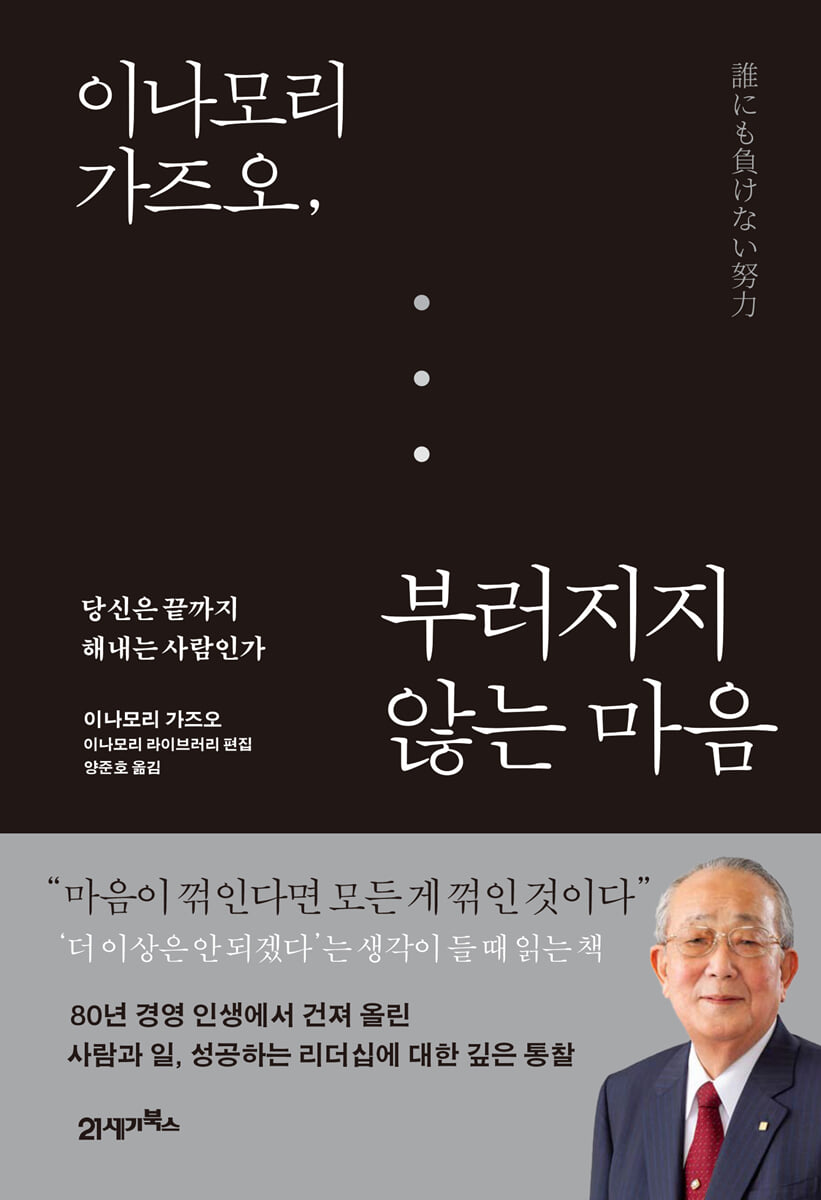
Kazuo Inamori, the Unbreakable Heart
 |
Description
Book Introduction
“If your heart is broken, everything is broken!”
A book to read when you feel like you can't take it anymore
What I have learned from my 80 years of management experience
Deep insights into people, work, and successful leadership.
The adjectives that follow the name Kazuo Inamori are splendid.
The founder of Kyocera and KDDI, one of Japan's three greatest businessmen, and a man who was called the God of Management while he was alive, a professional manager who took over as the unpaid chairman of Japan Airlines (JAL), which was on the verge of bankruptcy, at the age of 78 and turned the company into a profit-making company in just three years.
But the reason he is constantly mentioned to this day is not only because of these achievements.
The reason so many people still seek his advice is because of his extremely simple and fundamental management philosophy.
He says, "What sustained my otherwise unremarkable life was strong will, hard work, passionate dreams, and good motivation."
Kazuo Inamori has maintained these values throughout his life, values that anyone can recall but are difficult to maintain to the end.
And that ultimately led his life to success.
This book contains a selection of his numerous lectures, specifically messages to leaders.
This book, written with a vivid voice, captures the mindset, attitude, and values that a person in a leadership position should have, not only for entrepreneurs and managers, but also for heads of small organizations and all those who will become leaders in the future.
“The more difficult the task, the more you have to believe in yourself to succeed, or you will never succeed.”
“The less you have, the more your will, rather than your skill, produces results.”
“If you wish for something strongly enough, it will come true.”
"No one can beat you in effort! I've never seen success without 'effort.'"
His powerful and direct messages not only penetrate the very core of Honorary Chairman Inamori's "attitude toward life," but also still resonate deeply with countless people living in these uncertain times.
For anyone looking to make a breakthrough in life, this book would make a meaningful gift.
A book to read when you feel like you can't take it anymore
What I have learned from my 80 years of management experience
Deep insights into people, work, and successful leadership.
The adjectives that follow the name Kazuo Inamori are splendid.
The founder of Kyocera and KDDI, one of Japan's three greatest businessmen, and a man who was called the God of Management while he was alive, a professional manager who took over as the unpaid chairman of Japan Airlines (JAL), which was on the verge of bankruptcy, at the age of 78 and turned the company into a profit-making company in just three years.
But the reason he is constantly mentioned to this day is not only because of these achievements.
The reason so many people still seek his advice is because of his extremely simple and fundamental management philosophy.
He says, "What sustained my otherwise unremarkable life was strong will, hard work, passionate dreams, and good motivation."
Kazuo Inamori has maintained these values throughout his life, values that anyone can recall but are difficult to maintain to the end.
And that ultimately led his life to success.
This book contains a selection of his numerous lectures, specifically messages to leaders.
This book, written with a vivid voice, captures the mindset, attitude, and values that a person in a leadership position should have, not only for entrepreneurs and managers, but also for heads of small organizations and all those who will become leaders in the future.
“The more difficult the task, the more you have to believe in yourself to succeed, or you will never succeed.”
“The less you have, the more your will, rather than your skill, produces results.”
“If you wish for something strongly enough, it will come true.”
"No one can beat you in effort! I've never seen success without 'effort.'"
His powerful and direct messages not only penetrate the very core of Honorary Chairman Inamori's "attitude toward life," but also still resonate deeply with countless people living in these uncertain times.
For anyone looking to make a breakthrough in life, this book would make a meaningful gift.
- You can preview some of the book's contents.
Preview
index
preface
The more complex your mind becomes, the more you need to focus on principles.
Chapter 1.
It happens as you think
1.
Think about it persistently and intensely enough to seep into your subconscious.
2.
Aspire and aspire again
3.
A person who draws a big picture of his or her goals
4.
When you take work 'seriously,' change begins.
5.
Good motives bring greater success.
6.
What a beautiful heart attracts
7.
When God reaches out his hand
Chapter 2.
A person who has tasted the fruits of his labor
8.
When it comes to effort, I won't lose to anyone.
9.
Do you love what you are doing now?
10.
The desire to settle down is more dangerous than you think.
Chapter 3.
If you want to change your destiny through work
11.
Forge your own path
12.
Go straight towards your goal
13.
Face adversity head-on
14.
When you think it's over, that's when you have to start again.
15.
Emotional distress is poison to everyone.
16.
Be willing to fight and win
Chapter 4.
If your heart is too small, you won't last long.
17.
Lift up your heart
18.
Why Your Present Attitude Matters More Than Past Glory
19.
If you can reflect every day
20.
Let go of arrogance and be humble
Chapter 5.
When you develop people, your organization grows.
21.
Great good and small good
22.
Approach with affection
23.
Rebuke harshly and encourage warmly
24.
What it means to develop employees
25.
Drive them to the 'death ground'
26.
I'll leave it to you for now
Chapter 6.
What Makes an Organization Alive
27.
Establish your vision and mission
28.
Do we all have the same mind?
29.
Everyone wants to do something worthwhile.
30.
Whatever you do, pride is your driving force.
31.
A person who knows how to inject energy
32.
Leading by example: something that can never be overemphasized.
33.
Let go of selfishness
Chapter 7.
The joy of creation
34.
The fact that I too have infinite possibilities
35.
Think optimistically, verify pessimistically, and act more optimistically.
36.
Everything happens as you wish.
37.
Towards tomorrow rather than today, towards the day after tomorrow rather than tomorrow
Chapter 8.
Why challenges are worth it
38.
The weight of the word 'challenge'
39.
Think of your abilities as future progress
40.
Don't let go of the stepping stones
41.
Draw until you can see it
42.
What's on your mind right now?
Conclusion
43.
What the leader gains
supplement
List of sources for the text
Kazuo Inamori's "12 Management Articles"
Kazuo Inamori's "Six Diligent Practices"
Translator's Note
The more complex your mind becomes, the more you need to focus on principles.
Chapter 1.
It happens as you think
1.
Think about it persistently and intensely enough to seep into your subconscious.
2.
Aspire and aspire again
3.
A person who draws a big picture of his or her goals
4.
When you take work 'seriously,' change begins.
5.
Good motives bring greater success.
6.
What a beautiful heart attracts
7.
When God reaches out his hand
Chapter 2.
A person who has tasted the fruits of his labor
8.
When it comes to effort, I won't lose to anyone.
9.
Do you love what you are doing now?
10.
The desire to settle down is more dangerous than you think.
Chapter 3.
If you want to change your destiny through work
11.
Forge your own path
12.
Go straight towards your goal
13.
Face adversity head-on
14.
When you think it's over, that's when you have to start again.
15.
Emotional distress is poison to everyone.
16.
Be willing to fight and win
Chapter 4.
If your heart is too small, you won't last long.
17.
Lift up your heart
18.
Why Your Present Attitude Matters More Than Past Glory
19.
If you can reflect every day
20.
Let go of arrogance and be humble
Chapter 5.
When you develop people, your organization grows.
21.
Great good and small good
22.
Approach with affection
23.
Rebuke harshly and encourage warmly
24.
What it means to develop employees
25.
Drive them to the 'death ground'
26.
I'll leave it to you for now
Chapter 6.
What Makes an Organization Alive
27.
Establish your vision and mission
28.
Do we all have the same mind?
29.
Everyone wants to do something worthwhile.
30.
Whatever you do, pride is your driving force.
31.
A person who knows how to inject energy
32.
Leading by example: something that can never be overemphasized.
33.
Let go of selfishness
Chapter 7.
The joy of creation
34.
The fact that I too have infinite possibilities
35.
Think optimistically, verify pessimistically, and act more optimistically.
36.
Everything happens as you wish.
37.
Towards tomorrow rather than today, towards the day after tomorrow rather than tomorrow
Chapter 8.
Why challenges are worth it
38.
The weight of the word 'challenge'
39.
Think of your abilities as future progress
40.
Don't let go of the stepping stones
41.
Draw until you can see it
42.
What's on your mind right now?
Conclusion
43.
What the leader gains
supplement
List of sources for the text
Kazuo Inamori's "12 Management Articles"
Kazuo Inamori's "Six Diligent Practices"
Translator's Note
Detailed image

Into the book
The difference between a growing company and a stagnant company is revealed here.
Members of a stagnant company believe that no matter what the company does, it will never succeed.
Let's think about the world of sports.
A strong team is always strong.
Because we are accustomed to the habit of winning.
I don't even think about losing in the first place.
Because we have a track record of achievements up to that point and a strong belief that we will win.
What if there are no results?
It doesn't matter though.
If a team has the confidence that it can win, it will definitely become stronger.
The team that always loses thinks they will lose again before they even start the game, and in reality, they lose 100% because of that thought.
The impact of winning and losing habits on outcomes is incredibly powerful.
--- p.20, from “What You Think, Become”
In other words, it is important how you think about your goals.
If you think that doubling sales is easily achievable, that mindset will permeate your employees as well.
If you think, 'Double, that's ridiculous,' that feeling will also seep into the employees.
And if employees treat customers with the mindset that "it can't be done," sales will naturally stagnate.
--- p.29, from “What You Think, Become”
They say there are many ways to achieve success, but I believe that success cannot be achieved without 'working hard'.
To survive in this competitive environment and difficult economic downturn, you absolutely need a 'hardworking attitude.'
--- p.59, from “Those Who Have Tasted the Results of Their Efforts”
When everyone is working with excitement and hope, everything goes smoothly.
The problem comes when you hit a snag.
When your mind becomes confused and mistakes become frequent, you become anxious and wonder if you can do well no matter how hard you try.
When you start to doubt what you've been working towards, the results will show up just as your heart tells you.
In other words, the results of the work are already in your mind.
--- p.72, from “If you want to change your destiny through work”
You have to stick with it until the end until you feel like you can do it, that you have to do it.
The more difficult the task, the more you will never be able to accomplish it unless you believe in its possibility.
--- p.163, from “What Makes Organizations Alive”
A company cannot grow if it doesn't challenge itself with new things, things that others aren't doing.
But unfortunately, when we start doing that, the market for it doesn't exist yet.
How to sell something that people don't know about yet.
What is needed in such cases is not skill, but heart.
I believe that anything can be achieved only when accompanied by a strong will, strong passion, and a strong desire to become that way.
That will is transmitted through your soul.
It depends on how you want to fill your life.
Members of a stagnant company believe that no matter what the company does, it will never succeed.
Let's think about the world of sports.
A strong team is always strong.
Because we are accustomed to the habit of winning.
I don't even think about losing in the first place.
Because we have a track record of achievements up to that point and a strong belief that we will win.
What if there are no results?
It doesn't matter though.
If a team has the confidence that it can win, it will definitely become stronger.
The team that always loses thinks they will lose again before they even start the game, and in reality, they lose 100% because of that thought.
The impact of winning and losing habits on outcomes is incredibly powerful.
--- p.20, from “What You Think, Become”
In other words, it is important how you think about your goals.
If you think that doubling sales is easily achievable, that mindset will permeate your employees as well.
If you think, 'Double, that's ridiculous,' that feeling will also seep into the employees.
And if employees treat customers with the mindset that "it can't be done," sales will naturally stagnate.
--- p.29, from “What You Think, Become”
They say there are many ways to achieve success, but I believe that success cannot be achieved without 'working hard'.
To survive in this competitive environment and difficult economic downturn, you absolutely need a 'hardworking attitude.'
--- p.59, from “Those Who Have Tasted the Results of Their Efforts”
When everyone is working with excitement and hope, everything goes smoothly.
The problem comes when you hit a snag.
When your mind becomes confused and mistakes become frequent, you become anxious and wonder if you can do well no matter how hard you try.
When you start to doubt what you've been working towards, the results will show up just as your heart tells you.
In other words, the results of the work are already in your mind.
--- p.72, from “If you want to change your destiny through work”
You have to stick with it until the end until you feel like you can do it, that you have to do it.
The more difficult the task, the more you will never be able to accomplish it unless you believe in its possibility.
--- p.163, from “What Makes Organizations Alive”
A company cannot grow if it doesn't challenge itself with new things, things that others aren't doing.
But unfortunately, when we start doing that, the market for it doesn't exist yet.
How to sell something that people don't know about yet.
What is needed in such cases is not skill, but heart.
I believe that anything can be achieved only when accompanied by a strong will, strong passion, and a strong desire to become that way.
That will is transmitted through your soul.
It depends on how you want to fill your life.
--- pp.228-229, from “Why Challenges Are Worthwhile”
Publisher's Review
In an age of uncertainty,
What to keep and what to discard!
“In an era of high growth, any leader can achieve results.
But in these low-growth times, the results of a task can vary significantly depending on the qualifications of the person in charge.”
Kazuo Inamori knew exactly the weight a leader would bear in times of crisis.
As stated in the preface to this book, Kazuo Inamori wanted to provide an unchanging compass to leaders who have lost their way in an age of uncertainty and to those who doubt their own worth and abilities every day.
In this book, he shares, without embellishment, the values he has learned while quietly walking through 80 years of management.
In a world that is rapidly changing, overflowing with new technologies and information to learn, and increasingly difficult to predict the consequences, anyone who must endure this era cannot help but feel anxious.
In such times, to keep your mind sharp, you must realize what unchanging values are and hold on to them, rather than blindly chasing after what changes.
We must calm our anxious and helpless hearts and continue to walk toward the future.
Kazuo Inamori shows us, through his life and words, and through this book, what results these values, which are so obvious that they feel clichéd, such as 'raw will and effort' and 'the attitude of persistently drawing out what I want to do, what I will do, and what kind of person I ultimately want to become', ultimately bring about.
“If you want to achieve your dreams, work hard and don’t lose to anyone.”
The number one principle that Kazuo Inamori has maintained throughout his life!
The values he pursued throughout his life were diverse, including maintaining good motives, being humble, being eager and eager again, and working creatively.
But, among them, what was emphasized every time was ‘effort.’
“When you ask people, ‘Are you working hard?’ the answer is, ‘Yes, I’m working hard enough.’
So from then on, I decided to ask myself, 'Are you working hard enough that you don't lose to anyone?'
‘I am doing it’, that alone is not enough.
If you don't do things more seriously and with more immersion, neither your work nor your life will go well.
(Kazuo Inamori)”
When he founded Kyocera at the age of 27, it was a small company that could have collapsed at any time.
It is only natural that he worked hard and put in all his effort to protect his business.
Yes, that's right.
He realized early on that in order to achieve something with little, he had no choice but to wield the weapon called 'effort' to the fullest.
So, he made 'effort' his first value and always emphasized it to himself and his employees.
In other words, he knew that a person who lost the 'attitude to try' was as good as losing his greatest weapon.
This book is special simply because it reawakens the value of 'effort' and the will to do so.
Because it tells us that if we just hold onto that one thing, today's time can flow differently than yesterday.
Additionally, it contains values necessary for managing work and life, such as attitudes and mindsets toward work and people, so this book will be a meaningful gift for anyone who wants to find a breakthrough.
“When you think it’s over, that’s when it really begins.”
A heartwarming piece of advice that will help you get back on your feet when you feel like you can't take it anymore.
Kazuo Inamori, known as the "God of Management," founded Japan's top companies Kyocera and KDDI and rebuilt Japan Airlines from the brink of bankruptcy into the world's most profitable airline.
This book was born from four years of work, beginning in 2010 when he was tasked with rebuilding Japan Airlines, a task everyone thought was impossible. It is also a "leadership introduction" used in training new employees at the Kyocera Group.
This book, which contains the message that Kazuo Inamori sincerely wanted to convey to those who were more devastated than anyone else in the face of the greatest crisis at the time, teaches us how to cultivate an unbreakable spirit in the face of any adversity, as the title, "Unbreakable Heart," suggests.
In particular, his message, “Taking one more step when you think it’s the end is what separates success and failure,” provides powerful motivation to readers who are in moments of frustration.
The wisdom Kazuo Inamori has acquired over the past 80 years as a businessperson and as a leader has been expressed in concrete and clear language, inspiring the reader's heart.
He shows how to turn a crisis into an opportunity through advice such as “effort that will not be defeated by anyone,” “thinking of your abilities as a future-oriented project,” and “how to elevate your mind and immerse yourself in management.”
This book goes beyond simple business strategy to become a philosophy of life, offering readers a treasure trove of practical wisdom they can apply in every aspect of their lives.
Even in moments when one feels like one is about to collapse, Inamori's philosophy that "if the heart does not collapse, nothing else will collapse" gives readers the courage and strength to stand up again.
This book will provide inspiration and wisdom not only to managers but also to anyone struggling with life's challenges, enabling them to overcome their limitations and make a fresh start.
What to keep and what to discard!
“In an era of high growth, any leader can achieve results.
But in these low-growth times, the results of a task can vary significantly depending on the qualifications of the person in charge.”
Kazuo Inamori knew exactly the weight a leader would bear in times of crisis.
As stated in the preface to this book, Kazuo Inamori wanted to provide an unchanging compass to leaders who have lost their way in an age of uncertainty and to those who doubt their own worth and abilities every day.
In this book, he shares, without embellishment, the values he has learned while quietly walking through 80 years of management.
In a world that is rapidly changing, overflowing with new technologies and information to learn, and increasingly difficult to predict the consequences, anyone who must endure this era cannot help but feel anxious.
In such times, to keep your mind sharp, you must realize what unchanging values are and hold on to them, rather than blindly chasing after what changes.
We must calm our anxious and helpless hearts and continue to walk toward the future.
Kazuo Inamori shows us, through his life and words, and through this book, what results these values, which are so obvious that they feel clichéd, such as 'raw will and effort' and 'the attitude of persistently drawing out what I want to do, what I will do, and what kind of person I ultimately want to become', ultimately bring about.
“If you want to achieve your dreams, work hard and don’t lose to anyone.”
The number one principle that Kazuo Inamori has maintained throughout his life!
The values he pursued throughout his life were diverse, including maintaining good motives, being humble, being eager and eager again, and working creatively.
But, among them, what was emphasized every time was ‘effort.’
“When you ask people, ‘Are you working hard?’ the answer is, ‘Yes, I’m working hard enough.’
So from then on, I decided to ask myself, 'Are you working hard enough that you don't lose to anyone?'
‘I am doing it’, that alone is not enough.
If you don't do things more seriously and with more immersion, neither your work nor your life will go well.
(Kazuo Inamori)”
When he founded Kyocera at the age of 27, it was a small company that could have collapsed at any time.
It is only natural that he worked hard and put in all his effort to protect his business.
Yes, that's right.
He realized early on that in order to achieve something with little, he had no choice but to wield the weapon called 'effort' to the fullest.
So, he made 'effort' his first value and always emphasized it to himself and his employees.
In other words, he knew that a person who lost the 'attitude to try' was as good as losing his greatest weapon.
This book is special simply because it reawakens the value of 'effort' and the will to do so.
Because it tells us that if we just hold onto that one thing, today's time can flow differently than yesterday.
Additionally, it contains values necessary for managing work and life, such as attitudes and mindsets toward work and people, so this book will be a meaningful gift for anyone who wants to find a breakthrough.
“When you think it’s over, that’s when it really begins.”
A heartwarming piece of advice that will help you get back on your feet when you feel like you can't take it anymore.
Kazuo Inamori, known as the "God of Management," founded Japan's top companies Kyocera and KDDI and rebuilt Japan Airlines from the brink of bankruptcy into the world's most profitable airline.
This book was born from four years of work, beginning in 2010 when he was tasked with rebuilding Japan Airlines, a task everyone thought was impossible. It is also a "leadership introduction" used in training new employees at the Kyocera Group.
This book, which contains the message that Kazuo Inamori sincerely wanted to convey to those who were more devastated than anyone else in the face of the greatest crisis at the time, teaches us how to cultivate an unbreakable spirit in the face of any adversity, as the title, "Unbreakable Heart," suggests.
In particular, his message, “Taking one more step when you think it’s the end is what separates success and failure,” provides powerful motivation to readers who are in moments of frustration.
The wisdom Kazuo Inamori has acquired over the past 80 years as a businessperson and as a leader has been expressed in concrete and clear language, inspiring the reader's heart.
He shows how to turn a crisis into an opportunity through advice such as “effort that will not be defeated by anyone,” “thinking of your abilities as a future-oriented project,” and “how to elevate your mind and immerse yourself in management.”
This book goes beyond simple business strategy to become a philosophy of life, offering readers a treasure trove of practical wisdom they can apply in every aspect of their lives.
Even in moments when one feels like one is about to collapse, Inamori's philosophy that "if the heart does not collapse, nothing else will collapse" gives readers the courage and strength to stand up again.
This book will provide inspiration and wisdom not only to managers but also to anyone struggling with life's challenges, enabling them to overcome their limitations and make a fresh start.
GOODS SPECIFICS
- Date of issue: March 26, 2025
- Format: Hardcover book binding method guide
- Page count, weight, size: 248 pages | 346g | 128*188*19mm
- ISBN13: 9791173571640
- ISBN10: 1173571647
You may also like
카테고리
korean


korean

![ELLE 엘르 스페셜 에디션 A형 : 12월 [2025]](http://librairie.coreenne.fr/cdn/shop/files/b8e27a3de6c9538896439686c6b0e8fb.jpg?v=1766436872&width=3840)


