

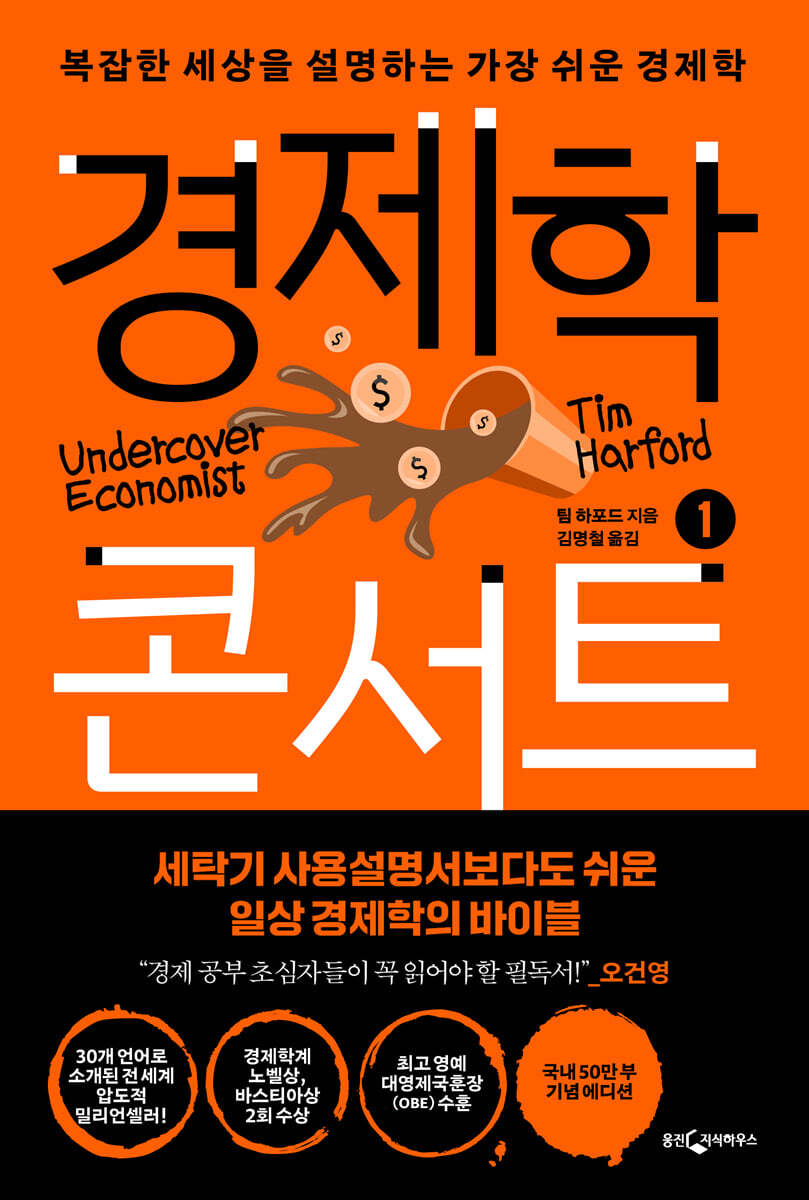
Economics Concert 1
 |
Description
Book Introduction
“The Carl Sagan of economics,
Tim Harford has rewritten the history of economics textbooks!”
The best book that has caught the attention of economists around the world!
The bible of everyday economics, easier than a washing machine instruction manual!
How economics is hidden in our daily lives.
“To me, who was a beginner in economics,
“The only economics book that made me feel like my feet were on the ground!”
Oh Geon-young, Vice President of Shinhan Bank's WM Group and author of "Surviving Inflation"
“Capturing the public’s heart and applying economic logic to everyday life
“A rare masterpiece explained in an easy-to-understand manner!”
_Stephen Levitt, author of Freakonomics
***** An overwhelming million-seller worldwide, introduced in 30 languages
***** Winner of the Nobel Prize in Economics and the Bastiat Prize twice
***** Awarded the highest honor, the Order of the British Empire (OBE)
***** Published in Korea as a commemorative edition of 500,000 copies
Economist Tim Harford, who has unraveled the principles of economics in everyday life in an easy and witty way, is worthy of Malcolm Gladwell's rave reviews as a "genius economic storyteller!" The book "The Undercover Economist" has been published with a new cover to commemorate the sale of 500,000 copies in Korea.
The first edition of 『Economics Concert 1』, published in 2006, was evaluated as a book that raised the level of economics textbooks that had previously been limited to 'common sense' to a new level, and it received so much love that it was selected as the 'Book of the Year' that year, and has proudly established itself as a true bestseller.
This book, which does not simply impart economic knowledge, but clearly reveals how economics is hidden in our complex and closely interconnected daily lives and teaches us how to “view the world with an economic mindset,” has been praised as “an economics textbook for the entire nation.”
Furthermore, it has been introduced in over 30 languages both domestically and internationally, and has remained a global bestseller, firmly maintaining its position as the 'Bible of economics studies'.
Tim Harford has rewritten the history of economics textbooks!”
The best book that has caught the attention of economists around the world!
The bible of everyday economics, easier than a washing machine instruction manual!
How economics is hidden in our daily lives.
“To me, who was a beginner in economics,
“The only economics book that made me feel like my feet were on the ground!”
Oh Geon-young, Vice President of Shinhan Bank's WM Group and author of "Surviving Inflation"
“Capturing the public’s heart and applying economic logic to everyday life
“A rare masterpiece explained in an easy-to-understand manner!”
_Stephen Levitt, author of Freakonomics
***** An overwhelming million-seller worldwide, introduced in 30 languages
***** Winner of the Nobel Prize in Economics and the Bastiat Prize twice
***** Awarded the highest honor, the Order of the British Empire (OBE)
***** Published in Korea as a commemorative edition of 500,000 copies
Economist Tim Harford, who has unraveled the principles of economics in everyday life in an easy and witty way, is worthy of Malcolm Gladwell's rave reviews as a "genius economic storyteller!" The book "The Undercover Economist" has been published with a new cover to commemorate the sale of 500,000 copies in Korea.
The first edition of 『Economics Concert 1』, published in 2006, was evaluated as a book that raised the level of economics textbooks that had previously been limited to 'common sense' to a new level, and it received so much love that it was selected as the 'Book of the Year' that year, and has proudly established itself as a true bestseller.
This book, which does not simply impart economic knowledge, but clearly reveals how economics is hidden in our complex and closely interconnected daily lives and teaches us how to “view the world with an economic mindset,” has been praised as “an economics textbook for the entire nation.”
Furthermore, it has been introduced in over 30 languages both domestically and internationally, and has remained a global bestseller, firmly maintaining its position as the 'Bible of economics studies'.
- You can preview some of the book's contents.
Preview
index
Recommendation
Prologue: If You Could See the World Like an Economist
CHAPTER 1: Starbucks' Management Strategy You Don't Know - Differential Rent Theory
What determines the price of coffee? / Why it sells well even though it is expensive? / Ricardo's business model / Factors behind high rents / Aren't we being ripped off? / People who welcome regulation / The business principles of the mafia / A clever way to block competition / Scarcity determines wages / Seeing the world through the eyes of an economist
CHAPTER 2 The Secret Supermarkets Want to Hide: Price Differentiation
Regulars, cheating or preferential treatment/ Price-insensitive customers/ Hide cheap products/ Organic product tricks/ There is no such thing as a cheap supermarket/ Confuse prices/ Price and scarcity/ Why cheap is expensive/ How to open every customer's wallet/ Retain customers who leave
CHAPTER 3 The Perfect Market Economists Dream of _The Perfect Market
What Prices Tell Us / Characteristics of a Perfectly Competitive Market / Non-Market Systems / Price Traffic Lights / Efficiency vs. Fairness / Head Start Theory / Why Taxes Become Unfair / Heating Costs for Seniors Living Alone
CHAPTER 4: The Economics of Commuting: Externalities
The Pain of Commuting / Shameless Drivers / Why Traffic Jams Occur / The Conflict Between Pleasure and Inconvenience / Can Congestion Charges Stop Traffic Jams / Measuring Externalities / What We Don't Know / The New Orleans Effect / Air Pollution Permit Tickets / The Economy Reduces Air Pollution / Pleasant Externalities / Subsidies for Externalities / The Economy Beyond Numbers
CHAPTER 5 Why Good Used Cars Are Missing from the Used Car Market: Information Asymmetry
The Used Car Trading Game / The Battle for Information / Distorted Choices / The Causes of Insurance Premium Increases / Does Insurance Cause Accidents? / The Problems of Social Insurance / Keyhole Economics
CHAPTER 6 What the Stock Rich Know: Stock Prices and Scarcity
The Stock Market and Murphy's Law / What Drives Stock Prices / The Selfishness of Fund Managers / The Truth About Stock Price Graphs / Spotting Bubbles / Find the "Best," Not the "First"
CHAPTER 7: From Poker to Auctions: The Fierce Economic Game _Game Theory
Poker, a microcosm of a complex world / Game masters / A game for idiots / Auctions and game theory / Auction problem-solving methods / The greatest auction of the 21st century / Why communication rates are so high / The aftermath of auctions
CHAPTER 8 A Country Where the Government is a Thief _ Rational Ignorance
Why are we still poor? / The theory of government thieving / Those who welcome dictatorship / The limits of institutional reform / The world's worst library / Are there opportunities for development?
CHAPTER 9: Surviving in a Unified World: Comparative Advantage
Doing what you do best / The magic of exchange / The debate over globalization / Does protectionism cause environmental pollution? / People who chose sweatshops / The strategy of scarcity
CHAPTER 10 China's Strategy to Dominate the World Economy
Two Revolutions / Investing for the Future / Growth Beyond Plan / The Miracle of Privatization / Riding a Tricycle / Choosing a Better Life
Prologue: If You Could See the World Like an Economist
CHAPTER 1: Starbucks' Management Strategy You Don't Know - Differential Rent Theory
What determines the price of coffee? / Why it sells well even though it is expensive? / Ricardo's business model / Factors behind high rents / Aren't we being ripped off? / People who welcome regulation / The business principles of the mafia / A clever way to block competition / Scarcity determines wages / Seeing the world through the eyes of an economist
CHAPTER 2 The Secret Supermarkets Want to Hide: Price Differentiation
Regulars, cheating or preferential treatment/ Price-insensitive customers/ Hide cheap products/ Organic product tricks/ There is no such thing as a cheap supermarket/ Confuse prices/ Price and scarcity/ Why cheap is expensive/ How to open every customer's wallet/ Retain customers who leave
CHAPTER 3 The Perfect Market Economists Dream of _The Perfect Market
What Prices Tell Us / Characteristics of a Perfectly Competitive Market / Non-Market Systems / Price Traffic Lights / Efficiency vs. Fairness / Head Start Theory / Why Taxes Become Unfair / Heating Costs for Seniors Living Alone
CHAPTER 4: The Economics of Commuting: Externalities
The Pain of Commuting / Shameless Drivers / Why Traffic Jams Occur / The Conflict Between Pleasure and Inconvenience / Can Congestion Charges Stop Traffic Jams / Measuring Externalities / What We Don't Know / The New Orleans Effect / Air Pollution Permit Tickets / The Economy Reduces Air Pollution / Pleasant Externalities / Subsidies for Externalities / The Economy Beyond Numbers
CHAPTER 5 Why Good Used Cars Are Missing from the Used Car Market: Information Asymmetry
The Used Car Trading Game / The Battle for Information / Distorted Choices / The Causes of Insurance Premium Increases / Does Insurance Cause Accidents? / The Problems of Social Insurance / Keyhole Economics
CHAPTER 6 What the Stock Rich Know: Stock Prices and Scarcity
The Stock Market and Murphy's Law / What Drives Stock Prices / The Selfishness of Fund Managers / The Truth About Stock Price Graphs / Spotting Bubbles / Find the "Best," Not the "First"
CHAPTER 7: From Poker to Auctions: The Fierce Economic Game _Game Theory
Poker, a microcosm of a complex world / Game masters / A game for idiots / Auctions and game theory / Auction problem-solving methods / The greatest auction of the 21st century / Why communication rates are so high / The aftermath of auctions
CHAPTER 8 A Country Where the Government is a Thief _ Rational Ignorance
Why are we still poor? / The theory of government thieving / Those who welcome dictatorship / The limits of institutional reform / The world's worst library / Are there opportunities for development?
CHAPTER 9: Surviving in a Unified World: Comparative Advantage
Doing what you do best / The magic of exchange / The debate over globalization / Does protectionism cause environmental pollution? / People who chose sweatshops / The strategy of scarcity
CHAPTER 10 China's Strategy to Dominate the World Economy
Two Revolutions / Investing for the Future / Growth Beyond Plan / The Miracle of Privatization / Riding a Tricycle / Choosing a Better Life
Detailed image

Into the book
Maybe you didn't think you'd be buying this book when you left home this morning.
But through the actions of many people, including myself, editors, marketers, proofreaders, printers, papermakers, ink suppliers, and many others, some magical force worked, and you bought this book.
Economists explain how such systems work, why companies promote, and how you, as a customer, react.
--- p.11
The purpose of this book is to help you see the world like an economist.
While I won't say anything about exchange rates or business cycles, I will explain things like the secrets of used cars.
We'll explore topics ranging from big ones like how China is lifting millions of people out of poverty in a short period of time to smaller ones like how to avoid paying too much at the supermarket.
All of this will play out like a detective investigation, but I'll teach you how economists use their investigative tools.
I hope that after reading this book, you will become a more savvy consumer and a smarter voter who can see the truth behind what politicians say.
--- p.13
But many people like the fact that Ricardo had insights that contribute to our understanding today, some 200 years ago.
It's not easy to see the similarities between 19th-century farms and 21st-century foamy coffee.
Economics can also be thought of as a modeling exercise, analyzing the fundamental principles and patterns underlying seemingly complex problems, such as rent on a farm or a coffee shop.
--- p.30
So many things in our lives are sold at high prices.
Of course, there are cases where it is a natural result of scarcity.
There aren't many apartments in New York that overlook Central Park or in London that overlook Hyde Park.
On the other hand, since there are many people who want such apartments, the prices go up and many people cannot afford to buy them.
In this case, there is no regret.
But I don't understand why popcorn sold at theaters is so expensive.
It's not like we're running out of popcorn.
Therefore, we first need to identify the causes of rising prices.
--- p.33
However, just because economics is an objective means of analysis does not mean that economists are necessarily objective.
Economists study topics such as the balance of power, poverty, growth, and development.
It is not easy to remain unfazed by the real world while elucidating the underlying dynamics of such topics through economic models.
Thus, economists go beyond their role as technicians of economic policy and advocate certain economic policies.
[…] billions of people could benefit from better economic policies.
Hundreds of thousands of people are dying because of flawed economic policies.
Sometimes the logic of economics is so clear that economists are forced to take a firm stance.
--- p.55
While poor passengers were denied even necessary services, rich passengers were over-served.
This is similar to the reason why it is rare to find a well-equipped boarding waiting area at any airport in the world.
If airlines had comfortable, well-equipped, free boarding areas, they could no longer sell business class seats and offer the benefit of "exclusive airport lounge access."
The same reason can explain why first class and business class passengers board and disembark before economy class passengers.
This 'service' is not aimed at economy class passengers, but rather to make this pitiful and pathetic sight visible to passengers sitting at the front of the plane.
--- p.92
Note that I have equated the terms 'correct' and 'efficient' here.
We will briefly examine these premises below.
So, if the right things are produced in the right quantities and in the right ways, and go to those who value them most, there is no greater efficiency than that.
In other words, it means that efficiency cannot be maximized more than in a perfectly competitive market.
And from the truth contained in the pricing system, we naturally arrive at the following conclusion:
Price represents a company's costs and also expresses what customers perceive as value.
--- p.123
First of all, the following physical factors are difficult to measure:
How much more damage is done to the road by one more car? How much more noise does one car create? How many accidents does one cause? How much delay does one cause to other cars? How much pollution is created? How much does that pollution harm one's health? The psychological impact is even more difficult to measure.
How do nuisances like air pollution, noise, time delays, and stress affect people, and even contribute to disease and death? Needless to say, people will value these things differently.
It's easy to give up when faced with problems like this.
Clearly, it seems impossible to calculate the costs of noise or time delay.
But we are fooling ourselves if we think we can avoid these decisions.
Every policy decision made by the government and every individual choice you make has inherent values, even if no one speaks about them or admits them themselves.
--- p.167
But if investors were truly rational, there could be no predictable stock price movements.
Because every trend is predictable and every predictability spreads quickly.
All that remains is unpredictable news.
Only random news moves stock prices, so the indices that measure stock prices and the stock market as a whole rise and fall completely randomly.
Mathematicians call this movement a 'random walk'.
To be more precise, the stock market can be said to exhibit a 'random walk with a trend'.
A trend refers to a longer-term fact, such as the fact that the stock market has been moving upward over the past few months, which has, on average, outperformed other potential investments such as savings or real estate.
However, this trend cannot change the fundamental analysis, and therefore trends are relatively small compared to random movements on a particular day.
Should we believe in random walk theory?
--- p.245
The first clue that something is wrong with this traditional argument is that it implicitly assumes that poor countries have lagged behind rich countries for the past century, and that the longer they do, the faster they will catch up.
Poorer countries can catch up faster because they can reap the greatest rewards with even small new investments in infrastructure and education.
Rich countries, on the other hand, do not gain much from additional investment.
This is called 'diminishing returns'.
But through the actions of many people, including myself, editors, marketers, proofreaders, printers, papermakers, ink suppliers, and many others, some magical force worked, and you bought this book.
Economists explain how such systems work, why companies promote, and how you, as a customer, react.
--- p.11
The purpose of this book is to help you see the world like an economist.
While I won't say anything about exchange rates or business cycles, I will explain things like the secrets of used cars.
We'll explore topics ranging from big ones like how China is lifting millions of people out of poverty in a short period of time to smaller ones like how to avoid paying too much at the supermarket.
All of this will play out like a detective investigation, but I'll teach you how economists use their investigative tools.
I hope that after reading this book, you will become a more savvy consumer and a smarter voter who can see the truth behind what politicians say.
--- p.13
But many people like the fact that Ricardo had insights that contribute to our understanding today, some 200 years ago.
It's not easy to see the similarities between 19th-century farms and 21st-century foamy coffee.
Economics can also be thought of as a modeling exercise, analyzing the fundamental principles and patterns underlying seemingly complex problems, such as rent on a farm or a coffee shop.
--- p.30
So many things in our lives are sold at high prices.
Of course, there are cases where it is a natural result of scarcity.
There aren't many apartments in New York that overlook Central Park or in London that overlook Hyde Park.
On the other hand, since there are many people who want such apartments, the prices go up and many people cannot afford to buy them.
In this case, there is no regret.
But I don't understand why popcorn sold at theaters is so expensive.
It's not like we're running out of popcorn.
Therefore, we first need to identify the causes of rising prices.
--- p.33
However, just because economics is an objective means of analysis does not mean that economists are necessarily objective.
Economists study topics such as the balance of power, poverty, growth, and development.
It is not easy to remain unfazed by the real world while elucidating the underlying dynamics of such topics through economic models.
Thus, economists go beyond their role as technicians of economic policy and advocate certain economic policies.
[…] billions of people could benefit from better economic policies.
Hundreds of thousands of people are dying because of flawed economic policies.
Sometimes the logic of economics is so clear that economists are forced to take a firm stance.
--- p.55
While poor passengers were denied even necessary services, rich passengers were over-served.
This is similar to the reason why it is rare to find a well-equipped boarding waiting area at any airport in the world.
If airlines had comfortable, well-equipped, free boarding areas, they could no longer sell business class seats and offer the benefit of "exclusive airport lounge access."
The same reason can explain why first class and business class passengers board and disembark before economy class passengers.
This 'service' is not aimed at economy class passengers, but rather to make this pitiful and pathetic sight visible to passengers sitting at the front of the plane.
--- p.92
Note that I have equated the terms 'correct' and 'efficient' here.
We will briefly examine these premises below.
So, if the right things are produced in the right quantities and in the right ways, and go to those who value them most, there is no greater efficiency than that.
In other words, it means that efficiency cannot be maximized more than in a perfectly competitive market.
And from the truth contained in the pricing system, we naturally arrive at the following conclusion:
Price represents a company's costs and also expresses what customers perceive as value.
--- p.123
First of all, the following physical factors are difficult to measure:
How much more damage is done to the road by one more car? How much more noise does one car create? How many accidents does one cause? How much delay does one cause to other cars? How much pollution is created? How much does that pollution harm one's health? The psychological impact is even more difficult to measure.
How do nuisances like air pollution, noise, time delays, and stress affect people, and even contribute to disease and death? Needless to say, people will value these things differently.
It's easy to give up when faced with problems like this.
Clearly, it seems impossible to calculate the costs of noise or time delay.
But we are fooling ourselves if we think we can avoid these decisions.
Every policy decision made by the government and every individual choice you make has inherent values, even if no one speaks about them or admits them themselves.
--- p.167
But if investors were truly rational, there could be no predictable stock price movements.
Because every trend is predictable and every predictability spreads quickly.
All that remains is unpredictable news.
Only random news moves stock prices, so the indices that measure stock prices and the stock market as a whole rise and fall completely randomly.
Mathematicians call this movement a 'random walk'.
To be more precise, the stock market can be said to exhibit a 'random walk with a trend'.
A trend refers to a longer-term fact, such as the fact that the stock market has been moving upward over the past few months, which has, on average, outperformed other potential investments such as savings or real estate.
However, this trend cannot change the fundamental analysis, and therefore trends are relatively small compared to random movements on a particular day.
Should we believe in random walk theory?
--- p.245
The first clue that something is wrong with this traditional argument is that it implicitly assumes that poor countries have lagged behind rich countries for the past century, and that the longer they do, the faster they will catch up.
Poorer countries can catch up faster because they can reap the greatest rewards with even small new investments in infrastructure and education.
Rich countries, on the other hand, do not gain much from additional investment.
This is called 'diminishing returns'.
--- p.314
Publisher's Review
This fast-paced, witty, and engaging book offers a useful and insightful approach to analyzing modern economics and interpreting a range of issues.
- [San Diego Union-Tribune]
Harford shows that the fundamental concepts of economics can be applied to all aspects of the world.
He also uses his wit and wisdom to easily resolve various discussions.
- [Houston Chronicle]
From the price of a cup of coffee to the pitfalls of buying and selling used cars,
Understand the economic laws of everyday life
Exploring the delightful loopholes of complex economics
A masterpiece by undercover economist Tim Harford!
"Do supermarkets really offer the lowest prices?", "Why is it so hard to find a decent used car in the used car market?", "Why is it so hard for people who are sick to get health insurance?" It's easy to overlook these questions, but situations that are difficult to understand often arise around us.
The key to solving these riddles lies in none other than the economic laws hidden in everyday life.
Even seemingly unrelated economics can be properly explained through economic theory. "Economics Concert 1" helps those born and raised in the world of the market economy, yet living with little understanding of economics, understand economics in the easiest and most enjoyable way possible.
From the secrets of the price of a cup of coffee to the Greenbelt paradox, this popular economics introductory book explains our lives in an easy-to-understand way. It naturally covers core economic theories such as price discrimination, game theory, information asymmetry, and comparative advantage through easily accessible, everyday examples.
At the same time, it tells a fascinating story about how the 'invisible hand' that moves the world works, covering everything from Ricardo's theory to the Nobel Prize-winning theory of economics.
This clearly explains how economics affects our lives.
Malcolm Gladwell, author of Outliers, said, “Any book by Tim Harford is worthy of celebration.
He has praised Tim Harford's book with the rave review, saying, "He has a knack for bringing immense joy to the 'dreary discipline' of economics."
This is why Tim Harford's "The Economics Concert" series, a representative work of his economics introductory book series that awakens the eyes of anyone who picks up this book to view the world through an economic mindset, has long been loved by readers.
“A must-read for beginners studying economics!”
『Surviving Inflation』 by Oh Geon-yeong, 『Freakonomics』 by Steven Levitt, etc.
An economics textbook highly praised by numerous economic experts!
Tim Harford, author of the world-renowned million-seller "Economics in Concert" series and an economist who has clearly and wittily explained the principles of economics in everyday life both on TV and in the classroom, studied economics at Oxford University and worked as a writing advisor to senior economists at the International Finance Corporation at the World Bank.
Despite his numerous activities since then, one thing he has never let go of for nearly 20 years since 2005 is the legendary column titled “Undercover Economist” for the Financial Times.
His first book, 『Economics Concert 1』, a compilation of his early columns, became an Amazon bestseller immediately after its publication and received rave reviews from numerous readers.
Not only readers, but also major American media outlets and economists have selected it as a 'must-read book for a proper understanding of economics.'
In particular, Steven Levitt, author of the best-selling book “Freakonomics,” praised the book, saying, “A rare masterpiece that captures the public’s heart and explains the economic logic of everyday life in an easy-to-understand way!” Martin Wolf, a columnist representing the Financial Times and known as an “economist with outstanding ability to analyze reality,” gave the book authority by saying, “In Tim Harford’s hands, the basic concepts of economics have gained a powerful force that can illuminate every aspect of the world we live in.”
In Korea, Oh Geon-young, an economic expert who has received the love of countless readers for his bestsellers 『Surviving Inflation』 and 『The Wealth Scenario』, also proved the book's influence and long-standing reputation by recommending it, saying, "This is the only economics book that gave me, a beginner in economics, the feeling of my feet touching the ground."
The more uncertain the situation, the more important it is to understand the "laws that drive the economy."
Differential rent theory, price discrimination, externalities, information asymmetry…
The bible of economics, explaining seemingly boring economic discourse with easy-to-understand examples.
What secret lies behind the price of a delicious Starbucks coffee, a popular stop on the busy commute?
Most people think it's because of the expensive rent, but the reason for the high rent is none other than Starbucks' customers who are insensitive to prices.
Author Tim Harford uses the theory of differential rent proposed by millionaire economist David Ricardo to clearly explain the 21st-century coffee business using the example of a 19th-century farm, making economics more accessible.
Furthermore, it examines the benefits and injustices that have been overlooked from an economic perspective, such as how supermarkets use sophisticated tricks in product displays and shopper flow to empty customers' wallets ('price confusion'), and how cars overflowing on the roads cause serious air pollution but drivers do not pay any costs for it ('externalities').
In addition, the world of everyday economics that we discover through a total of 10 chapters is strategic, rational, and diverse.
『Economics Concert 1』 can also be said to be a book about the way economists view the world.
An economist's eyes capture the extraordinary aspects of ordinary people.
What exactly do economists look at? What would they say if asked? And why should they even ask such questions? The answers to all these questions are contained here.
Even those who find economics difficult will discover how useful and engaging it can be through this book, brimming with wit and insight.
Above all, you will have the opportunity to understand the world through economic intuition.
- [San Diego Union-Tribune]
Harford shows that the fundamental concepts of economics can be applied to all aspects of the world.
He also uses his wit and wisdom to easily resolve various discussions.
- [Houston Chronicle]
From the price of a cup of coffee to the pitfalls of buying and selling used cars,
Understand the economic laws of everyday life
Exploring the delightful loopholes of complex economics
A masterpiece by undercover economist Tim Harford!
"Do supermarkets really offer the lowest prices?", "Why is it so hard to find a decent used car in the used car market?", "Why is it so hard for people who are sick to get health insurance?" It's easy to overlook these questions, but situations that are difficult to understand often arise around us.
The key to solving these riddles lies in none other than the economic laws hidden in everyday life.
Even seemingly unrelated economics can be properly explained through economic theory. "Economics Concert 1" helps those born and raised in the world of the market economy, yet living with little understanding of economics, understand economics in the easiest and most enjoyable way possible.
From the secrets of the price of a cup of coffee to the Greenbelt paradox, this popular economics introductory book explains our lives in an easy-to-understand way. It naturally covers core economic theories such as price discrimination, game theory, information asymmetry, and comparative advantage through easily accessible, everyday examples.
At the same time, it tells a fascinating story about how the 'invisible hand' that moves the world works, covering everything from Ricardo's theory to the Nobel Prize-winning theory of economics.
This clearly explains how economics affects our lives.
Malcolm Gladwell, author of Outliers, said, “Any book by Tim Harford is worthy of celebration.
He has praised Tim Harford's book with the rave review, saying, "He has a knack for bringing immense joy to the 'dreary discipline' of economics."
This is why Tim Harford's "The Economics Concert" series, a representative work of his economics introductory book series that awakens the eyes of anyone who picks up this book to view the world through an economic mindset, has long been loved by readers.
“A must-read for beginners studying economics!”
『Surviving Inflation』 by Oh Geon-yeong, 『Freakonomics』 by Steven Levitt, etc.
An economics textbook highly praised by numerous economic experts!
Tim Harford, author of the world-renowned million-seller "Economics in Concert" series and an economist who has clearly and wittily explained the principles of economics in everyday life both on TV and in the classroom, studied economics at Oxford University and worked as a writing advisor to senior economists at the International Finance Corporation at the World Bank.
Despite his numerous activities since then, one thing he has never let go of for nearly 20 years since 2005 is the legendary column titled “Undercover Economist” for the Financial Times.
His first book, 『Economics Concert 1』, a compilation of his early columns, became an Amazon bestseller immediately after its publication and received rave reviews from numerous readers.
Not only readers, but also major American media outlets and economists have selected it as a 'must-read book for a proper understanding of economics.'
In particular, Steven Levitt, author of the best-selling book “Freakonomics,” praised the book, saying, “A rare masterpiece that captures the public’s heart and explains the economic logic of everyday life in an easy-to-understand way!” Martin Wolf, a columnist representing the Financial Times and known as an “economist with outstanding ability to analyze reality,” gave the book authority by saying, “In Tim Harford’s hands, the basic concepts of economics have gained a powerful force that can illuminate every aspect of the world we live in.”
In Korea, Oh Geon-young, an economic expert who has received the love of countless readers for his bestsellers 『Surviving Inflation』 and 『The Wealth Scenario』, also proved the book's influence and long-standing reputation by recommending it, saying, "This is the only economics book that gave me, a beginner in economics, the feeling of my feet touching the ground."
The more uncertain the situation, the more important it is to understand the "laws that drive the economy."
Differential rent theory, price discrimination, externalities, information asymmetry…
The bible of economics, explaining seemingly boring economic discourse with easy-to-understand examples.
What secret lies behind the price of a delicious Starbucks coffee, a popular stop on the busy commute?
Most people think it's because of the expensive rent, but the reason for the high rent is none other than Starbucks' customers who are insensitive to prices.
Author Tim Harford uses the theory of differential rent proposed by millionaire economist David Ricardo to clearly explain the 21st-century coffee business using the example of a 19th-century farm, making economics more accessible.
Furthermore, it examines the benefits and injustices that have been overlooked from an economic perspective, such as how supermarkets use sophisticated tricks in product displays and shopper flow to empty customers' wallets ('price confusion'), and how cars overflowing on the roads cause serious air pollution but drivers do not pay any costs for it ('externalities').
In addition, the world of everyday economics that we discover through a total of 10 chapters is strategic, rational, and diverse.
『Economics Concert 1』 can also be said to be a book about the way economists view the world.
An economist's eyes capture the extraordinary aspects of ordinary people.
What exactly do economists look at? What would they say if asked? And why should they even ask such questions? The answers to all these questions are contained here.
Even those who find economics difficult will discover how useful and engaging it can be through this book, brimming with wit and insight.
Above all, you will have the opportunity to understand the world through economic intuition.
GOODS SPECIFICS
- Date of issue: December 31, 2022
- Page count, weight, size: 420 pages | 558g | 145*215*20mm
- ISBN13: 9788901268095
- ISBN10: 8901268094
You may also like
카테고리
korean


korean

![ELLE 엘르 스페셜 에디션 A형 : 12월 [2025]](http://librairie.coreenne.fr/cdn/shop/files/b8e27a3de6c9538896439686c6b0e8fb.jpg?v=1766436872&width=3840)


