

First study of ETF
 |
Description
Book Introduction
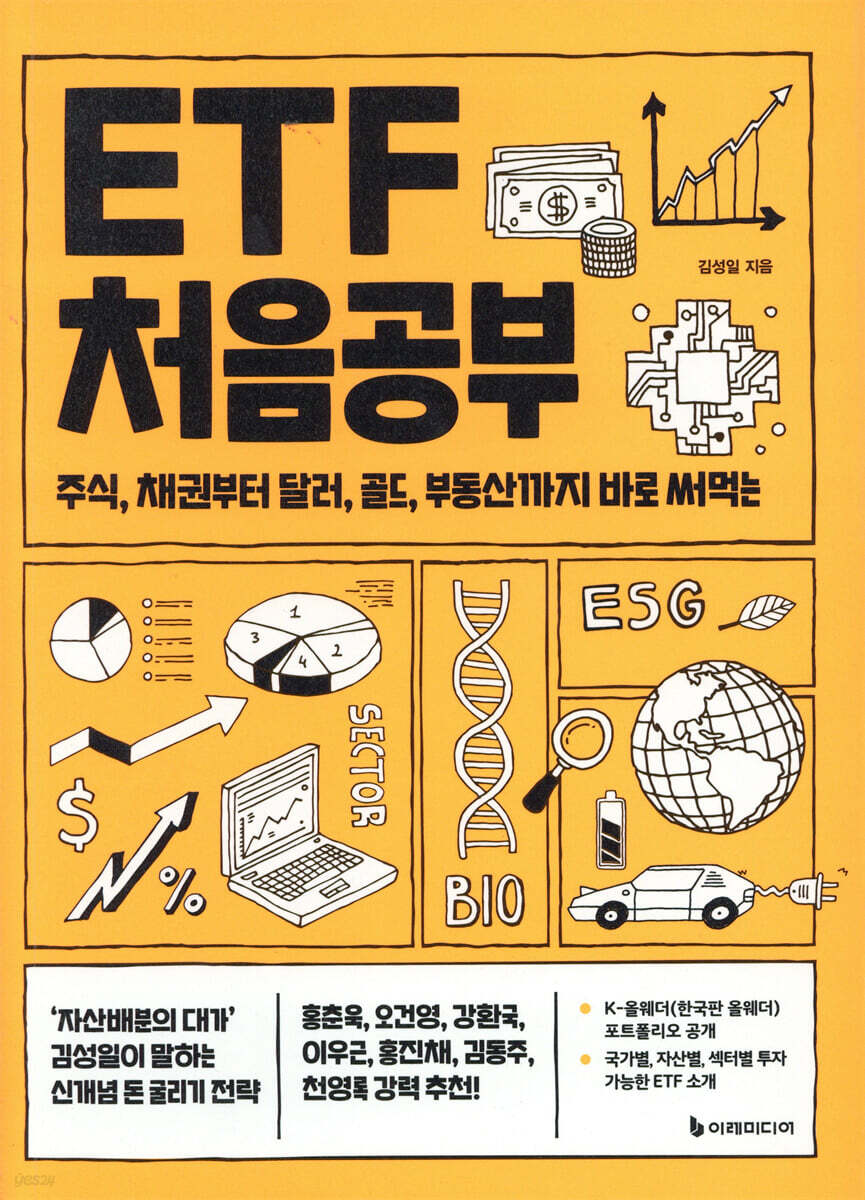
A new work by Kim Seong-il, the 'master of asset allocation'! From the basic concepts of ETFs to introductions to investable ETFs by country, asset, and sector. A book that contains everything about ETFs! "ETF Basics" is the new book by Kim Seong-il, a renowned "asset allocation expert." It covers basic ETF concepts and terminology, as well as examining investable ETFs and their performance by country, asset, and sector. The biggest advantage of ETFs is that they allow you to invest in virtually any asset class, including stocks, bonds, real estate, commodities, currencies, and foreign investments. Moreover, investment is possible even with small amounts of money. If you add stability to this, it would be perfect. In that respect, this book is noteworthy. Of particular note is K-All Weather, a Korean version of the fund managed by Bridgewater, founded by Ray Dalio. All-weather refers to a portfolio that can withstand all seasons. The author not only presents an investment portfolio that can generate profits at any time through ETFs, but also reveals the returns of each ETF in detail, helping beginners make safer investments. Simply put, you can invest just by looking at the rates of return listed in the book. This book will serve as an excellent guide not only for beginners who are just starting out with ETF investing, but also for intermediate and advanced investors who are unsure which ETF to choose among the numerous ones. And you will surely become an expert like no one else just by reading it. |
- You can preview some of the book's contents.
Preview
index
In an era where recommended investment is essential, ETFs are essential knowledge for investors.
Introduction: The Best ETF for Beginner Investors
Chapter 1: A Super-Simple ETF Investment Recipe for Beginners
01 Investing is cooking
02 Are active funds better?
03 Super-Simple Investment Portfolio: K-All Weather
04 The Sweet and Bitter Taste of Investing: Profit and Risk
05 To find the optimal investment ratio
Chapter 2: Investing in ETFs
Chapter 3: ETF Basics
01 ETF Super Easy Understanding
02 Introduction to the ETF Market
03 Advantages of ETFs
Chapter 4: In-Depth Study of ETFs
01 ETF distributions and dividend income tax
02 Things to know when investing in ETFs
03 ETF Investment Risks
Chapter 5: Complex but Curious Concepts
01 PR, TR, NTR comparison
02 Understanding Gifts and Futures Trading
03 Understanding Synthetic ETFs
04 Understanding Active ETFs
05 Understanding Foreign Exchange Exposure and Foreign Exchange Hedging
Chapter 6: Introduction and Analysis of Major ETFs
01 Understanding the basic indices
02 Developed Country Stock ETFs
03 Emerging Market Stock ETFs
04 Developed Country Bond ETFs
05 Emerging Market Bond ETFs
06 Alternative Investment ETFs
Chapter 7: Detailed Classification of ETFs According to Investment Purpose
01 Various industrial classification criteria
02 Domestic sector type
03 Domestic factor type
04 Domestic theme type
05 Domestic strategic type
06 Domestic active type
07 Domestic asset allocation type
08 Global Asset Allocation
09 US Sector Type
10 US Factor Type
11 American Theme
12 American Strategic Type
13 Global Sectors
14 Global Themes
15 Chinese sectors
16 Chinese Theme Type
17 European Factor Type
18 Japanese sector type
19 Leverage and Inverse
Late investing is navigating rough seas.
Introduction: The Best ETF for Beginner Investors
Chapter 1: A Super-Simple ETF Investment Recipe for Beginners
01 Investing is cooking
02 Are active funds better?
03 Super-Simple Investment Portfolio: K-All Weather
04 The Sweet and Bitter Taste of Investing: Profit and Risk
05 To find the optimal investment ratio
Chapter 2: Investing in ETFs
Chapter 3: ETF Basics
01 ETF Super Easy Understanding
02 Introduction to the ETF Market
03 Advantages of ETFs
Chapter 4: In-Depth Study of ETFs
01 ETF distributions and dividend income tax
02 Things to know when investing in ETFs
03 ETF Investment Risks
Chapter 5: Complex but Curious Concepts
01 PR, TR, NTR comparison
02 Understanding Gifts and Futures Trading
03 Understanding Synthetic ETFs
04 Understanding Active ETFs
05 Understanding Foreign Exchange Exposure and Foreign Exchange Hedging
Chapter 6: Introduction and Analysis of Major ETFs
01 Understanding the basic indices
02 Developed Country Stock ETFs
03 Emerging Market Stock ETFs
04 Developed Country Bond ETFs
05 Emerging Market Bond ETFs
06 Alternative Investment ETFs
Chapter 7: Detailed Classification of ETFs According to Investment Purpose
01 Various industrial classification criteria
02 Domestic sector type
03 Domestic factor type
04 Domestic theme type
05 Domestic strategic type
06 Domestic active type
07 Domestic asset allocation type
08 Global Asset Allocation
09 US Sector Type
10 US Factor Type
11 American Theme
12 American Strategic Type
13 Global Sectors
14 Global Themes
15 Chinese sectors
16 Chinese Theme Type
17 European Factor Type
18 Japanese sector type
19 Leverage and Inverse
Late investing is navigating rough seas.
Detailed image

Into the book
ETFs are a great tool that allows even the average individual to invest as well as professionals.
It made it possible for ordinary people to make investments that were previously only available to experts or groups of experts.
In the past, there were few ways for individuals to invest in government bonds.
Although it was possible to invest indirectly through funds, there were not many funds that dealt only in government bonds.
The advent of low-cost ETFs has made investing in government bonds much easier. ETFs aren't just about stocks and bonds.
It is very diverse, including real estate, crude oil, gold, foreign stocks, and currency.
With the development of information media such as the Internet, it has become much easier to obtain information about various assets.
In the past, even with information, it was difficult to find ways to invest. However, the development of ETFs has made it possible to invest in a variety of assets across various countries.
--- p.16~17
ETF products can be traded at all securities firms.
Therefore, any place with high reliability, a well-developed computer system, and low transaction fees is fine.
Due to the management of supervisory agencies, most securities companies' computer systems have been standardized.
However, large securities firms may be relatively more stable than small and medium-sized securities firms.
As of the end of 2020, there were a total of 58 securities firms registered with the Korea Financial Investment Association.
Among them, there are 38 domestic securities firms and 20 foreign securities firms.
Among the 28 domestic securities firms, 21 are listed on the KOSPI or KOSDAQ markets.
--- p.92
There are a total of four developed country stock ETFs launched in our country.
Three are hedged (H) and one is exposed.
Even for stocks of the same developed country, performance and movement differ depending on the underlying index and whether or not there is currency hedging.
Therefore, you should understand the underlying index and consider whether it is hedged before choosing an ETF.
--- p.205
Traditional ETFs aim to track market indices.
However, there have been attempts to gain additional profits beyond index tracking, and one such management strategy is smart beta.
Smart beta is the opposite of market beta and is also called alternative beta, progressive beta, or strategic beta.
Or, it is also called factor investing, meaning investment that uses multiple factors.
--- p.356
Past performance alone cannot predict future performance.
However, making hasty investment decisions simply because something is frequently featured in the media, is a hot topic in business, or is popular may not yield the results you expect.
We must not forget that investing based on trends can be risky.
It made it possible for ordinary people to make investments that were previously only available to experts or groups of experts.
In the past, there were few ways for individuals to invest in government bonds.
Although it was possible to invest indirectly through funds, there were not many funds that dealt only in government bonds.
The advent of low-cost ETFs has made investing in government bonds much easier. ETFs aren't just about stocks and bonds.
It is very diverse, including real estate, crude oil, gold, foreign stocks, and currency.
With the development of information media such as the Internet, it has become much easier to obtain information about various assets.
In the past, even with information, it was difficult to find ways to invest. However, the development of ETFs has made it possible to invest in a variety of assets across various countries.
--- p.16~17
ETF products can be traded at all securities firms.
Therefore, any place with high reliability, a well-developed computer system, and low transaction fees is fine.
Due to the management of supervisory agencies, most securities companies' computer systems have been standardized.
However, large securities firms may be relatively more stable than small and medium-sized securities firms.
As of the end of 2020, there were a total of 58 securities firms registered with the Korea Financial Investment Association.
Among them, there are 38 domestic securities firms and 20 foreign securities firms.
Among the 28 domestic securities firms, 21 are listed on the KOSPI or KOSDAQ markets.
--- p.92
There are a total of four developed country stock ETFs launched in our country.
Three are hedged (H) and one is exposed.
Even for stocks of the same developed country, performance and movement differ depending on the underlying index and whether or not there is currency hedging.
Therefore, you should understand the underlying index and consider whether it is hedged before choosing an ETF.
--- p.205
Traditional ETFs aim to track market indices.
However, there have been attempts to gain additional profits beyond index tracking, and one such management strategy is smart beta.
Smart beta is the opposite of market beta and is also called alternative beta, progressive beta, or strategic beta.
Or, it is also called factor investing, meaning investment that uses multiple factors.
--- p.356
Past performance alone cannot predict future performance.
However, making hasty investment decisions simply because something is frequently featured in the media, is a hot topic in business, or is popular may not yield the results you expect.
We must not forget that investing based on trends can be risky.
--- p.400
Publisher's Review
With just this one book, you too can become an ETF expert!
11 Reasons Why You Should Start Investing in ETFs!
In the United States, it is said that the higher the income, the wealthier the person, and the more educated the person is, the more likely they are to prefer ETFs.
The reason will be obvious.
Because it has many advantages.
As a simple example, ETFs allow for small-scale, diversified investments, just like funds.
To buy one share of Samsung Electronics, you need about 70,000 won, which is the current price.
However, with ETFs, you can buy good stocks like Samsung Electronics, SK Hynix, Naver, Kakao, and Samsung SDI in one basket for half the price of 36,000 won.
In other words, even if the price of Samsung Electronics stock falls, if the price of other stocks in the same basket rises, the ETF I bought may also rise.
In this respect, ETFs can be safe assets with the effect of diversification.
Additionally, there's the benefit of being exempt from securities transaction taxes. Here are some reasons to invest in ETFs:
You can invest in various asset classes.
You can implement a variety of strategies previously only available to a small number of hedge funds or professional investors.
Diversification of investments is possible with small amounts.
The management fee is lower than that of a general fund and there is no early redemption fee.
You can safely achieve market average returns.
It is advantageous from a tax perspective because it is exempt from securities transaction tax.
ETFs are transparent because they disclose the stocks they hold daily.
It is easy to invest in sectors or themes according to policy.
Since the fluctuations are not large, you can gain trading experience relatively safely.
You can receive dividend income from individual stocks in the basket.
Real-time trading is possible, just like stocks.
The number of ETFs is growing explosively.
In the United States in particular, starting with one ETF in 1993, there were 102 ETFs traded in 2002, and over 2,200 in 2020.
This is the same in other countries, with more than 7,700 ETFs currently being traded worldwide.
Revealing the return results of each ETF through backtesting!
The ETF investment secrets of the 'asset allocation master'!
There are a variety of assets you can invest in with ETFs.
As mentioned earlier, you can invest in virtually any asset, including stocks, bonds, real estate, crude oil, gold, foreign stocks, and currencies.
It varies depending on the type, but in the case of inexpensive ETFs, the price per share is only a few thousand won.
In other words, you can invest with a small amount of money, and the management fees are lower than those of other financial products.
You can also track indices, sectors or stocks, or choose more aggressive investments like inverse or leveraged funds.
If you're considering investing, it's a good tool for asset allocation. If you're looking to make money, it can be a good short-term or long-term investment.
This book takes all of these situations into account.
Author Kim Seong-il begins by identifying an investor's investment tendencies and then explains step-by-step how to invest according to those tendencies to avoid failure and achieve stable profits.
At the center of it all is ‘K-All Weather’.
This book is a Korean adaptation of the fund managed by Bridgewater, founded by Ray Dalio, and the author reveals a portfolio that can withstand all seasons.
Additionally, for readers unfamiliar with ETFs, we provide detailed information on investable ETFs by country, asset, and sector.
In addition, the backtesting results of the index and its corresponding ETF investment performance are introduced in detail, allowing readers to make investment choices based solely on the results, making it a useful investment reference for both beginners and intermediate investors.
In particular, the return results disclosed along with various types of ETFs enable investors to make safer investments.
Simply put, this book makes it possible to invest just by looking at the rate of return, and the methods for making profits are all contained within this book.
"ETF Basics" will be an excellent guide not only for beginners who are just starting out with ETF investing, but also for intermediate and advanced investors who are unsure which ETF to choose among the numerous ETFs.
11 Reasons Why You Should Start Investing in ETFs!
In the United States, it is said that the higher the income, the wealthier the person, and the more educated the person is, the more likely they are to prefer ETFs.
The reason will be obvious.
Because it has many advantages.
As a simple example, ETFs allow for small-scale, diversified investments, just like funds.
To buy one share of Samsung Electronics, you need about 70,000 won, which is the current price.
However, with ETFs, you can buy good stocks like Samsung Electronics, SK Hynix, Naver, Kakao, and Samsung SDI in one basket for half the price of 36,000 won.
In other words, even if the price of Samsung Electronics stock falls, if the price of other stocks in the same basket rises, the ETF I bought may also rise.
In this respect, ETFs can be safe assets with the effect of diversification.
Additionally, there's the benefit of being exempt from securities transaction taxes. Here are some reasons to invest in ETFs:
You can invest in various asset classes.
You can implement a variety of strategies previously only available to a small number of hedge funds or professional investors.
Diversification of investments is possible with small amounts.
The management fee is lower than that of a general fund and there is no early redemption fee.
You can safely achieve market average returns.
It is advantageous from a tax perspective because it is exempt from securities transaction tax.
ETFs are transparent because they disclose the stocks they hold daily.
It is easy to invest in sectors or themes according to policy.
Since the fluctuations are not large, you can gain trading experience relatively safely.
You can receive dividend income from individual stocks in the basket.
Real-time trading is possible, just like stocks.
The number of ETFs is growing explosively.
In the United States in particular, starting with one ETF in 1993, there were 102 ETFs traded in 2002, and over 2,200 in 2020.
This is the same in other countries, with more than 7,700 ETFs currently being traded worldwide.
Revealing the return results of each ETF through backtesting!
The ETF investment secrets of the 'asset allocation master'!
There are a variety of assets you can invest in with ETFs.
As mentioned earlier, you can invest in virtually any asset, including stocks, bonds, real estate, crude oil, gold, foreign stocks, and currencies.
It varies depending on the type, but in the case of inexpensive ETFs, the price per share is only a few thousand won.
In other words, you can invest with a small amount of money, and the management fees are lower than those of other financial products.
You can also track indices, sectors or stocks, or choose more aggressive investments like inverse or leveraged funds.
If you're considering investing, it's a good tool for asset allocation. If you're looking to make money, it can be a good short-term or long-term investment.
This book takes all of these situations into account.
Author Kim Seong-il begins by identifying an investor's investment tendencies and then explains step-by-step how to invest according to those tendencies to avoid failure and achieve stable profits.
At the center of it all is ‘K-All Weather’.
This book is a Korean adaptation of the fund managed by Bridgewater, founded by Ray Dalio, and the author reveals a portfolio that can withstand all seasons.
Additionally, for readers unfamiliar with ETFs, we provide detailed information on investable ETFs by country, asset, and sector.
In addition, the backtesting results of the index and its corresponding ETF investment performance are introduced in detail, allowing readers to make investment choices based solely on the results, making it a useful investment reference for both beginners and intermediate investors.
In particular, the return results disclosed along with various types of ETFs enable investors to make safer investments.
Simply put, this book makes it possible to invest just by looking at the rate of return, and the methods for making profits are all contained within this book.
"ETF Basics" will be an excellent guide not only for beginners who are just starting out with ETF investing, but also for intermediate and advanced investors who are unsure which ETF to choose among the numerous ETFs.
GOODS SPECIFICS
- Publication date: June 10, 2022
- Page count, weight, size: 524 pages | 1,090g | 170*235*35mm
- ISBN13: 9791191328516
- ISBN10: 1191328511
You may also like
카테고리
korean


korean

![GQ KOREA Mark (Monthly): December [2025]](http://librairie.coreenne.fr/cdn/shop/files/8ef265dbbfbf186523ed75ba7319009d.jpg?v=1765340328&width=3840)


