

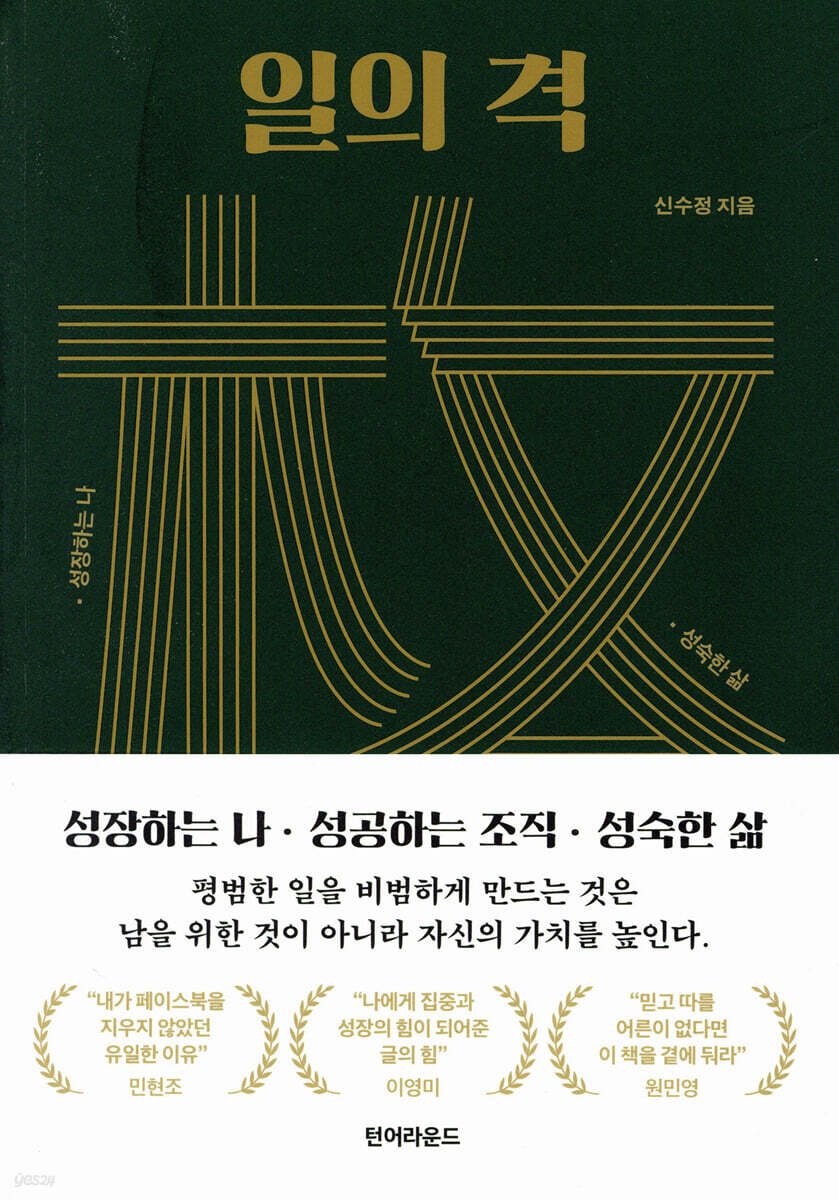
The level of work
 |
Description
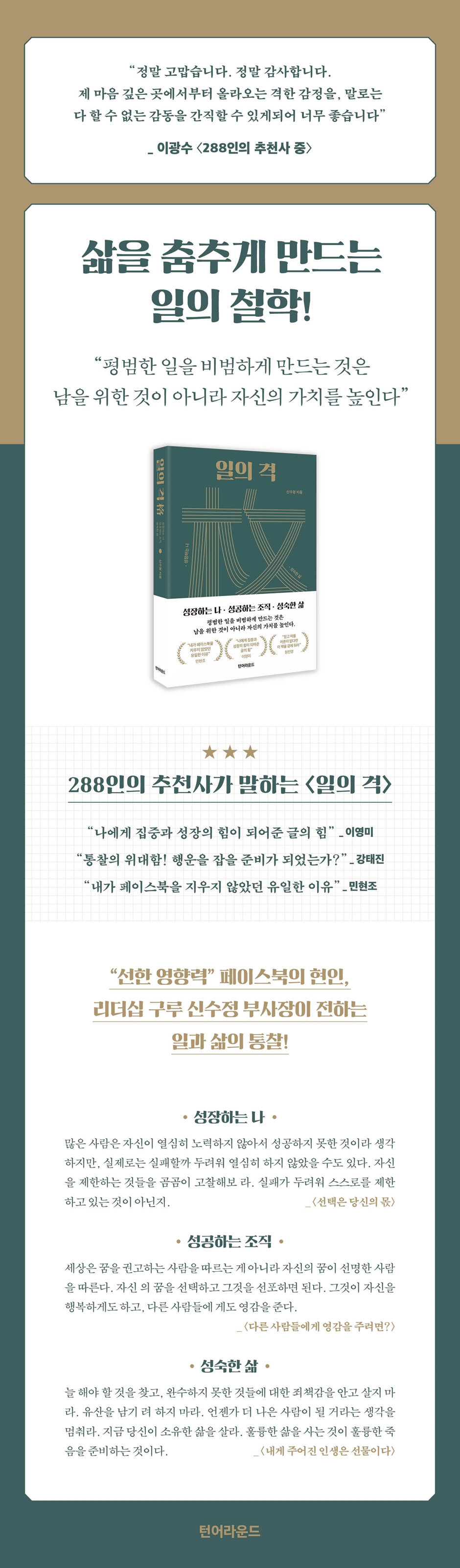
Book Introduction
“The Philosophy of Making Life Dance”
Repeated requests from Facebook readers for publication have finally been made into a book!
Recommendations from 277 Facebook users who have experienced the changes in work and life firsthand!
"The Greatness of Insight! Are You Ready to Seize Your Luck?" _ Kang Tae-jin
“The Only Reason I Didn’t Delete Facebook”_ Min Hyun-jo
The power of writing, which gave me the strength to focus and grow. _ Lee Young-mi
“What makes ordinary things extraordinary is
“It’s not about serving others, it’s about increasing your own value.”
Facebook's sage, leadership guru
Insights on work and life from Vice President Shin Soo-jung!
"The Class of Work" is a collection of writings by KT Vice President Shin Su-jeong, who practices "positive influence" by receiving sympathy and enthusiastic support from numerous professionals through her experiences and insights on work and life on Facebook.
It is filled with various field experiences accumulated over a long period of time and traces of reading thousands of books.
Based on three core themes—growth, success, and maturity—it presents practical solutions that can transform individuals, organizations, and our lives for the better.
Repeated requests from Facebook readers for publication have finally been made into a book!
Recommendations from 277 Facebook users who have experienced the changes in work and life firsthand!
"The Greatness of Insight! Are You Ready to Seize Your Luck?" _ Kang Tae-jin
“The Only Reason I Didn’t Delete Facebook”_ Min Hyun-jo
The power of writing, which gave me the strength to focus and grow. _ Lee Young-mi
“What makes ordinary things extraordinary is
“It’s not about serving others, it’s about increasing your own value.”
Facebook's sage, leadership guru
Insights on work and life from Vice President Shin Soo-jung!
"The Class of Work" is a collection of writings by KT Vice President Shin Su-jeong, who practices "positive influence" by receiving sympathy and enthusiastic support from numerous professionals through her experiences and insights on work and life on Facebook.
It is filled with various field experiences accumulated over a long period of time and traces of reading thousands of books.
Based on three core themes—growth, success, and maturity—it presents practical solutions that can transform individuals, organizations, and our lives for the better.
- You can preview some of the book's contents.
Preview
index
Recommendations: 288 recommendations and words of encouragement.
(From.
Facebook)
Introduction
Chapter 1.
Growth | Technology that maximizes work performance
_ The Joy of Growth and Key Clues for a Career
1.
What is the secret to success for ordinary people?
2.
The greatest enemy of success is not failure, but boredom.
3.
Just go find it
4.
Want to get a higher salary?
5.
How to Outperform Harvard Students
6.
To satisfy the other person
7.
It's good for leaders not to be the ones who expend too much energy.
8.
How to become extraordinary even when ordinary
9.
80% of careers are determined by unexpected coincidences.
10.
Busy people are always busy
11.
Smash the glass.
12.
Be a jerk sometimes
13.
Questions to find answers to when you have difficulties and worries
14.
Think of it as going towards something, not avoiding it.
15.
To move beyond one level, a different perspective is needed.
16.
He's a coach, not a beginner coach
17.
What kind of teacher should I look for when learning something for the first time?
18.
The Light and Dark Side of Concentration and Willpower
19.
Will the best performers achieve the greatest success?
20.
Why Mother Teresa flew first class
21.
Will competing with outstanding people improve your skills?
22.
If you write it down, you can handle it
23.
How much help can other people's secrets to success be to me?
24.
If there are many people around me who are better than me
25.
Focus on what only you can do
26.
The art of learning
27.
Knock and it will be opened
28.
Intense curiosity and persistence beat genius.
29.
The way to learn effectively is to learn inefficiently.
30.
"Getting it right from the start" is holding back "agility."
31.
The 'short but many times' strategy
32.
low-level thinking strategies
33.
How to discover your talent
34.
Getting a hit means you can throw a strike.
35.
strategic incompetence
36.
We need to listen to what the old farts have to say
37.
What's the secret to looking incredibly smart even if you're not that smart?
38.
Howard Schultz wasn't the first person to visit an Italian café.
39.
Learning is a habit
40.
Do what you should have done then, now.
41.
How to stay smart as you age?
42.
Hit the hammer hard
43.
The best mentor is the one you paid for.
44.
Accumulation and then divergence
45.
There's nothing shameful about baking bread...
46.
Words that have already been lost
47.
Is it speed reading or thorough reading?
48.
Debunking the myth of willpower: Pursue inefficiency.
49.
Don't avoid feedback
50.
The illusion of the word 'enjoy'
51.
Invest your money and time in "techniques and training," not "acquiring information."
52.
Small secrets to gaining trust
53.
What's your biggest piece of advice for young people?
54.
It's okay to give up
55.
Weaknesses become strengths
56.
Yes is Yes and No is No
57.
Tiptoe right past the amygdala.
58.
Why Baek Jong-won's Coaching Fails
59.
A person who reflects continues to reflect, and a person who studies continues to study.
60.
The more expert you are, the more tiring and demanding your daily life in your field becomes.
61.
If you are an expert, you should say more.
62.
You have to become 'eul' to become skilled
63.
Worst excuse: There are so many people who are better than me.
64.
Your talent is your greatest asset.
65.
It was when I was 45 years old
Chapter 2.
Success | Discovering the Leadership That Leads Organizations to Success
_ Advice for <successful> organizations and leadership
1.
Who did you find?
2.
Drivers don't get carsick
3.
A leader is a gardener, not a chess player.
4.
Being able to hear critical opinions requires respect.
5.
Is Yes Man a bad thing?
6.
Take the upward escalator
7.
How to write for people in important positions
8.
How to rapidly improve the capabilities of an organization?
9.
About the evaluation
10.
Why do great goals and strategies fail in execution?
11.
About philosophy and core values
12.
Reasons to let go of Torai
13.
Why the Best Practices Don't Work
14.
The secrets that made us successful can also make us fail.
15.
Happy Retirees vs. Unhappy Retirees
16.
How do I speak directly to my boss?
17.
Misunderstanding about trust among members
18.
How to deal with a boss who makes things difficult for you?
19.
If you can build a powerful team of 10, you can build a team of 1,000.
20.
About change
21.
The reason we are reluctant and resistant to new things is not because we don't like them, but because we don't know.
22.
This is the way we live
23.
Before becoming a leader, you develop yourself, but after becoming a leader, you develop others.
24.
How to motivate?
25.
To inspire others?
26.
Learn it all beats Know it all
27.
It's not that I hate work, it's that I hate the way it's done.
28.
The first key to uniting an organization
29.
There is no bad team.
There are only bad leaders.
30.
The biggest risk to the healthy growth of an organization
31.
Understand differences and solve problems
32.
The assumptions we accept as truth sometimes limit us.
33.
People only move in the direction that is 'profitable'.
34.
Are you laughing? Are you kidding?
35.
Mastering inefficiency
36.
What makes a good company?
37.
A good leader can be a fool
38.
Experts move themselves, leaders move others.
39.
The courage to say you don't know what you don't know
40.
A simple way to make a competent employee incompetent
41.
If I don't speak up, the leader won't know me well.
42.
How Leaders Can Get Employee Feedback Without Getting Hurt
43.
Do you need to change your personality to become a great leader?
44.
17 Reasons Why Leaders Have a Hard Time Earning Respect
45.
There are times when inefficiency is effective.
46.
The conductor makes no sound
47.
To what extent should leaders establish personal bonds with their employees?
48.
It is important to have a sense of calling as a ‘leader’ rather than a ‘team leader’.
49.
Don't look for solutions in people.
50.
Who will you choose?
51.
It's not about having something, it's about making something.
52.
How did that person get to that position?
53.
If you open the window, flies will come in too.
54.
How to tell if someone is really smart or just bragging
Chapter 3.
Maturity | How to Find Meaning in Work and Life
_ Insights for a 〈mature〉 life
1.
The person who pushes me away
2.
What does it mean to live authentically? Giving up on being a good person.
3.
Your attitude after failure determines what happens next.
4.
There's no need to be so excited or sad
5.
What is the third leg of your chair?
6.
Is it better to live simply or to live extravagantly?
7.
Separation of tasks
8.
Let's stop
9.
The more you act, the happier you become.
10.
It's okay to laze around a little
11.
I pretended to be good, but I ended up being good.
12.
Does the position make the person? Or does the person make the position?
13.
That's all
14.
If you keep doing the same thing, your whole life will disappear.
15.
A life without signals
16.
I am frustrating myself
17.
Beware of things going too well
18.
Deprivation makes us strong
19.
Why the "God of Work" Isn't Recognized at Home
20.
There is no such thing as useless work.
21.
Am I the controller, the cause, the free agent of my life?
22.
Wealth is about freedom and independence
23.
Why you don't need to seek approval and praise from others
24.
What kind of life do you really want to live?
25.
What is there to boast about, to be proud of?
26.
I AM ENOUGH
27.
Why do good people have it harder?
28.
I can live just by thinking about it
29.
It's not hard because it's 'heavy'
30.
Stress is my friend and my challenge.
31.
It's okay if things don't go well
32.
Freud vs. Adler: The Choice Is Yours
33.
What is the funniest story?
34.
The only thing that can change your life is yourself.
35.
Don't suppress it, reinterpret it.
36.
The power of faith
37.
The impact of causality and chance on life
38.
Freedom, Anxiety, and the Creator of Life
39.
Don't spread the word too much just because you like it.
40.
What is the worst thing you can do to your brain?
41.
Just that little thing
42.
We are the average of five people we spend most of our time with.
43.
An ordinary grandparent around you could be a noble person.
44.
If there is a cart, there is a road.
45.
About mental
46.
It's good to be clear about your weaknesses and traumas.
47.
Accepting the retreat
48.
Live as a Player, Not a Worker
49.
Is it a sailing ship or a cruise ship?
50.
On the myth of effort
51.
The reason we can't change is because we can't let go of the benefits.
52.
This world exists to oneself to the extent of one's own perception.
53.
Be-Do-Have
54.
Life itself is a gift, small happiness
55.
The life given to me is a gift
Concluding remarks
(From.
Facebook)
Introduction
Chapter 1.
Growth | Technology that maximizes work performance
_ The Joy of Growth and Key Clues for a Career
1.
What is the secret to success for ordinary people?
2.
The greatest enemy of success is not failure, but boredom.
3.
Just go find it
4.
Want to get a higher salary?
5.
How to Outperform Harvard Students
6.
To satisfy the other person
7.
It's good for leaders not to be the ones who expend too much energy.
8.
How to become extraordinary even when ordinary
9.
80% of careers are determined by unexpected coincidences.
10.
Busy people are always busy
11.
Smash the glass.
12.
Be a jerk sometimes
13.
Questions to find answers to when you have difficulties and worries
14.
Think of it as going towards something, not avoiding it.
15.
To move beyond one level, a different perspective is needed.
16.
He's a coach, not a beginner coach
17.
What kind of teacher should I look for when learning something for the first time?
18.
The Light and Dark Side of Concentration and Willpower
19.
Will the best performers achieve the greatest success?
20.
Why Mother Teresa flew first class
21.
Will competing with outstanding people improve your skills?
22.
If you write it down, you can handle it
23.
How much help can other people's secrets to success be to me?
24.
If there are many people around me who are better than me
25.
Focus on what only you can do
26.
The art of learning
27.
Knock and it will be opened
28.
Intense curiosity and persistence beat genius.
29.
The way to learn effectively is to learn inefficiently.
30.
"Getting it right from the start" is holding back "agility."
31.
The 'short but many times' strategy
32.
low-level thinking strategies
33.
How to discover your talent
34.
Getting a hit means you can throw a strike.
35.
strategic incompetence
36.
We need to listen to what the old farts have to say
37.
What's the secret to looking incredibly smart even if you're not that smart?
38.
Howard Schultz wasn't the first person to visit an Italian café.
39.
Learning is a habit
40.
Do what you should have done then, now.
41.
How to stay smart as you age?
42.
Hit the hammer hard
43.
The best mentor is the one you paid for.
44.
Accumulation and then divergence
45.
There's nothing shameful about baking bread...
46.
Words that have already been lost
47.
Is it speed reading or thorough reading?
48.
Debunking the myth of willpower: Pursue inefficiency.
49.
Don't avoid feedback
50.
The illusion of the word 'enjoy'
51.
Invest your money and time in "techniques and training," not "acquiring information."
52.
Small secrets to gaining trust
53.
What's your biggest piece of advice for young people?
54.
It's okay to give up
55.
Weaknesses become strengths
56.
Yes is Yes and No is No
57.
Tiptoe right past the amygdala.
58.
Why Baek Jong-won's Coaching Fails
59.
A person who reflects continues to reflect, and a person who studies continues to study.
60.
The more expert you are, the more tiring and demanding your daily life in your field becomes.
61.
If you are an expert, you should say more.
62.
You have to become 'eul' to become skilled
63.
Worst excuse: There are so many people who are better than me.
64.
Your talent is your greatest asset.
65.
It was when I was 45 years old
Chapter 2.
Success | Discovering the Leadership That Leads Organizations to Success
_ Advice for <successful> organizations and leadership
1.
Who did you find?
2.
Drivers don't get carsick
3.
A leader is a gardener, not a chess player.
4.
Being able to hear critical opinions requires respect.
5.
Is Yes Man a bad thing?
6.
Take the upward escalator
7.
How to write for people in important positions
8.
How to rapidly improve the capabilities of an organization?
9.
About the evaluation
10.
Why do great goals and strategies fail in execution?
11.
About philosophy and core values
12.
Reasons to let go of Torai
13.
Why the Best Practices Don't Work
14.
The secrets that made us successful can also make us fail.
15.
Happy Retirees vs. Unhappy Retirees
16.
How do I speak directly to my boss?
17.
Misunderstanding about trust among members
18.
How to deal with a boss who makes things difficult for you?
19.
If you can build a powerful team of 10, you can build a team of 1,000.
20.
About change
21.
The reason we are reluctant and resistant to new things is not because we don't like them, but because we don't know.
22.
This is the way we live
23.
Before becoming a leader, you develop yourself, but after becoming a leader, you develop others.
24.
How to motivate?
25.
To inspire others?
26.
Learn it all beats Know it all
27.
It's not that I hate work, it's that I hate the way it's done.
28.
The first key to uniting an organization
29.
There is no bad team.
There are only bad leaders.
30.
The biggest risk to the healthy growth of an organization
31.
Understand differences and solve problems
32.
The assumptions we accept as truth sometimes limit us.
33.
People only move in the direction that is 'profitable'.
34.
Are you laughing? Are you kidding?
35.
Mastering inefficiency
36.
What makes a good company?
37.
A good leader can be a fool
38.
Experts move themselves, leaders move others.
39.
The courage to say you don't know what you don't know
40.
A simple way to make a competent employee incompetent
41.
If I don't speak up, the leader won't know me well.
42.
How Leaders Can Get Employee Feedback Without Getting Hurt
43.
Do you need to change your personality to become a great leader?
44.
17 Reasons Why Leaders Have a Hard Time Earning Respect
45.
There are times when inefficiency is effective.
46.
The conductor makes no sound
47.
To what extent should leaders establish personal bonds with their employees?
48.
It is important to have a sense of calling as a ‘leader’ rather than a ‘team leader’.
49.
Don't look for solutions in people.
50.
Who will you choose?
51.
It's not about having something, it's about making something.
52.
How did that person get to that position?
53.
If you open the window, flies will come in too.
54.
How to tell if someone is really smart or just bragging
Chapter 3.
Maturity | How to Find Meaning in Work and Life
_ Insights for a 〈mature〉 life
1.
The person who pushes me away
2.
What does it mean to live authentically? Giving up on being a good person.
3.
Your attitude after failure determines what happens next.
4.
There's no need to be so excited or sad
5.
What is the third leg of your chair?
6.
Is it better to live simply or to live extravagantly?
7.
Separation of tasks
8.
Let's stop
9.
The more you act, the happier you become.
10.
It's okay to laze around a little
11.
I pretended to be good, but I ended up being good.
12.
Does the position make the person? Or does the person make the position?
13.
That's all
14.
If you keep doing the same thing, your whole life will disappear.
15.
A life without signals
16.
I am frustrating myself
17.
Beware of things going too well
18.
Deprivation makes us strong
19.
Why the "God of Work" Isn't Recognized at Home
20.
There is no such thing as useless work.
21.
Am I the controller, the cause, the free agent of my life?
22.
Wealth is about freedom and independence
23.
Why you don't need to seek approval and praise from others
24.
What kind of life do you really want to live?
25.
What is there to boast about, to be proud of?
26.
I AM ENOUGH
27.
Why do good people have it harder?
28.
I can live just by thinking about it
29.
It's not hard because it's 'heavy'
30.
Stress is my friend and my challenge.
31.
It's okay if things don't go well
32.
Freud vs. Adler: The Choice Is Yours
33.
What is the funniest story?
34.
The only thing that can change your life is yourself.
35.
Don't suppress it, reinterpret it.
36.
The power of faith
37.
The impact of causality and chance on life
38.
Freedom, Anxiety, and the Creator of Life
39.
Don't spread the word too much just because you like it.
40.
What is the worst thing you can do to your brain?
41.
Just that little thing
42.
We are the average of five people we spend most of our time with.
43.
An ordinary grandparent around you could be a noble person.
44.
If there is a cart, there is a road.
45.
About mental
46.
It's good to be clear about your weaknesses and traumas.
47.
Accepting the retreat
48.
Live as a Player, Not a Worker
49.
Is it a sailing ship or a cruise ship?
50.
On the myth of effort
51.
The reason we can't change is because we can't let go of the benefits.
52.
This world exists to oneself to the extent of one's own perception.
53.
Be-Do-Have
54.
Life itself is a gift, small happiness
55.
The life given to me is a gift
Concluding remarks
Detailed image
Into the book
“Making ordinary things extraordinary is not about doing them for others, but about enhancing your own worth.
Also, such a person never continues to do that thing.
“You will do bigger things, and when you get used to doing it, you will do even bigger things or start your own business and you will be extraordinary.”
--- p.49
“Change is painful.
After accumulation, there is divergence.
If you can't stand it during that period and run away, abandoning your principles and best practices, you will live on that side dish and that meal forever.
The reason people fail is not only because they don't know the rules of success, but also because even if they learn and know them, they can't stick to the new rules until they reach the critical point of complete change.
This is especially important until you get used to the new change, as most people fail and return to their original state during this period.”
--- p.142
“Before becoming a leader, you develop yourself. After becoming a leader, you develop others.”
--- p.200
"What's the difference between an expert and a leader? There are many, but the biggest difference, I believe, is this: an expert moves himself, while a leader moves others."
Experts are usually accustomed to coming up with great ideas on their own and implementing them themselves.
This is very effective for staff, consultants, coaches, speakers, writers, and researchers who work alone, lead small, fast-paced organizations, or provide advice.
However, leading a large organization with tens, hundreds, or thousands of people or taking on a large business is different.
In these cases, there isn't much you can do on your own.
The key here is to present a vision and inspire others.
“If the members of an organization don’t take action, no matter how smart, how expert, or how globally renowned you are, it’s difficult to achieve much.”
--- p.229
“The important thing is to live true to myself.
Living true to myself means living according to my own standards, not according to the feelings of others.
Sometimes you refuse to do things you don't want to do.
Even if you get rejected, try again.
Rather than trying to do everything for the other person, I help them solve their own problems or leave them alone.
They don't lend money easily.
If you have any worries, don't worry alone or feel guilty. Just talk to the other person.
Say what you want to say.
“Sometimes I enjoy hearing that I am a poisonous person.”
--- p.267
“If there is night, then day comes, and if there is day, then night comes. That is life.
“It’s just that for some people who are less fortunate, the nights are a little longer, and for others who are more fortunate, the days are a little longer.”
--- p.271
“Living simply because you have no financial means, or seeking out luxury to show off and look good to others because you are concerned about comparing yourself to others – neither is freedom.
“True freedom is choosing for yourself.”
--- p.273
“Many people think they don’t succeed because they don’t try hard enough, but in reality, they may not have tried hard enough because they were afraid of failing.
So, take a moment to reflect on the things that limit you.
“Are you limiting yourself because you’re afraid of failure?”
--- p.319
“Rather than a list of things to do, make a bucket list of things you want to do.
Live happily and joyfully.
Enjoy the little things, savor them, love them, laugh them, be happy, forgive them, and live generously.
When we live with death in mind, we live each day lovingly, wisely, freely, and generously.
Because every moment is a gift.”
Also, such a person never continues to do that thing.
“You will do bigger things, and when you get used to doing it, you will do even bigger things or start your own business and you will be extraordinary.”
--- p.49
“Change is painful.
After accumulation, there is divergence.
If you can't stand it during that period and run away, abandoning your principles and best practices, you will live on that side dish and that meal forever.
The reason people fail is not only because they don't know the rules of success, but also because even if they learn and know them, they can't stick to the new rules until they reach the critical point of complete change.
This is especially important until you get used to the new change, as most people fail and return to their original state during this period.”
--- p.142
“Before becoming a leader, you develop yourself. After becoming a leader, you develop others.”
--- p.200
"What's the difference between an expert and a leader? There are many, but the biggest difference, I believe, is this: an expert moves himself, while a leader moves others."
Experts are usually accustomed to coming up with great ideas on their own and implementing them themselves.
This is very effective for staff, consultants, coaches, speakers, writers, and researchers who work alone, lead small, fast-paced organizations, or provide advice.
However, leading a large organization with tens, hundreds, or thousands of people or taking on a large business is different.
In these cases, there isn't much you can do on your own.
The key here is to present a vision and inspire others.
“If the members of an organization don’t take action, no matter how smart, how expert, or how globally renowned you are, it’s difficult to achieve much.”
--- p.229
“The important thing is to live true to myself.
Living true to myself means living according to my own standards, not according to the feelings of others.
Sometimes you refuse to do things you don't want to do.
Even if you get rejected, try again.
Rather than trying to do everything for the other person, I help them solve their own problems or leave them alone.
They don't lend money easily.
If you have any worries, don't worry alone or feel guilty. Just talk to the other person.
Say what you want to say.
“Sometimes I enjoy hearing that I am a poisonous person.”
--- p.267
“If there is night, then day comes, and if there is day, then night comes. That is life.
“It’s just that for some people who are less fortunate, the nights are a little longer, and for others who are more fortunate, the days are a little longer.”
--- p.271
“Living simply because you have no financial means, or seeking out luxury to show off and look good to others because you are concerned about comparing yourself to others – neither is freedom.
“True freedom is choosing for yourself.”
--- p.273
“Many people think they don’t succeed because they don’t try hard enough, but in reality, they may not have tried hard enough because they were afraid of failing.
So, take a moment to reflect on the things that limit you.
“Are you limiting yourself because you’re afraid of failure?”
--- p.319
“Rather than a list of things to do, make a bucket list of things you want to do.
Live happily and joyfully.
Enjoy the little things, savor them, love them, laugh them, be happy, forgive them, and live generously.
When we live with death in mind, we live each day lovingly, wisely, freely, and generously.
Because every moment is a gift.”
--- p.361
Publisher's Review
“The truest form of comfort for work and life.”
As we work and live our lives, there are difficult and challenging moments.
In those moments, simply pouring out our hearts to someone can often bring us great comfort and strength.
We are surrounded by countless relationships where we work, eat, laugh, chat, and talk with countless people.
But when you really want to hear words of comfort and courage from someone, it's surprisingly hard to think of someone you can openly share your innermost feelings with.
That's when people look for books.
We turn to books in place of the one person who understands our feelings even though we couldn't bring ourselves to say them, the one person who tells us to be brave even though we've never heard from them before, and the one person who gives us the empathy we really needed but never asked for.
『Work's Level』 will help you become that kind of person.
Rather than simply wiping away tears and offering vague comfort and encouragement, we will help you understand the essential meaning of the sweat and tears you are shedding now.
I will share with you the wisdom, courage, and methods to become the master of your own life and mind.
The author says he wants to make the world a better place to live in, even if only a little, through his 'good influence.'
The publisher wants to work harder to ensure that the 'good influence' can reach your work and life.
If anyone sees this, I have something I really want to say.
“You’ve come to the right place.” I sincerely hope that this book will be of some help to you in your work and life.
_ Turnaround Kang Min-ho
As we work and live our lives, there are difficult and challenging moments.
In those moments, simply pouring out our hearts to someone can often bring us great comfort and strength.
We are surrounded by countless relationships where we work, eat, laugh, chat, and talk with countless people.
But when you really want to hear words of comfort and courage from someone, it's surprisingly hard to think of someone you can openly share your innermost feelings with.
That's when people look for books.
We turn to books in place of the one person who understands our feelings even though we couldn't bring ourselves to say them, the one person who tells us to be brave even though we've never heard from them before, and the one person who gives us the empathy we really needed but never asked for.
『Work's Level』 will help you become that kind of person.
Rather than simply wiping away tears and offering vague comfort and encouragement, we will help you understand the essential meaning of the sweat and tears you are shedding now.
I will share with you the wisdom, courage, and methods to become the master of your own life and mind.
The author says he wants to make the world a better place to live in, even if only a little, through his 'good influence.'
The publisher wants to work harder to ensure that the 'good influence' can reach your work and life.
If anyone sees this, I have something I really want to say.
“You’ve come to the right place.” I sincerely hope that this book will be of some help to you in your work and life.
_ Turnaround Kang Min-ho
GOODS SPECIFICS
- Date of issue: July 1, 2021
- Page count, weight, size: 365 pages | 600g | 140*210*22mm
- ISBN13: 9791190276023
- ISBN10: 119027602X
You may also like
카테고리
korean


korean

![ELLE 엘르 스페셜 에디션 A형 : 12월 [2025]](http://librairie.coreenne.fr/cdn/shop/files/b8e27a3de6c9538896439686c6b0e8fb.jpg?v=1766436872&width=3840)


