

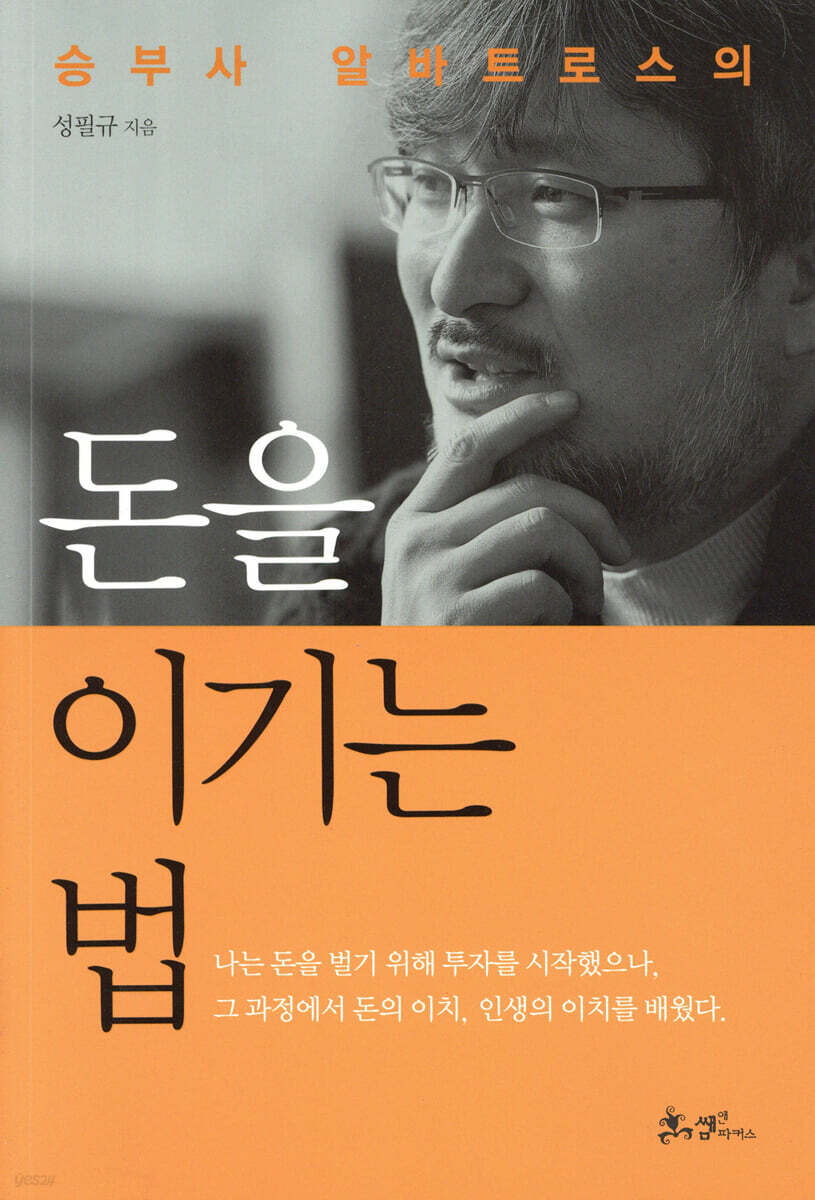
How to win money
 |
Description
Book Introduction
Seong Pil-gyu, the "Albatross" of the Stock Market
The secret to making 'profits' in the stock market, according to him.
Seong Pil-gyu, Chairman of PK Investment Consulting, known as the "Albatross" and "Legend of System Trading," is the "Gambler of the Stock Market."
He is a true mythical figure in the stock market, having invested in the stock market in 1994 with a seed capital of 1.5 million won and recorded an unprecedented cumulative return of over 10,000 times.
This achievement was possible through countless trials and errors and thorough preparation.
When he became complacent, great failure followed, and when he sought the easy way out, the market punished him harshly.
Ultimately, it was when he realized that 'money is something to be won rather than earned' that he started making profits.
The author argues that investment knowledge alone cannot guarantee success in the market, and that there is absolutely no method that will guarantee success, never fail, or always be profitable.
However, he emphasizes that there are 'principles to win' in the market.
That is the 'principle of winning over money'.
'Winning over money' means not being swayed by greed, acknowledging your own abilities, and preparing for the market with a humble but fierce mind.
The unwavering principle in front of money is the principle of winning over money.
The reason he was able to be more daring when the market faced a crisis was because he believed in these winning principles and stayed true to them.
Instead of providing investment knowledge, the author reveals even the most shameful memories in detail.
I hope that those who are just entering the market or are already deeply involved in the market will not have to go through the same trial and error that I did.
It contains a sincere wish to jump into the market after understanding the principles of money and the market.
The author also shares the investment principles and secrets that helped him survive all the ups and downs.
If the author is an investor, he or she should know these principles before jumping into the market.
I hope you write it down on your desk and keep it in your mind.
He says that if you know this, you will never be eliminated from the stock market.
As we share his dramatic investment life, we laugh and cry together, almost as if we were in the middle of a fierce battle.
In the midst of extreme failure and frustration, you can feel the cruelty and fear of the market, and in the scene where you finally make a big profit, you can feel the joy of being a winner in the market.
You will experience the market as it is and come to understand the principles of the market and money deep in your heart.
The secret to making 'profits' in the stock market, according to him.
Seong Pil-gyu, Chairman of PK Investment Consulting, known as the "Albatross" and "Legend of System Trading," is the "Gambler of the Stock Market."
He is a true mythical figure in the stock market, having invested in the stock market in 1994 with a seed capital of 1.5 million won and recorded an unprecedented cumulative return of over 10,000 times.
This achievement was possible through countless trials and errors and thorough preparation.
When he became complacent, great failure followed, and when he sought the easy way out, the market punished him harshly.
Ultimately, it was when he realized that 'money is something to be won rather than earned' that he started making profits.
The author argues that investment knowledge alone cannot guarantee success in the market, and that there is absolutely no method that will guarantee success, never fail, or always be profitable.
However, he emphasizes that there are 'principles to win' in the market.
That is the 'principle of winning over money'.
'Winning over money' means not being swayed by greed, acknowledging your own abilities, and preparing for the market with a humble but fierce mind.
The unwavering principle in front of money is the principle of winning over money.
The reason he was able to be more daring when the market faced a crisis was because he believed in these winning principles and stayed true to them.
Instead of providing investment knowledge, the author reveals even the most shameful memories in detail.
I hope that those who are just entering the market or are already deeply involved in the market will not have to go through the same trial and error that I did.
It contains a sincere wish to jump into the market after understanding the principles of money and the market.
The author also shares the investment principles and secrets that helped him survive all the ups and downs.
If the author is an investor, he or she should know these principles before jumping into the market.
I hope you write it down on your desk and keep it in your mind.
He says that if you know this, you will never be eliminated from the stock market.
As we share his dramatic investment life, we laugh and cry together, almost as if we were in the middle of a fierce battle.
In the midst of extreme failure and frustration, you can feel the cruelty and fear of the market, and in the scene where you finally make a big profit, you can feel the joy of being a winner in the market.
You will experience the market as it is and come to understand the principles of the market and money deep in your heart.
- You can preview some of the book's contents.
Preview
index
Intro.
I am ready to leave the market at any time.
Prologue.
How the Albatross Lives
Part 1: Albatross, the Path I Walked
Chapter 1.
Young masters of the guest room (1994-1998)
A late-blooming college student's misadventures / The fortune teller and the university professor / A year buried in stock books
Young Masters in the Hall/ A Crash, a Wingless Fall/ Small Differences Divide Lives
Chapter 2.
Betting on the Stock Market (1999-2003)
Highlights of the Millennium Festival: KOSDAQ / Encounters with Operational Forces / The Beginning of a Relationship / The 9/11 Terror and the Butterfly Effect
The Devil, Truly Bewitched/ Gets Engaged in Another Operation/ Gambles on the Derivatives Market
Chapter 3.
The Beginning of System Trading (2004-2008)
The Harsh Price of Pride / The Chart of Fear / 'I Will Win This Game' / Opportunity Comes to Everyone
To be worthy of today's toast/ To be a gambler with soul
Chapter 4.
To a wider market (2009-2012)
To a slightly bigger stage/ One of the biggest promises/ PK Investment Consulting/ The image of a 'speculator'/
The price already reflects everything/Becoming a gambler with a soul
Part 2.
The principles of victory that protected me
Chapter 5.
The investment rules that protected me
1st_ Go your own way / 2nd_ Win first and then fight / 3rd_ Money management is your lifeline /
4th_ Keep working hard with a humble heart
Chapter 6.
Market-beating investment psychology
You can't beat the market with knowledge. Why do we only remember successful trades? Investing begins with knowing yourself.
If you enjoy investing, you win. / Today's happiness is / Only principles can control greed. /
How to overcome fear
Chapter 7.
The Philosophy of Money, the DNA of a Gambler
Does value come first, or does competition come first? / Luck doesn't build skill. /
Why Fraud is So Prevalent in the Stock Market / Enjoy the Joy of Slowness / What Investing and Dieting Have in Common
Bias against derivatives trading
Epilogue.
I walk my path today too
I am ready to leave the market at any time.
Prologue.
How the Albatross Lives
Part 1: Albatross, the Path I Walked
Chapter 1.
Young masters of the guest room (1994-1998)
A late-blooming college student's misadventures / The fortune teller and the university professor / A year buried in stock books
Young Masters in the Hall/ A Crash, a Wingless Fall/ Small Differences Divide Lives
Chapter 2.
Betting on the Stock Market (1999-2003)
Highlights of the Millennium Festival: KOSDAQ / Encounters with Operational Forces / The Beginning of a Relationship / The 9/11 Terror and the Butterfly Effect
The Devil, Truly Bewitched/ Gets Engaged in Another Operation/ Gambles on the Derivatives Market
Chapter 3.
The Beginning of System Trading (2004-2008)
The Harsh Price of Pride / The Chart of Fear / 'I Will Win This Game' / Opportunity Comes to Everyone
To be worthy of today's toast/ To be a gambler with soul
Chapter 4.
To a wider market (2009-2012)
To a slightly bigger stage/ One of the biggest promises/ PK Investment Consulting/ The image of a 'speculator'/
The price already reflects everything/Becoming a gambler with a soul
Part 2.
The principles of victory that protected me
Chapter 5.
The investment rules that protected me
1st_ Go your own way / 2nd_ Win first and then fight / 3rd_ Money management is your lifeline /
4th_ Keep working hard with a humble heart
Chapter 6.
Market-beating investment psychology
You can't beat the market with knowledge. Why do we only remember successful trades? Investing begins with knowing yourself.
If you enjoy investing, you win. / Today's happiness is / Only principles can control greed. /
How to overcome fear
Chapter 7.
The Philosophy of Money, the DNA of a Gambler
Does value come first, or does competition come first? / Luck doesn't build skill. /
Why Fraud is So Prevalent in the Stock Market / Enjoy the Joy of Slowness / What Investing and Dieting Have in Common
Bias against derivatives trading
Epilogue.
I walk my path today too
Into the book
“Don’t call yourself an investor until you’ve been completely broke three times.” I read that line in a book and thought, “What a wonderful saying,” but I never imagined that after going through three near-hellish bankruptcies myself, those words would resonate so deeply with me.
At the time I was reading the book, I was a college student without a family, so I only understood the feelings of Korekawa Kinjo, who had to rent a room in a friend's house because he couldn't even afford a place for his family to stay, through context.
But later, after a heartbreaking investment failure, I was forced to spend months at the office, leaving my young son and wife behind. I don't know whether to call it a coincidence or a cruel twist of fate.
---p.34
After waking up, the index plummeted by 10 points, and most of the listed stocks fell to the point where the red light on the electronic scoreboard in the auditorium disappeared.
The prelude to the IMF bailout had just begun.
But in this situation, I couldn't put into practice the one word I had written down so many times: 'cut your losses.'
As soon as the market opened, the index went down in a sharp downward motion, and my body froze as if I had been stuffed.
I was determined to cut my losses if the price rebounded by just a few percent during the session, but there was no sign of a weak rebound.
---p.44
It was precisely the morning after Ahn Jung-Hwan scored the golden comeback goal against Italy that my imagination was shattered.
Lower limit.
That too was a pile of sell orders at the lower limit price from the time of the simultaneous bid.
It was something I couldn't understand at all.
This was because there was no place where this much quantity could come from.
How could this happen to me?
I looked at the sky while drinking soju, which I couldn't drink, under Mapo Bridge.
I closed my eyes as I watched countless people wearing red T-shirts crowding around Mapo Bridge.
I desperately hoped this was a dream.
---p.102
2, 3, 4, 5, 6, 7, 8 billion… .
In the blink of an eye, the amount of loss grew larger and larger as the numbers changed.
Like a frog caught in the jaws of a poisonous snake, I couldn't take my eyes off the red numbers growing like a snowball.
It felt like my heart stopped.
The market is frozen in the face of a massive tsunami.
That too, perfectly.
I closed my eyes tightly and sorted out the amount that exceeded 1 billion won, but the final loss was 1.28 billion won.
That day, I lost all my savings and ended up in debt of about 900 million won.
After all that time spent struggling to pay off all that debt after my stock market failure, I can't believe I'm facing this again.
I couldn't even sigh.
---pp.127~128
Finally, the account operations that had been suspended have been resumed.
The time has come to give it a try.
The feeling was very good.
It seemed like the fog was clearing.
People can usually intuitively feel whether they will succeed or fail at something.
You yourself know best how much you have prepared and how intensely you are competing.
At least that summer I was pushing myself to my limits.
Now it's out of my hands and I'm leaving it to the market.
Preparations are complete.
Now it was up to fate.
---p.158
This time it was different.
This time, we get to taste the fruits of our long wait.
The profits on that day were greater than the profits in the previous few months.
I will never forget how I felt that day.
I was the one who had been fooled three times in the market, cried twice in the stock market, and even knelt in the derivatives market.
The time I had to endure was 4 years and 5 months, and the tears I had to shed were also like a bucket.
It was a very lonely time for me.
Although I had become so experienced that I could handle most transactions without any worries, on this day I couldn't help but get lost in countless thoughts.
---p.175
In the fall of 2008, fear gripped everyone, and my account was sucking in profits like it was sucking the market.
And in November, the market reached its peak of volatility, and I was able to stand tall at the peak of my profits.
Finally, the bet was right and the challenge was successful.
Since I worked harder than anyone else, maybe the profit was a fair reward.
---p.177
When a stock market crash occurs, this primal instinct is the first thing that comes into play in the human mind.
The rational, textbook logic that the bottom is when everyone sells out is triggered much later than the predator avoidance instinct that seeks to escape fear.
This is not something that can be achieved through effort.
Because the human mind has evolved in that way, and even now, this primary function is still much stronger and more primitive in humans.
When I reflect on the failures that have dealt me a crushing blow as I've walked the path of investing, I realize I'm no different.
At the time I was reading the book, I was a college student without a family, so I only understood the feelings of Korekawa Kinjo, who had to rent a room in a friend's house because he couldn't even afford a place for his family to stay, through context.
But later, after a heartbreaking investment failure, I was forced to spend months at the office, leaving my young son and wife behind. I don't know whether to call it a coincidence or a cruel twist of fate.
---p.34
After waking up, the index plummeted by 10 points, and most of the listed stocks fell to the point where the red light on the electronic scoreboard in the auditorium disappeared.
The prelude to the IMF bailout had just begun.
But in this situation, I couldn't put into practice the one word I had written down so many times: 'cut your losses.'
As soon as the market opened, the index went down in a sharp downward motion, and my body froze as if I had been stuffed.
I was determined to cut my losses if the price rebounded by just a few percent during the session, but there was no sign of a weak rebound.
---p.44
It was precisely the morning after Ahn Jung-Hwan scored the golden comeback goal against Italy that my imagination was shattered.
Lower limit.
That too was a pile of sell orders at the lower limit price from the time of the simultaneous bid.
It was something I couldn't understand at all.
This was because there was no place where this much quantity could come from.
How could this happen to me?
I looked at the sky while drinking soju, which I couldn't drink, under Mapo Bridge.
I closed my eyes as I watched countless people wearing red T-shirts crowding around Mapo Bridge.
I desperately hoped this was a dream.
---p.102
2, 3, 4, 5, 6, 7, 8 billion… .
In the blink of an eye, the amount of loss grew larger and larger as the numbers changed.
Like a frog caught in the jaws of a poisonous snake, I couldn't take my eyes off the red numbers growing like a snowball.
It felt like my heart stopped.
The market is frozen in the face of a massive tsunami.
That too, perfectly.
I closed my eyes tightly and sorted out the amount that exceeded 1 billion won, but the final loss was 1.28 billion won.
That day, I lost all my savings and ended up in debt of about 900 million won.
After all that time spent struggling to pay off all that debt after my stock market failure, I can't believe I'm facing this again.
I couldn't even sigh.
---pp.127~128
Finally, the account operations that had been suspended have been resumed.
The time has come to give it a try.
The feeling was very good.
It seemed like the fog was clearing.
People can usually intuitively feel whether they will succeed or fail at something.
You yourself know best how much you have prepared and how intensely you are competing.
At least that summer I was pushing myself to my limits.
Now it's out of my hands and I'm leaving it to the market.
Preparations are complete.
Now it was up to fate.
---p.158
This time it was different.
This time, we get to taste the fruits of our long wait.
The profits on that day were greater than the profits in the previous few months.
I will never forget how I felt that day.
I was the one who had been fooled three times in the market, cried twice in the stock market, and even knelt in the derivatives market.
The time I had to endure was 4 years and 5 months, and the tears I had to shed were also like a bucket.
It was a very lonely time for me.
Although I had become so experienced that I could handle most transactions without any worries, on this day I couldn't help but get lost in countless thoughts.
---p.175
In the fall of 2008, fear gripped everyone, and my account was sucking in profits like it was sucking the market.
And in November, the market reached its peak of volatility, and I was able to stand tall at the peak of my profits.
Finally, the bet was right and the challenge was successful.
Since I worked harder than anyone else, maybe the profit was a fair reward.
---p.177
When a stock market crash occurs, this primal instinct is the first thing that comes into play in the human mind.
The rational, textbook logic that the bottom is when everyone sells out is triggered much later than the predator avoidance instinct that seeks to escape fear.
This is not something that can be achieved through effort.
Because the human mind has evolved in that way, and even now, this primary function is still much stronger and more primitive in humans.
When I reflect on the failures that have dealt me a crushing blow as I've walked the path of investing, I realize I'm no different.
---p.269
Publisher's Review
Seong Pil-gyu, the "Albatross" of the Stock Market
The secret to making 'profits' in the stock market, as he says!
The stock market's gambler, the legend of system trading, and the "Albatross" Seong Pil-gyu, Chairman of PK Investment Consulting.
The protagonist of the 'myth' who invested in the stock market with nothing and recorded a cumulative return of over 1,000 times.
Although he went bankrupt three times, he rose again as a winner in the market through thorough recovery and his unique competitive spirit.
He talks about money, investing, and the battles of life.
How do you survive in this fiercely contested arena? What are the secrets to profitability?
“There can never be a ‘must’ or ‘always’ in the stock market.
There is no way to always succeed, never fail, or always make a profit.
But there is a winning principle.” _From the text
Seong Pil-gyu, the Albatross, the stock market's gambler
He talks about money, investing, and the battles of life.
Seong Pil-gyu, Chairman of PK Investment Consulting, known as the "Albatross" and "Legend of System Trading," is the "Gambler of the Stock Market."
He is a true mythical figure in the stock market, having invested in the stock market with nothing in 1994 and recorded an unprecedented cumulative return of over 1,000 times.
As André Kostolany said, “Don’t call yourself an investor until you’ve been completely bankrupt three times.” Despite experiencing three near-death experiences, he has achieved remarkable success, and has even maintained a profitable streak for eight consecutive years since introducing system trading.
This achievement was possible through countless trials and errors and thorough preparation.
When he was confident that no one in our country could match his investment knowledge, he suffered a great failure, and when he tried to find an easy way out, the market punished him harshly.
He started making money when he realized that 'money is something to be won rather than earned.'
The author argues that investment knowledge alone cannot win in the market, and that there is absolutely no method that will always succeed, never fail, or always be profitable.
However, he emphasizes that there are 'principles to win' in the market.
It is the 'principle of winning money'.
'Winning over money' means not being swayed by greed, acknowledging your own abilities, and preparing for the market with a humble but fierce mind.
A principle that does not waver in the face of money, that is the principle that wins over money.
The reason he was able to be more daring when the market faced a crisis was because he believed in these winning principles and stayed true to them.
"How to Win Money" is a book that talks about the principles he learned in his investment life.
The stock market seemed easy,
A devastating later failure and enlightenment
"The Korean stock market will soon break through its historic high this month." An investment theory class I happened to attend.
I couldn't even imagine how that class, which I was half-asleep listening to, would change my life in the future.
The stock market, which he jumped into with 1.5 million won that he had saved from working part-time all summer, seemed like a land of opportunity where he could easily make money.
But what a surprise! Far from the expected 1,000-point mark, the index only managed to reach three digits, and the Samsung Electronics stock he'd been betting on was constantly moving sideways and then falling.
The first trade ended in failure.
But he felt the stock was a bargain, even though he lost nearly half his money on his first trade.
It was a confidence that one day, I would definitely make a profit.
The stock market seemed so easy.
At the time, he had no idea how much of a wound this belief would later bring him.
In this way, he gradually saves up investment funds and begins to study stocks in earnest.
It was also then that I began reading biographies and memoirs of stock market gurus like John Templeton, Benjamin Graham, Warren Buffett, Peter Lynch, George Soros, Peter Bernstein, and André Kostolany.
When he started investing again, he was no longer a college senior in practical investing.
At that time, 'the young master of Sinchon' was what they called him.
Through classic investment strategies such as 'split buying', 'split selling', and thorough 'stop loss', he maintains profits of close to 300%.
Until his dreams were shattered by the unexpected IMF crisis.
The author looks back at his own foolishness at the time and mocks himself, saying, 'It was a comedy.'
I was proud of the title of 'young master' and had nothing to fear in the world.
However, it didn't take long for the principal, which had risen to 100 million won, to fall to 20 million won.
And I look back on that time.
‘How low I was…’
The honor and pride of being a 'stock expert',
Throw his life into the abyss
"Let's just recover the principal." This is something stock investors often say and hear.
But this is the most obvious lie running rampant in the market.
If you earn, you earn, if you lose, you lose, and you will never be able to get out of that game.
He was no different.
"I'll just recover my principal, pass the CPA exam, and return to a normal life." He was reliving his crushing defeat and waiting for an opportunity.
It shows the ability to recover the principal when everyone is groaning in the waiting room based on the principles of the '5-day line' and the 'break-loss line'.
According to the author, it was his last golden opportunity to get out of the stock market as he had promised himself.
But he was already just a young man, dazzled by the sweetness of stock investment.
He was already known as the 'young master', and he had changed too much to dream of a normal life.
Going from strength to strength.
There was nothing rough in his life at that time.
The steady income seemed to speak of a bright future for him.
Moreover, his fame became known nationwide as he began lecturing as an internet securities instructor.
The lectures filled up as soon as registration began, and even the expensive lectures with monthly fees of 500,000 won were sold out early.
He was already terribly sinking himself into the swamp of self-conceit.
Three miserable failures, and four comebacks.
This statement may be a dramatic portrayal of his rock-solid investment life, but it was perhaps a defeat he would not have suffered if he had not been greedy and arrogant.
His first failure was when he got caught up in the trap of pride by being the most popular lecturer and got involved in the operation, his second failure was when he got caught up in the operation because he was blinded by the 'greed' of making easy money, and his third bankruptcy was when he got involved in the operation because of his 'arrogance' after promising a daily newspaper reporter '50 weeks of consecutive profits'.
A loss of 1.28 billion won in just one day.
The market took everything from him.
I thoroughly chewed over and reviewed my failures.
Despite the market's opinion that he would never recover, he trained even harder.
I realized that everything happened because I couldn't win over money.
I also clearly witnessed through three failures that greed, pride, and human psychology dominate the market.
I realized that investment knowledge isn't an eternal truth, and I vowed to dedicate myself to systematic trading to avoid being swayed by human emotions.
'You can fail in the market, but you can never fail in life.' This was the realization I gained around this time.
What he had to do going forward was to know 'how to win in the market' and bet when he was confident in that winning method.
And that bet later proved to be a hit.
And he recalls that day when he reaped thousands of times the profits.
“Perhaps many people would expect the feeling of this day to be thrilling or ecstatic.
But that wasn't all.
It's really hard to pinpoint the emotions, but if I had to find a word that would be closer, it would be loneliness.
“On a day when I should have been so happy, I don’t know why I felt loneliness before joy, but that’s how it was.”
Three bitter failures.
If it weren't for the stock market, I would have lived an ordinary life as a husband to a woman and a father to a child.
He was calm enough to feel loneliness rather than joy at the moment of success.
Living life enjoying even the little things,
That's how you win money!
As the author repeatedly says in the book, "How to Win Money" does not contain any of the common investment techniques.
No one goes bankrupt because they lack investment knowledge or techniques.
The market has proven this so far.
People fail more because they have no principles than because they don't have sound investment knowledge.
If investment knowledge could beat the market, countless stock experts and investment gurus would not fail, but in reality, this is not uncommon.
Instead of providing investment knowledge, the author reveals even the most shameful memories in detail.
I hope that those who are just entering the market or are already deeply involved in the market will not have to go through the same trial and error that I did.
It contains a sincere wish to jump into the market after understanding the principles of money and the market.
As we share his dramatic investment life, we laugh and cry together, almost as if we were in the middle of a fierce battle.
In the midst of extreme failure and frustration, you can feel the cruelty and fear of the market, and in the scene where you finally make a big profit, you can feel the joy of being a winner in the market.
By experiencing the market as it is, you will come to understand the principles of the market and money deep in your heart.
another.
The author's investment principles and secrets that helped him protect himself through all the ups and downs are also included.
If it were not necessary or if it would have been useless, it would not have been included in the book.
These are the principles that investors should know before jumping into the market.
I hope you write it down on your desk and keep it in your mind.
If you know this, you will never be eliminated from the stock market.
There is no more failure in life because of money.
An investment that makes life happy is a truly winning investment, and isn't that the way to win over money?
“Don’t leave winning or losing to luck. A true gambler only goes to check after winning!” From the author’s words.
The secret to making 'profits' in the stock market, as he says!
The stock market's gambler, the legend of system trading, and the "Albatross" Seong Pil-gyu, Chairman of PK Investment Consulting.
The protagonist of the 'myth' who invested in the stock market with nothing and recorded a cumulative return of over 1,000 times.
Although he went bankrupt three times, he rose again as a winner in the market through thorough recovery and his unique competitive spirit.
He talks about money, investing, and the battles of life.
How do you survive in this fiercely contested arena? What are the secrets to profitability?
“There can never be a ‘must’ or ‘always’ in the stock market.
There is no way to always succeed, never fail, or always make a profit.
But there is a winning principle.” _From the text
Seong Pil-gyu, the Albatross, the stock market's gambler
He talks about money, investing, and the battles of life.
Seong Pil-gyu, Chairman of PK Investment Consulting, known as the "Albatross" and "Legend of System Trading," is the "Gambler of the Stock Market."
He is a true mythical figure in the stock market, having invested in the stock market with nothing in 1994 and recorded an unprecedented cumulative return of over 1,000 times.
As André Kostolany said, “Don’t call yourself an investor until you’ve been completely bankrupt three times.” Despite experiencing three near-death experiences, he has achieved remarkable success, and has even maintained a profitable streak for eight consecutive years since introducing system trading.
This achievement was possible through countless trials and errors and thorough preparation.
When he was confident that no one in our country could match his investment knowledge, he suffered a great failure, and when he tried to find an easy way out, the market punished him harshly.
He started making money when he realized that 'money is something to be won rather than earned.'
The author argues that investment knowledge alone cannot win in the market, and that there is absolutely no method that will always succeed, never fail, or always be profitable.
However, he emphasizes that there are 'principles to win' in the market.
It is the 'principle of winning money'.
'Winning over money' means not being swayed by greed, acknowledging your own abilities, and preparing for the market with a humble but fierce mind.
A principle that does not waver in the face of money, that is the principle that wins over money.
The reason he was able to be more daring when the market faced a crisis was because he believed in these winning principles and stayed true to them.
"How to Win Money" is a book that talks about the principles he learned in his investment life.
The stock market seemed easy,
A devastating later failure and enlightenment
"The Korean stock market will soon break through its historic high this month." An investment theory class I happened to attend.
I couldn't even imagine how that class, which I was half-asleep listening to, would change my life in the future.
The stock market, which he jumped into with 1.5 million won that he had saved from working part-time all summer, seemed like a land of opportunity where he could easily make money.
But what a surprise! Far from the expected 1,000-point mark, the index only managed to reach three digits, and the Samsung Electronics stock he'd been betting on was constantly moving sideways and then falling.
The first trade ended in failure.
But he felt the stock was a bargain, even though he lost nearly half his money on his first trade.
It was a confidence that one day, I would definitely make a profit.
The stock market seemed so easy.
At the time, he had no idea how much of a wound this belief would later bring him.
In this way, he gradually saves up investment funds and begins to study stocks in earnest.
It was also then that I began reading biographies and memoirs of stock market gurus like John Templeton, Benjamin Graham, Warren Buffett, Peter Lynch, George Soros, Peter Bernstein, and André Kostolany.
When he started investing again, he was no longer a college senior in practical investing.
At that time, 'the young master of Sinchon' was what they called him.
Through classic investment strategies such as 'split buying', 'split selling', and thorough 'stop loss', he maintains profits of close to 300%.
Until his dreams were shattered by the unexpected IMF crisis.
The author looks back at his own foolishness at the time and mocks himself, saying, 'It was a comedy.'
I was proud of the title of 'young master' and had nothing to fear in the world.
However, it didn't take long for the principal, which had risen to 100 million won, to fall to 20 million won.
And I look back on that time.
‘How low I was…’
The honor and pride of being a 'stock expert',
Throw his life into the abyss
"Let's just recover the principal." This is something stock investors often say and hear.
But this is the most obvious lie running rampant in the market.
If you earn, you earn, if you lose, you lose, and you will never be able to get out of that game.
He was no different.
"I'll just recover my principal, pass the CPA exam, and return to a normal life." He was reliving his crushing defeat and waiting for an opportunity.
It shows the ability to recover the principal when everyone is groaning in the waiting room based on the principles of the '5-day line' and the 'break-loss line'.
According to the author, it was his last golden opportunity to get out of the stock market as he had promised himself.
But he was already just a young man, dazzled by the sweetness of stock investment.
He was already known as the 'young master', and he had changed too much to dream of a normal life.
Going from strength to strength.
There was nothing rough in his life at that time.
The steady income seemed to speak of a bright future for him.
Moreover, his fame became known nationwide as he began lecturing as an internet securities instructor.
The lectures filled up as soon as registration began, and even the expensive lectures with monthly fees of 500,000 won were sold out early.
He was already terribly sinking himself into the swamp of self-conceit.
Three miserable failures, and four comebacks.
This statement may be a dramatic portrayal of his rock-solid investment life, but it was perhaps a defeat he would not have suffered if he had not been greedy and arrogant.
His first failure was when he got caught up in the trap of pride by being the most popular lecturer and got involved in the operation, his second failure was when he got caught up in the operation because he was blinded by the 'greed' of making easy money, and his third bankruptcy was when he got involved in the operation because of his 'arrogance' after promising a daily newspaper reporter '50 weeks of consecutive profits'.
A loss of 1.28 billion won in just one day.
The market took everything from him.
I thoroughly chewed over and reviewed my failures.
Despite the market's opinion that he would never recover, he trained even harder.
I realized that everything happened because I couldn't win over money.
I also clearly witnessed through three failures that greed, pride, and human psychology dominate the market.
I realized that investment knowledge isn't an eternal truth, and I vowed to dedicate myself to systematic trading to avoid being swayed by human emotions.
'You can fail in the market, but you can never fail in life.' This was the realization I gained around this time.
What he had to do going forward was to know 'how to win in the market' and bet when he was confident in that winning method.
And that bet later proved to be a hit.
And he recalls that day when he reaped thousands of times the profits.
“Perhaps many people would expect the feeling of this day to be thrilling or ecstatic.
But that wasn't all.
It's really hard to pinpoint the emotions, but if I had to find a word that would be closer, it would be loneliness.
“On a day when I should have been so happy, I don’t know why I felt loneliness before joy, but that’s how it was.”
Three bitter failures.
If it weren't for the stock market, I would have lived an ordinary life as a husband to a woman and a father to a child.
He was calm enough to feel loneliness rather than joy at the moment of success.
Living life enjoying even the little things,
That's how you win money!
As the author repeatedly says in the book, "How to Win Money" does not contain any of the common investment techniques.
No one goes bankrupt because they lack investment knowledge or techniques.
The market has proven this so far.
People fail more because they have no principles than because they don't have sound investment knowledge.
If investment knowledge could beat the market, countless stock experts and investment gurus would not fail, but in reality, this is not uncommon.
Instead of providing investment knowledge, the author reveals even the most shameful memories in detail.
I hope that those who are just entering the market or are already deeply involved in the market will not have to go through the same trial and error that I did.
It contains a sincere wish to jump into the market after understanding the principles of money and the market.
As we share his dramatic investment life, we laugh and cry together, almost as if we were in the middle of a fierce battle.
In the midst of extreme failure and frustration, you can feel the cruelty and fear of the market, and in the scene where you finally make a big profit, you can feel the joy of being a winner in the market.
By experiencing the market as it is, you will come to understand the principles of the market and money deep in your heart.
another.
The author's investment principles and secrets that helped him protect himself through all the ups and downs are also included.
If it were not necessary or if it would have been useless, it would not have been included in the book.
These are the principles that investors should know before jumping into the market.
I hope you write it down on your desk and keep it in your mind.
If you know this, you will never be eliminated from the stock market.
There is no more failure in life because of money.
An investment that makes life happy is a truly winning investment, and isn't that the way to win over money?
“Don’t leave winning or losing to luck. A true gambler only goes to check after winning!” From the author’s words.
GOODS SPECIFICS
- Date of publication: April 19, 2013
- Page count, weight, size: 336 pages | 495g | 152*214*30mm
- ISBN13: 9788965701415
- ISBN10: 8965701414
You may also like
카테고리
korean


korean

![ELLE 엘르 스페셜 에디션 A형 : 12월 [2025]](http://librairie.coreenne.fr/cdn/shop/files/b8e27a3de6c9538896439686c6b0e8fb.jpg?v=1766436872&width=3840)


