

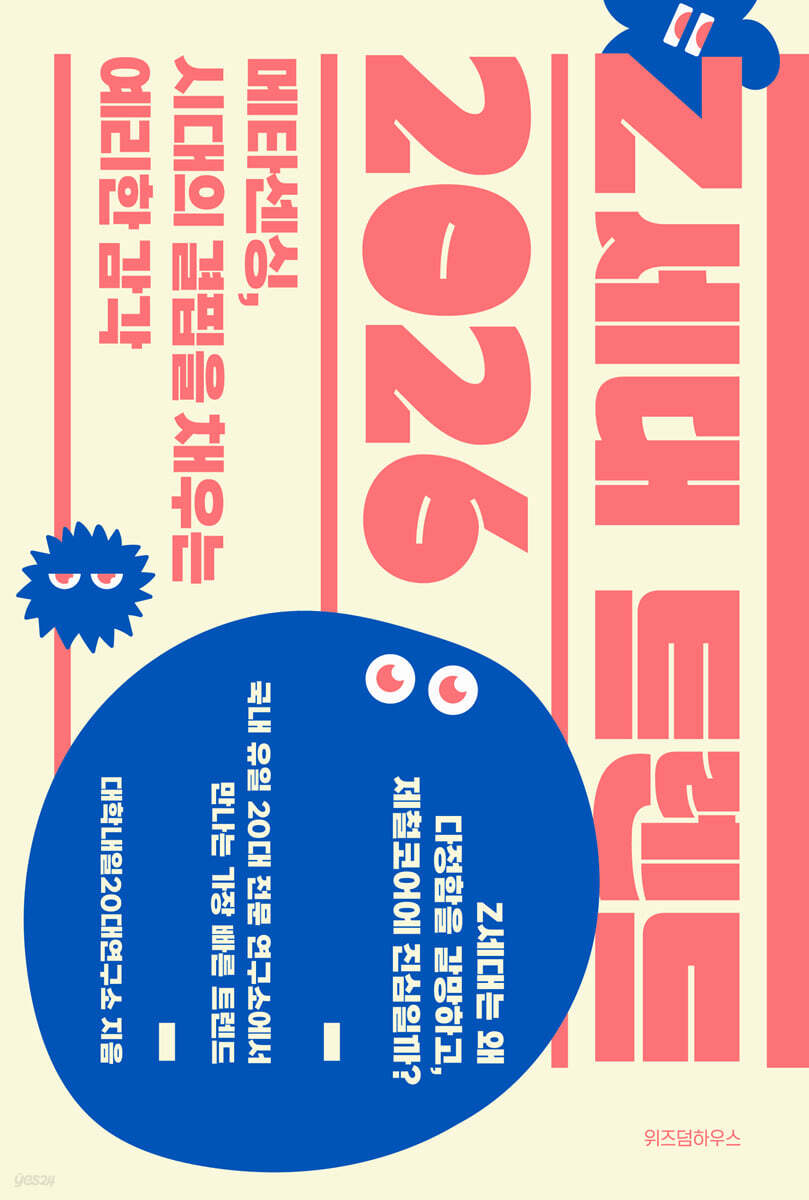
Generation Z Trends 2026
 |
Description
Book Introduction
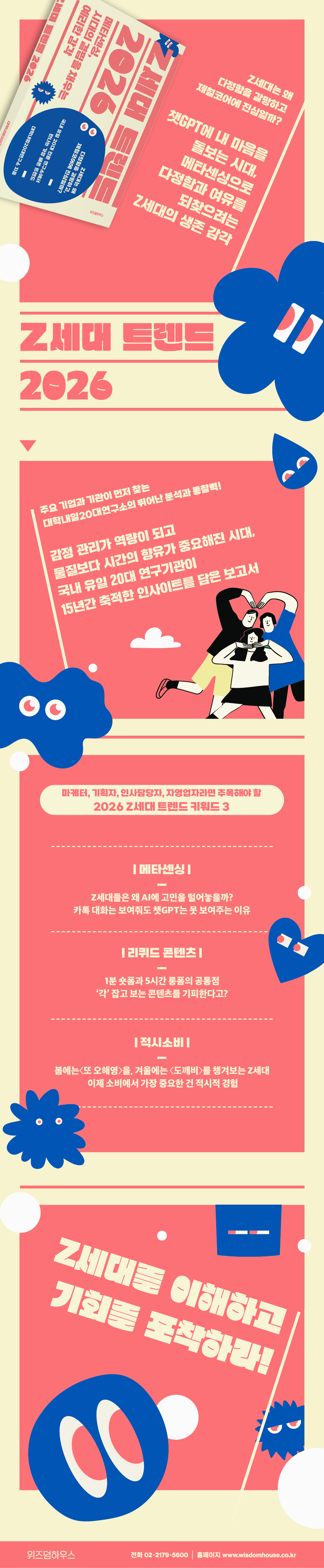
Why does Generation Z crave affection and be so passionate about seasonal cores?
The era of taking care of my mind through ChatGPT,
Generation Z's survival instincts: reclaiming affection and leisure through metasensing
Generation Z has evolved to go beyond simply feeling the anxiety that builds up amidst a prolonged recession, social conflict, and climate crisis. They have actively managed it, evolving into ways to fill the gaps in value for others and society.
The University Tomorrow 20s Research Institute defines these characteristics of Generation Z as 'MetaSensing.'
Metasensing goes beyond the ability to detect and manage emotions, encompassing a sense and attitude that extends to the affection, generosity, and consideration of our surroundings and society as a whole.
What's interesting is that these activities are more than just a fad; they are ongoing.
Generation Z is more sensitive to trends and moves quickly than anyone else, but the need for emotional management and increased affection continues to be a constant part of their lives.
This is strong evidence that Generation Z has the ability to “metasens” and fill in the deficiencies of not only themselves but also others and society.
《Generation Z Trends 2026》 examines various aspects of Generation Z's emotional management methods, values, preferred content, relationships, and consumption, based on their characteristic of metasensing.
For marketers, planners, HR professionals, and all other professionals seeking to connect with Generation Z, it provides insights that go beyond simple keywords to help them understand the generation's behavioral principles and seize opportunities.
The era of taking care of my mind through ChatGPT,
Generation Z's survival instincts: reclaiming affection and leisure through metasensing
Generation Z has evolved to go beyond simply feeling the anxiety that builds up amidst a prolonged recession, social conflict, and climate crisis. They have actively managed it, evolving into ways to fill the gaps in value for others and society.
The University Tomorrow 20s Research Institute defines these characteristics of Generation Z as 'MetaSensing.'
Metasensing goes beyond the ability to detect and manage emotions, encompassing a sense and attitude that extends to the affection, generosity, and consideration of our surroundings and society as a whole.
What's interesting is that these activities are more than just a fad; they are ongoing.
Generation Z is more sensitive to trends and moves quickly than anyone else, but the need for emotional management and increased affection continues to be a constant part of their lives.
This is strong evidence that Generation Z has the ability to “metasens” and fill in the deficiencies of not only themselves but also others and society.
《Generation Z Trends 2026》 examines various aspects of Generation Z's emotional management methods, values, preferred content, relationships, and consumption, based on their characteristic of metasensing.
For marketers, planners, HR professionals, and all other professionals seeking to connect with Generation Z, it provides insights that go beyond simple keywords to help them understand the generation's behavioral principles and seize opportunities.
- You can preview some of the book's contents.
Preview
index
introduction.
A sense of rediscovering the deficiencies of the times
PART 1.
2026 Generation Z Trend Issues
ISSUE 1.
Metasensing: Understanding Emotions, Sensing the World
CHAPTER 1.
Why KakaoTalk conversations can be displayed but ChatGPT cannot
CHAPTER 2.
Objectify opaque emotions clearly
CHAPTER 3.
Personal Emotional Care for Generation Z
Conclusion of ISSUE 1.
Affectionate beings survive
ISSUE 2.
Liquid Content: Enjoy flexible, loose, flowing content.
CHAPTER 4.
This is the content that Generation Z chooses.
CHAPTER 5.
Liquid Content: Filling Generation Z's Lives
Conclusion of ISSUE 2.
Content that fills the gaps in everyday life
ISSUE 3.
Just-in-time consumption: Consuming the moment when it's now or never
CHAPTER 6.
Experience also has value
CHAPTER 7.
Timely consumption to enjoy the present moment
CHAPTER 8.
How to store a sense of timeliness
Conclusion of ISSUE 3.
Designing timely experiences that stimulate the senses
PART 2.
A moment of change where trends are visible
MOMENT 1.
Microconsumption: The Desire to Spend in a Thinner Wallet
CHAPTER 9.
A Shift in the Consumption Paradigm: The Emergence of Microconsumption
CHAPTER 10.
The new law of consumption created by micro-consumption
MOMENT 2. AI Natives: Generation Z's AI Adaptation Period
CHAPTER 11.
Generation Z's imagination becomes reality.
CHAPTER 12.
AI as a companion for building life together
CHAPTER 13.
What's scary isn't the job, it's dependence
MOMENT 3.
Personal Sanctuary: A Essential Space in the Age of Personalization
CHAPTER 14.
Generation Z dreams of living as complete individuals.
CHAPTER 15.
A life that can still be your own
MOMENT 4.
Climate Adaptation: Changing Consumption Trends Driven by Climate Change
CHAPTER 16.
From ethical consumption to survival consumption
CHAPTER 17.
Climate change is changing our lifestyles
Acknowledgements
Americas
Glossary of terms
A sense of rediscovering the deficiencies of the times
PART 1.
2026 Generation Z Trend Issues
ISSUE 1.
Metasensing: Understanding Emotions, Sensing the World
CHAPTER 1.
Why KakaoTalk conversations can be displayed but ChatGPT cannot
CHAPTER 2.
Objectify opaque emotions clearly
CHAPTER 3.
Personal Emotional Care for Generation Z
Conclusion of ISSUE 1.
Affectionate beings survive
ISSUE 2.
Liquid Content: Enjoy flexible, loose, flowing content.
CHAPTER 4.
This is the content that Generation Z chooses.
CHAPTER 5.
Liquid Content: Filling Generation Z's Lives
Conclusion of ISSUE 2.
Content that fills the gaps in everyday life
ISSUE 3.
Just-in-time consumption: Consuming the moment when it's now or never
CHAPTER 6.
Experience also has value
CHAPTER 7.
Timely consumption to enjoy the present moment
CHAPTER 8.
How to store a sense of timeliness
Conclusion of ISSUE 3.
Designing timely experiences that stimulate the senses
PART 2.
A moment of change where trends are visible
MOMENT 1.
Microconsumption: The Desire to Spend in a Thinner Wallet
CHAPTER 9.
A Shift in the Consumption Paradigm: The Emergence of Microconsumption
CHAPTER 10.
The new law of consumption created by micro-consumption
MOMENT 2. AI Natives: Generation Z's AI Adaptation Period
CHAPTER 11.
Generation Z's imagination becomes reality.
CHAPTER 12.
AI as a companion for building life together
CHAPTER 13.
What's scary isn't the job, it's dependence
MOMENT 3.
Personal Sanctuary: A Essential Space in the Age of Personalization
CHAPTER 14.
Generation Z dreams of living as complete individuals.
CHAPTER 15.
A life that can still be your own
MOMENT 4.
Climate Adaptation: Changing Consumption Trends Driven by Climate Change
CHAPTER 16.
From ethical consumption to survival consumption
CHAPTER 17.
Climate change is changing our lifestyles
Acknowledgements
Americas
Glossary of terms
Detailed image
Into the book
The keyword that runs through this paradoxical phenomenon is ‘emotion.’
Generation Z faces and manages their emotions by confiding in AI.
At the same time, we consider ways to communicate without hurting others' feelings. The keyword "emotion" stood out not only in AI utilization but also in the hundreds of trends we observed throughout the year.
By watching 'emotional exhibition' content that honestly captures emotions, people can feel vicariously satisfied, record their own emotions, and even create their own routines for managing their emotions.
So why has "emotion" become such a crucial keyword for Generation Z? The answer can be found in the contemporary environment they live in today.
--- p.19
A defining characteristic of Generation Z's approach to emotions is their pursuit of both objective understanding and personalized management.
In particular, there is a noticeable tendency to interpret emotions based on hormonal or temperamental aspects.
In early 2025, an article was posted on X that proposed a solution by linking emotions and hormones, and it became a hot topic.
Here are some introductions:
When I'm stressed, I go for a walk to relieve cortisol.
When I'm in pain, I run to release endorphins.
When I feel tired, I take a cold bath to help release dopamine.
If you have insomnia, get some sunlight to stimulate melatonin production.
When I'm sad, I eat fruit to release serotonin.
--- p.31
Generation Z's metasensing extends beyond objectively understanding and managing their own emotions to maintaining or improving relationships with others and sensing and filling the gaps in our society.
Perhaps what Generation Z seeks to fill with, while fully managing their emotions, is not only inner strength but also these human values.
In this way, Generation Z seeks to connect with others through affectionate language and build warmer relationships. Consequently, metasensing is expected to heighten the importance of "affection" in our society and increase the "total amount of affection."
--- p.46
Although movies, webtoons, and web novels have different formats, they have one thing in common: the transition from immersion to content is not free.
For Generation Z, flexibility in speed, timing, and shifting the point of immersion is important when consuming content, but this content has limitations in this regard.
I find it difficult to freely control how long I watch, at what speed, and when I focus and when I don't, which makes it difficult to choose that content.
In other words, for Generation Z, movies, webtoons, and web novels are considered content that requires a significant investment of time and immersion.
To achieve this, I believe that it is necessary to create an environment for immersion or secure time, and if there is no clear value or attractive factor worth investing time in, it is difficult to start in the first place.
--- p.53
This change can also be observed in Generation Z's record-keeping methods.
When we talk about recording our daily lives, we usually think of a diary that organizes our experiences of the day.
However, Generation Z's recording methods are very diverse.
In particular, it focuses on one's own feelings.
For example, one Gen Zer said that they record their day's emotions as a "playlist memo."
It involves selecting and organizing music that matches the feeling you have at that moment in a smartphone notepad.
He added that it feels like opening an emotional time capsule, as it allows you to trace your own emotional flow.
In addition, various methods of recording emotions stand out, such as organizing emotions with a photo taken that day and a short sentence that matches it, or selecting a sentence from a book that suits one's mood and writing it down to record emotions.
For Generation Z, the act of storing emotions is becoming a routine in itself.
--- p.98
A look at the commonalities of the changed Open Run targets clearly reveals the characteristics of recent consumption patterns.
That is, it is 'micro'.
It's cheaper, smaller, and less burdensome, yet it still offers the exclusivity and satisfaction that consumers are willing to invest time and effort into.
This phenomenon of consumers wanting to open-run products to obtain cheaper, smaller, and lighter items goes beyond a simple change in trend and signifies a fundamental shift in the consumption paradigm itself.
This is the emergence of a new consumption trend called ‘micro-consumption.’
--- p.115
For Generation Z, who grew up in an era of hyper-personalization, the basic unit of life is the individual.
No matter what lifestyle you choose, maintaining a complete personal routine and lifestyle is a key value.
In other words, their prioritization of a complete individual perspective when drawing their present or future lives is not limited to the single-person household type.
Even if the form of the household changes due to marriage, childbirth, or cohabitation, the central perspective on their life is still 'life as an individual.'
I value creating and maintaining a personal sanctuary where I can be whole.
--- p.156
Climate change is creating a shift from consumption for the good of the planet to consumption for survival, for my own comfort.
In the past, value consumption such as ESG was a matter of choice rather than necessity, so daily consumption patterns did not change significantly.
If the price was expensive, I didn't buy it, and I also prioritized my own convenience.
But things are different now that climate change has become a matter of survival.
Parasols, once a staple for mothers, have become a must-have for Generation Z to survive the heat, and unfamiliar items like cooling tissues and cooling pads are selling like hotcakes.
Things that were not major consumer items suddenly emerged as essential 'survival items'.
In this way, climate change is changing our lifestyles and consumption patterns in a comprehensive way.
Generation Z faces and manages their emotions by confiding in AI.
At the same time, we consider ways to communicate without hurting others' feelings. The keyword "emotion" stood out not only in AI utilization but also in the hundreds of trends we observed throughout the year.
By watching 'emotional exhibition' content that honestly captures emotions, people can feel vicariously satisfied, record their own emotions, and even create their own routines for managing their emotions.
So why has "emotion" become such a crucial keyword for Generation Z? The answer can be found in the contemporary environment they live in today.
--- p.19
A defining characteristic of Generation Z's approach to emotions is their pursuit of both objective understanding and personalized management.
In particular, there is a noticeable tendency to interpret emotions based on hormonal or temperamental aspects.
In early 2025, an article was posted on X that proposed a solution by linking emotions and hormones, and it became a hot topic.
Here are some introductions:
When I'm stressed, I go for a walk to relieve cortisol.
When I'm in pain, I run to release endorphins.
When I feel tired, I take a cold bath to help release dopamine.
If you have insomnia, get some sunlight to stimulate melatonin production.
When I'm sad, I eat fruit to release serotonin.
--- p.31
Generation Z's metasensing extends beyond objectively understanding and managing their own emotions to maintaining or improving relationships with others and sensing and filling the gaps in our society.
Perhaps what Generation Z seeks to fill with, while fully managing their emotions, is not only inner strength but also these human values.
In this way, Generation Z seeks to connect with others through affectionate language and build warmer relationships. Consequently, metasensing is expected to heighten the importance of "affection" in our society and increase the "total amount of affection."
--- p.46
Although movies, webtoons, and web novels have different formats, they have one thing in common: the transition from immersion to content is not free.
For Generation Z, flexibility in speed, timing, and shifting the point of immersion is important when consuming content, but this content has limitations in this regard.
I find it difficult to freely control how long I watch, at what speed, and when I focus and when I don't, which makes it difficult to choose that content.
In other words, for Generation Z, movies, webtoons, and web novels are considered content that requires a significant investment of time and immersion.
To achieve this, I believe that it is necessary to create an environment for immersion or secure time, and if there is no clear value or attractive factor worth investing time in, it is difficult to start in the first place.
--- p.53
This change can also be observed in Generation Z's record-keeping methods.
When we talk about recording our daily lives, we usually think of a diary that organizes our experiences of the day.
However, Generation Z's recording methods are very diverse.
In particular, it focuses on one's own feelings.
For example, one Gen Zer said that they record their day's emotions as a "playlist memo."
It involves selecting and organizing music that matches the feeling you have at that moment in a smartphone notepad.
He added that it feels like opening an emotional time capsule, as it allows you to trace your own emotional flow.
In addition, various methods of recording emotions stand out, such as organizing emotions with a photo taken that day and a short sentence that matches it, or selecting a sentence from a book that suits one's mood and writing it down to record emotions.
For Generation Z, the act of storing emotions is becoming a routine in itself.
--- p.98
A look at the commonalities of the changed Open Run targets clearly reveals the characteristics of recent consumption patterns.
That is, it is 'micro'.
It's cheaper, smaller, and less burdensome, yet it still offers the exclusivity and satisfaction that consumers are willing to invest time and effort into.
This phenomenon of consumers wanting to open-run products to obtain cheaper, smaller, and lighter items goes beyond a simple change in trend and signifies a fundamental shift in the consumption paradigm itself.
This is the emergence of a new consumption trend called ‘micro-consumption.’
--- p.115
For Generation Z, who grew up in an era of hyper-personalization, the basic unit of life is the individual.
No matter what lifestyle you choose, maintaining a complete personal routine and lifestyle is a key value.
In other words, their prioritization of a complete individual perspective when drawing their present or future lives is not limited to the single-person household type.
Even if the form of the household changes due to marriage, childbirth, or cohabitation, the central perspective on their life is still 'life as an individual.'
I value creating and maintaining a personal sanctuary where I can be whole.
--- p.156
Climate change is creating a shift from consumption for the good of the planet to consumption for survival, for my own comfort.
In the past, value consumption such as ESG was a matter of choice rather than necessity, so daily consumption patterns did not change significantly.
If the price was expensive, I didn't buy it, and I also prioritized my own convenience.
But things are different now that climate change has become a matter of survival.
Parasols, once a staple for mothers, have become a must-have for Generation Z to survive the heat, and unfamiliar items like cooling tissues and cooling pads are selling like hotcakes.
Things that were not major consumer items suddenly emerged as essential 'survival items'.
In this way, climate change is changing our lifestyles and consumption patterns in a comprehensive way.
--- p.172
Publisher's Review
In an era where emotional management has become a skill and the enjoyment of time has become more important than material possessions.
A report containing insights accumulated over 15 years by Korea's only top 20 research institutes.
You can show KakaoTalk conversations, but not Chat GPT?
Why Affection Is Considered a "Skill"
For Generation Z, AI is more than just a search bar.
When they've had a minor argument with a friend, when a single word from their boss worries them, or when the future feels uncertain, they turn to ChatGPT. AI is always available for conversation, never hurts, and offers empathy, comfort, and even solutions.
Now, Generation Z is confiding in AI about their innermost concerns, something they would be reluctant to share even with their closest friends.
But paradoxically, in reality, there is a growing number of Generation Z members who find it difficult to express their emotions and engage in face-to-face relationships.
We keep a safe distance from others to avoid being hurt, communicate through text instead of expressing our emotions immediately, and even ask AI to write comforting messages to our friends.
Generation Z is exploring ways to manage themselves and avoid hurting the feelings of others by expressing their emotions to AI.
This is not simply a matter of using technology; it reflects an era in which ‘emotional management’ has become a personal skill.
Ultimately, for Generation Z, AI is a ‘tool of emotions.’
In these uncertain times, it is a survival strategy to protect the one area that remains constant: emotions.
Generation Z uses AI to confront their emotions without hiding them, and through this process, they regain affection and composure.
Why Webtoons, Web Novels, and Movies Are Disconnected from Generation Z
Liquid content: What 1-minute short-form and 5-hour long-form have in common
Rather than focusing solely on one piece of content, Generation Z enjoys multiple pieces of content simultaneously and switches between them freely.
For them, content is not something to be enjoyed at a constant speed from beginning to end, but something they can immerse themselves in at any point they want, skip when necessary, and freely control the speed and time.
For this reason, movies, webtoons, and web novels are considered content with a high barrier to entry for Generation Z.
On the other hand, the content that Generation Z prefers these days is diverse, including YouTube, social media, books, and exhibitions.
At first glance, they seem like completely different fields, but what they have in common is that 'you can freely control speed, time, and immersion point.'
The concept that describes this flexible consumption method is 'liquid content.'
Liquid content includes content that naturally permeates the gaps of everyday life and can be consumed flexibly depending on the situation.
A representative type of liquid content is interactive content.
Although the context is unclear and the content is low-density, this allows you to pause and resume listening at any time, and to immerse yourself momentarily in only the parts that interest you.
This is why you can watch it without any burden even if the running time is over an hour.
Ultimately, the key is ‘free control.’
More important than a well-crafted narrative is a flexible structure that allows you to control your own pace and immersion.
The challenge for content creators and brands is not to force and encourage immersion, but to create a space where immersion is not necessary, so as to integrate into the daily lives of Generation Z.
Attitude toward timely consumption and experiences
The cheat key that works for Generation Z: "Jecheol"
Generation Z's consumption trends are shifting beyond the material scarcity of the past and focusing on "experiences and sensations that can only be felt in this moment."
If material values that only a select few could enjoy, such as premium, limited edition, and luxury goods, were the standard for scarcity, today's Generation Z places greater value on sensations and experiences than on price or quantity.
In an uncertain future, the 'now that must not be missed' has become the new consumption standard.
They value immediate experiences as their core value and regard time itself as an asset.
We decide on our spending based on how valuable and enriching the given time can be, and the 'cost-effectiveness' of the experience compared to the time spent.
Going further, the sense of enjoying the experience of the moment more valuably is receiving attention.
These characteristics are expressed in a specific consumption attitude called ‘just-in-time consumption.’
In particular, the concept of 'season' has emerged as a cheat key for Generation Z consumption.
Representative examples include ingredients and content that can only be enjoyed at this moment.
Dramas, movies, novels, and poetry collections that capture the scenery and atmosphere of each season are used as a means for Generation Z to fully enjoy the sense of the seasons.
Even in offline spaces, Generation Z values "experiences that can only be had at this moment, with this emotion," and designing the moment of experience with a sense of intensity leads to high-density consumption.
Ultimately, what matters to Generation Z is 'how much they can enjoy this time.'
Designing environments that maximize the enjoyment of momentary sensations and experiences will become increasingly important in the future.
Understand Generation Z and seize the opportunity!
Discover the fastest trends at Korea's first and only specialized research institute for those in their 20s.
Part 1 of this book explored key trends for Generation Z, such as metasensing, liquid content, and just-in-time consumption. Part 2 focuses on new trend moments driven by Generation Z.
It captures the new rules of life and consumption in uncertain times, including micro-consumption, AI natives, personal sanctuaries, and climate adaptation. It also highlights various micro-trends, from how AI is utilized to the desire to live as a complete individual to lifestyles shaped by climate change.
The pace of change is accelerating, and its scope and influence are expanding, to the point where many people are saying, "If this continues, we will soon be eliminated."
AI, which has been commercialized for less than a year, is transforming our daily lives, workplaces, and schools. It is also changing our choices and the way we live, with climate change, the ongoing economic downturn, and even the trend toward hyper-personalization.
This book serves as a guide to understanding the trends and opportunities created by Generation Z amidst this epochal turning point, and to reading about the changes in daily life and consumption patterns.
If you want to stay focused and lead new trends in this rapidly changing era, you need to pay attention to the keywords presented in this book.
Even in these rapidly changing times, you will be able to seize opportunities that should not be missed.
A report containing insights accumulated over 15 years by Korea's only top 20 research institutes.
You can show KakaoTalk conversations, but not Chat GPT?
Why Affection Is Considered a "Skill"
For Generation Z, AI is more than just a search bar.
When they've had a minor argument with a friend, when a single word from their boss worries them, or when the future feels uncertain, they turn to ChatGPT. AI is always available for conversation, never hurts, and offers empathy, comfort, and even solutions.
Now, Generation Z is confiding in AI about their innermost concerns, something they would be reluctant to share even with their closest friends.
But paradoxically, in reality, there is a growing number of Generation Z members who find it difficult to express their emotions and engage in face-to-face relationships.
We keep a safe distance from others to avoid being hurt, communicate through text instead of expressing our emotions immediately, and even ask AI to write comforting messages to our friends.
Generation Z is exploring ways to manage themselves and avoid hurting the feelings of others by expressing their emotions to AI.
This is not simply a matter of using technology; it reflects an era in which ‘emotional management’ has become a personal skill.
Ultimately, for Generation Z, AI is a ‘tool of emotions.’
In these uncertain times, it is a survival strategy to protect the one area that remains constant: emotions.
Generation Z uses AI to confront their emotions without hiding them, and through this process, they regain affection and composure.
Why Webtoons, Web Novels, and Movies Are Disconnected from Generation Z
Liquid content: What 1-minute short-form and 5-hour long-form have in common
Rather than focusing solely on one piece of content, Generation Z enjoys multiple pieces of content simultaneously and switches between them freely.
For them, content is not something to be enjoyed at a constant speed from beginning to end, but something they can immerse themselves in at any point they want, skip when necessary, and freely control the speed and time.
For this reason, movies, webtoons, and web novels are considered content with a high barrier to entry for Generation Z.
On the other hand, the content that Generation Z prefers these days is diverse, including YouTube, social media, books, and exhibitions.
At first glance, they seem like completely different fields, but what they have in common is that 'you can freely control speed, time, and immersion point.'
The concept that describes this flexible consumption method is 'liquid content.'
Liquid content includes content that naturally permeates the gaps of everyday life and can be consumed flexibly depending on the situation.
A representative type of liquid content is interactive content.
Although the context is unclear and the content is low-density, this allows you to pause and resume listening at any time, and to immerse yourself momentarily in only the parts that interest you.
This is why you can watch it without any burden even if the running time is over an hour.
Ultimately, the key is ‘free control.’
More important than a well-crafted narrative is a flexible structure that allows you to control your own pace and immersion.
The challenge for content creators and brands is not to force and encourage immersion, but to create a space where immersion is not necessary, so as to integrate into the daily lives of Generation Z.
Attitude toward timely consumption and experiences
The cheat key that works for Generation Z: "Jecheol"
Generation Z's consumption trends are shifting beyond the material scarcity of the past and focusing on "experiences and sensations that can only be felt in this moment."
If material values that only a select few could enjoy, such as premium, limited edition, and luxury goods, were the standard for scarcity, today's Generation Z places greater value on sensations and experiences than on price or quantity.
In an uncertain future, the 'now that must not be missed' has become the new consumption standard.
They value immediate experiences as their core value and regard time itself as an asset.
We decide on our spending based on how valuable and enriching the given time can be, and the 'cost-effectiveness' of the experience compared to the time spent.
Going further, the sense of enjoying the experience of the moment more valuably is receiving attention.
These characteristics are expressed in a specific consumption attitude called ‘just-in-time consumption.’
In particular, the concept of 'season' has emerged as a cheat key for Generation Z consumption.
Representative examples include ingredients and content that can only be enjoyed at this moment.
Dramas, movies, novels, and poetry collections that capture the scenery and atmosphere of each season are used as a means for Generation Z to fully enjoy the sense of the seasons.
Even in offline spaces, Generation Z values "experiences that can only be had at this moment, with this emotion," and designing the moment of experience with a sense of intensity leads to high-density consumption.
Ultimately, what matters to Generation Z is 'how much they can enjoy this time.'
Designing environments that maximize the enjoyment of momentary sensations and experiences will become increasingly important in the future.
Understand Generation Z and seize the opportunity!
Discover the fastest trends at Korea's first and only specialized research institute for those in their 20s.
Part 1 of this book explored key trends for Generation Z, such as metasensing, liquid content, and just-in-time consumption. Part 2 focuses on new trend moments driven by Generation Z.
It captures the new rules of life and consumption in uncertain times, including micro-consumption, AI natives, personal sanctuaries, and climate adaptation. It also highlights various micro-trends, from how AI is utilized to the desire to live as a complete individual to lifestyles shaped by climate change.
The pace of change is accelerating, and its scope and influence are expanding, to the point where many people are saying, "If this continues, we will soon be eliminated."
AI, which has been commercialized for less than a year, is transforming our daily lives, workplaces, and schools. It is also changing our choices and the way we live, with climate change, the ongoing economic downturn, and even the trend toward hyper-personalization.
This book serves as a guide to understanding the trends and opportunities created by Generation Z amidst this epochal turning point, and to reading about the changes in daily life and consumption patterns.
If you want to stay focused and lead new trends in this rapidly changing era, you need to pay attention to the keywords presented in this book.
Even in these rapidly changing times, you will be able to seize opportunities that should not be missed.
GOODS SPECIFICS
- Date of issue: October 22, 2025
- Page count, weight, size: 196 pages | 340g | 145*215*12mm
- ISBN13: 9791171715121
- ISBN10: 1171715129
You may also like
카테고리
korean


korean

![GQ KOREA Mark (Monthly): December [2025]](http://librairie.coreenne.fr/cdn/shop/files/8ef265dbbfbf186523ed75ba7319009d.jpg?v=1765340328&width=3840)


