

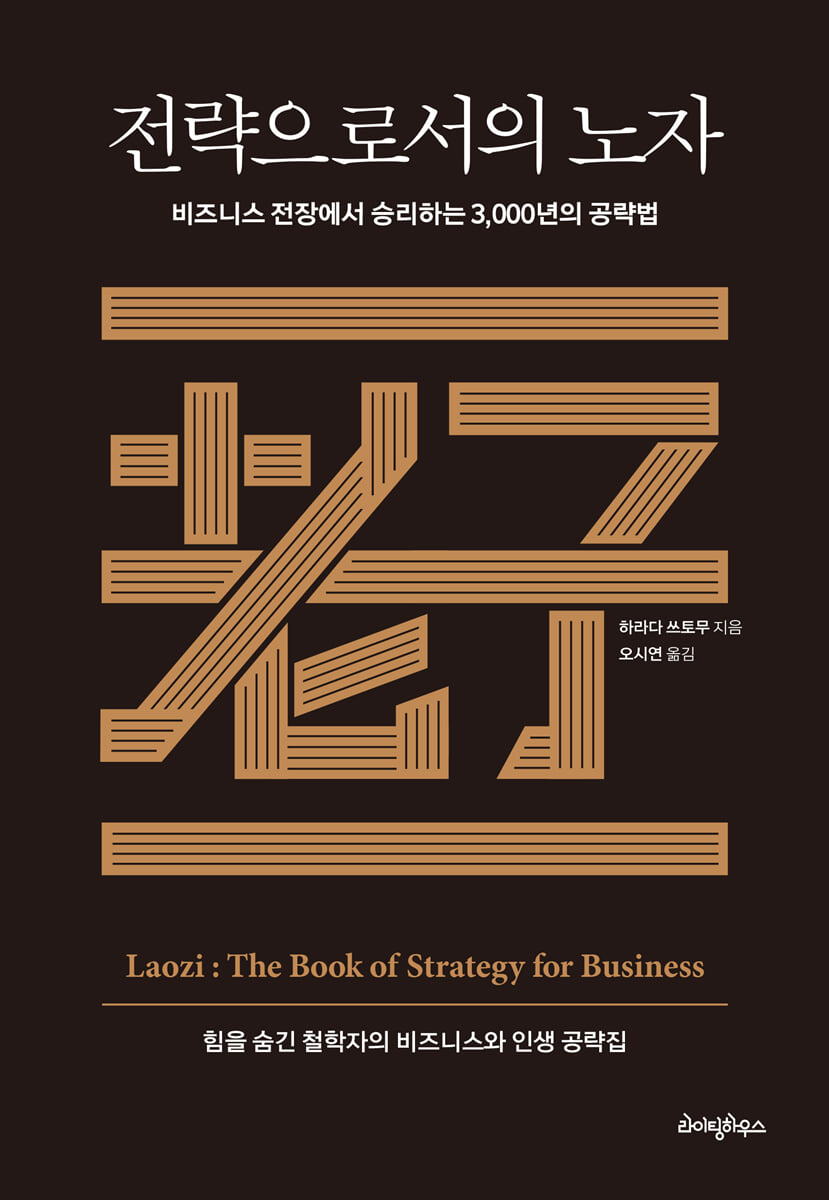
Lao Tzu as a Strategy
 |
Description
Book Introduction
“At the root of ‘The Art of War’ was Lao Tzu’s ‘Tao Te Ching’!”
11 Battlefield Disruption Strategies from Lao Tzu, the Hidden Strategist
Lao Tzu as Strategy (Lighting House) has been published, reinterpreting Lao Tzu's Tao Te Ching from a modern management perspective and explaining how to strategically apply it to business and life.
The Tao Te Ching, also known as the Lao Tzu, is the essence of Eastern philosophy that inherited the worldview of the Book of Changes, which contains 3,000 years of Chinese wisdom, and had a profound influence on all Eastern thought that emerged thereafter.
In 『Lao-tzu as Strategy』, the author reinterprets Lao-tzu's text by connecting it to the theory of formations in 『The Art of War』, and finds the roots of modern strategic thinking in 『Tao Te Ching』.
『Lao-tzu as Strategy』 focuses on 『Lao-tzu』 as a dynastic art of governance and a book on military strategy, and vividly explains, with various examples, how Lao-tzu's "strategy of paradox" can be utilized in the rapidly changing business battlefield, and how those strategies still work (albeit hidden) in the modern era.
For this book, the author cross-checked all interpretations of the major commentaries on the Tao Te Ching, extracted only the core of the carefully selected original text, and included it in an easy-to-read modern translation.
We also reinterpreted the classics through interdisciplinary research encompassing economics, management, and psychology, and made every effort to incorporate abundant examples from the business world.
Through the author's new interpretation of Lao-tzu, readers will gain profound insights from the timeless wisdom of 3,000 years of Eastern philosophy throughout the book.
11 Battlefield Disruption Strategies from Lao Tzu, the Hidden Strategist
Lao Tzu as Strategy (Lighting House) has been published, reinterpreting Lao Tzu's Tao Te Ching from a modern management perspective and explaining how to strategically apply it to business and life.
The Tao Te Ching, also known as the Lao Tzu, is the essence of Eastern philosophy that inherited the worldview of the Book of Changes, which contains 3,000 years of Chinese wisdom, and had a profound influence on all Eastern thought that emerged thereafter.
In 『Lao-tzu as Strategy』, the author reinterprets Lao-tzu's text by connecting it to the theory of formations in 『The Art of War』, and finds the roots of modern strategic thinking in 『Tao Te Ching』.
『Lao-tzu as Strategy』 focuses on 『Lao-tzu』 as a dynastic art of governance and a book on military strategy, and vividly explains, with various examples, how Lao-tzu's "strategy of paradox" can be utilized in the rapidly changing business battlefield, and how those strategies still work (albeit hidden) in the modern era.
For this book, the author cross-checked all interpretations of the major commentaries on the Tao Te Ching, extracted only the core of the carefully selected original text, and included it in an easy-to-read modern translation.
We also reinterpreted the classics through interdisciplinary research encompassing economics, management, and psychology, and made every effort to incorporate abundant examples from the business world.
Through the author's new interpretation of Lao-tzu, readers will gain profound insights from the timeless wisdom of 3,000 years of Eastern philosophy throughout the book.
- You can preview some of the book's contents.
Preview
index
Introduction
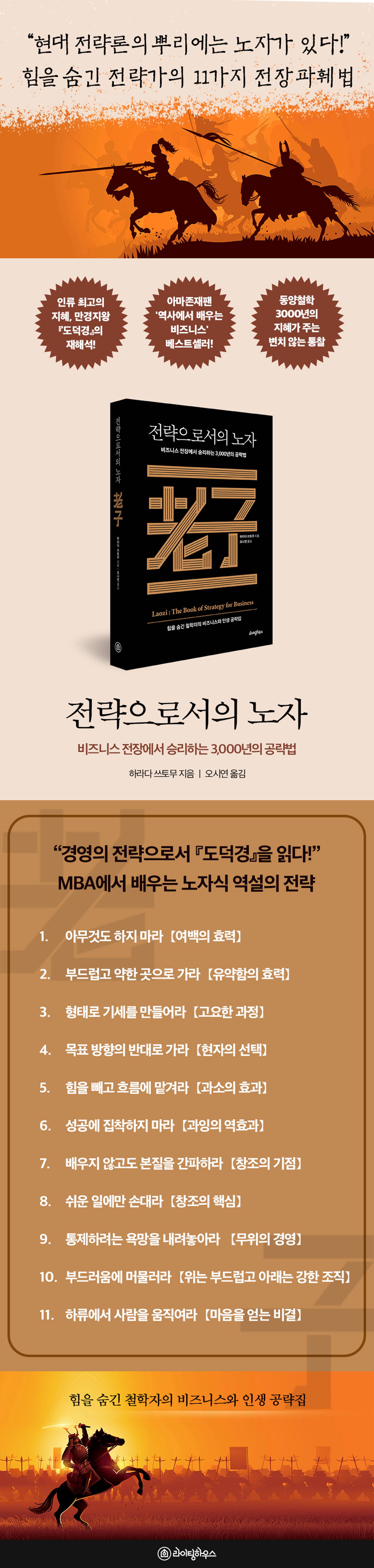
Part 1: Reading Lao-tzu as a Management Strategy
Rule 1: Great Leaders Do Nothing
The Power of White Space│The Only Battle Lost by the General│A Leader Is a "Being Hidden in the Shadows"│Infinite Possibilities Hide in Nothingness│Guiding Others' Actions by "Not Interfering"│A House Has Use Because It Has Space│Following Subordinates Is the Best│True Leadership According to Drucker
Rule 2: The strong cannot defeat the weak.
The Power of Weakness│We don't lose because we don't fight│Achieving profitable management by 'Throw away customer satisfaction'│Everything gathers in soft and weak places│Weakness, not strength, wins the trust of subordinates│The difficulty of weakness│Managing a weak organization│What is the 'intangible strategy' practiced by Lao Tzu's saints?
Third Plan: Creating Momentum with Form
The Quiet Process│The Source of Ideas - Picasso's Perspective│Everything is Born in a Quiet Process│The Leader's Role is to Increase the Momentum of a Rolling Ball│Misfortune and Fortune Are Like Intertwined Threads│Think of the Quiet Process as a Pendulum Movement│A Leader Who Makes Quick Decisions is Aware of the Pendulum Movement
Step 4: Go in the opposite direction of your goal.
The Wise Man's Choice│Do not expect to be filled│A tree must bend to live long│To realize 'strength', first move toward 'weakness'│Central Power and Neutralization - The Standard of Decision│To advance or to flee│To harmonize but not assimilate - Hwa-i-bu-dong
Rule 5: Let go and go with the flow.
The Underpower Effect│The More Service-Oriented You Are, the More Customers Leave│The Underpower Effect: A Strategy from Start to Bottom│How to Escape the Winner's Curse?│Two Types of Strategic Disengagement│A Business Interpretation of "He Who Knows Enough Is Rich"│The Platform No One Noticed
Rule 6: Obsession with Success Leads to Destruction
The Backlash of Excess│Takeda Shingen's '70% Victory'│The Backlash of Excess - A Strategy from Bottom to Top│Fill Your Belly, Not Your Eyes│Why Highly Intelligent Managers Fail│Avoid Analysis Paralysis Syndrome│Ordinary Leaders Work Too Much and Eventually Burn Out
Seventh Commandment: Seeing the Essence Without Learning
The Origin of Creativity│Does Creativity Require Sense?│Reading the Buds of Business with a Straightforward Eye│Respect Talents Free from Stereotypes│Does Studying Make You a Criminal?│Insight into Customer Needs Comes from a Flash│When Responding to Signs, Minimal Effort Achieves Maximum Effect│The Law of Jam: Excessive Information Clouds Judgment
Rule 8: Only Tackle Easy Things
The Core of Creation│Heroes of Greek Mythology and the Saints of Lao Tzu│Leverage Your Strengths│Learn from What the Public Despises and Ignores│Why Does Creation Without Insight Fail?│Lao Tzu's Three Treasures: Compassion, Frugality, and Not Trying to Lead the World
Rule 9: Let Go of the Desire to Control
Management without Action│Lao Tzu's Management Rankings│Give Authority to Roles, Not Positions│What Jo Cham, Who Contributed to the Unification of the World, Did Every Day│Signs of an Organization's End│Should the Kiln-Boiling Method Be Abolished│You Can't Know in Advance What Will Be Success and What Will Be Failure│Break the Rules, Even If It's Necessary
Rule 10: Great Leaders Stay Gentle
An organization that is soft at the top and strong at the bottom. It values common sense over rules. It responds nimbly to situations. Great leaders don't divide. Outstanding leaders evolve routines.
Rule 11: Move people downstream
The Secret to Winning Hearts│Stand Down Where the Wind Blows│Manage Your Business Like Boiling a Small Fish│Ideal Organizational Management│The Essence of Organizational Dominance
Part 2: Applying Lao Tzu's Strategy in Practice
Life or Death Question 1 ── How to Activate the Organization?
Improve employee quality of life to boost productivity. Eliminate obstacles to momentum. Great leaders do nothing.
Life or Death Question 2 ── How to Regenerate the Organization?
Returning to optimal levels of overload │ Conditions for transitioning from defense to offense │ Excellent leaders go in the opposite direction of their goals.
Life or Death Question 3 ── How to Continue Growth?
Follow the winning formula│Build a platform│Set a routine│A competent leader lets go
Life or Death Question 4 ── How to Start a New Business?
Pivots through Small Experiments│Start with Simple Ideas│Great Leaders Only Do Easy Things
Life and Death Question 5 ── How to create an organization that operates autonomously?
Adding Toppings to the Platform│Luck Adopts a Prepared Mind│Exceptional Leaders Let Go of the Desire to Control the Organization
Part 1: Reading Lao-tzu as a Management Strategy
Rule 1: Great Leaders Do Nothing
The Power of White Space│The Only Battle Lost by the General│A Leader Is a "Being Hidden in the Shadows"│Infinite Possibilities Hide in Nothingness│Guiding Others' Actions by "Not Interfering"│A House Has Use Because It Has Space│Following Subordinates Is the Best│True Leadership According to Drucker
Rule 2: The strong cannot defeat the weak.
The Power of Weakness│We don't lose because we don't fight│Achieving profitable management by 'Throw away customer satisfaction'│Everything gathers in soft and weak places│Weakness, not strength, wins the trust of subordinates│The difficulty of weakness│Managing a weak organization│What is the 'intangible strategy' practiced by Lao Tzu's saints?
Third Plan: Creating Momentum with Form
The Quiet Process│The Source of Ideas - Picasso's Perspective│Everything is Born in a Quiet Process│The Leader's Role is to Increase the Momentum of a Rolling Ball│Misfortune and Fortune Are Like Intertwined Threads│Think of the Quiet Process as a Pendulum Movement│A Leader Who Makes Quick Decisions is Aware of the Pendulum Movement
Step 4: Go in the opposite direction of your goal.
The Wise Man's Choice│Do not expect to be filled│A tree must bend to live long│To realize 'strength', first move toward 'weakness'│Central Power and Neutralization - The Standard of Decision│To advance or to flee│To harmonize but not assimilate - Hwa-i-bu-dong
Rule 5: Let go and go with the flow.
The Underpower Effect│The More Service-Oriented You Are, the More Customers Leave│The Underpower Effect: A Strategy from Start to Bottom│How to Escape the Winner's Curse?│Two Types of Strategic Disengagement│A Business Interpretation of "He Who Knows Enough Is Rich"│The Platform No One Noticed
Rule 6: Obsession with Success Leads to Destruction
The Backlash of Excess│Takeda Shingen's '70% Victory'│The Backlash of Excess - A Strategy from Bottom to Top│Fill Your Belly, Not Your Eyes│Why Highly Intelligent Managers Fail│Avoid Analysis Paralysis Syndrome│Ordinary Leaders Work Too Much and Eventually Burn Out
Seventh Commandment: Seeing the Essence Without Learning
The Origin of Creativity│Does Creativity Require Sense?│Reading the Buds of Business with a Straightforward Eye│Respect Talents Free from Stereotypes│Does Studying Make You a Criminal?│Insight into Customer Needs Comes from a Flash│When Responding to Signs, Minimal Effort Achieves Maximum Effect│The Law of Jam: Excessive Information Clouds Judgment
Rule 8: Only Tackle Easy Things
The Core of Creation│Heroes of Greek Mythology and the Saints of Lao Tzu│Leverage Your Strengths│Learn from What the Public Despises and Ignores│Why Does Creation Without Insight Fail?│Lao Tzu's Three Treasures: Compassion, Frugality, and Not Trying to Lead the World
Rule 9: Let Go of the Desire to Control
Management without Action│Lao Tzu's Management Rankings│Give Authority to Roles, Not Positions│What Jo Cham, Who Contributed to the Unification of the World, Did Every Day│Signs of an Organization's End│Should the Kiln-Boiling Method Be Abolished│You Can't Know in Advance What Will Be Success and What Will Be Failure│Break the Rules, Even If It's Necessary
Rule 10: Great Leaders Stay Gentle
An organization that is soft at the top and strong at the bottom. It values common sense over rules. It responds nimbly to situations. Great leaders don't divide. Outstanding leaders evolve routines.
Rule 11: Move people downstream
The Secret to Winning Hearts│Stand Down Where the Wind Blows│Manage Your Business Like Boiling a Small Fish│Ideal Organizational Management│The Essence of Organizational Dominance
Part 2: Applying Lao Tzu's Strategy in Practice
Life or Death Question 1 ── How to Activate the Organization?
Improve employee quality of life to boost productivity. Eliminate obstacles to momentum. Great leaders do nothing.
Life or Death Question 2 ── How to Regenerate the Organization?
Returning to optimal levels of overload │ Conditions for transitioning from defense to offense │ Excellent leaders go in the opposite direction of their goals.
Life or Death Question 3 ── How to Continue Growth?
Follow the winning formula│Build a platform│Set a routine│A competent leader lets go
Life or Death Question 4 ── How to Start a New Business?
Pivots through Small Experiments│Start with Simple Ideas│Great Leaders Only Do Easy Things
Life and Death Question 5 ── How to create an organization that operates autonomously?
Adding Toppings to the Platform│Luck Adopts a Prepared Mind│Exceptional Leaders Let Go of the Desire to Control the Organization
Detailed image
Into the book
Even if you choose one of the two extremes, it is important to note that in Lao Tzu's case, he did not abandon the other options.
For example, choosing weakness is not about abandoning strength, but about exercising it.
As we see in Chapter 7, Lao Tzu rather argues that maintaining gentleness is strength (Tao Te Ching, Chapter 52).
Or there is a phrase in the 10th commandment that says, 'Know your masculinity while maintaining your femininity.'
Choosing femininity while knowing masculinity in the extremes of masculinity and femininity means choosing femininity while also maintaining the ability to exercise the strengths of masculinity.
In other words, the purpose of choosing one side is to leverage the strengths of the other side, not to discard the latter.
It is deliberately choosing one side to save both sides.
One of the characteristics of Chinese thought, not just Laozi, is this dualistic thinking.
--- From "Going in the Opposite Direction of the 4th Plane's Goal"
The core of Chinese thought is not to try to resolve conflicts by force, but to accept them as they are and embrace them.
An outstanding leader practices this attitude and values the principle of “harmony but not assimilation” as stated in the Analects.
However, many organizations often do the opposite, opting for a "compromise but not harmony" approach, where they only superficially compromise to smooth things over, while in reality they ignore or cover up the conflict.
Rather, what is needed is an attitude that acknowledges and embraces the conflict as it is, and continues to interact.
--- From "Going in the Opposite Direction of the 4th Plane's Goal"
The implications of the cases of IKEA and Slack are clear.
The more service-minded you are, the more likely it is that customers will leave.
What's really important is not 'multiplication', but that you must thoroughly relax to succeed.
The term 'reducing force' used here means restraining oneself from 'subtracting' something the user does not want, and stopping one step before what is considered optimal.
The 'compensatory effect' that comes from this strategic power withdrawal is the key to business model innovation.
The path of the sage that Lao Tzu spoke of also refers to this ‘strategic power reduction.’
The compensation effect refers to the principle that when there is a shortage, a reaction occurs to fill it, and conversely, when there is an excess, a counteraction occurs to reduce it.
Here, the former is called the 'effect of under-effect' and the latter the 'effect of over-effect'.
--- From "5th Commandment: Let Go of the Force and Go with the Flow"
American psychologist Sheena Iyengar conducted the following experiment in a supermarket.
When shelves with 24 types of jam and shelves with 6 types of jam were installed, more people tried the shelf with 24 types.
However, the actual purchase rate was 10 times higher for the one with only 6 types of jam.
This experiment demonstrates the phenomenon of 'choice paralysis', where too many choices can lead to postponing or giving up on making a decision.
This is sometimes called the 'Law of Jam' or the 'Law of Decision Avoidance'.
According to this law, paying too much attention to external information can actually hinder decision-making.
Closing the door can be seen as pointing to such harm.
Rather than gathering excessive information, it is more important to focus on specific leading indicators and practice Lao Tzu's principle of "knowing the world without leaving the door."
--- From "The Sixth Rule: Seeing the Essence Without Learning"
Lao Tzu also presents the same ranking of various governance methods, namely, management methods today, in the passage cited in the first section.
To summarize, it is as follows.
1st: The Politics of Inaction (Lao Tzu)? Self-Management
2nd Place: Politics of Benevolence (Confucianism)? Leadership-Type Management
3rd Place: Rule of Law (Legalism)? Rule-Based Management
4th: Politics of Scheming (Spring and Autumn Period and Warring States Period)? Faction-centered Management
A modern interpretation of the politics of inaction could be translated into 'self-management management' like holacracy.
There, upper management delegates full authority without interfering with the field.
Even though the field may not know who the upper management is, the organization functions smoothly through the field's autonomy and performance of its roles.
The second place is 'leadership-type management', which is management that demonstrates charismatic leadership and in which subordinates have strong loyalty to the leader.
The third is 'rule-based management', which is representative of a bureaucratic organization, and the lowest is 'factional management', which causes internal politics.
--- From "9th Commandment: Letting Go of the Desire to Control"
The 'form' that enables self-management management can be summarized as follows.
? Platform: A structure that creates the effect of white space
? Routine: A structure that creates the effect of weakness
As pointed out in the first chapter, the purpose of the platform is to create a margin effect.
By not interfering, space is created, and that space creates new 'momentum'.
Meanwhile, routines are needed on that platform as a form of improvisational response, that is, to exert the effect of weakness.
There are natural routines that enhance momentum, and there are artificial routines that hinder momentum.
For example, the cases of Zappos and Semco may seem to be rejecting the existing hierarchy.
In fact, positions have been eliminated and decentralized as much as possible, which can be seen as a horizontal flattening of the existing hierarchy.
This amounts to a denial of authority, or in other words, of the 'flow of instructions'.
However, at the same time, it should be noted that a new hierarchy is emerging from the negation of the 'directive flow'.
That hierarchy is the ‘hierarchy of work flow.’
In other words, Holacracy and Semco's organizational structure signify a 'shift from command flow to work flow.'
--- From "Strategy 10: An Excellent Leader Stays Gentle"
Even in large organizations, decentralized autonomous organizations are not necessarily impossible.
Rather, it is necessary.
Formal organizations can maintain their existing pyramidal structure, but at the same time, they can increase the vitality of the entire organization by promoting voluntary and flexible informal networks.
For example, you can run a voluntary project team or study group in parallel with your existing work.
Organizational theorist Professor John Kotter calls this a 'dual operating system'.
It is a method that runs in parallel with an autonomous network-based operating system, separate from the existing hierarchical system.
The latter can be said to be a modern version of the 'country with a small territory and small population' mentioned in the Tao Te Ching.
Ultimately, how well these autonomous, distributed organizations are built and operated becomes a key factor in determining the organization's vitality, or "momentum."
--- From "Moving People Downstream in the 11th Strategic Plan"
Paradox, one of the core expressions of Lao-tzu's thought, contains the meaning that during the process of natural momentum unfolding, that is, the period of quiet movement, we should utilize that momentum and be careful not to deviate from the orbit.
Basically, you just have to go with the flow.
This state can be expressed as 'adapting to the times'.
However, when the moment comes when the momentum reverses like a pendulum, rather than forcibly going against it, you should quietly step back and wait until the flow turns back to the direction.
This is the attitude of ‘acclimatization by time.’
When the momentum completely stops, you need to find a new movement.
The method is not to push up a huge rock, but to detect very subtle signs and gradually grow them.
This requires a flexible and open mind, without any attachment to a specific direction.
This attitude of responding flexibly to situations can be expressed as 'playing with the times (時游)'.
What self-managing leaders need is not heroic actions like pushing a huge boulder to the top of a mountain.
Rather, it is about accepting what is happening nearby and responding to it quietly.
The construction of the form (structure) is done.
However, once the form is complete, the wisdom of not adding anything else, that is, 'doing nothing', is important.
For example, choosing weakness is not about abandoning strength, but about exercising it.
As we see in Chapter 7, Lao Tzu rather argues that maintaining gentleness is strength (Tao Te Ching, Chapter 52).
Or there is a phrase in the 10th commandment that says, 'Know your masculinity while maintaining your femininity.'
Choosing femininity while knowing masculinity in the extremes of masculinity and femininity means choosing femininity while also maintaining the ability to exercise the strengths of masculinity.
In other words, the purpose of choosing one side is to leverage the strengths of the other side, not to discard the latter.
It is deliberately choosing one side to save both sides.
One of the characteristics of Chinese thought, not just Laozi, is this dualistic thinking.
--- From "Going in the Opposite Direction of the 4th Plane's Goal"
The core of Chinese thought is not to try to resolve conflicts by force, but to accept them as they are and embrace them.
An outstanding leader practices this attitude and values the principle of “harmony but not assimilation” as stated in the Analects.
However, many organizations often do the opposite, opting for a "compromise but not harmony" approach, where they only superficially compromise to smooth things over, while in reality they ignore or cover up the conflict.
Rather, what is needed is an attitude that acknowledges and embraces the conflict as it is, and continues to interact.
--- From "Going in the Opposite Direction of the 4th Plane's Goal"
The implications of the cases of IKEA and Slack are clear.
The more service-minded you are, the more likely it is that customers will leave.
What's really important is not 'multiplication', but that you must thoroughly relax to succeed.
The term 'reducing force' used here means restraining oneself from 'subtracting' something the user does not want, and stopping one step before what is considered optimal.
The 'compensatory effect' that comes from this strategic power withdrawal is the key to business model innovation.
The path of the sage that Lao Tzu spoke of also refers to this ‘strategic power reduction.’
The compensation effect refers to the principle that when there is a shortage, a reaction occurs to fill it, and conversely, when there is an excess, a counteraction occurs to reduce it.
Here, the former is called the 'effect of under-effect' and the latter the 'effect of over-effect'.
--- From "5th Commandment: Let Go of the Force and Go with the Flow"
American psychologist Sheena Iyengar conducted the following experiment in a supermarket.
When shelves with 24 types of jam and shelves with 6 types of jam were installed, more people tried the shelf with 24 types.
However, the actual purchase rate was 10 times higher for the one with only 6 types of jam.
This experiment demonstrates the phenomenon of 'choice paralysis', where too many choices can lead to postponing or giving up on making a decision.
This is sometimes called the 'Law of Jam' or the 'Law of Decision Avoidance'.
According to this law, paying too much attention to external information can actually hinder decision-making.
Closing the door can be seen as pointing to such harm.
Rather than gathering excessive information, it is more important to focus on specific leading indicators and practice Lao Tzu's principle of "knowing the world without leaving the door."
--- From "The Sixth Rule: Seeing the Essence Without Learning"
Lao Tzu also presents the same ranking of various governance methods, namely, management methods today, in the passage cited in the first section.
To summarize, it is as follows.
1st: The Politics of Inaction (Lao Tzu)? Self-Management
2nd Place: Politics of Benevolence (Confucianism)? Leadership-Type Management
3rd Place: Rule of Law (Legalism)? Rule-Based Management
4th: Politics of Scheming (Spring and Autumn Period and Warring States Period)? Faction-centered Management
A modern interpretation of the politics of inaction could be translated into 'self-management management' like holacracy.
There, upper management delegates full authority without interfering with the field.
Even though the field may not know who the upper management is, the organization functions smoothly through the field's autonomy and performance of its roles.
The second place is 'leadership-type management', which is management that demonstrates charismatic leadership and in which subordinates have strong loyalty to the leader.
The third is 'rule-based management', which is representative of a bureaucratic organization, and the lowest is 'factional management', which causes internal politics.
--- From "9th Commandment: Letting Go of the Desire to Control"
The 'form' that enables self-management management can be summarized as follows.
? Platform: A structure that creates the effect of white space
? Routine: A structure that creates the effect of weakness
As pointed out in the first chapter, the purpose of the platform is to create a margin effect.
By not interfering, space is created, and that space creates new 'momentum'.
Meanwhile, routines are needed on that platform as a form of improvisational response, that is, to exert the effect of weakness.
There are natural routines that enhance momentum, and there are artificial routines that hinder momentum.
For example, the cases of Zappos and Semco may seem to be rejecting the existing hierarchy.
In fact, positions have been eliminated and decentralized as much as possible, which can be seen as a horizontal flattening of the existing hierarchy.
This amounts to a denial of authority, or in other words, of the 'flow of instructions'.
However, at the same time, it should be noted that a new hierarchy is emerging from the negation of the 'directive flow'.
That hierarchy is the ‘hierarchy of work flow.’
In other words, Holacracy and Semco's organizational structure signify a 'shift from command flow to work flow.'
--- From "Strategy 10: An Excellent Leader Stays Gentle"
Even in large organizations, decentralized autonomous organizations are not necessarily impossible.
Rather, it is necessary.
Formal organizations can maintain their existing pyramidal structure, but at the same time, they can increase the vitality of the entire organization by promoting voluntary and flexible informal networks.
For example, you can run a voluntary project team or study group in parallel with your existing work.
Organizational theorist Professor John Kotter calls this a 'dual operating system'.
It is a method that runs in parallel with an autonomous network-based operating system, separate from the existing hierarchical system.
The latter can be said to be a modern version of the 'country with a small territory and small population' mentioned in the Tao Te Ching.
Ultimately, how well these autonomous, distributed organizations are built and operated becomes a key factor in determining the organization's vitality, or "momentum."
--- From "Moving People Downstream in the 11th Strategic Plan"
Paradox, one of the core expressions of Lao-tzu's thought, contains the meaning that during the process of natural momentum unfolding, that is, the period of quiet movement, we should utilize that momentum and be careful not to deviate from the orbit.
Basically, you just have to go with the flow.
This state can be expressed as 'adapting to the times'.
However, when the moment comes when the momentum reverses like a pendulum, rather than forcibly going against it, you should quietly step back and wait until the flow turns back to the direction.
This is the attitude of ‘acclimatization by time.’
When the momentum completely stops, you need to find a new movement.
The method is not to push up a huge rock, but to detect very subtle signs and gradually grow them.
This requires a flexible and open mind, without any attachment to a specific direction.
This attitude of responding flexibly to situations can be expressed as 'playing with the times (時游)'.
What self-managing leaders need is not heroic actions like pushing a huge boulder to the top of a mountain.
Rather, it is about accepting what is happening nearby and responding to it quietly.
The construction of the form (structure) is done.
However, once the form is complete, the wisdom of not adding anything else, that is, 'doing nothing', is important.
--- Among the words that came out
Publisher's Review
“Why do Japanese MBAs teach Lao-tzu?”
Western philosophy up to manager level, Eastern philosophy from executive level.
Professor Tsutomu Harada, an expert in strategic theory, teaches Lao Tzu's management strategy at the Institute of Modern Management and the Kobe University MBA program.
He has been actively introducing OODA (Observe, Orient, Decide, Act), the Uda Loop, which is an application of the US military strategy to modern management, to the Japanese management world as an alternative to the rapidly changing management environment in which existing strategies represented by the PDCA (Plan, Do, Check, Act) cycle no longer work.
As soon as it was announced that John Boyd, the greatest military strategist of the 20th century who led the Gulf War to victory and was even called the "grandson of America," had theoretically established the maneuver strategy of the U.S. Air Force, it was adopted as a modern management theory.
Silicon Valley venture companies, which repeatedly pivot through small experiments and then advance into new businesses based on the accumulated results, were a good match from the beginning for the strategy of 'rapid rotation of the OODA loop' and 'capturing opportunities from small victories' through it.
Professor Tsutomu Harada, while studying the OODA loop, confirmed that the OODA loop is connected to the OODA theory from Lao-tzu to Sun-tzu.
In fact, John Boyd considered The Art of War, not Clausewitz's On War, to be the best book on war theory, and he was greatly influenced by Sun Tzu's Theory of Formation in establishing the Wu Da Loop.
When we trace back the roots of modern management strategy, which involves reading the flow of a situation and making decisions, we find that its origin lies in Lao Tzu's 『Tao Te Ching』.
This is why Professor Tsutomu Harada teaches the thousands-year-old classic "Lao Tzu" to executives from various business industries in his MBA program.
“Increase talent density and transform into an autonomous organization!”
The Business Strategy of a Strategist Who Hidden His Power: A Small Country with Few People
Professor Tsutomu Harada says that what Lao Tzu, as a strategist, valued most was today's "self-management style of management."
Companies like Netflix, which minimizes hierarchy and boldly eliminates rules, and Semco, the pinnacle of autonomous management, fall into this category.
What they have in common is that they do not have a pyramid-shaped structure, but rather a decentralized structure that can respond nimbly to a rapidly changing business environment.
But even if the structure is changed, the question remains: "Can an organization function properly without rules?"
Netflix solved this problem by increasing its "talent density."
To create an autonomous organization without control, we first filled the organization with only the highest level of talent who shared the corporate philosophy.
This is connected to Lao Tzu's core concept of 'small country with few people'.
In this expression, which appears in Chapter 80 of the Tao Te Ching, 'small country' refers to a country made up of small villages that are loosely connected.
Professor Tsutomu Harada brings this concept, which Lao Tzu established as a kind of utopia, to modern management, comparing it to a "small, nimble, autonomous organization."
He argues that this model isn't limited to small, elite ventures, but can also be readily adopted by large corporations by creating a "dual operating system" separate from their existing hierarchical systems. With the advent of AI, we've entered an era of "lightweight civilization," where largeness succumbs to extinction. It's surprising that 3,000 years of Eastern philosophy already holds the answer to innovation.
“Use only half of your strength and move people downstream!”
The Life Strategy of a Philosopher Who Hidden His Power: Harmony and Light, Harmony and Difference
`
In East Asia, there was a tendency to accept Confucius's philosophy as a guide to public life and Lao-tzu's philosophy as a guide to private life.
The expression “Harmonizing light and becoming one with the dust of the world” (和光同塵: gathering light and becoming one with the dust of the world) that appears in Chapter 56 of the Tao Te Ching encapsulates the charm of Lao Tzu’s philosophy as a guide to personal life.
When we think of Lao Tzu, we often think of a reclusive man who distanced himself from worldly affairs, but the Tao Te Ching actually contains many passages explaining how to govern a country and bring peace to the world.
According to the author, Lao Tzu's Wuwei Zi Ren (無爲自然) is not a hermit who turns his back on the world, but is closer to the life strategy of Hua Guang Dong Jin, who 'hides true strength and heads to the lowly places in the world.'
This is also clearly revealed in the three treasures that Lao Tzu mentioned as the guideline of the Tao: ‘compassion,’ ‘frugality,’ and ‘not trying to get ahead of the world.’
One of the expressions that represents Confucian philosophy as a guide to public life is '和而不同' (a gentleman is harmonious but not assimilated) from the Analects.
This refers to the attitude of a leader who acknowledges and embraces conflict, but continues to interact without losing himself.
According to the author, the core of Eastern philosophy is not to try to force a resolution to such conflicts, but to accept and embrace contradictions as they are.
This does not mean denying both extremes, but rather making decisions while keeping them all alive.
Even in Lao Tzu's case, even if he chose one of the two extremes, it did not mean that he had abandoned other options.
For example, choosing weakness is a strategic exercise of strength, not a abandonment of strength.
This kind of dualistic thinking is one of the most prominent characteristics not only in Laozi but also in Eastern thought as a whole.
Looking back on the wisdom of 3,000 years of Eastern philosophy from the perspective of strategic theory through "Lao-tzu as Strategy" will open up new insights and possibilities for individuals and organizations, even in today's reality where we are forced to choose between two opposing superpowers.
Western philosophy up to manager level, Eastern philosophy from executive level.
Professor Tsutomu Harada, an expert in strategic theory, teaches Lao Tzu's management strategy at the Institute of Modern Management and the Kobe University MBA program.
He has been actively introducing OODA (Observe, Orient, Decide, Act), the Uda Loop, which is an application of the US military strategy to modern management, to the Japanese management world as an alternative to the rapidly changing management environment in which existing strategies represented by the PDCA (Plan, Do, Check, Act) cycle no longer work.
As soon as it was announced that John Boyd, the greatest military strategist of the 20th century who led the Gulf War to victory and was even called the "grandson of America," had theoretically established the maneuver strategy of the U.S. Air Force, it was adopted as a modern management theory.
Silicon Valley venture companies, which repeatedly pivot through small experiments and then advance into new businesses based on the accumulated results, were a good match from the beginning for the strategy of 'rapid rotation of the OODA loop' and 'capturing opportunities from small victories' through it.
Professor Tsutomu Harada, while studying the OODA loop, confirmed that the OODA loop is connected to the OODA theory from Lao-tzu to Sun-tzu.
In fact, John Boyd considered The Art of War, not Clausewitz's On War, to be the best book on war theory, and he was greatly influenced by Sun Tzu's Theory of Formation in establishing the Wu Da Loop.
When we trace back the roots of modern management strategy, which involves reading the flow of a situation and making decisions, we find that its origin lies in Lao Tzu's 『Tao Te Ching』.
This is why Professor Tsutomu Harada teaches the thousands-year-old classic "Lao Tzu" to executives from various business industries in his MBA program.
“Increase talent density and transform into an autonomous organization!”
The Business Strategy of a Strategist Who Hidden His Power: A Small Country with Few People
Professor Tsutomu Harada says that what Lao Tzu, as a strategist, valued most was today's "self-management style of management."
Companies like Netflix, which minimizes hierarchy and boldly eliminates rules, and Semco, the pinnacle of autonomous management, fall into this category.
What they have in common is that they do not have a pyramid-shaped structure, but rather a decentralized structure that can respond nimbly to a rapidly changing business environment.
But even if the structure is changed, the question remains: "Can an organization function properly without rules?"
Netflix solved this problem by increasing its "talent density."
To create an autonomous organization without control, we first filled the organization with only the highest level of talent who shared the corporate philosophy.
This is connected to Lao Tzu's core concept of 'small country with few people'.
In this expression, which appears in Chapter 80 of the Tao Te Ching, 'small country' refers to a country made up of small villages that are loosely connected.
Professor Tsutomu Harada brings this concept, which Lao Tzu established as a kind of utopia, to modern management, comparing it to a "small, nimble, autonomous organization."
He argues that this model isn't limited to small, elite ventures, but can also be readily adopted by large corporations by creating a "dual operating system" separate from their existing hierarchical systems. With the advent of AI, we've entered an era of "lightweight civilization," where largeness succumbs to extinction. It's surprising that 3,000 years of Eastern philosophy already holds the answer to innovation.
“Use only half of your strength and move people downstream!”
The Life Strategy of a Philosopher Who Hidden His Power: Harmony and Light, Harmony and Difference
`
In East Asia, there was a tendency to accept Confucius's philosophy as a guide to public life and Lao-tzu's philosophy as a guide to private life.
The expression “Harmonizing light and becoming one with the dust of the world” (和光同塵: gathering light and becoming one with the dust of the world) that appears in Chapter 56 of the Tao Te Ching encapsulates the charm of Lao Tzu’s philosophy as a guide to personal life.
When we think of Lao Tzu, we often think of a reclusive man who distanced himself from worldly affairs, but the Tao Te Ching actually contains many passages explaining how to govern a country and bring peace to the world.
According to the author, Lao Tzu's Wuwei Zi Ren (無爲自然) is not a hermit who turns his back on the world, but is closer to the life strategy of Hua Guang Dong Jin, who 'hides true strength and heads to the lowly places in the world.'
This is also clearly revealed in the three treasures that Lao Tzu mentioned as the guideline of the Tao: ‘compassion,’ ‘frugality,’ and ‘not trying to get ahead of the world.’
One of the expressions that represents Confucian philosophy as a guide to public life is '和而不同' (a gentleman is harmonious but not assimilated) from the Analects.
This refers to the attitude of a leader who acknowledges and embraces conflict, but continues to interact without losing himself.
According to the author, the core of Eastern philosophy is not to try to force a resolution to such conflicts, but to accept and embrace contradictions as they are.
This does not mean denying both extremes, but rather making decisions while keeping them all alive.
Even in Lao Tzu's case, even if he chose one of the two extremes, it did not mean that he had abandoned other options.
For example, choosing weakness is a strategic exercise of strength, not a abandonment of strength.
This kind of dualistic thinking is one of the most prominent characteristics not only in Laozi but also in Eastern thought as a whole.
Looking back on the wisdom of 3,000 years of Eastern philosophy from the perspective of strategic theory through "Lao-tzu as Strategy" will open up new insights and possibilities for individuals and organizations, even in today's reality where we are forced to choose between two opposing superpowers.
GOODS SPECIFICS
- Date of issue: October 25, 2025
- Page count, weight, size: 340 pages | 458g | 145*210*21mm
- ISBN13: 9791193081181
- ISBN10: 1193081181
You may also like
카테고리
korean


korean

![ELLE 엘르 스페셜 에디션 A형 : 12월 [2025]](http://librairie.coreenne.fr/cdn/shop/files/b8e27a3de6c9538896439686c6b0e8fb.jpg?v=1766436872&width=3840)


