

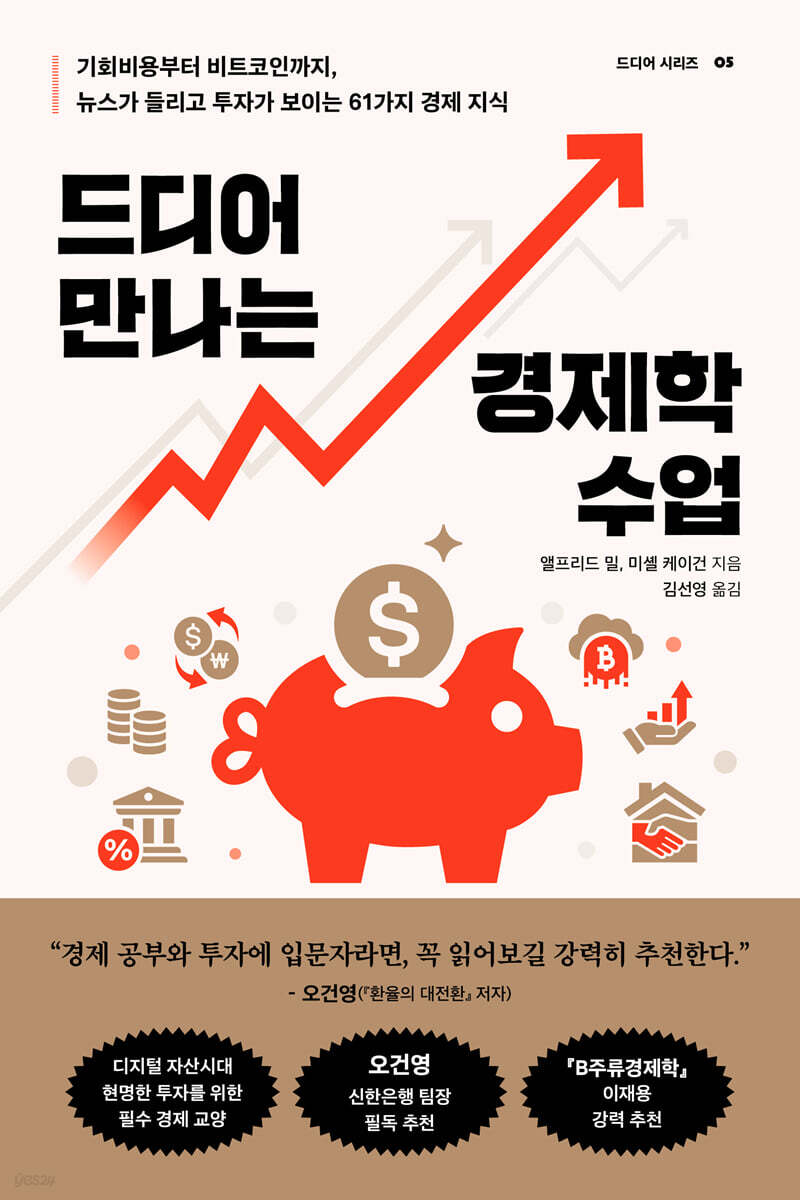
Finally meeting the economics class
 |
Description
Book Introduction
In an era where wallets are getting lighter,
Economics Classes That Make a Difference in Your Choices
“If you’re new to economics and investing, I highly recommend reading this.”
★★★ Shinhan Bank Team Leader Oh Geon-young's must-read recommendation
“Keep it within reach and read one or two topics a day.
“There is no better book for an introduction to economics!”
★★★ Highly recommended by accountant Lee Jae-yong
Trump's tariff bomb, Warren Buffett's investment strategy, the future of Bitcoin...
Economic knowledge that will protect your assets!
In 2025, Trump's economic shockwaves will be targeting your wallet! The trade war and tariff bomb that began with President Trump's inauguration in January are shaking the global economy.
The US stock market is fluctuating, prices are rising, interest rates are fluctuating…
All this news is hitting your paycheck and your shopping cart hard.
In times of uncertainty, what you need is a solid economic weapon.
This book transforms complex economic terms and theories into “practical knowledge that can be applied immediately.”
From Adam Smith's "invisible hand" to the latest cryptocurrency taxation issues, this book contains 61 key economic insights to help you decipher economic news and make wise investment decisions.
Just 10 minutes a day, one lesson in economics, can change your assets and spending patterns.
From the mechanisms of price fluctuations to lessons learned from the Silicon Valley Bank crisis and Bitcoin investment strategies, complex economic news becomes easier and your investment perspective broadens!
※ Practical economic insights you will gain through this book
▶ The ability to determine how to manage your loans and investments right now based on interest rate fluctuations
▶ A way of thinking that calculates opportunity costs in all life choices, including employment, career changes, and financial planning.
▶ The Safest Asset Allocation Strategy and Inflation Protection During a Recession
▶ Predicting the Impact of Trump's Tariff Policy on Our Household's Shopping Cart Prices
▶ "Should I buy Bitcoin or not?" Key information needed for cryptocurrency investment decisions
Economics Classes That Make a Difference in Your Choices
“If you’re new to economics and investing, I highly recommend reading this.”
★★★ Shinhan Bank Team Leader Oh Geon-young's must-read recommendation
“Keep it within reach and read one or two topics a day.
“There is no better book for an introduction to economics!”
★★★ Highly recommended by accountant Lee Jae-yong
Trump's tariff bomb, Warren Buffett's investment strategy, the future of Bitcoin...
Economic knowledge that will protect your assets!
In 2025, Trump's economic shockwaves will be targeting your wallet! The trade war and tariff bomb that began with President Trump's inauguration in January are shaking the global economy.
The US stock market is fluctuating, prices are rising, interest rates are fluctuating…
All this news is hitting your paycheck and your shopping cart hard.
In times of uncertainty, what you need is a solid economic weapon.
This book transforms complex economic terms and theories into “practical knowledge that can be applied immediately.”
From Adam Smith's "invisible hand" to the latest cryptocurrency taxation issues, this book contains 61 key economic insights to help you decipher economic news and make wise investment decisions.
Just 10 minutes a day, one lesson in economics, can change your assets and spending patterns.
From the mechanisms of price fluctuations to lessons learned from the Silicon Valley Bank crisis and Bitcoin investment strategies, complex economic news becomes easier and your investment perspective broadens!
※ Practical economic insights you will gain through this book
▶ The ability to determine how to manage your loans and investments right now based on interest rate fluctuations
▶ A way of thinking that calculates opportunity costs in all life choices, including employment, career changes, and financial planning.
▶ The Safest Asset Allocation Strategy and Inflation Protection During a Recession
▶ Predicting the Impact of Trump's Tariff Policy on Our Household's Shopping Cart Prices
▶ "Should I buy Bitcoin or not?" Key information needed for cryptocurrency investment decisions
- You can preview some of the book's contents.
Preview
index
Recommendation
Introduction: Economics as a Weapon for Life
1 How Economics Interprets the World
Infinite Desire, Finite Resources: The Birth of Economics
The Startup CEO Who Dropped Out of Harvard: The Truth About Opportunity Cost
How Poor Countries Became Rich: The Magic of Comparative Advantage
Why Trump Is Obsessed with Tariffs: The Economics of a Trade War
Why the Planned Economy Failed: The Triumph of the Market Economy
The Invisible Hand vs. Das Kapital: Smith and Marx, the Battle of the Century
Why We Make Irrational Choices: The Birth of Behavioral Economics
How Crises Contagious: Insights from Modern Economics
2 The Psychological Game of Currency and Markets
How Money Came to Rule the World: Barter and the Emergence of Currency
What Central Banks Do: The Law of Money Supply
How Interest Rates Are Determined: The Five Blocks That Determine Interest Rates
How Banks Create Money: The Beginning of Everything: Loans
Why Silicon Valley Bank Collapsed: The Bank Run That Shocked the World
Why Do Identical Items Cost Differently?: The Law of Marginal Utility and Demand
The tug-of-war between producers and consumers: determining supply
Why Are Masks Sold Out?: The Coronavirus Pandemic and Panic Demand
Accounting vs. Economics: Different Perspectives on Profit
How to Calculate Optimal Production: Production Functions in the Long Run and Short Run
The most ideal market: the role model of perfect competition.
Why Starbucks Raises Prices So Frequently: The Weaknesses of Monopolistic Competition
How Netflix Conquered the OTT Market: The Light and Dark Side of an Oligopoly
Why You Can Only Send Letters Through the Post Office: The Virtues of a State Monopoly
The Dark Shadow Surrounding Oil: The War on Cartels
Why Gas Prices Fluctuate Daily: Game Theory and Price Wars
Why beer companies keep releasing new ads: The ongoing price war and the rise of non-price competition.
Who Determines Convenience Store Workers' Wages?: The Two Faces of the Minimum Wage System
Why Cash Is More Popular Than Vouchers: The Dysfunction of Subsidies
When Should Government Intervene in the Market: Causes of Market Failure
3 Financial Numbers You Didn't Know
Who Sets Loan Interest Rates: The Loanable Funds Theory and the Liquidity Preference Theory
When countries and companies need emergency funds: Two types of short-term bonds: commercial paper and bonds.
Long-Term Investing Involves Risk: The Difference Between Intermediate-Term Bonds, Long-Term Bonds, and Municipal Bonds
ETFs are hot these days?: The Principles of the Stock Market
Why the US Dollar Became a Reserve Currency: How Exchange Rates Are Determined
Dogecoin? Ethereum?: The Birth of Blockchain Technology and Cryptocurrency
Where Money Flows: From Households to Firms: The Circular Economy Model
Measuring a National Economy: What GDP Tells Us
The Impact of Consumer Sentiment on GDP: The Importance of Disposable Income
The Final Puzzle of GDP: Exports That Determine a National Economy
Does an increase in GDP mean economic growth? Nominal GDP vs. Real GDP
Can Money Buy Happiness?: The Limits of GDP and Other Welfare Indicators
Can You Predict Exchange Rates with a Hamburger?: 7 Unique Economic Indicators
4 Hidden Players Driving the Global Economy
Why Recessions and Booms Repeat: The Secret of the Business Cycle
Why Fiscal Deficits Accumulate: How Governments Manage Debt
Why Unemployment Benefits Are Necessary: Full Employment and the Natural Rate of Unemployment
My salary went up, but why is it lower than last year? The wall of inflation.
Save or Invest: Surviving Rising Prices
Inflation Fighter Paul Volcker: The Principle of Stabilizing the Economy by Raising Interest Rates
How the National Economy Works: Aggregate Demand vs. Aggregate Supply
Is Laissez-faire Really the Best Policy?: Theories of Classical Economics
Why Keynes Cried Out Government Intervention: Key Concepts in Keynesian Economics
Did Reaganomics Succeed? Supply-Side Economics and the Laffer Curve
Why the Fed's Words Move the World: The Gatekeeper of the Global Economy
Expansion or Tightening: How the Fed Responds to Inflation
Towards a World Without Poverty: The Role of the World's Three Major Economies
The Nightmare of the Great Depression and Great Recession: Economic Crises of the 20th and 21st Centuries
Why Credit Management Matters: Lehman Brothers and Credit Suisse
Will Trump's Stimulus Plan Succeed? Recent Trends in the US Economy
Striving for a Better World: The Criteria for Economic Growth
What Really Drives Economic Growth: The Seeds of Production, Human and Physical Capital, and Research and Development
Can Governments Address Inequality?: The Principles of Income Redistribution
Is 'Sustainable Growth' Really Possible? Climate Exchanges and Carbon Credits
Introduction: Economics as a Weapon for Life
1 How Economics Interprets the World
Infinite Desire, Finite Resources: The Birth of Economics
The Startup CEO Who Dropped Out of Harvard: The Truth About Opportunity Cost
How Poor Countries Became Rich: The Magic of Comparative Advantage
Why Trump Is Obsessed with Tariffs: The Economics of a Trade War
Why the Planned Economy Failed: The Triumph of the Market Economy
The Invisible Hand vs. Das Kapital: Smith and Marx, the Battle of the Century
Why We Make Irrational Choices: The Birth of Behavioral Economics
How Crises Contagious: Insights from Modern Economics
2 The Psychological Game of Currency and Markets
How Money Came to Rule the World: Barter and the Emergence of Currency
What Central Banks Do: The Law of Money Supply
How Interest Rates Are Determined: The Five Blocks That Determine Interest Rates
How Banks Create Money: The Beginning of Everything: Loans
Why Silicon Valley Bank Collapsed: The Bank Run That Shocked the World
Why Do Identical Items Cost Differently?: The Law of Marginal Utility and Demand
The tug-of-war between producers and consumers: determining supply
Why Are Masks Sold Out?: The Coronavirus Pandemic and Panic Demand
Accounting vs. Economics: Different Perspectives on Profit
How to Calculate Optimal Production: Production Functions in the Long Run and Short Run
The most ideal market: the role model of perfect competition.
Why Starbucks Raises Prices So Frequently: The Weaknesses of Monopolistic Competition
How Netflix Conquered the OTT Market: The Light and Dark Side of an Oligopoly
Why You Can Only Send Letters Through the Post Office: The Virtues of a State Monopoly
The Dark Shadow Surrounding Oil: The War on Cartels
Why Gas Prices Fluctuate Daily: Game Theory and Price Wars
Why beer companies keep releasing new ads: The ongoing price war and the rise of non-price competition.
Who Determines Convenience Store Workers' Wages?: The Two Faces of the Minimum Wage System
Why Cash Is More Popular Than Vouchers: The Dysfunction of Subsidies
When Should Government Intervene in the Market: Causes of Market Failure
3 Financial Numbers You Didn't Know
Who Sets Loan Interest Rates: The Loanable Funds Theory and the Liquidity Preference Theory
When countries and companies need emergency funds: Two types of short-term bonds: commercial paper and bonds.
Long-Term Investing Involves Risk: The Difference Between Intermediate-Term Bonds, Long-Term Bonds, and Municipal Bonds
ETFs are hot these days?: The Principles of the Stock Market
Why the US Dollar Became a Reserve Currency: How Exchange Rates Are Determined
Dogecoin? Ethereum?: The Birth of Blockchain Technology and Cryptocurrency
Where Money Flows: From Households to Firms: The Circular Economy Model
Measuring a National Economy: What GDP Tells Us
The Impact of Consumer Sentiment on GDP: The Importance of Disposable Income
The Final Puzzle of GDP: Exports That Determine a National Economy
Does an increase in GDP mean economic growth? Nominal GDP vs. Real GDP
Can Money Buy Happiness?: The Limits of GDP and Other Welfare Indicators
Can You Predict Exchange Rates with a Hamburger?: 7 Unique Economic Indicators
4 Hidden Players Driving the Global Economy
Why Recessions and Booms Repeat: The Secret of the Business Cycle
Why Fiscal Deficits Accumulate: How Governments Manage Debt
Why Unemployment Benefits Are Necessary: Full Employment and the Natural Rate of Unemployment
My salary went up, but why is it lower than last year? The wall of inflation.
Save or Invest: Surviving Rising Prices
Inflation Fighter Paul Volcker: The Principle of Stabilizing the Economy by Raising Interest Rates
How the National Economy Works: Aggregate Demand vs. Aggregate Supply
Is Laissez-faire Really the Best Policy?: Theories of Classical Economics
Why Keynes Cried Out Government Intervention: Key Concepts in Keynesian Economics
Did Reaganomics Succeed? Supply-Side Economics and the Laffer Curve
Why the Fed's Words Move the World: The Gatekeeper of the Global Economy
Expansion or Tightening: How the Fed Responds to Inflation
Towards a World Without Poverty: The Role of the World's Three Major Economies
The Nightmare of the Great Depression and Great Recession: Economic Crises of the 20th and 21st Centuries
Why Credit Management Matters: Lehman Brothers and Credit Suisse
Will Trump's Stimulus Plan Succeed? Recent Trends in the US Economy
Striving for a Better World: The Criteria for Economic Growth
What Really Drives Economic Growth: The Seeds of Production, Human and Physical Capital, and Research and Development
Can Governments Address Inequality?: The Principles of Income Redistribution
Is 'Sustainable Growth' Really Possible? Climate Exchanges and Carbon Credits
Detailed image

Into the book
Through this book, readers will gain a precise understanding of the impact of interest rates, exchange rates, and stock price fluctuations on their assets. They will also be able to understand the characteristics of various investment products to develop wise asset management strategies. They will also be able to predict the impact of global economic changes on the Korean economy and their daily lives.
Why is economic literacy important now? The answer is clear.
Because to survive in a rapidly changing economic environment, you need to be able to read and interpret the economy properly.
--- p.9, from “Introduction”
Today, economists study a wide range of economic phenomena driven by scarcity, from how Netflix subscription prices are set to how central banks determine interest rates.
It's interesting how humans cope with resource scarcity.
Sometimes we create complex plans and systems to ensure that resources are distributed fairly to everyone, and sometimes we leave it to the market to find a balance between supply and demand.
All economic entities, from individuals to society as a whole, strive to efficiently allocate limited resources and utilize them in the best possible way.
--- p.18, from “Infinite Desire, Finite Resources: The Birth of Economics”
To overcome these limitations, modern economists have developed various theories that take into account all the imperfect factors that affect the economy.
The new fields that emerged from this process are information economics and behavioral economics.
I have been studying how information gaps affect the economy and why humans make irrational and illogical choices.
Thanks to this, we have been able to understand economic activity and growth from a different perspective and in a broader way.
--- p.57, from “Why We Make Irrational Choices: The Birth of Behavioral Economics”
If you think about it carefully, fiat currency seems like a far-fetched idea that could only exist in science fiction novels.
This is because the currency in use today has no intrinsic value and functions solely on the basis of the agreements and promises of the people.
The only thing that guarantees the value of money is trust.
When you think of bank transfers, online bill payments, check cards, and checks, doesn't the concept of money and currency feel even stranger?
--- p.85, from “What Central Banks Do: The Law of Money Supply”
When there are many market participants, no single producer or consumer has much influence over price and transaction volume.
Because they have to compete with other producers or consumers.
However, if there is only one producer or consumer, they can exert significant influence on the price.
For example, Walmart, a large discount retailer in the United States, has monopoly power over many suppliers.
Since Walmart is the sole supplier to these suppliers, it can set its prices at will.
--- p.140, from “The Most Ideal Market: The Role Model of Perfect Competition”
Whether it's stocks, mutual funds, or exchange-traded funds, the stock market's function is ultimately to connect investors and borrowing companies.
Companies seeking investment turn to the stock market to obtain the necessary funds.
Equity financing, which involves issuing stock to raise funds, may be cheaper than debt financing, which involves borrowing money, but it can also result in a significant loss of control by giving shareholders a portion of the company's ownership.
Yet, many companies wisely use equity financing to maintain control over their companies while still obtaining the capital they need to invest and grow.
--- p.212, from "ETFs are hot these days?: The Principles of the Stock Market"
To store and trade cryptocurrencies, you need a dedicated wallet.
This wallet can be installed on electronic devices such as mobile phones or tablets, or stored in the cloud.
Creating a cryptocurrency wallet generates an encrypted key that allows you to verify your identity, access your cryptocurrency, and begin trading immediately.
Keys are divided into 'public key' and 'private key'. The public key is used to identify the address of a specific wallet, and the private key is used to access the cryptocurrency linked to the wallet and manage the assets.
--- p.228, from "Dogecoin? Ethereum?: Blockchain Technology and the Birth of Cryptocurrency"
GDP should be approached as a flow rate that measures the flow over a certain period of time, rather than as a solid brick that is piled up rigidly.
Think of a bathtub with the faucet turned on and the drain open.
The water flowing from the faucet is GDP.
The water in the bathtub represents the wealth of the country, and the water flowing out of the drain represents loss and outflow of value, such as depreciation.
As long as the outflow of wealth does not exceed GDP, the country's wealth will continue to grow.
--- p.244, from “Measuring the National Economy: What GDP Tells Us”
Demand-pull inflation occurs mostly when income or assets increase, leading to increased consumption.
A representative example is the significant increase in consumption during the COVID-19 pandemic, when the U.S. government released disaster relief funds and household debt surged.
To solve this, we need to curb excessive consumption.
Governments need to take steps to reduce demand to an appropriate level, such as raising taxes or reducing spending, or central banks need to tighten lending by raising interest rates.
However, if the government persists in its extravagant fiscal policies or the central bank continues to pump money into the market, demand-driven inflation is bound to worsen.
Why is economic literacy important now? The answer is clear.
Because to survive in a rapidly changing economic environment, you need to be able to read and interpret the economy properly.
--- p.9, from “Introduction”
Today, economists study a wide range of economic phenomena driven by scarcity, from how Netflix subscription prices are set to how central banks determine interest rates.
It's interesting how humans cope with resource scarcity.
Sometimes we create complex plans and systems to ensure that resources are distributed fairly to everyone, and sometimes we leave it to the market to find a balance between supply and demand.
All economic entities, from individuals to society as a whole, strive to efficiently allocate limited resources and utilize them in the best possible way.
--- p.18, from “Infinite Desire, Finite Resources: The Birth of Economics”
To overcome these limitations, modern economists have developed various theories that take into account all the imperfect factors that affect the economy.
The new fields that emerged from this process are information economics and behavioral economics.
I have been studying how information gaps affect the economy and why humans make irrational and illogical choices.
Thanks to this, we have been able to understand economic activity and growth from a different perspective and in a broader way.
--- p.57, from “Why We Make Irrational Choices: The Birth of Behavioral Economics”
If you think about it carefully, fiat currency seems like a far-fetched idea that could only exist in science fiction novels.
This is because the currency in use today has no intrinsic value and functions solely on the basis of the agreements and promises of the people.
The only thing that guarantees the value of money is trust.
When you think of bank transfers, online bill payments, check cards, and checks, doesn't the concept of money and currency feel even stranger?
--- p.85, from “What Central Banks Do: The Law of Money Supply”
When there are many market participants, no single producer or consumer has much influence over price and transaction volume.
Because they have to compete with other producers or consumers.
However, if there is only one producer or consumer, they can exert significant influence on the price.
For example, Walmart, a large discount retailer in the United States, has monopoly power over many suppliers.
Since Walmart is the sole supplier to these suppliers, it can set its prices at will.
--- p.140, from “The Most Ideal Market: The Role Model of Perfect Competition”
Whether it's stocks, mutual funds, or exchange-traded funds, the stock market's function is ultimately to connect investors and borrowing companies.
Companies seeking investment turn to the stock market to obtain the necessary funds.
Equity financing, which involves issuing stock to raise funds, may be cheaper than debt financing, which involves borrowing money, but it can also result in a significant loss of control by giving shareholders a portion of the company's ownership.
Yet, many companies wisely use equity financing to maintain control over their companies while still obtaining the capital they need to invest and grow.
--- p.212, from "ETFs are hot these days?: The Principles of the Stock Market"
To store and trade cryptocurrencies, you need a dedicated wallet.
This wallet can be installed on electronic devices such as mobile phones or tablets, or stored in the cloud.
Creating a cryptocurrency wallet generates an encrypted key that allows you to verify your identity, access your cryptocurrency, and begin trading immediately.
Keys are divided into 'public key' and 'private key'. The public key is used to identify the address of a specific wallet, and the private key is used to access the cryptocurrency linked to the wallet and manage the assets.
--- p.228, from "Dogecoin? Ethereum?: Blockchain Technology and the Birth of Cryptocurrency"
GDP should be approached as a flow rate that measures the flow over a certain period of time, rather than as a solid brick that is piled up rigidly.
Think of a bathtub with the faucet turned on and the drain open.
The water flowing from the faucet is GDP.
The water in the bathtub represents the wealth of the country, and the water flowing out of the drain represents loss and outflow of value, such as depreciation.
As long as the outflow of wealth does not exceed GDP, the country's wealth will continue to grow.
--- p.244, from “Measuring the National Economy: What GDP Tells Us”
Demand-pull inflation occurs mostly when income or assets increase, leading to increased consumption.
A representative example is the significant increase in consumption during the COVID-19 pandemic, when the U.S. government released disaster relief funds and household debt surged.
To solve this, we need to curb excessive consumption.
Governments need to take steps to reduce demand to an appropriate level, such as raising taxes or reducing spending, or central banks need to tighten lending by raising interest rates.
However, if the government persists in its extravagant fiscal policies or the central bank continues to pump money into the market, demand-driven inflation is bound to worsen.
--- pp.301~302, from “Salaries have increased, but why are they lower than last year? The wall called inflation.”
Publisher's Review
The era of Trumpnomics,
Create your own economic shield
“My salary has increased, but strangely, my finances have become tighter.”
“I’m confused about whether I should buy more US stocks or liquidate them.”
“Should I buy Bitcoin now?”
If you've ever wondered about these things, you need financial literacy.
Because the economy is not just a news story, it is a key factor that determines every moment of our lives.
In 2025, with President Trump's tariff bombs looming, the global economy is more uncertain than ever.
"Economics Class: Finally Encountered" contains practical economic knowledge to help you make rational choices in these uncertain times.
Rather than a heavy and boring economics textbook, it provides 61 essential economic concepts that can be applied directly in real life, explained in a clear and easy-to-understand manner with examples.
From opportunity cost to behavioral economics, inflation, the true nature of the US-China trade war, and even the mechanisms of interest rate determination… Reading this book will help you understand how economic concepts that once seemed like daunting theories directly impact your wallet.
It provides insights into recent financial crises, particularly the Silicon Valley Bank crisis, and predicts the future impact of the Trump administration's economic policies.
Financial thinking is a powerful tool that goes beyond simply making and spending money to guide all of your life's choices for the better.
The stronger your economic literacy, the more confident you can be in making important life decisions, including spending and investing.
"Finally, an Economics Class" will instantly transform economics from a "difficult and distant subject" to a "weapon that will transform my life."
Making the complex world easier to understand,
Economics as a weapon for life
"Economics Class: Finally Encountered" clearly explains the core concepts of economics with real-life examples so that even beginners can easily understand them.
Based on over 20 years of experience as a financial consultant, the authors have carefully selected only knowledge that can be applied directly in real life.
This book teaches you how to apply economic thinking to every choice you make in your daily life.
You can learn through vivid examples how to calculate opportunity costs when choosing between Company A offering 50 million won per year and Company B offering 40 million won, how to make the optimal decision between buying a house or renting during a period of rising interest rates, and even how to calmly respond to a stock market crash without panicking.
Additionally, sellers will be able to understand consumer psychology to develop pricing strategies that maximize sales, while buyers will be able to learn how to deal wisely with price discrimination.
All this knowledge is presented not as mere theory, but as practical tools that can be applied immediately after learning.
The biggest features of this book are ‘accessibility’ and ‘practicality.’
Economic terms and concepts are broadly divided into four topics, with independent subtopics for each topic, so you can read the part that interests you first.
It contains the core concepts essential to understanding economics, presented in a friendly context, so you can gain complete knowledge in a short period of time.
It also goes beyond theory and provides specific directions on how to apply it to actual investment and consumption decisions.
As you read through real-life examples, you'll gain a clearer understanding of how economics can transform your life.
This book provides an essential 'perspective' for viewing today's increasingly uncertain world.
Studying economics is a process of developing insight to predict change and design a better future.
In times of crisis, we must develop a keen eye to read and judge values.
Hidden in economic news
The art of reading the flow of money
“Once tapering begins, the dollar will strengthen.”
“The economy is reviving thanks to the Fed’s massive purchases of Treasury bonds through the open market.”
Did you immediately understand the preceding sentences the moment you read them? It's not easy to grasp the true meaning amidst the daily barrage of economic news.
From cryptocurrencies to quantitative easing, amidst the constantly evolving economic jargon, few people are able to grasp the practical information that impacts their personal wealth and investments.
"Economics Class: Finally Encountered" clears the fog of difficult economic terminology from readers' eyes and helps them gain a clear investment perspective.
By unraveling complex economic concepts through accessible storytelling, we offer a discerning and realistic way to interpret the hidden meaning of economic news.
This book logically explains the chain reactions in the economy, such as the impact of Trump's tariff policy on food prices and the mechanism by which the Federal Reserve's interest rate decisions are linked to mortgage rates.
Readers will learn how to view the world through the special "lens" that economists use.
After reading this book, you will experience a moment of realization every time you come across economic news: "Aha, that's the concept!"
Economic news will no longer be a list of boring numbers, but will become valuable knowledge for planning the future.
Create your own economic shield
“My salary has increased, but strangely, my finances have become tighter.”
“I’m confused about whether I should buy more US stocks or liquidate them.”
“Should I buy Bitcoin now?”
If you've ever wondered about these things, you need financial literacy.
Because the economy is not just a news story, it is a key factor that determines every moment of our lives.
In 2025, with President Trump's tariff bombs looming, the global economy is more uncertain than ever.
"Economics Class: Finally Encountered" contains practical economic knowledge to help you make rational choices in these uncertain times.
Rather than a heavy and boring economics textbook, it provides 61 essential economic concepts that can be applied directly in real life, explained in a clear and easy-to-understand manner with examples.
From opportunity cost to behavioral economics, inflation, the true nature of the US-China trade war, and even the mechanisms of interest rate determination… Reading this book will help you understand how economic concepts that once seemed like daunting theories directly impact your wallet.
It provides insights into recent financial crises, particularly the Silicon Valley Bank crisis, and predicts the future impact of the Trump administration's economic policies.
Financial thinking is a powerful tool that goes beyond simply making and spending money to guide all of your life's choices for the better.
The stronger your economic literacy, the more confident you can be in making important life decisions, including spending and investing.
"Finally, an Economics Class" will instantly transform economics from a "difficult and distant subject" to a "weapon that will transform my life."
Making the complex world easier to understand,
Economics as a weapon for life
"Economics Class: Finally Encountered" clearly explains the core concepts of economics with real-life examples so that even beginners can easily understand them.
Based on over 20 years of experience as a financial consultant, the authors have carefully selected only knowledge that can be applied directly in real life.
This book teaches you how to apply economic thinking to every choice you make in your daily life.
You can learn through vivid examples how to calculate opportunity costs when choosing between Company A offering 50 million won per year and Company B offering 40 million won, how to make the optimal decision between buying a house or renting during a period of rising interest rates, and even how to calmly respond to a stock market crash without panicking.
Additionally, sellers will be able to understand consumer psychology to develop pricing strategies that maximize sales, while buyers will be able to learn how to deal wisely with price discrimination.
All this knowledge is presented not as mere theory, but as practical tools that can be applied immediately after learning.
The biggest features of this book are ‘accessibility’ and ‘practicality.’
Economic terms and concepts are broadly divided into four topics, with independent subtopics for each topic, so you can read the part that interests you first.
It contains the core concepts essential to understanding economics, presented in a friendly context, so you can gain complete knowledge in a short period of time.
It also goes beyond theory and provides specific directions on how to apply it to actual investment and consumption decisions.
As you read through real-life examples, you'll gain a clearer understanding of how economics can transform your life.
This book provides an essential 'perspective' for viewing today's increasingly uncertain world.
Studying economics is a process of developing insight to predict change and design a better future.
In times of crisis, we must develop a keen eye to read and judge values.
Hidden in economic news
The art of reading the flow of money
“Once tapering begins, the dollar will strengthen.”
“The economy is reviving thanks to the Fed’s massive purchases of Treasury bonds through the open market.”
Did you immediately understand the preceding sentences the moment you read them? It's not easy to grasp the true meaning amidst the daily barrage of economic news.
From cryptocurrencies to quantitative easing, amidst the constantly evolving economic jargon, few people are able to grasp the practical information that impacts their personal wealth and investments.
"Economics Class: Finally Encountered" clears the fog of difficult economic terminology from readers' eyes and helps them gain a clear investment perspective.
By unraveling complex economic concepts through accessible storytelling, we offer a discerning and realistic way to interpret the hidden meaning of economic news.
This book logically explains the chain reactions in the economy, such as the impact of Trump's tariff policy on food prices and the mechanism by which the Federal Reserve's interest rate decisions are linked to mortgage rates.
Readers will learn how to view the world through the special "lens" that economists use.
After reading this book, you will experience a moment of realization every time you come across economic news: "Aha, that's the concept!"
Economic news will no longer be a list of boring numbers, but will become valuable knowledge for planning the future.
GOODS SPECIFICS
- Date of issue: March 28, 2025
- Page count, weight, size: 408 pages | 140*210*25mm
- ISBN13: 9791139721898
- ISBN10: 1139721895
You may also like
카테고리
korean


korean

![GQ KOREA Mark (Monthly): December [2025]](http://librairie.coreenne.fr/cdn/shop/files/8ef265dbbfbf186523ed75ba7319009d.jpg?v=1765340328&width=3840)


