

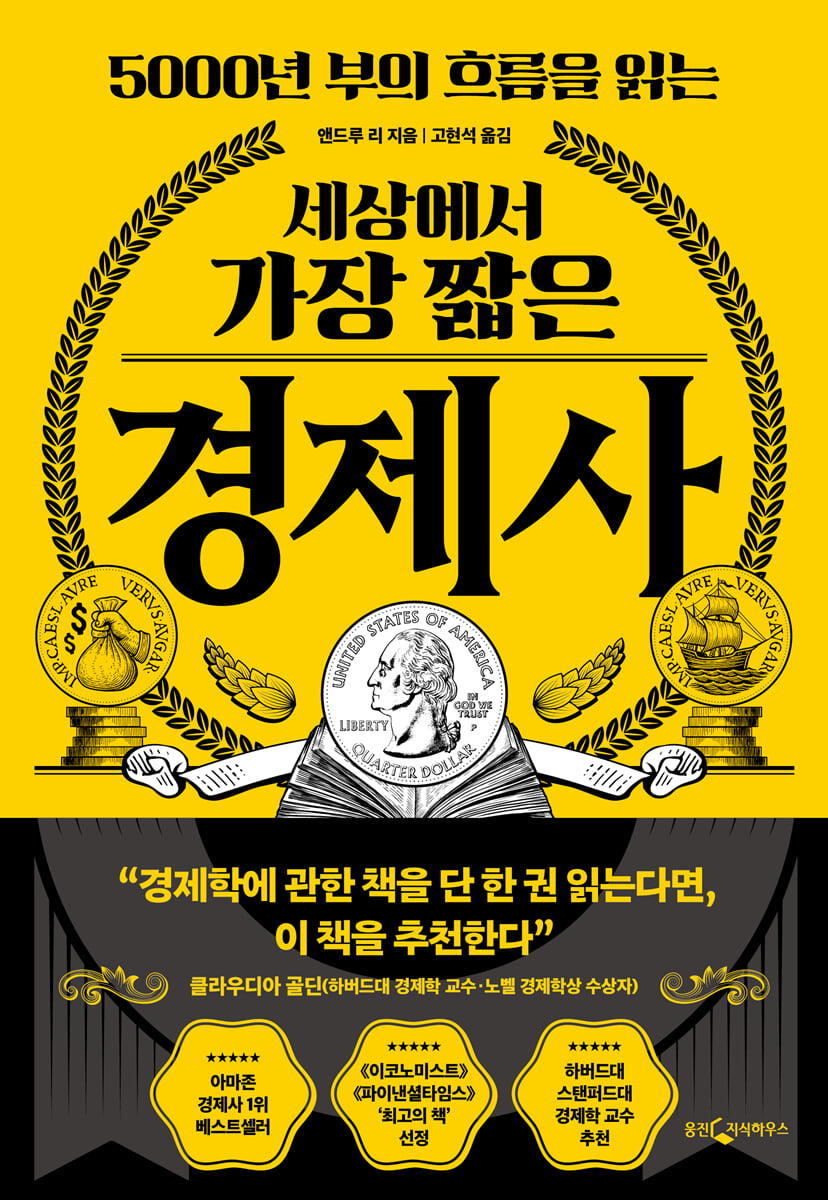
The world's shortest economic history
 |
Description
Book Introduction
★Amazon Economic History's #1 Bestseller
★Recommended by economics professors at Harvard and Stanford University
★Selected as a 'Best Book' by The Economist and The Financial Times
The power to understand today's global economy,
Make it yours quickly and easily through economic history.
Why did Trump's "tariff bomb" heighten global tensions? Why did central banks fail to anticipate rapid inflation following the pandemic? Why does investing in ethical AI and reducing carbon emissions make economic sense? To understand today's global economy, marked by heightened uncertainty and volatility, we need a macroscopic perspective that connects the past and present, and ourselves and the world, rather than fragmented knowledge.
"The World's Shortest Economic History: Reading the Flow of Wealth Over 5,000 Years" summarizes the vast history of the global economy, from the Agricultural Revolution to the Industrial Revolution, the post-war Golden Age, and the post-pandemic era, in a concise, accessible format.
From those who want to understand how the world works to those who want to manage their daily economic activities, such as investing, spending, and saving, more wisely, anyone can quickly and easily acquire a minimum level of economic knowledge that can be used throughout their lives through this book.
★Recommended by economics professors at Harvard and Stanford University
★Selected as a 'Best Book' by The Economist and The Financial Times
The power to understand today's global economy,
Make it yours quickly and easily through economic history.
Why did Trump's "tariff bomb" heighten global tensions? Why did central banks fail to anticipate rapid inflation following the pandemic? Why does investing in ethical AI and reducing carbon emissions make economic sense? To understand today's global economy, marked by heightened uncertainty and volatility, we need a macroscopic perspective that connects the past and present, and ourselves and the world, rather than fragmented knowledge.
"The World's Shortest Economic History: Reading the Flow of Wealth Over 5,000 Years" summarizes the vast history of the global economy, from the Agricultural Revolution to the Industrial Revolution, the post-war Golden Age, and the post-pandemic era, in a concise, accessible format.
From those who want to understand how the world works to those who want to manage their daily economic activities, such as investing, spending, and saving, more wisely, anyone can quickly and easily acquire a minimum level of economic knowledge that can be used throughout their lives through this book.
- You can preview some of the book's contents.
Preview
index
Introduction
Chapter 1: The Human Exodus from Africa and the Beginning of Agriculture: The Birth of the First Wealth in Ancient Civilizations
The Agricultural Revolution and the First Wealth | Geographical Factors and Technological Innovation | The Traps of the Agricultural Revolution | Incentives for Innovation | The Emergence of Money | The Beginning of International Trade
Chapter 2: The Grand Canal, the Printing Press, and the Black Death: The Commercial and Economic Development of Medieval Cities
Money Gathers Where There's Water | The Printing Revolution | Life in the Middle Ages | The Boom Brought by the Black Death
Chapter 3: The Age of Exploration: How the Discovery of the New World Changed the World Order
The Light and Shadow of the New World Discovery | Why Africa Became a Source of Slaves | The First Joint Stock Company | The Birth of Marine Insurance and the Poor Law
Chapter 4: The Industrial Revolution and the Wealth of Nations: Sustained Economic Growth Becomes Possible
Why Did the Industrial Revolution Happen in Britain? | Adam Smith's Wealth of Nations | The Bourgeois Revolution and Free Economic Activity | Utilitarianism and Economics | The Shadow of Industrialization | Protectionism vs. Free Trade
Chapter 5: Trade, Migration, and Clean Cities: More People, Better Lives
The Expansion of Western Imperialism | Changes Caused by Industrialization | Social Reform and Sanitary Innovation | The Rise of Monopoly Capital
Chapter 6: Central Banks, Modern Factories, and Mass Consumption: Capitalism's Infiltration of Everyday Life
Marshall's Economic Model | The Establishment of the Federal Reserve | Mass Production and Consumerism | World War I and the Communist Revolution
Chapter 7: World War I and the Great Depression: The Worst Possible Consequences of Protectionism
The Great Depression Strikes the World | Keynes vs. Hayek | Why the Depression Prolonged | Awakening and Reform | The Introduction of National Accounting
Chapter 8: World War II and the Bretton Woods System: Laying the Foundation for World Economic Integration
Allied victory was predetermined | The statistical fallacy learned from bombers | The new postwar world order | Keynesian theory spreads globally | From cradle to grave
Chapter 9: Thirty Years of Glory?: The Fate of Rich and Poor Nations Diverge
The Rise of Labor Unions | The Golden Age of Capitalism | The Differentiation and Development of Economics | The Invention of the Container | Increasing Interconnectivity | Countries Failing to Prosper | Democracies Don't Experience Famine
Chapter 10: Markets Everywhere: Small Government and the Age of Neoliberalism
From Big Government to Small Government | Neoliberal Economics | The Truth About Privatization
Chapter 11: The War on Inflation: The Doors to Financial Capitalism Open Wide
Strengthening Central Bank Independence | Why Interest Rates Matter | India's Economic Revolution | Asian Tigers | How Rich Nations Are Made | The Population Explosion and the Green Revolution | Rising Life Expectancy | The Widening Gap Between Rich and Poor | Diverging Solutions to Inequality
Chapter 12: Hot Markets and a Hotter Planet: The Most Rational Explanation for Irrational Overheating
Lessons from Behavioral Economics | The Worst Market Failure in Human History | Moral Hazard and the Financial Crisis | The Economics of Corruption | You Can't Beat the Market | Structural Stagnation and the Specter of Isolationism
Chapter 13: Pandemics and Beyond: Epidemics, Algorithms, and Big Data
Central Banks in a Dilemma | The Harmful Effects of Supply Chains and Data Monopolies | Big Data and Economics
Chapter 14: The Present and Future of Economics: New Challenges in an Age of Uncertainty
What drives prosperity? Where does happiness come from? Can we hedge against future risks? Is a recession inevitable? What is the desirable role of government? You see as much as you know.
Chapter 1: The Human Exodus from Africa and the Beginning of Agriculture: The Birth of the First Wealth in Ancient Civilizations
The Agricultural Revolution and the First Wealth | Geographical Factors and Technological Innovation | The Traps of the Agricultural Revolution | Incentives for Innovation | The Emergence of Money | The Beginning of International Trade
Chapter 2: The Grand Canal, the Printing Press, and the Black Death: The Commercial and Economic Development of Medieval Cities
Money Gathers Where There's Water | The Printing Revolution | Life in the Middle Ages | The Boom Brought by the Black Death
Chapter 3: The Age of Exploration: How the Discovery of the New World Changed the World Order
The Light and Shadow of the New World Discovery | Why Africa Became a Source of Slaves | The First Joint Stock Company | The Birth of Marine Insurance and the Poor Law
Chapter 4: The Industrial Revolution and the Wealth of Nations: Sustained Economic Growth Becomes Possible
Why Did the Industrial Revolution Happen in Britain? | Adam Smith's Wealth of Nations | The Bourgeois Revolution and Free Economic Activity | Utilitarianism and Economics | The Shadow of Industrialization | Protectionism vs. Free Trade
Chapter 5: Trade, Migration, and Clean Cities: More People, Better Lives
The Expansion of Western Imperialism | Changes Caused by Industrialization | Social Reform and Sanitary Innovation | The Rise of Monopoly Capital
Chapter 6: Central Banks, Modern Factories, and Mass Consumption: Capitalism's Infiltration of Everyday Life
Marshall's Economic Model | The Establishment of the Federal Reserve | Mass Production and Consumerism | World War I and the Communist Revolution
Chapter 7: World War I and the Great Depression: The Worst Possible Consequences of Protectionism
The Great Depression Strikes the World | Keynes vs. Hayek | Why the Depression Prolonged | Awakening and Reform | The Introduction of National Accounting
Chapter 8: World War II and the Bretton Woods System: Laying the Foundation for World Economic Integration
Allied victory was predetermined | The statistical fallacy learned from bombers | The new postwar world order | Keynesian theory spreads globally | From cradle to grave
Chapter 9: Thirty Years of Glory?: The Fate of Rich and Poor Nations Diverge
The Rise of Labor Unions | The Golden Age of Capitalism | The Differentiation and Development of Economics | The Invention of the Container | Increasing Interconnectivity | Countries Failing to Prosper | Democracies Don't Experience Famine
Chapter 10: Markets Everywhere: Small Government and the Age of Neoliberalism
From Big Government to Small Government | Neoliberal Economics | The Truth About Privatization
Chapter 11: The War on Inflation: The Doors to Financial Capitalism Open Wide
Strengthening Central Bank Independence | Why Interest Rates Matter | India's Economic Revolution | Asian Tigers | How Rich Nations Are Made | The Population Explosion and the Green Revolution | Rising Life Expectancy | The Widening Gap Between Rich and Poor | Diverging Solutions to Inequality
Chapter 12: Hot Markets and a Hotter Planet: The Most Rational Explanation for Irrational Overheating
Lessons from Behavioral Economics | The Worst Market Failure in Human History | Moral Hazard and the Financial Crisis | The Economics of Corruption | You Can't Beat the Market | Structural Stagnation and the Specter of Isolationism
Chapter 13: Pandemics and Beyond: Epidemics, Algorithms, and Big Data
Central Banks in a Dilemma | The Harmful Effects of Supply Chains and Data Monopolies | Big Data and Economics
Chapter 14: The Present and Future of Economics: New Challenges in an Age of Uncertainty
What drives prosperity? Where does happiness come from? Can we hedge against future risks? Is a recession inevitable? What is the desirable role of government? You see as much as you know.
Detailed image

Into the book
Agriculture has brought about a major turning point in the world economy.
Because the community was able to store food reserves.
Food storage allowed people to have a stable diet throughout the year and also served as an early form of insurance against crop failures.
When people's consumption is less volatile than their income, economists call this "consumption smoothing."
The reason so many people today take out loans to buy homes, save for retirement, and sign up for health insurance can be explained by this very concept of consumption equalization.
---From "Chapter 1: Humanity's Escape from Africa and the Beginning of Agriculture"
There was little incentive to invest in areas where the risk of death was terribly high.
On the other hand, in countries with relatively low settler mortality rates, such as Canada, the United States, Chile, and Australia, colonial powers invested extensively in everything from railways to universities.
In countries with high settler mortality rates, such as Nigeria, Angola, and Madagascar, colonial structures were essentially resource-exploitative, with colonizers seeking to extract as much wealth as possible, from slaves to precious metals.
---From "Chapter 3: The Age of Exploration"
Economic growth has generally led to population growth rather than improved living standards.
It was the Industrial Revolution that changed all this.
Since the Industrial Revolution, life expectancy at birth has doubled, real income has increased 14-fold, and average height has increased by about 10 centimeters.
In modern economic systems, it is natural to expect that living standards will improve with each generation, but economic growth before the Industrial Revolution was slow and erratic.
---From "Chapter 4: The Industrial Revolution and the Wealth of Nations"
Economically speaking, the outcome of World War II was somewhat predictable from the beginning.
As in the American Civil War and World War I, the initial allocation of resources ultimately favored the victorious side.
Compared to the Axis powers (Germany, Italy, Japan, and their allies), the Allies (Britain, France, and their allies) had more than twice as much population, seven times more territory, and a 40 percent higher total income.
---From "Chapter 8: World War II and the Bretton Woods System"
As in the case of the railroad industry, short-sighted privatization often yields high initial sales profits, but in effect imposes a long-term tax on consumers.
Because consumers have to pay a lot of money for privatized public services.
Many economists today are increasingly skeptical of privatization, which could entrench monopolies.
---From "Chapter 10: There is a Market Everywhere"
Monetary policy is fundamentally a game of predictions.
Because interest rates shape the future, central banks must constantly battle the odds.
So, according to William McChesney Martin, then chairman of the Federal Reserve in 1955, “just as the party is getting underway, the central bank should take away the punch bowl.” As we will see, the first quarter of the 21st century presented new challenges for central banks trying to strike a balance.
---From "Chapter 11: The War on Inflation"
The U.S. Office of Management and Budget recommends using a discount rate of up to 7% when evaluating infrastructure projects.
However, if the discount rate is 7%, the benefit in 10 years should be twice the current cost, and in 100 years it should be a whopping 868 times.
Applying this logic to personal value, it means that the value of one person 100 years ago is equivalent to the value of 868 people today.
Could the value of one George V be considered equal to the value of an entire high school today? To avoid such absurd conclusions, Stern adopted a low discount rate and placed greater weight on the welfare of future generations.
---From "Chapter 12: The Hot Market and the Hotter Earth"
Has economic growth made us happier? In the 1970s, economist Richard Easterlin analyzed early cross-national life satisfaction surveys and concluded that, beyond a certain point, income growth no longer makes people happier.
This claim, known as the 'Easterlin Paradox', was generally accepted as orthodoxy until the 2000s.
But new analyses based on much larger data sets have shown that this proposition is not true.
Both within countries and across countries, people with higher incomes report feeling happier.
Because the community was able to store food reserves.
Food storage allowed people to have a stable diet throughout the year and also served as an early form of insurance against crop failures.
When people's consumption is less volatile than their income, economists call this "consumption smoothing."
The reason so many people today take out loans to buy homes, save for retirement, and sign up for health insurance can be explained by this very concept of consumption equalization.
---From "Chapter 1: Humanity's Escape from Africa and the Beginning of Agriculture"
There was little incentive to invest in areas where the risk of death was terribly high.
On the other hand, in countries with relatively low settler mortality rates, such as Canada, the United States, Chile, and Australia, colonial powers invested extensively in everything from railways to universities.
In countries with high settler mortality rates, such as Nigeria, Angola, and Madagascar, colonial structures were essentially resource-exploitative, with colonizers seeking to extract as much wealth as possible, from slaves to precious metals.
---From "Chapter 3: The Age of Exploration"
Economic growth has generally led to population growth rather than improved living standards.
It was the Industrial Revolution that changed all this.
Since the Industrial Revolution, life expectancy at birth has doubled, real income has increased 14-fold, and average height has increased by about 10 centimeters.
In modern economic systems, it is natural to expect that living standards will improve with each generation, but economic growth before the Industrial Revolution was slow and erratic.
---From "Chapter 4: The Industrial Revolution and the Wealth of Nations"
Economically speaking, the outcome of World War II was somewhat predictable from the beginning.
As in the American Civil War and World War I, the initial allocation of resources ultimately favored the victorious side.
Compared to the Axis powers (Germany, Italy, Japan, and their allies), the Allies (Britain, France, and their allies) had more than twice as much population, seven times more territory, and a 40 percent higher total income.
---From "Chapter 8: World War II and the Bretton Woods System"
As in the case of the railroad industry, short-sighted privatization often yields high initial sales profits, but in effect imposes a long-term tax on consumers.
Because consumers have to pay a lot of money for privatized public services.
Many economists today are increasingly skeptical of privatization, which could entrench monopolies.
---From "Chapter 10: There is a Market Everywhere"
Monetary policy is fundamentally a game of predictions.
Because interest rates shape the future, central banks must constantly battle the odds.
So, according to William McChesney Martin, then chairman of the Federal Reserve in 1955, “just as the party is getting underway, the central bank should take away the punch bowl.” As we will see, the first quarter of the 21st century presented new challenges for central banks trying to strike a balance.
---From "Chapter 11: The War on Inflation"
The U.S. Office of Management and Budget recommends using a discount rate of up to 7% when evaluating infrastructure projects.
However, if the discount rate is 7%, the benefit in 10 years should be twice the current cost, and in 100 years it should be a whopping 868 times.
Applying this logic to personal value, it means that the value of one person 100 years ago is equivalent to the value of 868 people today.
Could the value of one George V be considered equal to the value of an entire high school today? To avoid such absurd conclusions, Stern adopted a low discount rate and placed greater weight on the welfare of future generations.
---From "Chapter 12: The Hot Market and the Hotter Earth"
Has economic growth made us happier? In the 1970s, economist Richard Easterlin analyzed early cross-national life satisfaction surveys and concluded that, beyond a certain point, income growth no longer makes people happier.
This claim, known as the 'Easterlin Paradox', was generally accepted as orthodoxy until the 2000s.
But new analyses based on much larger data sets have shown that this proposition is not true.
Both within countries and across countries, people with higher incomes report feeling happier.
---From "Chapter 14: The Present and Future of Economics"
Publisher's Review
What if you can't figure out what to do even after following the daily economic news?
Now is the best time to study economic history!
The rise of autocratic "strongmen," geopolitical crises in Europe and the Middle East, and the deepening decoupling between the US and China have made the global economy more uncertain and volatile than ever.
As a result, many people understand the fragmentary information about the economic issues that have surfaced, but are still confused.
To prevent today's carefully considered choices from turning into tomorrow's worst outcomes, we need a historical perspective that can read the direction and flow of change.
This is why economic history can be your powerful weapon.
Trump's "tariff bomb" heightened tensions and affected global stock markets, reminiscent of the 1930s, when protectionism and isolationism were rampant.
The fearful experience of repeated hyperinflation events in the past underlies the aggressive, high-interest-rate policies pursued by central banks around the world at the expense of growth in the wake of the pandemic.
In this way, economic historical insights connect the past and the present and broaden your perspective.
The flow of wealth over 5000 years is visible at a glance!
High-value reading for busy modern people
The problem is that the history of the economy is so vast and complex that it can be said to be the history of mankind.
Therefore, most of the famous books on economic history are often 'brick books' that are difficult for non-specialists to tackle.
Our daily lives are too busy to read these recommended books.
"The World's Shortest Economic History: Reading the Flow of Wealth Over 5,000 Years" is a book for readers who have always had a thirst for economic history but have been unable to approach it quickly.
This book, which contains all the crucial moments in economic history that shaped today's world in a short volume that anyone can read in one night, is a perfect basic economic textbook for busy modern people.
Even if you have never studied economics
This book is readable and understandable!
Basic knowledge of economic history that you can read once and use for a lifetime.
"The World's Shortest Economic History: Reading the Flow of Wealth Over 5,000 Years" uses the historical flow from the Agricultural Revolution, the Industrial Revolution, the post-war era, and the post-pandemic era as the "woof" and the various figures active during that time, as well as economic ideas, systems, new technologies, and innovations, as the "warp" to richly weave together the 5,000-year history of global wealth.
The contents of the book, which consists of 14 chapters, can be summarized by period as follows.
- Pre-modern economic activity: From “Chapter 1: Humanity’s Escape from Africa and the Beginning of Agriculture” to “Chapter 3: The Age of Exploration,” we quickly review pre-modern economic activity.
From the debate over whether the Agricultural Revolution enriched human life to how the Black Death, which wiped out a third of Europe's population, brought about the collapse of the feudal system, and why the first joint-stock companies and marine insurance emerged during the 15th-century Age of Exploration, this fascinating story unfolds.
- The birth and development of the modern economy: From “Chapter 4: The Industrial Revolution and the Wealth of Nations” to “Chapter 8: World War II and the Bretton Woods System,” we focus on the development process of the modern economy that emerged from the Industrial Revolution.
It introduces the core theories of great economic thinkers such as Adam Smith, David Ricardo, Alfred Marshall, Keynes, and Hayek, while providing an easy-to-understand explanation of how the two world wars and the Great Depression of the interwar period reshaped the world order.
- The Golden Age of Capitalism and Its Behind: From “Chapter 9: Thirty Years of Glory?” to “Chapter 11: The War on Inflation,” this book examines the period of economic prosperity known as the “Golden Age of Capitalism” around the turn of the 20th century, when economic integration accelerated and international trade increased.
In this course, you can hear economic explanations of the decisive factors that differentiate rich and poor countries, and the widening gap between rich and poor.
- 21st Century Economic Crisis and Future Challenges: From “Chapter 12: Hot Markets and a Hotter Planet” to “Chapter 14: The Present and Future of Economics,” this book looks back at the lessons the global economy learned from major events of the 21st century, such as the dot-com bubble, the submortgage crisis, and the pandemic crisis, and shows what solutions economic thinking proposes for future issues such as climate change, artificial intelligence, and big data.
Although this book covers a significant amount of economic theory, from Marshall's supply and demand curves to behavioral economics, it contains no graphs or formulas.
Even when explaining key concepts covered in textbooks, such as incentives, specialization, scarcity, and discount rates, we focus on their context and utility rather than being confined to academic definitions.
Thanks to this, even if you have never studied economics before, you can easily understand the contents of the book.
This book also does not stop at a history centered on macroscopic structures and institutions.
It reveals the economic principles at work in our daily lives, from religion to crime to sports, and transforms economic history, which can be boring, into a fun and practical cultural experience that connects with reality.
Your economic activities such as investing, spending, and saving
The best liberal arts that will upgrade you to the next level
In the past, information itself was power, but today, there is an abundance of information that is more than necessary.
Now, even when encountering the same news, we need to be able to read the context and reinterpret the situation to seize opportunities ahead of time.
In this respect, economic history provides a useful intellectual foundation for developing one's own solid and clear perspective.
Now, let's lightly begin studying economic history, which we've been putting off for so long, with "The World's Shortest Economic History: Reading the Flow of Wealth Over 5,000 Years."
Now is the best time to study economic history!
The rise of autocratic "strongmen," geopolitical crises in Europe and the Middle East, and the deepening decoupling between the US and China have made the global economy more uncertain and volatile than ever.
As a result, many people understand the fragmentary information about the economic issues that have surfaced, but are still confused.
To prevent today's carefully considered choices from turning into tomorrow's worst outcomes, we need a historical perspective that can read the direction and flow of change.
This is why economic history can be your powerful weapon.
Trump's "tariff bomb" heightened tensions and affected global stock markets, reminiscent of the 1930s, when protectionism and isolationism were rampant.
The fearful experience of repeated hyperinflation events in the past underlies the aggressive, high-interest-rate policies pursued by central banks around the world at the expense of growth in the wake of the pandemic.
In this way, economic historical insights connect the past and the present and broaden your perspective.
The flow of wealth over 5000 years is visible at a glance!
High-value reading for busy modern people
The problem is that the history of the economy is so vast and complex that it can be said to be the history of mankind.
Therefore, most of the famous books on economic history are often 'brick books' that are difficult for non-specialists to tackle.
Our daily lives are too busy to read these recommended books.
"The World's Shortest Economic History: Reading the Flow of Wealth Over 5,000 Years" is a book for readers who have always had a thirst for economic history but have been unable to approach it quickly.
This book, which contains all the crucial moments in economic history that shaped today's world in a short volume that anyone can read in one night, is a perfect basic economic textbook for busy modern people.
Even if you have never studied economics
This book is readable and understandable!
Basic knowledge of economic history that you can read once and use for a lifetime.
"The World's Shortest Economic History: Reading the Flow of Wealth Over 5,000 Years" uses the historical flow from the Agricultural Revolution, the Industrial Revolution, the post-war era, and the post-pandemic era as the "woof" and the various figures active during that time, as well as economic ideas, systems, new technologies, and innovations, as the "warp" to richly weave together the 5,000-year history of global wealth.
The contents of the book, which consists of 14 chapters, can be summarized by period as follows.
- Pre-modern economic activity: From “Chapter 1: Humanity’s Escape from Africa and the Beginning of Agriculture” to “Chapter 3: The Age of Exploration,” we quickly review pre-modern economic activity.
From the debate over whether the Agricultural Revolution enriched human life to how the Black Death, which wiped out a third of Europe's population, brought about the collapse of the feudal system, and why the first joint-stock companies and marine insurance emerged during the 15th-century Age of Exploration, this fascinating story unfolds.
- The birth and development of the modern economy: From “Chapter 4: The Industrial Revolution and the Wealth of Nations” to “Chapter 8: World War II and the Bretton Woods System,” we focus on the development process of the modern economy that emerged from the Industrial Revolution.
It introduces the core theories of great economic thinkers such as Adam Smith, David Ricardo, Alfred Marshall, Keynes, and Hayek, while providing an easy-to-understand explanation of how the two world wars and the Great Depression of the interwar period reshaped the world order.
- The Golden Age of Capitalism and Its Behind: From “Chapter 9: Thirty Years of Glory?” to “Chapter 11: The War on Inflation,” this book examines the period of economic prosperity known as the “Golden Age of Capitalism” around the turn of the 20th century, when economic integration accelerated and international trade increased.
In this course, you can hear economic explanations of the decisive factors that differentiate rich and poor countries, and the widening gap between rich and poor.
- 21st Century Economic Crisis and Future Challenges: From “Chapter 12: Hot Markets and a Hotter Planet” to “Chapter 14: The Present and Future of Economics,” this book looks back at the lessons the global economy learned from major events of the 21st century, such as the dot-com bubble, the submortgage crisis, and the pandemic crisis, and shows what solutions economic thinking proposes for future issues such as climate change, artificial intelligence, and big data.
Although this book covers a significant amount of economic theory, from Marshall's supply and demand curves to behavioral economics, it contains no graphs or formulas.
Even when explaining key concepts covered in textbooks, such as incentives, specialization, scarcity, and discount rates, we focus on their context and utility rather than being confined to academic definitions.
Thanks to this, even if you have never studied economics before, you can easily understand the contents of the book.
This book also does not stop at a history centered on macroscopic structures and institutions.
It reveals the economic principles at work in our daily lives, from religion to crime to sports, and transforms economic history, which can be boring, into a fun and practical cultural experience that connects with reality.
Your economic activities such as investing, spending, and saving
The best liberal arts that will upgrade you to the next level
In the past, information itself was power, but today, there is an abundance of information that is more than necessary.
Now, even when encountering the same news, we need to be able to read the context and reinterpret the situation to seize opportunities ahead of time.
In this respect, economic history provides a useful intellectual foundation for developing one's own solid and clear perspective.
Now, let's lightly begin studying economic history, which we've been putting off for so long, with "The World's Shortest Economic History: Reading the Flow of Wealth Over 5,000 Years."
GOODS SPECIFICS
- Date of issue: June 26, 2025
- Page count, weight, size: 328 pages | 526g | 145*210*20mm
- ISBN13: 9788901295695
- ISBN10: 8901295695
You may also like
카테고리
korean


korean

![GQ KOREA Mark (Monthly): December [2025]](http://librairie.coreenne.fr/cdn/shop/files/8ef265dbbfbf186523ed75ba7319009d.jpg?v=1765340328&width=3840)


